Tag Archives: science fiction

Only hours left to finalize your 2019 Hugo Award ballot—and I’m still waffling!

The 2018 trophy, designed by Sara Felix and Vincent Villafranca. (Photo by Vincent Villafranca)
The final deadline for this year’s voting is upon us (midnight tonight in my timezone), and I think that I’m finished fiddling with my ballot. Maybe. I may give in to temptation and login to move a couple around. Once again, I’m happy to report that all of the categories have plenty of excellent entries. Which isn’t to say that I absolutely loved everything nominated. But even those stories that weren’t particularly my favorite, I can appreciate how well they were crafted and understood why someone nominated them. This is, again, a vast improvement over the situation a few years ago. I think we can see that the rules changes instituted to limit the effects of block voting have been a success. And we should keep them.

I mentioned the temptation to move things around, and I should explain that a bit. The Hugos use a ranking system, so you pick which entry is your first choice, your second, and so on. Along with the option to placing No Award in the ranking. And one of the recently adopted rules adds a kind of instant run-off along with the ranking. It’s all well and good that the system has a way to break ties, but that doesn’t help the individual voter when you sincerely feel too or more nominees in a given category are equally excellent.

So one place where I had that dilemma this year was Best Novel. Three of the novels I nominated during the nomination phase made it to the final ballot. When I first saw the ballot announcement I was over the moon. Yay! I loved three of those books! And other people liked them, too! But then I started trying to decide how to rank them… and see in the nomination phase you just list five books things in a category without regard to whether any of them are better than the others. They are all five my favorites! Yay!

But now… now I have to pick. I can’t just say, “they’re all wonderful!” I have to rank them.

It was easy to procrastinate, because while three of the books were ones I’d already read and thought was great, the other three were ones I hadn’t read, yet. One of those other three was a book I had purchased and was in my to-read pile (because my husband had enthused about the audiobook), but I hadn’t read it yet. Obviously I couldn’t rank the category until I had read all the books. Similarly, there were at least two stories in each of the other fiction category that I hadn’t yet read, either.

Anyway, while several of the categories were ranked on my ballot weeks ago, I hadn’t touched the novels until Monday night. Because I finally finished the last novel that day. And I’d gotten through everything else. So I didn’t have any excuse.

It was so hard. I like them all. I want to give a Hugo rocket to each of them. I made a choice. I ranked them.

There is another category that I think is giving everyone problems. It’s the relatively new category of Best Series. To be eligible the series has to consist of a minimum of three works totaling a minimum of 240,000 words.

When the new category was being debated, one of the arguments that swayed my opinion was the the category would allow us to recognize the excellence of a whole that is greater than the sum of its parts. A long-running series might consist of a bunch of merely good books, one or two mediocre entries, and only a couple of truly stand-out stories—yet the overall story, the long arcs that play out of the course of the individual tales, is award-worthy. The category offers a way to recognize the skill of spinning a larger tale, of keeping the reader coming back for more, in a different way that the individual book and short fiction awards.

Implicit in that idea, to me, was that Best Series should go to a group of books that had otherwise been overlooked by the Hugos.

But then, the very first year it went, the award went to a series which had won two Nebula awards, two Locus awards, and four Hugo awards. Now, it happens to be a series that I loved, and okay, I admit, I put it at the top of my ballot that year. But not without some trepidation about whether the award might better to another series. I rationalized this by reminding myself that the six most recent books in the series had not won awards, even then three of those were my favorites of the whole series, two of which I thought were absolutely robbed by not getting an award.

The next year the winner was a different series written by the same author. The first book of the series had won a Mythopoeic award; the second book won the Hugo, Nebula, and Locus awards. While the total number of awards the series had won was smaller, it was also a shorter series (only three books and a bunch of short stories). Again, it didn’t feel as if it was a series that had been overlooked previously.

On the other hand, both of those wins went to series that had been going from many years, and since one of the objections that other people raise to the category is to ask, “Can you really judge a series that isn’t complete?” Since the speed at which new entries in both series as considerably slowed, and each have had a book published that feels like an ending to a saga, it can be argued that they meet that objection as close as you can meet it without making a rule that the award is only allowed to awarded posthumously.

And I don’t like that for several reasons. To the extent that awards are recognition, I prefer recognizing excellent work while the author or artist is alive to feel the love, you know?

A few nominees each of the three years the award has existed thus far as series that seem quite clearly to still be in the middle. So I have some issue putting them at the top of the ballot. And I remain uncertain what criteria we ought to be using to decide which is best. Is the idea to look for qualities of the series that span multiple books, or is it okay if a series just has a bunch of great entries?

I don’t know.

I figured out how I picked my number one in this category this time. And I know since the only rules the Hugos have ever had is to define eligibility, I don’t think anyone is going to make it clearer how we ought to be judging them.

He has no sock(puppet)s, and he must cry wolf*—bullied bullies are everywhere

April, 1958 issue of Amazing Science Fiction. Cover art by Ed Valigursky
This cover art by Ed Valigursky for the April, 1958 issue of Amazing Science Fiction shows a completely different kind of sci fi puppy than we’ll be talking about today.
I started to assemble this post about an aggrieved conservative sci-fi writer last week, but other things kept coming up, and since the kerfuffle seems to have blown over, I wasn’t sure there was much value in throwing in my two cents. But then a couple of the most recent developments in some national news stories made certain similarities between the actions of certain distressed pups and other angry white men. I decided that with so angry white men claiming to be victims, and maybe it was worth looking at a fairly inconsequential example that played out over a handful of days to get some insight into the motivations of the others. So, first, the meltdown of one of the fringe members of the melancholy canines.

Note: At no point in the following will I link directly to the angry, profanity-laden posts of the bullied bully. All links are to others talking about the situation. Some of them link to the rants, if you really need to read them.

So, a writer who markets himself** to a particular subset of science fiction fans—conservative, pro-gun rights—got really upset when some editor at Wikipedia tagged his wikipedia page to discuss possible deletion. The original article looked like it was lifted almost entirely from his own web page, and the only citations it had was to his blog and webpage. Under various editorial guidelines of Wikipedia the article certainly didn’t appear to meet the minimal criteria for keeping. I mean, come on: a bunch of the links on the first author’s page were places where you could buy his merchandise and his custom knives!

Of course, this happens all the time. Articles get flagged. There is one author’s article (that got referenced in some of the rants) that was tagged over seven years ago… and it has never actually been deleted. Part of the purpose of tagging such articles is to try to get some attention to them so that people will clean them up, add citations, and so forth.

Anyway, because of the angry screed, dozens of people went to Wikipedia and screamed at the editors, accusing them of being angry libtards targeting conservative writers. Which, given the fairly well-documents conservative bias of Wikipedia editors, is more than slightly hilarious. Said wikipedia editors quickly determined that a certain number of the angry attack accounts were sock-puppet accounts belonging to the aggrieved author, and banned his account (though the discussion continued).

Equally of note is that a large number of identifiable actual liberal members (or not-so-liberal but still despised by the aggrieved author and is allies) of the sci-fi community logged in to argue against deleting the conservative author’s page, arguing that his long publishing history, award nominations, and so forth qualified him as notable. They also helped clean up the article and added a lot of third party citations (to places like Publisher’s Weekly, Locus Magazine, Wall Street Journal, Stars and Stripes, et cetera). In other words, the people he always claims are out to get him were actually helping.

But that wasn’t enough! No, being an angry little white puppy he was absolutely certain that there is a conspiracy to bully people like him, so he started predicting specific conservative writers would have their articles flagged next. Then, lo and behold, a few hours after each time he went online to make such a prediction, the authors he named had a deletion tag added to their Wikipedia page by a mysteriously recently-created wiki account. Many of those were very quickly untagged by the administrators.

It should be noted that, in addition to the sock puppet activities that got his account banned during this kerfuffle, the author has a history of getting accounts suspended on other social media platforms for setting up sock puppet accounts to follow him and agree with him. So, applying Occam’s Razor, we can assume that his predictions are not proof he is an oracle, but rather a troll.

The upshot of all this is not only was the aggrieved author’s page spared, but so were all the others that supposedly had been targeted.

The aggrieved author and his allies are so defensive that they don’t notice who is willing to help them. I also think contributing to the problem is how incredibly insular they are. The old version of his wikipedia page and a couple of the others that were briefly flagged only had links to pages controlled by the people who were the subjects of the articles. Yeah, some of the pages had a lot of self-promotion, but I think it doesn’t even occur to them to search for mentions outside their own favorite web portals. It didn’t take long for other people to find dozens of articles outside that insular bubble that mentioned the author or his work.

But despite overwhelming evidence that the content of the articles was the issue rather than any politics, and that people they insist are enemies are more than willing to help out if they see a problem, they insist that they are victims. It’s a classic persecution complex: a delusion that they are constantly being tormented, stalked, tricked, or ridiculed.

Except I think it goes beyond delusion. Being despised is their life blood. One commenter said on one of the blog posts: “Nobody hates them as much as they seem to need to think someone hates them and that is just a miserable way to go through life.” They feel miserable because they aren’t receiving the adoration or acclaim or praise they feel entitled to. But, they can’t admit that they are to blame for how other people perceive them. They need scapegoats. If other people hate them and are conspiring against them, then their misery isn’t their fault. Yes, it is a miserable way to live, but to them it seems less miserable than holding themselves accountable.

And that brings us to other, more serious ways this need to be hated can effect all of us. It begins yesterday when Senator Mitch McConnell took to the senate floor to whine about American citizens pointing out that his actions in blocking election reform again and again despite overwhelming evidence of foreign interference in our elections isn’t in the best interest of Americans. How dare we, the citizens who of the country whose Constitution he has sworn to uphold, express an opinion about his actions! How dare we present the evidence that of actions that at least border*** on treasonous!

His actions aren’t the problem, he insists. No! The real problem is all of us haters. Oh, and any of us citing this evidence are being just like McCarthy—you know, the angry Senator who in the fifties destroyed a bunch of people’s careers and lives without ever actually presenting any evidence that they were enemies of the nation. This is an interesting twist on crying wolf, I must say.

Similarly, the alleged president is still screaming at congresspeople and people of color who disagree with some of his policies, in between is constant stream of insults hurled at various US cities, territories, states, and even people who call him ‘Mr. President’—while at the same time pushing a narrative that people who criticize the US should leave.

Again, the problem isn’t him attacking anyone and everyone, the problem is all those mean haters. And if you think I’m stretching things to compare the alleged president to the aggrieved author: remember the many times that Trump has called into various radio shows and the like, claiming to be someone else praising Trump.

So, I guess a fondness for sockpuppets is another way to spot these angry bullies who think they’re victims.

They claim to be defenders of free speech, yet they are always throwing tantrums when other people say things they don’t like.


Footnotes:

* The title is a riff on Harlon Ellison’s Nebula- and Hugo-winning short story from 1966, I Have No Mouth, and I Must Scream. In no way should this be read to infer that the late Mr. Ellison is involved in any way.

** When describing this situation to some friends I mentioned that all of the author photos available for him feature him holding a gun. And in at least one I saw, holding it incorrectly. I must state for the record that that characterization was wrong: there are also biographical pictures of him holding various hunting knives, swords, or wearing bandoliers of shotgun shells.

*** Personally I think he went way past the border when he blocked the release of the information about Russian interference just before the 2016 election. Everything since has just been him going deeper and deeper into treason.

SF-adjacent: the inherent fuzziness of human enthusiasms

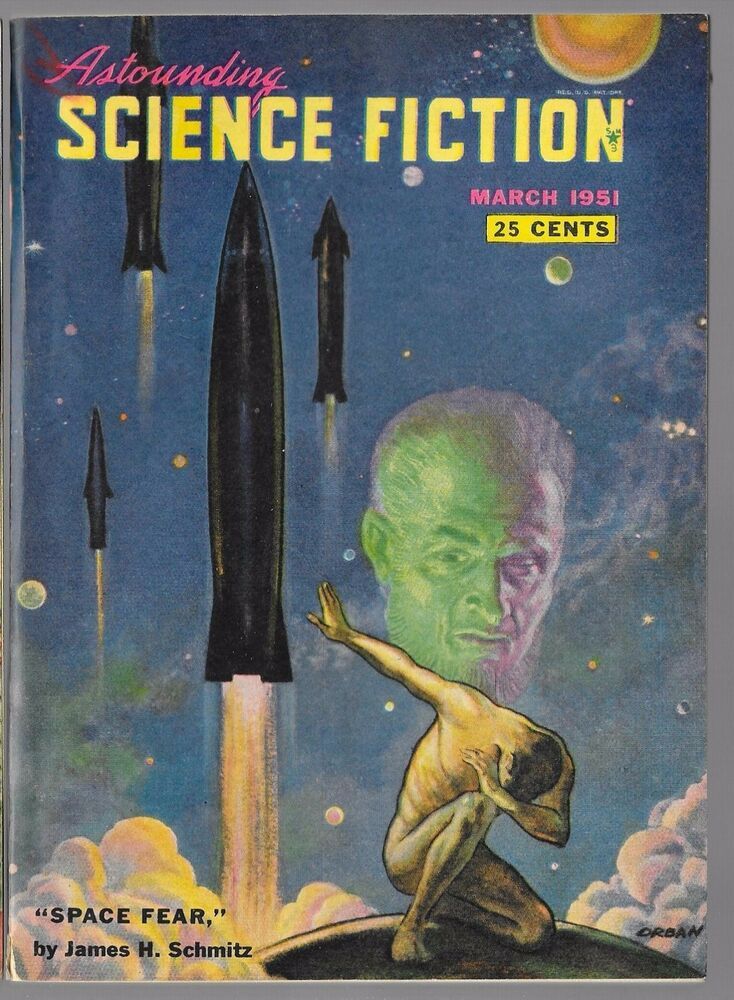
Astounding Science Fiction, March 1951 issue, cover art by Paul Orban.
Camestros Felapton has been doing a fascinating series of posts reviewing sci-fi stories about dinosaurs—it started out specifically stories about dinosaurs that had been nominated for a Hugo, but he expanded as he realized that looking at stories that didn’t get nominated (and analyzing possible reasons why) is also a useful way to look at the science fiction/fantasy field.

In one of those posts he reviews a story that isn’t technically a sf/f story, though it is about the making of a sf/f film and is written by Ray Bradbury. And there was a fascinating conversation that occurred in the comments about edge cases, and the notion of sf-adjacent things. In the post he made a list of topics that sf-fans are sufficiently enthusiastic about that stories (even non-fiction ones) with that element might be considered part of the sf category:

  • Space travel
  • Rockets
  • Robots and Artificial Intelligence
  • Dinosaurs

I don’t, by the way, disagree with him at all in his definition of things that can be considered sf-adjacent. The list is great, as far as it goes. I would rephrase it a bit:

  • Manned space travel/astronomical phenomenon
  • Rockets and satellites and unmanned spacecraft
  • Robots and Artificial Intelligence (modern readers)
  • Dinosaurs and extinct mega-fauna

It could be argued that I’m just being pedantically specific with a couple of these. But, stay with me: I very seldom met a fellow dinosaur enthusiast who wasn’t also equally excited to talk about Mammoths, Smilodons, giant Sloths, Dire Wolves, giant Tortoises, and other extinct non-dinosaurs of the Pleistocene. A news blog I follow used to have a contributor who regularly posted stories about new fossil finds, paleontology, and such, with the tag “dinosaur news” and there would always be at least one comment from someone whenever the extinct animal in quest wasn’t actually a dinosaur. And they were usually of the “well actually” type of comment. So she started including a note to the effect that she knew this thing wasn’t a dinosaur, but that people who were interested in such paleontological news stories often found them with “dinosaur” as a search term.

And this gets to why I expanded the first two bullets to be more explicit: there is a significantly large fraction of science fiction fans who are almost pathologically pedantic. Such a person might insist that the term “space travel” should only refer to people moving through outer space, for instance. Of course, another person might object to rockets being a separate category. And anyone might ask why manned space travel is separate from rockets and satellites. To me, space travel is about the experience of traveling in space, while rockets is about the technological and engineering problems of the vehicles and such themselves. Similarly, things that we learn about distant objects in the universe through telescopes and other sensors are a different topic than the sensors themselves and how they are made.

I added the “modern reader” qualifier to the third bullet because I think for sf/f fans who were alive in the 50s and 60s and actively reading sf/f published at that time (so, maybe people born before 1948-ish) that the third category would have been “Robots and computers” which could be argued subsumed AI, but any computer topic seemed futuristic at the time, whereas just plain computers have been humdrum for a while. Further, I suspect that the Robots and AI section will morph again when the young children of today become active consumers of sf/f, because a lot of us have AIs on our pockets, now. And many of us have robots in our homes. Robots and AI are swiftly becoming mundane phenomena. I’m not sure what it will morph into, but it will morph.

In the essay in question, Cam clearly says that his list isn’t intended to be exhaustive. And since he wrote the list while in the middle of tracking down, reading, and reviewing stories published between 1952 and 1971, it makes sense that those are the topics that would first come to mind. I think a more exhaustive list could easily include topics from medical and biological sciences, for instance.

Not all science fiction fans are nerdily into engineering and hard science. Many of us are just as interested in the so-called soft sciences (dinosaurs!). For a lot of fans, the appeal is less about how technology works, and more about how technology changes us and society. Most people don’t know how smart phones work, for instance, but everyone has opinions about how our social habits and expectations have changed now that nearly everyone has a magic hunk of glass in their pockets that allows them to communicate with the world. And it’s not just luddites. During one of the panels at Locus Awards Weekend, a panelist commented that you have to keep telephones out of certain kinds of stories. Mary Robinette Kowal (current president of Science Fiction and Fantasy Writers of America) agreed: “Right, they are just too dangerous to plots. Pfft! Letting people talk to each other?”

Speculating about what other inventions might change our behavior (collective and otherwise) is a component of sf which is just as importance as how those inventions work. And one of the ways we think about that is to look at how historical inventions and discoveries changed society. You don’t have to know who an automated loom works to be interested in how the cheap manufacture of textiles changed how we live and even how we think about clothes, for instance.

So there are probably fans who would ask why Mechanization isn’t on the list. I might point out that a mechanized loom is a type of robot, so maybe mechanization belonged on the list a few generations ago? Or am I just spinning out of control with all these fuzzy boudnaries?

Because now I’m wondering, if sf-fandom had existed in the early 19th century, before Sir Richard Owen first coined the word “dinosaur,” what might the list have looked like?

Maybe that’s a question for another day

Colorful, dramatic, and large-scale: riffing on several sf/f topics

Epics in Space!

A while ago I was chatting with an acquaintance online, who had asked me what kinds of science fiction I liked. I tried not to ramble too much, so I listed off some sub-genres along with a comment that I like a lot of different things. Though the person I was chatting with described themself as a sci fi fan, they had never heard the term “space opera” before, and asked me if it was a kind of sci fi musical. So I had to explain that the opera in space opera was related more to the type of stories that a lay person might associate with opera, and how the term was a derivative of the term “soap opera.” The stories are colorful, dramatic, often having sweeping epic feel to the plot (think pirates, or wars, or the succession of thrones), and where most of the action happens in space.

Turns out that this guy’s idea of science fiction was a bit different than most, because when I asked his favorites, he listed Game of Thrones, the Sookie Stackhouse books, and the Darkover series—which I think of as fantasy, rather than science fiction.

Clearly, as with any label, there is going to be some dispute about whether a particular work of art fits into the category, and whether the category itself makes sense. And sometimes part of the issue is like the confusion of this guy: the term “space opera” is more closely related to the old Latin meaning of “opera” as a plural of “opus” than the modern meaning of a type of musical performance. So a modern English speaker misunderstands the term. A similar kind of confusions is probably why there don’t seem to be any books being labeled “planetary romance” lately. For full explanation of this, take a look at this post by Cora Buhlert: The Gradual Vanishing of the Planetary Romance.

The term “romance” in this case refers to a literary term from the 17th century, which can be defined as: “a fictitious narrative depicting a setting and adventures remote from everyday life.” Which is why, by the way, a lot of what we would think of as science fiction of the late 19th Century and very early 20th Century was sometimes labeled “scientific romance.” It had nothing to do with two people falling in love, but rather an adventure with either circumstances, setting, or characters that no one would describe as mundane.

If you haven’t read Buhlert’s blog post (which you should do, because it’s good), let me quickly explain that a planetary romance is generally a science fiction adventure story set on a single world. And more specifically, where the culture, geography, and/or history of the world play a prominent role in the story. There is more than a bit of overlap between planetary romance and space opera, which Buhlert details better than I could.

Ambitious Ambiguity

Thinking about labels always sends me down multiple rabbit holes. I have very strong feelings about the difference between science fiction and fantasy, yet I once freaked out a friend at my strong insistence that Babylon Five was techno-fantasy, not science fiction. My argument was that just because it is using science fiction tropes, settings, and accessories, the fundamental world-building (the origins of the Vorlons and the Shadows, and more importantly the ancient races all the way back to the First Ones) were mythological, not scientific. It’s one thing if a story was written at a time when we didn’t know the age of the universe, and we were still trying to figure out evolution. It Straczynski had written Babylon Five in the 19th Century rather than the late 20th, then yes, his world building would have been right in line with current scientific thought.

Now, I made that argument at a time in my life when I was feeling a particularly pedantic and was doing a much poorer job of repressing my inner asshole. I don’t begrudge anyone calling it science fiction, and there has never been a science fiction tale written that got every last bit of science right. More than one person has proposed a definition of science fiction thusly: “in which imaginary science is posited, and the subsequent story follows the imaginary science consistently.” Which is one way to avoid the critiques about faster-than-light travel, which appears ever more unlikely as our understanding of physics improves, for instance. But once we let the label get that flexible, we have to ask ourselves: just how much differently can the science in your imaginary world be?

Is Terry Pratchett’s Discworld series science fiction? In that story, the world is an enormous disc balanced on four elephants standing on the back of a turtle that is flying through interstellar space, with a tiny satellite sun orbiting the whole turtle-elephant-disc assembly (and planets such as our, orbiting much larger stars, are simply eggs that will one day hatch into baby turtles with elephants and discs upon them). Pratchett sets up rules about how magic flows from the central spire of the mountains at the center of the disc, and other things that he then tries to stay consistent as he tells his tales. So, could it be argued as an edge case science fiction tale? Well, we can certainly argue about it, but I want to go a little further out there.

Spoiler Alert: From here on, I will be talking about plot points of Good Omens. Proceed at your own risk.

I posit that the novel Good Omens by Terry Pratchett and Neil Gaiman is science fiction. It imagines that the entire universe (including the fossils that seem to be hundreds of millions of years old) was literally created a mere 6000 years ago, and that angels and demons are real, and that the creator has an ineffable plan for it all. It further imagines that at least some prophets really can see the future, and that the apocalypse described in the New Testament book of Revelations is a real thing that will happen once the anti-christ comes to power.

And everything that happens in the book tries to stay true to those assumptions. That being the case, one could argue that not only is it science fiction, but that is is a planetary romance. Why? Well:

  • It is set on only one world, Earth,
  • the central plot is driven by the fact that both the demon Crowley and the angel Aziraphale have become very fond of Earth, its the people and their cultural artifacts (food, fine wine, music),
  • and the forces that oppose them are the heaven vs hell apocalyptic stuff baked into the Earth at its creation

Planetary romance!

I recently wrote a review of the Good Omens mini-series, in which I confessed that I hadn’t read the book until earlier this year (and that I liked it so much that I read it again, then downloaded the BBC radio play version and listened to that). So I watched the mini-series the weekend it debuted, and this last week-end I rewatched the whole thing. There are lots of things I noticed the second time through that I missed the first, and I think it is definitely worth watching more than once!

Now, even though Neil Gaiman (who co-wrote with the late great Terry Pratchett the original novel published in 1990) wrote the script of the new series and served as the showrunner, I knew that there would be changes from the original. Some of those changes were necessary to update the story from 1990 (minor example: the home of the demon Crowley in the book is described in great detail, but the show’s version looks very different; the book’s version of the flat sounds very much like cutting-edge interior decorating of the late 1980s, while Crowley is always embracing the latest in cool, so his home decor will look very different in 2019, so the set designer changed it), others were to fill in gaps, or to even out emotional arcs that play differently on screen than on paper—those were all to be expected. Some of the differences fall into a different category.

Some of those differences jumped out at me during the re-watch, and I was trying to figure out how to put that type of change into words, when I found this blogpost on the Wisteria Lodge tumblr: Crowley & Aziraphale: Book vs. Miniseries. Before I jump into this, I want to steal a disclaimer from the Wisteria Lodge post:

(and just to be REALLY CLEAR, I love them both. But the differences are fascinating, since it’s the same author adapting his work after almost 30 years. And how often do you get to see *that*?)

How someone perceives the personalities of the characters in the series will vary from how they appear in the book if for no other reason than to see an actor embody the character, and infuse the character with their own understanding is going to be different than what any individual reader imagined while reading it, right? But as the author of the linked blog post points out (and you should go read the whole post yourself, it is really good!), the central characters of Crowley and Aziraphale are written differently.

The author of the blog post lays out differences in the characters they saw. For me, the thing I noticed was the series!Crowley became more cynical and more angry over the centuries. Tempting Eve to take the apple was just a bit of fun, and he never expected that god would throw the humans out of the idyllic garden and into the harsh world because of it. Meanwhile, book!Crowley’s level of cynicism doesn’t ever overwhelm his baseline facade of cool detachment.

Similarly, book!Aziraphale isn’t all sweetness and light. Yes, he’s the softie who gave the flaming sword to Adam and Eve so that they could protect themself, but in the book he also has no compunction with using his powers to frighten away mobsters. And he’s also the one who suggests killing the 11-year-old anti-Christ. In the book it is Aziraphale who sincerely makes the argument that it is for the greater good. In the series, those arguments were given to the Archangel Gabriel. Series!Aziraphale has been trying to stick to the divine plan for the last 6,000 years, and remains convinced until rather late that heaven will listen to reason if only things are explained to them. While book!Aziraphale knows that that will never happen.

The novel was definitely about questioning authority and questioning the roles society assigns you and questioning the definitions of morality. There was also a lot of commentary about the nature of power structures, the nature of ignorance, and the power of denial. And all of that is still in the series, but the subtle shift, most evident in the slightly different characterizations of Aziraphale and Crowley, and how their arcs play out, shifts more of the emphasis onto not just questioning authority, but holding authority accountable. It’s not just questioning roles assigned to you, but asking why those roles never allow for vulnerability. And it doesn’t just question the definitions of morality, by the time the show is over it demonstrates that the traditional picture of the forces of heaven isn’t different in any important way from the forces of hell.

Love plays a much more overt role in the themes of the series than in the book. Adam’s love for the part of the country where he grew up, his love for his friends, his love of the idea of what his dog should be, and so forth all play a big role in averting the apocalypse. Then there is the mutual love and respect of Aziraphale and Crowley (and you can’t just call it friendship: Aziraphale threatens to never speak to him again if he doesn’t think of something, and Crowley stops time itself and then gives the 11-year-old anti-Christ the pep talk he needs to avert the apocalypse; that’s love). And of course, it’s Adam’s realization about the importance of his earthly parents loving and caring for him, and how it trumps his Satanic heritage is the heart of the resolution.

Over all, I think while I still love the book immensely, the mini-series gives a more mature and nuanced take on the serious topics which are being tackled with all this silliness and cheek.

It’s okay to like things that make you happy: my review of Good Omens

Bubbles for the Powerpuff Girls exclaims, “I'm not dumb! I just like nice things that make me happy! At last I don't to to fight and be mean all the time like some people!”
(Click to embiggen)
First, I have a few confessions to make. Even though I have been a squeeing fanboy of Terry Pratchett’s books for decades, and a similarly enthusiastic fan of Neil Gaiman’s writing for a similar period of time, I hadn’t read the novel they collaborated on, Good Omens, before this year. This fact caused considerable consternation to my husband shortly after we moved in together nearly 21 years ago as we were combining our book collections. It wasn’t just because I was already such a big fan of both Pratchett and Gaiman, but also because the subject matter: the end of the world as described in the book of Revelation in the New Testament (with a lot of related and semi-related items of mythology)—topics that I had a great deal of interest in.

Why I hadn’t at that point takes a bit of explanation. The year the book was published was a tumultuous time in my personal life.1 Some of my friends who were reading the book recommended it, but all of my attention was focused on other priorities. Then there were other issues for the next few years.3

The upshot of all that is: when Michael expressed shock that I hadn’t read the book, I had to confess that I barely even knew it existed. For the next several years it sat in my queue of books I was going to read someday. But there are always a lot of books in that queue, and I was busy reading new books from my favorite authors and only slowly making a dent in that other pile.

Then Terry Pratchett announced that he had Alzheimer’s disease. And some time after learning about that, I made a decision to set four of the Discworld books that I hadn’t gotten to, yet, and Good Omens in a different category: books I will read if I find myself feeling particularly sad that no new books would be coming from Terry.4

Once Neil announced that Terry had asked him, as his dying request, to make an adaptation for Good Omens to be made into a movie or television show, I knew that I wouldn’t be able to leave the book in that special queue. So earlier this year, as the date for the release of the series approached—not to mention the teasers and trailers and interviews for the series that kept crossing my social media feeds—I finally read the book.

Twice.

Then I downloaded the BBC radio play adaptation that was made before Terry died and listened to that. So, yes, Michael and all the rest of my friends who were flabbergasted that I hadn’t read it were right: it’s a book that I immediately loved.

This last weekend I binge-watched the series, and I can honestly say I love it, too. With Neil writing the script and acting as show-runner5, the series is faithful to the book. A demon and an angel who, rather than being immortal enemies, have forged a friendship during their millenia on Earth, and have grown quite fond of the world and the clever things people keep inventing, set out to stop the apocalypse. Complicated by the fact that they have mislaid the anti-christ. Plus, they don’t have access to the one and only existing copy of the book, The Nice and Accurate Prophecies of Agnes Nutter, Witch.

Most of the cast of thousands of characters from the book made it to the screen (many quite brilliantly cast). And the things that Neil added to keep the emotional arcs running through each episode6 fit nicely and do their jobs.

It’s a fun show. And it still gives you the same kind very wry and wise observations about human nature that Neil and Terry employ subtly in their other works.

I admit, I wish that at least one old trope that underlay the relationships of two pairs of the supporting characters had not remained faithful to the book. I speak of that tired old canard: the competent, accomplished woman who falls for the forlorn, bumbling man who has little, if anything, to recommend him. When I read the book earlier this year, this bothered me most with Madame Tracy—I mean, really, what does she see in Shadwell?

For the other relationship, the version of Witch-hunter Private Pulsifer in the book is given a little more time to demonstrate that he isn’t completely useless. So it didn’t annoy me quite as much as the other relationship–in the book. Alas, much of that is omitted from the series.8

But the central relationships: demon and angel out to save the world (and each other), and the 11-year-old anti-christ who just wants to have fun with his friends (and not understanding his new powers) work splendidly. And don’t let the summary that it’s a comedic look at the apocalypse fool you–the story explores some heavy questions.

The series tell a hilariously engaging story about some serious subjects (what really is the difference between good and evil, do the ends ever justify the means, how many forms that platonic love can take, and so on) without ever tripping over itself. Most of the jokes land as well or better than they did in the book.

I really liked it.

And at the end, just as the first time I reached the end of the book, I felt that if a demon, an angel, and a determined eleven-year-old can save that world, maybe there is some hope for ours.


Footnotes:

1. I had reached a point where I was no longer fooling myself that I was bisexual–but I was also married to a woman2 and there were many reasons that confronting that conflict was being avoided by both of us. I was also experiencing some really weird and frankly frightening health issues.

2. Who remains one of my best friends all these years later.

3. The subsequent separation and divorce, plus the social and financial fallout from that continued for a few years. Then my partner (we called each other husbands, but Ray never lived long enough for us to be legally more than registered domestic partners) was diagnosed with a terminal illness. Again, all my attention was elsewhere.

4. I hadn’t dipped into that pile before this year, though I have re-read a lot of my favorites more frequently than I used to.

5. A job that he said, since he’s never really done it before, he approached thusly: any time there was a decision to be made, he asked himself which choice would have delighted Terry, if he were here to see the final product. And that’s the one he chose every time.

6. Often either things that they decided just to allude to in the original novel, or in some cases sub-plots and characters from the sequel that they planned and plotted but never wrote.7

7. Planned title: 668: The Neighbor of the Beast.

8. The parts I’m thinking of mostly involved him reading more of the archaically worded prophecies from Agnes Nutter’s books and helping Anathema figure out what they mean. Since that kind of scene is difficult to make interesting on screen, I understand why they were minimized.

We have always been here, part 3

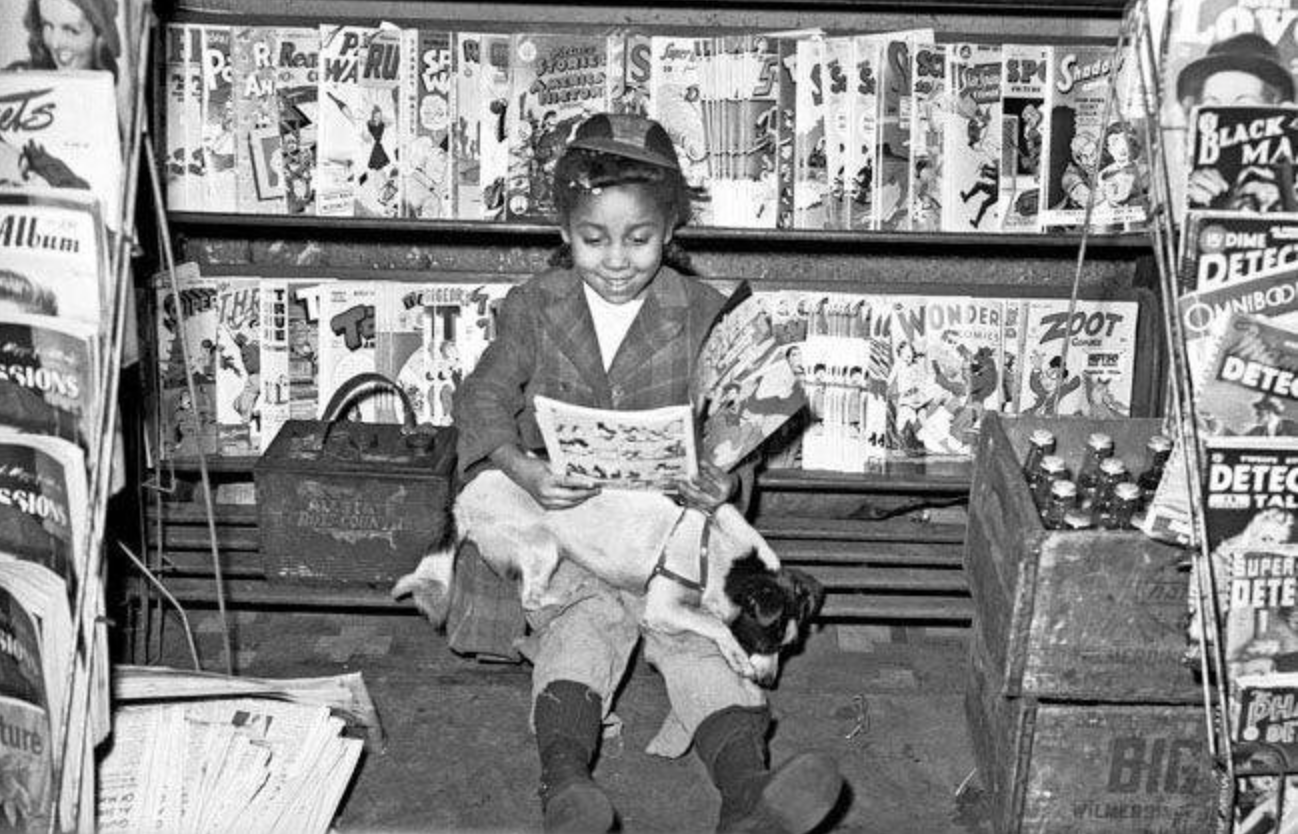
Look at this African-American girl gleefully reading comic books in the 1940s...
Look at this African-American girl gleefully reading comic books in the 1940s… (click to embiggen)
So, this third installment in a series about misperceptions of what diversity means and how it has occured in science fiction/fantasy has been sitting in the draft queue for a long time, in part because I needed to do some more research to shore it up. But now, thanks to Cora Buhlert, I can leverage this excellent review: The Golden Age Was More Diverse Than You Think of this year’s Retro Hugo ballot. The whole post (and her many links) are worth the read, but I’m going to steal quote an important bit:

Survivorship bias can be found doubly in the Retro Hugos, because not only do people (and the Retro Hugo nominator base is small compared to the current year Hugos) tend to nominate the famous stories, the ones that endured, they also tend to nominate and vote for writers (and editors and artists) whose names the recognise. This is why unremarkable debut stories by future stars tend to get nominated for the Retro Hugos, while better but lesser known works and authors tend to get overlooked…

But even taking the known problems with the Retro Hugos into consideration, the breadth and variety of stories on the 1944 Retro Hugo ballot is astounding (pun fully intended), as is the fact that quite a few of them don’t really fit into the prevailing image image of what Golden Age science fiction was like. And this doesn’t just apply to left-field finalists such as Das Glasperlenspiel by Hermann Hesse in the novel category or Le Petit Prince by Antoine de Saint-Exupéry and The Magic Bed-Knob by Mary Norton in the novella category, neither of whom I would have expected to make the Hugo ballot in 1944, if only because US science fiction fans wouldn’t have been familiar with them. No, there also is a lot of variety in the stories which originated in US science fiction magazines.

As I said, go read her entire post, it’s worth your time.

Among the claims that is constantly put forward from some quarters are that:

  • until very recently, virtually all sf/f was written by straight white men,
  • until very recently, the vast majority of readers of sf/f were straight white men and boys,
  • for most of fandom’s history, the vast majority of people organizing clubs and conventions were straight white men (young and old),
  • even now, the vast majority of “real fans” are straight white men and boys,

…therefore any sf/f that features protagonists other than straight white men, and talks about any issues not of interest to straight white men, isn’t real science fiction or fantasy, but it is so-called message fiction.

But the truth is that all four of those claims are false. And that isn’t a matter of opinion. Go look at the 1944 Retro Hugo ballot. More than a single token woman author. And even more intriguing, a rather large number of protagonists and major characters in the works are women and people of color.

In a previous blog post, I linked to some of 1930s, 40s, and 50s sf/f fan publications, showing that some of the most prominent founders of U.S. science fiction fan clubs during the Golden Age were queer men and women (who also became active in the gay/lesbian rights movement).

Go to the staff meeting of any medium-to-large sized fan-led sf/f convention today, and take a look at just how many of the people in that room are not male. Dig a little deeper and you’ll find a disproportionate number who are queer. And that has been the case for at least three decades that I know of (I didn’t attend my first convention until the late 1970s, and didn’t start paying attention to how they were run until the late 80s, so I can’t offer personal testimony beyond that).

Look around any big convention at how many girls and women are doing cosplay, or staffing booths in the dealer’s dens, or are panelists. It’s harder to find how many are queer, but next time you’re at a convention, look for some panels whose titles mention queer topics, then go stick your head in the door of a couple and see how full the rooms are.

Listen, I’m an old literally white-bearded white guy. I grew up reading Heinlein and Clarke and Asimov in the 1960s. But I’m also gay. And I was also just as fervently a fan of Ursula Le Guin, Andre Norton, and Madeleine L’Engle back then. But more importantly, one reason I was a fan from such an early age was because my mother was one of the biggest fans of Robert Heinlein and similar sci fi of the 50s and 60s you will ever meet. I am a second generation fan, but it wasn’t my dad who was reading sci fi (he preferred spy novels and westerns), it was my mom.

I’ve written before in a different context how my mom’s old, worn copy of Dune (which she told me I had to wait until I was older before I could read it) often tantalized me on the book shelf when I was a kid. A couple of things I should add to that story: she bought the Ace paperback brand new when it first came out in 1965, and it was looking very worn around 1969 when she decided to move it to a less tempting location. It looked that way after only 4 years because she re-read it frequently.

I know that’s only one anecdotal sample, but I also remember that when we went on our regular visits to used book stores when I was a kid, my mom was never the only woman browsing the sci fi/fantasy shelves.

People of all genders read, create, watch, and love sci fi and fantasy (and comic books and horror and thrillers and weird fiction and all the other sub-genres). People of all sexual orientations read, create, watch, and love sf/f. People of all races read, create, watch, and love sf/f. People of color, queer people, women, and nonbinary people all exist, and together, they outnumber straight white men in world population (and also U.S. population, if you’re one of those people who think that the phrase “Third World Country” is objective terminology). If you’re trying to exclude people of color, queer people, women, and non-binary people, you are the one focusing on a niche market.

If you are a writer excluding any or all of those categories of people from your cast of characters, whether you mean to or not, you are serving a misogynist, racist, homophobic agenda. And that’s definitely not a non-political stance. Those stories are not non-political fun.

Science fiction was arguably created by a young woman/teen-age girl (Mary Shelley), for goodness’ sake!

But what is it? Or, why we worry about sf/f, sub-genres, and fictional rules

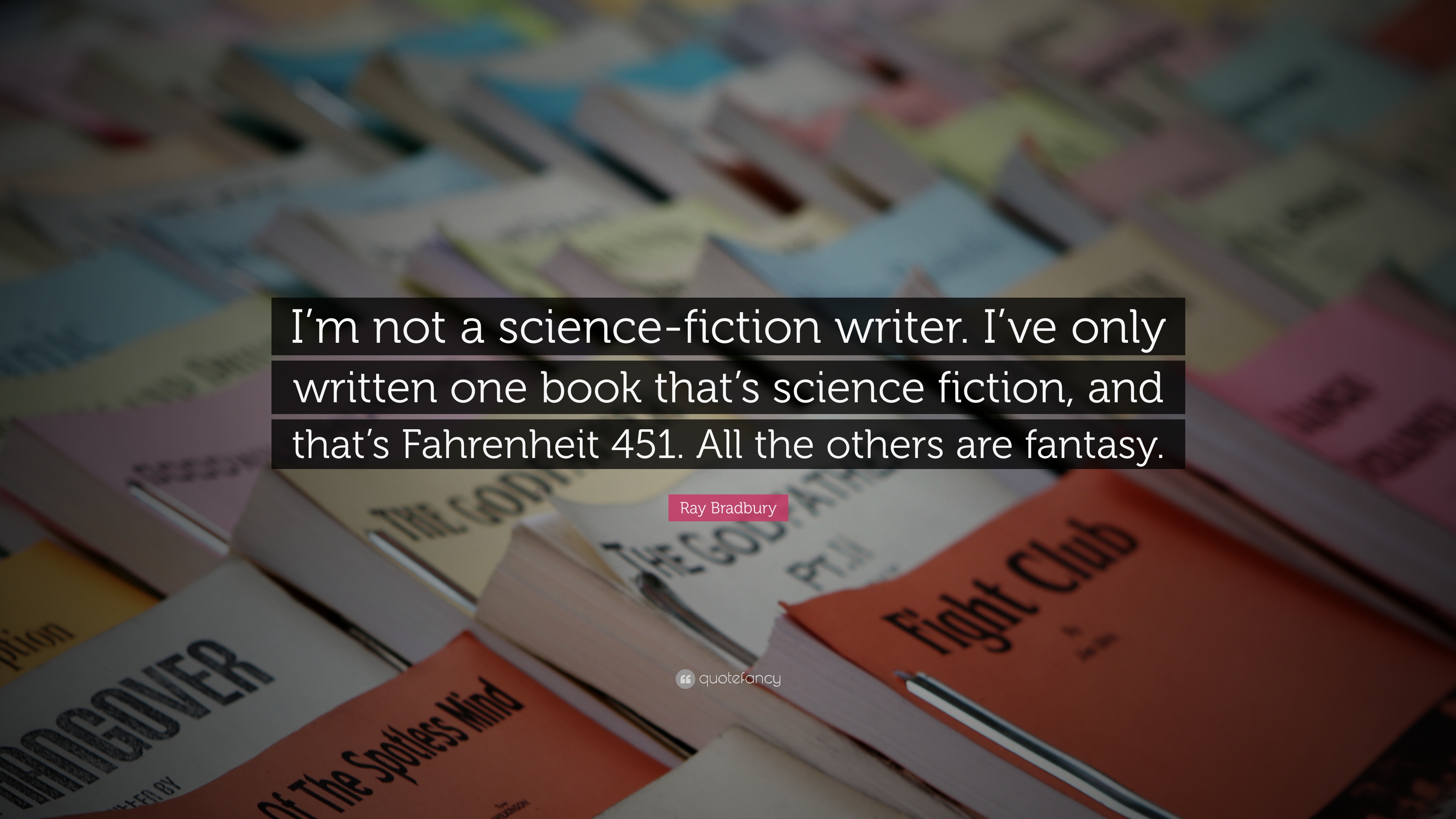
“I'm not a science fiction writer. I've only written one book that's science fiction, and that's Fahrenheit 451.. All the others are fantasy.” —Ray Bradbury
(click to embiggen)
I was reading (and participating) in the comments on Camestros Felapton’s excellent review of one of the Hugo nominated stories, and found myself thinking a lot about how and why we humans like to classify everything in general, and stories/movies/et cetera in particular.

For instance, what is the difference between science fiction and fantasy? When I was much younger, I would have answered that fantasy was “just making any old thing up” while science fiction required an understanding of and adherence to science! (and was therefore superior). But as Thor observed that all words are made up, so too all stories are made up. The usual definition isn’t far from what younger me said (minus the hypocritical and judgmental bit): Science fiction deals with scenarios and technology that may be scientifically possible at the time written, while fantasy deals with supernatural and magical occurrences that have no basis in science.

Of course, that phrase “may be possible” includes a lot of hand-waving. Faster-than-light travel seems less and less likely to be possible as our understanding of physics has grown, yet everyone is quite happy to classify space opera as clearly part of science fiction.

It has been persuasively argued that what dictates that one novel is shelved in the science fiction section, while another is shelved with fantasy, and yet another shelved in horror all comes down to marketing. Not because marketers are trying to advance some sort of agenda, but because a lot of readers like having books offered in familiar categories. Unfortunately, the marketers (and associated persons in the publishing industry), being human, can make those distinctions on rather dubious criteria. One of my favorite authors, who writes books that cross over many genres (and has won at least one major fantasy award for a work of horror), often finds her books being reviewed as “Young Adult” simply because she’s a woman and the books tend to explore sf/f themes.

Of course, that opens up another can of worms. Who decided that “Young Adult” was a genre? It’s an age category, like Middle Grade and Early Reader, right?

It’s useful, sometimes, to talk about a specific work of fiction in reference to similar works of fiction. The aforementioned comment thread I was involved in included a discussion about why portal fantasies seem to be resurging lately, which is why I starting thinking about what portal fantasies are. I know several works that everyone agrees are portal fantasies. When I suggested that the Saturday morning live action children’s show Land of the Lost from the 1970s (I don’t want to talk about the more recent movie) might be a portal fantasy, someone else pronounced it portal science fiction.

The conventional definition of a portal fantasy is a story in which people from our mundane world enter into a different, fantastical world, through a portal of some kind. In Land of the Lost, the family on a rafting trip go through some kind of hole in space or time and land in a world where there are dinosaurs, some primates that might be precursors of genus homo, and humanoid reptileans. Sounds pretty fantastical to me! I mean the dinosaurs and primates may have overlapped a bit in Cretaceous–Paleogene boundary, but none of those primates were the size of chimpanzees, nor had brains anywhere near the size of the critters in the show. So it isn’t a time warp they went through to an earlier part of Earth’s history.

So is it a portal fantasy with some sci fi trappings? Or are the sci fi elements enough to call it something other than a fantasy?

Let’s set that aside for a moment and talk about magic systems. Because one of the things that often distinguishes science fiction from pure fantasy is the presence of magic. But some fantasies involve very strictly defined magic, with laws that seem to be as rigid as physics, and logical ways one can deduce what is and isn’t possible to do with magic from those laws. Yet, how is that different than the fictional science that underpins many science fiction stories? The author is just positing a different set of discoveries of natural law.

I described my younger self’s definition of sci fi as hypocritical because I’ve found myself, for the last decade or so, far more interested in writing fantasy. I have a couple of sci fi tales still rattling around in my collection of works in progress, but fantasy has been where I keep finding myself. And while most of my fantasy stories involve magic, I’m not one of the authors who thinks it is necessary to work out very precisely how the magic works in my universes. I have rules of my own, and I write my stories within them, but I don’t think it particularly interesting to have one of my characters (no matter how much the Mathemagician, for instance, may love giving lectures) deliver an info dump about the limitations of magic in his world. When it is important to the plot, I work it in, so that the reader understands what is happening and what’s at stake, but otherwise, I leave it to things like: dragons can fly and breathe fire, sorcerers can hurl fireballs and ride flying carpets/magic brooms, priests can smite their enemies and their blessings can cure wounds, and all of these things have costs commiserate with the extent to which reality is being bent.

And I admit one reason I don’t like going into any more detail than that is because ever since my early days of roleplaying (late 1970s, before Advanced Dungeons & Dragons, First Edition existed), the people I liked playing with least were the ones who got into long tetchy arguments about the rules before and after every single dice roll. Your mileage may vary, so if you want to write down all the laws of magic for your stories, go right ahead.

But, the fact that most fantasy stories do have rules of how the magic/supernatural stuff works, and most fantasy authors try to follow those rules and keep them consistent, I still have trouble seeing how some people can so blithely draw a strict distinction between science fiction and fantasy. XKCD had a great cartoon not that long ago around the fact that you can describe the tiny nuclear power cells in the two Voyager spacecraft as “orbs of power!” Because they are balls of a very rare metal which, once assembled, simply radiate energy for many, many, many years. Not only that, if you touch them (without proper protection), you can die! It sure sounds like a cursed magical item, such as an Infinity Stone, doesn’t it?

To circle back to the Land of the Lost–the humanoid reptiles had some very sophisticated science fictional equipment, but it was all powered by mysterious little crystals. Put the right colored crystal in the right spot and voila! A portal opens and a healing beam of energy comes down or something. Again, is that science or magic? Because, seriously, crystals?

These sorts of questions are why the late, great Jack Chalker was fond of saying, “All science fiction is fantasy, but not all fantasy is science fiction. And some science fiction becomes fantasy as our understanding of science changes over time.”

Weekend Update 4/13/2019: Evil comes in many forms…

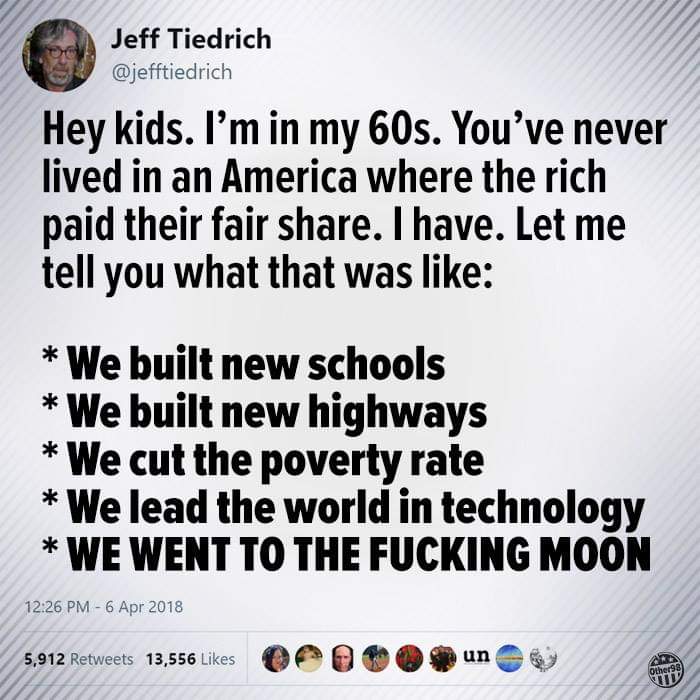
Tweet from Jeff Tiedrich (@jefftiedrich)  “Hey kids. I'm in my 60s. You've never lived in an America where the rich paid their fair share. I have. Let me tell you what that was like: * We built new schools * We built new highways * We cut the poverty rate * We lead the world in technology * WE WENT TO THE FUCKING MOON”
We went to the moon! (click to embiggen)
Once again here we are with some stories that broke after I completed this week’s Friday Five or have had further developments since being reported in an earlier Friday Five or Weekend Update. Specifically stories that I want to editorialize a bit more about than I usually do in the Friday Five. And spoilers: it isn’t all bad news!

Let’s begin with a series of stories that are specifically relevant here in my home state of Washington.

I have occasionally written before about our local perennial anti-tax, anti-gay, anti-well-anything-decent initiative filer Tim Eyman. A man whose full-time job for a couple of decades has been running these shitty initiatives to restrict the power of the legislature to raise taxes, to make it difficult for local governments and counties to raise taxes, to stop transit projects, to repeal gay civil rights protections and so many more. He famously planned to make his official announcement of filing one anti-gay initiative dressed in a pink tutu because he somehow thought that would be funny—one of his supporters showed up with a rented Darth Vader costume and convinced him to wear that instead.

A bit over a month ago his usually operation switched gears when the Attorney General filed a lawsuit against him and one of his paid signature gathering groups for campaign finance violations including money laundering and diverting a lot of funds for Eyman’s personal use. The state elections commission had already ruled on some of his earlier campaigns that this sort of thing was frequently happening, and in a settlement of those charges some years ago, Eyman agreed to never the the treasurer of an initiative campaign or similar operation. But that apparently didn’t stop the malfeasance.

So, right after that, he sent out a whining money beg to his supporters, in which he also mentioned that he was filing for personal bankruptcy and that his wife was divorcing him. And it is mostly in the realm of that separate bankruptcy filing that he came into the news this week: Judge refuses to let Eyman back out of bankruptcy. So, when he filed for bankruptcy, his claim was that between his wife leaving him and that fundraising has become less successful (which he was blaming on the lawsuit that had just been filed—I guess his argument was that donors heard rumors of the lawsuit coming and had stopped sending in money?), plus the estimated legal fees for defending in that lawsuit, that he was going broke. He filed for Chapter 11, which allows for a reorganization and gives the bankrupt person some same in how the finances are sorted out.

The state has since asked the court to convert this to a Chapter 7 bankruptcy, where all assets are liquidated and then the court decides how to parcel out to the debtors. They argued that the primary purpose of the filing was to protect his wealth from the lawsuit—in other words, to prevent any punitive action of the courts from actually, you know, punishing him. And to bolster their argument, they produced bank records showing that he is spending money and an incredible rate, among other things.

This news going public apparently is not going over well with the donors who had started sending in money for his legal defense fund. So Eyman had filed a counter motion to end the bankruptcy proceedings entirely, all but admitting that the only real point of the filing was to avoid being penalized later.

The judge didn’t let him out of the filing, but also didn’t grant the state’s request. What he did do was order that Eyman has to every month file a list of exactly what he’s spending his money on, along with an estimate of his expenses for the coming months, and that at a particular date ahead, file a budget that the court will enforce.

This comes one week after the judge in the lawsuit dealt him another blow: Tim Eyman loses in court, faces possible lifetime ban on managing political finances . The lawsuit is still in early stages. There isn’t a jury or anything, yet. But part of the process includes the state outlining the kinds of penalties they will ask the jury and the judge to consider. And one of those was a lifetime ban on having any management or control over the finances of any political campaign. Eyman countered that this would infringe on his constitution right to free speech, because the courts have ruled that political spending is a form of speech.

The judge ruled, based on Supreme Court rulings in the matter, that what the court has said that spending your own money for political reasons is protected speech, but not spending other people’s money. She also pointed out that similar lifetime bans have been handed out in various jurisdictions (such as the one forbidding him from being a treasurer of a political committee) without the courts ruling them unconstitutional. This doesn’t mean that he has been banned, it just means that it remains an option in the proceedings.

And all of this is separate from his criminal trial of stealing an office chair from a store: Watch-WA Anti Tax Zealot, Tim Eyman, Steals Office Chair from Office Supply Store- in campaign shirt. And don’t forget the follow-up: Tim Eyman films himself trying to return the chair he allegedly stole. I’m sorry, just watch the video in the first story. Tell me that was an accident! He claims that since he came back inside the store and bought other things, that he meant to tell the clerk about the chair, or that he thought he did tell the clerk. But witnesses at the scene note that he tried to decline the offer of one of the employees to carry take his heavy purchases out to his car on a handtruck, and when they wouldn’t be deterred, insisted that they stack the stuff up next to his car, then he fumbled with his keys for many minutes until the clerk went back inside.

My only regret on this story is that, since Tim is a well-to-do white guy, that he’ll only get a slap on the wrist for stealing a $70 chair.

Imagine for a minute how all of this would go down if he wasn’t white…


Now we go from anti-tax/anti-gay a-holes who troll the tax system, to another kind of troll: Online trolls hijacked a scientist’s image to attack Katie Bouman. They picked the wrong astrophysicist. So, along with the story about that image that scientists created from 5 million terrabytes of data from hundreds of telescopes around the world to finally get a look at the supermassive accretion disk around a supermassive blackhole, people were sharing images of astrophysicist Katie Bouman with the giant stack of hard drives.

A bunch of misogynist guys online started spreading the story that another scientist had done most of the work. And the put his picture and several lies into memes of their own to share. He came back at them, hard. Since these trolls are usually also anti-gay, it seems like a bit of poetic justice that the guy they tried to make into their anti-feminist hero not only wouldn’t play along, but also is openly gay. And he used the media attention to point out that we need to do more to encourage girls and women into pursuing science careers, and that his branch of study, astrophysics is especially in need of more diversity.

As both he and Bouman point out in the various stories: hundreds of scientists contributed. Many many algorithms were developed and used to pull data from the various kinds of telescopes involved. Bouman coordinated the assembly, and contributed algorithms of her own, but she never claimed to be the sole discoverer.

This kind of science takes a whole lot of people. Not just because there is a lot of data to get through, but because different people bring different perspectives, and as they interact, more interesting ideas emerge. So, we need more people in science, and we need more kinds of people in science!


And yet another kind of troll: More than half of banned books challenged for LGBTQ content – The American Library Association noted there’s a “greater number of challenges” to LGBTQ books — “especially those with transgender characters.”. Because of course they are. Dang it, why are people so scared of queer kids? Why?


Finally, I promised at least some good news, and here it is! The first official teaser for Star Wars Episode IX dropped, and it is so good! Sometimes I wish we lived in a galaxy far, far away, where evil can be defeated with courage, ingenuity, and a light sabre…

STAR WARS: EPISODE IX – THE RISE OF SKYWALKER Teaser Trailer [HD] Mark Hamill, Carrie Fisher:

(If embedding doesn’t work, click here.)

Who is the actual monster? Or, more of why I love sf/f

The Modern Prometheus Preface Mary Shelley subtitled her novel "The Modern Prometheus." According to the Greeks, Prometheus, a Titan who preceded the Olympian Gods, created Man from clay. Zeus demanded food offerings from Man, but Prometheus taught them how to trick Zeus into accepting the less useful parts of a butchered animal so that Man could keep the best parts for themselves. Once Zeus learned of the deception he decreed that Man was not to be allowed fire. Prometheus crept into the underworld, stole fire from Hephaestus, and gave it to Man. Again, Zeus discovered the transgression and chained Prometheus to a rock, where an eagle would devour his liver every day (it would grow back every night). He remained there for 30,000 years.
[Swiped from an educational slideshow about Mary Shelley’s most famous novel: https://www.slideshare.net/mrsallen/frankenstein-the-modern-prometheus )
I’ve written about Frankenstein as a pair of classic movies, as an award-winning parody, as the basis of a whacky sixties comedy, and I’ve mentioned it many times while talking about the history of science fiction, but I’ve never written a post just about the original novel published in 1818. I’m obviously long overdue, and since something I saw on line earlier this week almost made me type a twitter storm of irritated commentary, I figure that now is as good a time as any to remedy the situation.

The full title of the novel is Frankenstein, or The Modern Prometheus, and Mary Shelley famously wrote the short “ghost story” that would eventually become the novel in 1816 while she and the man who would later become her husband were at Lake Geneva, Switzerland, spending a lot of time with Lord Byron. The novel was published in 1818 in a limited run as a tthree-volumn set without the author’s name. After a successful run of a play based on the novel, a second edition, listing Mary as the author, was published in 1823. Finally, in 1831 a heavily revised edition was published, and for the first time made available at a “popular edition” price.

Most people think they know the story of Frankenstein, but few have actually read the book. And as a fairly typical novel of its time, the very slow burn of the story, not to mention the surfeit of complex sentences and frequently mini-monologues of all the characters can make it a difficult read for modern readers. Even the structure of the novel is different than typical modern books.

The novel is told in the first person, but from three different viewpoints. It begins from the viewpoint of the captain of a sea vessel that has been trapped in the Arctic ice, who finds a half-dead man similarly marooned. The man identifies himself as Victor Frankenstein, and then tells the captain how he came to transform a body assembled from corpses into a living being, then horrified at how hideous is looked (not anything it actually did), that he rejected it, drove it away, fervently hoping it was die in the forest since it had no skills, couldn’t talk, et cetera, and then tried to go back to his life. The middle of the book is from the creature’s point of view (though still filtered, because the creature eventually found Victor and told him the story, which Victor is now telling to the captain who is writing all of this down for us).

The creature did not die. He took shelter new the cottage of a family that lived in the woods, and by watching them learned to speak, eventually learned to read, and came to hope that he might not die alone in the world. The grandfather of the family was blind, and the creature struck up a friendship with him, carefully only coming around when the old man was alone (since every person who had laid eyes on the creature up to that point had been so horrified by his appearances as to scream and chase him away). Alas, the rest of the family catches him once, and they have the usual reaction, sending the creature fleeing deeper into the woods. The creature finds Victor, explains all of this, and then asks Victor to create a second person like himself, to be his companion and mate. Victor agrees.

The next part is back to Victor’s point of view, and Victor begins assembling body parts in secret again, but he suddenly becomes afraid of what will happen if the creature and his mate can actually reproduce. I emphasize at this point that here at more than two thirds of the way through the novel the creature hasn’t harmed anyone, hasn’t threatened anyone, has not behaved in any way other than as frightened child. But Victor suddenly decides that he can’t let the creature have a companion, he destroys the body parts, tells the creature he will not help him after all. The creature loses it, and eventually decides the best way to get his revenge on Victor is to start killing people Victor loves. Victor tries and fails to kill the creature, and they wind up chasing each other across northern Europe and into the Arctic.

Finally, we return to the viewpoint of the sea captain, as Victor gives a last monologue and dies. The creature find the ship, has a conversation with the captain in which he agrees that he has done terrible things, and explains that his intention had been to lure Victor to a spot where the creature could kill him, and then not just kill himself, but set himself on fire in a place where no one would be able to study his body and figure out how Victor did it.

And that’s where it ends.

Like any work of art, everyone interprets the story differently. A little over a year ago there was a bit of a kerfluffle when one newspaper ran a story about how modern readers feel sympathy for the creature with a headline that referred to such students as “snowflakes.” There seemed to be an assumption that having sympathy for the creature—seeing him as misunderstood and a victim—was some sort of modern politically correct reaction.

There’s a big problem with that: the original novel actually does portray the creature as a victim and as being misunderstood. And that’s not interpretation, it is literally what happens in the story. Not to say the story makes him a blameless victim, and certainly how the creature takes his revenge by killing innocent people beloved by Victor is an evil act.

But it is an act of revenge. And the book frames it that way.

Lots of people assume that the theme of the book is that there are some things which mortals are not meant to know, and that if mere humans try to play god horrible things will happen. But that isn’t really Victor’s sin. We get a hint of that in the title itself: Frankenstein, or The Modern Prometheus. Prometheus was not a mortal who stole from the gods, Prometheus was one of the gods (yes technically a Titan, but that was just the name in Greek mythology for the first generation of gods). And what Prometheus was ultimately punished for was giving humans the gift of fire, then not making sure they would use it responsibly.

Victor’s sin, then, is that he gave life to a creature, and then abandoned it, rather than caring for it. As the creatures creator, he had a responsibility to teach it how to get along in the world, to know right from wrong, and so on. He didn’t do that. And he drove the creature away not because of anything the creature did, but simply because of the creature’s hideous appearance.

The middle narrative, when the creature tries to teach himself how to be a good person, is the next big clue as to the real them. The creature naturally craves love and the comfort of companionship, and he tries to learn how to be a member of society. He befriends the blind man and earns his trust. It is only when once again people see him and assume because of his looks that he must be a dangerous, evil thing, that he abandons his plan to try to become part of the human community.

Then there is this admission from Victor himself, in the final deathbed monologue:

“In a fit of enthusiastic madness I created a rational creature, and was bound towards him, to assure, as far as was in my power, his happiness and well-being. This was my duty”

Victor goes on, unfortunately, in that monologue to insist that he was right to abandon the creature, but his rationalization only works by assuming that somehow he knew how the creature would react to yet another betrayal.

Finally, we have the creature’s final plan: he had already destroyed the remaining records of Victor’s experiments (those that Victor hadn’t destroyed himself), then set out to kill both Victor and himself so that no one could have create another creature like himself. Before Victor died, he had admitted to the captain that the creature had been leaving clues to make sure that Victor was still pursuing him. The creature had thought it out: Victor was the only one who knew how he had reanimated dead flesh, but it was possible that another could study the creature’s corpse and figure it out, so the creature needed to kill Victor, and then he needed to destroy himself. He planned to set himself on fire somewhere on the arctic ice precisely because any remains would eventually wind up lost in the sea.

In other words, he was cleaning up Victor’s mess.

There are plenty of quotes one can pull from Victor’s and the creature’s monologues to support the usual interpretation that this was all about an arrogant scientist treading into areas best left alone. But those are all perspectives of characters within the narrative. Just because a character says something, that doesn’t mean it is what the author believes—it’s something the author thinks the character must believe in order for their actions to make sense.

I’ve said many times that an author’s values and beliefs manifest not necessarily in the words of the characters, but in the consequences of the actions of characters, and how the way the narrative portrays them shows you whether the author thinks those consequences are deserved. It’s very clear from that perspective that yes, both Victor and his creation have done deplorable, immoral things. But it is also clear which of them realizes it and takes personal responsibility for it.

Victor blames the creature for everything, including his own actions, up to his dying breath. The creature blames both Victor and himself for the various atrocities, and in taking the blame, pronounces (and then carries out) his own death sentence.

Which means that ultimately, it isn’t the creature who is the monster.

Filling up the gaps, or, why An Archive Of Our Own deserves that Hugo nomination

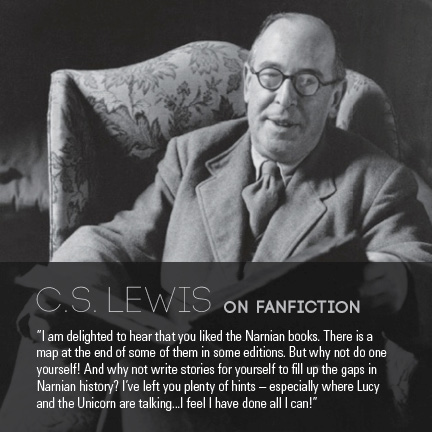
The actual quote, according to Lewis' Letters to Children (in aanswer to a letter from a child named Denise) was: “I am delighted to hear that you liked the Narnian books, and it was nice of you to write and tell me. There is a map at the end of some of them in some editions. But why not do one yourself! And why not write stories for yourself to fill up the gaps in Narnian history? I've left you plenty of hints—especially where Lucy and the Unicorn are talking in The Last Battle. I feel I have done all I can!”
The actual quote, according to Lewis’ Letters to Children (in aanswer to a letter from a child named Denise) was: “I am delighted to hear that you liked the Narnian books, and it was nice of you to write and tell me. There is a map at the end of some of them in some editions. But why not do one yourself! And why not write stories for yourself to fill up the gaps in Narnian history? I’ve left you plenty of hints—especially where Lucy and the Unicorn are talking in The Last Battle. I feel I have done all I can!”

The Hugo Awards Ballot was released a bit ago (and I linked to at least one post about it at the time), and one of the more interesting items to make it to the ballot was the fanfiction web site, Archive Of Our Own (known to many of us as AO3) in the Best Related Work category. This nomination is, of course, not without some controversy. Best Related Work is usually awarded to works of non-fiction, such as biographies of authors and editors from the field, or collections of non-fiction essays and/or reviews, and so forth, but the definition of the category allows for other things, which bothers some people. This is hardly the first time that something which isn’t clearly a non-fiction book or collection or non-fiction essays has been nominated, and it won’t be the last.

The first objection many people have is that it doesn’t qualify. I think this blog post says it best: Archive of Our Own is a work and its related and I’m really happy that it’s a Hugo finalist.

Cam expanded the official definition of the category into a bullet list and then answered most of the issues. I’m just going to blatantly steal most of it here, then proceed:

  1. Related to the field or fandom. Lots of SF/F in there and by its nature what gets written is out of fanishness. Check.
  2. Either non-fiction or, if fictional, is noteworthy primarily for aspects other than the fictional text. The contents of the archive are fiction but what is being nominated is the thing as an entity. Consider the difference between lots of science fiction novels and a library of science fiction novels. It’s the library that’s being nominated, which includes its contents but which is not the same as its contents. Check.
  3. Not eligible in any other category. Obviously. Check.
  4. Which has been substantially modified during the previous calendar year. I think this is the only weak point in an eligibility argument…

On the last part of the category definition, the archive itself, as a platform, has some significant expansions to the search and filter options. There are a number of other feature improvement during the 2018 calendar year, including: support for several new character sets (which means the works originally written in languages the previously couldn’t be uploaded and read can—it isn’t just emojis!), importing several other fandom archives that were in danger of being lost due to various issues through the Open Doors Project (which isn’t just about importing the contents, but also the relational data and ownership controls), and a change log.

If the argument is that the platform itself and the way it enables fannish activity is what has been nominated, then I think those clearly qualify as significant changes in how the platform worked before.

A related controversy to the questions of whether it is really eligible under the current definition is whether the category definition itself is the problem. One form this argument has taken is that a win for AO3 will open up the floodgates of other weird things being nominated and soon non-fiction books and the like will never be honored again.

Bull!

That’s a slippery slope argument, and there are many reasons logicians consider the slippery slope assertion a logical fallacy. And I’m not wasting any more pixels on a logical fallacy.

An actually debatable aspect to this argument is whether or not non-fiction book-length works deserve specific category of their own, while a separate and more explicitly Miscellaneous category could exist beside it. I think the answer at this time is that we just don’t know if it would make sense to split this into two categories.

One reason I lean against splitting them is that, as it is now, the down ballot categories get the attention of fewer nominators and voters as it is, and I think that added another category isn’t going to help that situation. Whether there are enough items that aren’t non-fiction books at this time to give us more than 6 candidates a year is simply not clear.

Another reason I lean against it is that no matter how categories are defined, there going to be works that don’t clearly belong in them. Books, stories, dramatic works, et al, are works of art. And art is supposed to be creative. Humans are tool-making animals that constantly improve existing tools and invent new ones. There are going to be emerging forms of artistic expression that don’t clearly fit into an existing category. For that reason I’m very comfortable with having at least one of the categories have a flexible enough definition to allow for those unexpected things.

I mean, seriously, if sci fi fandom can’t accommodate novel means of expression, then what is the point of its existence?

And a third reason I lean against splitting the category is that well, some years there aren’t that many excellent non-fiction works of book length concerning sf/f or the fandom published. At least not IMHO. If, when the nominating data is released after the awards ceremony, it turns out that some book-length non-fiction just barely missed making the ballot, that might indicate that we need to rethink the categories. Which is why I said we can’t know, just yet.

Let’s move on to the next controversy: what exactly has been nominated here? Most everyone is going with the argument that it is the platform and the manner in which it promotes and facilitates the creation, collection, and discovery of fanfiction and related information. And I totally understand that interpretation and that is certainly what many of the people who were arguing in favor of nominating it said.

But I want to point you to item number two in Cam’s list above. I really like his analogy of thinking of this as a library that has been nominated. The library as a whole is more than just the sum of its parts, but it also includes those parts. And further, without those parts, it is meaningless. A library with no books at all is just a building with shelves, right?

Well, sort of.

A library is also a system for collection, collating, relating, and distributing books. And that is not an insignificant thing. Which is why a lot of people are pushing the nomination of the platform. But a library is also a system for stimulating imaginations. In that way, a good library is, itself, a work of art.

A library is also a system for education, and more than just as a repository of information. Sufficient exposure to books has the effect of inspiring some people to write books of their own, and so a library is also a system for creating writers, and ultimately, a system for creating more books. Again, the library can’t do that if it doesn’t contain the books that inspire.

AO3 fulfills that phenomenon, too. There are many professional writers working today who started out writing fan fic. And I don’t just mean younger writers reading fanfic online. The internet didn’t exist when I was six years old, and I hadn’t yet discovered the existence of mimeographed-then-sent-through-snail-mail fanzines, yet. But I was writing my own versions of stories I loved at that age. Sometimes my motivation was to tell more stories because I had reached the end. Other times I was unhappy with how a story had turned out, so I decided to write my own version.

All of that is how I got into writing. It’s why I started faithfully reading The Writer and Writer’s Digest in the local libraries. It’s why I started mailing my (at the time very derivative) stories to magazines when I was 12 or 13 years old. It’s why I kept working at it until I started actually getting published (even if it was almost always in very small circulation ‘zines).

The creation and consumption of fan fiction is, in itself, a fannish activity. The conversation, both implied and overt, that happen between the fans and creators of fanfic constitute commentary on the original works that inspired the fan fiction, as well as the phenomena of how people receive and react to narratives and other works of art. Creating fan fiction, for some, is a training ground for going on to create original fiction.

And sometimes, when either the original works have gone into public domain, or when a clever writer changes things just enough that they don’t infringe on trademarks, fan fiction wins Hugo Awards.

So, a platform that facilitates the creation and discovery of hundreds of thousands of works of fan fiction certainly deserves to be in the running for a Hugo itself. And everyone who contributes to it, not just the administrators and programmers, should be proud.