Tag Archives: sf/f

That’s not a plothole, or, Just because it isn’t like yours, that doesn’t mean it’s bad…

“While not every book is intended for every reader, each of us has the right to decide for ourselves what to read, listen to, or view. Celebrate your freedom to read!”
Freedom to read! (click to embiggen)”
I saw this great, short post on Tumblr some time back that I thought I would expand into a series of posts about writing. I thought that I recorded the name of the Tumblr blog that I lifted it from, but when I went into my note a while later, it wasn’t there. I didn’t really want to steal it without attributing it, and for some reason it hadn’t Googled the quote until today.

People should probably learn the difference between “plot holes” and “things I didn’t like” or “things the franchise plans to explain in the future” or “things film makers didn’t think they needed to explicitly explain because they thought you had critical thinking skills”
—Gina at ahandsomestark.tumblr.com

I was reminded of this quote while reading some gripes about the recent Captain Marvel movie—complaints that echo criticisms of other films, books, and shows that all happen to have one thing in common: the protagonist isn’t a cishet white male.

To stick to Captain Marvel for a minute, the particular complaint is that it is supposedly a bad movie because Carol’s final battle with the bad guy doesn’t involve her defeating said bad guy without using her superpowers. Now read that again: guys who claim to be superhero fans are angry that the superhero used her superpowers to defeat the bad guy. Not only that, they claim this failure of the superhero to not use her super powers is bad plotting.

Of course, they didn’t phrase it that way. And when someone called them on it, asking them why they expect a superhero in a superhero movie to not use super powers, they twisted themselves in a knot trying to say that wasn’t what they were saying.

And you know what, they are sort of correct on that. I mean, it is exactly what they’re saying, but it isn’t what they mean. What they mean is that the moral victory that Carol achieves at the end of the film isn’t the moral victory they think she should achieve. They can’t even see what the victory is, because they are so deeply immersed in societal expectations of gender roles that they can’t perceive it.

Several times in the movie the audience is shown, as she gets fragments of her memories back, Carol climbing back to her feet after getting knocked down. That is a fairly standard part of any hero’s story, right? No matter how many times you get knocked down, you stand back up and keep fighting. The part these guys don’t understand is it isn’t just about being physically knocked down—it’s also about the guys yelling at her to stay down, telling her that she doesn’t belong there, telling her she isn’t good enough, telling her that the only worth she has is what they have given her.

Overcoming that constant message is the point.

Members of marginalized groups understand that. We’ve spent our whole lives being told that who and what we are isn’t good enough. We’ve been told that our worth comes from what they have given us. We’ve been told that only if we become like them will we amount to anything in the world. We are told to be quiet, do as we’re told, act more like them, et cetera, et cetera, et cetera.

The whole point of Carol’s arc is that she has been lied to, manipulated, and put in a position where her power is limited by the liars. She was always good enough. She was always strong enough. But she believed the liars. And her triumphant moment at the climatic battle is first the moment when she throws off the shackles and embraces the power that was always there.

An even more important moment is when the man who has been lying to her day in and day out for years, who falsely told her that the only reason she had anything was because he gave her his blood, who kept telling her she was too emotional, and that she would never be good enough if she couldn’t come down to his level and win under his rules (rules that are very specifically designed to ensure her loss). Her triumph was when she realized that her worth had nothing to do with his approval.

When she refuses to stoop to his level and blasts him in the face, that was an incredibly big deal. Because the enemy she was always facing was the abusive, manipulative, toxic system that he represented.

I understood how important that moment was because for me it reasonated with the moment in my teens when I finally realized that every time my dad had been telling me that I was broken, worthless, not man enough, et cetera, had been a lie. The moment I stood up to him, and then walked away from him was an important victory.

Millions of women who watch Captain Marvel recognize that moment because they all have had a time where they realized they don’t have to please and prove their worth to the awful, lying people and the system that has been holding them down. Their value does not derive from pleasing a man or serving the needs of men—their worth comes from within.

Her character arc is not going from powerless to powerful—her arc is about going from oppressed to free. Just because it wasn’t the arc you were expecting, that doesn’t mean it isn’t a character arc, nor a worthwhile one.

Finally, if you really think that somehow you were robbed because at the end she didn’t engage in a meaningless fist fight with the lying dude at the end, tell me why everyone in the theatre back in Raiders of the Lost Ark burst into shouts and applause when Indy was confronted by the unknown sword-wielding man and he merely pulled out his gun and shot him.
Life is short and other musings about writing, reading, and variety in sf/f

“Life is short. Write that novel. Paint that painting. Try new recipes. Learn black magic. Go into the forest at night. Summon a demon. Earn that demon's trust. Become best friends with it. Brag to everyone else about your new cool demon best friend. Knit that sweater.”
Life is short… (click to embiggen)
So, I started Camp NaNoWriMo yesterday. I and a few friends have a cabin (which is basically a private chat group for up to 12 people who have set up projects). Camp NaNoWriMo is similar to the full fledged National Novel Writing Month, but it’s meant to be a bit more low-key and flexible. You get to set your own word count goal, for one. Lots of people use Camp NaNo to edit or revise a large project (such as whatever they wrote during a previous NaNoWriMo). It’s fun. I like having the private chat and having a structure for posting progress, getting and giving encouragement to friends, and so on.

Our cabin isn’t full, so if something like this appeals to you, set up a project and send me a message with your user name so I can send you an invitation to our cabin.

My particular project is an editing one, and I’m counting words as I go through scenes in the larger project. When I finish the edits on a scene, I copy it into a seperate Scrivener document to keep track of my word count. I was a little suprised at how much I got done on the first day, since it was a day at work where I don’t really get a chance to take a full lunch to spend writing, and I was feeling more than a bit out of it when I got home from work.

In other news, the 2019 Hugo and Campbell Awards Finalists have been announced. I was quite pleased to see that in every category at least one thing I nominated made it to the final ballot. The flip side of that is that there are also a lot of things with which I’m not familiar that made it onto the ballot, so I get to read a lot of new stuff soon!

I was really happy to see that Archive of Our Own—a massive fan fiction repository—is nominated in the Related Works category. It’s a little weird, because there are thousands of contributors (including me, though I have such a teeny tiny bit of stuff posted I don’t really count). Clearly if it wins, thy won’t be handing one of the big rocket trophies to every contributor. There are a couple of things in that category that I haven’t read, so I don’t yet know if AO3 is going to be my first choice for Related Work, yet.

As I said, I’m once again looking forward to reading stuff that has been nominated for the Hugos. As happy as I am to see things I nominated make the list, I also love seeing new things that I haven’t read, yet. Because, as I mentioned as part of another point last week, no one’s favorites list can encompass all of science fiction/fantasy. And that isn’t just because a whole lot of it is being published today (although with self-publishing being so much easier, and the internet making things more discoverable, there is an incredibly wide variety to choose from).

But a lot of people operate under the illusion that in times past a single fan could, indeed, read everything in the genre that had been published that year. It only seems that way if you assume that only the authors and stories you have heard of years later are who and what were being published at that time. A great example of this misapprehension is one of the flaws in a recent blog post by whacko Brian Niemeier (that I won’t link to directly, but since Camestros Felapton does a nice analysis of some of the flaws, I’ll link to his post: Did fandom cause the collapse of civilisation or vice versa? Let’s Assume Neither 🙂).

Niemeier makes the claim that “back in the day” everyone read Edgar Rice Burroughs and everyone listened to The Shadow radio show. Now, it’s true that Burroughs’ Tarzan books sold so well that he was able to form a film company and produce his own adaptations of his books, something that would be unthinkable for an author to do today. But it’s simply not true that everyone read the Tarzan books, if for no other reason that regular readers of novels and the like have always been a minority of the population. James Branch Cabell, a contemporary of Burroughs, sold more copies of his books during the nineteen-teens and -twenties than Burroughs did, yet he is largely forgotten today. There were scores of magazines publishing sci fi, fantasy, horror, and related fantastical fiction, publishing thousands of stories during that time most of which written by hundreds of authors many of whom we’ve never heard of.

While there is a huge amount of fantastic fiction to love now, there was a huge amount then, too. And I think that’s great! Because not everyone likes the same things, and the more variety there is, the more likely that there is something wonderful to discover and read for the first time, right? Similarly, the fact that many people like many things, mean that something you or I create is likely to find a receptive audience.

I am quite certain that if someone wrote a story about a conjurer who becomes best pals with a demon and they take up knitting together, someone out there will want to read it.

And those are good things.

Narrow horizons and frozen minds — or sf/f shouldn’t be an old boys’ club

“Kids these days will never know the joys of oil lamps and chamber pots”The tired cliche that there are certain “classics” of sf/f that one must have read in order to be a real fan has reared its ugly head. The current iteration is an assertion that writers of sf/f (aspiring or otherwise) who have not read the classics are not able to write good sf/f. And specifically the “classics” one is supposedly required to read and love in order to be a good writer of science fiction and fantasy are the usual suspects: Heinlein, Asimov, Clark, and so on.

Poppycock!

Now, it is true that I read Heinlein, Asimov, and Clark. I have written on this blog about how some of their work helped me in my formative years. I have also written on this blog about problematic aspects of both their writing and some of their personal life choices. I’ve also written before about how some of their writing hasn’t aged very well. Heck, when I was in my teens in the 1970s reading some of their older work, I was finding myself rolling my eyes over things that seemed either embarrassingly wrong or more than a little sexist and/or racist.

Unfortunately a lot of books from the middle of the last century that were important to the development of the genre, and/or were beloved by many fans over a span many years, don’t hold up so well years later.

But that’s not my only problem with this notion. Because people have been bandying around those specific names as “must-reads” for decades. A lot of excellent science fiction was written back then by other people. And a whole lot of good science fiction has been written since the heyday of Heinlein, Asimov, and Clark. A lot has changed in the genre. Sure, Asimov’s short story “The Last Question” was profound and mind-boggling when it was published in 1954 (63 years ago), but when I read it for the first time in 1973, even 13-year-old me saw the ending before it arrived. It was bit disappointing, to be honest. Because the story had been so influential that the once mind-boggling idea had been incorporated, expanded, deconstructed, and re-imagined several times in that 19-year span.

And it’s continued to be re-used in sci fi since. Heck, the entire story was boiled down to a two-sentence (and hilarious) joke in a 1992 episode of BBC’s Red Dwarf!

Which is not me saying that something which has been done before can never be repeated. Looking at old ideas in new ways is an essential part of sf/f. It’s just that the value of revisiting the same “classics” over and over is questionable, at best.

I would feel a little less like this was white guys insisting that everyone has to read their favorite old white guys if some of this “must read” lists included Mary Shelley’s Frankenstein published in 1816, as well as anything by Octavia Butler, Joanna Russ, Ursula LeGuin, or Andre Norton.

The usual argument is that Heinlein, Asimov, and Clark created the genre—and you can’t understand what it is now without reading them. Except, they didn’t create it. If you want to understand the origins you need to go back at least another hundred years to Shelley’s Frankenstein, for one, and stories from Nathaniel Hawthorne (“Dr. Heidegger’s Experiment”, “Rappaccini’s Daughter” for instance) in the 1830s.

Sure, I think a writer needs to have read a lot and broadly to feed their craft. But when I say broadly, I mean really broadly. Read things outside your favorites, absolutely! Not everything you read needs to be a masterpiece, by anyone’s definition. You can learn from bad examples as well as good. Playfulness is an important part of the creative process, so reading light entertaining tales is just as important to feeding your artistic soul as reading deep, meaningful, serious stories.

Science fiction is supposed to be about not just looking at the horizon, but going past it. Not just using your mind, but expanding it.

And you know what doesn’t stretch anyone’s horizon or expand anyone’s mind? Everyone reading the exact same thing.

If the only input anyone has are the same list of books from the same authors, decade after decade, then every creator will just be regurgitating the same stuff that every other creator has.

There is value in studying what has been done before in your chosen field of writing, but it isn’t the only way to learn to create good stories in the genre. Just as one can learn to drive a modern car without first mastering the horse and buggy, you can learn to write without memorizing a specific set of books from a very narrow set of writers who were working 60+ years ago. If you want to study earlier generations of writers, remember that there is a vast volume of science fiction and fantasy works beyond anyone’s chosen list of classics or favorites. Find lists that don’t include the same few “must reads” and sample the less often recommended works, if you’re going to do that.

Similarly, there can be value for some readers in understanding the roots of some of the things being created today, but it isn’t necessary. You don’t have to go back in time to watch traveling vaudeville shows in order to understand and fully appreciate modern movies, right? You can understand and fully appreciate modern stories without reading the old stuff, first.

Look out at that horizon, and take aim for what’s beyond!

Rabbit Holes, Wardrobes, and Magical Doors—escaping into better worlds with sf/f

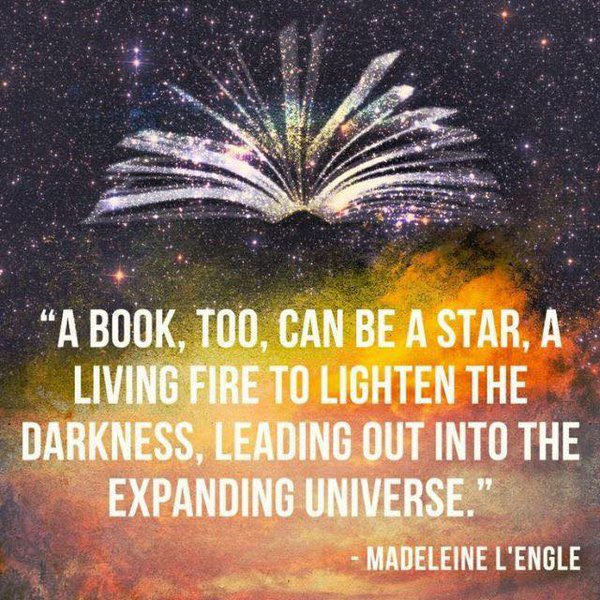
“A book, too, can be a star. A living fire to lighten the darkness, leading out into the expanding universe.” —Madeleine L'Engle
(click to embiggen)
Among the albums my parents owned when I was a kid were a number by comedians who were popular back in the 50s and 60s—and there was one where the guy told a long, hilarious tale which ended with the words, “I told you that story so I could tell you this one.” Which led into another that was quite entertaining, but even moreso because you had heard the previous one. Which is a long way for me to say, I’ve been wanting to write this post for a long time, but first I really needed to write about Seanan McGuire’s Wayward Children series. Which I did last week.

When I heard McGuire say that as a child she loved stories where the child protagonists went to a magical world where they became heroes and warrior-princesses and the like, but was always so angry that they then had to go back home, I was nodding emphatically in agreement. I wanted to get lost in the misty woods and find myself caught in a war between goblins and elves. Or go around a bend on a lake shore and find myself face to face with a giant beetle who greeted me and told me we had to run because danger was coming and so forth.

Except I didn’t want to have to come home again after the first adventure was over. The other world was so much better than the real world. I recall one time when I asked a teacher I trusted why the stories always ended there, she wasn’t very understanding. “Wouldn’t you rather be home with your mom and dad and all your friends?”

She didn’t know what to say when I asked, “What friends?” I didn’t add that if I could run away and never see my father again I would be the happiest boy in the world. This isn’t to say that I never had friends as a child. But being the kind of kid who was always quickly labeled a sissy (or worse words) and a weirdo whenever new kids met me, combined with the number of times we moved because of my dad’s work in the petroleum industry (ten elementary schools across four states), I never had a lot of friends. This particular conversation happened less than two months after we had moved yet again, and I hadn’t yet really found a friend at the new place.

Another time that I told someone how much I wished I could live in one of those magical worlds, the person tried to convince me that the things which seemed like an adventure would not be fun. “Real monsters aren’t just scary, they actually hurt you.”

I had learned through multiple experiences that if I told such adults that I already lived with exactly the kind of monster who actually hurt you that I would be disbelieved at best. Because the kinds of adults who will see a ten-year-old with stitches and multiple contusions on his face and one arm in a sling, look that kid in the eyes, then lecture him that if he was just more well-behaved his father wouldn’t do these things to him not only don’t know what monsters are—they enable monsters.

That reality is precisely why portal fantasies appealed so strongly to me as a kid. And why the endings were always so frustrating.

Let’s pause a moment to go over some terminology. A portal fantasy is a story in which people from our mundane world enter into a different, fantastical world, through a portal of some kind. Classic examples are falling down a rabbit hole in Alice’s Adventures in Wonderland, or through the enchanted wardrobe in The Lion, the Witch, and the Wardrobe, or carried off by a tornado in The Wizard of Oz, or being injured and losing consciousness to wake up elsewhere as in the Thomas Covenant books.

A portal fantasy is different than an immersive fantasy, where all of the action occurs within the fantastical world and there are no characters who come from the mundane world. Think of Lord of the Rings or The Last Unicorn or any of the Conan the Barbarian stories. It is also different from an intrusive fantasy, where magical/fantastic creatures somehow come into what otherwise appears to be our mundane world—sometimes the narrative assumption is that the magic has been there all along, but for whatever reason most of us are unaware of it and thus don’t believe in it. Think of Dracula or Harry Potter and the Philosopher’s Stone or A Wrinkle In Time.

The particular appeal of the portal fantasy for a kid like me is that in the fantastic world, I would have options that aren’t available to me in the real world. I didn’t see how any of the monsters and evil overlords in the fantasy books were worse than things my father (and the whole structure of society that enabled child abuse) did to me. As a kid, I may not have really understand the concept which is summed up by the old adage, “Better the devil you know than the devil you don’t,” but there was one thing that the protagonists of the portal fantasies had that I didn’t have in the real world: agency. The kids transported to the magical kingdom may have been put in perilous situations, but they weren’t powerless.

It wasn’t just when I was a young child that other people critiqued my enjoyment (and enthusiastic recommendations) of portal fantasies. In my teens and later, an additional critique was added: “You just want a happy ending.” This was usually served with a heaping helping of cynicism about how happy endings don’t exist in the real world, and people who don’t understand that are defective in some way. All of that judgmental cynicism is also the foundation of critiques (that often comes from certain people who call themselves fans of sf/f) which dismiss many works of speculative and fantastic fiction as merely fan service.

I have two responses to this line of argument.

First, go back up and re-read the bit about having to survive beatings from my dad that led to hospital trips. I suspect I know far better than the people who make the happy ending argument just how bad the real world can be. And I survived that. And you better believe that part of the reason I survived it is because fantasy books helped me to imagine a life where the monsters could be conquered. That alone should justify the existence of so-called escapist literature.

For the second and more important response, let’s go back to the Wayward Children books and the author thereof. There are two things I’ve come to expect from a Seanan McGuire book:

  1. At some point in the story she will break my heart,
  2. By the time I get to the end, I will be holding my hands out (metaphorically) toward the author like a Dickensian urchin and will plead, “Please, may I have some more?”

And to be clear, I mean there are things that happen in the stories (not just this series) to the main characters that make me physically shed tears as I’m reading. Sometimes McGuire has left me sobbing uncontrollably with some developments that happen. Characters in her stories do not always get a happy ending. Many very unhappy things happen to them. So if all I wanted was happy stories where nothing bad ever happens, why do I keep reading her stuff (excitedly pre-ordering things when I can; and recommending the stories to others)?

Because I never get the feeling that she is doing it just to shock me. She never allows harm to happen lightly—even to the bad guys. Death never happens senselessly. By which I mean both that the bad things always makes sense within the world, but also because the bad things are integral to the plot. It always feels genuinely that she knows this pain and she understands it. These stories don’t sensationalize or revel in pain and suffering, they show pain because real people suffer things that hurt this much. In the real world, far too often the pain of many types of people is ignored, rationalized, and even celebrated.

I don’t want to celebrate pain. Celebrate the moments of happiness and love that characters seize despite misfortune? Yes, please!

Lost Dreams and Wayward Worlds – or, more of why I love sf/f

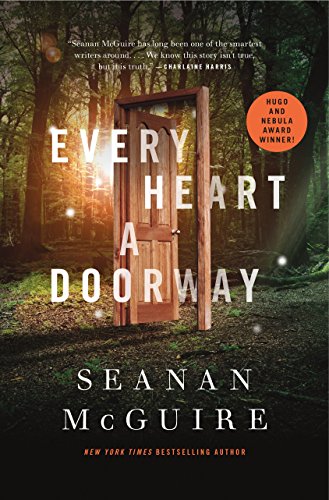
<em>Every Heart a Doorway</em> by Seanan McGuire kicked off the Wayward Children series and won a Hugo award, Locus award, Nebula award, and an Alex award.
Every Heart a Doorway by Seanan McGuire kicked off the Wayward Children series and won a Hugo award, Locus award, Nebula award, and an Alex award.
I bought the Kindle edition of Every Heart a Doorway several months after it came out in 2016, but it sat in my library for a while unread. Several people had recommended the book, but there are always so many unread books in my queue. I think what prompted me to read it was that it was showing up on people’s recommended lists for books to nominate for awards in January 2017. I plunged in and devoured a lot of things that had been in my queue for a while in the first few months of 2017, in part because reading fiction was so much less fraught than paying attention to the real world right then. I liked Every Heart…, even though it broke my heart. And at the end, I really, desperately wanted to know what happened next. I understood that a sequel was coming out, but wasn’t sure when.

Then my husband and I attended Locus Awards weekend in June of that year, where McGuire was a guest. There’s an autograph session during Locus Awards Weekend, and the University Book Store sets up several tables with books that have been nominated for the Locus, along with other books by some of those authors, and I was delighted to see that the sequel to Every Heart… was available. So I wound up buying both a hardcopy of Every Heart a Doorway and Down Among the Sticks and Bones (even though I already had the Kindle edition of the first), so I could get them autographed.

As of this month, there are four books in the series (I should note for the pedants: these are short books; for awards purposes they count as novellas rather than novels). I just finished the fourth a week or so ago, and I had originally intended this post to be a review just of the fourth book, but I realized I don’t want to review it without talking about the entire series.

Children have always disappeared under the right conditions; slipping through the shadows under a bed or at the back of a wardrobe, tumbling down rabbit holes and emerging somewhere… else.

On a panel at Locus Awards Weekend, McGuire talked about why she wrote the first book. She described stories she adored as a child, where a kid or kids who didn’t seem to fit in at home would find themselves transported to a magical kingdom, have incredible adventures, save the world… and then were forced to go back home and just be the ordinary, unappreciated kid they had always been. “And I just wanted to know why? Why couldn’t they stay and keep being heroes?”

So the first book introduces you to Eleanor West’s Home for Wayward Children. Eleanor was, herself, a girl who slipped through the shadows into another world, before eventually having to return to ours. She set up the school as a refuge for those children who were not happy to be sent back to mundania. She tells the parents and other outsiders that her goal is to help the children get over their delusions and learn to cope, but that’s just to keep them from worrying. The school is full of children who have been to many different kinds of worlds, and in the first book, seen through the viewpoint of the latest arrival, Nancy, we learn a bit about the many magical worlds, some of the rules of how they operated, the theories of why some children are drawn to those worlds and why the worlds discard them or push them out after a time.

We also deal with a series of murders that begin happening in the real world at the school. That’s where my heart got broken, because McGuire didn’t pull any punches. Characters the reader becomes very attached to are not spared, if it makes sense in the story that they die.

The second book is a prequel. It tells the story of two of the children we met in the first book, and how they fell into their magical world. The Moors are kind of an old Universal Studios Monster Territory. There is a nobleman (The Master) that everyone knows is a vampire. There are villagers who know that if they abide by certain rules they can go about their lives mostly unharmed and protected from other horrors that roam the countryside. There is a mad scientist (Dr Bleak) who can bring some of the dead back to life, and help put people back together if they are injured or maimed. The children who fall through are a pair of twins, Jacqueline and Jillian back home, though they prefer to go by Jack and Jill. Jack becomes the apprentice of Dr. Bleak, while Jill becomes the ward of The Master. More choices are made, and alas, some characters pay the price of other people’s choices, and we learn how the girls came to be sent back from the Moors, and why one of them did the things she did in the first book.

The third book, Beneath a Sugar Sky begins at the school, where we meet a couple of new characters, Cora and Nadya. Cora is a brand new student, recently returned from a world where she was transformed into a mermaid and became a hero. Nadya has been at the school longer. She also went to a water world, though hers was a much darker one than Cora’s. Their day is interrupted when an impossible girl falls from the sky and demands to be taken to meet her mother. The reason Rini is impossible is because her mother was a child who died in the first book, having never found a way to return to the magical candy land kingdom, yet Rini claims that her mother did return, re-unite with the farmboy she had a crush on before and defeated the evil Queen of Cakes. Rini was born about 9 months after the defeat of the Queen, and everything in her life was going famously until her mother mysteriously disappeared. And now Rini’s body is slowly vanishing.

Eventually Cora and Nadya join two boys we met in the first book, Kade and Christopher, in a quest with Rini to figure out how to bring Rini’s mother back from the dead and get fate back on track before Rini vanishes altogether. They wind up visiting two different magical worlds before everything is sorted out.

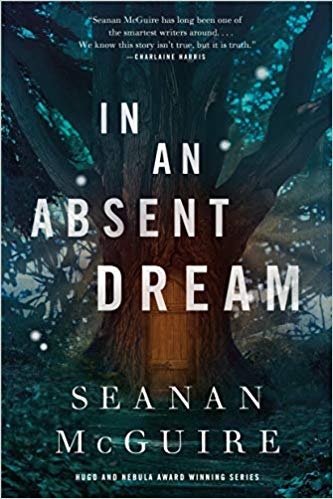
Cover for <em>In An Absent Dream</em> Book 4 in the Wayward Children Series by Seanan McGuire.
Cover for In An Absent Dream Book 4 in the Wayward Children Series by Seanan McGuire.
Which brings us to book four, the one I read most recently. In An Absent Dream is another prequel, telling the backstory of one of the characters we met in the first book. We meet the little girl first at her sixth birthday, when she makes peace with the fact that, in part because her father is the school principal, she will not have friends at school. A couple of years later she finds a mysterious tree with a door in it and goes through, where she finds the Goblin Market. She finds a friend and a mentor there, has some adventures, and makes more friends. But while grieving over a death she returns to the real world, and is not able to find the door back for a couple of years. For the rest of the book we watch as Lundy tries to make a life going back and forth between the worlds. Because she does love her family (especially her younger sister), yet she loves her best friend in the Goblin Market, too.

Trying to balance both, she makes a magical deal that doesn’t quite work how she wishes.

This one is different in tone than the previous one. The narrator has more of a personality, rather than feeling objective. The narrator directly addresses the reader from time to time, telling us a bit about what is about to happen. Those of us who read the first book already knew how Lundy’s story would end. More so than we did for Jack and Jill in the second book. So I think the narration had to be framed this way.

I do believe that the second and fourth books can be read as stand-alones You don’t need to know anything that happened in the other books to understand anything that happens in them.

I’m less certain about the third book. The story carries on just fine, but I’m not sure a reader who had not read the first book would find it as compelling. Mainly because a lot of the emotional drive of the third book is whether the one character who died in the first book will be brought back. And it was in the first book that the reader meets her and gets to know her, and therefore would be invested in saving her.

I find the entire series a lot of fun. Not everyone gets a happy ending, or the happy ending that you want, but the stories contain joy and some triumphs. And there is more than a bit of the found family theme in several aspects of the series.

McGuire has mentioned on social media that the publisher has contracted for eight books so far in the series. She’s also said that her plan is to continue the pattern established thus far: odd-numbered entries will be stories that take place at the school, even-numbered books will be portal fantasies in which we see a wayward child or two find their magic door, of fall down the rabbit hole, or slip through a shadow in the back of the cupboard to find a magical world.

I’m looking forward to the rest!

Sometimes Extinction Arrives on Wheels — more of why I love sf/f

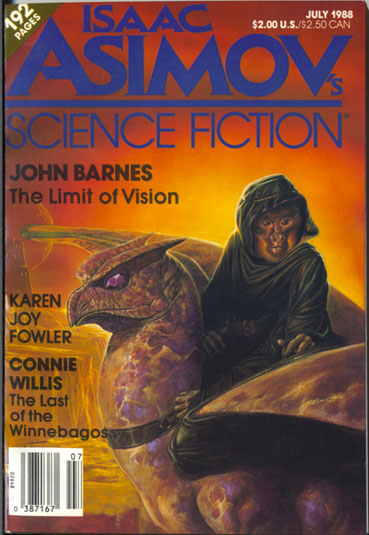
Asimov's Science Fiction Magazine, July 1988. Cover art by Bob Eggleton.
Asimov’s Science Fiction Magazine, July 1988. Cover art by Bob Eggleton.
Some months back I wrote about the first story written by Connie Willis that I remember reading. And while that story is awesome and I still find new insights every time I read it decades later, the first of her stories that made me go, “Dang! This author is GREAT!” Was from a few months later that same year: “The Last of the Winnebagos.”

The story is about a photojournalist who is supposed to be on his way to cover a political event, but he stops to take pictures of the so-called Last of the Winnebagos. The tale is set in a dystopia near-future where, among other changes, the entire species of dog was wiped out by a plague. During the death spiral of the dogs extinction, laws against animal cruelty and the like have ratcheted up, and the Society of the Prevention of Cruelty to Animals has become not just a major political force, but for all intents and purposes a national secret police force. Even accidentally killing an animal can result in serious prison time and other steep penalties.

There are other changes that have taken place unrelated to the dog plague. Energy sources are rationed, for instance. At the time of the story there are only three states left in the country that have not banned RVs and similar gas-guzzlers. Even in those states where they are still allowed, just vehicles are banned from federal freeways. So the elderly couple who drive around in one of the last RVs, regularly park somewhere public, put up a sign, and for a small fee give people a tour of this relic of a bygone era.

While taking pictures and interviewing the couple, the photojournalist takes particular interest in the photos they have of their last pet, who succumbed to the plague, like so many others. During this portion of the story, we learn of that the journalist has an ongoing side project to take photos of people talking about their beloved dogs, trying to catch the moment when, as he says, “their face reveals the beloved pet.”

I don’t want to give away any more of the plot. Suffice it to say that there are secrets revealed—such as why the photojournalist is more interested in the elderly couple and their photos of like on the road with their beloved, long-lost pet than the paid gig. And we learn a few more interesting twists about the dystopic America the characters inhabit.

That’s a big part of why this story hooked me. The dystopia that Willis imagines in this story is quite different than any I had seen before. Yet utterly believable. People will vote for very strange things and get behind politicians proposing quite ridiculous things if they get riled up enough. A truth that has been demonstrated very painfully the last few years.

Even though the story involves the journalist driving over great distances a few times, interacting with the “secret police” as well as ordinary citizens, the tale always feels intimate. We’re exploring something very personal and painful in this story. In addition to seeing some novel ideas (for the time) of how certain technologies would change.

It was a good story. A thought-provoking story. A story that explored both personal grief, and communal regret. As well as looking of multiple (and very plausible) types of extinction.

Fighting toward the light at the end of the tunnel—or why hope is important in sf/f

What’s wrong with hope? (click to embiggen)
One of the things I loved about tumblr (before the SESTA/FOSTA madness), was the wide variety of cool things that would come across my dashboard because someone had reblogged something reblogged by someone who had reblogged from someone else. At some point in the last year, this blog post by Alexandra Rowland crossed my timeline. I thought it was cool, and I liked it and reblogged it myself, and I didn’t think about it again until last week when everyone was posting links to an article on the same subject on Vox (and in many cases arguing against the premise). The original post was simple:

The opposite of grimdark is hopepunk. Pass it on.

Rowland goes on to describe hopepunk in more detail. In later posts, when lots of people argued about the term she chose (often suggesting noblebright as the preferred term), she explained how a hopepunk world is different than a noblebright one. Noblebright is where every hero is noble and pure and they conquer evil because they are noble and pure and once evil is conquered everything goes back to being noble and pure. A hopepunk world isn’t a rose-colored fairytale place, instead:

The world is the world. It’s really good sometimes and it’s really bad sometimes, and it’s sort of humdrum a lot of the time. People are petty and mean and, y’know, PEOPLE. There are things that need to be fixed, and battles to be fought, and people to be protected, and we’ve gotta do all those things ourselves because we can’t sit around waiting for some knight in shining armor to ride past and deal with it for us. We’re just ordinary people trying to do our best because we give a shit about the world. Why? Because we’re some of the assholes that live there.

I’m not completely sure when the term grimdark was first coined, but I know the attitude was around (and works of fiction based on it were getting praised and winning awards) in the late 1980s. Grimdark is sometimes described as a reaction to idealistic heroic fiction, meant to portray how nasty, brutish, violent, and dark the real world is. It has also been defined somewhat more accurately as a type of fiction that prefers darkness for darkness sake, replacing aspiration with nihilism and the assertion that true ethical behavior is either futile or impossible.

I think a much more accurate description of the majority of grimdark is torture porn and rape porn pretending to be a deconstruction of unrealistic tropes. Damien Walter noted in an article for the Guardian a few years ago that it is driven by a “commercial imperative to win adolescent male readers.”

Usually in grimdark stories the driving narrative force is to do the most brutal, shocking, nasty thing the author can to characters that they have made likable—with a lot of misogynist skewing. Rape of women and children is particularly prevalent in these stories, usually justified by the claim that that is realistic for pre-industrial societies, ignoring the fact that in war zones throughout history men were almost as likely to be the victims of rape by the enemy as women. I also have trouble with the “realistic” defense particularly in the epic fantasy settings because those authors never show people dying of cholera or dysentery—which in the real historical settings were at least a thousand times more likely to be the cause of a person’s death than torture or rape.

Grimdark appeals most strongly to white (usually straight) young men from middle class backgrounds—the sort of people who are least likely to have experienced much in the way of grimness in the real world. They are the kinds of guys who will insist that they are oppressed now because women, people of color, and queer folks have some civil rights protections. In short, they are the kind of people that:

They’re nice white middle class boys and the closest they’ve ever come to the ghetto is when they accidentally got off at the tube in Brixton once, took one look around and ran crying back into the tube.

I’ll tell you where that quote came from in a minute. First, I want to finish explaining why I believe it is mostly white, straight, middle class young men who find this appealing. It’s precisely because their exposure to grim realities is almost always secondhand. The notion that the person held up as a hero isn’t really a paragon of virtue is something they didn’t experience firsthand as a child. They didn’t routinely have someone they admired and loved call them an abomination, for instance. Queer kids, on the other hand, experienced that again and again growing up. Women learn early in life that the best they can expect from society and family if they get sexually harassed or assaulted is that they will be blamed for not somehow avoiding the situation. People of color learn that their lives are considered disposable by much of society, and so on.

Brutality, nastiness, and cruelty aren’t surprising revelations, to us. They are things we learn to expect (and endure with a smile if we don’t want to get grief from those around us). So we don’t get the same puerile thrill from its portrayal as others do.

I started working on this post last weekend after reading some of the follow-ups to the Vox story that I included in the Friday Five. And then I discovered that Cora Buhlert had already said much of what I thought about the issue (and had a lot more references than I to quote) in a blog post that I failed to read last week while I was being sick and not reading much of anything: The Hopepunk Debate. The block quote above came from there, where she was quoting a much older posting she had done elsewhere. You should go read her post, because it’s full of all sorts of interesting citations and observations.

When grimdark first started popping up, it seemed to many like an interesting and novel way to look at our perceptions of culture. It was the scrappy newcomer to the pop culture landscape—in 1987. In the 30-some years since, it has become one of the dominant paradigms of storytelling. The most popular fantasy series on television anywhere right now, Game of Thrones, is grimdark. It’s no longer surprising when likable characters are maimed and tortured and murdered in brutal ways in popular shows and books. It’s become boringly predictable.

Except that’s not quite true. Brutality has always been banal.

This gets to why I think Rowland is right to use the suffix -punk in her description of this reaction to grimdark. Grimdark has become the norm in too much of speculative fiction. Believing that hope is a thing worth kindling is, in such an environment, an act of rebellion.

We can argue about what kind of works qualify as hopepunk. For instance, I think that The Empire Strikes Back could be considered hopepunk. Luke’s insecurities and imperfections drive his part of the plot. Lando isn’t a nice guy (charming, yes, but not nice). Han is imperfect in different ways than Lando or Luke. Lots of things don’t go right for the heroes, but they don’t give up.

I’ve said many times that science fiction is the literature of hope. Even in most dystopian fiction, I have said, there is a glimmer of hope. I fully understand that that is something I believe, and isn’t necessarily an empirical fact. I believe the best sf/f can be realistic, it can be dark, it can portray the imperfect and even nasty nature of the world, while still offering that glimmer of hope.

And the truth is that that world is more realistic. That is an empirical fact. If the worst possible outcome was always more likely than others, our planet would be a barren, lifeless rock. Yes, we all die eventually, as far as we know all living creatures do. But the world is full of life because more often than not, living things survive, they endure, and they pass the gift of life along. Not understanding that requires turning an awfully big blind eye on the world. It’s a boring and inaccurate assessment of the world around us.

“The trouble is that we have a bad habit, encouraged by pedants and sophisticates, of considering happiness as something rather stupid. Only pain is intellectual, only evil interesting. This is the treason of the artist: a refusal to admit the banality of evil and the terrible boredom of pain.”
— Ursula K. Le Guin, “The Ones Who Walk Away From Omelas”

Hitchers, and Reapers, and Phantom Riders—more of why I love sf/f

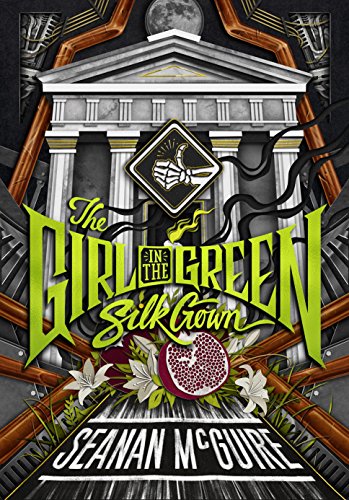
Cover art for The Girl in the Green Silk Gown.
Before I get into this book review, I feel the need to disclose a few things. Seanan McGuire, the author of the books I’ll be discussing below, is a personal friend of some of my friends. Other than sitting in some panels that she has been on at conventions, and a short conversation (which consisted of me gushing like a fanboy) at an autograph session where she signed some of her books for me, I am not myself meaningfully acquainted with her. However, because we have these mutual friends in addition to me being a fan of her work and following her on social media, some might say that my opinions of her work are biased. On the other hand, any of the writers or artists who are my friends can tell numerous stories of me giving harsh critiques of their work to them, which I hope will provide some indication that I am able to judge the work of fiction as a work of fiction regardless of who created it.

But that isn’t quite full disclosure. Because I am also quite a nerd/fan of anything to do with Urban Legends. And I have a particular fondness for any sort of work of fiction that attempts to explore and more fully explain folklore. For example, see any of the blog posts where I talk about Mary Stewart’s Arthurian novels: The Crystal Cave, The Hollow Hills, The Last Enchantment, and The Wicked Day.

Because of my love for urban legends and fiction based on folklores, I was aware of the existence of the McGuire’s earlier book, Sparrow Hill Road and had it on my list of books I intended to buy and read some day. Sparrow Hill Road is a fix-up; which means that a number of stories which had originally been published elsewhere are assembled (and sometimes altered or expanded) into a single story. This is different than an anthology, which is merely a collection of the previously printed stories. In a fix-up, the author transforms the series of pre-existing stories into a more coherent, novel-like structure.

I had not gotten around to buying and reading this book, when I became aware that a sequel—which was not a fix-up but was a new story conceived and written as an entire book from the get-go—was about to be published. As in, within a few days of me finding out it was in the pipeline, it would be available to purchase. So I went ahead and pre-ordered the second book, while buying and downloading the first, which I started reading right away.

The urban legend McGuire explores here is a subset of the Phantom Hitchhiker. There are many versions of the Phantom Hitchhiker, but McGuire focuses on is “the girl who asks for a ride home; the one who turns out to have been dead all along.” So the first book, Sparrow Hill Road, introduces us to Rose Marshall, who was 16 in 1952. When her boyfriend failed to pick her up for the prom, Rose got in her car and started down Sparrow Hill Road and wound up in a fight for her life against, well, that’s a detail that is revealed slowly over the course of the individual episodes in this first book. Suffice it to say that Rose is killed and she becomes the Phantom Prom Date.

Over the course of the stories we watch as Rose interacts with the living and certain supernatural forces. From the child separated from her parents at a rest stop who Rose leads to safety, to an angry ghost that doesn’t even remember why it wants to kill, to a retired banshee who still likes to lend a helping hand, we see a wide variety of people and other beings whose destinies are tied up in the highways and byways of America. McGuire builds a rich and multilayered mythology here, weaving in elements of folklore and other urban legends to create a fascinating twilight world.

Rose’s primary function is to help those who are fated to die on a roadway get through the transition and head on to the afterlife (one that is denied to her for various reasons) without becoming one of those vengeful spirits or other dangerous creatures. Sometimes she’s called to a scene where the mortal can be saved, and if Rose can, she does.

The Girl in the Green Silk Gown is where things start hopping. Rose’s first full-length novel opens up 60 years after her initial accident. She’s been 16 years old for all that time, and has become an expert at navigating several layers of reality—dipping into the mortal realm when needed—and familiar with a lot of supernatural threats. Throughout the 60 years she has been pursued off and on by the immortal Bobby Cross, who was responsible for her death. Killing her wasn’t enough. He is out to end her, because consumer her soul (or essence or whatever) being necessary to preserving his immortality. She has eluded him many times over the years, so he launches a more complicated scheme to strip of her powers and trap her in the mortal realm where he’ll be able to finish her off. With a very unlikely ally, she embarks on a quest the included going to the depths of the underworld in an attempt to not just survive, but get back what she’s lost.

The novel builds on and expands a lot of the secrets of the ghost roads and related phenomenon introduced in the first collection. There are some great new characters, as well as the return of several favorites. It’s fun. It is tense when necessary. McGuire kept me turning the pages, anxious to know what would happen next.

I think that The Girl in the Green Silk Gown can be read and enjoyed by someone who hasn’t read the first book. I recommend them both. I’ve seen some overall positive reviews that are less happy with the episodic nature of the first book, particularly the fact that the stories aren’t entirely arranged chronologically. So if you think that might bother you, maybe try the second book first.

I loved them both!

Thoughts on a book recommendation list

James Davis Nicoll writes book reviews and related articles that are published (among other places) at Tor.com. He recently posted “100 SF/F Books You Should Consider Reading in the New Year” where he gives brief (and fun) descriptions of each of the books. They include both fantasy and science fiction, and range over a rather long publishing time. He says in bold print in the introduction, and repeats in all caps at the end, that this list is not meant to imply that these are the only books one should consider reading this year.

Shortly after it went up, he found out other book bloggers were making a meme out of it, where they would list all 100 and mark them in some way to indicate which ones you have read. So on his personal blog he listed only the titles, authors, and year of publication with the suggestion: italics = you’re read it already, underscore = you would recommend a different book by this author, and strikethrough = you recommend no one read the book. And since I keep meaning to write more about books on this blog, I figure this is an easy way to start.

The Goblin Emperor by Katherine Addison (2014)
The Stolen Lake by Joan Aiken (1981)
Fullmetal Alchemist by Hiromu Arakawa (2001-2010)
Yokohama Kaidashi Kikō by Hitoshi Ashinano (1994-2006) [partial]
The Handmaid’s Tale by Margaret Atwood (1985)
Stinz: Charger: The War Stories by Donna Barr (1987)
The Sword and the Satchel by Elizabeth Boyer (1980)
Galactic Sibyl Sue Blue by Rosel George Brown (1968)
The Mountains of Mourning by Lois McMaster Bujold (1989)
War for the Oaks by Emma Bull (1987)
Wild Seed by Octavia E. Butler (1980)
Naamah’s Curse by Jacqueline Carey (2010)
The Fortunate Fall by Raphael Carter (1996)
The Long Way to a Small, Angry Planet by Becky Chambers (2015)
Red Moon and Black Mountain by Joy Chant (1970)
The Vampire Tapestry by Suzy McKee Charnas (1980)
Gate of Ivrel by C.J. Cherryh (1976)
Sorcerer to the Crown by Zen Cho (2015)
Diadem from the Stars by Jo Clayton (1977)
The Dark is Rising by Susan Cooper (1973)
Genpei by Kara Dalkey (2000)
Servant of the Underworld by Aliette de Bodard (2010)
The Secret Country by Pamela Dean (1985)
Dhalgren by Samuel R. Delany (1975)
The Door into Fire by Diane Duane (1979)
On the Edge of Gone by Corinne Duyvis (2016)
Spirit Gate by Kate Elliott (2006)
Enchantress From the Stars by Sylvia Louise Engdahl (1970)
Golden Witchbreed by Mary Gentle (1983)
The Dazzle of Day by Molly Gloss (1997)
A Mask for the General by Lisa Goldstein (1987)
Slow River by Nicola Griffith (1995)
Those Who Hunt the Night by Barbara Hambly (1988)
Winterlong by Elizabeth Hand (1990)
Ingathering by Zenna Henderson (1995) — (this is actually a collection of a series of stories, about half of which I have read separately)
The Interior Life by Dorothy Heydt (writing as Katherine Blake, 1990)
God Stalk by P. C. Hodgell (1982)
Brown Girl in the Ring by Nalo Hopkinson (1998)
Zero Sum Game by S.L. Huang (2014)
Blood Price by Tanya Huff (1991)
The Keeper of the Isis Light by Monica Hughes (1980)
God’s War by Kameron Hurley (2011)
Memory of Water by Emmi Itäranta (2014)
The Fifth Season by N. K. Jemisin (2015)
Cart and Cwidder by Diane Wynne Jones (1975)
Daughter of Mystery by Heather Rose Jones (2014)
Hellspark by Janet Kagan (1988)
A Voice Out of Ramah by Lee Killough (1979)
St Ailbe’s Hall by Naomi Kritzer (2004)
Deryni Rising by Katherine Kurtz (1970)
Swordspoint by Ellen Kushner (1987)
A Wrinkle in Time by Madeleine L’Engle (1962)
Magic or Madness by Justine Larbalestier (2005)
The Dispossessed by Ursula K. Le Guin (1974)
Ancillary Justice by Ann Leckie (2013)
Biting the Sun by Tanith Lee (Also titled Drinking Sapphire Wine, 1979)
Ninefox Gambit by Yoon Ha Lee (2016)
Wizard of the Pigeons by Megan Lindholm (1986)
Adaptation by Malinda Lo (2012)
Watchtower by Elizabeth A. Lynn (1979)
Tea with the Black Dragon by R. A. MacAvoy (1983)
The Outback Stars by Sandra McDonald (2007)
China Mountain Zhang by Maureen McHugh (1992)
Dreamsnake by Vonda N. McIntyre (1978)
The Riddle-Master of Hed by Patricia A. McKillip (1976)
Lud-in-the-Mist by Hope Mirrlees (1926)
Pennterra by Judith Moffett (1987)
The ArchAndroid by Janelle Monáe (2010)
Jirel of Joiry by C. L. Moore (1969)
Certain Dark Things by Silvia Moreno-Garcia (2016)
The City, Not Long After by Pat Murphy (1989)
Vast by Linda Nagata (1998)
Galactic Derelict by Andre Norton (1959)
His Majesty’s Dragon by Naomi Novik (2006)
Dragon Sword and Wind Child by Noriko Ogiwara (1993)
Outlaw School by Rebecca Ore (2000)
Lagoon by Nnedi Okorafor (2014)
Alanna: The First Adventure by Tamora Pierce (1983)
Woman on the Edge of Time by Marge Piercy (1976)
Godmother Night by Rachel Pollack (1996)
Goblin Market by Christina Rossetti (1859)
My Life as a White Trash Zombie by Diana Rowland (2011)
The Female Man by Joanna Russ (1975)
Stay Crazy by Erika L. Satifka (2016)
The Healer’s War by Elizabeth Ann Scarborough (1988)
Five-Twelfths of Heaven by Melissa Scott (1985)
Everfair by Nisi Shawl (2016)
Frankenstein by Mary Shelley (1818)
A Door Into Ocean by Joan Slonczewski (1986)
The Crystal Cave by Mary Stewart (1970)
Up the Walls of the World by James Tiptree, Jr. (1978)
The Thief by Megan Whalen Turner (1996)
The Snow Queen by Joan D. Vinge (1980)
All Systems Red by Martha Wells (2017)
The Well-Favored Man by Elizabeth Willey (1993)
Banner of Souls by Liz Williams (2004)
Alif the Unseen by G. Willow Wilson (2012)
Ariosto by Chelsea Quinn Yarbro (1980)
Ooku by Fumi Yoshinaga (2005-present)

Nicoll tends to review books that don’t get reviewed elsewhere, and he reads a prodigious amount, it shouldn’t shock anyone that this list includes a lot of authors who don’t fall into the cishet white male category. I was pleased at how many of the books on the list were ones I had already read and liked. There were a few that were already in my to-read pile, and a good number that I’ve seen before and been interested in, but just hadn’t gotten around to.

And a bunch of these have been added to my wishlist, now.

I should try to put together some recommendation lists of my own. Or maybe just find a few more lists others have posted to link to.

Course Correction vs Necromancy—a follow up on exclusion at sf/f conventions

“Brad T, Larry C's critique of WorldCon was never in substance ANTI-gatekeeping but rather them wanting "SJWs" gatekept OUT. Brad T in particular wanted Hugos to go to trad "Nutty Nugget" style works *REGARDLESS* of what fans wanted. Both Brad & Larry have been vocal in wanting SF cons to be traditional & to keep programming the old guard. I suspect if SHoyt could reanimate the corpse of RAHeinlein, that's who would be on every panel in perpetuity. SP was about being against the *NEW* & different.”
More commentary on the programming issues (click to embiggen)
I wrote a couple of weeks ago about problems with the Worldcon Programming, and more particularly some of the very telling comments some programming staff members made.

The con chair asked Mary Robinette Kowal (who I quoted in one of those posts) to assist in repairing the programming grid. She’s run programming for more than one Nebula conference (and I believe a few other conventions) and seemed a good choice. She made a couple of short comments online right after agreeing, in which she said she had several volunteers to help, and would be too busy for the next several days to answer any questions from people not directly involved.

The con has subsequently published a new schedule, which looks much more diverse (in both topic and participation). I’ve seen several of the pros who had previously said they would withdraw from programming to make room for others since post that they had agreed to participate in at least one event in the new schedule.

I’m sure it was a mad scramble, and my hat’s off to the staff for realizing they needed to fix the problems, for being willing to accept help when it was offered, and to everyone who pitched in. It looks like a great program. I hope this was a learning experience for some people.

And I hope everyone who attends has a fabulous time.

But the best commentary I’ve seen on the topic of convention programming, the desire some fans have to only include popular/well-known/established writers, et cetera, has got to be the amusing short story Cora Buhlert posted a few days ago: Convention Programming in the Age of Necromancy – A Short Story. You should go read it there, because it’s hilarious, but I will include the opening to give you a taste:

At the daily program operations meeting of a science fiction convention that shall remain unnamed, the debate got rather heated.

“We absolutely need to hold the ‘Future of Military Science Fiction’ panel in Auditorium 3,” the head of programming, whom we’ll call Matt, said.

“And why?” his fellow volunteer, who shall henceforth be known as Lucy, asked, “Is military SF so important, that it needs one of the bigger rooms, while we shove the ‘Own Voices’ panel into a tiny cupboard?”

“No,” Matt said, “But Auditorium 3 has air conditioning.”

Lucy tapped her foot. “And? Are old white dude military SF fans more deserving of coolness and air than own voices creators and fans?”

Matt sighed. “No, but Heinlein’s reanimated corpse is coming to the panel. And trust me, he smells abominably. Oh yes, and he’s declared that he wants to attend the ‘Alternative Sexualities in Science Fiction’ panel, so we’d better put that in a room with AC, too.”

A personal note: The first time I was in charge of programming for a convention was an accident. I was on staff as the convention book editor (and I was also responsible for laying out the pocket program), and had previously been a panelist at the same convention. The person who was in charge of programming missed a couple of meetings as we were getting down to the wire, and she wasn’t responding to e-mails or phone calls from anyone. I was getting frantic because I didn’t have content for the program books. Many of us who had responded to the programming survey were worried because we hadn’t heard what panels (if any) we were on.

Turned out that the person in charge of programming had had a massive stroke and was in the hospital for an extended time. The hospital had not been able to contact her daughter (who was also on con staff, but she lived on the other side of the country, and her job at the con was strictly on-site. The daughter was on an extended business travel thing during the weeks all this was going down). The upshot was that at nearly the last minute to finish the program books, we found all this out, and suddenly I was in charge of programming. With the help of a couple of other people (and with a pile of email messages once we redirected the programming alias), I put together a programming grid in about three days. It wasn’t the best programming grid I ever saw, but we got it done.

And panelists were happy. We got a lot of compliments on the programming.

And that’s how I ended up in charge of programming for the following two years at that convention. We had a slightly less frantic process the next two years.

The woman who had the stroke did get out of the hospital and even attended the next couple of year’s convention in a wheelchair. Sadly, one of the things my successor had to put in his first grid as programming lead was a memorial service for her.

I wish I had a more upbeat ending to this tale.

The only conclusion I have is: running programming for a convention takes you in directions you never expected. It is an adventure, but remember that one of the definitions of “adventure story” is something really awful that happens to someone else.