Tag Archives: society

Romanticizing the exotic

My Great-uncle Lyle used to tell the story of how his grandparents (my great-great grandparents) married. Great-great-grandpa had been raised a good Irish Catholic boy. He wanted to marry a Native American girl. His priest didn’t believe in interracial marriage, so they ran off to Kansas until they found a minister who would marry them. And that’s how we ended up being Baptists.

Once he told that story within earshot of his brother, my Great-uncle Roy. Roy said that wasn’t quite right. He’d been told that the state they lived in when they met didn’t allow interracial marriage, they’d had to run off to Missouri to marry, then settled in Kansas.

Lyle shrugged, said that great-great-grandma had said it was the priest. Then they both started speculating that it might have been something a bit less noble, such as that they were already living together, so the priest didn’t approve for non-racial reasons.

There are a few problems with the story. One: Missouri didn’t repeal it’s law against interracial marriage until the 1950s. Now, some of those laws only prohibited Whites from marrying Blacks, and didn’t specifically mention Native Americans. I haven’t been able to find out the specifics of Missouri’s law back in the 1880s, but it renders that part of the story a little suspect.

The other is that there’s some doubt about great-great-grandma’s ethnicity. Clearly she told her grandsons that she was full-blooded Choctaw. In the couple of photographs that have survived of her she certainly could pass for Native American. One of my cousins who is into genealogy has found contemporary documents that list her race as either Indian or Choctaw.

But going back one generation further, we find that at different times in his life her father claimed to be from the Choctaw tribe, and other times from the Cherokee. Her mother apparently told at least one person she was “half Indian” at least once. No official records list them as such, but then, since great-great-grandma’s father was born only four years after the passage of the Indian Removal Act, if they had recent Native ancestors, their families would have had reason to keep it secret, or at least minimize it.

Also, the geographical location of the families of both of great-great-grandma’s parents for several prior generations in northwestern Virginia, doesn’t make the Choctaw connection very likely, as the tribe’s traditional territory was south of Virginia.

Finally, records indicate Great-great grandma was born in Kansas in the county where she married Great-great grandpa. No indication of an elopement at all. He was born in Ohio, and appears to have met her after coming out west to “seek his fortune.”

A lot has been written about why some U.S. white families claim some Native American heritage when little evidence exists, and also why virtually no U.S. whites ever admit any African ancestry. I’m sure those sociological reasons play into our family’s excursion into this genealogical conjecture.

The whole thing amounts to a personal “just-so” story—an unverifiable and unfalsifiable narrative to explain a tradition, a biological trait, or a behavior. For instance, my Great-grandmother I. wanted white hair as she got older. Her hair stubbornly remained black, with only a very modest sprinkling of silver right up to the end. She always attributed it to “Mother’s people,” saying that her mother and maternal grandmother had dark hair that never went gray. My two great-uncles both took pride in their versions of the story because it seemed to cast our ancestors as independent people unfettered by societal conventions. Great-uncle Lyle usually brought up the story whenever someone in the family made any sort of racist comment, and concluding with an admonition against racism.

My amateur-genealogist cousin has uncovered a lot of family stories indicating that other descendants of our great-great-great grandparents would bring up the supposed Native American heritage as an excuse for being short-tempered; a bit less noble than my great-uncles’ take, but not really any more sensical.

For a long time I thought of the story as a sort of affirmation of my own non-heterosexuality. If these ancestors could defy the social and legal forces that condemned their love, raise five daughters who all went out to have families of their own (all seeming to live happy lives as productive members of society), then no one in my family had the right to condemn my love.

The narrative each generation of the family wove fit their own sensibilities, projecting our own notions about what is right and proper (and whether “proper” is a good thing or a bad thing) onto the previous generations’ stories. I don’t think that’s wrong, per se. I loved and admired my grandmother, great-grandparents, and great-uncles for various things they did while we were together, and am happy to keep their memories alive now that they’re gone. They were each attempting to do the same thing for the previous generations that I didn’t get to meet personally, and hoped that perhaps I would help keep those memories alive, too.

Memory isn’t the same thing as fact. Even in our own lives, so we shouldn’t be surprised to discover that memories passed down have taken on a life of their own that strays away from the purely factual.

Did my great-great grandparents elope? Doesn’t look like it. Was Great-great grandma Native American? Can’t verify it. Was Great-uncle Lyle correct to condemn racism? Absolutely.

Maybe his facts weren’t right, but the point he always made was that despite appearances, we’re all descended from the same big, tangled family tree. That it doesn’t matter where some of the intervening ancestors came from, because ultimately we’re all human. And that’s truth, which sometimes is different than fact.

This time it’s (not so) personal

When I wrote about how people process history and, more specifically, how believable character motivation in fiction is when based upon distant historical events, a few people pointed to ethnic conflicts which have gone on for generations as a counterexample. I had almost talked about that in the original post, but decided that might be one digression too many.

It’s certainly true that such conflicts have raged on for many generations, sometimes spanning centuries. The key here, I think, is that word “spanning.” People aren’t just holding a grudge about the injustice visited upon an ancestor 11 centuries ago, they are holding a grudge about indignities and atrocities they have witnessed themselves (or experienced the aftereffects of themselves), which they perceive to be a continuation of hundreds of other injustices going all of the way back to that original one.

For instance, a young man may grow up hearing tales from a very young age about how his father was killed by those evil Freedonians when he was just a babe, just as a couple of uncles, great-aunts and great-uncles, and so on where unjustly arrested, or tortured, or raped, or killed previously. The Freedonians have always hated the Sylvanians, he is told. Since he is a Sylvanian, they must hate him, too. Everything bad that happens to him in his life, he blames on the Freedonians, either directly because a Freedonian is present, or indirectly because he believes his hardships would be fewer if they hadn’t taken his father from him.

The historical narrative of the many past conflicts between Freedonia and Sylvania provide a context to his personal frustrations and disappointments. Tales of particularly egregious atrocities from the past serve as a rationalization for any actions against Freedonians he takes. Or excuses for any atrocities that others may point out Sylvania inflicted upon Freedonia.

There is also a sort of compound-interest effect. The young man was raised by people who had internalized their own victimization until it metastasized. People brimming over with hatred are not very good at nurturing. The more generations in a row this happens, the less likely each new generation is going to be to empathize with people they perceive as “other.”

The problem is that anyone who has not been raised in the same culture, has not witnessed similar injustices, has not experienced first hand the animosity between the two groups, has a very hard time understanding what the fuss is all about. I can’t count the number of times I’ve read or heard someone ask about troubles in the Middle East, or Subsaharan Africa, or Eastern Europe, “Why can’t they just come to a reasonable settlement?”

Which gets us back to the author’s difficulty.

In order to make a reader care as much about the injustices inflicted by the Freedonians as your Sylvanian protagonist, you have to put the reader in your protagonist’s shoes. It’s not enough to have one of your characters lecture another, “As you know, Bob, the Freedonians are a merciless, hateful people.” You have to show them being merciless. You have to show your protagonist suffering at their hands.

That requires telling the story of how these sorts of age-old hatred are perpetuated because they are renewed again and again with each new generation. Even then, most readers are going to see all those past actions as abstractions. They may sympathize with your protagonist, but they’ll also wonder why he can’t see how odd it is to hold a person living now responsible for actions that took place hundreds of years before that person was born.

Which is a good question to raise. There’s a lot of good drama you can wring out of that sort of situation. If that’s the kind of story you want to tell, go for it! But that means going all in. No half-measures. No long expository dump where one character lectures another about the 1200 year history of mutual failed (but not for lack of trying) genocide between Freedonia and Sylvania.

Show it, don’t tell it.

Acclimated

“Bring your coat; it’s cold out!”

I was reminded recently of the last time I visited Arizona. It was 1982. I was attending college1 in southwest Washington. My mom, who had remarried a couple years before, was living in Phoenix with my stepdad and the older of my sisters2.

My sister was getting married3 on Christmas Eve, so I came to visit for Christmas break to attend the wedding and have Christmas with Mom.

Every time we left the house, Mom would urge me to bring my coat. And everywhere I went, I wound up carrying my coat draped over one arm. I regretted not packing several pairs of shorts. The temperature, as I recall, never dropped below the low 60s (Farenheit)4. My Mom and Step-dad weren’t the only people wearing coats at the restaurants, movie theaters, and so on. I was sweating, but surrounded by an entire city of people practically shivering from the “cold.”

December in Phoenix, at least that year, was like June in Seattle.

On the other hand, I start complaining about the heat when the temperature gets up into the high 70s—and whining by the upper 80s—which makes friends who live in Phoenix (and Texas, southern California, Florida, et cetera) laugh5. Since for only two or three weeks in August or July does Seattle temperatures get into what most people would classify as summer-ish, my tolerance for heat is nearly non-existent.

Mom’s acclimation to Phoenix winter was particularly amusing to me, because during my childhood we lived in much, much colder places. During my junior high years, for instance, one of my morning chores during winter months was to carry an extension cord out to the driveway and plug-in the engine block heater for Mom’s car. It was actually two heaters: one built into the oil pan, the other into the coolant system. It warmed up the engine block enough to make the car start easily in the cold. On those mornings where the thermometer out on our front porch showed the temperature was colder that -10°F (-23°C), I had to string the second extension cord out to plug in the engine block heater for Dad’s pickup.

It got cold enough to justify the second extension cord at least a couple dozen times each winter.

Some years ago when on Christmas Eve I called my grandmother who still lives in that small Colorado town, she told me it hadn’t been a terribly cold Christmas thus far. “We only got to 25-below6 once or twice this week!”7

And one of my cousins who was there chimed in that the windchill factor was only “minus fifteen.”

Mom lived in that part of the country for a good 18 years, yet only a year or so in Phoenix was all it took for her to start thinking that what I considered early summer weather required a coat. Not a jacket, but a coat!

People are adaptable. We get used to the environment we’re in (physical, emotional, or cultural), adjusting our comfort levels without concious thought. Adaptability is a good thing. It doesn’t hurt, every now and then, to try to step outside yourself and look at what you’ve learned to accept as normal. In the abstract, are those really good things? Is this really where you want to be? Are you really who you want to be?

Similarly, are the people you disagree with just looking at things from a different perspective? Just because I think it’s madness to wear a coat when the temperature is in the upper 60s doesn’t mean it’s wrong. Not in the way they would be if they were huddled under an umbrella complaining about getting wet when the sun is shining and the precipitation is zero.

It’s important to distinguish between the way a person reacts to facts and the facts themselves.


1. During the long stretch of attending part-time, while living with my grandparents and working several jobs.

2. Our younger half-sister was living with my dad and stepmother back in Utah.

3. Which is a story so convoluted that if I used it in the plot of a novel, critics would universally pan the book as being totally unbelievable.

4. I have been known to be out and about wearing shorts when the temperature is 50°F (10°C)—and sometimes colder.

5. Of course, the last time I was in Texas in the summer, I noticed how many people spent those hot, muggy months inside their homes air-conditioned down to the lower 70s, riding in air-conditioned cars to sit in restaurants or churches air-conditioned down to the upper 60s, so I’m not sure they have as much to laugh about as they think.

6. That’s -25°F, or -30°C.

7. Just today my half-sister, who lives nearby, commented that the high temperature this week had been 6°, or -14°C.

The cooing of turtledoves fills the air

Reporter Marissa Bodnar took this video of the first same-sex couple to be married in Maine stepping out of city hall a bit after midnight:

Crowds greet first same-sex married couple

That was a big crowd to be standing outside at midnight on a snowy night, waiting for a few hours to congratulate some of their fellow citizens. News reports indicated two protestors standing some distance away, singing religious songs. Apparently they kept fleeing the reporters and cameras. One talked briefly to a print reporter and said, “This is a wicked thing,” but wouldn’t say anything more.

I would be the first to defend the right of the protestors to make their beliefs known in a public space. But if you are going to do that, have enough strength of your convictions to stand up for those beliefs. If you don’t have the courage to be photographed protesting in public, why bother? It must be a very, very fragile world you live in if the thought of two women being in love will utterly destroy it. If two middle-aged men (who have been building such a life together for nine years) showing up at city hall (with their four grown children to cheer them on) to get a marriage certificate threatens your whole belief system, it can’t be a very robust faith. No wonder they’re so afraid of everything!

When people find love and build a life together, living and working within their community, that’s a good thing. Accepting your neighbors for who they are strengthens society, it doesn’t weaken it.

Shared fear erodes all that is good in us. Shared joy uplifts and strengthens.

So, share the joy.

Gold rings (ba-dum-bum-bum)

About a week after we eloped a friend said, “I’m going to ask you a question that may seem weird, but I’m asking because so many people asked me the same question after I got married: do you feel different?”

My answer was, “Actually, yes, I do. It’s a little weird. Great, but weird.”

There are several reasons I didn’t expect to feel different. Michael and I have been together for nearly fifteen years, living together for 14½ of them. We already know each other’s quirks, bad habits, good habits, who is most likely to misplace his keys/wallet/watch/phone (me), or who is most likely to not check to see if his keys are in his pocket until he’s out of the house but know exactly where they are inside the house (Michael). We’ve registered as domestic partners, first with the city, and then when the state offered it, the state. We even had a small party with friends the first time. We’ve been through medical emergencies together. We’ve bought two cars together. We’ve been calling each other (and thinking of each other as) “husband” for many years.

When voters in our state approved the referendum three years ago affirming the legislature’s vote that extended all the state-given rights and responsibilities of marriage to domestic partnerships (but not to call it marriage), one of the changes was that the process of dissolving a partnership became the same as getting a divorce. When we received the official notice from the state that we had a certain number of days to dissolve the partnership under the old (much quicker and simpler) process before the new law went into effect, I remember we had a few moments of joking that if either of us wanted out, this was our last chance. It was a sobering thought, and one which I don’t think most couples entering into marriage think about as much as they ought.

So while I think the latest vote that got rid of domestic partnerships and extended marriage to same-sex couples was important, I didn’t expect to feel different. Having been through so much with Michael already—having covered all that emotional ground together—I figured the actual being married part would feel like the same old same old. I knew I would get emotional during the actual ceremony. I cry at tearful scenes in movies that I’ve seen millions of times, for goodness sake. Of course I was going to tear up a bit.

Okay, so I didn’t just cry a little bit. I cried while reading news stories of couples who had been together for many decades getting their licenses. I cried seeing the pictures and watching the videos of crowds of people congratulating strangers. I cried when they took our picture after we picked up our license. I cried when relatives and friends sent their congratulations. And I cried at our elopement. I cried a lot.

And I still get teary-eyed. While I was tidying the house on the afternoon of Christmas Eve it struck me that this is our first Christmas as a married couple. And I teared up and had to go give Michael a hug.

I know part of that is because it is new. I know another part of it is because I’ve had to fight for legal equality my whole life, and it’s still just a bit of a shock that a majority of voters in my state agreed this institution should be open to gay people, too. Related, over the last few decades I have become painfully familiar with just how many legal rights and responsibilities are utterly unavailable to couples who don’t have the flimsy piece of paper from the state saying you’re married.

A few years ago I read an editorial about how important marriage is to society. In building her argument, the author pointed to several gay rights web sites that had lists of legal rights available only through marriage and heart-wrenching stories of long-term partners being kept out of hospitals or funerals by bigoted relatives as the best source of information about how deeply entrenched the concept of marriage is in many of our customs and laws. “No one understands the value of a social or legal institution more than the people who are not allowed in,” she said.

Which brings me to the people who feel such a burning desire to keep the institution an exclusive club that only allows people of whom they approve. People don’t raise millions of dollars, compose disingenuous television commercials, and pass laws to exclude people from a mere piece of paper. They don’t amend state constitutions, try to oust judges, or fire teachers to prevent the mere public acknowledgement of the “true commitment that happened in private.” To do that sort of thing you must believe that this institution is something more important than a simple piece of paper or public declaration.

So one shouldn’t be surprised if one does feel something once you’ve managed to join that very institution.

I’ve been failing to complete this posting for several days because I can’t quite put into words the difference that I’m feeling. Searching the web, I see that in other blogs and articles it’s split about 50-50 between people who insist that nothing feels different, and those who admit that it does feel different, but they can’t quite explain what it is.

One thing I know it isn’t: the ceremony was not the culmination of our relationship. It isn’t a pinnacle. It was a high point, but it isn’t the highest we will ever reach together.

It was a wonderful and very moving day. It was and is fabulous to feel the genuine excitement from our friends. The love and support and well wishes that we’ve received have been palpable and have made me grateful to have so many wonderful people in our life. It’s the beginning of a new phase in our journey through life together. Not radically different on a day-to-day basis, but very subtly different.

I can’t fully describe all the ways I feel different. And I certainly don’t claim that the way I feel is the same way any other married person ought to feel. But I do know that I feel very, very, very lucky to have this wonderful man as my husband.

And maybe that’s all that matters.

Milking it (Not just for eight maids)

When I was a teenager, the local community college upgraded the lights for its baseball field. After the first night game, a relatively well-to-do widow who lived next to the field called to complain that the lights kept her awake. They were so bright, her curtains couldn’t keep the light out.

So a school official met with her. At her request, he came back during a game and let her show him how much of her house was impacted by the lights. The school brought in some experts to look things over.

Fairly quickly, the school offered to pay to install new windows and blinds, and to investigate whether trees could be planted on school property to shade her house, or whether a tall barrier would work better. She responded with a letter from her lawyer, explaining that the only acceptable solution was the complete and permanent removal of the lights. The letter also asserted that the additional heat from the lights made the house unbearable as summer came on.

The college countered with an offer of more remediation steps, including paying for a central cooling system. She answered by filing a lawsuit against the school and several state agencies.

Thus began a back and forth of offers and rejections. Various state officials became involved. More accomodations were offered. She countered by adding the names of specific officials to the lawsuit, and recruiting various cranks (who would all be part of the Teabagger movement if they were around today) to stage protests, storm board of trustees meetings, and so on.

When the school offered to buy her house for a specific percentage above assessed value and to pay to move her to her new home, her lawyer suggested she take it. She fired the lawyer and hired a new one, and filed more motions to the court. The state attorney general’s office recommended, with all the time and money already sunk into an attempt to get a settlement, that they not risk the expense of all the suits going to trial. They recommended the school moved to condemn her property for the construction of new facilities (they had been buying up property nearby and building new buildings, already).

The process for condemning land when needed for essential services (which, thanks to the original framers of the state constitution, includes education) is much quicker than any lawsuit. The appeals process is more limited, and the standards for filing a suit to stop condemnation are much higher than that to file an ordinary suit.

By the time I was a student at the college, and Editor of the student paper, the final appeal of the condemnation was in the works. She suddenly changed her tune. Those same cranks who had mobbed meetings and staged protests, insisting that none of the offers the school had made were an acceptable solution, now demanded that the school stop the condemnation process, buy her the new blinds, and plant a line of trees to shade her property from the field lights.

Though the drama seemed to be nearly over, I thought it might be worth a story or two. One of the other student reporters was very keen to interview the widow, so I assigned the story to him. A couple days before deadline, he told me the interview had been awkward, but he would have the story in.

The threatening phone calls started before I’d even seen the story, and long before we printed anything. I’d been a student journalist in high school before coming to college, and I’d gotten threats and harassment before. But they had been mostly from other students. This was, I think, the first time that nearly all the threatening phone calls, messages, and notes had been coming from adults outside the school. And some were very vicious, though, to be fair, none were death threats; we usually only got those in relationship to abortion and art show reviews—yes, art show reviews!

I attended the board of trustees meeting where the last opportunity for the school to back out of the condemnation proceeding took place. Dozens of people showed up to speak on the widow’s behalf. But she wasn’t there. She had never attended any of the meetings. She wasn’t incapable of leaving her house. She had hosted several strategy dinners at a restaurant just outside of town to arrange that crowd at the meeting, for instance.

Every single person who spoke on her behalf mentioned again, and again, how she was such a helpless little old lady. And they repeated the appeal for the school to do the very things they had offered to do many times before starting condemnation procedures.

One of the reasons I believe she never showed up at any public meeting was because in person she didn’t come across as a helpless old lady. The student reporter who had interviewed her said that at first she was very sweet and charming, but he must have said the wrong thing at one point, because she became hostile—not in a screaming or insulting way, he said. Her eyes went from twinkly to glaring like a predator. She made several veiled threats indicating she might be able to cause him some trouble if his story didn’t treat her fairly.

Difficult to play the helpless victim when you’re threatening people, particularly in that cold, quiet, and calculating manner.

Even if I hadn’t know that, the personality type was clear by her legal findings. Every compromise that was offered simply spawned more threats, until finally the bluff is called, and suddenly she was all for compromise. It’s classic bully behavior.

Just like Archbishop J. Peter Sartain of Seattle, who spent the summer and fall issuing statements that the passage of the Marriage Equality Referendum on the ballot would force his priests and churches to perform same-sex marriages, and urging all religious people to oppose it for that reason. And now that it has passed, he’s issued a set of instructions to the churches in his archdiocese, quoting the portion of the same law that explicitly exempts churches and ministers from performing same.

Classic bully behavior.

Oh, lord, the leaping!

Within minutes of the news of the horrific shooting at an elementary school, the voices of inaction started spreading across the social networks:

  • “Even if you ban all the guns, people can still be killed with other things!”
  • “Why do people start talking about mental health care whenever there’s a violent event?”
  • “Now is not the time to talk about political action. People are just starting to mourn this senseless tragedy.”
  • “Why does the media put so much attention to these things? It only encourages other people to do this so they’ll become famous!”
  • “If only there were more armed citizens, this could be prevented.”

…and so on.

An internet meme is one of the least nuanced ways to discuss anything, but I have to admit that sometimes they raise a good point. Thanks to one failed clownish attempt to take out a jet with a shoe bomb, millions of us are forced to take off our shoes when we go through security at airports. Meanwhile, over 30,000 people are killed by gun violence every year in the U.S., but we can’t even talk about changing any gun regulations?

The air travel security processes that have been imposed on us are a horrific overreaction, don’t reduce the odds of a disaster by a significant amount, and are therefore a colossal waste of time and money. So we shouldn’t duplicate the thinking over there.

But doing nothing after decades of these mass shootings is an even more colossal waste.

The good news is, there are options between the extremes of overreacting and doing nothing.

Will banning assault weapons end violence? Of course not. But think about this: last week, a man went on a rampage and stabbed 22 school children in China, but no one died. Yes, it was a horribly traumatic event. Yes, it is certainly possible to kill someone with a knife, but it is much harder for a single person to inflict deadly wounds on a whole bunch of people in a short time with knives than with an assault rifle. So regulating the sale of certain types of weapons, offering gun buy-back programs, and so forth might save a few thousand lives a year.

Will better mental health options end all violence? No. And the usual argument people make on this point is that most mass shooters have fallen through the cracks of the mental health system. The problem with that argument is that currently, the mental health care system has cracks the size of the Grand Canyon. Nearly everyone falls through the cracks. Let’s get a functioning system together, first, shall we?

The variant on the mental health argument I was quite amused with recently is that, since so few of these shooters survive to be diagnosed, we can’t assume they are mentally ill. One person making this argument insisted that mentally ill people are no more likely than the non-ill to be violent. And as proof said, “Of the 61 mass shooters of the last five years, only 38 exhibited signs of mental illness before the crime, but none had been diagnosed.” Thirty-eight out of sixty-one is 62%. According to the National Institute of Mental Health, only 26% of the population suffer from a diagnosable mental or mood disorder at any time. So 62% seems at least a bit disproportionate.

The “now is not the time” argument is beyond infuriating. If anything, talking about it after a tragedy is too late, certainly not too soon. And silencing the discussion by saying we’re trying to politicize a tragedy? That is politicizing a tragedy. So, stop being a hippocrit, man up, and debate the issue.

The “media creates these events” argument is very tempting. And in more than a few of the cases there is evidence that the person was trying to make a statement, having left behind videos or notes. But you know who else does that sort of thing? Terrorists. And no sane person believes that the guys who flew those planes into the World Trade Center thinks that if only the news hadn’t revealed their names, that they would have never done it.

The “more guns argument” overlooks a few facts. First, there are already more privately owned guns in this country than there are people. We have no shortage of guns available for citizens to defend themselves. Second, one need look only at incidents such as the Lakewood shoot a couple years ago in my state: four armed cops, all experienced, all having been in shooting situations before hand, were at a cafe when an armed guy walked in and started shooting. He wasn’t even armed with an assault rifle, but none of the officers was able to draw and fire back in time to stop him from killing all four. There are dozens of similar cases, and statistics galore that indicate that just having responsible, trained, armed people there doesn’t put a stop to these crimes. In the majority of the cases, even after a large force of armed police arrive, it’s the shooter killing himself that ends the massacre, not the police killing him.

And all of these leaps to unsupportable conclusions are keeping us from tackling any of the sources of the problems that lead these guys (and they are almost all men, usually young men) to do these things. We aren’t willing to talk about our society’s toxic expectations of what masculinity means. We aren’t willing to discuss the correlations between the economic and romantic frustration that many of these mass murderers express before these things happen, and how many of them form alliances with gun-stockpiling, paranoid communities.

We have to stop leaping to conclusions, stop following our gut reactions, and look at the facts. We have to be willing to start seriously implementing multiple changes. We have to be willing to get past the bumper sticker/internet meme rhetoric and talk about the difficult problems.

Otherwise, the senseless deaths are going to just keep happening.

As long as you hold me tight

I’ve been grinning like a loon much of the day.

I have also been crying a lot—tears of joy (and astonishment).

Today the law allowing same sex couples to marry went into effect in our state (having been passed by the legislature, signed by the governor, and finally approved by a 54% majority of voters {in a year where the state at 81% voter turnout, I might add}).

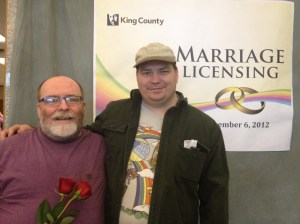
Picture taken by Chelsea Kellogg, reporter for the Stranger.
Michael and I.

For various reasons, we didn’t go to wait in line for the office opening at one minute after midnight. We each took the day off from work and headed downtown after the sun was up and we’d had some breakfast. Since one of the reasons we didn’t want to be standing around outside on a nearly-winter night with rain in the forecast was that Michael still has the cough from our recent bouts with the flu, I let him sleep in. So we got to the county admin building at nearly noon.

I spent the morning reading news blogs and looking at the pictures of couples who had been the first in line at our county and a few others that opened early. They selected some couples to go first in line, such as a sweet pair of ladies who are in their late 70s-early 80s and had been together for over 35 years. Or the two men that age who have been together more than 40. Seeing the picture of one guy pushing his husband-to-be in his wheelchair up to the counter made me cry. There were a lot of pictures like that being posted by the various news outlets.

When we arrived, there wasn’t a big line. We were pointed in the right direction by people at several points, and getting congratulated by all these people. While there wasn’t a line, every workstation was busy with couples getting their licenses. And just as we and another couple were leaving… two more couples came in. So it was at the steady stream point by then.

A reporter from The Stranger asked if she could take our picture and ask a few questions. Since I read their blog every day, of course I was willing to answer questions. The first picture in this post is the one she took.

Us again. Why do I always stand on his right?

In addition to the regular paperwork, we were given a copy of the proclamation signed by the county executive, and various other commemorative items. We were directed out a different door than the way we’d come in, and some more volunteers were there, handing out roses and taking pictures in front of a sign commemorating the first day that marriage equality was the law. They took a few of these with my camera, then one of the others asked if we wanted one of us kissing.

For whatever reason, that was when I started crying for us. All of my tearing up, getting misty-eyed, and full-fledged crying earlier in the day had been for other people. This was the one where it finally hit me in the gut: the most wonderful man in the world has not only been living with me and putting up with me for nearly 15 years, but finally we’re going to be married. Not civilly united, or domestically partnered, or any of those other names, but married. Part of my astonishment is the simple fact that this wonderful guy actually wants to be saddled with me. I mean, yes, we’ve been together nearly 15 years (it will be 15 in February), and he’s had ample opportunity to run for the hills and hasn’t. But you have to understand, I don’t completely get why he puts up with me. Seriously, there are times I can’t stand to be around me, so I know for a fact I am not easy to live with!

Fortunately, Micheal's hat is hiding my tears.
Fortunately, Micheal’s hat is hiding my tears.

And there were more people waiting outside. We were offered donuts. There were also people handing out business cards and promotional fliers for wedding-related services. That’s to be expected, obviously. And I’m not complaining. Thanks to the fliers I’ve found several possible places to rent for our reception that I didn’t even know existed.

There were no protestors, though. I had kind of expected some. There are always a few of those people with the old testament signs and such at events like the Pride parade, so I just figured they’d turn out for this. Then when we saw that the line was shrunk to the trickle, I thought that protestors had left. I didn’t find out until we were back home that the reporter was there taking more pictures, after the big lines were through, because there had been a rumor that a group was coming to protest. Apparently they never showed up.

While we were walking back to the bus stop, a random woman on the sidewalk saw the roses, looked at us, grinned, and said, “Congratulations!”

I’ve violated one of my rules and dived into the comments sections of some of those news sites posting the pictures. And the amazing thing is how very few haters are commenting there. In the ones I looked at, if there were negative comments at all, for every 1 negative comment there were easily 20 comments from people saying how happy the pictures make them feel, with lots of mentions of people needing to grab a tissue. And a number of people going out of their way to say things like, “I want to say for the record, that I don’t believe any of these couples has in any way diminished my heterosexual marriage.”

I thought I was emotionally overwhelmed when the Referendum passed, and when I thought about all those straight people who voted for it. But it feels more overwhelming now. I guess going in and getting the license finally is making it feel real.

We have a three-day waiting period. We’re going to have a simple ceremony with friends this Sunday. We’re calling this the Elopement. I want to get the legal stuff handled as quickly as possible, if for no other reason than that I can finally add Michael to the much better medical and dental at my work. So this is the legal thing. And I know some of our friends will be there, and it will be fun and happy.

But the real purpose of a wedding is to allow your extended community of friends and family in on it. I don’t just mean the celebration. I believe that what makes marriage sacred is not that two people have made a pledge before some deity, it is because a group of people have committed to support two people in their love. When I attend someone’s wedding, I’m entering into a covenant with them and the other attendees, affirming a particular loving relationship, but also affirming the power of love itself. It’s a commitment to the extended ties that bind all of us together in circles of mutual affection and respect.

Which is why, yes, we’re planning something bigger and a bit more formal later next year.

And there will most definitely be a party.

Grateful, not resentful

Many years ago, when I was either still attending university or during that first couple years after, while visiting my mom for one of the holidays, she handed me a manila envelope. “I was cleaning some things out, and I found these papers. I don’t know if they’re important, but it’s old school things I thought you might like.”

My mom is one of the people from whom I inherited my own packrat tendencies (which I have been fighting most of my adult life), so I knew if I looked at them while she was watching and decided they weren’t worth keeping, that she would retrieve them and hang onto them for years. So I always took whatever weird stuff she offered me and waited until I got home to review it.

The envelope contained about 20 sheets of paper. Two were report cards from different grades. Neither was an official end-of-term report card. Both were midterm “advisory” report cards. “Your child’s grade will probably be this if work does not change.” Most of the other papers were even less archive-worthy. Most contained no person information at all: announcements about an upcoming parent-teacher night, for instance.

But there were a couple that were revelations. There was a letter to my parents explaining that our family qualified to have a charity pay for my first pair of eyeglasses back in grade school. There were some papers related to a free lunch program during another part of grade school.

Until I read those papers, I had had no idea. I remembered, during those particular grades, that about once a month Mom would hand me a sealed envelope which I had to take to the school office, where I would be given lunch tickets for myself and my little sister. I thought everyone’s parents had to fill out a couple forms for lunch tickets. And I guess I just assumed there was a cheque in there, somewhere.

I knew that there were things we couldn’t afford. But other kids’ parents were also frequently saying, “We can’t afford that” or “When you get a job and can pay for it yourself, you can have a fill-in-the-blank.” So I didn’t think much about it. It never occurred to me that we were poor.

Of course, we couldn’t be poor! Poor people lived in shacks or in ghettos. We lived in ordinary parts of each of the small towns we moved to as my dad’s work demanded. We owned a car and a pickup truck. Poor people didn’t have jobs, or didn’t have regular jobs, anyway. They were always begging or looking for work. Or if they were “bad, lazy poor people” they were always waiting for their next Welfare cheque. My dad had a job. He’d been working for the same company for as long as I could remember, so we couldn’t be poor. We just weren’t rich, that’s all.

Certainly by the time I was in High School I had a much better idea of the broad spectrum of economic status that families inhabited. I understood that most of my childhood my dad had been “working class” rather than true middle class. But I also knew that the old lower, middle, and upper class division of economic status was a gross oversimplification.

And somehow, I had never figured out that we had taken assistance. I think the shock was mostly because of how hotly my dad frequently ranted about the evils of people who depended on charity. The almost stereotypical way he sneered at programs like welfare and food stamps because they “took money from hard working people.”

That attitude, which was frequently echoed by other adults in my community—especially at church social functions—had always seemed weird to me. During Sunday School lessons or the Sunday sermon, we would be taught that Jesus expected us to feed the hungry, clothe the poor, and take care of the sick. Yet at the church potluck, people who actually took handouts were talked about almost as if they were in league with the devil.

Why the resentment? Everyone needs help some time. There should be no shame in needing a hand of any kind (I hate that cliche about hand-up vs handout) once in a while. The proper response to getting a little help is gratitude. And the proper response when you have been the one helping, is to tell the person, “if you want to pay me back, just promise when you see someone else who needs help, you’ll offer what you can.”

Resentment and condescencion corrupt and destroy the soul, leaving only emptiness behind.

Gratitude and charity do the opposite.

So, go feed your soul.

Get me to the church on time!

One of my favorite scenes in the movie Jeffrey is where a priest, played by Nathan Lane, explains to the protagonist that the protagonist’s ideas about god came from the album cover of the original cast recording of My Fair Lady. He further claims it’s where most gay men got their notions about god.

My Fair Lady Original Cast AlbumHis reasoning is: most parents in the 50s and 60s had a copy of the album*, most gay kids went through at least a phase of listening to musical soundtracks (and even if they didn’t, they all at least saw the cover art), most kids didn’t realize that the man in the clouds on the cover art manipulating the stars like puppets on strings was supposed to be George Bernard Shaw (the man who wrote the play upon which the musical was based), they believed it was god. “It was your parents’ album. You were little. You thought it was god!” Then he goes on to explain that god doesn’t run the world like that.

Part of why that scene cracked me up is because I did go through a phase of listening to the soundtracks of musicals—musicals that in many cases I had never seen. I’m not completely sure why my folks owned several sound track albums, but they did. I do know that my mom had a tendency, if she saw a movie adaptation of a musical, to buy the original broadway cast album instead of the movie album. Anyway, My Fair Lady was one of those albums that I listened to a lot as a kid, but I had never seen the show.

I wound up making up my own version of what happened between the songs. I also imagined my own versions of the choreography and costumes, guided by whatever photographs were part of the album cover, or in some cases, versions of the songs I’d seen on TV. There were a lot of musical variety shows on the air when I was a kid, and stars of movies and broadway shows would often be guests on the variety programs, and might perform a version of (or parody of) a scene from the musical, with regulars from the variety show filling in for various characters.

So in my head, the song “Get Me To the Church On Time” was not primarily about the wild last night of partying that Eliza Doolittle’s long-widowed father wanted to have before he married in the morning. I didn’t know enough of the play to know the context, for one. I think the album only identified the character as “Alfie” so I had no way to know he was supposed to by Eliza’s father. The lyrics talk about having a whopper, and kicking up a rumpus, but somehow I thought it was about celebrating the marriage itself—partying because he was overjoyed to be getting married, rather than a last night of debauchery because he would never be having fun again.

It was also about all the people around him, friends and strangers alike, joining in on the joy and exaltation.

It’s that imagined version of the song and dance that kept popping up in my head last Tuesday night as I saw that Marriage Equality was winning at the ballot box. It was that image of friends, family, neighbors, and complete strangers shouting “hurray!” that came to mind as I thought of the hundreds of straight people who manned those phone banks—calling strangers and patiently explaining that the law explicitly exempted churches and religious institutions from performing same sex marriages (not that the law needed it, it’s already established in other laws and court decisions; churches can choose to turn away opposite sex couples for whatever religious reason they want, too). The thousands of straight people who donated to the campaigns. The thousands of straight people who urged neighbors, co-workers, and family members to give equality a chance. The hundreds of thousands of straight people who voted that way.

Depending on which statistics you believe, gays and lesbians make up somewhere between 3 and 10 percent of the population. There’s no way we could have voted this in for ourselves. There’s no way we could have handled all of the ground game: the canvassing, the pamphleting, the phone banking, and so on.

It was my imaginary version of “Get Me to the Church on Time” that was playing in my head when straight friends told me, “I thought of you and Michael while I was filling out my ballot.” It was the soundtrack to the images I saw on TV of the straight couples joining in the party at the campaign headquarters on the news.

It’s what comes to mind when I re-watch the tearful speech of the straight, Republican state senator explaining why she was voting for the law that kicked this off last spring. Or when I read stories of the way, the last few years, many straight couples have taken a moment in their wedding ceremonies to acknowledge that they have friends and loved ones who are denied the right to choose to enter this important institution, and asking their guests to join the fight for equality.

Yes, part of the reason there were tears in my eyes on Tuesday night when I saw the news that marriage equality had won in Maine, and then in Maryland, and that it was leading in my home state of Washington was because I’m looking forward to finally getting to marry (rather than “domestically partner”???) Michael. But that was only part of it.

The rest of those tears of joy was the realization that a majority of my fellow citizens–not just my fellow homos, or my friends, but a bunch of people who don’t know me–has our back.

Thank you.

And I hope you all get invited to a lot of weddings, because you deserve to celebrate with us.

UPDATE: I started this the morning after Election Night. Because of craziness at work, I didn’t finish it until a day later. And I didn’t see this column by Dan Savage on the same topic until Thursday night. His is definitely worth a read.


* Remember, Jeffery is a comedy, it’s not a real statistic.