Tag Archives: writing

Hit the word count again, but…

nanowrimo_2016_webbadge_winnerMy NaNoWriMo project this year was to fix the gaping plotholes in two novels that I had decided to split apart from a previous NaNoWriMo. I had decided that there were just way too many subplots for one novel, and the fact that for at least three-fourths of the original 105,000 word draft that there were a bunch of the characters who never interacted with the others until the end, led me to try separating it.

But it wasn’t a matter of arbitrarily breaking it in the middle and trying to write something that would feel like climax but still lead into book two. The first two-thirds of book two happens at the same time as the entirety of book one, and then all the characters from book one start coming into the main plot of book two. Also one of the sets of subplots came together in a big battle (it’s a light fantasy in an epic fantasy wrapper, so there are battles) in the second half of the original rough draft made the book feel as if it had two climaxes, so trying to turn it into two books made sense.

Anyway, I had second drafts of two related books that didn’t work and had a some missing connective bits, so I made that this year’s project. Existing scenes that required a major re-write were counted in this year’s word count along with completely new scenes. And I hit the 50,000 mark, and have at least improved things, but I don’t feel as if I’ve actually fixed the plot problems. Which was what I had hoped for.

I don’t really have a conclusion. I know my productivity went way down after the election, and I haven’t really gotten back into a good space where I’m being productive and liking what I write.

Just keep writing, just keep writing, cry when you need to, just keep writing

“Shut up and write the book” Detlef Schluchter @D_Schluchter
“Shut up and write the book” Detlef Schluchter @D_Schluchter (click to embiggen)
A couple of times this week I’ve been tempted to write a blog post about the struggle I’m having with my project for National Novel Writing Month (NaNoWriMo), but then decided that was a procrastination trap and worked on the books instead. I seem to be back on track wordcount-wise, so that was probably a good call.

I’m still very worried about the future of the country, and yes more than a bit about my future and that of a lot of people I know and love. Brooding, worrying, researching, and chatting online last week didn’t help. Meeting some of our friends Saturday night and getting to vent and worry a bit together, but more importantly to commiserate and other wonderful things that friends do for each other helped me incredibly. Seeing more friends Sunday helped even more.

I’m also not going to discount how much help the unexpected crying while walking home from work on Monday provided. Keep in mind my walk takes a bit over an hour, and for more than half of that I couldn’t stop crying. Exercise and crying, I wholeheartedly endorse it!

http://qz.com/839234/barack-obama-trumps-win-was-a-tough-loss-for-democrats-but-hes-still-fired-up-to-fight/
Seeing this message from President Obama helped, a lot. I had already privately given myself a deadline of getting over the moping by the end of this week. With the help of wonderful friends, I’m getting there.

Now, I have these books to finish, so I better shut up and write!

I am a writer, have pity on my husband

I had a plan last night to attempt to try to deal a bit with my current doldrums. I’m sure that it’s a combination of my usual sort-of seasonal depression (starts most years around the time I realize it’s nearly Ray’s birthday and running until about the anniversary of his death), the shock-dismay-disappointment of the election, the other unrelated uncertainties (our landlady has sold the building and we may have to move when our lease is up), and my frustration with the projects I’m trying to finish during NaNoWriMo.

The plan was an old standby that has helped many a time before: pick one of the movies in our collection that I know will make me cry a few times, snuggle up under a blanket and watch it. It’s amazing how having a really good cry helps getting me back on something approaching an even keel.

So that was the plan. I left the office and began the walk home. I drilled down in the vast collection of playlists on my phone to find one I hadn’t listened to in a while. It started with Beyoncé’s “Halo” and jumps around in genres after that. I picked it primarily because I hadn’t listened to it in long enough that I didn’t remember what all was in it, to be honest. I didn’t expect that when the Al Green version of “How Can You Mend a Broken Heart?” came up that I’d start crying while I was trying to walk home.

So there I was, walking along, bawling my eyes out at least half of the walk home. It didn’t feel as cathartic as the good cry over a movie by any means. So I was still planning to do the movie thing when I got home.

But I got there and my husband was pulling beef ribs out of the oven that he had cooked until they were falling apart. And while I ate I was scrolling through the database of our movies we’ve got ready for streaming, and chatting a little bit online with a couple of my NaNoWriMo buddies and I just couldn’t pick a movie. And I was feeling exhausted.

So I curled up on the recliner and took a nap. I was afraid it was going to be one of those depression naps: where I sleep until the wee hours of the morning and wake up, not feeling any less depressed, but too awake to sleep and knowing that I wouldn’t feel rested when it was time to get up for work because I would stay up the rest of the night unable to sleep.

What actually happened is I slept for just over an hour. I felt like writing when I woke up, so I did. And by the time midnight rolled around, I’d written a bit over 1800 more words on my novels, and had some confidence that maybe I had sorted out the plot things. My husband was in bed asleep by then, so I put things away, turned out lights, and went to bed.

I don’t feel much better this morning but I feel less worn out and unmotivated. I thought I had about a half hour I could spend writing a blog post about where I was at, maybe talk about the plotting issues or something, but first I did a quick check of social media, where someone was sharing this from Schreibblockade offiziell, a blog by Lenia Roth:

© Lenia Roth http://official-schreibblockade.tumblr.com/post/152069773859/deep-sigh
Which says the writing stuff I was mulling over more succinctly. Plus I haven’t recommended another blog in a while, so I can take three or four birds with one stone which is even better than the usually proverbial rock tossing, right?

So, go check out the cool cartoons, commentary, and other stuff on Schreibblockade offiziell, and let’s all try to have a better day.

(And I still may pull out one of the tear-jerker movie some night this week.)

It’s NaNoWriMo time again!

nanonovemberbanner

I’m participating in National Novel Writing Month (NaNoWriMo) once more. If you don’t know what that means, let me quote their website:

National Novel Writing Month (NaNoWriMo) is a fun, seat-of-your-pants approach to creative writing.

On November 1, participants begin working towards the goal of writing a 50,000-word novel by 11:59 PM on November 30.

There are rules, but for years I participated as a Rebel, until a few years ago when they dropped the one rule that kept making me a rebel.

  • Write one 50,000-word (or longer!) novel, between November 1 and November 30.
  • Start from scratch.
  • Write a novel. We define a novel as a lengthy work of fiction.
  • Be the sole author of your novel.
  • Write more than one word repeated 50,000 times.

It used to be that you were supposed to begin with a total blank page (or empty word processor file) and not type any words of the actual novel before November 1. Now the new rule is that you only count the words you actually write during November in your total. So since I was usually working on finishing or revising an existing piece, I was a rebel.

This year I’m being a rebel again because I’m working on finishing two novels started previously. I’m writing new scenes in a separate file to handle the word count. If I substantially re-write an existing scene, I’ll copy it over to that file to keep track of the words, but if I’m just tweaking a few things, I won’t.

One of the coolest things about NaNoWriMo the last few years is that the makers of Scrivener, which is in my not-so-humble opinion the best writing software out there (for macOS, Windows, and iOS), make a special trial version available free for the duration of NaNoWriMo plus seven days. So if, at the end of the month, you decide you don’t want to buy the software, you can still export your work to a format that is readable by other (inferior) word processors.

You can download this special trial and a custom NaNoWriMo Novel template here.

The NaNoWriMo template is like the ordinary novel template, except that it contains links to free video tutorials, and it contains a macro that will output your novel in a scrambled plain text form if you are paranoid about uploading your piece to the word-count verifying function later in the month.

Scrivener is not merely a word processor. The folks who make it (and it’s a very tiny company of, last time I checked, five people) describe it as a complete writing studio, or a content generation system. Scrivener has projects rather than single files. you can add scenes or chapters, move them around, view them in a summary mode where they look like index cards, and so on. Each project also has a research binder where you can save all your notes and scribblings and other supporting information. It’s all kept in the project, but won’t appear in the final product when you publish the manuscript in all the supported formats (including epub, of course).

One of my favorite features is that, from within the Research binder, you can select an “Import web page” function. Paste the URL of the page in question, and Scrivener will go out, copy all the text, images, links and so forth, and make it a “page” in the research binder or your project file. It’s not a link, it’s a complete copy. So if the web page goes away, you still have all the information from the page. This is really handy when you’re doing research on the web.

Scrivener is an awesome program that I’ve been using for years, and on top of all this content management and publishing functionality, it only costs US$45. That’s full price. You don’t have to pay full price! If you download the NaNoWriMo trial (either Windows or Mac version) and set up a NaNoWriMo account, at the end of the month you can buy it for a 20% discount, no matter whether you finished your 50,000 words or not.

If, however, you do finish the 50,000 words and upload and get verified, they’ll send you a code that lets you buy Scrivener at half price. When I first started using the older version a few years ago (not as part of NaNoWriMo, I’d simply read a review of the software somewhere), after just a week of the free trial I decided that the full price was a bargain, and I have never regretted it.

I’ve only used the Mac and iOS versiosn. I have a couple of friends who regularly use the Windows version and they like it a lot.

I really love Scrivener, can you tell?

There are some other special offers for NaNoWriMo participants, if you’re participating, you might want to check them out.

The only tools other than Scrivener on the sponsor offers page that I’ve used is Aeon Timeline and Evernote. I have found Aeon Timeline very useful for charting out the events of the world I have created for my series of fantasy novels. Evernote was useful for taking notes in various places and having it available on my other devices, but I don’t find it suitable for serious writing. They also no longer support free access on an unlimited number of devices, you have to pay a subscription to get that.

Anyway, whether you’re doing NaNoWriMo or not, if you’re a writer, I can’t recommend Scrivener enough. You can get the NaNoWriMo trial version at the link I shared above, or if you don’t want to be bothered with NaNoWriMo, but the tool sounds interesting, their ordinary 30-day trial version is here.

gravitarEither way, let’s get writing!

No one else can tell the stories I have to tell

“Don’t forget, no one else sees the world the way you do, so no one else can tell the stories that you have to tell.” — Charles de Lint
There are lots of stories boiling over in the real world that I have strong urges to comment on. Some of them are about Facebook’s advertising platform violating the Fair Housing Act, some are about the FBI director violating the Hatch Act, some are about inappropriate use of force against protestors who happen to be racial minorites while white armed criminals are acquitted, and so on. All of those stories are important, all of them involve real people and real harm, and all of them are worthy of some consideration.

But part of the reason I filled out my ballot as soon as it arrived (and let me just say again that I am so happy my state went all mail-in some years ago) was in hopes that I would stop obsessing quite so much at all the outrageous things going on in the world. I have a couple of important writing goals to finish before NaNoWriMo starts. I have hefty writing goals for NaNoWriMo itself. This is the third year in a row that one of my goals for the year is to spend less time and energy being outraged and more time writing and enjoying life.

This horrible year just keeps getting me wound up so much that some days I can’t seem to get anything done. And I’m not the only one (don’t just read Scalzi’s post, take a few moments to read the moderated comments to that post).

It’s not just about deadlines. I have stories to tell, stories I think need to be told… Continue reading No one else can tell the stories I have to tell

Trust the reader to keep up

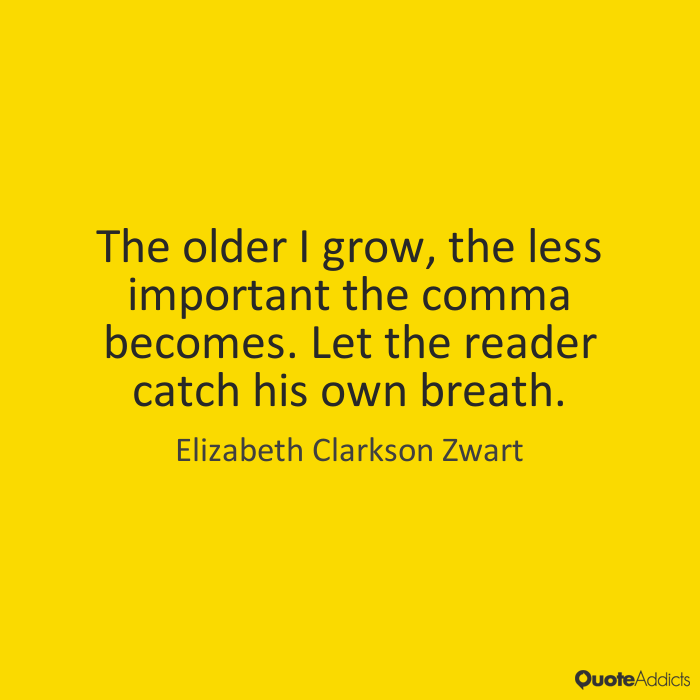
“The older I grow, the less important the comma becomes. Let the reader catch his own breath.” —Elizabeth Clarkson Zwart
I don’t like expository dumps.

An expository dump (or info dump) is a “a very large amount of information supplied all at once, expecially as background information in a narrative.” That’s a rather academic definition, and like most language definitions, it contains subjective terms. Exposition is simply text that explains something. Narratives need a certain amount of exposition to work. What I object to is large chunks of explanation that stops the action of the story. For example, a few years ago I wrote about a fantasy novel I stopped reading because the third or fourth chapter of the book consisted entirely of one character lecturing another about the history of the world. That’s sloppy writing, at best.

I don’t have anything against exposition, per se. There’s a lot of expository writing in some of my favorite novels. Just earlier this week, for instance, I was reading in Nisi Shawl’s novel, Everfair (which is a non-eurocentric steampunk novel, so far), a description of a small train. The description gave us some hints of how the fictional world’s technology differs from our own history, gave us a sense of not just the look of one of the supporting characters, but his personality, and also had hints about the social strata of the country which the viewpoint character was visiting. But this wasn’t a long passage. It was only two paragraphs. And rather than prattling on for pages about the history of the country, it gave us a few tidbits of information from which we could infer more. And it isn’t just description. Something is happening: a supporting character is arriving to some anticipation of the viewpoint character.

In my own writing you will find very little exposition. To me, the heart of any story are the triumphs, failures, hopes, and fears of the characters moving through it. Yes, I’ve done a lot of world building. If you ask, I can go on an length about all sorts of things in the history of the fictional world where my fantasy novels are set. I have to know all of that stuff to tell stories. But most readers are interested only in a fraction of it.

No one wants to read a scene in which one character prattles on about how ten years ago when the previous emperor died, a group of traitorous nobles assassinated several of the heirs in an attempt to grab the throne for themselves, including the motives of each of the conspirators, who died and who survived. When it was important to the plot I’m writing now, I had one character mention “the succession crisis in the capitol year ago.” There was another point where that history was relevant to the reason one character was hostile to another, and was able to have just a few lines of the argument between those characters give a few more details. But those lines also moved the plot point that was happening right that moment along, and gave the reader some insight into the personalities of the two arguers (as well as a couple of other characters who were trying to get them to stop arguing and deal with the problem at hand).

I do that because I trust that readers are smart enough to put pieces together and build their own picture of the world. I don’t need the reader to visualize exactly how the stitching on a character’s clothing looks, or the precise shape of the filigree on a particular piece of furniture, or to keep track of which pillows are round and which are square in order to follow the story.

If I wanted to tell the story of the succession crisis, I would make the crisis itself the story. I’d pick one of the characters involved as my protagonist and tell the tale. But if it’s backstory, we don’t need all the details. Sure, it’s handy to know that in the present timeline, one particular vampire-like character was one of the failed conspirators who was cursed by someone who loved one of the murdered heirs (hey, it’s a fantasy universe, why can’t we have a good curse every now and then?). That tells you how the character wound up an evil parasitic undead, and gives you some hints as to how trustworthy he is going to be to his alleged allies in the current story. It may also help the reader understand his motives at later points in the tale. But I was able to convey that in a couple of lines of dialog and keep moving on with the current tale.

Not everyone is as comfortable without all the details as I am. I understand that. And there’s a part of me that always worries that I haven’t given readers enough clues. So sometimes I do something like write a whole chapter worth of flashback, which I read and re-read and argue with myself about whether it’s really needed and do I really want pull the reader out of the current story.

And eventually I usually figure out that if I tweaked some dialog over here, and add a small scene where two characters who weren’t aware of the past events find some of the aftermath, and realize that yes, I should trust the reader to figure it out and move those flashbacks over into my big file of background information that the reader is never going to see.

Because part of trusting the story is trusting the reader to not just to follow it. I want the reader caught up in the story I’m telling right now. I want the reader turning the pages as quickly as they can, breathlessly asking, “And then what happens?”

Little things can make or break your story

“The best writing is re-writing.” — e.b. white

The other night I assembled an Aviation cocktail for the first time. It’s a drink my friend, Jared, likes, so I texted him a picture of my first attempt. It’s made with gin, maraschino liqueur, crème de violette and lemon juice. I’d followed a recipe out of a bar book. When I commented that it didn’t taste as good as I remembered, he suggested his own recipe, which differed from the book very slightly. Specifically, he suggested 1/2 an ounce of lemon juice rather than 3/4 as the book. That was the only difference.

I tried it, and that tiny change made a major difference in the taste. And not in the way I had expected. The drink tasted slightly less sweet with a bit less lemon. Two of the ingredients are very sweet, whereas lemon juice is generally more tart, so I don’t know if it was just a contrast change in the mix or what, but the tiny adjustment made a big improvement.

I’ve been struggling with the revision of my novel, The Trickster Apocalypse for a while. After working on the first draft for a long time, regularly reading chapters to my monthly Writers’ group, I had revised and assembled the whole thing, and gotten three people to agree to read it all the way through. There had been some common comments from all of them regarding some frustration with the protagonists or inconsistencies in their characterization.

So I’ve been re-reading and revising. I recently shared two new scenes and one heavily revised one with two of the readers and my group, and there was a consensus that these little revisions changed their perception of the main plot and one subplot significantly.

I’ve described the novel as “a light fantasy in an epic fantasy wrapper using anthropomorphic tropes to tell how reluctant and unlikely heroes try to avert a prophesied apocalypse.” As a light fantasy, certain things happen in the story because they’re funny. It was easy, especially when I was working on the first draft and reading it to others in a serialized fashion, to pepper in jokes throughout. People laughed when they read the scenes, so that seemed like a good thing, right?

But when someone read the whole thing in un-serialized circumstances, a couple of the jokes late in the book subverted the emotional arc of at least one of the protagonists. It’s not that I can’t have jokes late in the book, but I can’t show one character’s emotional journey from reluctant to get involved to taking a stand in a big showdown if I keep showing ways that he is trying to dodge responsibility. A scene that would have been funny and in character in chapter four doesn’t work in chapter seventeen, after the reader has watched the character start growing beyond that.

The scene is funny, which is good in a light fantasy, but any scene in a novel needs to either advance the plot, establish or resolve a conflict, illuminate a character, show how a character has changed, reveal new information to the reader, or hit an important emotional beat. It’s not that the scene has to go, but every scene, particularly jokes about the protagonist’s character need to move the things forward, not back.

I should have realized during an earlier revision phase a couple of these developments were actually throwbacks to earlier versions of the character. I didn’t in part because in a couple of cases the jokes were working so well, I wanted to keep them in. When people repeat the classic writing advice to “kill your darlings,” it isn’t because your favorite lines or sequences are always bad, it’s because that sometimes, because some bit is a favorite, it blinds us from noticing that it’s wrong for this scene or this stage of the story.

Removing a single misplaced joke can change the taste of the entire tale.

Wrestling the bear: getting to the end of your novel

“Writing a book is like wrestling a bear. Some days you're on top. Some days the bear's on top. And some days the bear is on top, dancing around the room, ordering lattes.”—Neil Gaiman
“Writing a book is like wrestling a bear. Some days you’re on top. Some days the bear’s on top. And some days the bear is on top, dancing around the room, ordering lattes.”—Neil Gaiman
Writers approach writing in different ways. When I’m on writing panels at conventions, I try to slip in the disclaimer that no one can tell you how to write. All I (or anyone else) can do is tell you how I write. What works for me might not work for you. I can also give encouragement, share some tricks and techniques that other writers have shared, I can share certain abstracted observations about technique or perception, or I can be a sounding board when you’re trying to sort a scene or story out. But everything I say (even though I may sometimes say it very emphatically) is ultimately a suggestion. If it works for you or helps, great. If not, I’m sorry.

The way your brain works will not be precisely the same as mine. What motivates you will be different than what motivates me. The problems and plotholes and stalling points in your story will be different than in mine.

In short, each of us is wrestling a different bear. But that doesn’t mean we can’t help each other out… Continue reading Wrestling the bear: getting to the end of your novel

The first draft is always… well, a draft

“You might not write well every day, but you can always edit a bad page. You can't edit a blank page.”—Jodi Picoult
“You might not write well every day, but you can always edit a bad page. You can’t edit a blank page.”—Jodi Picoult
It’s a sentiment that many writers far more accomplished than I have expressed over the years: “You might not write well every day, but you can always edit a bad page. You can't edit a blank page.” I’m quoting Jodi Picoult in this instance. And she’s right. It is better to get something written down, even when you think it’s horrible, than not to write anything at all. It is much easier to revise a completed story than it is to write the story to begin with. And it is also true that no one, no matter how talented, experienced, or inspired they are, writes wonderfully every single time they sit down to write.

But while the sentiment represents the truth, it is not the whole truth. Not by a long shot… Continue reading The first draft is always… well, a draft

Don’t waste the reader’s time: avoiding the one-way street

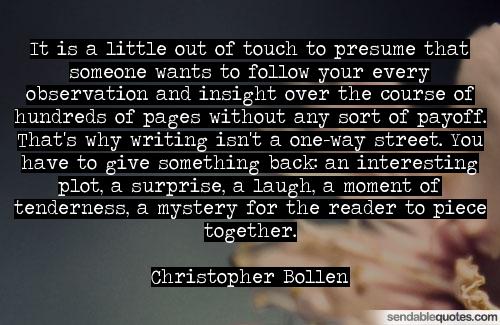
“It is a little out of touch to presume that someone wants to follow your every observation and insight over the course of hundreds of pages without any sort of payoff. That's why writing isn't a one-way street. You have to give something back: an interesting plot, a surprise, a laugh, a moment of tenderness, a mystery for the reader to put together.” — Christopher Bollen
Christopher Bollen explains that writing isn’t a one-way street (click to embiggen)
There was a lot of talk on social media this week because a group of jerks harassed the writer of an episode of a television show about said episode until the writer deleted their social media accounts. And it was harassment, not critique. You can be unhappy with a story, you can dislike it, you can even tell other people you don’t like it; but that doesn’t mean you can make ad hominem attacks on the writer, threaten the writer and their family, hurl bigoted slurs, and so forth.

Similarly, you can be unhappy with a story because you feel the story is reinforcing sexist, or homophobic, or racist, or ableist myths. You can call out the problem when a story pushes that agenda. You can express your disappointment. You can organize a boycott. But again, pointing out problems in a narrative should not turn into harassment of the people involved.

In this case it was actually two hordes of idiots harassing the writer. One group were angry because they thought the writer was pushing a relationship between two characters they didn’t want together. The other group were angry because the relationship wasn’t going where it had “clearly” been implied it was going.

Readers aren’t the only ones who can be jerks. Writers can disrespect their audience; they can make mistakes, abuse the reader’s trust, they can cheat and exploit their audience. Which isn’t to say that the writer owes any reader or group of readers a specific outcome, or a particular plot resolution. But as writers we must always remember Niven’s Law for Writers: It is a sin to waste the reader’s time.

In the simplest sense that means that as writers we owe the reader our best professional effort. We tell the story as best we can. No story and no draft will ever be perfect, so we can’t get hung up on revising until it is, but we don’t turn in a half-assed effort.

I want to make a brief digression here. Most of my fiction writing and publishing has been in small press and amateur publications. Occasionally, when as an editor I have given writers aspiring to those publications feedback and requests for re-writes, a writer has pushed back. “You can’t hold me to professional standards, I’m not getting paid!” I didn’t quibble over the fact that technically, because we were giving them free copies of the publication if we used their story it meant they were getting paid, instead I said, “I’m publishing to professional readers. They pay for the privilege of reading my zine. And even though what they pay barely covers the costs of printing, and doesn’t provide any monetary compensation to you, or me, or the copy editors, or the layout specialist, the reader is still paying.” Of course they didn’t have to make re-writes if they didn’t want to. But if they didn’t, I wasn’t going to publish the story, because I wasn’t going to ask my readers to spend their time or money on a story I didn’t think was ready.

To get back to what we mean when we say it is a sin to waste the reader’s time, in a deeper sense that means playing fair. If there are mysteries for the reader to try to solve, you can’t withhold information. Obscure it amongst a bunch of other description? Sure. Distract the reader by dangling a red herring in the same scene? Also perfectly reasonable, but you can’t simply not show the reader vital information.

Also, don’t spring surprises on the reader merely for the sake of shock. It’s easy to think that surprises and shocks and twists are the only way to create suspense, but that’s wrong. Suspense happens when the reader cares about your character. If you create characters the reader identifies with and cares about, you can create suspense out of anything that the character cares about. You create that caring by treating the reader with respect and showing the reader the hearts of your characters.

Don’t lead the reader down a painful emotional path without giving them a pay-off. If you make the reader care about the protagonist and then allow the reader to see a horrible thing happen to the protagonist, don’t skip past the messy emotional fallout. You don’t have to show blood and gore—often graphic descriptions of violence are more boring than engaging—but show us how the bad thing affected the characters. Let the reader experience their sorrow or anger or triumph. Don’t skip that to get to the next plot twist.

When you tell a story, you are asking the reader to give you their time and attention. Make sure that the journey your tale takes them on is worth it.

“It is a little out of touch to presume that someone wants to follow your every observation and insight over the course of hundreds of pages without any sort of payoff. That’s why writing isn’t a one-way street. You have to give something back: an interesting plot, a surprise, a laugh, a moment of tenderness, a mystery for the reader to put together.” — Christopher Bollen