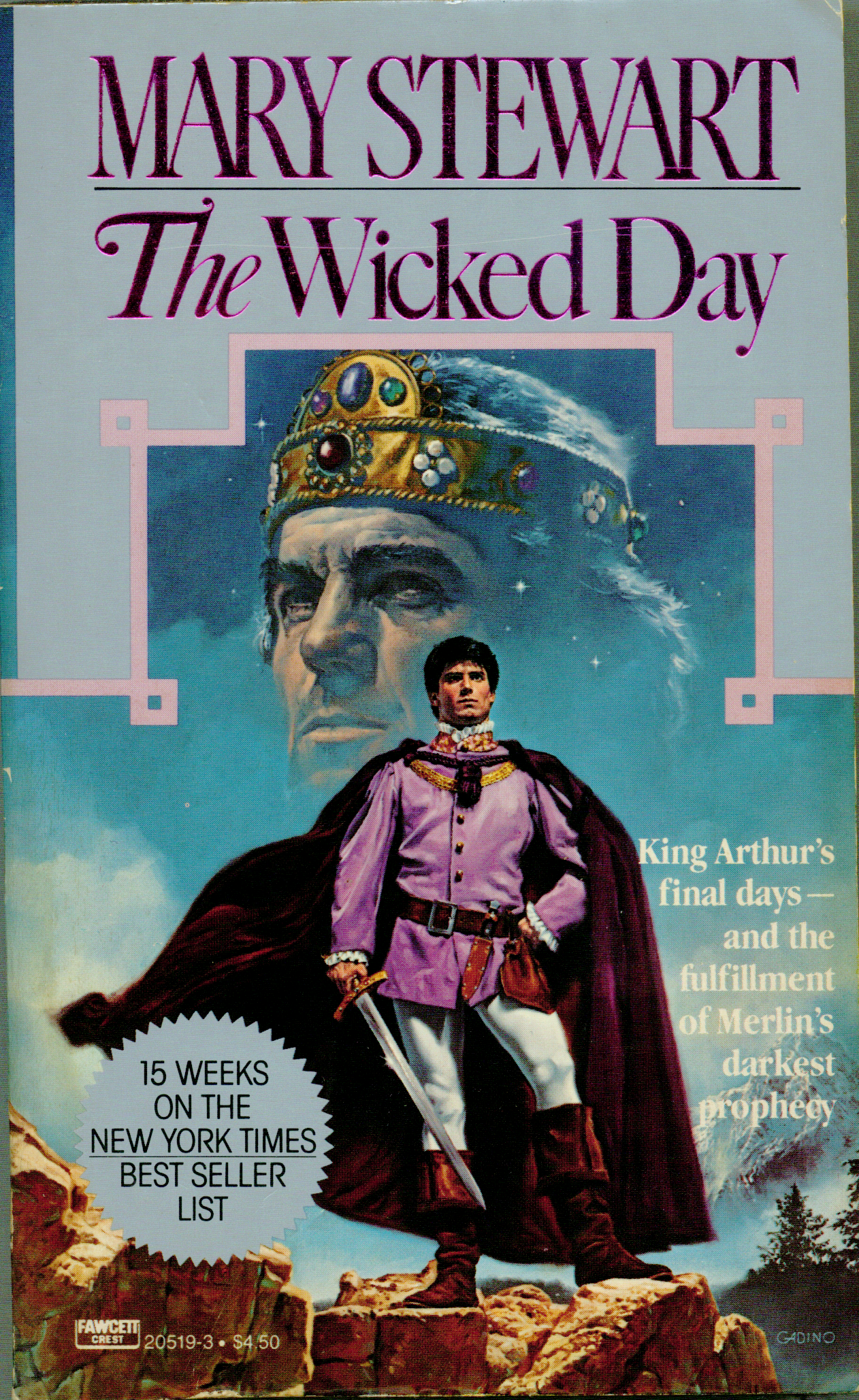
A scan of my own copy of The Wicked Day, by Mary Stewart, purchased back in 1983. (Click to embiggen)In the last two weeks I have written about the first three books in Mary Stewart’s Merlin series. The first three books are first-person narratives told from Merlin’s point of view, while the fourth book is told in third-person, mostly from both Mordred and Arthur’s points of view. Part this choice was necessitate by the fact that the crucial parts of Mordred’s story happen after the death of Merlin, so Merlin can’t narrate it. And if you’re familiar with the classic Arthurian legend, you know that both Mordred and Arthur die at the same time, so neither of them could be the narrator.
Even within the third-person narrative, Stewart shifts perspective. The opening of the book is told in an omniscient viewpoint, the narrator revealing the thoughts and feelings of all the characters. While the bulk of the book is subjective, in some chapters the reader is privy to Mordred thoughts but sees all the other characters through his eyes only. In other chapter’s we are in Arthur’s perspective. Then at the end, she moves t a more objective viewpoint, though not fully omniscient. Anyway, I’m spending so much time talking about this viewpoint stuff, which you might be inclined to think of as the mere mechanics of writing, because in a completely different sense, The Wicked Day is all about viewpoints. Several important plot points turn on the fact that one or more characters is operating on incomplete or completely mistaken understanding. And the theme is about perspectives…Continue reading Dark Prophecies and Evil Half-brothers – more of why I love sf/f→
Yesterday I wrote about queer invisibility in movies, television, books, and other forms of cultural expression—specifically why being annoyed at us for trying to find hints of our existence in such things contributes to the culture of oppression. Comprehending that requires understanding decades of discrimination, the consequences of straight male privilege, and finding a way to empathize with people who have lived with the alienation, rejection, and oppression that results from the aforementioned discrimination.
Which can make the whole thing seem overwhelming.
But each of us who creates art and stories can contribute to the solution. Queers aren’t the only ones who are marginalized—or excluded completely—from most stories. And no writer is immune. For example, many years back at my monthly writer’s meeting I was receiving feedback on a chapter of a book I was writing. Another member of the group asked me why there were no women in the book. I’d read a number of chapters by that point, and it just seemed odd to her in a story where my protagonist was a middle school student that there had been no female characters, at all.
Ah, love!I was having a discussion about a movie with some friends on line, and two of us were commenting upon the possible romantic relationships between some of the characters. Because one of the pairs under consideration were two male characters who had not explicitly been portrayed as non-heterosexual, another friend in the conversation commented that he never understood why people do that.
At the time, I decided to keep the conversation light, and simply said that we saw it because it was obvious. The real answer is a lot more complicated and serious than that. I didn’t feel up to explaining the unconscious homophobia underlyng the very question, and sometimes, frankly, I’m just tired of being disappointed in people.
But the problem persists, far beyond the people involved in that conversation. And yes, it is a problem, a very real and serious problem. What is the problem, you ask? Some people say the problem is invisibility or cluelessness, but…
In this way the writer can present his cowardice, laziness, and lack of imagination, as artistic integrity. “I couldn’t write gay characters; I didn’t have any.” Hand-to-forehead; the tortured auteur.
—Andrew Wheeler, writing for Comics Alliance
It’s actually about erasure and willful blindness. As I’ll explain further…
When I set my goals for this year, I pledged to continue the things I thought worked last year and added some new things. One of the things that I think helped me achieve those goals was writing a monthly report on the blog on my progess. It’s a new month, so here’s the next report!
In the his first podcast recorded after the Supreme Court ruled in favor of marriage equality, Dan Savage explained how he no longer felt any urge to argue with the haters. No matter what messages they sent, no matter what outrageous thing he’d read them saying about marriage, his reaction was no longer to get irritated and start arguing. And he admitted it was a bit of a surprise. “I realized that I’m just over it. They have lost.” And listening to him, I recognized that I was feeling much the same way. I’m still annoyed that so many state and local officials are fighting it, and the BS religious liberty laws still get my dander up, but I know what he means. The court based its ruling on the Fourteenth Amendment to the Constitution. They’re done. The haters can’t win.
The Fourteenth Amendment was passed in the wake of the Civil War, and it is specifically about rights of the citizens which can never be denied by states. The entire point was to try to prevent individual states from denying fundamental rights to citizens under states’ rights claim. No matter what argument they put forward, eventually a Federal Court is going to look at their case, will point to Justice Kennedy’s ruling, and will order the county or the state or the judge to comply. They’re done. It’s over. I find I don’t feel the slightest urge to click on headlines about some clerk or some judge or whoever refusing to issue licenses. I was reading them during the first week or so after the ruling, but my righteous indignation has moved on in regards to that specific issue.
Not everyone has. I get reminded of that every time I stray onto Facebook and accidentally see anything posted by most of my relatives. And some of the people who haven’t moved on are being complete dicks about it, angrily going off on people who have done nothing more than use the rainbow filter on their user picture on social media. Fortunately, there are plenty of people who feel the other way: Restaurant Owner Overwhelmed By New Business After Standing Up To An Anti-Gay Bully My favorite line: “food does not judge and everyone is welcome under a roof of love here!”
Meanwhile, because the Supreme Court ruling casts the right to marry as a fundamental right under the Fourteenth Amendment, Same-Sex Couples Are Securing Retroactive Recognition Of Their Marriages. Again, it’s a matter of fundamental rights that belong to everyone under the law, which means that they always ought to have been available.
Of course, a lot of people understand that the battle is over. Some of them have understood for a while, and have stopped supporting the organizations whose only mission is to take away marriage rights from queers (and before that they opposed civil unions), as well as take any other rights they can think of. As their fundraising has dropped off, they’re becoming more transparently desperate for cash: And now NOM is literally pleading with its (theoretical) supporters. Their fall has been predicted for a while now. I have had no doubt myself once the tide turned.
One of my favorite bits from the 2014 Slate article:
At every turn, NOM has played dirty, illegally keeping its donor lists secret and actively hiding its fundraising reports from ethics commissions. Its unprecedented campaigns against equality-minded judges represent a shocking encroachment upon judicial independence. And its constant barrage of ad hominem attacks against LGBTQ Americans turned a political campaign into a vicious assault on gay people’s dignity.
—Mark Joseph Stern, writing for Slate
There is an important detail that they have left out of the article: that 2.5 million dollar debt? It’s actually part of an even larger “loan” that their non-political “charity” made to the political arm a couple of years ago. The “charity” other money was raised under IRS rules that say it cannot be used for political purposes. So it’s a teensy bit unethical to loan it for political activity, though technically not illegal. Unless they don’t pay it back. Which, at the rate their fundraising has fallen off a cliff, I suspect they won’t.
It’s so bad, that when as part of his campaign finance statements made after the 2012 election ended (so after 2012), even Mitt Romney’s people felt the need to distance themselves from the donations the Romneys had made to NOM earlier. He’s not running for any office, any longer, and he’s probably the most famous living Mormon right now, so most everyone assumes he’s opposed to marriage equality, yet even he felt the need to minimize his involvement in the fight against marriage equality.
At least some people can read the writing on the wall…
It’s Friday! The last Friday in July, and what a strange summer it has been thus far! But good news, a long running copyright dispute may finally be resolved!
Anyway, here is a collection of some of the things that I ran across over the course of the week which struck me as worthy of being shared. Sorted into categories with headings so you can skip more easily:
What Walter Palmer Did Wasn’t Hunting. ” Killing a single lion in 2015 is mathematically equivalent to murdering 400,000 of the planet’s roughly eight billion people.”
(There were many, many more outrageous headlines regarding the clowns scrambling to out-bigot each over for the Republican nomination; but sometimes enough is enough.)
I couldn’t find a nice large image of the same cover art as my copy on line, so spent a while trying to scan the gold paperback. The best image I got was this one, even though you can see my hands and iPhone reflected in the cover. (Click to embiggen)Last week I wrote about the first two books in Mary Stewart’s Merlin trilogy and how they became the standard against which I measure all Arthurian stories. The third and fourth books in the series came along some time later, and consequently influenced me in very different ways.
Before I get into that, I want to remind you that voting for the Hugo Awards ends tomorrow. If you are a Sasquan (WorldCon 2015) member and haven’t completed your ballot online, do it now before the servers get bogged down with the rush. The ballot is here. If you aren’t a member, you can still buy a supporting membership to become a voter, but since processing a membership might take a while as more traffic hits the servers, time is running out!
Sometimes it feels as if my whole life consists of defending why I like something. When I was a kid, I was frequently called up to justify why I preferred reading books to playing with other kids my age. Even the notion that reading was educational wasn’t enough to satisfy some people (many of them teachers). And heaven forfend that I should mention how many times “playing” with kids my age actually meant being bullied, harassed, and ridiculed non-stop! As I got older, the kind of books I liked became the issue. “Reading too much make-believe is unhealthy!1” or “Aren’t you a little old to believe in all the space hooey?2”
My copy of Bleak House looked a lot like this one.Of course, it wasn’t just the science fiction and fantasy that set people off. If I was caught reading a book about science fact, or the hardcover of Charles Dickens’ Bleak House my grandma bought me at a library sale, or my well-worn paperback of Homer’s The Iliad, it was more proof that I was an “over-educated freak4.”
When I finally escaped to college and met people who valued reading over sports, I thought that I had left all of that behind. Oh, how naive I was! According to these literati wannabes, my tastes were quite low brow. How could I possible understand the meaning of serious art and literature if I actually enjoyed Hitchhiker’s Guide to the Galaxy or The White Dragon or Harpist in the Wind or Midnight at the Well of Souls? Or even worse, I watched television!?
It’s easy to dismiss those latter examples as either snobbery or hipster-ism. Except I can be just as guilty of judging other people for liking things that I don’t.
Who am I kidding? I have been incredibly worse about this. When I think a particular book or series or movie or what-have-you is not just unlikeable, but very badly made, it will completely boggle my mind when someone I know actually likes it. And I seem to be absolutely incapable of hiding my incredulity. I frequently have to remind myself that sometimes what I think of as one of a particular work’s mediocre-but-not-awful parts might be someone else’s fiction kink. And by fiction kink I mean, it’s something they like or identify with so much that it can be a redeeming quality. Such a redeeming quality makes the parts some of us see as glaring shortcomings, merely a small price to pay to get the other thing.
Goodness knows I have my own favorite books, series, and movies that I know are flawed, but I enjoy them anyway because they contain a particular character dynamic, or a type of plot line, or use a particular combination of mythic tropes which appeal to me. I try to make the distinction between something that I don’t like for reasons of taste as opposed to something I don’t like for reasons of actual quality. It is a subjective judgement, but not an impossible one.
I got tired of finding myself having to defend my preferred reading material. Eventually, I was saved by Leo Tolstoy. Tolstoy, the Russian author of such great classic novels as War and Peace and Anna Karenina. I have to confess that I tried to read War and Peace at least a couple of times, and just failed to plough all the way through it. And failing to get through it was one of the things that made me wonder if those people who said my tastes were too low brow to understand great works of art were correct. But then, when a similar sort of discussion happened in one of my college literature classes, the instructor5 quoted a bit from Tolstoy’s nonfiction book, What is Art? I think it was this passage:
The assertion that art may be good art and at the same time incomprehensible to a great number of people is extremely unjust, and its consequences are ruinous to art itself…it is the same as saying some kind of food is good but most people can’t eat it.
—Leo Tolstoy
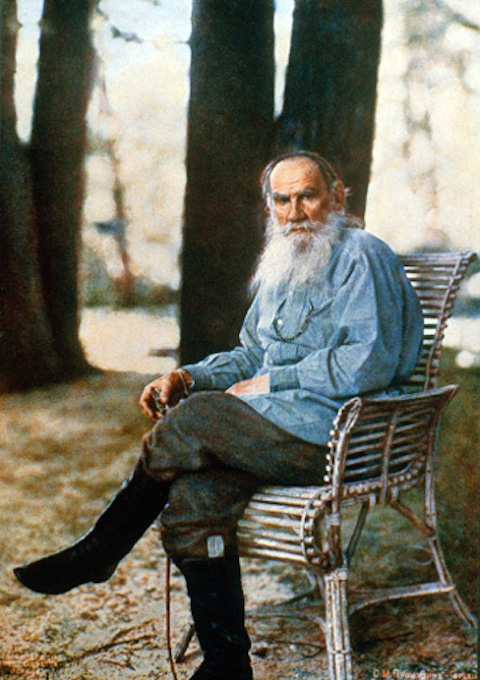
A portrait photograph of Tolstoy taken in 1908 by Sergei Prokudin-Gorsky, who had invented one of the early methods of color photography.Not long after that, I found a copy of the book in the library, which I wound up checking out and reading. There are a lot of Tolstoy’s arguments in the book which I don’t agree with. He had adopted, by the time he wrote it, a rather radical form of Christian anarchy. So he critiqued a lot of specific examples of art as being immoral in content—more often because he thought it promoted capitalism and classism than the sorts of things that get the modern religious right up in arms. He dissed Shakespeare and Dickens, for instance (though with a lot of caveats in Dickens’ case, since much of Dickens’ later work was critical of the dehumanizing effects of the industrial revolution).
Despite those parts of his thesis with which I still disagree, his arguments in favor of accessibility and sincerity in art helped me figure out that those literati wannabes had mistaken obscurity for superiority. They’ve fallen victim to the notion that if “ordinary” people enjoy something, it cannot possibly be high quality. If you define art by its difficulty to be comprehended, you’ve completely misunderstood what art is. That doesn’t mean that art can’t be challenging, but there is a difference between a piece that requires thought, afterthought, and re-visiting to tease out all the layers of meaning and something which hides its meaninglessness under layers of pretension.
Art is a human activity consisting in this, that one man consciously, by means of certain external signs, hands on to others feelings he has lived through, and that other people are infected by these feelings and also experience them.
—Leo Tolstoy
The way I usually try to sum up Tolstoy’s notion is: Art happens when the heart of the artist touches the heart of the audience, and the audience responds. The audience doesn’t have to like it; a piece of art that evokes intense dislike must be doing something right, or you wouldn’t feel so strongly about it. But art should never leave you unmoved.
Footnotes
1. The exact words said both to me (and later to my parents at a parent-teacher conference) by my seventh grade social studies teacher. He was not that only one who said things to that general effect.
2. The exact words said to me by a minister3 of another church who caught me reading during afternoon free time on a rainy day at Bible camp. Again, he was not the only person by any means to make similar comments about my penchant for both science fiction and science fact, particularly NASA.
3. Of course, this was the same preacher who thought it was funny, when teasing or disagreeing with a boy (he never would do such a thing to a girl, oh no!), to grab your pinkie, twist it into a stress position, and keep you there not only until you agreed with whatever he was trying to make you say, but that you cried sufficiently that he thought you had learned your lesson.
4. The favorite phrase one of my uncles like to use to describe me.
5. Several instructors quoted Tolstoy at me around this time. Another literature profession quoted the famous line, “All happy families are alike; each unhappy family is unhappy in its own way” but he completely misunderstood it. On the other hand, one of my mathematics professors quoted the exact same line, and then explained how the line was the perfect example of an important statistics concept. The concept is sometimes referred to as the Anna Karenina principle in honor of the Tolstoy novel from which the line comes. One way to think of the principle is this: in any system, there are a large number of ways that a given process can fail, and the only way to achieve success is to avoid every single possible failure. A successful outcome depends on every single requirement being met, whereas a single shortcoming in only one requirement can cause failure of the entire endeavor.
The Hugo trophies handed out at the 21st World Science Fiction Convention, also known as Discon I, held in Washington, D.C., 1963.First, another reminder that voting for the Hugo Awards ends on Friday. If you are a Sasquan (WorldCon 2015) member and haven’t completed your ballot online, do it now before the servers get bogged down with the rush. The ballot is here. There is still time to buy a supporting membership to become a voter, but since processing a membership might take a while as more traffic hits the servers, you want to do that soon!
I have had two topics I’ve been trying to finish a blog post on today, one kept turning into yet another a kvetch about the Sad/Rabid Puppies bloc-voting scheme, and the other is just not quite finished (which I’m kind of sad about, as it features both another Tolstoy quote and a digression on statistics). And then I read Aaron Pound’s blog post, 2015 Hugo Voting – Roundup and Review and his first few paragraphs more calmly say some of the things I was trying to say, and I figure why not just point people to his better post (and if you haven’t read his blog before, take a look around while you’re there!).
And I have to quote my favorite bit:
The worst thing that could have happened to the reputations of many of the Puppy-promoted authors is that people would read their work, and once they were placed on the Hugo ballot, that is exactly what happened.
– Dreaming About Other Worlds blog
Anyway, don’t forget to vote! And remember that buying a supporting membership to WorldCon supports not just the Hugos, but the conventions themselves! (And I’ll try to finish up the Tolstoy/statistics post in time to post this week!)
The Hugo trophy handed out at the 15th World Science Fiction Convention held in London, England in September of 1957.In his novel, Anna Karenina, Leo Tolstoy wrote, “All happy families are alike; each unhappy family is unhappy in its own way.” A lot of people think that Tolstoy was making a cynical comment about happiness, but the idea that the novel explores and demonstrates is actually that there are many, many different things that can go wrong in one’s life to make one unhappy (and you only need one of those things to happen), whereas the only way to be truly happy is to avoid each and every one of those misery inducers. I have some philosophical disagreements with the second half of that. But what got me thinking about all of this was trying to describe to a friend why I believe that specifically the Sad/Rabid Puppies are doomed to fail, based on my observations over the years of groups ranging from the anti-gay National Organization for Marriage to the Westboro Baptist Church to Jerry Falwell’s Moral Majority, and before that Anita Bryant’s anti-gay Save the Children, and way way before that Falwell’s proselytizing against racial equality de-segregation.
That’s because, while unifying social justice advocates is like herding cats because they are each outraged in their own way, haters are easy to predict because they are only happy when the people they hate are unhappy.
But I think more than enough pixels have been spilt explaining all of that. Today, let me remind you that voting for the Hugo Awards ends on Friday. If you are a WorldCon member and haven’t completed you ballot online, do it now before the servers get bogged down with the rush. The ballot is here. There is still time to buy a supporting membership to become a voter, but since processing a membership might take a while as more traffic hits the servers, you want to do that soon! George R.R. Martin posted a nice summary of why, if you love science fiction and fantasy, you should “ vote NOW.”
Both Michael and I completed our ballots this weekend. The system allows you to go back and change things if you want, and there are two categories I keep changing my mind about. I’m not certain whether or no I’ll post my final ballot. I can sympathize with arguments for either option. I’ve already said enough in my Hugo Ballot Review series of posts for a bunch of the categories to give everyone a good guess.
I should also mention that if you are a WorldCon member this year (supporting or full attending), and if you purchase an advanced pre-supporting membership for 2017, you can vote in the site selection for 2017. That deadline is August 10, but you can’t vote online. Rules require the committee conducting the vote to allow each of the groups that are bidding to host the con to audit the ballots and for ballots to be signed. So you need to do it soon enough for your ballot to arrive in the mail by August 10th (not be postmarked by August 10, but to arrive at their P.O. Box, which this year is in Pennsylvannia).
The pre-supporting membership will automatically become a supporting membership for whichever of the bidding committees win the site selection vote, so you will be a supporting member in 2017 (and if it winds up in a city near you or that you’ve always wanted to visit, it’s cheaper to upgrade your supporting membership to full membership). This also means you’ll be able to nominate and vote in the 2017 Hugos.
If you want to vote in the 2016 Hugos, you can buy a supporting membership to WorldCon 2016 (being held in Kansas City). If you do all of this, then you can nominate and vote in the Hugos every where from now on simply by buying a pre-supporting membership in the future WorldCon as soon as the e-mail comes out telling you that site selection voting for the 2018 has opened (and the next year, and the next). And you will get that email because it goes out to everyone who is a supporting or attending member for each current WorldCon. The pre-supporting memberships are usually slightly cheaper than what a supporting membership costs once the site selection vote is over.
Once you get on that train, it’s a simple matter of buying each pre-supporting membership as soon as they are announced, and then you can both nominate and vote in each year’s Hugo Awards. And while everyone is reminding everyone to vote, the only way to reduce the odds of future bloc-voting schemes succeeding is to get a much higher percentage of the people who will vote in the Hugos, to also participate in the nomination process.
I don’t want to unduly influence anyone’s voting in the site selection, but I was amused, after my husband and I had each independently filled out or ballots, we revealed to each other our reasons for voting as we did. I voted for Helsinki as my first choice because I think that Finland deserves to have a WorldCon (and I’ve always been fond of Finland because of one teacher’s aid I had in high school who was Finnish). Michael also thought Finland should get it because they have been passed over before, and added that if he wins the Lotto and we decide to go, it would be a fun part of Europe to see. We both voted for Montreal and Shizuoka (Japan) as our second and third choices because, as I put it, if finances suddenly come together for attending in 2017, Japan or Quebec should have more pleasant weather in August than Washington, D.C.
Neither of us want to go to D.C. in August.
And if Helsinki wins, all of us can put this song on continuous loop:






 Font Folly