I had something else entirely queued up to publish today, but I think this video, which I saw this morning thanks to a Towleroad post is a better use of your time:
Last Week Tonight with John Oliver: Televangelists:
Watching this, seeing the clips John plays of televangelists telling people god will erase their debt if the just charge another thousand dollars to their credit card to donate to the “church” made me angry, but also very sad. I remembered a specific family in one of the churches I attended as a child (this was about 1972 or so) who sent a lot of money to one of the television preachers because he told them if they give “with faith” god would send it back “a hundred-fold!”
They did not get any money back of any kind: no windfall, no spontaneous arrival of a big raise or whatever. What they did get was a lot more money problems.
A Kentucky newspaper, the Lexington Herald-Leader has published a rather stern editorial about the thrice-divorced county clerk who is still defying the federal court order to issue marriage licenses to same sex couples and the hate-group paying for her lawyers: Time for Davis to do her job or resign. I’m just going to quote the main point:
Rowan County Clerk Kim Davis has chosen to prolong her moment in the limelight by defying a federal judge’s order to issue marriage licenses to legally qualifed people who apply for them.
U.S. District Judge David Bunning kindly but firmly told Davis Wednesday that in our system her religious beliefs don’t trump the rights of the taxpayers who pay her almost $80,000 annual salary. Sharing Davis’ glow is Liberty Counsel, which describes itself as a nonprofit that provides pro bono legal representation related to “religious freedom, the sanctity of life, and the family,” funded by tax-deductible donations and grants. In 2012 those gifts reached just over $3.5 million and in 2013 topped $4.1 million, according to IRS filings.
The husband and wife team who founded and run Liberty Counsel, Anita and Matthew Staver, were paid $137,758 and $153,591, respectively, in 2013. The staff of five ran up $184,479 in travel expenses that year and spent $429,584 on conferences, conventions and meetings. Liberty Counsel paid one independent contractor over $600,000 for “email alert services,” and another almost $500,000 for printing and mail services. “Case costs,” were reported at $105,487. Liberty’s attorneys know they can’t win the case in Rowan County.
Same-sex marriage is legal since the Supreme Court’s June 26 decision and it’s Davis’ job to issue marriage licenses. So, why is Liberty Counsel marching alongside Davis in this losing cause? It takes a lot to keep that marketing machine humming and those executives paid, and the only way to keep those donations coming is to stay in the news. For that purpose a losing cause is just as good as, perhaps better than, a winning one.
When I describe the Liberty Counsel as a hate group, that’s not just one queer’s opinion. The Southern Poverty Law Center, which has decades of experience fighting hate groups of many kinds, officially designated the Liberty Counsel a hate group some years ago, and lists them as a still active hate group.
GLAAD (the Gay & Lesbian Alliance Against Defamation) has more details about the on-going activities of the Liberty Counsel and it’s co-founder/leader, Mat Staver.
The editorial’s conclusion puts the whole affair quite succinctly: “Davis can resign if she’s morally unable to issue the marriage licenses while the appeal is pending. Law-abiding, taxpaying Rowan County citizens have been denied their constitutional rights for almost two months while Davis has kept her job and Liberty has ginned up its marketing machine.”
One of the links I included yesterday accused one of the young women who interrupted the rally of being a rightwing Christian whack-o, based on the fact that she attends Seattle Pacific University and has admitted online that when she was younger (as in, middle school aged) she was a Sarah Palin supporter. The piece I linked is hardly the only one of that nature I’ve seen online, with lots of people not understanding how someone who claims to be progressive could attend such a conservative school.
So let me just say that I am an extremely liberal (so liberal that I neither eschew the label “liberal” nor do I consider it an insult when someone calls me a socialist) queer man… and I attended Seattle Pacific University. Even harder for some people to believe: I attended that extremely conservative christian university back in the days when their policies still required “unrepentant homosexuals” to be expelled! (They have since lightened up only a little bit, and actually have allowed a straight-gay alliance type club to officially form on campus).
I’ve said it before, and I’ll say it again: kids raised in extremely conservative families sometimes have to go to the kinds of schools their parents and community will support, even if they have outgrown their family’s rightwing beliefs. You get the education you can, and you go out into the world and make your way. I had some extremely good professors and will put the quality of the higher mathematics, physics, and rhetoric classes I took there against any other university you care to name. Also, some of the most fiercely progressive activists I have known have not only been Christian, they were ministers.
Anyway, I’m glad that they stood up and made their voices heard. I love Bernie Sanders, but I have to agree that until this happened, he hadn’t been connecting the dots in either his speeches or his campaign materials between his economic justice arguments and institutional racism. And we can’t solve the problems of economic disparity without addressing institutional bigotry that contributes to it.
It’s Friday! The second Friday in August. Tonight is the first pre-season game for my beloved Seahawks, playing against the team I grew up rooting for because of where I lived, the Denver Broncos. Which means that mostly it will be all the rookies on both sides, because neither coach wants to risk the star players getting injured in what is merely an exhibition game. But it’s the first time seeing them play, so I’ll be watching!
Anyway, here is a collection of some of the things that I ran across over the course of the week which struck me as worthy of being shared. Sorted into categories with headings so you can skip more easily:
Hardcover copy of the original version of David Gerrold’s When Harlie Was One.I was thirteen or fourteen years old when I found the copy of When Harlie Was One in the public library. The book jacket described an intelligent machine that has to prove he is a person or be shut down. It sounded really cool. This was during a period in my life where I was literally reading at least one entire book every day. I visited the library constantly, turning in a pile of books I’d finished every few days and checking out more. I read during every free moment. I even read while I was walking to school or while walking home. Yep, I was that kid, walking down the sidewalk with my nose stuck in a book. Books weren’t my only friends, but they were my best friends.
Thinking back, I’m sort of surprised that particular public library in that tiny town had this book. It had only been published a year or two previously. Most of the science fiction they had was stuff that had been around for much longer. Of course, When Harlie Was One had been nominated in the best novel category for both the Nebula Award and the Hugo Award (it won neither) not long before the library acquired it, so maybe that’s why the librarian who ordered new books picked it. I don’t know…Continue reading Thinking Machines and Thoughtless People: more of why I love sf/f→
I’ve seen a lot people, from reporters to pundits to ordinary folks, make the specific claim that Donald Trump is in the lead among Republican voters not because they agree with his crazy racist and misogynist comments, but because they know his comments drive “liberals” nuts. These folks usually go on to say that eventually the Republican voters will get serious and vote for one of the other candidates once they’re finished yanking our chains. The unspoken proposition in that reasoning is that some of the other candidates are less racist and/or less misogynist than Trump is.
And I can’t figure out how anyone who has actually heard any of them talk could think that.
I said, half-jokingly, that I wasn’t going to watch the debates last week because I’d wind up drinking an unhealthy amount of alcohol to get through it. I have a much bigger reason not to listen to it: there is no policy differences between any of the 17 Republican candidates. None.
All of them want to de-fund Planned Parenthood.
All of them are opposed to marriage equality in particular and gay rights in general (yes, even former Governor Kasich, don’t let his sound byte about attending a “gay marriage” distract you from his decades of voting against and vetoing gay rights bills, funding for heatlh care for domestic partners of state employees, gay adoption, and so on).
All of them are opposed to a woman’s right to choose.
All of them are opposed to raising the minimum wage.
All of them are apposed to restrictions on the same banking and financial institutions that destroyed the economy.
All of them are in favor of more war.
All of them want to repeal the Affordable Care Act.
All of them want to cut taxes even further on the rich.
All of them want to take away the few remaining protections workers have in the work place.
None of them want to do anything about climate change.
All of them favor some flavor of “religious liberty” laws that allow people to discriminate.
All of them oppose anti-bullying programs in public schools that don’t have religious exemptions allowing Christian kids to bully their queer classmates.
All of them try to blame problems in the economy caused by some of their other policies on immigrants.
All of them want states to be able to enact more laws designed to keep poor and minority voters from voting…
I could keep going. But, seriously, the only thing that differentiates any of them is the tone of arguments they make on those issues, and which of those things they think is more important. But they’re all in favor of racist and misogynist policies. Each and every one of them. And they believe all of those things because the Republican base supports all of that.
To be fair, a lot of the base is sincere when they claim not to be bigots. This isn’t to say that they aren’t bigots, I’m just saying that they sincerely believe that they aren’t. It’s like one of my relatives who sends me sad messages wondering why my husband and I didn’t come to her Independence Day barbecue, the same day she was posting long tirades on Facebook about how god is going to destroy america because of marriage equality. She doesn’t see the contradiction between claiming she loves and respects us, her gay nephew and his husband, while also insisting that our love is an abomination that is going to cause an apocalypse.
Similarly, they have no qualms getting angry at the Black Lives Matter protestors by insisting “the blacks” should be grateful to the police for all the good they do. And “those blacks” shouldn’t be out protesting because of a “thug” who got what was coming to him. And if “those blacks” had real jobs instead of “taking welfare all the time” they wouldn’t have time to be protesting. But they insist they aren’t racist and it is a terrible slander for someone like me to point it out. Oh, and how dare I be offended about the confederate flag when “that damn president covered the white house in the immoral rainbow after the gay marriage ruling!”
But they aren’t bigots, no, not at all.
One of the local news people, when he expressed the hope that all this apparent support for the candidate saying the most obviously racist and misogynist things is some sort of put-on, said he did so because he hoped that the American people weren’t that bigoted. “The majority can’t really believe that stuff, can they?” The problem he’s having is the assumption that the Republican base represents the American population as a whole.
Let’s do some very rough math. In the last presidential election, the Republican candidate got only 47% of the vote. Less than a majority. And we know from other polling that the got less than a third of the so-called swing voters (that notion is worth its own blog post). So let’s say that roughly 45% of the population aligns with the Republicans. Other statistics show us that less than one-third of voters participate in primaries and caucuses. So that means that at most, 15% of the population falls into the category of “likely Republican primary voter.” And at most, 25% of those people support Donald Trump. So, 25% of 15% leaves us with 3.75%. In other words, less than 4% of all voters support the blatantly racist, misogynist b.s. that Trump is spewing.
Unfortunately, other polling indicates that at least 60% of likely Republican voters oppose gay rights, pro-choice policies, and civil rights protections. Which is why the other 16 clowns officially in the race for the nomination all have policies statements that align with Trump’s, they’re just a bit more genteel in their language (some times). But lest you despair, that’s 60% of the 45% mentioned earlier. So while these positions will continue to dominate the Republican party, by sticking to these ideas the candidates are only appealing to 27% of the entire electorate; in the process alienating most of the remaining 73%.
So it isn’t likely to be a winning strategy in the end. And while it’s scary to realize there are folks who feel that way, I think it’s good that things like this remind us who they are.
Mythphile.com (Click to embiggen)Several times over the years I’ve gotten into discussions with co-workers (who are also technical writers) about the differences between writing fiction vs technical documentation vs other kinds of non-fiction, and why many of them believe you can’t be good at both kinds of writing. The usual feeling is that the requirements of most organizations needing technical writing are so regimented that they stamp out any possibility for creativity. The people who make this argument believe that technical writing is merely describing and presenting facts in the correct order, whereas fiction writing requires an artiste.
Others argue in the opposite direction. Once you learn basic spelling and grammar, they claim, fiction writing is just about making things up. It’s not possible to get anything wrong. If you accidentally contradict yourself, well, it’s your story, change it! They believe it’s much more difficult to learn and understand all the parts of a device or program or process and then explain it in a concise way.
Both arguments are exactly wrong. And both contain as much truth as falsehood.
A writer’s job—whether she is a novelist, technical writer, journalist, or historian—is to take an idea or vision they have in their own head, and use words to evoke or transfer that same knowledge to the mind of the reader. That process, the meeting of minds, is ultimately the same whether you are describing how to configure a clustered server application, an adventure in a distant galaxy, or the process to make your great-grandma’s chicken noodle casserole.
There are specifics in each of those scenarios that are different, but they all use the same skills. And non-fiction is never as straight forward as people think. This is why you end up with situations, such as the Stonewall movie I’m feeling trepidatious over (and wrote about yesterday). If you’re trying to tell someone about a series of actual events, you still have to make narrative decisions about where to begin, how much background information to include and when, which events to include and which to leave out, and where to end it.
German drama critic, Gustav Freytag, suggested this method of analysing the structure of stories in 1863. (englishbiz.co,uk Click to embiggen)For a novel or movie based on a historical event, that also means choosing viewpoint characters, constructing an emotional arc you think will resonate with the audience, and arranging events to follow that arc to reach a satisfying conclusion. Real life seldom happens in a neat, precise order that perfectly follows Freytag’s Triangle.
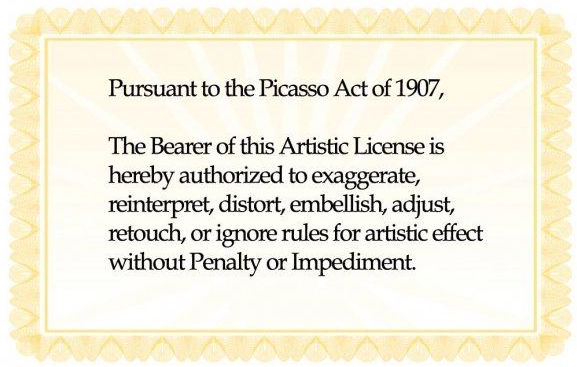
So you have to make compromises. You fudge the timing of events to make a more dramatic and satisfying story, perhaps. This is what we actually mean by “artistic license.” In order to tell the story in a way that moves people, you take a few liberties. In the 1995 movie about the Stonewall Riots that I mentioned yesterday, for instance, they take an event that happened in 1966 and drop it into 1969. The sip-in was an event organized by the Mattachine Society, the non-radical gay rights organization that had been around since 1950. Lots of states had laws against bars serving gay people—specifically in New York at the time, a bar could lose its license if it simultaneously served drinks to more than one gay person. A single openly gay person at a bar was okay, but two (such as a couple on a date!) was a big no-no. So this group of very respectable-looking people went from bar to bar, made a big announcement that they were gay, and asked to be served. They had to go to a bunch of bars before someone refused to serve them, at which point they could file a lawsuit, whose ultimate aim was to get the regulation thrown out in court as a violation of the Constitutional rights of association and assembly. Which they did.
None of the people involved in the sip-in had anything to do with the Stonewall riots later on. And the Stonewall Inn was not one of the bars where they tried to get served at. The makers of the 1995 movie, for whatever reason, decided to have the heroes of their movie being the guys that also stages the sip-in, and had them do it a month or so before the riots at Stonewall. It doesn’t really make much sense, and it certainly isn’t how it happened. The filmmaker was probably trying to come up with a way to show that his fictionalized versions of the real people who spontaneously rose up in the riots were actively fighting for their rights before that night. It was a way to show them as being active, aware participants in history, to give them agency in the plot. Because, apparently, deciding as an unarmed person to physically fight back against a bunch of armed police officers isn’t active enough!
I think that’s going to ultimately prove to be what’s happening with that brick-throwing scene that everyone is up in arms about in the trailer. The movie maker, having decided to tell the story through his fictional character who is not based on any specific participant in the riots, and who was crafted specifically to be an archetypical everyman, needs to do something active to show agency, and to move the audience to see him as the hero of his personal narrative. That doesn’t necessarily excuse it, but it would explain it.
It is a tough problem. When I was doing an edit pass on the first book in my Trickster series, I realized that I had spent so much time weaving all of the subplots together (and all the jokes—the word apocalypse may be in the title of the first book, but I am writing light fantasy!) so that all the characters get to the big climactic battle and have their emotional arcs culminate, I had turned my main protagonist (and one of the supporting protagonists) into a soccer ball. They were each propelled by events from one part of the plot to the next, seldom showing any agency. They each made decisions along the way, but I had wound up writing those scenes in such a way that each was always reacting to events outside his control. Fortunately it didn’t take a lot of revision to recast some of those scenes to make it clear that there were actual choices being made. I added one scene to give the main protagonist a more active role in shaping the end result of the plot. I think it worked.
As a storyteller, I know why these decisions about how to make a compelling tale out of historical events happen. Your hope is that the overall effect is to illuminate the past, show how far we’ve come, and introduce people unfamiliar with the topic to the struggles of the people involved. If not done right, you might still please the audience, but you’ve muddled things up, erased the real heroes, and sold the viewer a pretty but awful lie.
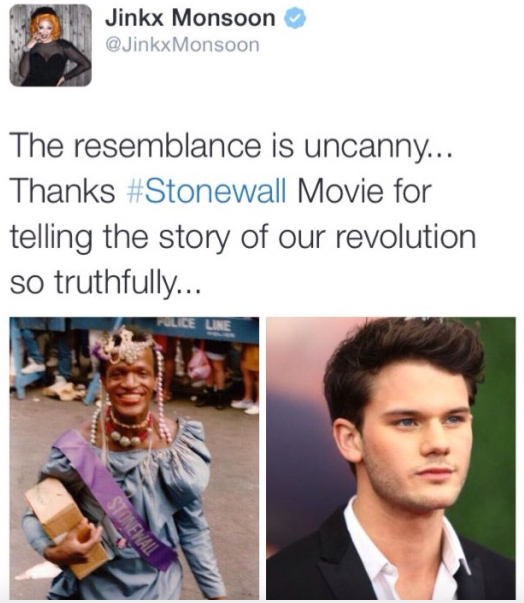
Marsha P. Johnson (on the left) was an African-American drag queen/street queen who actually participated in the Stonewall riot and was seen by several witnesses smashing a police car with a brick that night. Later she was a co-founder of the Street Transvestite Action Revolutionaries. The actor on the right is portraying the only brick-thrower seen in the trailer for the new Stonewall movie. (click to embiggen)I have a confession to make. When I first saw the trailer for the new Stonewall movie set to come out next month, the white-washing and cis-washing were not the first things that jumped out at me. At least not directly.
If you aren’t familiar with the controversy: the trailer for the new movie focuses on a white, cisgendered young man as the viewpoint character, and more specifically, causes some people to infer that he is the one who threw the first brick and starts the Stonewall Riot on that June night in 1969. The Stonewall Riots being the event usually credited with starting the modern gay rights movement. This is a problem because, while no one knows for certain who threw the first beer bottle, we do know is that the first person seriously fighting back that night was a butch lesbian who got away from the cops (and was chased down, beaten, and dragged back) while resisting being put in the paddy wagon (it was probably Stormé DeLarverie, though some witnesses claim that it was someone else). A transwoman of color, Miss Major Griffin-Gracy, also fought back, was clubbed unconscious, and was one of the few actually taken to jail that night. And no one disputes that it was Marsha P. Johnson (who was at the bar that night with friends to celebrate her birthday) who smashed one of the police cars with a brick…Continue reading Please don’t ask me to applaud mighty whitey→
Another in my series of posts recommending web comics:
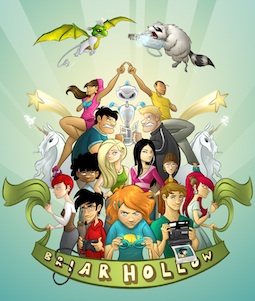
Briar Hollow by Terry Blas & Kimball DavisThis story about a nerd named Molly and her friends at college is a fun blend of romance, nerdy things, cryptozoology, and missed signals. I discovered Briar Hollow by Terry Blas & Kimball Davis because an acquaintance recommended the Gnerd Podcast, and while checking it out, discovered that the guy who does the podcast also does a web comic. Since I only discovered it recently and started reading from the beginning, it wasn’t until I had become completely addicted and reached the most recent page that I saw that he hasn’t updated since November. Eeeek! Maybe if we all write him fan mail there will be a new page soon? Anyway, I think what he’s published so far is entertaining and worth the read, and really hope he continues the story.
This one is a little complicated. See, several years ago I was reading a web comic called Finn and Charlie Are Hitched, which was a three-panel gag strip about Charlie and Finn, a couple of gay guys who are married and their sometimes whacky friends. It was a fun slice-of-life strip and I enjoyed it. But for some reason I stopped reading it (probably something silly like I lost the bookmark and just didn’t go searching for it). Anyway, I was reading another web comic entirely recently based on someone’s recommendation, and they had some links to recommended comics and I saw the name “Charlie and Finn Are Hitched” and I thought, “Hey, didn’t I used to read that?” I got there, and learned that the final strip was published on New Year’s Eve 2013, at which point the artist said that he was closing the strip, but that we could read more about the characters in his new comic, Muddler’s Beat by Tony Breed. And you can! Charlie and Finn are still there, and still hitched, and several other characters from the original series are still there. It’s still humorous, with occasional trips into serious topics (the series of strips about the death of Charlie and Finn’s cat for instance). In his announcement of the new comic, the artist said that the new strip would be more ensemble oriented. I like both strips. It’s a little weird, now that I’m caught up on Muddler’s Beat to go back and look at the earliest years of the original strip, as the artist has improved over time (which one would expect). Anyway, the original strip is also available in dead trees editions.
Some of the comics I’ve previously recommended:
“Mr. Cow,” by Chuck Melville tells the tale of a clueless cow with Walter Cronkite dreams. If the twice-weekly gags about a barnyard of a newsroom aren’t enough excitement for you the same artist also writes and draws (and colors!) some awesome fantasy series: Champions of Katara and Felicia, Sorceress of Katara. If you like Mr. Cow, Felicia, or Flagstaff (the hero of Champions of Katara) you can support the artist by going to his Patreon Page. Also, can I interest you in a Mr. Cow Mug?
“Deer Me,” by Sheryl Schopfer tells the tales from the lives of three friends (and former roommates) who couldn’t be more dissimilar while being surprisingly compatible. If you enjoy Deer Me, you can support the artist by going to her Patreon Page!
And I love this impish girl thief with a tail and her reluctant undead sorcerer/bodyguard: “Unsounded,” by Ashley Cope.
The Young Protectors by Alex Wolfson begins when a young, closeted teen-age superhero who has just snuck into a gay bar for the first time is seen exiting said bar by a not-so-young, very experienced, very powerful, super-villain. Trouble, of course, ensues.
If you want to read a nice, long graphic-novel style story which recently published its conclusion, check-out the not quite accurately named, The Less Than Epic Adventures of T.J. and Amal by E.K. Weaver. I say inaccurate because I found their story quite epic (not to mention engaging, moving, surprising, fulfilling… I could go on). Some sections of the tale are Not Safe For Work, as they say, though she marks them clearly. The complete graphic novels are available for sale in both ebook and paper versions, by the way.
I haven’t done a questionnaire or similar post in a while…
Name: Gene
Where are you from? The U.S. Narrowing it down further: ten elementary schools, four states. My father worked in the petroleum industry, so while I was born in northwest Colorado, and we returned to that same small town by the time I entered middle school, we lived in a bunch of small towns in Colorado, Nebraska, Wyoming, and Utah…
Favorite colours? Purple! Violet! Plum! Aubergine! Lavender! Lilac! Also various shades of pink, orange, and teal. And did I mention purple?
Write something in capitals: NASA
Favorite band / musician: As in many things, I have lots of favorites. I love, love, love Scissor Sisters, and wish that their “hiatus” would end sometime soon. Rufus Wainwright, Mika, Pet Shop Boys, Taylor Swift, Will Young, John Grant… and don’t get me started on the divas!
Favorite number: My favorite integer is 5. Which is also my favorite rational number. Though 3/5 is also good. Favorite algebraic irrational is the square root of 2. My favorite transcendental irrational is e. My favorite indeterminate form is ∞0…. I could go on (I majored in Math at university, can you tell?)
Favorite drink: In the morning, coffee. Afternoon, tea (especially Earl Grey with lavender). Current favorite cocktail is a Manhattan, straight up. But my old stand by is an extra dry martini (a real martini with gin; people who call vodka drinks martinis should be shot). Favorite wine is Montepulciano d’Abruzzo. Coconut water and Dry’s Lavender soda are also big faves.
Tag 8 people you want to know better: Everyone! Seriously, if you see this and you wanna post your answers, go for it. If you don’t, no worries!
It’s Friday! The first Friday in August. It is also, alas, the first Friday without Jon Stewart hosting the Daily Show. I don’t know how we’re going to get through the insanity of the 2016 Presidential Campaign without him to help us laugh at the worst of it…
Anyway, here is a collection of some of the things that I ran across over the course of the week which struck me as worthy of being shared. Sorted into categories with headings so you can skip more easily:
(There were many, many more outrageous headlines regarding the clowns scrambling to out-bigot each over for the Republican nomination; but sometimes enough is enough.)











 Font Folly