I heard the news that there had been a shooting Thursday in the International District (a place some people still call Chinatown), but I didn’t know that it was Donnie Chin until Friday: Donnie Chin, Chinatown ID’s ‘frontline hero,’ killed in early morning shooting. He’d been the director of the International District Emergency Center for some years. The IDEC is hard to describe. A “volunteer-based emergency services organization” Yes, they provided emergency medical services, but Donnie did so much more. He got homeless people to shelters, he helped find lost children. He checked regularly on elderly and disabled residents. He provided translation services for people whose English was not good, helping them navigate the medicare system and so forth. They say a lot of elderly people who realized their memory was getting bad, actually left their prescriptions with him, and he came to their homes and gave them their pills for the day, so they wouldn’t accidentally overdose themselves. On top of all that, he simply patrolled the neighborhood, keeping an eye out for trouble.
I didn’t know Donnie personally. I first heard of Donnie back in the 90s, when I was briefly dating a guy who was active in the Q-Patrol (Donnie wasn’t involved in Q-Patrol, it’s that some of the people in Q-Patrol were trying to model what they did on the things that Donnie and his organization did in the International District). And I remember when one of the local papers ran a nice story on him a few years later.
What can I say, except that we’ve lost a hero?
In other regional news, there was some good news yesterday: Court sides with state on Plan B sales. When you’re a pharmacist, your job is to provide medication, not impose your religious beliefs on others. And the court agrees. I go further: I think that refusing to provide Plan B because they think it is an abortion drug is proof that the pharmacist is incompetent at the science side (it isn’t abortion, the biochemical process prevents implantation, just like birth control methods taken before the act), and should have their license revoked. But I’m a hard ass.
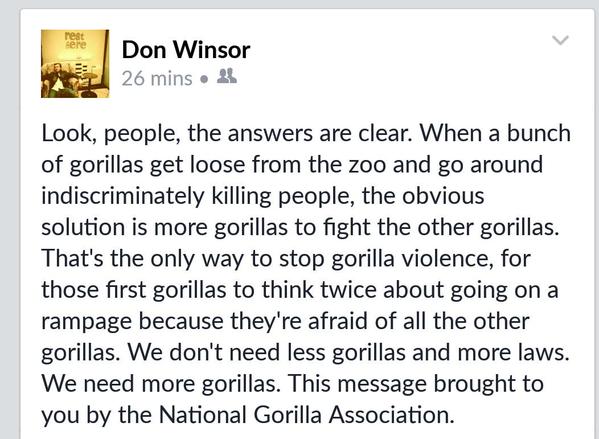
A tweet whose image is being shared around on various social media.And of course, Lafayette Shooter Was A White Supremacist Tea Party Type. Yes. And in case there is any doubt, La. gunman was a Tea Partier who hated Obama, admired Hitler and wanted women to shut up in church where we also learn, “Houser was turned down for a concealed carry permit in 2006 because of apparent mental health issues and a previous arrest in Columbus, Georgia, for arson.” And I already know that since the mass shooting of 20 grade school children a few years ago couldn’t get America off its collective butt and pull its head out of its arse and admit that there is something seriously wrong with the gun laws in this country, I know an angry man killing two women and injuring nine others in a movie theatre isn’t going to do anything, either. One thing I want to observe: some of the headlines and summaries describe it as if it was blindly shooting into the crowd, but that isn’t what witnesses described. He slowly, silently, and methodically shot at individuals. I suspect it is no coincidence at all that the two fatalities were young women. Angry misogynist murders women at showing of film by feminist comedian; police worry “we may not find a motive.”
It’s Friday! A Friday in which every source of news is almost certainly going to be giving wall-to-wall coverage of yet another horrific shooting in a public place. Which I’m not going to say anything more about just now.
Anyway, here is a collection of some of the things that I ran across over the course of the week which struck me as worthy of being shared. Sorted into categories with headings so you can skip more easily:
Americans’ Air Conditioning Habit Is Eco-Friendly. The European myth that we use more a/c is based on comparing American cities with average summer temps on 88F (31C) to European cities with average summer temps of 73F (23C).
(There were many, many more outrageous headlines regarding the clowns scrambling to out-bigot each over for the Republican nomination; but sometimes enough is enough.)
I’ve mentioned before that it’s my Mom’s fault that I am a fan of both science fiction and mysteries. From the time I was a baby, she would read aloud to me from whatever book she was reading (and when I got to the point I was trying to talk, she would cajole me into repeating back words and phrases and eventually whole sentences, which is how I learned to read at least a year before I was sent off to school). Since her favorite authors were Agathe Christie and Robert Heinlein, they made up a large proportion of what she read. But that’s a slight oversimplification. Because she read other books, too. The Christies and the Heinleins resonated with me in a way that the gothic romances she was also fond of did not. With one exception.
Mary Stewart wrote romances that weren’t always classified as romance. They were mysteries as well, and she integrated the two elements in a way where the solving of the mystery illuminated the character development as the characters fell for each other. So you’ll find some places classify her old books as thrillers, or mysteries, or romances, depending on the whims of the reviewer. Paperbacks my parents each bought tended to get taken back to used book stores to be traded in for store credit unless they were deemed worthy of multiple rereads. So there were only a couple of Stewart’s romances (most originally written in the 50s) that stayed on our bookshelves for years. One particular that I remember reading myself after pulling it off Mom’s shelf several times to look at the cover, was Stewart’s romance/thriller The Moon-Spinners.
The Hugo trophy handed out at the 67th World Science Fiction Convention in Montréal in 2009. Designed by Dave Howell. This is the only Hugo trophy that I have personally touched. (Click to embiggen)This was going to be merely the next in my own journey of reviewing the Hugo nominees before casting my ballot. I have attempted to read all the nominees with an open mind, rather than cast a No Award vote for anything that had made it onto the ballot due to the bloc-voting scheme of the Sad Puppies and Rabid Puppies. Links to my previous reviews are included below…Continue reading Hugo Ballot: My final take before voting closes→
I find myself reading about consent a lot. Having grown up in a culture which socializes guys not to take “no” for an answer, while socializing girls not to make trouble and always put other people’s wants and comforts first, it’s no wonder a lot of people don’t seem to understand consent in that context. Then there’s the whole Harper Lee and her “new” book situation. Is she healthy and aware enough to give informed consent? Does she actually know what’s going on, or is she a victim of the younger lawyers from who sister’s old firm who have taken over her estate now that her sister has died?
When I had read that her home state had initiated an investigation because of the reports of coercion, and that the state had determined that she had given her consent freely, I was mollified. I also rationalized it by comparing it to volumes I own of posthumously published material from Arthur Conan Doyle and from J.R.R. Tolkien. Those early drafts (heavily annotated by experts) and small one-offs originally created for a limited audience are fascinating and very educational, particularly from a writers’ point of view. If I can own those and enjoy them, do I have a right to condemn anyone who purchases this “new” book?
Of course, there is a difference. Tolkien and Conan Doyle have been dead for decades, these things have the notes and commentary making it clear that they are drafts or incomplete works. They aren’t being represented as something the author thought was a finished product. They’re clearly an exercise is the academic study of the work of those writers, and intended to illuminate the other works of the author.
But now I read that the investigation that looked into Harper Lee’s case did not include any medical personnel. No part of the investigation seemed to focus on whether she still possesses the capacity to give informed consent. That changes things a lot.
I do like one local book reviewers’ take on it: he read the new book, says the first chapter is amazing and you can understand why instead of outright rejecting it, the editor asked her to write a different story without the flashbacks to the narrator’s childhood, but rather to tell a story about the protagonist as a child. And then as you get into the rest of the book, the fact that this is a first draft of a first novel by a novice author is clear. And, he says, you can see why, with the help of an agent and the editor, it took her about a dozen rewrites of that second version of the book to arrive at To Kill A Mockingbird.
One other reason: there is absolutely no doubt that at the time Lee wrote To Kill A Mockingbird that she thought it was complete, that she was ready for it to publish, and that she knew what she was doing.
It’s also, if my very vague memories of reading it in my early teens, a very good book. Which I intend to re-read soon!
As usual, there were a few big news stories of the week I didn’t include in Friday links, and a few that have had more developments that I didn’t see until after I set up the posts to publish. Because I put the Friday Links post together Thursday night, but also because I post a full version of the post to my old LiveJounal and Dreamwidth blogs and my Blogger site, none of which I’ve ever been able to fully automate, so I spend way longer putting them together than I probably ought to.
Anyway, my social media streams were flooded with a lot of Caitlyn Jenner stuff. Mostly people reacting to other people’s snark and derision, especially about her winning the Arthur Ashe Courage Award, Caitlyn Jenner at ESPY Awards: Accept People ‘for Who They Are’. The speech itself was awesome, with a lot of heart, and focused on the problems of trans kids: Caitlyn Jenner honors transgender boy with Macomb County ties during her ESPYs speech. But haters gotta hate. And I think all we can do when they do is shut them down, like Joey Vicente, a U.S. Army behavioral health specialist did in the post I’ve pictured here. Click it to embiggen and read it.
Tangentially: GoodAsYou.Org’s Jeremy Hooper reads all the news blogs and such of the professional anti-gay haters so we don’t have to, and reports that Maggie Gallagher of NOM is trying to claim that support for gay marriage is suddenly plummeting. Jeremy explains how Maggie has constructed this lie (or is it self-delusion), but there’s also this: U.S. Support for Same-Sex Marriage Stable After High Court Ruling. Which isn’t stopping the wingnuts (especially my relatives on Facebook) from continuing to post foaming-at-the-mouth rants about the coming apocalypse because of the gays, how the rainbow flag is a “dark symbol of tyranny,” and the need to assert their religious liberty by discriminating agains the gay. Patheos has a nice counter to this: Your “Deeply Held Religious Belief” Isn’t Biblical. If only there was some way to get people to stop screaming and listen, eh?
It’s Friday! A glorious Friday that did not arrive a moment too soon. I should have more witty things to say, but I’m just soooo tired.
Anyway, here is a collection of some of the things that I ran across over the course of the week which struck me as worthy of being shared. Sorted into categories with headings so you can skip more easily:
Santorum Calls For A Constitutional Amendment To Ban Same-Sex Marriage. Note that the other wingnut pesidential hopefuls decided it was slightly more reasonable to call for a constitutional amendment giving states the right to define marriage. Which is slightly less bigoted-sounding.
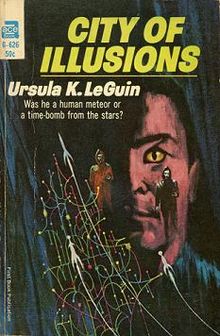
The cover of my paperback version is a bit more tattered than this image I found (Click to embiggen).I think I found my copy of Ursula K. LeGuin’s City of Illusions at the used book store that was in a town thirty miles away from the town I lived in for most of middle school. I know that I owned it before my folks split when I was 15. I don’t recall exactly where I acquired it, but I do know why I wanted to book: the character on the front of the cover had cat’s eyes, which I thought was really cool.
I don’t think this was the first sci fi novel I read that featured such a character. There are are so many sci fi books with characters that look mostly human, but have eyes like a cat or a bird of prey. But it was the eyes that really grabbed me.
The story begins with the man on the cover being found in the woods without any memory, not even a language, no clothes, and no clues as to who he is. The people who find him aren’t certain he’s human, because of the eyes, but they take him in, name him Falk, and teach him. We learn that this is Earth of a distant future, once part of an interstellar federation of some sort, conquered by aliens, and now severely de-populated and isolated from the rest of interstellar society. The aliens technically rule the world, but they keep to themselves in a single massive city.
Falk eventually sets out on a quest to try to discover who he is. This allows the author to show the reader other parts of the world before Falk finally is taken captive by the alien overlords who tell him he’s one of only two survivors of a crashed spaceship from another world. They introduce him to the other survivor, and offer to restore his memory—though it will mean erasing his current personality. Falk agrees, and the novel switches to the point of view of the restored personality, who doesn’t know what Falk knows about how the humans on earth are treated. The aliens want Falk to go back to his own people and tell them how they are running earth as a garden, keeping the humans happy.
Eventually the original personality is able to awaken Falk’s memories, which also means that he winds up with two personalities trying to work together.
I’ve left out an important detail: just about everyone seems to be telepathic, Falk, all the humans he meets, and the aliens. Telepathy was how the old Federation came to be, because no one can tell a lie in psychic communication. Except it turns out the alien invaders can. Falk and the restored original personality realize the aliens aren’t going to let him go if he remembers the truth about Earth, so he has to steal a spaceship and escape to his homeworld where he may be able to convince them to attempt to liberate Earth. There’s a cute telepathic trick that Le Guin uses at a crucial point in the climax, and the story ends on wit Falk on his way to his homeworld, but without the certainty that Earth will be liberated.
The novel straddles several categories of science fiction. The world is a post-apocalyptic world, even if the apocalypse happened a thousand years ago and a new, stable set of societies have developed. There’s also the aliens subjugating humans genre. And the isolated protagonist who has to discover who he is.
The novel is one of three loosely connected books (the others being Rocannon’s World and Planet of Exile) in which Le Guin was working out a single future history, in which humans have been seeded on many worlds, and they have diverged in various ways, but still consider themselves one race. This is where it encompasses another idea that was more popular in Golden Age science fiction: humans aren’t native to Earth, but were seeded there hundreds of thousands of years before our time.
Some of her much more famous later books, The Left Hand of Darkness, The Dispossessed, and The Word for World is Forest are sequels, in a sense, to these books. They all allude to the common history of these three, in any case, so a lot of people lump them all (along with a few others and some short stories) into a single saga called The Hainish Cycle. Le Guin herself has rejected the label, in part simply because the collective works don’t tell a single story. Another reason is that in the first three books she was trying to figure out how to do a future history, rather than having drafted a coherent future history as a grand backstory to it all. So there are contradictions and variances in the histories of all the books.
The City of Illusions is one of those stories that sticks with me in weird ways. I remember Falk, his struggle to discover himself, and especially the way that Le Guin portrays the two people living inside one head phenomenon at the end. I remember the notions and paradox of telepathic lying. But I forget things like what the aliens are like. I forget what any of the other human societies that Falk visits during his adventures are like. That’s not a bad thing. The story is, on one level, about isolation and discovery. And that part really resonated for me at that age. Some of her other ideas from this book I find myself incorporating into my own stories without consciously realizing where they came from. Which I think means that Le Guin conceived them and executed them well: they’ve become part of the fabric of how I think things would actually work.
Years later, I have read many other Le Guin books, and I own her translation of the Tao Te Ching, a holy book that figures in this novel’s plot. Which I think means that once I finish reading this last Hugo novel, I need to add City of Illusions to this year’s queue for a re-read.
As the number of people officially announcing their candidacy for the Republican nominee for president keeps going up and up, I’ve noticed a lot of people making the same lame meta-joke: “Looks like instead of a clown car, we need a clown van.” This joke, besides being lame because each political observer has been repeating the van comment several times, is bad because it completely misunderstands the whole point of calling the field of potential candidates a clown car to begin with…Continue reading Of clowns, cars, and twits→
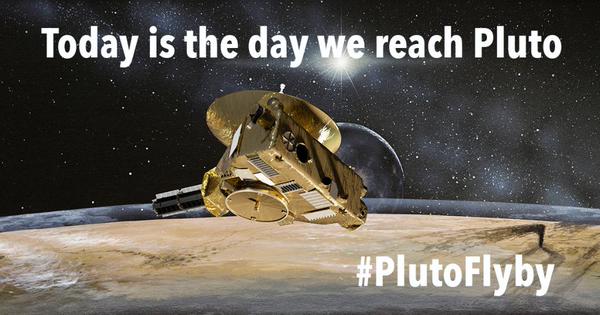
NASA.gov (Click to embiggen)We’ve come a long way from the morning in June, 1965, when I watched my first NASA launch, live. I’m pretty sure that Walter Cronkite was the narrator of my adventure. And by long way I do mean literally. The furthest from the Earth’s surface that Gemini 4 got was about 155 nautical miles. New Horizons has traveled about 3,000,000,000 miles (that 3 billion, yes, billion-with-a-B) to do its Pluto flyby.
The Gemini launch was the first one that was broadcast live, around the world, by satellite. So a lot of people watched the launch. And it was a great flight. Ed White (Edward H. White II) become the first person to space walk, exiting the capsule in a spacesuit with a camera. NASA only let him stay out 20 minutes (actually, they were telling the other astronaut, James A. McDivitt, to get White back in sooner, but White was trying to stay out as long as he could). White and McDivitt could communicate to each other over an intercom line that was part of the tether, but it didn’t connect with the exterior radar to the ground. On top of that, the primary communication system with the ground was having some problems (the VOX unit at McDivitt’s end didn’t correctly identify when McDivitt was talking, so it kept cutting in and out and odd times, so he had to switch to the push-to-talk mechanism).
NASA didn’t want White outside of the capsule during any of the periods when the capsule was out of range of a tracking station (we didn’t have quite as extensive a network of tracking stations around the world back then, so there were a few points in the orbit where we were out of communication with the capsule).
I’ve been a space geek at least since 1965. Probably longer, but the Gemini 4 launch is the earliest one I remember watching (and apparently drove everyone crazy talking about it for weeks after).
So, yes, I’m pretty excited about our flyby of the planet Pluto (if you’re one of those deluded people who adhere to the totally ridiculous redefinition, don’t bother arguing; a scientific definition of an class of object should depend upon the objectively measurable properties of that object only, not the presence or absence of other objects in its vicinity). I can’t wait until we start receiving the images New Horizons is taking today. We’re going to learn so much!





 Font Folly