Several years ago I witnessed an altercation on the bus. When I first got on, I noticed one guy with blond hair that was combed just so and his mustache was freshly trimmed, and he was dressed in what looked like a new suit and tie. He was sitting up super-straight, as if he had an iron rod up his backside. Everything about him radiated attitude. His smile was particularly smug.
I had already seen that one of my favorite seats near the back was open, so I headed back there and turned my attention back to the news radio I was listening to on my headphones.
Except as the bus pulled away from the stop, I could see people up in the front of the bus near this guy being more agitated. A couple people leaned forward and seemed to be addressing him angrily. And then I noticed that a woman also up in the front had put her hands over the ears of the little boy (who I presumed was her son) in the seat next to her, so I pulled off my headphones to hear was was happening…Continue reading Angry men on buses — not all violence is equal→
(Click to embiggen)In the old days, when reading usually meant you were holding a physical book or magazine or manuscript in your hand, if something you read so infuriated you or was simply awfully written, you could literally throw it against the wall (or into the trashcan) in disgust. On Sunday this last weekend I really, really wanted to do that after reading a particular blog post. I’m not going to link to it or identify the author, because that would just be harassment—even though the author of the blog post is a professional who uses their blog to give advice and has (self) published books offering advice on writing. Instead, I need to follow the advice I give all the time: if you want more good things in the world for people to read, don’t complain about what’s out there, make something yourself.
Over the years I’ve had many conversations with aspiring writers. This happened especially a lot when I was the publisher of a small zine and attending sf/f conventions where I appeared on writing and publishing panels and usually had a table selling copies of the zine. A significant fraction of these random aspiring writers would talk about stories that they were working on but couldn’t quite figure out how to finish. And once I got into the details with them, it would eventually emerge that they hadn’t actually written any of the story. It was an idea they had and which they had talked about at length with friends. In many cases they would talk about the files they had full of descriptions of characters and an outline of the history of the world, but when pressed, they would admit that they hadn’t actually written a single word of the story itself.
Planning and thinking and even doodling about a story, gathering research and writing up background information are important tasks which are often necessary to the writing process, but none of that is the actual story. So I would tell these writers a few of rules:
Stop talking about the story to other people, because that just makes the storytelling part of your brain think you’ve already written the tale. Sit down and start writing it.
You don’t have to do world building before you start writing. Recently I saw a lot of people online passing around an excerpt from on old interview with one of Tolkein’s kids where the kid asserts that dad didn’t start writing the story itself down until the children started catching him in contradictions. I don’t know if the anecdote is true, but you can tell a lot of story before you have to stop and start making notes about the world building.
Just sit down and put one word after the other. Don’t worry about whether you’ve started the story at the correct place. Don’t worry about the perfect opening line. You can figure that out later. Don’t get hung up (in the first draft) worrying about if people will understand the story or will like the story. Just start writing. The first draft is you telling the story to yourself. Worry about everything else after you have finished the first draft.
Don’t stop and go back and re-write scenes again and again. Force yourself to leave things in the story until you reach an ending. Yes, you may scrap a ton of what you wrote later, but don’t fall into the trap of rewriting one scene for eternity.
Write. A writer writes. Do it!
If you are writing a story, you’re writing. If you’re doing something else, you aren’t writing. Obviously, sometimes you have to take a break, or do some plotting, or jot down background information, or update a timeline, and so forth in order to know what to write next, none of that is actually writing. So if you’re spending more time on that than actually writing the tale, you need to stop, sit down at your favorite word processor or writing notebook, and start writing.
The blog post that angered me this weekend asserted that if you haven’t been published you aren’t a writer. I tend to have a knee-jerk reaction to gatekeeping, but even discounting that, I have problems with that distinction. I understand that the author was trying to address the issue of people who are merely daydreaming about writing. And I agree that we do a disservice to aspiring writers if we enable their mistaken notions that writing is easy or that it’s a sort of magic process of ideas coming to us from the ether.
But getting published is a very arbitrary and classist hurdle. And particularly in this age of self-publishing, it’s not a terribly useful distinction.
Are you writing? Not background notes, but an actual story with dialogue and a narrative moving forward? Then you are a writer. Maybe you’re still in the early stages of learning your craft. Maybe what you wrote this morning was completely awful. Maybe you’re still afraid to show it to other people. Maybe you showed it to someone and they didn’t like it.
That’s not important.
Are you writing? Are you doing the work of putting one word after the other striving to get to the end of the tale?
If you are writing a story, even if you don’t know what you’re doing yet, you’re a writer.
Click to embiggen)So Trump supporters have been organizing a so-called Mother Of All Rallies online for some time, and yesterday was the day. They have boasted, variously, that they had hundreds of thousands of confirmed attendees, or over a million confirmed attendees, et cetera. And how many people showed up? “Hundreds.” They couldn’t even get enough to fill a suburban high school football stadium! Pro-Trump rally draws hundreds, not thousands to Washington.
But just a few blocks away there was a bigger rally in front of the Lincoln Memorial: Pro-Trump Rally Dwarfed By ‘Juggalo’ Demonstration In D.C.. So fans of Insane Clown Posse were able to muster a much bigger crowd the the Make America Great Again people. But it gets worse! On the same day, Hillary Clinton was doing a book signing at a Costco in Brookfield, Connecticut.. guess what? Hillary Clinton Book-Signing Draws More Than 1,000 To Brookfield Costco. Hillary’s book signings are drawing larger crowds that the Trump supporters can muster!
Some folks are pointing to the news stories about former Trump supporters burning their Make America Great Again hats and this rally as indicating his support is slipping among his hardcore. I’m not sure that’s anywhere near the whole story. I think another important part is just how many fake accounts (twitterbots and such) make up the online Trump supporter crowd: Trump Twitter bots, numbering in millions, could be used to blanket internet with weaponized false info (by the way, that headline should read “is already being used to” not could be). A similar problem exists on Facebook, though because of some of the company’s policies, it’s a lot harder to determine just how many fake Americans Russian hackers manufactured to spread fake news and amp up membership on Pro-Trump pages: The Fake Americans Russia Created to Influence the Election. So I think one reason the organizers were expecting bigger crowds is they just haven’t figured out how many of their supportors online are fake accounts.
Besides, the Trump supporters burning their hats? They’re doing it for very racist reasons: Trump Supporters Are Burning Their MAGA Hats: They’re not happy about his prospective deal with Democrats to protect DACA recipients. That’s right, the hardcore supporters are angry because undocumented people who were brought to this country as children might, might be given a path to citizenship. You know, that thing the Trump supporter keep angrily asking why the Dreamers and such haven’t already done (because legally they still can’t)?
One more thing: all of those supporters burning those hats? They may want to think about the little American flag on that thing: I Wonder If Angry, MAGA Hat-Burning Trump Supporters Know They’re Burning a Tiny American Flag, Too. Since the pro-trump/anti-semetic/pro-gun demographic (i.e., most of his supporters) is also historically the same people who scream bloody murder if someone burns a U.S. flag as a protest.
But then, you can’t expect consistency from people who define the Statue of Liberty as a non-patriotic symbol, and reduce Christianity to hating queers.
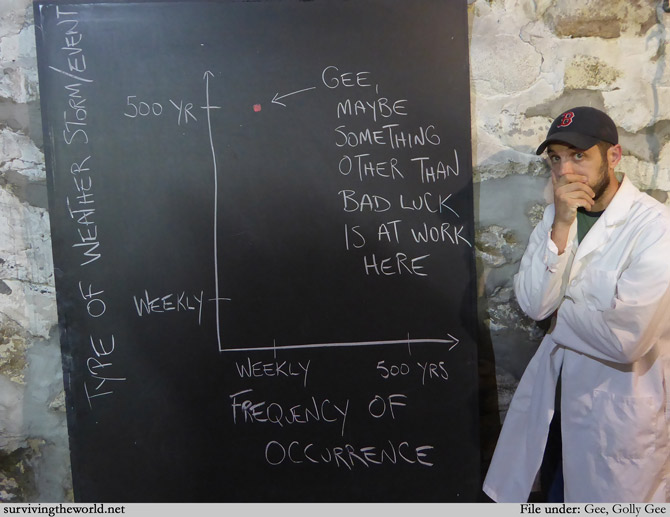
This week’s Surviving the World Comic is spot on. (click to embiggen) survivingtheworld.netIt’s Friday, the third Friday in September. I should be more happy about that than I am.
This week, my husband came down sick early in the week, and I have followed. So it hasn’t been a fabulous week for us. And you may notice that this week’s collection of links is a bit shorter, as once again I haven’t had as much time to read the news.
Anyway, here are the links I gathered this week, sorted into categories as accurately as I could.
This Week in Racists, White Nationalists, and other deplorables:
Good Christian Boys: Jesus Worse Than Hitler.“We executed Nazis after World War 2 for engaging in collective punishment and ordering reprisal killings—rounding up and shooting innocent villagers after resistance fighters staged attacks. Kevin would have us believe that Jesus—the Prince of Peace, the Friend of the Poor, the Lamb of God, etc.—will happily drown little old straight ladies in nursing homes because He’s angry at gay men cavorting in bars on the other side of town.”
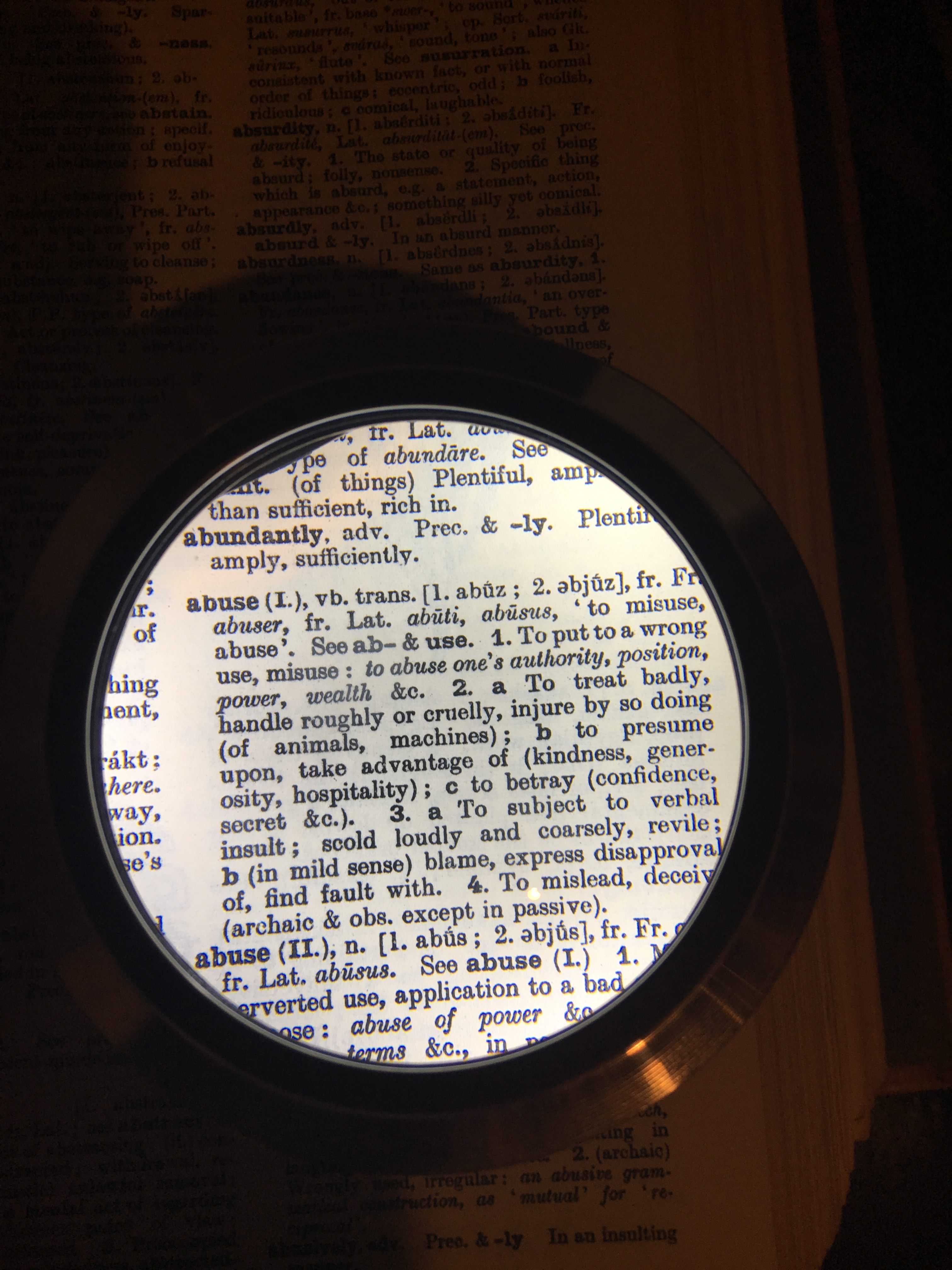
Abuse as defined in one of my dictionaries… (click to embiggen)I can’t count the number of times, as a child, that some adult (relatives, teachers, or people from church) would take me aside to suggest or insist that if I would just be more obedient or behave the way my dad expected, he wouldn’t have to be so strict with me. I know my younger siblings got similar admonishments: Dad wouldn’t be forced to use such strict punishments on us if only we could placate his moods. They never referred to his behavior as “abuse,” it was always said that he was “strict” and that he “had a temper.” And while they often implied that they thought his punishment was harsher than necessary, they never acknowledged that his behavior had crossed a line into being unacceptable or uncalled for. Which is quite amazing if I explain some of the specifics.
Apple announced more than one new phone yesterday, and like most years, a certain percentage of current iPhone owners are debating which one to upgrade to as our older iPhones are now more than two years old. More than one person I know is still hanging onto the same iPhone they’ve owned for three years and not sure that they will upgrade this year or wait a bit. But Apple haters all act as if all of us blindly rush out to buy the newest one every year. We don’t, but hey, if your life is so hollow that you need to make fun of other people’s choices of what goods and services to use, I guess that’s what you have to do.
But the really funny thing for me is how many of the haters are making fun of the cost of the high end Apply phone (not the shiny new iPhone 8 that the vast majority of us will buy, but the premium model that literally most of us can’t—not just because of the price, but because of manufacturing limits, but I’ll come back to that) are also comparing it to a particular Samsung Galaxy, about which others were asking just last month: Why does Samsung think you’d be willing to spend nearly $1,000 on a Galaxy Note 8?. Seriously, you can’t complain about price by comparing it to a phone that is just as expensive.
The answer to the question isn’t about either company being greedy—it’s about first the fact that some of those components simply cost more. The OLED screen currently used in the Galaxy Note 8 and that will be in the iPhone X costs at least $100 more each at wholesale than the screen used in the iPhone 8 and comparable screens on other Samsung phones that are less costly than the Galaxy Note 8. And that isn’t the only more expensive component either phone has.
But there’s another factor that a lot of people don’t get: manufacturing scale. The last few years, Apple has sold, on average, 800,000 new iPhones a day. In order to meet the demand, not only do they have to manufacture phones close to that rate, but all of the components that they buy from other companies have to be manufactured by those other companies at that rate. Samsung, currently the only source of the high-end OLED screen mentioned above, literally can’t manufacture them fast enough to meet that kind of demand. And that isn’t the only component in the premium phones like that. So part of the reason that both Samsung and Apple are charging nearly 1000 bucks for their highest-end phones is because they want most of their customers to buy the other models, the ones that don’t have components which can’t (yet) be produced at that quantity.
Embedding the screenshot of the quoted tweet in case the original goes away…So, chill. You buy the phone you want, or stick with the one you have already, and don’t be a douche making remarks that are far less clever than you think they are about other people’s choices and preferences. As more than one person has observed: asshole is the failure mode of clever.
I had a couple more posts about writing ready to go up this week. One was kind of a sequel to Monday’s Confessions of a writing tool addict—good intentions paving the way, while the other was a follow up on a much older post: Trust the reader to keep up. But then on Tuesday morning I read an essay that made me want to rethink some advice that I give out all of the time, but that I suspect I don’t follow as much as I think I do. And even more importantly, it makes me want to rethink some of my assumptions. You should really go read Celcilia Tan’s essay, “Let Me Tell You” at Uncanny Magazine.
Anyway, I unscheduled my two posts. I may rewrite them and post them eventually. Or I may just scrap them and start over. Tan’s essay has got me thinking about several things.
And an old and dear acquaintance reminded me that this excellent music video exists, and that in addition to being a good song, the lyrics speak truth:
Propellerheads feat: Miss Shirley Bassey – History Repeating:
“I know it’s here somewhere…”I’ve written a few times about some of the issues I face being a packrat who comes from a long line of packrats. One of the manifestations of the behavior is that I collect things, but not all of the things I collect are the sorts of things most people think of as collectable: keyboards, headphones, iPods, dictionaries, typewriters… and word processing programs. In a sense, my predilection for downloading and trying out new word processors is not unlike the way that many writers and artists and such like to try out new pens or buy new notebooks or sketchpads. You’re always looking for tools that will make some of your job easier, or are just nicer to use. And in the case of things like paper or pencils or brushes, they do get used up or wear out periodically, so having replacements already handy can be a good thing. When I see a cool-looking mechanical pencil, for instance, there isn’t much harm in picking it up and at least considering buying it. One of the pencils I already own might break, or get misplaced, right?
Software programs don’t usually work that way, but the non-rational part of my brain doesn’t quite get that. So seeing a review of a word processor that extolls features that appeal to me has the same effect on that impulsive part of the brain that makes me pick up a new pencil or pen or pocket notepad when it catches my eye in the store.
Many apps offer free trial versions, so it is literally a matter of just clicking or tapping a few times on my phone or laptop, and the next thing you know there’s a new word processor installed on my iPhone or iPad or Macbook Pro. And I will play with it for a bit, maybe find some things I like about it. If it works well and is cheap, well, I might buy it. If the free version has no time limit, I may just leave the free version on indefinitely.
Another in my series of posts recommending web comics that I think more people should read:
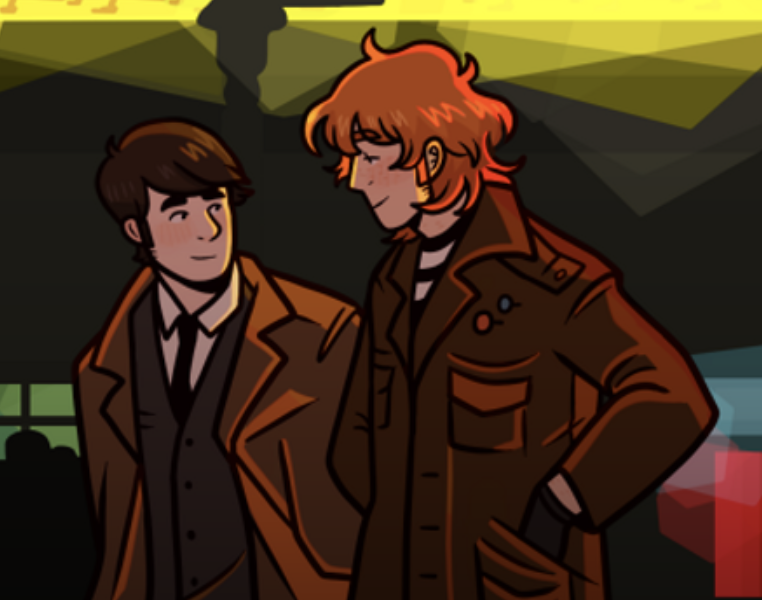
Stereophonic by C.J.P.“Stereophonic” by C.J.P. is a slice of life comic set in 1960s London. The two main characters are Elliot, an introverted art student, and Alex, an outgoing singer in a small band who works in a pub to make ends meet. When our story begins Elliot needs a flatmate to help with the rent and Alex needs a new place to live. It’s a very sweet and slow-build story. The artist describes it as a “queer historical drama that follows the lives of two young men living in 1960s London.” The art is good and the supporting cast is interesting. But I want to warn you that the story comes to a hiatus just as a couple of the subplots are getting very interesting. The artist had a serious health issue which was complicated by family problems, but has since started posting updates to his blog and Patreon page, assuring us that the story will resume soon. There are 300 pages of the comic available to read at that moment, let’s hope more comes soon. If you like the comic and would like to support the artist, C.J. has a Patreon page, plus t-shirts and other merchandise available at his store.
Some of the comics I’ve previously recommended: Some of these have stopped publishing new episodes. Some have been on hiatus for a while. I’ve culled from the list those that seem to have gone away entirely.
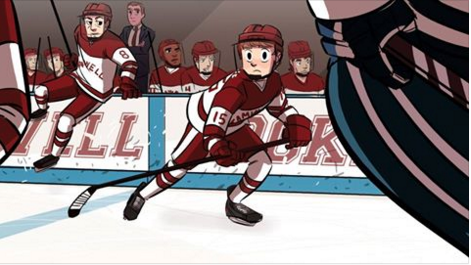
Check, Please! by Ngozi Ukazu is the story of Eric “Bitty” Bittle, a former junior figure skating champion from a southern state who is attending fictitious Samwell College in Massachusetts, where he plays on the men’s hockey team. Bitty is the smallest guy on the team, and in the early comics is dealing with a phobia of being body-checked in the games. He’s an enthusiastic baker, and a die hard Beyoncé fan.
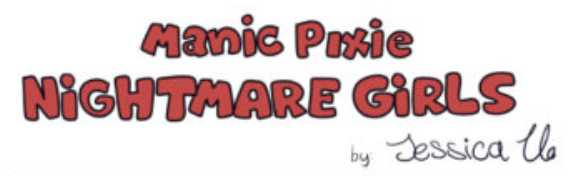
“Manic Pixie Nightmare Girls” by Jessica Udischas is a hilarious web comic that tells of the adventures of Jesska Nightmare, a trans woman trying to make her way in our transphobic world. The comics are funny, insightful, and adorably drawn. The sheer cuteness of the drawing style is a rather sharp contrast to the sometimes weighty topics the comic covers, and I think makes it a little easier to keep from getting bummed out to contemplate that the strips aren’t exaggerations. If you like the strip, consider supporting the artist through her patreon.
The Junior Science Power Hour by Abby Howard. is frequently autobiographical take on the artist’s journey to creating the crazy strip about science, science nerds, why girls are just as good at being science nerds as boys, and so much more. It will definitely appeal to dinosaur nerds, anyone who has ever been enthusiastic about any science topic, and especially to people who has ever felt like a square peg being forced into round holes by society.
The Young Protectors: Engaging the Enemy by Alex Wolfson begins when a young, closeted teen-age superhero who has just snuck into a gay bar for the first time is seen exiting said bar by a not-so-young, very experienced, very powerful, super-villain. Trouble, of course, ensues.
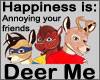
“Deer Me,” by Sheryl Schopfer tells the tales from the lives of three friends (and former roommates) who couldn’t be more dissimilar while being surprisingly compatible. If you enjoy Deer Me, you can support the artist by going to her Patreon Page!
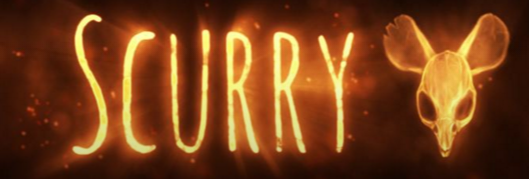
Scurry by Mac Smith is the story of a colony of mice trying to survive a long, strange winter in a world where humans have mysteriously vanished, and food is becoming ever more scarce.
And I love this impish girl thief with a tail and her reluctant undead sorcerer/bodyguard: “Unsounded,” by Ashley Cope.
Fowl Language by Brian Gordon is a fun strip about parenting, tech, science, and other geeky things. The strips are funny, and he also has a bonus panel link to click on under the day’s strip.
The Last Halloween by Abby Howard is the creepy story of 10-year-old Mona who is reluctantly drafted to save the world on Halloween night. This is by the same artist who does the Junior Science Power Hour. She created this strip as her pitch in the final round of Penny Arcade’s Strip Search, which was a reality game show where web cartoonists competed for a cash prize and other assistance to get their strip launched. Though Abby didn’t win, she started writing the strip anyway. If you like the comic, you can support Abby in a couple of ways: she has some cool stuff related to both of her strips in her store, and she also has a Patreon.
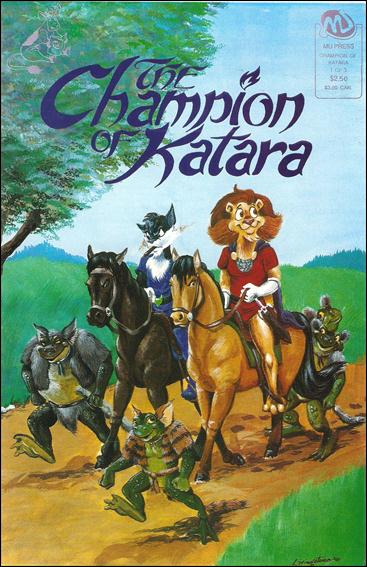
“Champion of Katara” by Chuck Melville tells the tale of a the greatest sorcerer of Katara, Flagstaff (Flagstaff’s foster sister may disagree…), and his adventures in a humorous sword & sorcery world. If you enjoy the adventures of Flagstaff, you might also enjoy another awesome fantasy series set in the same universe (and starring the aforementioned foster sister): and Felicia, Sorceress of Katara, or Chuck’s weekly gag strip, Mr. Cow, which was on a hiatus for a while but is now back. If you like Mr. Cow, Felicia, or Flagstaff (the hero of Champions of Katara) you can support the artist by going to his Patreon Page. Also, can I interest you in a Mr. Cow Mug?
If you want to read a nice, long graphic-novel style story which recently published its conclusion, check-out the not quite accurately named, The Less Than Epic Adventures of T.J. and Amal by E.K. Weaver. I say inaccurate because I found their story quite epic (not to mention engaging, moving, surprising, fulfilling… I could go on). Some sections of the tale are Not Safe For Work, as they say, though she marks them clearly. The complete graphic novels are available for sale in both ebook and paper versions, by the way.
Oglaf, by Trudy Cooper and Doug Bayne is a Not Safe For Work web comic about… well, it’s sort a generic “medieval” high fantasy universe, but with adult themes, often sexual. Jokes are based on fantasy story and movie clichés, gaming tropes, and the like. And let me repeat, since I got a startled message from someone in response to a previous posting of this recommendation: Oglaf is Not Safe For Work (NSFW)!
This photo of the Eagle Creek Fire, taken by Kristi McCluer of Vancouver, Washington, went viral this week, though few who shared the photo gave her credit.It’s Friday, the second Friday in September. Usually at this point I will wax poetic about the blessédness of this month and the superiority of people burn during it, but right now with all the insane weather and earthquakes and wildfires and tsunamis… I’m not sure it’s really appropriate
All week long locally they’ve been promising us that the hellish smoke layer (seriously, ashes were falling from the sky like snowflakes on Tuesday, and the sun has been blood red for days) would start to clear out and be all gone before the end of the week. And then each day the forecast has revised and moved that day back. As I right this Thursday night we are still under a layer of smoke, air quality has only improved to Moderately Bad, and there has been no sign of the promised rain.
Anyway, here are the links I gathered this week, sorted into categories as accurately as I could.
Click to embiggenIn 1990 Mister Rogers Sued The KKK For Impersonating Him (and won!). In 1990, Mr. Rogers sued the KKK for impersonating his voice in prerecorded messages. These messages said “AIDS was divine retribution” and included radio skits simulating lynchings of black children on a playground. The messages were spread to elementary and middle school children by passing out misleading fliers with a phone number to call for a special message from a friendly neighbor.
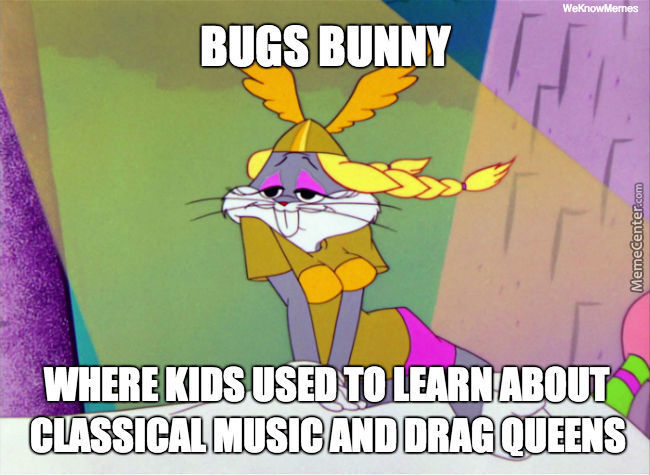
“Bugs Bunny: where kids used to learn about classical music and drag queens.”At several points during my childhood people asserted the claim that what was “wrong” with me was caused by the movies/TV shows I watched or the books I read. At one point certain extended family members were trying to convince my parents that I shouldn’t be allowed to watch scary cartoons. At another point, a lot of church people were certain that my interest in science, particularly astronomy, was turning me into a satanist or even worse, an atheist! There were lots of times that various people asserted that either musicals, or fantasy/sci fi, or some other thing I was interested in was why I kept getting bullied by the other kids at school. The truth is, that many teachers, church members, and family members were all bullying me as much as any kids at school were, though they weren’t willing to admit it. Throughout my childhood and teen years I was constantly trying to figure out how to get people to stop despising me. A big part of why I couldn’t figure it out was that there were actually two reasons. First, I was queer, and second, I was smarter than average with a particular knack for analytical thinking.
When people find a person in their midst who does not conform to their expectations, their reaction is to try to find a behavioral cause of that non-conformity. Because admitting that different kinds of people exist naturally challenges the simplest notion of normality. So when confronted with a smart, slightly gender-non-conforming kid who seems to know about things people don’t expect kids to understand, they go looking for an easy explanation of why I’m different. And it really was both of those differences that confused people. More than one relative on different sides of the family commented that as a young child I seemed like an adult trapped in a kid’s body.
When you are clinging to the notion that there is a limited number of ways to be normal with someone who doesn’t fit any of your notions, the easiest thing is to look at which of the non-conforming person’s interests seem least like theirs. So in the 1960s and ’70s, people focused on my interest in science, science fiction, fantasy and related topics. Because before the era of the personal computer and the cultural behemoth that was the original Star Wars, those things were completely beyond the kin of normal humans. Some of the cover art of magazines and paperback books raised a few eyebrows. At least one relative asserted the belief that reading superhero comics, with all of those skin tight costumes on the male heroes, would turn a boy into a sissy.
In retrospect I find it hilarious, because of all the media/fiction I can recall from my childhood, the only place where gender fluidity and related topics occurred regularly was not in science fiction, fantasy, or science fact books, but in one of the most popular forms of pop culture of many decades: Looney Tunes cartoons, specifically Bugs Bunny cartoons.
Even before Bugs Bunny had the name “Bugs,” he was dressing up as a woman to seduce a male character. Long before he ever dressed as a woman to distract Elmer Fudd or Yosemite Sam, the character then referred to informally as “Happy Rabbit” disguised himself as a female version of the unnamed hunter’s dog to distract the dog from his trail. So if everyone’s theory that somehow what made me non-conforming was the shows I watched, clearly it should have been Bugs Bunny they focused on, right? Contrariwise, Bugs is a great argument against the whole media-causes-queerness argument: as I pointed out in a post last week, for a number of years the Looney Tunes cartoons weren’t just ubiquitious, they were almost universally adored by a couple of generations of folks. If media exposure causes queerness, then just about every single person aged 40-something through 60-something alive in North America right now should be an out queer, because Bugs taught us all that to be a drag queen was to be triumphant.
This meaning of drag: “Women’s clothes as worn by a man; (less commonly) men’s clothes as worn by a woman; a party at which such clothes are worn” as rendered in the Oxford English Dictionary has been around since the late 19th Century. The first written citation coming in 1870 as a reference to male actors portraying female characters on the stage. At various times in the history of the theatre, it had been common to cast young men in the feminine roles, because it was considered inappropriate for women to perform on stage. So there is a certain tradition in the theatre (which cropped up later in movies, though usually for comedic effect) of men dressing as women on stage. There is also a tradition of characters of either sex on stage and in movies dressing in disguises—sometimes disguises that shouldn’t fool anyone—and carrying on for scene after scene completely pulling the wool of the eyes of other characters.
The disguises that Bugs donned in the various cartoons weren’t always drag. The point of the gag was how gullible Bugs’ adversary could be in light of the disguise, no matter how ridiculous. Which is why I don’t think it ever occurred to anyone back then that how easily the hero of the story could adopt the persona of a woman and seductively entrance the villain might be just a little bit queer. Maybe it was the fact that the audience was in on the joke—Bugs was dressing as a woman to fool his antagonist and make the audience laugh, not because he enjoyed it, and certainly not because he was actually trying to seduce the other character. Maybe it was simply the fact that they understood the jokes in a Bugs Bunny cartoon, but sf/f didn’t appeal to them, and a lot of that cover art looked erotic, demonic, and sometimes both.
To me, the ease with which Bugs transformed himself in his various disguises is a manifestation of a much, much older narrative tradition: The Trickster God. One of the oldest examples of which is the Old Norse story of the time that Loki is tasked by Odin with getting the gods of Asgard out of a particularly unwise bet. The gods had made a deal with a builder to create a magnificent fortification, but that if the builder couldn’t do it in a ridiculously short time with no help except that of his horse, the gods would never have to pay for the fortress. It quickly becomes clear that that both the builder and his horse are possessed of magical abilities and will succeed at the seemingly impossible task. Loki tries various things, but eventually is only able to succeed by transforming himself into a beautiful mare in heat, and thus lure the magical horse away. In the Norse story, Loki actually mates with the horse and later gives birth to another magical steed, Sleipnir, which becomes Odin’s horse and figures in a lot of other myths.
I’m just glad that I never pointed out that little similarity back then. It was one thing when I was sometimes forbidden to check out certain books from the library, or buy certain paperbacks at the used book store. It would have been infinitely crueler to forbid me from watching Bugs and Daffy!
 Several years ago I witnessed an altercation on the bus. When I first got on, I noticed one guy with blond hair that was combed just so and his mustache was freshly trimmed, and he was dressed in what looked like a new suit and tie. He was sitting up super-straight, as if he had an iron rod up his backside. Everything about him radiated attitude. His smile was particularly smug.











 Font Folly