My cough is still lingering. It has become much less frequent, which leads me even more to suspect that it’s a weird hay fever side effect, but still, no fun. And on Monday we set a record for heat, and the temperatures remain much higher than I am comfortable with.
Which brings us to the Friday Five. This week I bring you:the top five stories of the week, five stories of interest to queers and our alles, five stories about the pandemic, five stories about the alleged president of the republic, five stories about hate and injustice, and five videos (plus notable obituaries and some things I wrote).
False dichotomies…The Hugo Awards (though at the time they were called the Science Fiction Achievement Awards) were first awarded at the 1953 WorldCon (PhilCon II, which was the 11th World Science Fiction Convention) in a process much different than the way winners are selected today. The organizers of the 1954 WorldCon did not conduct any sort of award survey or ceremony, but the 1955 organizers did, as did the next few WorldCons. It wasn’t until 1961 that the rules for the awards were codified with the adoption of the World Science Fiction Society constitution, which also made the awards a permanent recurring part of the convention.
In 1994 the World Science Fiction Society approved the awarding of Retrospective Hugos for those years when there had been a WorldCon, but no Hugos. WorldCons aren’t required to award them. Also, Retro Hugos awards are allowed only for specific years: 50, 75, or 100 years before the current Worldcon, and only if another WorldCon hasn’t already awarded Retro Hugos for that year.
The original idea was that the Retro Hugos can only be given out 11 times—for the years 1939, 1940, 1941, 1946, 1947, 1948, 1949, 1950, 1951, 1952, and 1954. Because there was no WorldCon from 1942-1945, due to World War II. A recent rule change now allows for awards for those war years, as well, which is how we got to the ceremony earlier this week at CoNZealand where Retro Hugos for 1945 were handed out.
When I first heard about the idea, I thought it was a good one. People were creating and reading (or viewing) science fiction in those years, and it made sense that the organizations handing out awards for excellence in sf/f should look at award-worthy stuff during that time. It gives fans a chance to read stories with which they are unfamiliar and learn about the history of this genre we love, right? And if gives us, as a community, and opportunity to recognize some works and creators who are less famous today.
In practice, I’m not sure things have exactly worked out that way.
A lot of the Retro Hugos have gone to people who are still famous today (and who often had received plenty of awards while they were still alive). And it isn’t even because those are the best stories that made it to the ballot from that year. Several of the Retro Hugos have gone to rather mediocre stories from early in the careers of people who went on later to write much better stuff.
In other words, it seems that a lot of voters aren’t actually reading the nominated works, but rather picking works that are written by people they have heard of.
It it difficult to track down some of these old stories, I get it. Even though there are wonderful fan blogs out there publishing lists of links to where you can find these tales (since they have often fallen into the public domain many are available for free). As a voter myself, I admit that each time it has been a struggle to read everything nominated from both the regular Hugo ballot and the Retro Hugo ballot during the time between when the ballots are announced and when voting closes.
An even more difficult category is Best Editor, Short Form. Which is, in practical terms, an award for best magazine editor. So in order to do one’s due diligence this year, for instance, you would have to peruse all of the issues published in the eligibility year of the at least the magazines Astounding Stories, Weird Tales, Famous Fantastic Mysteries, Amazing Stories, Thrilling Wonder Stories, and Planet Stories.
That’s a lot of 75-year-old magazines to track down.
And if, like me, you track down scanned versions of the old zines at places like the Internet Archive, probably your first reaction will be a lot of “WTF?” because all the ‘zines from that era printed a lot of stuff which would never pass muster today. A month or so ago it shouldn’t have surprised me at how much WTF-material there was (because this is hardly my first time looking at stories and magazines from the time), yet it did a bit. It’s amazing how quickly we forget the weird stuff, the poorly written stories you couldn’t force yourself to finish, and so on. You remember the stories you thought weren’t bad (and sometimes even quite good) more than the other stuff.
If you aren’t willing to do that, you’re going to fall back (as the voters did this year), and the name you know: John f-ing Campbell, yet again.
I haven’t read every single issue of Astounding (later renamed Analog) Campbell ever edited, but I’ve read enough to draw an opinion of his skills as an editor overall. Looking at the stories he published in the year under questions, to the extent I could in the time frame, I found his selection of stories to be overall, mediocre. Yes, there was good stuff in there, but the was a lot more meh than wow.
I believe strong arguments can be made for at least two of the other nominees to be ranked above Campbell in this particular year. But if you point that out, people come back with basically three counter-arguments:
Everyone knows that Astounding was hands-down the best sci fi ‘zine of the time so who else could anyone vote for,
Campbell’s influence over the field dwarfs everyone else so who else could anyone vote for,
I liked more of the stories in the Astounding issues I sampled than in the others so…
The third of those arguments is the only one with any legitimacy. But let’s deal with the first two before I tackle the third.
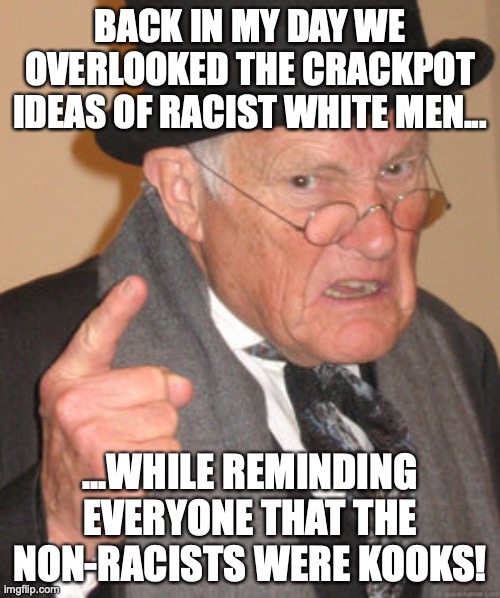
It’s amazing how many people still feel the need to defend the already much lauded racist, fascist misogynist…“Everyone knows” is simply a really bad reason to make any decision. We’re talking about very subjective things here, for one. And for most people it’s all second-hand knowledge at best. Most contemporary fans weren’t alive 75 years ago, let alone comprehensibly reading everything that was published. And cultural artifacts don’t survive equally. Astounding appealed to a certain demographic who, for a variety of reasons, are much more likely to live and remain active in a particularly hobby for many years than some others. The demographic has also, historically, had its preferences elevated above other groups, whose preferences and activities are often erased from history.
Also, the Suck Fairy has had 75 years to visit those publications. You shouldn’t fall back on the received wisdom without verifying for yourself.
As to the second argument, well, Donald J. Trump’s influence over the United States right now dwarfs everyone else, but it hardly means historians should be handing him a “Best President” trophy. I know that metaphor is a stretch, but the point is that having a lot of influence isn’t the same thing as using that influence well. And again, how much of Campbell’s influence was due to him, and how much is it due to that ability of the demographic he most appealed to to have an outsized impact on how the time period is remembered?
That third argument is a reasonable reason to determine who you vote for, I agree. But at least some of the people I’ve seen making that argument don’t stop at “this is why I voted for him,” they went on and tacked on the “…so who else could anyone vote for?”
Judging the editor categories is always difficult. Most people approach it by voting for the nominee who published the stuff the individual voter liked most.
That’s not the only criteria one ought to consider, in my opinion. Full disclosure: for over twenty years I edited a very small ‘zine that printed science fiction. Our circulation was never over about 300, but we also knew we were aiming at a particular niche. Still, it means I judge editors by more than just whether I like every story they publish. I didn’t limit myself, as an editor, to publishing only stories I thought were award-worthy and would stand the test of time. I picked stories because I thought my readers would like them and were worth their time and attention. Another quality I judge editors on is how well they seem to know their audience. If I have information about how they treat the writers they work with and the staff of their publications, I let that influence me, too.
Because giving your audience things they will enjoy (which isn’t the same thing as fan service, but that’s another discussion), cultivating writers, and managing staff are all also part of the job of an editor.
If I only voted for the editors whose publications I loved (and only stories I loved, et cetera), there would have been a lot more No Awards on my Hugo ballots over the last five years. I can look at something that isn’t to my particular taste and say, “Well, I don’t like that, but I know a lot of people do, and this seems to be a competent execution/exploration of a topic I don’t care for” and go ahead and vote for it. It’ll just be lower on my ballot than other things.
None of this is to say that no one has a right to vote for Campbell in the Retros. The question I raise in the title of this blog post is about whether the Retro Hugos are actually recognizing things that are award-worthy, or merely handing out trophies to nominees based on received wisdom instead of merit.
Unfortunately, the jury is still out.
Edited to add: Not many minutes after this published, one reader pointed out a copy-and-paste blunder that ate one whole sentence and part of a word.
Then another pointed out that my question is sort rhetorical for at least the next year, since the 1946 Retros were given out at LA Con III back in 1996, so it won’t be until 2022 that the question will come up again. To which I say, an amendment to the WSF Constitution has to be passed at two WorldCons before taking effect, though we don’t need a rule change if the organizers of 2022 and later conventions can be convinced that maybe these aren’t a great idea…
And Cora Buhlert wrote more elequantly on the same topic and included a lot links to other people writing on the same topic: Why the Retro Hugos Have Value.
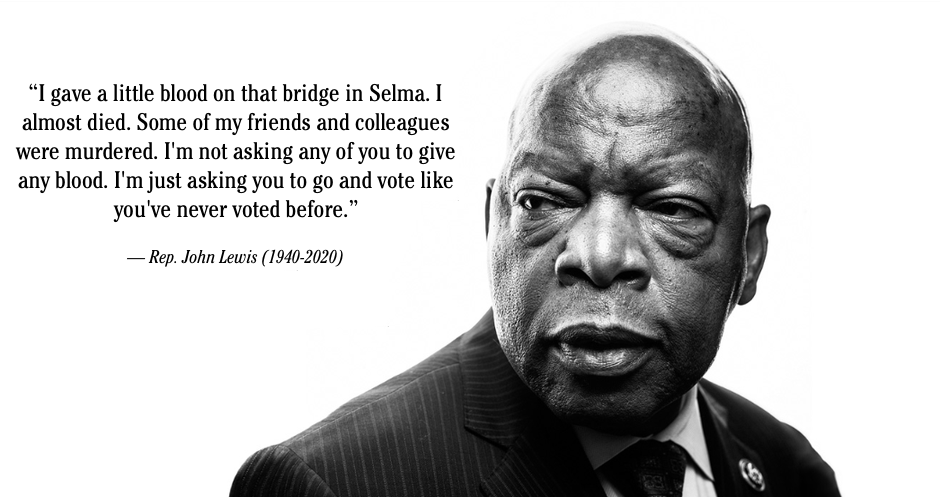
“I gave a little blood on that bridge in Selma. I almost died. Some of my friends and colleagues were murdered. I’m not asking any of you to give any blood. I’m just asking you to go and vote like you’ve never voted before.”
Register to vote.
If you think you are already registered to vote, check to make sure. In many states voter suppression tactics include deregistering voters.
Vote.
Vote in every election and for every race.
Vote as if your life depends on it (it does). Vote as if your life, your community, and your country depends on it (they do).
Make sure you’re registered. Don’t let them prevent you from voting!
“America has once again proven that a pile of dead bodies is on cause for change and the fact that you’re not sure which issue I’m talking about speaks to the depther of that problem.”
Full quote: “Do not get lost in a sea of despair. Be hopeful, be optimistic. Our struggle is not the struggle of a day, a week, a month, or a year, it is the struggle of a lifetime. Never, ever be afraid to make some noise and get in good trouble, necessary trouble.”
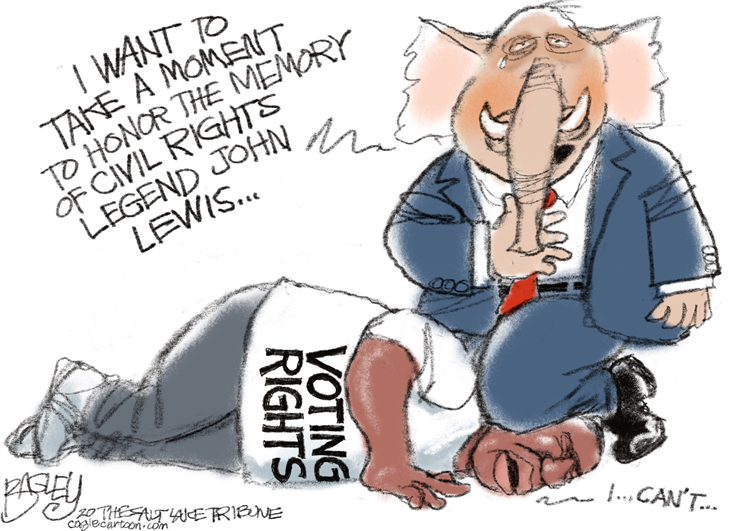
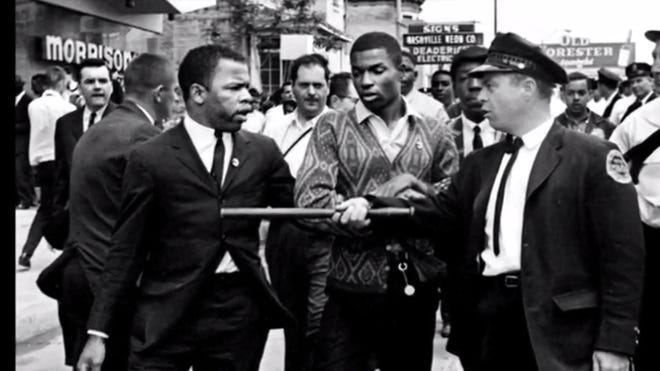
Lots of other people have written about U.S. Representative John Lewis. He was one of many fighting in the civil rights movement from the Nashville Student Movement in 1960, through the Freedom Rides and beyond. He was one of the “Big Six” organizers of the 1963 March On Washington (and until his death last week, he was the last survivor of the Big Six). He was beaten by police, arrested, had dog set on him, received countless death threats, but he never backed down. And eventually, he became not just an activist, but a member of Congress.
He was an American Hero from early on.
But he became one of my personal heroes in 1996. Bill Clinton had run for President on a promise to bring equal rights to the LGBT community, but instead he caved to pressure from the Republicans, conservative Democrats, and (even more problematic) timid Democrats. Instead of equality, he created the Don’t Ask, Don’t Tell policy for the armed services, which instead of making it easier for queer people to serve, significantly increased the number of discharges for being gay. And he also ultimately signed the so-called Defense of Marriage Act, which made it illegal for the federal government to recognized marriages of same-sex couples if states decided to extend those rights, and also exempted states from recognizing those marriages from other states (a clear violation of the Full Faith and Credit clause of the U.S. Constitution).
John Lewis was not one of the timid Democrats. He rose in opposition to the act. He spoke passionately about why he would vote against it.
“This bill is a slap in the face of the Declaration of Independence. It denies gay men and women the right to liberty and the pursuit of happiness. Marriage is a basic human right.”
—Rep. John Lewis, explaining why he was voting against the so-called Defense of Marriage Act in 1996
Unfortunately, the law passed. And we would have to wait for the Supreme Court to finally rule it unconstitutional in 2012.
That wasn’t the only time that John Lewis—a straight Black man, raised in the south, and an ordained Southern Baptist preacher—fought for LGBT rights.
“I have fought too hard and too long against discrimination based on race and color not to stand up against discrimination based on sexual orientation. I’ve heard the reasons for opposing civil marriage for same-sex couples. Cut through the distractions, and they stink of the same fear, hatred, and intolerance I have known in racism and in bigotry.”
—Rep. John Lewis, in an op-ed he wrote for the Boston Globe in 2003
“As a nation, we cannot say we are committed to equality, if we do not mandate equality for every citizen. You cannot have equality for some in America and not equality for all. This is another major step down a very long road toward the realization of a fair and just society. We should embrace the decision of the United States Supreme Court. It is now the law of the land.”
—Rep. John Lewis, commenting after the Supreme Court legalized Marriage Equality in 2015
I had really hoped that Rep. Lewis would live long enough to see us oust the fascist from the White House. I guess we’ll have to do in on our own.
Every time I see another headline about Lewis’s death, tears come to my eyes. We have lost a giant.
I’ve had a cough and sore throat since Saturday. The temperatures were scalding hot for a few days, and then we got a few days of overcast cooler days, though the forecast says that will soon pass. And, of course, the slow burn apocalypse of the real world drags on.
Which brings us to the Friday Five. This week I bring you:the top five stories of the week, five stories of interest to queers and our alles, five stories about the pandemic, five stories about the alleged president of the republic, five stories about science fact and fiction, and five videos (plus notable obituaries).
David Shor’s Unified Theory of American Politics. “In the postwar era, college-educated professionals were maybe 4 percent of the electorate. Which meant that basically no voters had remotely cosmopolitan values. But the flip side of this is that this educated 4 percent still ran the world. Both parties at this point were run by this highly educated, cosmopolitan minority that held a bunch of values that undergirded the postwar consensus, around democracy and rule of law, and all these things.”
(Click to embiggen)And here we are at the third Friday in July!
Much of this week I’ve been playing a much more annoying version of the “COVID or hay fever?” game. Not exactly a fun game in any variation. The weather got hot enough that I got to test my new air cooling devices this week. And then a new weather front moved in and we are back to rain and cool again. Usually summer arrives around July 11th here in the Pacific Northwest, but this year maybe not?
Which brings us to the Friday Five. This week I bring you:the top five stories of the week, five stories of interest to queers and our alles, five stories about the pandemic, five stories about the alleged president of the republic, and five videos (plus notable obituaries and some things I wrote).
“Most of the meat is produced by others, and some of the cuts are delicious and uncontaminated. But tainted meat — say, Trump steaks — also gets out the door in ever increasing amounts and without regulatory oversight.
“The argument from the head butcher is this: People should be free to eat rotten hamburger, even if it wreaks havoc on their gastrointestinal tract, and the seller of the meat should not be the one to tell them which meat is good and which is bad (even though the butcher can tell in most cases).
“Basically, the message is that you should find the truth through vomiting and — so sorry — maybe even death.”
Time once again to visit stories that broke after I posted this week’s Friday Five or represent a new development in a story I’ve linked to and/or that I’ve ranted or otherwise expressed opinions upon before. This week supplemented with some graphics I collected for possible inclusion in blog posts which are just going to sit on the hard disk unless I upload a whole bunch of them at once. Let’s just jump in, shall we?
Roger Stone is an ass. He is a criminal. He is almost certainly a traitor. But he did all of that to help the alleged president, so of course just before he is to serve an extremely light sentence for the crimes he was convicted of, the narcissistic fascist occupying the oval office has commuted his sentence. And of course he had to spew a bunch of lies while doing it: Debunking 12 lies and falsehoods from the White House statement on Roger Stone’s commutation.
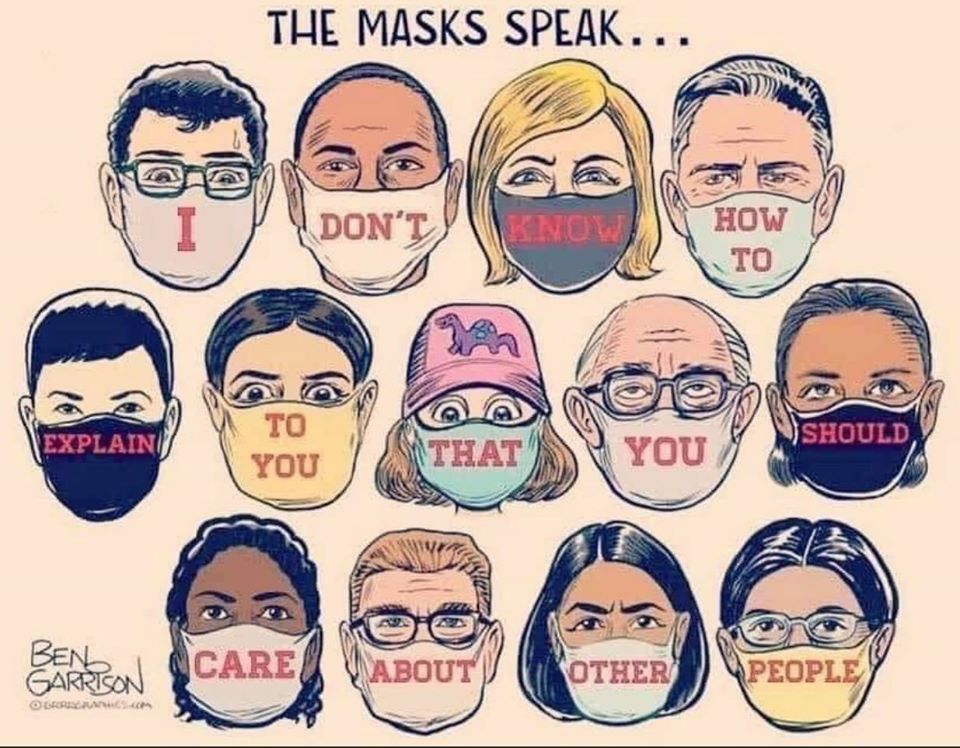
The masks speak…The vast majority of Americans are trying to be smart. We are trying to practice social distancing. We are wearing masks when we go out. The problem is a minority of stupid, evil, mother-fuckers. And I know that if too many of them get sick that puts health care workers at risk… but me thinking that politicians like this are only getting what the deserve is NOT what’s putting those workers at risk: Commissioner who Voted Against Masks in Critical Condition with COVID-19. If he dies, he had it coming. And I will not apologize for pointing out that fact. Speaking of people who had it coming: 26 lawmakers have tested positive for COVID-19 in Mississippi state legislature outbreak.
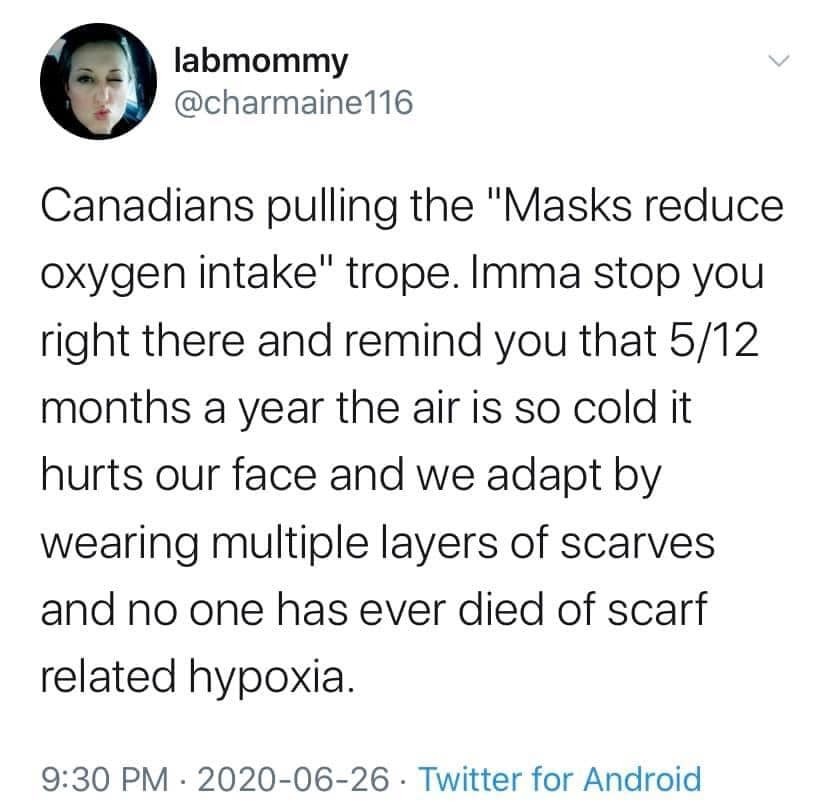
(Click to embiggen)And while I mostly point out the failings of my fellow Americans, it is important to remember that we don’t have a monopoly on either stupidity or ignorant conservatism. Wear a mask, and stop being a drama queen! Surgical teams wear masks far more restrictive than the simple cloth masks we’re asking for–and they complete hours long complicated surgeries with no one passing out, et cetera. Wearing a mask is different than not wearing one, but it isn’t onerous, it isn’t damaging to your health, and it isn’t something you can’t get used to. And it does save the lives of other people. Stop being ignorant, selfish pricks, and wear a mask!
That’s all the bad news I can deal with this morning. Let’s look at something less serious, shall we?
Lin-Manuel Miranda And Stephen Cobert Perform “Button!”:
As a long-time resident of Western Washington state (I came to live here as a teenager way back in 1976), I am well aware of the fact that summer weather doesn’t typically arrive here until July 11. Many locals joke that it is July 5, mostly because people remember how many 4ths of July were overcast and/or rainy, and that sunny weather arrived sometime after Independence Day, but statistically it isn’t the 5th, it’s the 11th. I mention this because all this week a lot of local news blogs and such have been hyping the fact this this year year has seen the coolest first week in July in Seattle since 2002. Since I’m a person who basically melts into a puddle of Unable-to-do-anything whenever the temperature gets about 80º Farenheit, I’m not exactly complaining, mind you.
Which means that this must be the Friday Five. This week I bring you:the top five stories of the week, five stories about the pandemic, five stories about deplorable people, and five videos (plus notable obituaries and some things I wrote).
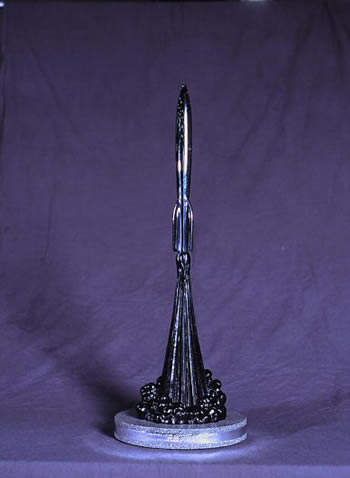
The Hugo trophy given out at NolaCon II, New Orleans, 1988. Trophy designed by: Ned Dameron Photo by: Michael BenvenisteThe Hugo Online Ballots have finally opened! Which means I have a lot fewer excuses not to start filling mine out. If you are a Hugo voter (i.e., have a membership to this year’s WorldCon) and you haven’t received the email telling you how to log in and vote, you should probably check your spam folder(s). I haven’t posted any reviews of any of the books or stories or otherwise on the ballots, yet. But some other folks have. I am most enthused about a series of blog posts that Camestros Felapton is putting up this week, here’s the overview: It’s Hugo Fan Writer Finalist Week! Each day this week he is posting a “Hugo Fan Writer: Why you should vote for… ” essay. Because each and everyone one of the six nominees in that category this year are just bloody brilliant fan writers. I wanna give all six of them the rocket.
His reviews give a nice overview of what each of the fan writers produce, with helpful links to stuff the many places you can find their work. Even if you aren’t a Hugo voter, but you love sci fi/fantasy, you should check these six writers out. They are all wonderful.
Just as I’m finding it very difficult to rank the six fan writer nominees, I’m having a nearly equally hard time in the Novel category. I may have to write about that some more later.
But for now, if you’re a voter, go vote! If you’re a fan, go check out those fan writers!
 And we have arrived at the final Friday in July!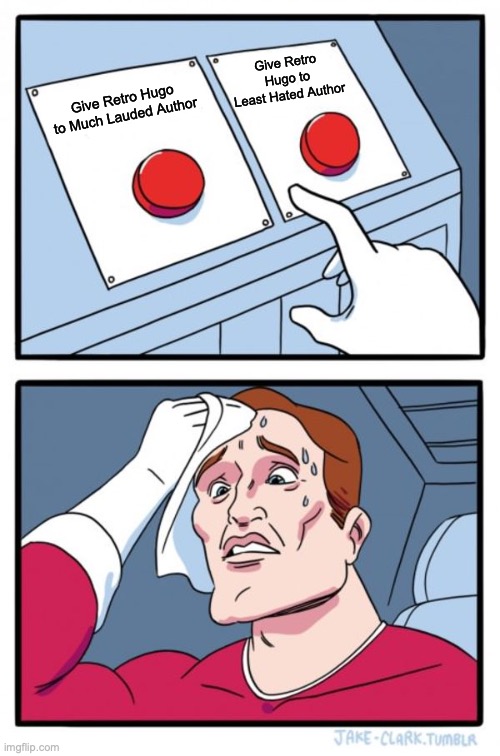







 Font Folly