I've loved reading for as long as I can remember. I write fantasy, science fiction, mystery, and nonfiction. For more than 20 years I edited and published an anthropomorphic sci-fi/space opera literary fanzine. I attend and work on the staff for several anthropormorphics, anime, and science fiction conventions. I live near Seattle with my wonderful husband, still completely amazed that he puts up with me at all.
View all posts by fontfolly →
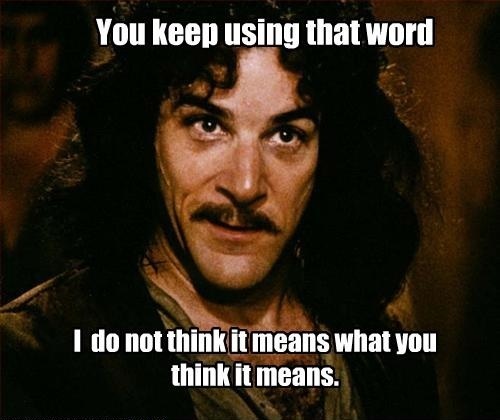
“You keep using that word. I do not think it means what you think it means.”I don’t remember when I first heard “duuuuuude!” As a word intended to communicate anything from, “Hello, friend!” to “I agree!” to “Don’t panic” to “I can’t believe you just said/did that! What were you thinking?” and a million things in-between. Before I looked up the linquistic history of the word, I had hazarded a guess that it was late in high school, which would put it roughly in the year 1978-79. And while that particular sense of the word seems to have arisen in several different American subcultures in the 50s and 60s, it didn’t really begin the move into pop culture until the early 80s, so it was more likely in college (which began as several years of attending community college part-time while working to save up for university, before three more years there) where I acquired the habit.
I know in the 90s I used the word with friends and acquaintances of both genders. One butch lesbian friend was very fond of using “Dude!” to mean, “You can’t be serious!” for instance. So even though I knew that the word originally meant (back in the 1800s) a foppish young man who dressed in overly-fashion-conscious clothes and affected a sophisticated manner, and then later had morphed to describe a man from the city visiting the western countryside who was unfamiliar with physical labor and the necessities of life on the range, I thought of it as a gender-neutral term.
I was reading this blog post: Constantine or when the imitators eclipse the original about why an adaptation of a classic might be well done, but still seem derivative (and not of its source material). It reminded me of once when I read someone’s post about being disappointed about a Theodore Sturgeon book from the fifties, because it seemed to be a rip-off of the X-men. So I explained that it was the other way around: the original X-men comic book was created more than a decade after the Sturgeon works in question, and the same reason many people called Sturgeon’s stories classics, meant that lots of stories written since then have incorporated (and in many cased improved upon) his original ideas.
Once I noticed the phenomenon, I started seeing it everywhere. A story that had first introduced a particular concept or literary technique is hailed as a classic or breakthrough, but a decade of more later when hundreds of stories, movies, television episodes, et al have been influenced by it, the original pales by comparison.
I think Buhlert, the author of the above linked blog post, is correct that this phenomenon is a big part of why the recent television adaptation of the comic book character John Constantine flopped. But I also think there is more to it than that. I complained at the time that the showrunners had explicitly stated that this John Constantine, unlike the character in the comic books, was definitely not bisexual. And I don’t think the decision was a bad one because I think adaptations ought to slavishly follow the original. Nor do I think the decision was bad merely because as a queer person myself I take queer erasure personally.
It was a bad decision artistically because it was a symptom of a bigger problem. The people adapting the character and the character’s story failed to understand the essence of the character. Constantine isn’t merely a mystical version of a noir detective. While the character appears to dwell in that aesthetic, there is a significant difference. The archetypical noir protagonist is alienated and filled with existential bitterness, striving against random uncaring fate. Noir protagonists (and noir story lines) lack hope. Noir protagonists are frequently doomed because they are manipulated by others, traditionally a femme fatale.
The art style of Hellblazer, the comic series that starred Constantine, was very like a film noir. And Constantine’s cynicism looks an awful lot like the typical noir protagonist to the casual observer. But Constantine wasn’t alienated. Alan Moore, who created Constantine, once said that he was aiming for a character who knew everything and knew everyone; a character who was charismatic and never at a loss for what to do. That made Constantine, in several important aspects, the opposite of a noir protagonist. Constantine doesn’t struggle against random, uncaring fate—he often struggles against supernatural forces that are emphatically intentional in their disruption of mortal life—not at all random.
Constantine cares about people; he’s not alienated, he’s connected. And while manipulation happens in Constantine stories, it is usually Constantine doing the manipulation, rather than being the victim of manipulation. His cynicism comes from observing, again and again, that people he cares about always die. The noir protagonist’s cynicism, on the other hand, is usually the result of being betrayed or failed again and again by people they trust.
For example, in one issue of the comic, the King of the Vampires kills a man that Constantine had hooked up with the night before. When the King asks Constantine if the dead man was a friend, Constantine’s reply is, “He’s dead now, so he must have been.”
Sidenote: It has been said that noir’s roots are irrevocably American. I agree with Buhlert’s assessment that Constantine is quintessentially British, and that he works best in a British setting. And even when his stories don’t have a British setting, he is better when being writing by a British author (in my humble opinion). The showrunners’ decision to move Constantine to the U.S. certainly didn’t improve the chances they would catch the essence of the character.
To get back to my main point: You can have a straight character who has all of those characteristics, but the same sort of shallow misunderstanding of the character which leads someone to say, “we can drop his queerness” also led them to miss all the other things that made Constantine different from the noir archetype. When you combine that with the phenomenon that much of urban fantasy has adopted the aesthetic of the original Hellblazer comics, it just increased the likelihood that what they produced would come out as a bland copy of something we’ve seen a thousand times before.
“Highly Illogical — Vulcan for Dumbass.I wrote a lot less about the Hugos this year than last. I participated in the nominating process. I was greatly disappointed that having so many new nominators didn’t prevent the Rabid Puppies from bloc-filling several categories again. And I read (or tried to read in some cases) everything that was nominated which I hadn’t already read in time to fill out my ballot. Saturday night, I was very happy to see that the horrible things the Puppy slate-voters forced onto the ballot didn’t win. I was also happy that there were fewer categories that we had to No Award this year.
Not writing about it so much this year was intentional. One benefit of that was that I had fewer vitriolic comments come in on this blog that I had to delete rather than approve. I was a lot less anxious about what the results of the voting would be than I was last year. I’m not sure how much of that was because last year the Hugo voters overwhelmingly rejected the Puppy slate, rather than a result of actively avoiding writing and thinking about them as much.
I am quite certain that at least part of the reason I was less emotionally distraught going in was that I didn’t force myself to read all the way to the end of every entry in short story, novella, and novelette this year. I gave each entry three pages to hook me, and if they didn’t hook me by then, I stopped and put them beneath No Award on my ballot. Reading some of that awful stuff—stories that would have been rejected for poor composition, lack of plot, or gapping logic holes by most of the fanzines I’ve ever been associated with—and getting outraged at the knowledge that such poorly crafted material had displaced more deserving works was a big part of why I was so upset last year.
The works that won this year are great and quite deserving. A couple of them were even things that I nominated, so that was fun.
There was some drama at WorldCon, at least some of it related to the proponents of the Puppy cause. But I also hear that a lot more very cool stuff happened.
“The one thing I keep learning, again and again, as I study this award is that, much as it frustrates me, much as it throws up shortlists that disappoint me, much as it often seems stuck in a middlebrow rut, the Hugo is always what it is. It doesn’t take thousands of new voters to keep the Hugo true to itself, because the people who vote for it every year will do that job themselves. With something like half the voters we had last year, we still managed to send the same message: that we have no patience for astroturf; that we have no time for writing that embarrasses the paper and ink used to print it; and that this is an award that can be gamed, but it can’t be stolen. This year’s Hugo voters had no trouble telling junk from serious nominees; they saw the difference between the nominees being used as shields by the puppies and the ones that truly represent their literary tastes and politics. And even more importantly, in the best novel and best novella categories in particular, Hugo voters recognized some of the finest and most exciting work published in this genre in years.”
One place where I disagree with Nussbaum is about the nature of the drop-off in voting numbers this year compared to last, after last year had such a dramatic surge of new voters. Last year’s number of voters was 5,950, which was a big leap from the 3,587 ballots cast in 2014. This year, the number dropped down to 3,130, which is in the ballpark of the 2014 number. However, as many people pointed out, 2014 had an usually high number of Hugo voters. In fact, from 1976 through 2010, the average number of ballots cast each year was about 1100.
So to argue that the voting numbers this year have dropped back to the level before is a bit shaky. Yes, last year after news broke of the Puppy assaults on the award, a couple thousand more fans than usual purchased WorldCon supporting memberships. Based on all the blogging and how they voted, those extra memberships were people coming to vote against slate voting, or at least the worst of the slates. But that the numbers didn’t leap that high this year doesn’t mean those extra fans all gave up. I know of six people who voted for the first time ever last year because of the Puppies, and who also voted this year. That isn’t a scientific sample by any means, but 3130 votes is a lot higher than the pre-Puppy typical number.
Also, last year wasn’t the first year that the Puppies ran their campaign, it was simply the first year that they managed to take over entire categories on the ballot with their bloc voting scheme.
She’s right that it is harder to get people to do something they’ve never done before consistently, but I don’t think that all of us who had never voted before last year are going away.
“[Theodore “Vox Day” Beale] is trying his best to spin the defeat as a victory (“we have the SF-SJWs exactly where we want them at this point in time”) but even the fake sci-fi boys on Reddit’s gamergate hangout KotakuInAction can see what happened. And they are indeed sad little puppies about it.”
“Another attempt by the Sad and Rabid Puppies groups to hijack the science fiction award goes to the dogs, as authors and titles not in their campaign take top prizes.”
And past Hugo-nominee Saladin Ahmed had a couple of good observations on Twitter:
The Hugos went to some very deserving works. The Fifth Season by N.K. Jemisin (which won Best Novel) was one of the best books I’ve read in the last couple of years; it’s hard to describe, but it is a book about a world where apocalypse events happen with great regularity, but it is also funny and hopeful even while commenting on the nature of inequality. And “Cat Pictures Please” by Naomi Kritzer (which won Best Short Story) was the a truly delightful take on Artificial Intelligence while being a comment on the human condition. I could keep going on, because oddly enough, my first choice in most of the categories of the ballot were also the winners. They were all really good. To read a good run-down of who won, you can check out this blog: The 2016 Hugo Awards or Fandom 2 : Puppies 0:
“To sum it up, in spite of canine interference, women won or co-won Hugos in nine of seventeen categories. All four fiction categories were won by women, three of them women of colour (plus a man of colour winning as translator). So inspite of the rabid puppies doing their worst, we still have one of the most diverse list of winners ever. And even though a couple of IMO puppy hostages finished under “No Award”, we also puppy hostages winning. Actual puppies, however, lost and lost badly.”
And I could repeat all the arguments I and others have made before of how the claims of the Sad and Rabid Puppies are highly illogical, but you’d have more fun reading the Guardian’s Book Blog where Damien Walter reads and reacts to some of the Puppies’ favorite authors, Hugo awards: reading the Sad Puppies’ pets:
“[T]he Sad Puppies don’t want any of their books to end up on bestseller lists or TV screens. It’s the same frustrating paradigm that British MP Michael Gove hit upon when he said that people were sick of experts, or what Donald Trump plays upon when he rails against “professional politicians”. We’re seeing the Dunning-Kruger effect played out on a mass scale, and the Sad Puppies are just a speck in that wider problem.”
Okay, the Puppies will be with us for years to come, just as we have never gotten rid of white supremacists nor men who want to take the right to vote away from women. But over time, the movements wither. As we’re seeing right now with the upsurgence of the Teabaggers and other Trump supporters, hate can rear its ugly head again. But in the long run, light dispels darkness and love beats hate. All this anger about people other than straight white dudes winning every single award is the dying gasp of a shrinking fraction of the population.
Vox Day and his ilk will keep trying to whip up trouble as long as he thinks it will help him sell books. But I think history is clear that he is going to be appealing to a smaller and smaller group of people. And as Mr. Spock once observed: “Without followers, evil cannot spread.”
Fortunately, there are people actively working to spread good. Alexandra Erin points out that the point of conventions or Hugos and any other awards is about connections and feelings of genuine admiration: WORLDCON: Comedy tomorrow, Hugos tonight. And once again George R.R. Martin hosted the Hugo Losers Party and handed out awards to people and publications that would have made the ballet without the slate voting: Alfie Awards.
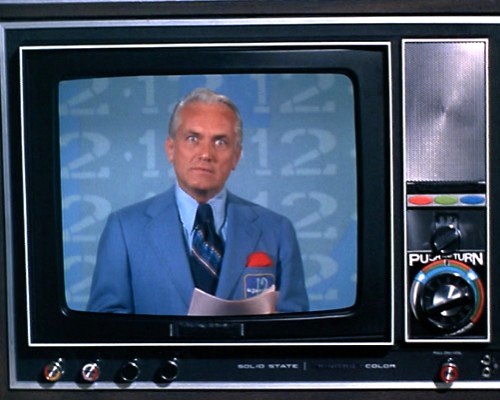
Ted Knight portraying fictional (and bumbling) news anchor, Ted Baxter, on the Mary Tyler Moore Show.Back in University, one of the majors I toyed with (I changed major several times) was Journalism. And I wasn’t the only person who studied and otherwise dabbled in the news biz for a while who thought about whether, if I pursued that career, I might one day be reporting news on the airwaves. I always thought it might be funny, if I were in a position to have a sign-off phrase, if I stole the phrase of the fictitious (and comedic) news anchor, Ted Baxter. Just as news legend Edward R. Murrow had always famously ended his broadcasts with, “Good night, and good luck,” Baxter signed off each night with, “Good night, and good news!”
In case you don’t know: Gawker started out many years ago as a snarky/gossipy blog that covered “the scene” in New York City, which quite often involved covering other news sites and publications and the people who wrote for them. This was back when founding editor Elizabeth Spiers wrote almost all of the content and treated it almost as a personal blog. Spiers moved on and other people took over. Gawker expanded and changed, becoming, as Joshua David Stein says in the Guardian peace, “bullies.” He goes into a bit more detail, calling Gawker “a fertile ground for many things – ego, fame, alacrity, wit, a quick turn of phrase – but kindness was not one of them.”
I’m not writing to apologize for Gawker nor to say they were justified in what they did (Stein attempts to do that in his article, but I remain unconvinced). What I do strongly believe, however, is that Gawker’s death isn’t anything to cheer about, either. There are simply no heroes in the story of its demise. In 2007 they “outed” Peter Thiel. Thiel is often described as a billionaire investor (though he’s probably not as rich as he claims), but a more accurate description would be, man who got rich by mismanaging other people’s billions in a way that enriched him and impoverished them. If you want to know what kind of person he is, he’s the man who agreed to be Trump’s token gay speaker at the Republican National Convention; it’s harder to get any sleazier that being a gay spokesperson for a convention that adopted the single most hateful anti-gay political platform in the history of the U.S. He’s also one of the guys who thinks that women shouldn’t have the right to vote.
I put “outed” in quotes because Thiel wasn’t exactly closeted at the time. He wasn’t exactly out a proud, because like most homocons he held most out and proud queer people in contempt, but he had gone to no pains to hide his orientation, and was a public figure who regularly sought publicity and was often still trying to get people to invest in his managed funds. Being outed didn’t cause any measurable harm to his reputation. He was in no danger of losing his job, et cetera. Still, he was pissed off at Gawker because of the incident, and swore to destroy them.
Gawker, in just one of the many cases of bullying, published a sex video of former pro wrestler Hulk Hogan. Hogan had been a public figure, but he was generally retired. He wasn’t the public spokesman for one of those anti-gay/anti-sex organizations campaigning for laws restricting other people’s rights in the name of morality. Which wouldn’t have, IMHO, been justification to publish the video, but could have been a legitimate rationale to report on its existence. But they didn’t have such a rationale, so publishing it was just a puerile bid for clicks.
Hogan sued. And as we now know, he was able to afford to fight it out in courts, refusing all settlements, for as long as he did because Thiel was actually paying the legal bills. Thiel has since admitted that he’s funding several other lawsuits still pending. Hogan won a large settlement (and I’m glad he won; I just wish he had done so without getting involved with a sleaze like Thiel). And the settlement was so huge, that it forced Gawker Media, the parent corporation of Gawker.com, into bankruptcy. Which has left a bunch of people who work for other, less sleazy news sites that Gawker has been buying up over the years, in a position of not knowing whether they still had jobs.
And I want to be very clear here: the other news sites were not run like Gawker, and the people working for them are not complicit in any way with the sorts of sleazy stories Gawker is known for. The other sites were purchased by Gawker to shore up Gawker’s financial position, and were allowed to be run as before so they’d keep producing the cashflow needed to support the business. Which is why Univision, which won the bankruptcy auction, has announced that the other sites will be allowed to keep operating as before. Univision has absolutely no interest in the Gawker.com name or its brand of “journalism.”
It’s not just the Thiel is a sleazy hypocrite and a bully—the real shame here is that he’s used his wealth to completely shut down a news site because he didn’t like their coverage. Gawker’s owner and managing editor, Nick Denton, has been deservedly hung out on a rope of his own making. But the actual executioner, Thiel, is not on the side of justice.
New CDC Data: LGB Teens Face Startling Rates of Violence, Bullying and Suicidality. Yes, I posted a story about this study last week. But I have since seen op-ed pieces that keep asking, “What’s the LGBT community going to do about this?” The LGBT community can’t do anything about this. This study is about how queer kids are treated in their homes, in their churches, and in their schools. The LGBT community con’t control homophobic parents, or homophobic churches, or schools. If yet another study showing that children are bullied to the point of suicide makes upsets the straight community, the straight community, which outnumbers us and has some control over these things, needs to step up.
Nathaniel Hawthorne wrote The Scarlet Letter in 1850.Occasionally I find myself in the position of having to defend labeling some books or movies or television shows as being part of the science fiction/fantasy genre. For instance, a few years ago, during the early seasons of Person of Interest, someone said I shouldn’t call it sf because it was just an action adventure with a computer. But the Machine (which is the only name they ever give it) isn’t a computer, it is an artificial intelligent program that runs on many machines and is able to correlation data from many feeds and accurately predict people who are going to be victims or perpetrators of serious crime. That’s science fiction. Particularly when it is discovered the Machine has found ways to bypass some limits imposed on it by it’s designers, and even arranges to have a new cluster of computers set up in a new location and transmits itself there, and then has its old location dismantled so that people who know about it can’t destroy it—well that’s exhibiting freewill and more! (Things get really interesting in later seasons when a second, less benevolent AI is introduced)
Similarly, I’ve seen people argue that The Green Glass Sea by Ellen Klages isn’t really science fiction because it’s a historical novel set in 1943 telling a coming-of-age story of an 11-year-old girl growing up in Los Alamos where her father works on the secret project to build an atomic bomb. Whereas I think the nerdiness of a girl in the 1940s who is building her own radio from parts salvaged at the junk yard, combined with the way the novel explores how the government’s pursuit of this new technological advantage uproots children and disrupts their lives (exploring how new technologies impact society and people in nonmaterial ways has long been a significant part of sf), more than qualifies it.
But the granddaddy of all sf/f novels that people don’t realize is science fiction has got to be Nathaniel Hawthorne’s The Scarlet Letter.
I can hear you protesting, “But the Scarlet Letter is a Gothic morality tale about Puritan scandal and consequences and forgiveness set in the Massachusetts Bay Colony that they made us read in school. It can’t possibly be science fiction!” That just means you aren’t looking at it from the perspective on 1850, when it was written. Your argument that it isn’t sci fi is similar to someone saying, “Twenty-Thousand Leagues Under the Sea isn’t sci fi because supermarines are real!” Submarines didn’t exist when Verne wrote his story of Captain Nemo and his fantastic undersea ship powered by a mysterious electric force.
Similarly, in the Scarlet Letter the character of Chillingsworth (who is secretly the long lost husband of poor Hester Prynne who is saddled with the shame of having had a baby born too long after the presumed death of her husband to be legitimate) is a great example of a science fictional mad scientist. His methods of subtle torture as he secretly experiments on Reverent Dimmesdale (while pretending to be trying to cure his illness) was very science fictional. There are no herbs known that will “corrupt the soul” as the text colorfully describes it. Certainly nothing that would force a man’s greatest fears and secrets to manifest as physical scars that spell out his greatest sins on his flesh!
When described that way, people think of Chillingsworth’s “dark medicine” as some kind of magic, like B-movie depictions of voodoo or the like (complete with colonial cultural misappropriation, but I’ll get to that). But when Hawthorne wrote it, he meant it as what we would today call science fiction. He and many other educated people at the time believed that the sorts of effects he described could be accomplished by the proper application of chemistry and biology, we just didn’t know how, yet!
Just as many scholars refer to Mary Shelley as the either the mother or grandmother of science fiction (never forget: the author of Frankenstein was a teen-age girl who wrote a story which invented sci fi on a dare in 1818), they also sometimes refer to Hawthorne as the grandfather of sci fi. Hawthorne’s more obviously sci fi type stories, such as “Rappacinni’s Daughter,” “The Artist of the Beautiful,” or “Dr Heidegger’s Experiment” usually featured a mad scientist type character, rushing in to the dark corners of the universe where angels and sensible people hesitate to tread. But his more famous bits of gothic tragedy also have these elements. The House of Seven Gables has a hypnotist and posits a notion of inherited sin—that committing particularly heinous acts will warp you in ways that will somehow be passed on to your children. If science had known of the mechanism of DNA at the time when Hawthorne wrote, he surely would have had some learnéd person in the narrative talk about the theory of corrupted chromosomes, for instance.
Which brings us back to The Scarlet Letter, and the medical experiments that Chillingsworth secretly subjects Dimmesdale to as part of a plan to exact revenge on the man.
The Scarlet Letter was unusual in Hawthorne’s time for feature a female protagonist. And even more, for portraying the fallen woman as a sympathetic character, more worthy of the reader’s love and respect than any of those who stand judgment over her (and her child). Especially more worthy that her long missing husband, who instead of proclaiming his identity upon returning, forgiving his wife Hester for doing what she had to do to survive while he was off studying herbs and potions with vaguely described Native Americans, and raising Pearl as his own child, embarked on a truly mad plan to exact revenge on the father of Hester’s child.
I saw movie adaptations of The Scarlet Letter before I read the book. A copy of the book was part of a set of classics that a relative had given me for a Christmas present, but I didn’t try to read it until after watching one of the movies on TV. When I did, I found a lot of the contents had been glossed over in the movie. The movie made Chillingsworth’s actions seem more like just some slow acting poison, whereas the book made it clear Chillingsworth was doing something far more subtle and medically revolutionary.
Meanwhile, Hester refused to give in to the public shaming, but to sew her own scarlet letter A on her clothing and support herself by sewing. She also tends to the sick and destitute in the community, so much so that many begin to say that the A she wears doesn’t stand for Adulterer, but Angel and Able. That was a revolutionary idea: that a woman could take her destiny in her own hands and assert her independence. It was radical in 1850 when Hawthorne wrote it, and it would have been even more revolutionary in the mid-seventeenth century when the action of the novel is set.
The Scarlet Letter painted a portrait of how someone shunned and ostracized by their community–even someone condemned by the religious leaders–could be a noble and good person, contributing to society and ultimately rising above the false morality of that community. That was an important lesson for this queer kid growing up among Baptists and rednecks.
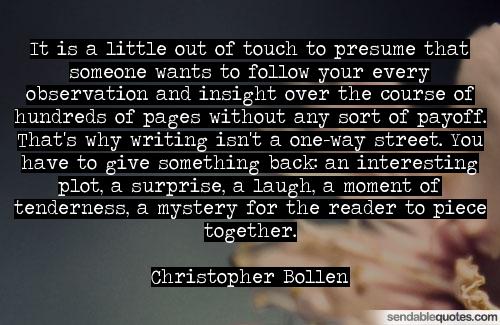
Christopher Bollen explains that writing isn’t a one-way street (click to embiggen)There was a lot of talk on social media this week because a group of jerks harassed the writer of an episode of a television show about said episode until the writer deleted their social media accounts. And it was harassment, not critique. You can be unhappy with a story, you can dislike it, you can even tell other people you don’t like it; but that doesn’t mean you can make ad hominem attacks on the writer, threaten the writer and their family, hurl bigoted slurs, and so forth.
Similarly, you can be unhappy with a story because you feel the story is reinforcing sexist, or homophobic, or racist, or ableist myths. You can call out the problem when a story pushes that agenda. You can express your disappointment. You can organize a boycott. But again, pointing out problems in a narrative should not turn into harassment of the people involved.
In this case it was actually two hordes of idiots harassing the writer. One group were angry because they thought the writer was pushing a relationship between two characters they didn’t want together. The other group were angry because the relationship wasn’t going where it had “clearly” been implied it was going.
Readers aren’t the only ones who can be jerks. Writers can disrespect their audience; they can make mistakes, abuse the reader’s trust, they can cheat and exploit their audience. Which isn’t to say that the writer owes any reader or group of readers a specific outcome, or a particular plot resolution. But as writers we must always remember Niven’s Law for Writers: It is a sin to waste the reader’s time.
In the simplest sense that means that as writers we owe the reader our best professional effort. We tell the story as best we can. No story and no draft will ever be perfect, so we can’t get hung up on revising until it is, but we don’t turn in a half-assed effort.
I want to make a brief digression here. Most of my fiction writing and publishing has been in small press and amateur publications. Occasionally, when as an editor I have given writers aspiring to those publications feedback and requests for re-writes, a writer has pushed back. “You can’t hold me to professional standards, I’m not getting paid!” I didn’t quibble over the fact that technically, because we were giving them free copies of the publication if we used their story it meant they were getting paid, instead I said, “I’m publishing to professional readers. They pay for the privilege of reading my zine. And even though what they pay barely covers the costs of printing, and doesn’t provide any monetary compensation to you, or me, or the copy editors, or the layout specialist, the reader is still paying.” Of course they didn’t have to make re-writes if they didn’t want to. But if they didn’t, I wasn’t going to publish the story, because I wasn’t going to ask my readers to spend their time or money on a story I didn’t think was ready.
To get back to what we mean when we say it is a sin to waste the reader’s time, in a deeper sense that means playing fair. If there are mysteries for the reader to try to solve, you can’t withhold information. Obscure it amongst a bunch of other description? Sure. Distract the reader by dangling a red herring in the same scene? Also perfectly reasonable, but you can’t simply not show the reader vital information.
Also, don’t spring surprises on the reader merely for the sake of shock. It’s easy to think that surprises and shocks and twists are the only way to create suspense, but that’s wrong. Suspense happens when the reader cares about your character. If you create characters the reader identifies with and cares about, you can create suspense out of anything that the character cares about. You create that caring by treating the reader with respect and showing the reader the hearts of your characters.
Don’t lead the reader down a painful emotional path without giving them a pay-off. If you make the reader care about the protagonist and then allow the reader to see a horrible thing happen to the protagonist, don’t skip past the messy emotional fallout. You don’t have to show blood and gore—often graphic descriptions of violence are more boring than engaging—but show us how the bad thing affected the characters. Let the reader experience their sorrow or anger or triumph. Don’t skip that to get to the next plot twist.
When you tell a story, you are asking the reader to give you their time and attention. Make sure that the journey your tale takes them on is worth it.
“It is a little out of touch to presume that someone wants to follow your every observation and insight over the course of hundreds of pages without any sort of payoff. That’s why writing isn’t a one-way street. You have to give something back: an interesting plot, a surprise, a laugh, a moment of tenderness, a mystery for the reader to put together.” — Christopher Bollen
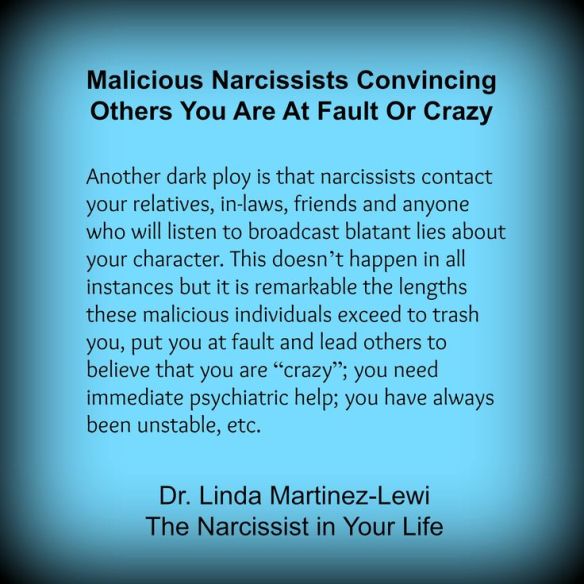
“Another dark ploy is that narcissists contact your relatives, in-laws, friends and anyone who will listen to broadcast blatant lies about your character. This doesn’t happen in all instances but it is remarkable the lengths these malicious individuals exceed to trash you, put you at fault and lead others to believe that you are “crazy”; you need immediate psychiatric help; you have always been unstable, etc. ” Linda Martinez-Lewi, Ph.D. Narcissistic Personality Clinical Expert (click to embiggen)I friend recently asked me, “What is going on with Trump?” He was specifically being exasperated that no matter what crazy thing that man says, there were still people supporting him. One answer is to look at the roots of middle-class fear and anxieties, and particularly the way that moneyed interests have (for more than two centuries) pitted various groups of the poor against each other, usually on racial and religious divides. But another way to understand Trump, his success, his reactions to adversity, and so forth, is to look at abusive men in general, and understand how they operate.
Having been raised by a physically and verbally abusive man, myself—and having been victimized by other abusers throughout my childhood and teens—I have a little bit of insight. Among the common tactics of abusers—particularly narcissistic abusers—are scapegoating and gaslighting.
When scapegoating, they blame other people for their own failures, no matter how improbable it is for the named person to have done that thing:
When gaslighting, they try to convince everyone that their victim is crazy, or the actual abuser, or is otherwise mentally or morally deficient. This is often combined with projection—accusing their victim of having motives that are actually the abuser’s:
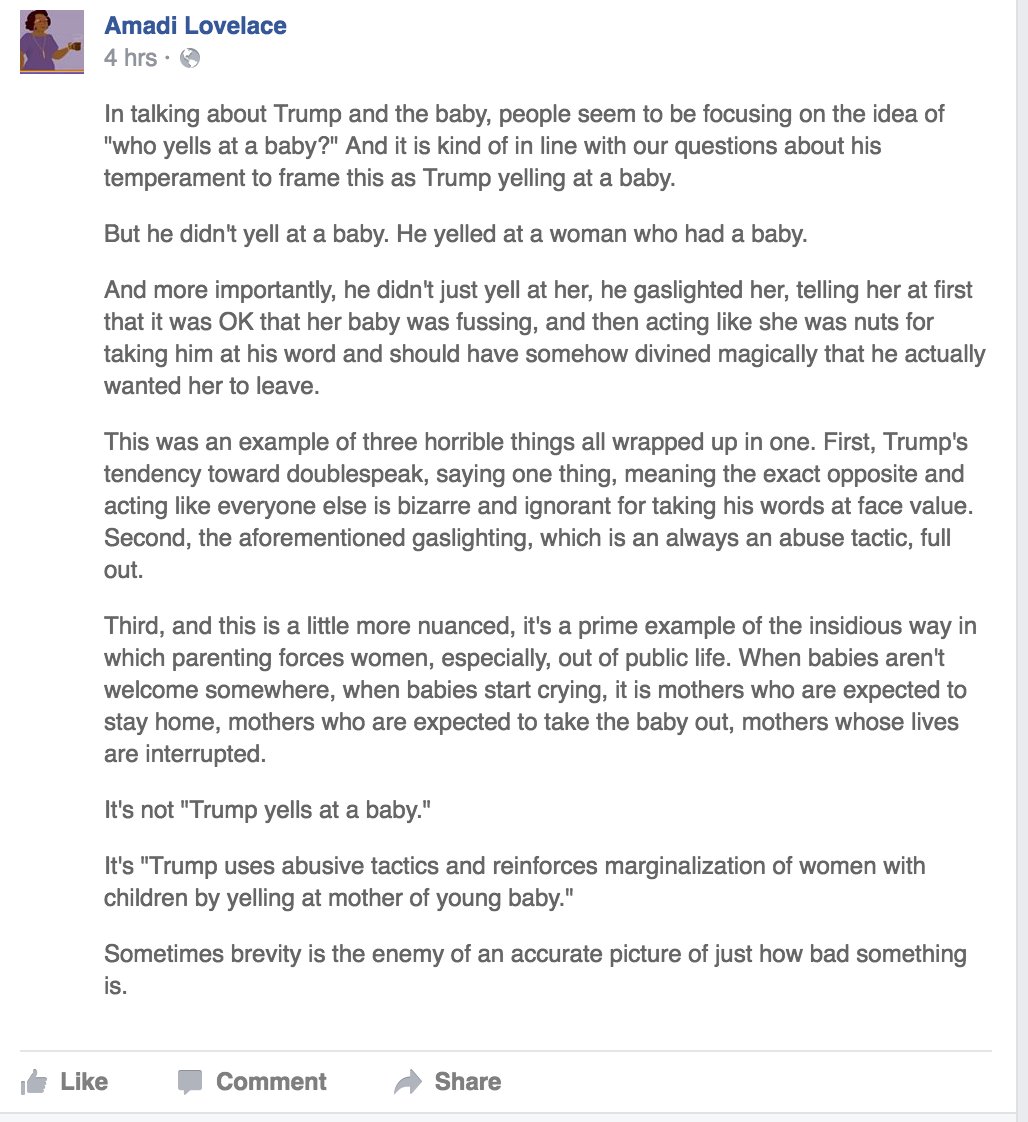
Unpacking the baby incident (click to embiggen)One of the best examples of these two tactics together was the incident that was widely reported, at the time, of Trump yelling at a baby. Someone had brought a baby to one of his rallies, and the child started crying loudly. First Trump said that it’s okay, he likes babies and could keep talking. Then, as the baby would not quiet down, he became irritated and explained that he had only been kidding when he said it was okay. He told the crowd that she must be crazy to think it was okay to be there with a crying baby. How could she not realize that she needed to leave as soon as the baby began making noise, he asked, when made some of the crowd laugh. Of course it’s the mother’s fault for taking him at his word and not somehow divining that he meant the opposite of what he said. Of course it is the mother’s fault for not controlling the baby or immediately leaving when the baby became a problem. And of course it is the mother’s fault for even thinking that she could participate in democracy or public life in any way while she had a baby.
As Amadi Lovelace sums it up in the screenshot: “Trump uses abusive tactics and reinforces marginalization of women with children by yelling at mother with baby.”
At this point you might be saying, “Fine, Gene, you’ve made a good case that Trump is not just a narcissist and a liar, but that he is specifically an abusive narcissist. But how does that explain the people who support him?” That’s simple: abusers are extremely good at manipulation and are especially good at finding people who are ripe for manipulation. The reason an abuser can get away with outrageous blame shifting in the face of overwhelming evidence to the contrary is because there are always people looking to hurl some blame around, themselves.
It’s like all those messages of condolence that I received from certain relatives a few months back when my abusive father died. One person said, “I remember when your parents found out they were going to have a baby, how excited he was and how much he was looking forward to being a father. He loved your mother so much. He was so happy the day you were born! I hope that you can focus on memories of those good times, before the troubles began. Don’t dwell on the bad times.” It’s subtle, but the clear implication is that it’s my fault that I don’t feel love and admiration for my father, because I focus on the bad times. But look at the most ridiculous part of that argument: it’s wrong of me to even think about his bad behavior which was going on for as long as I can remember instead of remembering his alleged good and loving actions which occurred before I was born. (Also, the first time my father beat me badly enough I had to be taken to an emergency room, I was four years old; so the bad times were well underway by then; how much of your life to you remember–really remember–before the age of four?)
To be clear, most of the relatives who made comments like this, are the same ones who during previous discussions of my dad’s issues, always pointed to an incident that happened to him about three months before I was born as the beginning of “the troubles.” It’s hard to get more ridiculous than blaming a person for not remembering things that happened before they were born. They don’t see that contradiction because reality doesn’t match their narrative that he was a good man who simply made some mistakes. Admitting that he was a bad father especially during the years I and my siblings were young and most vulnerable would mean admitting that they didn’t do anything to protect us.
People aren’t rational. They will ignore facts that contradict their chosen narrative. Trump’s appeals repel a lot of people who recognize the falsehoods and inconsistencies of his statements. But the exact some statements appeal to people who want to buy into parts of his narrative. Whether that narrative is that immigrants from south of the border are the cause of the stagnation of middle class earnings, or that muslims are the cause of every mass shooting, or that thug culture is to blame for the perceived (but fictional) increase in violent crimes, and so on. People who are afraid for their future and are angry at their perceived loss of privilege are looking for someone to blame. Even more, they are looking for someone who will assure them that there is someone else to blame. They are looking for someone to tell them that they aren’t wrong to hate people who have different skin colors, or different religions, et cetera.
Trump gives them that. He gives them targets for the anxieties and fear. He fans the flames of that fear into outrage and tells them that it is all right to blame other people. He tells them it is all right to resort to violence (“I’ll pay your legal fees” or “the second amendment people could stop her”). He tells them that anyone who disagrees is crazy, sleazy, immoral, and the enemy.
Abusers are good at finding victims. But they’re also good at finding others willing to hate those victims. And that’s what is “going on” with support of Trump.
“There are worse things in the world than a boy who likes to kiss other boys.” (click to embiggen)We’re another step closer to seeing the end of the so-called National Organization for Marriage. Over the last two days alone, Brian Brown, the current head of this anti-gay organization, has sent out follow-up emails to the organization’s usual begs for donations lamenting the lack of response. Except lamenting isn’t quite the right word: Brian Brown To Supporters: Thanks For Nothing, Losers.
Thursday’s email from Brown began with calling his donors pathetic: “We’re only 17% toward our goal of receiving 1,500 membership contributions of at least $35. That is pathetic.” And when that tactic failed to get the desired response, he followed up by called his donors quitters: “I really don’t believe — I just can’t imagine the thought — that NOM’s members have quit fighting for God’s institution of marriage. And yet, only 256 of you have responded with an urgently needed membership contribution during this critical period.”
Three years ago I wrote about how the organization was going in the red and only surviving by taking “loans” of several millions of dollars from a related religious education non-profit: In the hole, still digging. The money from the religious non-profit was raised under rules that forbid it being used for political advocacy purposes, which means that an outright transfer is illegal. However, as long as they call them loans they can. I wish that the IRS would investigate them over this, but we all know they won’t.
Not only are donations drying up, but they’ve been getting ever more pathetic turn-out for their March for Marriage events in Washington, DC, in 2014, then 2015, and earlier this year. I agree with Joe Jervis, who predicts that NOM will merge with the equally anti-gay World Congress Of Families, which just so happens to have hired Brian Brown as their new president. He’ll continue peddling hate, just mostly in countries where the message finds more sympathy.
It’s Friday! Already the second in August. Wow! Work has been more chaotic than usual. My usual metaphor is juggling chainsaws, and this week the yanked about six of the 12 chainsaws I was juggling away and tossed in a dozen to replace them. I remain more than completely book for the next many months.
I did more reading this week and not much writing, again. That needs to change.
Anyway, here are links to some of the interesting things I read on the web this week, sorted into various topic areas.







 Font Folly