All posts by fontfolly

Unknown's avatar

About fontfolly

I've loved reading for as long as I can remember. I write fantasy, science fiction, mystery, and nonfiction. For more than 20 years I edited and published an anthropomorphic sci-fi/space opera literary fanzine. I attend and work on the staff for several anthropormorphics, anime, and science fiction conventions. I live near Seattle with my wonderful husband, still completely amazed that he puts up with me at all.

Sentences that fill me with dread, part 2

“Oh! You work with computers?” or “You know about computers, right?”

In many ways this has gotten worse as computers become more ubiquitous.

The person most likely to ask this question is someone for whom computers are little more than magic totems. They don’t understand them. To the extent they use them, it is like a ritual. The only way they know how to do anything is to try to repeat the exact steps they have done before. If the machine reacts in a different way than it did before, they don’t stop to try to figure out what they did wrong, they just try to find a way to perform the next step in the ritual.

So they will click Okay or Continue or “that little X in the corner that makes things go away” without reading the message, and keep clicking hoping to see the thing they were expecting to see. And thus install all sorts of malware and bloatware and other things that eventually make their computer unusable.

That’s if they have a computer and programs that they have been using.

Worse are the ones (such as the last person who spoke the dreaded sentence to me) who have bought a computer “because they found a good deal” or took a hand-me-down from a friend of a friend, and now they want just a “little” help to set it up.

The particular person who most recently did this is a musician who is a new neighbor. She stopped me as I was walking past her place and asked the dreaded question. She explained that she had become very intrigued at things that another musician she met was doing in GarageBand on his iPad. He had explained that he had “the same program” on his computer, where he could do a lot more.

So she had bought a computer at a yard sale, and wanted me to show her how to put Garage Band on it so she could do the things he did.

As you have probably guessed, if you know anything about computers yourself, the machine she’d picked up at the yard sale was a really, really old PC. Probably not even one capable of running Windows. This thing was a brand I haven’t seen in decades. It probably was manufactured in 1989 or 1990, I don’t know if it would actually turn on (I didn’t let her get me past the stage where she was pointing to it through the window where it was piled up on a table).

I told her that any computer that old was either dead, or nearly so. That it would be nearly impossible to find software that would run on it. That GarageBand runs on Macs and iPads, only. It doesn’t run on Windows, and it certainly won’t run on DOS.

“But he told me I didn’t need a fancy computer…”

I tried to explain that she could pick up inexpensive used iMacs at several places that would run GarageBand. “But it needs to be a computer no more than five or six years old.”

She didn’t understand why I wouldn’t go into her house to look at the computer she had “just to be sure.” It didn’t have to be GarageBand, she could probably find some other music software, she said.

I tried to explain again that electronics that old fail, and because they’re so old, no one makes the parts any more. Also, none of the inputs will match any modern microphones or other accessories she would need for recording her music. And most importantly, the only software it could run (if all its parts were still working) was very old stuff that would have been sold, back in the day, on floppy disks. “Twenty-five year old floppy disks don’t work. The magnetic particles flake off. The plastic disk part loses its flexibility and even cracks and breaks.”

“I don’t mind a few cracks…”

I thought I was going to scream.

And it’s not just people buying really old (ancient) computers.

My husband works at a place that refurbishes and resells oldish computers. He frequently tells stories of people that buy a computer, then bring it back (sometimes months after the warranty period) complaining about problems that are always user error. Or trying to install something that it isn’t intended to run.

My friend, Mark, told the story of a co-worker who kept complaining about her iPod, that it wouldn’t take music from the Apple store, it couldn’t sync with iTunes, and it wouldn’t work with any iPod accessories she picked up. When he got tired of hearing her complain and offered to take a look, the first thing he said was, “That’s not an iPod.”

It was some very cheap, no-name music player. And no matter how he tried to explain it, she didn’t understand how he could claim it wasn’t an iPod. And when she was willing to admit that maybe it wasn’t an actual Apple-manufactured iPod, she still didn’t understand why it wouldn’t work with iPod things.

I suggested he should have told her that it was like this: a horse and buggy can get you from place to place on public roads not unlike a car, but if you try to pour gasoline down the horse’s throat, you’re going to regret it.

I don’t know if he ever got to use that analogy.
What I ate for breakfast (not)

My friend, Sheryl, likes to characterize a particular form of blogging as “what I ate for breakfast” posting. It’s easy to fall into the trap. You feel as if you should post something, and you may think of your blog as being the equivalent of sitting down to coffee with your friends, so you just babble about minutiae of your life without regard to how many people might actually be interested.

One reason that that sort of thing works in a face-to-face conversation is because there is (usually) a give and take. If you start to talk about the scrambled eggs you made, a friend might comment that they have never been any good at scrambled eggs, or another might comment about how their spouse is allergic to eggs, and the next thing you know, the topic has drifted to something else that everyone is interested in. But with your own blog, without any immediate nonverbal feedback from your friends, it’s really easy to just go on and on…

I try to avoid that, but one problem is that we don’t all classify minutiae the same way. I have posted, over the years on various blog and blog-like places, about my continuing battle with hay fever. That’s why I started titling those posts, when the topic comes up again, “Why I hate hay fever, reason #NNNN” with a new number in the thousands. I hope that the headline conveys to people that I know I’m about to babble about a topic that I’ve mentioned a lot, and even if you are a close personal friend who regularly comments on my blog, I will not be offended in the slightest if you just skip right over the post, perhaps thinking to yourself “Oh, no! Not again!”

A related phenomenon are long and/or frequent blog posts about the purpose of the blog, the nature of blogging, or the philosophy of blogging. Which is perfectly fine to do every now and then, particularly if you’re making a major change, and want to give people fair warning that this blog which used to be about your favorite local sports teams will from now on be all about collecting porcelain dolls.

I’m not making a major change. But based on a couple of comments I’ve received (not as comments on the blog, but either in email or in person), I thought I ought to mention that I’ve been using the Schedule feature here on WordPress, a lot.

Before I moved my primary blog to WordPress, it had always been the case that at any given time I had three, four, or a couple dozen essays/posts on various topics in various stages of completion. Some were completely done, and I was waiting for an appropriate time to post them. Most are only partial drafts. I poke at all of them from time to time, until they get finished and then become tomorrow’s post.

Frequently, thanks to confluences of events and the fickleness of my muse, three, four, or more will all get finished in a single evening or over the course of a Sunday afternoon when we don’t have anywhere else to be. So I wind up scheduling posts to go live around noon my local time over the next three to five days.

One of the reasons multiple postings will get done at nearly the same time is because they are on related topics. I have more than one aspect of a particular thing that I want to comment on, so I break it into different posts and set them to publish on consecutive days, for instance. What can I say? I am something of a motor mouth.

If something comes up that I feel I have to post about right away when I already have a bunch of days scheduled, I bump the others back and post the new thing.

In case you were curious.

Speaker for the Abyss

I thought I had said all I would say about the Orson Scott Card stuff in “Abyss Gazing” and “The Abyss’ Game“, unfortunately some people who I would have hoped knew better have decided that any gay people who have chosen or are contemplating choosing to withhold our patronage from anything that will put money in the pocket of that hateful homophobe, simply don’t understand the situation properly.

So they’ve decided to explain it to us…

Continue reading Speaker for the Abyss

The co-opting of the Nerds

The Great Nerd Summit (also known as San Diego Comic-Con International, or SDCC) of 2013 has just happened.

I have only attended once, back in the mid-80s when attendance was a mere 6000 people. Yes, I said “mere.” Last year’s attendance was more than 130,000 people. I don’t believe that official figures are out, yet, for this year. While the convention (called the Golden State Comic Book Convention when it was founded in 1970) originally was about Comics, and the word “comic” is still in its name, it had expanded far beyond that realm to embrace sci fi/fantasy books, movies with any sci fi or superhero connection what-so-ever, and gaming back when I was there.

Of course, comics is a style or medium of storytelling. I grew up reading both Donald Duck/Uncle Scrooge comics and X-men and the like, so even I knew that as a child. Yes, I said grew up. My mom was an X-men fan in the mid-sixties. I have mentioned before that I’m a second generation fan, right? My point being that you can conceivably tell any kind of story in comic form. And there have been the extremely interesting and well done examples of memoirs, biographies, and other kinds of story that don’t fit the comic book stereotype.

That said, SDCC has gotten to the point where it is the trade show for just about the entire entertainment industry. I understand why there are events highlighting upcoming movies such as sequels to The Avengers, Captain America, and Thor, as they’re all based on comics. And I understand why there are events rolling out teasers for My Little Pony: Friendship is Magic. It’s a cartoon, not a graphic story (there are comics, but those are spin-offs, and the official MLP events were all about the cartoon), but animated cartoons are an allied artform of comics. I even understand all the video game stuff that happens at the con.

But, much as I love Benedict Cumberbatch and the current BBC Sherlock series, I think that Sherlock events at SDCC is stretching the definition a bit. Whereas the fact that there were events for How I Met Your Mother, Veronica Mars, and Community is just insane.

The official SDCC award (as opposed to Awards sponsored by other organization which are simply presented at SDCC), the Inkpot, is given out for “outstanding achievement in the Popular Arts industry.” Which makes me think the event should more properly be called the San Diego Popular Arts Con.

I’ve gotten into arguments with fellow nerds about why Sherlock Holmes, as in the original character and stories by Arthur Conan Doyle, has often been included in science fiction events. I have defended the inclusion because Holmes could be argued to be an archetype of a particular kind of nerd: hyper observant, possessed of encyclopedic knowledge of a vast range of topics, an uncanny ability to find relationships between the most minute details, and infamously incapable of relating to people empathically. Serious articles have been published in psychological journals debating (pro and con) whether the fictional Holmes had Aspergers syndrome, for goodness sake! The Holmes stories may not be sci fi, but both the character and the methodology by which he solves his mysteries are highly identifiable to a significant portion of the fan community.

While I have made that argument, and will continue to do so, I’m also the first to admit that all it provides is a reasonable rationale for stretching the envelope to include Holmes as an allied creation. It’s a stretch, and I admit it.

A sort of similar argument can be made for the specific television show, Community, because its ensemble includes some nerds. But it’s a much more tenuous connection to make based on a couple of supporting characters, as opposed to the main character and his primary activity.

I can think of even more tenuous (and ludicrous) arguments that might be made for shows such as How I Met Your Mother, but all of them would be a smoke screen. The truth is that, as I mentioned, SDCC is a trade show, not a fan convention. Its purpose is to advertise, generate buzz, and fan the flames of enthusiasm for any popular art property that can shoehorn itself into the convention. That isn’t a bad thing, per se. Certainly no one is forcing fans to get online at a particular time on the final day of the convention so that the entirety of the next year’s memberships can be sold out in less than two hours. No one is forcing people such as myself to track down stories and videos of the events to get some ideas of what movies and shows I should be looking for in the future.

If you want to fan the flames of enthusiasm, there is no better place than the heart or mind of a nerd or geek. We’re more politely called fans, which is short for fanatic. The one trait that most distinguishes us from the mundanes is how incredibly, obsessively enthusiastic we get about the things we like. So even though some of us are primarily enthusiastic about science and science fiction, if you can get us interested in your show— even one that doesn’t have any discernible science-y aspects—we’ll talk about it. We’ll set our DVRs to catch your premiere. We’ll mention that it’s coming out to our less nerdy friends. We’ll make and post fan art or create and share silly memes based on photos from your show.

We will be your viral marketing campaign. And because tens of thousands of us are willing to buy memberships at SDCC each year, that means some of us are paying for the privilege.

Apart from other branding considerations, I think that’s why for the foreseeable future they won’t be replacing the “Comic” part of the name.

The Key to the Treasure

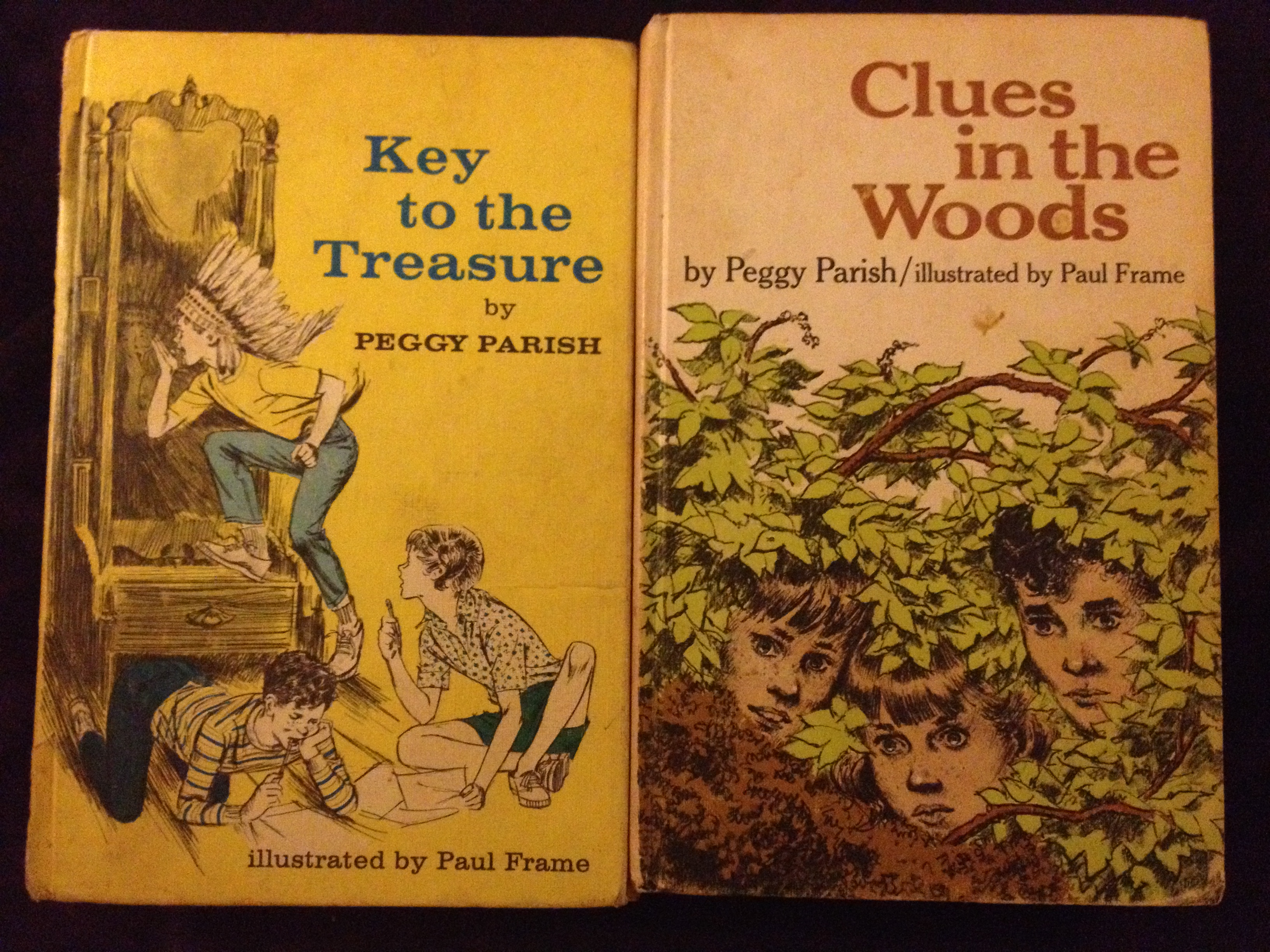
I think I was in third grade when I received my copies of Key to the Treasure, and its sequel, Clues in the Woods. The books, by Peggy Parish with illustrations by Paul Frame, were a pair of mysteries starring three siblings, Liza, Bill, and Jeb.

Hardcover copies of two books.
My old copies of these books are battered, but each still in one piece. (Click to embiggen)
My copies bear the Weekly Reader Book Club imprint. I remember reading and re-reading them many times as a kid.

I also remember, a few years later, finding another book in the series in a library. Turns out Parish wrote a total of six books in this particular series. From the descriptions of the plots, I think the book I found in the library was Pirate Island Adventure, which is actually the fourth book in the series. I remember being really disappointed by the book, primarily because the mystery solved in that book is nearly identical to the mystery in the first book.

It was probably also disappointing because the books seem clearly aimed at kids aged about 8 and under, and I was probably 11 or 12 when I found my third.

The books are currently out of print, so while I’m tempted to order the four volumes I don’t own, my choices are to spend either hundreds of dollars for old copies in “new condition,” or more reasonable prices for battered used copies.

Parish is, apparently, more famous for the Amelia Bedelia series, which I’d never heard of until I tried to track down information on these other books just this weekend.

I’ve re-read Key to the Treasure a few times as an adult (yes, including once this weekend). It doesn’t hold up too badly. The portrayal of the elderly Native America woman who had left a collection of “Indian artifacts” to the grandfather of the protagonist’s grandfather is a bit cringe worthy. And the artifacts themselves, representing a mish-mash of tribes—including the famous Gilligan’s Island Tropical Witch Doctor Tribe—is a bit more than cringe-worthy.

The dialog is a bit stilted, giving me flashbacks to my 1928 edition of a Hardy Boy’s mystery where the boys get scolded by their aunt because they got their ties messed up running home from school. Not sounding like the way real kids talked, even in 1966 when the first book was printed, but more like certain people thought children’s books should sound back then.

But I still enjoyed it. And even though I’ve read it a zillion times, enough years have passed since the last reading that I wasn’t certain how they were going to solve the puzzle. So at its heart the story still works.

And it passed the Lewis test. C.S. Lewis once said, “A children’s story that can only be enjoyed by children is not a good children’s story in the slightest.”

Why I hate hay fever, reason #5839

Technically, this one probably ought to be titled “Why I hate MY hay fever, reason #7” or something.

Because my overeager immune system reacts to apparently every pollen, every spore, and every mold it encounters, and because I live in the Pacific Northwest on the west side of the Cascade Mountains (where winter mostly consists of lots of rain with the temperature only occasionally flirting with freezing), I have mild-to-horrid hay fever symptoms for a minimum of ten months out of the year.

And the variation from mild to horrid and back again is not predictable. Sometimes the pollen count goes down, but the symptoms get worse, for instance.

This particular reason is a consequence of all those aforementioned things:

I can’t tell the difference between the first few days of a cold or flu and just waking up on a given day.

So, Wednesday night/Thursday morning I didn’t sleep well. It wasn’t a night of tossing and turning, staring at the clock, wishing that I could fall asleep. I slept. I just woke up about every 40 minutes or so for no discernible reason. It wasn’t until the second alarm went off in the morning and I dragged myself to the bathroom that I realized that I was too fuzzy headed to actually attempt to do any work. So I called in sick, took some Nyquil, and stumbled back to bed.

Even then, I was taking the Nyquil because it felt like a worse-than-usual hay fever day and I hoped the Nyquil would make me sleep for real for a few hours. I didn’t take it because I thought I was sick. It just felt like a slightly worse than usual hay fever morning.

I vaguely remember Michael saying he was leaving for work. I blinked. I rolled over, and saw that more than six hours had passed.

I felt better only insofar as my brain was capable of thinking in whole paragraphs, rather than just simple sentences. My head, sinuses, and throat all still hurt. But it was, still, only at the “worse than usual hay fever day” stage.

I logged in remotely to work and took care of a few urgent issues. I ordered pizza for dinner, chatted with Michael, and so on. It continued to just feel like a worse than usual hay fever day, though with added time disorientation because I’d slept most of the day. I went to bed early, this time taking Nyquil before hand.

Friday I woke up still feeling like a worse than usual hay fever day. Friday is my usual work from home day, so I slept in a little as usual. The only real difference from a usual work from home day was that I took non-drowsy cold tablets.

Friday night, after we got home from dinner, Michael crashed because he was feeling worn out. But he often does that on Fridays, particularly during hot and hottish weather, because he works all week in a warehouse.

In the wee hours of Saturday morning, Michael woke me up. It wasn’t intentional, he was just feeling extra cold and trying to get the blankets that had bunched up under me. He muttered something about thinking he had a fever. My thought at the time was, “Darn! I’ll have to drive to our friend, Sheryl’s place, without Michael.” And I conked out.

Hours later, when I shuffled to the bathroom, I slowly became aware that my aching sinuses, headache, ringing ears, sore throat, and queasy stomach were not all hay fever symptoms. And the house felt cold, even though the thermometer said it wasn’t.

I thought back about when I last took any medicine that had acetaminophen or something else that would mask a fever. It had been about ten hours, so I got out a thermometer.

Fever. Not a high one, but higher than my typical low-grade fever.

Yuck.

So I called to beg off on Writer’s Night (we weren’t hosting this month). I made some breakfast. Checked on Michael, then spent a few hours trying to work up the energy to go to the store to get soup and juice and general groceries.

I only had three dizzy-ish spells in the store.

The hardest part was putting the groceries away when I got home. I really just wanted to collapse.

I sat down, intending to just rest a bit before calling to cancel gaming tomorrow.

I conked out for almost four hours.

And that pretty much brings us to now.

I don’t have a fever any more. Throat and tummy are no longer being icky. My ears are back to their normal level of tinitus. My sinuses and head still hurt more than a typical hay fever day.

But I have developed a mild cough.

Yuck.

Not that I would have necessarily done much differently if I had realized Thursday that this wasn’t just hay fever. But it’s still irritating to realize I was probably sick for two days before I knew it.

I hate hay fever.

I used to do Friday Links

Before Twitter, I used to collect interesting links to news and news-ish things that I read over the course of the week, and then post them in a list on my old LiveJournal on Fridays. I called it “Friday Links.”

When I left my old job and switched to contracting, I had less freedom regarding what I could do during my lunch break. So, I got out of the habit. And people drifted away from LiveJournal. A few of us diehards still poke around there, but most of the folks who used to regularly read me there have gone elsewhere.

Now, I use my iPad to read news during my lunch break, and it’s easy to just tap and send the links to Twitter. Which isn’t quite the same.

I miss doing it. A few people who used to regularly read the old blog have mentioned that they miss my Friday Links.

So, here are a few:

Science Fiction’s Queer Problem

Image of the Day: “A Galaxy So Ancient It Shouldn’t Exist”

Elizabeth Warren Proves She’s Smarter Than A CNBC Host (Video)

Tyrannosaurus rex hunted for live prey

I Bet I Can Create A 25 Million-Year-Old False Alarm, Says Biologist E.O. Wilson

Dying Gay Man Flies to Maryland to Marry His Partner of Twenty Years (You may need a tissue or three)

The Oatmeal: How to Suck at Your Religion (some part of it will offend just about everyone, but it’s hilarious…)

Police Reports Illustrated: The Waitress and the Boiling Water (cartoon based on an actual police report)

The Wizard of Ahhhhs: note that the song is entirely a cappella. Great retelling of the movie:

And if you need some cute in your life, check out this youtube from winter before last at the Seattle Aquarium of a mama sea otter, Aniak, and her pup, Sekiu, when Sekiu was only one day old:

What-aged?

When we’re kids, we have little understanding of age. We understand that some kids are older than us, and some younger. We understand that adults get to do what they want and tell us what to do. We understand that some people are old. But exactly what all those mean is very vague.

And we want simple categories. A teen-ager is anyone aged 13 through 19, right? First graders are 5 or 6, right? So how old is a parent? How old are grandparents?

I was the oldest child in my family, and my parents were teen-agers when they married. My paternal grandparents had been 20 & 18 when they married, and my dad was their oldest, as well. My mom’s parents married similarly young, and while she was their second child, they were still quite young when she was born. That’s one reason most of my great-grandparents were around as active, alert adults throughout my childhood and teens.

My middle school basketball coach had been one of my dad’s high school buddies. His oldest son was in the same grade as I was. My middle school wrestling coach, on the other hand, had been my dad’s high school wrestling coach. Yet, his oldest son was only one grade ahead of me in school.

When you’re in middle school, you understand that adults can keep having children into their 30s and 40s. You can understand that the coach’s son who was only a year older than me had two sisters, both more than 10 years older than he was, and therefore coach could be both the parent of a middleschooler and the grandparent of one or more small children at the same time. But when you’re younger, the notion that parents can be a wide variety of ages isn’t even on your radar.

I had an example closer to home. My Mom’s baby brother (half-brother) is only three years older than me. So, one of my uncles was a senior in high school when I was a freshman in high school.

A friend of mine from college had a bad habit of hitting on high school girls. It was only a bit embarrassing when we were in college, because we weren’t that far out of high school ourselves. But when he kept doing it into his late twenties, it was getting more than a little disturbing.

But I don’t have much cause to talk. When Michael and I started dating, I was 37 and he was 27. He’s ten years younger than me, the same difference I was finding disturbing when my friend was lusting after those high school girls.

Obviously, a ten-year age difference isn’t that big of a deal when the younger person is indisputably an adult, or course.

One of my great-grandmothers was a 28-year-old widow with two small kids when she married my great-grandpa… who was only 16 years old at the time! Of course, that was nearly 100 years ago, and a 16-year-old who had been working as a ranch-hand full time for several years was not considered a child. And they stayed together for the rest of their lives, very happy together.

Then we have that much-abused term, “middle-aged.” It used to mean 50-ish, or more broadly 40-60. Men were expected to have their “mid life crisis” during the 40-60 time frame, for instance. It was sometimes defined as the third quarter of a typical lifespan. Medical and mental health people have started shifting the definition up, as life expectancy increased. I noticed a lot of people shifting it the other way, referring to anyone in their 30s as middle-aged.

I keep catching myself referring to one of the neighbors as a kid. He’s coming up on thirty, he and his girlfriend have lived together next door for more than five years. He works, pays his own bills, and is otherwise a fully functioning adult. He’s one of the most responsible people I know. When he and his girlfriend moved in, he just looked way too young to be getting his own apartment, so part of my brain pigeonholed him.

I don’t want to be that old guy who calls everyone “kid” or “son” and so on. I still feel weird when a stranger calls me “sir,” for goodness sake!

Sentences that fill me with dread, part 1

“I’m retired now, and thought I’d try to write a book about my experiences.”

This sentence might seem perfectly innocent. And anyone who has spent much time with me knows I’m always encouraging people to draw, write, sing, play instruments, and so on. I think everyone should try to make art every now and then.

I do.

But the above sentence fills me with dread when I hear it (and you may be surprised how many times I have heard that, or a close variation) in the context of someone just learning for the first time that I’m a writer (and editor and publisher). Because in that circumstance, it inevitably leads to them wanting me write their book for them.

They may not put it that way. They usually don’t believe that’s what they’re asking. They just want some advice, they say. They want someone to bounce some ideas off of, they say.

When I give them advice, they don’t like it. “First, you need to write. Don’t talk to people about your idea, sit down and start writing. Don’t know where to start? Here are some excellent books on writing. Here are my recommendations for software to use for the actual writing. Go to my writing web site (sansfigleaf.com), go to the Essays section, and click on the Writing tag. You’ll find over 60 essays I’ve already written on the writing process.”

My favorites are the ones who react to the list of books or the essays with, “I don’t have time to read all of that!” I’m only using the word “favorite” in that sentence half sarcastically. If they are that upfront with their unwillingness to learn on their own, they’re easy to deal with. “If you aren’t willing to read something that can help you achieve your dream, what makes you think anyone would want to read what you’re going to write?”

For a long time, the next most common objection was, “Why do I have to learn how to use a word processor? If my story’s good, won’t the publisher help me with that?” Trying to make them understand just how much time and expense is involved in transcribing a novel length story is always fun. Sometimes I can just go with a variant of the book answer: “If you think it’s too much trouble to learn how to do it, why do you think other people would be willing to do it for you for free?”

This usually leads to me having to explain that books which simply break even are the exception, and books that make large profits for all involved are rarer still. And no one can be certain which books will or will not take off in advance. No matter how awesome your story is, getting a lot of people to just look at it is an expensive undertaking. No one is going to take that chance on you if you make it even more expensive for them than other writers who submit completed stories in proper manuscript format.

There’s a special subset of these who will come rightout and say, “How about I tell you the stories, and you write them up for me? I’ll give you a portion of the proceeds!”

Computers have been ubiquitous in the American workplace for long enough now that fewer would-be memoirists balk at using them. But I expect a rise in the complimentary problem. “Here, let me show you what I’ve written so far!” And they send me a file that consists of a few hundreds words of babble. Sometimes it’s perfectly spelled babble, but it doesn’t make sense. Don’t get me wrong. I am the king of typos. If there is a circle in hell reserved for people who make too many typos, that’s where my soul is heading to in the afterlife. I’m not talking about typos. I’m talking about fragments that don’t quite make a sentence; sentences that don’t connect to each other; and either no paragraph breaks at all, or paragraph breaks that make no sense.

Don’t get me started on the pronoun problems. If I can find a few sentences that make sense to someone who doesn’t already know the people involved, the industry and its conventions, and so on, at all, then there will be a whole slew of he’s, she’s, him’s, and her’s with no way to be certain which he is which person.

No matter how they react to the other questions, if I keep having contact with them, they will ask for advice. However, in the middle of whatever advice I give, they will interrupt because I’m not giving them what they want. They want me to tell them some magic words which will make the whole thing just happen. Or they will try to recite one of their experiences to get me to tell them what part of the book it should go in.

The ultimate problem is that the person most likely to say, “I should write a book about my experiences” doesn’t understand books. A book, even a memoir, is not just a collection of interesting anecdotes. To be a book, there needs to be an overall narrative, something that shapes and unifies the whole thing; some sort of logical flow of one part into the next. If you’re going for a collection of barely related essays, something such as Sarah Vowel or a David Sedaris might write, each chapter or essay or whatever you call it has to have some sense of narrative completeness to it, with a theme that contributes to understanding the other sections.

Your anecdotes may be hilarious when told in person in small doses, but writing is a different language than speaking. An essay is not the same thing as an amusing anecdote. A book is more than just a collection of words. Stringing a few stories together isn’t writing a book.

There’s an old cliché that the difference between real life and fiction is that fiction must make sense. It doesn’t just apply to fiction. All writing, even writing about bizarre coincidences and strange behavior, has to make some kind of sense to the reader. A writer’s job is not simply to transcribe what happened. A writer’s job is to find that meaning, and convey it to the reader in such a way that they don’t notice that the writer is imposing a meaning on the events. A writer’s job is to fool you into thinking that the meaning he has carefully constructed is simply a fascinating experience you are having.

That isn’t something you can learn in a single evening over cocktails.

When it IS broke…

Many years ago—I think it was just before Ray and I moved in together (thus, years before Ray got sick, years before the chemo, years before he died)—I called Ray to confirm when we were next getting together.

He was crying.

It took a few minutes to get the story out of him. He’d been on his way out of a store, and he stopped to hold the door open for someone. Another person ran by on the sidewalk, bumping into Ray and knocking his shopping bag to the ground, which was followed immediately by the sound of breaking glass.

Ray had just purchased some sort of glass sculpture. I don’t know what it was of. All Ray would tell me that it was “beautiful, just beautiful.” But it had been smashed to a million pieces, he said.

I asked him what store it had been, so I could go buy him another one. But that just set him off worse, because it had been a present for me. He repeated how beautiful it was, and that he couldn’t afford to buy another one, and the person who had caused it to be smashed hadn’t even stopped to say he was sorry.

Nothing I could say or do made him feel better. And there was nothing anyone could do at that point. If we were living in a Lifetime movie, maybe the person who had knocked the bag from his hands and kept running, waving dismissively when Ray called out, would have encountered us again, and there would have been some kind of amends making.

But we don’t live in Lifetime movies. Sometimes bad things happen, and we just have to live with them. Ray got over it. Life went on.

I was reminded about that incident this week when I found another present from him broken.

I don’t know how it happened, for certain, and probably never will.

It begins a few weeks back when we were having a mini heat wave. We’d had enough hot days (for our climate) in a row that we’d decided to put the window fans up. During the summer we have mounted window fans running in the kitchen, the computer room, and the bedroom. Depending on which side of the house and what time of day it is, they’ll be either blowing fresh air in, or blowing hot air out.

So the second day the fans were going, I found a print on the floor. It’s a large piece of art our friend, Sky, made a few years ago. It’s a reclining courtesan in a green and blue kimono. It isn’t mounted in a heavy frame, it’s just matted. It’s 18 inches by 22 inches, so it isn’t a huge life-size portrait, but it’s large.

It hangs in our bedroom on the south wall. After I confirmed that Michael hadn’t taken it down for some reason, I decided that it must have been knocked down by the wind. We had fans in the window on a thermostat, and we’d forgotten to turn off the standing fan when we left for work in the morning. It had been a little windy that day. I figured there must have been some inopportune gusts of wind that knocked it off.

Never mind that it is nowhere close to the window, and other similarly lightweight pieces are hanging on the wall Closer to the fan. I figured either the wind angle had been just right, or because all of the other simply matted pieces are smaller—they hadn’t had enough surface area to catch enough wind force to bring them down.

Then this week, I found something else on the floor. In exactly the same spot the picture had landed. A resin “sculpture,” about 10 inches tall, which had been on a shelf about a foot below the picture.

Ray had given me the sculpture about a year after we moved in together. It’s an odd thing: a fairy tale castle built impossibly on a pair of rock spires coming up out of the ocean. At the time Ray gave it to me, I think he said that it reminded him of something I’d written. I didn’t remember writing about that sort of castle, but I write both sci fi and fantasy, and I tended to talk to him a lot about ideas I hadn’t yet turned into a story, so maybe it was something in one of those.

But this gets us to the part of the earlier incident that I could never tell him. Ray and I had very different tastes in decorating. We both tended to like very different kinds of kitsch (and yeah, sometimes my tastes are extremely kitschy). So when he said the glass sculpture which I never got to see was “beautiful,” I knew that there was more than a slim chance that I might have thought it hideous.

This resin thing isn’t hideous, but it’s not the sort of thing I would have ever bought myself. Even for only a quarter at a garage sale. So, even with his explanation that it reminded him of something I wrote, I didn’t quite understand why he thought I would like it.

I’m quite certain some of the things I gave him elicited the same reaction. Sometimes you think someone will like something, and you’re just completely wrong.

I haven’t kept every knick knack and tchotchke Ray ever got me. His family members asked me for some of them to remember him by. I gave a few others away to friends who expressed an interest. One particular friend, Kats, suggested when I was agonizing, about a year after Ray died, over a bunch of things that I really didn’t like but couldn’t bear to just toss, that I mail them to her (since she’s as much of a packrat as I am). She said she would find them good homes. We both knew that she would probably toss most of them, and that she was prepared to lie to me if need be about how she’d kept them all. But sometimes you need a little help deluding yourself when you’re being irrational.

This castle, though, I kept. I can’t really say why, because I don’t like it for itself. Neither do I dislike it. It’s just every time I look at it, I think of Ray trying to explain to me how it reminded him of stuff I wrote. Ultimately, it reminds me of the journey we both went through trying to learn to understand each other better.

So when I found it on the floor, broken in several places, I was more than a bit annoyed. Also, confused. I had an explanation for the picture falling down two weeks ago. This was something else. It’s too heavy to have been blown over, at least inside the house. The only other thing I found disturbed was a small plush Tigger that had been near it on the shelf. And one of the fragments that broke off was embedded, at a really weird angle, into the wooden bedstead. If it fell off the shelf, bouncing off the bedstead is almost a certainty, but it just looked odd.

We don’t live in a house, but rather a triplex. On the other side of that wall is the neighbor’s kitchen. A previous tenant had a tendency to slam the cupboards a lot, and sometimes it would make the pictures shake on our side. I haven’t heard anything like that with the couple that have lived there the last few years, but if it’s happening at a time of day when we’re not around, I wouldn’t hear it, would I?

It would be simple enough to glue the castle back together if I could find all the pieces, but I can’t. On the other hand, it’s just a silly tchotchke which, truth be told, I haven’t looked at at all in the last several years except when I decide to clean up that end of the bedroom. It’s just a thing, not a person. I should just get over it and move on.

And I will. But I don’t have to like it.