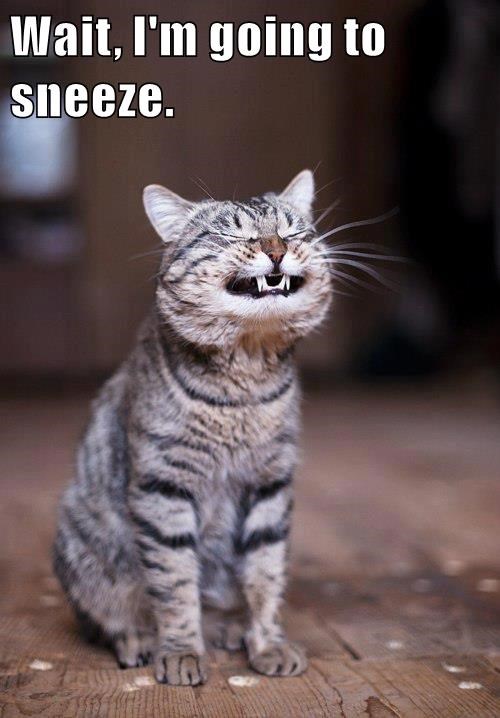
“Wait, I’m going to sneeze.”Some people will be surprised that I’m writing about hay fever when it is practically autumn. Well, this is one of the reasons my hay fever is so annoying. I have a moderate-to-severe allergic reaction to every pollen, spore, and mold that the allergists test for, and in the mild climate west of the Cascade Mountains, that means hay fever season runs from about mid-Febbruary to approximately mid-December every year.
We’ve had a significant shift in the weather this weekend. In the middle of last week we had one day where the temperature creeped above 80º in some places. All this week, the daily highs are forecast to be in the lower to mid-60s, plus rain every day.
I absolutely love this kind of weather.
Unfortunately, one of the “features” of my hay fever is that my sinuses react most harshly to changes. If a new species that hasn’t been the predominant pollen-contributor in a while ramps up production, my sinuses go bananas. If the weather changes, whether from damp and cool to dry and hot or the other direction, then it’s all congestion and running nose and red itchy eyes for a couple of days.
So, while I should be ecstatic that I had to pull the lightweight jacket out of the backpack (where it gets carried most of the summer in case we have rain) to wear for the trip in to work, I am instead sniffly and sneezing and miserable.
You have to respect the honesty…I lose things all the time. I wind up spending an embarrassing amount of time searching for misplaced eyeglasses, or the mug of coffee I had just a minute ago, or the bookmark I was using and I just want to set the book down long enough to get some more coffee, or the headphones I was wearing five minutes ago. So I’ll be retracing my steps, trying to remember what I did and was thinking about. I used to constantly lose my keys and wallet, and only slightly less often my badgeholder with my bus pass. And of course my phone. I was logging into Find My Phone at least twice a week to make the phone ping so I could find it. Now I have tiles attached to the keyring, badgeholder, and wallet. I can use an app on my phone to ping them. If I misplace the phone, I usually have my watch on and can use it to ping the phone, but I have also used the feature of the tiles where you can squeeze it’s button to make the phone you usually use to track them play the Find My Phone tone.
Misplacing things while moving around the house doing things is one category of lost possessions, but it isn’t the only one. No, far worse are those times when one I have to say the phrase, “I remember thqt last time I was using it I said to myself, ‘I need to put this somewhere that I won’t forget…’” Because I only utter that phrase after I have looked in the places where I thought I had put it way and now I can’t find it.
Part of it is about how my brain categorizes things. Let’s say I’m looking for the spray bottle with the stain remover in it. I’m putting my shirt in the hamper, and notice that I’ve spilled food on it earlier in the day, so I want to spray the stain with the soapy stuff before tossing it in the hamper in hopes of preventing a stain. And I go to the hall closet where the laundry detergent is, expecting to find the bottle there, but it isn’t there. And it isn’t in the bedroom by the hamper where I probably used it last time. This means that at some point while I was doing something completely unrelated to laundry, I noticed the spray bottle out where it shouldn’t be, and instead of putting it in the hall closet, I put is somewhere else. It might be in the cabinet under the bathroom sink, for instance, because a lot of soap-like things are kept there. Or I might have put it in the cabinet under the kitchen sink, because a lot of cleaning supplies are there.
Why not back to the closet? Because I probably found the bottle where it didn’t belong while I was in the middle of another task. And I didn’t want to lose track of the other task, but I also wanted to put the bottle away, and my silly brain instead up popping up with the location of the closet where the laundry detergent is, suggested some other place where other cleaning things are.
Maybe.
Or maybe the task I was in the middle of was getting ready for work and get out the door, and the next thing I had meant to do was assemble my lunch, so I carried the bottle with me as I go to assemble my lunch. Assembling the lunch involves getting some things out of the pantry. When I got into the pantry I reached for soup=in-a-cup, which involves opening a box and selecting one of the cups and realized I was still holding the bottle of stain remover so I set it on the lower pantry shelf to free up my hand and get the soup, then walk back out into the kitchen to get on with lunch. And because that lower shelf has a lot of bottles of varying sizes and a variety of colors of labels, and the pantry is only dimly lit, it just blended in and neither of us noticed it for two weeks.
But yes, one other time I found it under the bathroom sink. Another time under the kitchen sink. Both of those were found the same day I noticed it missing. The time it was left in the pantry it took longer.
Then there is the topic of important papers. Maybe I have a folder of instructions from the doctor for a procedure scheduled a couple of months out. I read through it all once, but I’ll need to consult it again a few days before, because I had dietary restrictions the day before. So it needs to be put away somewhere where it is out of the way, but I will find it when I need to.
So I take it into the computer room and I put it in a standing sorter near my desk where a bunch of other important papers are. Or at least, that’s what I thought I did, but of course when I go looking again it isn’t there. So if I didn’t put it there, where else did I put it? The drawers under the stand-up thing where a lot of other papers are? Maybe. Or maybe the bin where the bills to pay are kept. That’s a pile of papers I go through frequently and I always know where it is, so maybe that’s where I put it. Or maybe it’s in the filebox where a bunch of other important papers are kept… or…
So I spend a couple hours searching everywhere I can think of, and it’s getting late and I just resign myself to having to call the doctor’s office the next morning before I go to work. I begin the going to bed routine and I grab my nighttime meds… and that’s when I notice a familiar-looking folder stuck behind all the prescription bottles and vitamin bottles and the blood pressure thing and so forth. There wedged in besides the receipts from the pharmacy that I save so that every few months I can scan them in and fill out the only form and get re-imbursed for the co-pays.
I put it with other papers that I save, all right. And they’re even medical papers! But somehow making that decision got mangled in my memory as the location in the computer room.
It made sense at the time, but darned if I’ll remember a week afterward…
“I think people who hate on pumpkin spice but praise bacon are hypocrites. The only difference is that bacon is seen as ‘manly’ and pumpkin spice is seen as ‘girly.’ Both groups want to put it on everything, but only one gets shamed for it.”I love bacon. I love a good martini. I love nice olives. I love a my husband’s homemade chicken soup1. I like sampling different kinds of winter ales/holiday beers. I love cooking a big pot of chili to eat while watching a football game. I love the many variants of Earl Grey tea. I love coffee. I love beef stroganoff (both making it and eating it). I love sweet potato pie, pumpkin pie, pear and ginger pie, or any homemade fruit pie even though I can almost never eat pies any more. I love lamb stew. I love my husband’s solstice cake2. I love homemade vanilla and the many wonderful things I can make with it. I love cooking veal scallopini (and not just because when I open a bottle of wine to cook with I need to drink the rest of the bottle). I love very rare steak. I love a nice Old Fashioned made with really good bourbon. I also love a lot of what some people call froo-froo cocktails. I love homemade ginger bread.
And yes, sometimes, I like to spice things with a blend of cinnamon, nutmeg, ginger, allspace, and cloves. Because those spices tastes incredibly delicious on many foods.
As autumn approaches in the Northern Hemisphere, we see the unveiling of the many snarky and condescending memes and social media posts about pumpkin spice. And one of the things that really amuses me about them are the large number of them who seem to think that the drinks and foods and such are pumpkin flavored.
Pumpkin spice lattes do not taste like pumpkin. They taste like coffee, steamed milk, and cinnamon. It’s not pumpkin, guys, it’s pumpkin spice, specifically, the spices that are traditionally used in pumpkin pie. It’s spices—you know, those substances whose entire existence in our culture is to be added in small quantities to various edible things to make them taste better? It isn’t something weird or new-fangled or unnatural. They are spices.
If you don’t happen to like cinnamon and so forth, that’s fine. But there is no reason to go hating or shaming other people who do. And I find it particularly irritating when I see it being done by the kinds of guys who are really into craft beers, or who want bacon on everything, or who buy up the various winter ales/holiday beers as soon as they show up in stores. All of these foods and beverages are things that some people really like, other people could take or leave, and other people dislike. It’s no big deal.
I know that you don’t think you’re being an asshole. You think your clever meme about guys dressing up in pumpkins to attract the ladies is funny. I totally get it. There are foods and drinks that I despise, and sometimes I describe my dislike for them in rather extreme terms4. But just because I don’t like something doesn’t mean that it is inherently inferior to other things.
But your hating on pumpkin spice and your shaming of people who like it? That totally makes you an asshole. If you make fun of other people for liking cinnamon, you are a douche, an idiot, an asshole, and a petty insecure hypocrite.
You don’t have to buy any of the pumpkin spice things on the market. Their existence neither hurts you nor causes you harm. So chill. Relax. Let it go and stop hating on some spices. Unless you like being known widely as a prick.
Footnotes:
1. He makes the most amazing soup. One time when word got out that he was making chicken soup for a writing meeting we were hosting, one pair of friends changed their travel plans so they can attend for the soup. That’s how good it is.
2. It’s a cake he invented when he was tired of people always hating on fruit cake, so he concocted a way to turn pineapple, apricots, figs, and a bunch of fruit into a puree and then cook it in a way that people think they are just eating fluffy golden sponge cake. One year he made a bunch of them that we served at our Christmas party, took to some other people’s gatherings, and he took two into his work. The cakes were so good, that two of the people at his workplace got into a literal fist fight over the last slice of the cake. And the company instituted a rule that Michael couldn’t bring in home baked good any more, for fear it would happen again3.
3. Just more proof that I am the luckiest person in the world, because that amazing man is my husband!
4. For instance, raisins. I hate them5. I often call them Satanic Fruit.
5. Seriously, they taste so vile that I almost vomit with I get some in my mouth. It took several years to get to the point where I could stop that reaction and just find a napkin to put the the stuff in6.
6. And I have a history of this. When I was a toddler, the doctor wasn’t happy with some of my blood tests, and told my mom to feed me something like an ounce of raisins a day for nutritional purposes. My poor mom tried. I violently spit them out, cried, pushed her hands away, et cetera. She tried hiding them in other foods, soaking them in water, soaking rhem in apple juice, cooking them in various ways, and so forth. And every time I spit out the raisins. I would eat the other stuff around them, but I spit out the raisins again and again. Finally, Mom called the doctor’s office to say that I absolutely refused to eat the raisins. They started listing other foods that would take care of the nutritional deficiency they were worried about. When they got way down on the list and mentioned liver, Mom interrupted: “Liver! Why didn’t you say so, he loves liver!7” And she hung up the phone and headed to the store.
7. She knew I loved liver because my dad also liked liver, so just about every pay day they would splurge on some liver and Mom would cook up a mess of liver and onions for my dad. And at some point Dad offered me some and I gobbled it down and wanted more8.
8. I know lots of people hate liver, and that’s fine. May taste buds are different from yours. Raisins probably don’t make you gag because your taste buds are different. That’s okay. You can have my share of the world raisin supply. I’ll take your share of the world liver supply. We’ll all be happy, right?
The pill minder I’ve used for more than ten years broke…Lots of people are uncomfortable with change. For instance, I have medical conditions and have to take medicine every day. Some of the medications need to be taken every morning, some every night, and keeping track isn’t impossible, but it’s easiest if I have a system to collect them and keep track of which have been taken. Thus, the pill minder pictured here.
It isn’t the first one I’ve owned. Back in the ’90s I had one medication that had to be taken five times a day. That was no fun, let me tell you. So I had a pill minder back then that actually consisted of seven little four-compartment pill-minders. On a Tuesday morning I could pop up Tuesday’s four-compartment piece, take the morning pills, and then put the Tuesday minder in my backpack, go to work, and throughout the day take my other doses.
That served me fine for years. Even though as it got older most of the words printed on the little lids had rubbed off, and a couple of the little lids wouldn’t stay latched as the little plastic catches wore down. But the penny-pincher inside me kept saying that I could keep making do with it. Despite a few times when I had to dig around in the bottom of the pack to find the pills that had fallen out.
But my meds changed. The one that had previously needed to be taken as five little pills every four hours or so was replaced by one larger pill just once a day. Other medications that had come in small pills were replaced with new ones in very large pills and I had to admit that the old rickety minder with it’s tiny compartments wasn’t right any more. I just needed one with larger compartments divided into only a morning and evening for each day. So I bought a new one (the one pictured above). Which worked fine for years, until one lid broke off week before last.
I figured, oh, it’s just one day, and beside, I don’t carry this thing around with me any more, it stays home, right? Except just about every time I picked it up to open a compartment and take out the pills for that morning or evening, I’d spill some or all of the pills out of the broken compartment. I had to admit it was time to buy a new one and throw this one away.
The new one is pretty and new and shiny… and has a different kind of locking mechanism that means when I unluck, say, Wednesday morning’s compartment, all of the morning compartments are unlocked. So I have to be careful to relock each of the others each time.
Which gives a bit more insight into the sorts of behaviors that could turn one into a full-on hoarder: sometimes we hang on to things because they are familiar. And when we are forced to swtich to a new thing, we find things that are different from the old thing annoying. Because of the years of familiarity, very tiny inconveniences become very outsized annoyances.
The last couple of days while I’ve been using the new minder, I’ve been thinking about how my out of proportion annoyance is not unlike the irrational way that people often react to changes in society in general. Those of us who have spent our whole lives struggling for equal rights often find ourselves having to ask others (sometimes our own relatives) why it bothers them so much? How can decriminalizing my love life possibly hurt them? How does legal recognition of my marriage possibly hurt them? It isn’t logical.
And that’s precisely right. It isn’t a rational response. It is an out-of-proportion reacting to change. Men kissing men in public was unheard of when they were younger, why can’t it stay that way, they ask? And so on.
This doesn’t mean that they are right. Just as me clinging to the broken pill-minder did me no good, them clinging to the past does nothing good. There are notions that belong in the dustbin of history. Hoarding prejudice isn’t the answer to anything.
(click to embiggen)Monday evening when I left the office I noticed the slightly smoky or hazy look right away. I thought, at first, that perhaps a big truck with a load of gravel or something had just driven by and left a lot of dust in the air? Or maybe something had blown up a bunch of dirt from one of the several large construction sites near our building, you know. But as I proceeded to do my semi-random walk1, it became apparent that there was a slight haze everywhere, include, when I could see it, on the horizon. This was a bit worrying, especially remembering last year and the long stretch of days when we were blanketed in smoke from region wildfires, turning the sun a scary red, and sending everyone with hay fever and/or asthma into a bad way.
But the closest wildfires I had heard about in the news were in California. Also, since we’ve been in a heatwave, I have been paying attention to weather reports and prevailing wind directions, if for no other reason to pick which direction to aim the fans in the windows at home. And the wind had been coming from the north or northwest very consistently for days, which is the wrong direction to bring California smoke to us.
There was a silver lining to the globe-spanning smoke: it was blocking enough sun to pull region temperatures down by 1-4º Fahrenheit. Given that Sunday was the hottest day of the entire year, even a few degrees of cooling is greatly appreciated!
Wednesday morning while I was waiting for my bus, and then later walking from the bus to the office, I kept feeling phantom raindrops. My weather apps showed 0% chance of rain, and the radar showed nothing nearby. Also, the clouds didn’t look right for rain. At one corner, while waiting for the crosswalk to change, I was looking up at the cloud cover and I figured it out.
It wasn’t clouds. It was June Gloom in August. June Gloom is often a bank of fog on the region which doesn’t look like fog on the crowd, it looks like 100% cloud cover, but the bank only extends a thousand feet or so up. The air is very moist and cool, and water droplets aren’t falling from the sky, but they do occasionally form in the air around you.
And that’s a great feeling after a heatwave, let me tell you!
For the next several days, at least, the daily high temperatures are forecast only in the 70s, which is much more pleasant than we’ve had for a while. And we’re supposed to get some rain. I don’t know if it will be enough to get the creek and river levels back up from their current very low levels. And the long term forecast has some high 80s again next week, so we aren’t completely out of the woods, yet.
But I’ll gladly take several days of normal temperatures and a little rain.
Footnotes:
1. Since home is now too far from work to walk home, in an effort to replace that lost exercise, I set me watch to an open-ended outdoor walk, and walk around downtown, letting whichever crosswalk is showing WALK when I get to each corner2, until the watch says I’ve walked a mile, than I turn and head toward the bus stop.
2. I say semi-random above because, for instance, the first three blocks are not random. I walk straight up the steepest hill three blocks until I get to the mostly-flat part of downtown. And there are two major thoroughfares after that which I treat as bounding boxes. If I hit either of those and the crosswalk is green, I don’t cross, but instead circle the block and head back.
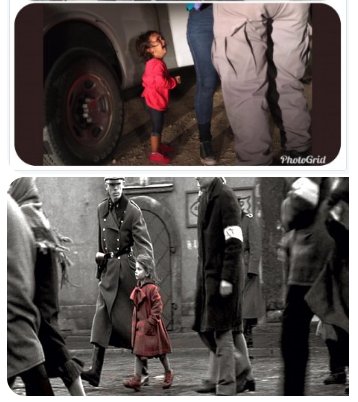
Upper picture is a child taken from parents by U.S. ICE agents, lower is child taken from parents by the original Nazis during WWII. Can we spot the similarities?
American attorney and author Mike Godwin coined his eponymous law on Usenet in 1990. Godwin’s law (or Godwin’s rule of Hitler analogies) is an internet adage asserting that “As an online discussion grows longer, the probability of a comparison involving Hitler approaches 1”; that is, if an online discussion (regardless of topic or scope) goes on long enough, sooner or later someone will compare someone or something to Adolf Hitler or his deeds. Promulgated by the American attorney and author Mike Godwin in 1990…. [There] is a tradition in many newsgroups and other Internet discussion forums that, when a Hitler comparison is made, the thread is finished and whoever made the comparison loses whatever debate is in progress.
—Wikipedia’s article on Godwin’s Law
Becaue of that latter tradition of the law being used as a trigger for moderators to shut down discussion threads, there are many well-meaning people who believe (falsely) that Godwin’s Law is a statement of a logical fallacy. In other words, they believe that someone how the act of invoking Hitler is an actual invalidation of the argument being made. In a time when:
actual neo-Nazis and White Supremacists have staged marches in our country at which other people were killed,
…one often finds oneself being concern trolled by someone trying to derail one’s comments with invocations of Godwin’s Law. Which makes said de-railers either complicit with all the evil being perpetrated by the so-called alt-right or really stupid (sorry, there is no other word for it).
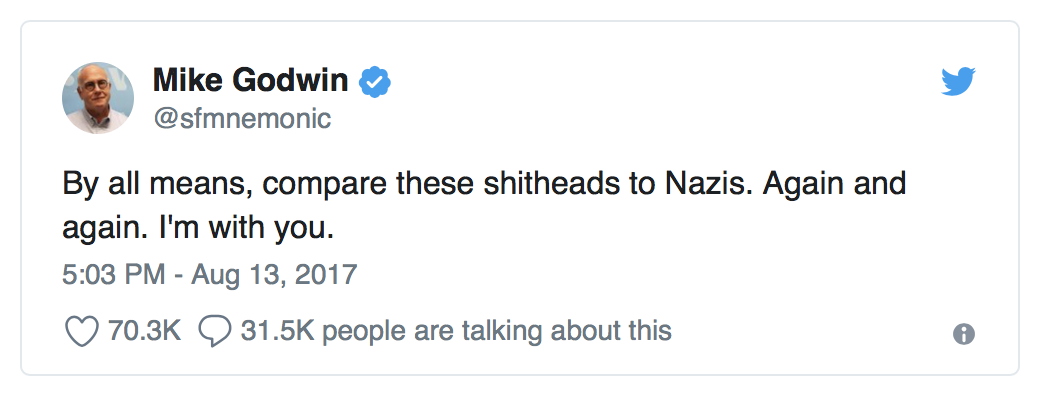
So this a reminder that Godwin himself, last year after the events of that Charlottesville neo-Nazi protest that resulted in injures and death, suspended his law:
We’re talking full-on fascism here, folks. Stop arguing semantics and let’s look for solutions. Also, if you have ever said, when contemplating the history of how the Nazis took over Germany in the 1930s, that you would never stand idly by had you been there. We are there now. What are you going to do?
A few other things that either didn’t make it into the Friday Five or come up after:
(click to embiggen)I’ve been to a lot of Pride parades and festivals since attending my first in 1990. One year I participated in the San Francisco Pride Parade one weekend, flew back home to Seattle where I marched in our parade the following week, and then in August I found myself in Vancouver, British Columbia where I hadn’t realized it was going to be their Pride Parade. San Francisco’s was like so gigantically larger and brasher than any other I had ever seen, while Vancouver’s was small but very enthusiastic.
The reason for the parade, ultimately, is to declare our existence–our survival in a society that is less than welcoming. We’re here. We’re your daughters, your neighbors, your sons, your co-workers, your friends, your siblings, or your parents. We’re not mysterious creatures lurking in seedy clubs–we’re the guy sitting across from you on the bus reading a book, or the two gals sitting in that next pew at church, or the pair of guys in the grocery store discussing how many hot dogs to buy for the cookout, or the grey-haired guy trying to read a label on a bottle of cold tablets in the pharmacy, or that kid on the skateboard going past your bus stop, or that guy sipping a coffee at Starbucks, or that gal a couple table over at the same coffee shop laughing at something on her computer.
We’re real, we’re everywhere, and we have hopes and dreams and worries just like you. We’re not asking for special rights, we’re asking for the same rights you take for granted. We’re asking to live our lives as openly as you live yours.
I enjoy watching the parade to acknowledge that survival. I cheer while watching the parade to express my admiration, support, and love for all of these survivors.
I cheer for people who are being brave and marching in their first parade; we see you and welcome you to the tribe.
I cheer and applaud so that those whose families rejected them and told them never to come back will know they have another family, and we’re clapping for them right now.
I cheer so that group of teen-agers (half of them straight and there to support their bi, gay, lesbian, and trans friends) will get the recognition they deserve.
I cheer so the couple in their matching sequined costumes will know someone appreciates the work they spent (perhaps being up all night gluing those sequins on).
I cheer the older couples walking together holding hands; we see your love and we celebrate how long you and your love had endured.
I cheer the younger couples walking hand in hand; I wish I had felt free to do that at their age, but I hope they have a bright future.
(click to embiggen)I applaud and cheer so that the trans* gals and trans* men know they are seen for who they are and we think they’re beautiful, wonderful, and I am proud to call them brothers and sisters.
I cry when I see those who are carrying a photo or wearing the name of a deceased loved one; we see your loved one and share your grief.
I cheer for PFLAG so that straight parents who have spent countless hours explaining to friends and relatives that their queer kids have nothing to be ashamed of, and yes they are very happy, and no those things you’ve heard or read about their health and lifespan are all myths will know their efforts are appreciated by the whole community.
I clap and cheer and laugh and cry as the parade goes on and on showing how big and wonderful and diverse and amazing our community is.
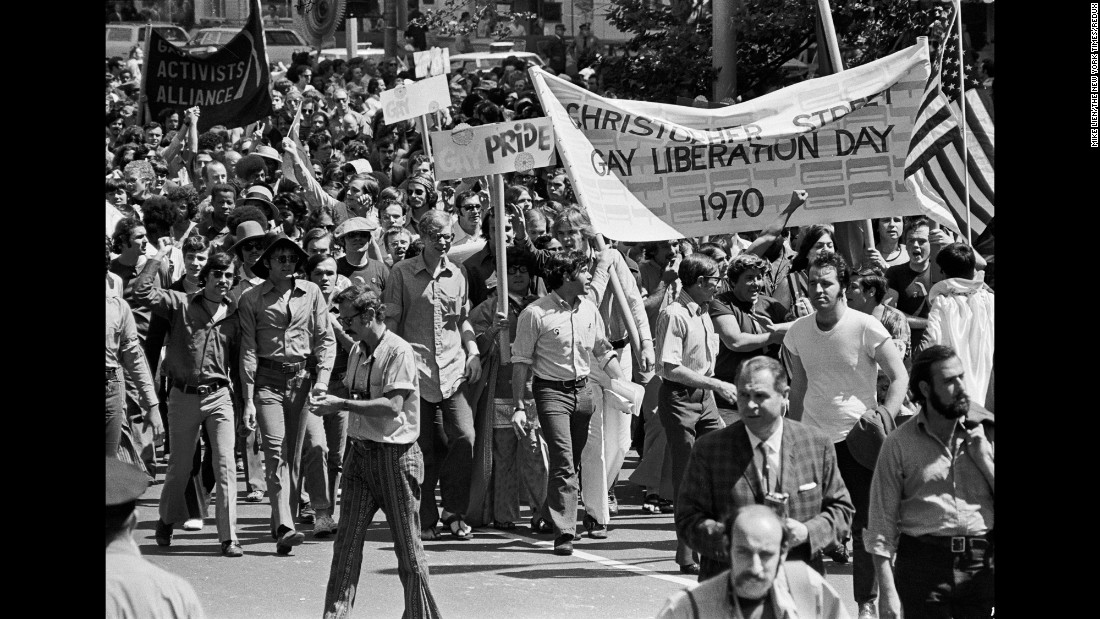
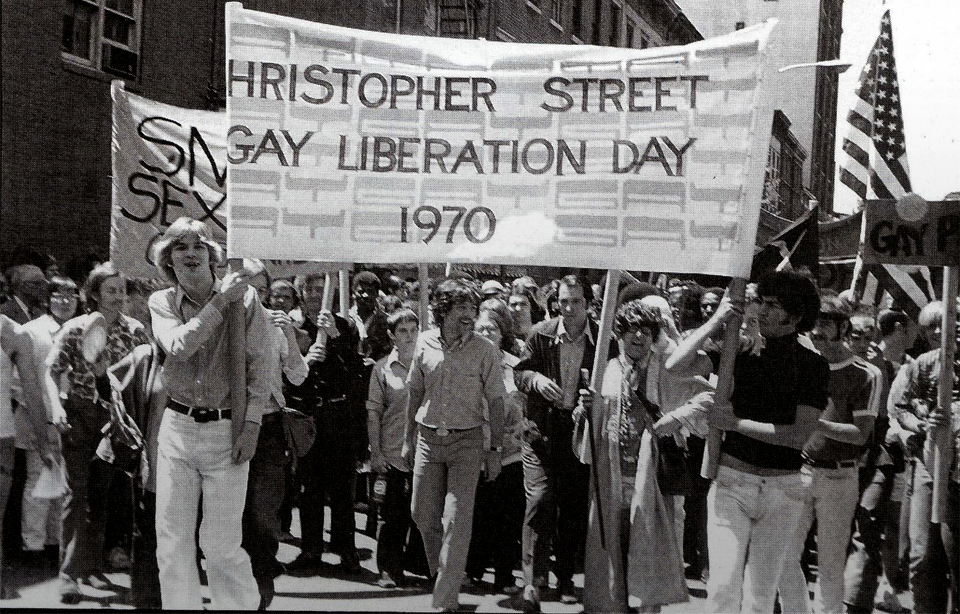
(click to embiggen)The very first Liberation Day Parade in New York City, was a protest march on the first anniversary of the Stonewall Riots (the first Pride was a riot). People were afraid of what would happen at the first march. Only a couple dozen people showed up at the starting point, with their protest signs. But they marched. And all along the announced route of the march, the sidewalks were lined with people. Street queens, and trans people, and gay men and lesbians and queers of many other stripes.
(click to embiggen)And then completely unplanned thing happened. As the small group of marchers went be, queer people and supporters started stepping off the curb and joining. By the time the marchers reached the Sheep’s Meadow in Central Park, the crowd numbered in the thousands.
It has been a tradition of Pride Parades ever since, that spectators step off the curb and join the march.
So when I march, there comes a point where I do that. I have cheered and applauded and made sure that others were seen. I have witnessed their love and courage and unique style. Until it is my turn to join the march. To be visible. To declare by my presence in that throng that I am queer. I’m here. And I will never go back into the closet.
(click to embiggen)I’ve written many times about the first time I watched a Pride Parade. Because of the lurid press coverage I had seen before that, and even some of the critical things I heard from certain queer acquaintances, I was expecting something very different that what I actually saw. So what did I see? Mostly a lot of very ordinary looking people. There was a group of people in shorts and t-shirts who were marching with their dogs on leashes. There was the group of people driving a particular small foreign car. The drivers were wearing matching t-shirts, and I suspect shorts, though it was hard to tell. There were many, many groups where most of the people were wearing matching t-shirts and shorts and walking behind a banner that declared they were with one non-profit organization or another. A lot of them.
There were a lot of pink triangles. There were also rainbows, some lambdas, and some labryses. A lot of people had pink or purple hair. Most of the groups had at least some members who had their children marching along beside them.
There were people dressed very scantily. There were banners and floats that had some sort of sexual innuendo as part of the theme. There wasn’t any actual nudity, but there were a few costumes that were very close to it. But the thing is, not quite a year before my first Pride Parade, I had attend my first Seattle Torchlight Family Seafair Parade with a bunch of co-workers. And at that parade—an official city parade with the word “family” in its title—I had seen a whole lot more near nudity, many more sexual innuendos as themes for floats, and a whole lot of drunken participants in the parade.
I should mention that there didn’t seem to be many queers in the pride parade who were under the influence. Certainly nowhere near as many as I saw at the Seafair Parade.
The difference was, that all of the sexual content and near nudity in the Seafair Parade was clearly aimed at the heterosexual male gaze. Just as I see a lot more sex in the typical set of Super Bowl commercials that I have ever seen at a Pride Parade. And that’s the thing: straight people are so used to straight male sexual desire used to sell everything from cupcakes to beer to automobiles, that they don’t even notice it any more.
Heck, in Seattle we have another annual parade called the Fremont Solstice Parade, and it is famous for have scores of nude bicyclists in it every year. Under Washington state law, if you have body paint on, it counts as not being nude. And it was a community parade put on by mostly straight people who was doing it for years before the queers in Seattle started doing it in our Pride Parade.
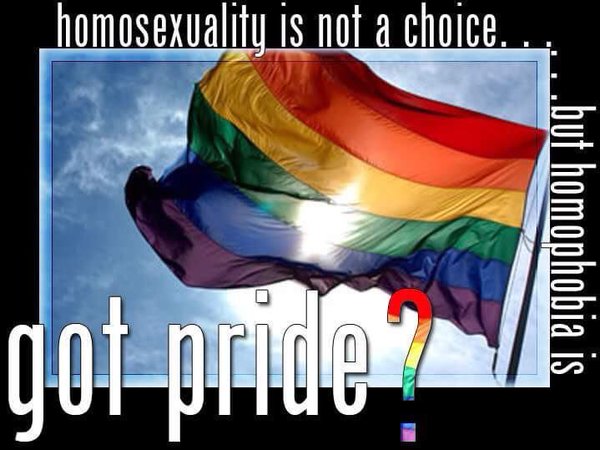
(click to embiggen)So if you’re one of those people who objects to Pride Parades because you think they’re too wild or sexy or whatever, I am just going to laugh at your cluelessness. I’ve written a few times about the people from within the community who hate it, and I have yet to meet one whose arguments didn’t boil down to being equivalent of the bigots. So if you’re one of those people you don’t get my laughter, you get my pity and a hope that someday you will stop being a self-loathing hater.
If you’re one of those people who think Pride isn’t needed because bigotry is somehow far behind us, please take this does of reality:
Finally, if you’re one of those people who asks, “If you’re born this way, what’s to be proud of?” First, look up at that list. Remember that that is barely scratching the surface of the hate, bullying, and oppression that every queer person has survived. So, what do we have to be proud of? Some people want us dead, but we’ve survived. Some people wish we were invisible, and we have stepped out into the light and shared our beautiful glittery freaky selves. We have been told we aren’t worthy of love, but we have found loving friends and chosen families and yes, even someone to call husband or wife. People have tried to bury us in hate, and we have shown the world our love. They have knocked us down again and again, and we have gotten back up, fiercer than ever. They have tried to force us into the shadows, and we have shown the world our light.
I’ve quoted before the old Jewish joke that the meaning of all Jewish holidays is, “They tried to kill us. We’re still alive. Let’s eat.” In the spirit of that sentiment:
They wish we were dead or invisible. We refuse to hide.
(click to embiggen)I was astonished, after I had been out of the closet for a bit, to look back on my previous life and realize how much of time and energy had been spent living in fear. Fear of being found out. Fear of being rejected by family and friends. Fear of being physically assaulted. Fear of living a life without love. Fear of dying alone. Fear of what would happen if the preachers were correct and a lake of eternal fire awaited me.
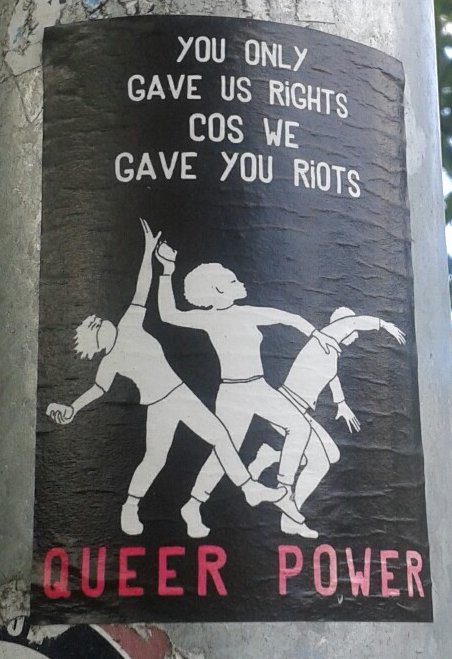
“You only gave us rights because we gave you riots. Queer Power” (Click to embiggen)All of those fears were based on real experiences. My dad’s most angry beatings were all accompanied with him calling me worthless, a faggot, and a cocksucker. And for several years I didn’t know what those last two words meant. The kids at school who bullied me (which often involved physical attacks) always called me a sissy or pussy while doing it. The teachers who verbally bullied me called me a sissy or faggot while doing so. In high school, a classmate I knew well was jumped by a group of jocks who were convinced he was gay (he wasn’t—years later he’s married to a great woman and they have two wonderful kids and we still chat online) and was in the process of being beaten up until a group of us found them and broke it up. Another classmate who I didn’t know very well was beaten so badly he was kept in the hospital for a few days. Again, it was because a group of guys at school thought he was gay (he was—last I heard, he and his partner of several years were living in Boston). A couple of other classmates who were outed in embarrassing ways were kicked out of their homes by their parents, and wound up living with relatives far away. One of my uncles (the same one who insisted that I was such a sissy because my parents let me own an action figure) said he would kill any of his sons if they turned gay.
So it wasn’t just anxiety. It wasn’t all in my head. The danger was real.
(click to embiggen)And because I’d been raised Southern Baptist, and I was the kind of nerdy kid who read the Bible all the way through on my own at least twice, I spent many, many hours begging god to take these feelings away from me. I spent a lot of time studying the guys that never got called out like I did, trying to figure out how to act more like them.
And while for many queer kids the world is a more tolerant place than it was for me in the 60s and 70s, thousands of teens in the U.S. are still thrown out on the streets every year by parents whose religion teaches it is better to drive the kid out than to “encourage their lifestyle.” Hundreds of children and teens still commit suicide every year because of bullying by people who suspect they are queer.
All the bullying, anxiety about being rejected, and so forth affects us. Studies show that most adult queers bear at least some of the neurological markers of PTSD—just like domestic abuse survivors. Coming out and finding communities that accept us doesn’t make that go away. We are always on the lookout for the next potential threat.
This is another variant rainbow flag that’s been around longer than the More Colors Flag.There were always moments when I would get angry because of the way I was treated. But particularly when I was a young kid, anger was never useful. I was physically unable to stand up to the bullies (for instance, the middle school bully who was enough bigger than me that he held me upside down for many minutes while his buddies kicked and spit on me).
Over the course of several years anger began replacing fear. There are many moments I can point to, but one that sticks out came in my early 20s. I was sitting in a church pew in a church where the musical ensemble I was directed had performed several songs for to support a revival meeting. The visiting preacher had delivered an unusual message for a revival: he had talked about unity and finding common ground among fellow Christians who didn’t always agree with us on every detail. It was conciliatory, rather than a fiery call to fight evil, which was a much more typical revival tone.
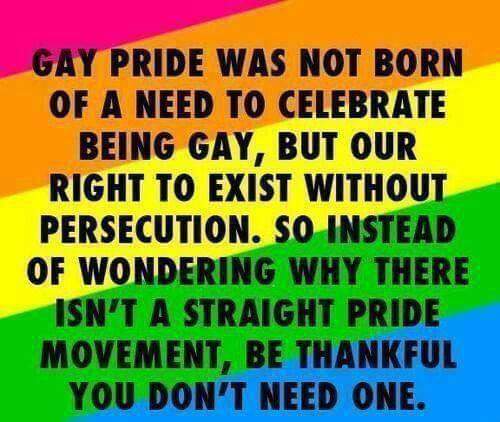
“Gay pride was not born out of a need to celebrate being gay, but our right to exist without persecution. So instead of wondering why there isn’t a straight pride movement, be thankful you don’t need one.”And then one of the pastors from the local church gave the closing prayer. That how I found myself with head bowed and eyes closed and suddenly shaking in fear as the pastor thank god for sending the scourge of AIDS to wipe out the evil homosexuals from the face of the earth. Oh, he went on and on about it. And because as far as I knew I was the only homo (very closeted) in that room, I half expected people to pull me aside for an intervention afterward. Or maybe that I would be jumped and beaten to within an inch of my life somewhere.
I realized some time later that the pastor wasn’t targeting he was arguing with the visiting pastor, using the passive-aggressive platform of a public prayer. But over the following days and weeks, as I realized that no one was targetting me, I began to get angry. And the more I thought about how that pastor had used a prayer to spew such hate, the more angry I became at the entire system.
That may have been the final nail in the coffin of my membership in the Baptist denomination—if not all of Christianity together.
“The only choice I made was to be myself.”There are many people who will tell you not to become an angry, militant advocate for anything. They will urge you to try to find middle ground, to compromise, to make peace with those you disagree with you. The problem is that there isn’t an acceptable middle ground between the propositions: “I want to live” and “you deserve death.” And the people who thank god for AIDS, who tell parents to kick their queer children out on the street, who argue that transitioning treatments are not medically necessary, and who argue we shouldn’t have marriage rights (which legally include the right to make medical decisions for one another and so forth)—they are all implying, if not outright saying, that queers deserve death.
Seriously, the only middle ground is that some queers deserve death. How is that a morally acceptable position for anyone?
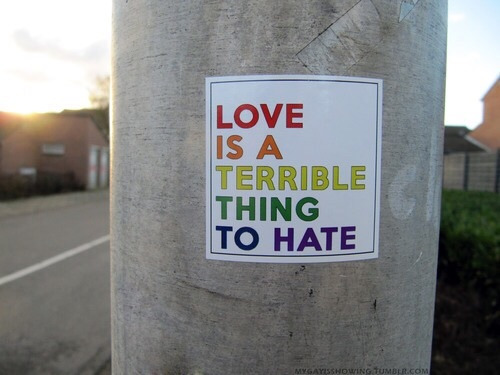
“Love is a terrible thing to hate.”So, yes, I am frequently an angry, militant queer. But all of the people on the other side are arguing in favor of murdering at least some queer people (or, I suppose you could argue that they are simply willing to allow some or most of us to die). That means that what I feel is righteous indignation. And if you don’t feel it at least a little bit on behalf of those kids bullied to death, the murdered trans people, and so on, well, I’m sorry to say, that means you’re on the side of the hateful murderers. I’m sure you have some rationalizations for why your position isn’t that, but you’re wrong. If you don’t believe our outrage is justified, then you’re not one of the good guys.
If that realization makes you unhappy, well, you have the power to fix it. Come over to the Light Side. Join the fight for justice, love, and life.
(click to embiggen)A few years ago one of the large anti-gay political action groups sponsored a protest march that was supposed to be in favor of “traditional” marriage. All of the signs and banners carried by participants in the rally were extremely anti-queer, and not one single sign was actually in favor of any kind of marriage. Now, because we monitor these things, I was one of literally thousands of queer and queer-allied people online who hijacked the hashtag of the anti-gay folks to post pro-gay memes and comments. There were so many of us queers and allies posting pro-queer rights comments, that we overwhelmed the bigots’ message, at least on social media.
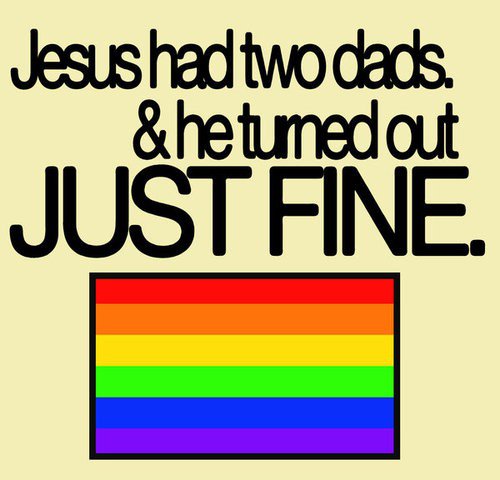
I received a lot of interesting replies. One person was particularly upset with me for sharing a meme similar to the one at the top of the post that talked about Jesus and his two dads. “Can’t you disagree without the blasphemy of saying god had a sexual relationship with Joseph?”
I responded by pointing out that the meme doesn’t mention sex, it simply affirms the Biblical texts which referred to Jesus as both the son of Joseph and the son of God. Then I said that the only blasphemy I saw were people trying to force some of their religious views into law, penalizing people who weren’t part of their flock. There were a couple of back and forths, but I had already promised myself that any bigots who chimed in would get two replies of me trying to clarify or whatever, and then after that my only reply to any further comments would be “Bless your heart.” So the discussion petered out.
blasphemy noun, Profane talk about something supposed to be sacred; impious irreverence.
I’m sorry, but I really was merely taking the Bible literally: the text calls Jesus the son of Joseph in some places, and the son of god in others. In fact, it refers to him as the son of Joseph more often than it calls him the son of god. The oldest surviving copies of the gospels never call him the son of god. And then there’s the whole genealogy in one of the gospels, showing how Jesus is descended from King David–through his father, Joseph!
So if it is profane to talk about Jesus having two dads, the profanity starts in the Bible.
If we’re going to get upset about any sex involving god, what about the nonconsensual impregnation of Mary? I mean, looking at the text, it’s pretty clear that god roofied Mary, then sent “the Holy Spirit to overshadow” her and conceive the child. I say nonconsensual because while an angel appears to Mary before it happens to tell her it is going to happen, at no point does the angel ask if she agrees to this thing. And really, Mary was almost certainly a teen-ager, confronted by a powerful otherworldly being who tells her that an even more powerful being is about the knock her up. With such a power differential, is the concept of consent even possible?
I’ve seen the arguments made, sometimes by people who claim to take the Bible literally, that this is just a standard divine intervention trope: Eqyptian and Greek mythology, for instance, are full of stories of gods having sons from mortal women. As if “everyone else is doing it” is a moral precept?
Among the many problems with people of various conservative types of Christianity imposing their beliefs on others through the force of law, is that even their own holy book isn’t very clear on these points. The person they have named their religion after, Jesus Christ, never once said anything about gay people, one way or the other. And believe me, there were gay people there in Galilee and Judea. If being gay was such a big sin, you would think he would mention it.
There are only six verses in modern English translations of the Bible that appear to refer to homosexuality directly. However, the four in the New Testament have only been that way since a re-translation in the 1920s. In the oldest versions of the text we have in the original languages (Arameic and Greek), the words were gendered references to temple prostitutes in two passages, the third is a reference to two separate sins (cheating on one’s spouse after making a monogamous committment, and having sex with someone before you have married). The fourth, meanwhile, no one knows. The Apostle Paul made up a greek word that occurs nowhere else in any ancient greek document my combining two existing words meaning bed and lewdness.
Honesty, given how opposed to marriage of any kind Paul was (he thought it was a waste of time and energy that would be better spent evangelizing), this might have been a word he coined to refer to those men who “so burned with lust” that they couldn’t concentrate on god’s work unless they married and had an outlet for the aforementioned lust. If so, then Paul was calling heterosexual marriage an abomination, not gay sex.
As to the old testament passages: modern Christians have no problem ignoring the other parts of Leviticus they don’t like (the prohibitions on bacon and shrimp, for instance), so it is difficult to take them seriously on this. Further, I’ve read more than one argument written by Jewish Rabbis that those texts should never be discussed out of context of the rest of the books (including a lot of commentaries and documents that were not absorbed into the Christian Bible), and are probably referencing some specific issues at the time of writing with men visiting temples of other gods and partaking of temple prostitutes. So it is more likely those verses are admonitions against idolotry and sex with someone other than one’s spouse after making a monogamous committment.
Please note I am paraphrasing. Wrestling with the Torah is a lifetime commitment of its own, and the fact that the church I was raised in has co-opted a not-terribly-well-done translation of the Torah doesn’t make me an expert.
Holy books, no matter whose holy books we are talking about, were written by humans. You can believe that they are divinely inspired if you wish, but the words were written by imperfect humans, using imperfect language, which is being read centuries later by other imperfect humans with imperfect understandings of languages that have changed during those centuries. Just to narrow it back down to the bible, that book itself contains many stories of people who were absolutely convinced that they knew what god wanted them to do, who turned out to be wrong. It also contains stories (go read an annotated version of the Saga of Sampson for one of the most entertaining) of people who were believed to be immoral or otherwise unsuitable for god’s work by all the godly people around them, who were actually the ones doing god’s work.
As my Bible professor in my university days was fond of saying, “The text keeps telling us that we can’t find all of the answers in the text. We have to think and develop compassion and a sense of justice on our own. And that’s a lot of work.”
If your argument that people who are gay, lesbian, bisexual, asexual, pansexual, trans, nonbinary et cetera don’t deserve equal rights is to quote your holy book without applying compassion, testing the situation against the notion of justice, and just thinking about whether you are even holding yourself to a similar standard, then you aren’t doing the work. You are failing your fellow humans. You are failing at your own religion.
And you are failing to regard the life and well-being of some of your neighbors with reverence. And that is true blasphemy.









 Font Folly