Some times, you just have to quote one of the masters:
“Critics who treat ‘adult’ as a term of approval, instead of as a merely descriptive term, cannot be adult themselves. To be concerned about being grown up, to admire the grown up because it is grown up, to blush at the suspicion of being childish; these things are the marks of childhood and adolescence. And in childhood and adolescence they are, in moderation, healthy symptoms. Young things ought to want to grow. But to carry on into middle life or even into early manhood this concern about being adult is a mark of really arrested development. When I was ten, I read fairy tales in secret and would have been ashamed if I had been found doing so. Now that I am fifty I read them openly. When I became a man I put away childish things, including the fear of childishness and the desire to be very grown up.”
—C.S. Lewis
#WeAreAmerica #LoveHasNoLabelsI find myself in really odd discussions lately on social media. The worst, to be honest, happen on Facebook—usually with relatives. But it’s not just the cousin who keeps insisting that only immigrants object to religious Christmas displays on the public dime. Nor is it merely the aunt who keeps insisting that she doesn’t hate “the gays” or “the transgendereds” but is constantly posting memes and personally penned rants about how god is going to destroy America because of gay rights, and allowing trans people to use a public bathroom leads to rape. It’s not even the folks who argued that their right to sell assault weapons was more important that my right to not want to be gunned down in a gay club.
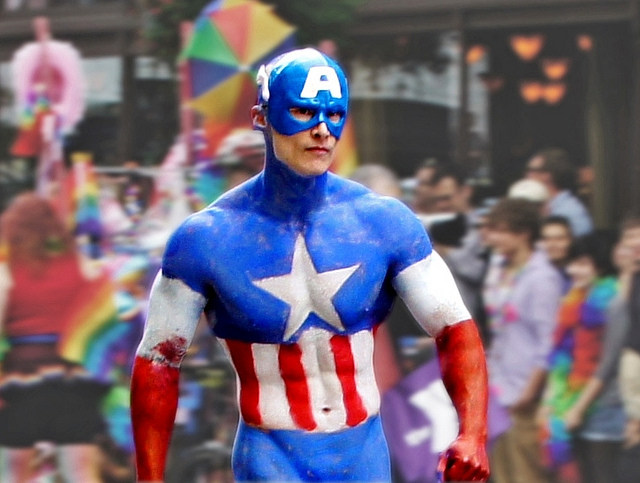
Captain America photographed in the 2012 Seattle Pride Parade (https://www.flickr.com/photos/sea-turtle/)It’s also the folks who post the “Make America Great Again” memes, and unironically talk about how perfect America was in the 60s or 50s or whenever their childhood was. It’s the people who post the “Thank a Veteran” memes while voting for Republican congresscritters who constantly cut funding for veteran’s health care (and everyone else’s healthcare while they’re at it). It’s the people who describe themselves as “patriot” but think that means a very specific rightwing viewpoint. It’s the people who scream “all lives matter!” in the face of overwhelming evidence that the murders of black people, brown people, trans people, or women, or Jewish people, or people perceived to be muslim are never given as much attention by the justice system as other people’s deaths.
I love America. I have a favorite Founding Father (and I can go on at great length about why he’s my favorite), and I have a second favorite (and I can go on at equally great length as to why he’s my second favorite and why I understand that a lot of people prefer him over my fave). I can quote whole sections of the Constitution from memory. I get irritated at people who leave their U.S. flags out in the rain or fly them at night without illumination. I get teary eyed when patriotic music plays. I believe, even though many of the men who signed the document didn’t, that the Declaration of Independence was right when it said that we are all created equal (though I really wish it said people instead of men). I believe that America’s ideals are great, and wonderful, and visionary, and worth fighting for.
But I’m also painfully and personally aware that neither our laws, nor our society, nor most of our institutions live up to those ideals. America has seldom been great if you were not a cis white heterosexual male—preferably protestant (or let’s be honest, with a veneer of being a protestant Christian). If you were lucky enough to fall into that privileged category as a child, or the next best thing, to be the child of such a person and therefore protected by their umbrella of privilege, yes, America seemed really cool when you were younger.
Part of that was all that privilege, but another part was that most real world problems weren’t yours to worry about. Your parents were responsible for keeping a roof over your head and food on the table. If your family wasn’t poor, you spent at least part of your childhood completely unaware of most of the downsides of the world. Similarly if you were lucky enough to have loving, non-abusive parents. So of course life seemed simpler then. It wasn’t any simpler. Violent crime rates were actually much higher (because they have been steadily decreasing for decades), for instance. A lot of diseases we have treatments or even cures for now were completely untreatable. If you weren’t white, male, or straight, the law denied you all sorts of rights many take for granted, and often actually criminalized your existence.
No one who calls themselves an American patriot should sit in silence while injustice, racism, sectarianism, homophobia, or misogyny are being perpetrated in our name. James Madison (called Father of the Constitution, though he preferred to be remembered for authoring the original Bill of Rights) warns us, “I believe there are more instances of the abridgement of freedom of the people by gradual and silent encroachments by those in power than by violent and sudden usurpations.”
It is our silence and indifference that erodes the promise of liberty. It isn’t the immigrant (besides, unless you are Native American, you or your ancestors are immigrants), it isn’t the person who adheres to a different faith than you, or to no faith. It isn’t the lesbian couple trying to buy a wedding cake. It isn’t the trans person wishing to use a public bathroom. It isn’t the African-American mother demanding justice for her 12-year-old gunned down in a playground by police. It isn’t people asking to close some of the loopholes in background checks before guns are purchases. It isn’t the Jewish person asking that we not have a manger scene in city hall. It isn’t the recent immigrant working two jobs and trying to fit in English as a Second Language class while getting their kids through school.
None of those people or events are what has made America anything less than great.
It’s people who call themselves “patriot” who blames any of those other people. It’s the people who call themselves “patriot” and lecture people on line about racism while their own user name is literally a vile racial slur. It’s the people who call themselves “patriot” who sits silents while others denounce people because of their race, religion, sexual orientation, sexual identity, et cetera.
Judging others for being different and denying them the rights of life, liberty, and the pursuit of happiness is not American—love, acceptance, and helping our neighbors is.
We Are America featuring John Cena | Love Has No Labels:
I do playlists, as I’ve mentioned a few times before. I’ve been working for the last week on a new Fireworks list. Digging back in my iTunes library I see I’ve got eleven previous ones each dated with the year I made, except the first one, which is merely called “Gene’s Fireworks List.” A lot of songs get repeated year after year. But this year I was having trouble, because America isn’t being it’s best. We often fall short of our ideals, but with the blatant racism, sectarianism, homophobia, and worse coming from the nominee of one of the major parties (I mean, how many times now has Donald Trump shared posts from literal white supremacist and neo-nazi sites so far?), well, I just feel as if we’re further from the aspirations of liberty and justice for all than we have been in a while.
So I wound up making two lists. One is fairly traditional, this one is just called 2016 Fireworks:
“Star Spangled Banner” – Keith Lockhart & the Boston Pops Orchestra
“God Bless American” – Kate Smith
“America” – Neil Diamond
“You’re a Grand Old Flag” – James Cagney & the cast of Yankee Doodle Dandy
“Liberty Bell March” – United States Marine Corps Band
“We Shall Be Free” – Garth Brooks
“National Emblem March” – Keith Lockhart & the Boston Pops Orchestra
“The Washington Post March” – United States Marine Corps Band
“Born in the U.S.A” – Bruce Springsteen
“The Thomas Jefferson March” – United States Marine Corps Band
“An American Trilogy” – Elvis Presley
“The Stars and Stripes Forever” – United States Marine Corps Band
“What a Wonderful World” – Louis Armstrong
“The Blue Danube Waltz” – United States Marine Corps Band
“Star Spangled Banner” – Dolly Parton
Then this was is a little more… aspirational:
“I Love the USA” – Weezer
“Song of the Patriot” – Johnny Cash
“This Land is Your Land” – Arlo Guthrie & Woody Guthrie
“Someday We’ll All be Free” – Donny Hathaway
“All-American Boy” – Steven Grand
“God Bless American” – Kate Smith
“Boogie Woogie Bugle Boy” – Bette Midler
“Chimes of Freedom” – Bruce Springsteen
“Oh, Freedom” – Harry Belafonte
“Bridge Over Troubled Water” – Simon & Garfunkel
“The Battle of New Orleans” – Johnny Horton
“Living In America” – James Brown
“The Star Spangled Banner” – Whitney Houston & The Florida Orchestra
I was hurrying to get to the bus stop on my way to work recently and as I started to cross a side street I was surprised at something I saw on the other side. It looked like someone had planted a bunch of new bushes along a construction fence. This new line of freshly planted greenery was on the exact spot that only a month or so before a hedge had been removed. Clearly the bushes were going to be in the way when workers needed to start demolition work. I had been sad to see them go, as I’ve been walking past that line of bushes for many years. It made no sense to plant new ones now, because they haven’t even begun to tear down the old buildings yet, let alone start the new construction. Why would anyone start planting new landscaping now?
I crossed the street and only when I got closer did I realize what I was actually looking at. They had cut down the old line of bushes, yes. But the roots were still there in the soil. And it was spring time and there was ample sun and rain, so new growth was vigorously re-asserting itself.
I was nearly past the bushes before I decided to stop and take a couple of pictures. Looking down at all that bright green new growth bushing out around the stumps, I couldn’t help think about how tenacious life is. Cut something down, and it will grow back.
It’s hardly an original metaphor, I know. But it’s a process I’ve lived through and witnessed more times than I can count. I was a teen-ager in 1977 when Anita Bryant led her first campaign to repeal an ordinance that would protect people from being fired or denied housing because of their sexual orientation. And when he supporters passed a law banning gays and lesbians from adopting or being foster parents. We weren’t even a decade past Stonewall, and getting a few anti-discrimination ordinances passed in some of the most liberal cities hadn’t been great progress, but it had seemed people were starting to come around. Then this happened.
As Bryant led successful campaigns in city after city to repeal those ordinances, it looked pretty grim. But queers and their supporters didn’t give up. People laughed when they found out that gay bars were boycotting orange juice (Anita Bryant’s primary source of income at the time came from making commercials for the Florida Orange Grower’s Assocation). Gay bars and restaurants removes screwdrivers from their menus and added a new drink called an Anita Bryant: vodka and apple juice. Reporters chuckled on air as they explained the boycott on local evening TV shows. Newspapers ran cartoons mocking the sissies for thinking that some cocktails would change anything.
But all the mocking put the information in front of people. And a surprising thing happened. Orange juice sales were hurt. People wrote to the Florida Orange Growers Association to protest their support of these anti-gay campaigns. The Association hadn’t been supporting Bryant’s campaign, but all that mocking coverage of the silly faggots and their boycott made people think they were. Not just silly faggots who brunched together and gossiped over cocktails.
And it put the issue of gay rights in the news in a different way than anyone had seen it before. Certainly I, as a seventeen-year-old living in a small town, had never been to a brunch with a bunch of queers, and I wouldn’t have known that there were actually places where the law might protect a queer person from some kinds of persecution. And the rhetoric of the anti-gay forces made a lot of people that you would never expect stand up for gay rights.
The result was that all over the country, queers and their allies formed new organizations to fight the anti-gay initiatives and referendums, and those organizations kept fighting. And people like me realized that they weren’t alone. There were people out there like us. There were people out there who wouldn’t hate us if we came out.
Unfortunately, we were then hit by the AIDS epidemic. It’s really hard to explain just how horrific that was to folks who didn’t live through it. As I pointed out in response to an online conversation a few months back, it was not simply that most gay people knew one or two people who died. It felt like everyone was dying. There were weeks when my (now late) partner Ray and I had to decide which of several funerals or memorial services happening on the same day we would be able to attend.
But even as we were dying, we fought back. We banded together into new groups like Act Up and Queer Nation and Q Patrol and many others. We banded together to take care of each other while White House press secretaries and reporters openly laughed and made jokes about our deaths. We buried our dead and we mourned and we got right back out on the streets and marched and demanded to be seen.
And the haters ran their anti-gay campaigns again. Initiatives to forbid gay and lesbian people to work in certain fields. Laws to criminalize our terminal illness (sadly still on the books in many states). Proposals to quarantine us in “medical camps.” Laws to ban us from adopting. Laws to ban us from putting partners on our insurance policies.
For every fight we lost, it just made us more determined. Like that hedge, you can cut us down, but our roots go deep. We come back, stronger, brighter, more determined to win the next battle. And every fight we won, when the opposition said, “Okay, fine, you can have those crumbs. Now be quiet!” we refused to go away.
Joe Jervis, who runs the Joe.My.God web site, every year explains why he thinks the Pride Parade is important, which he sums up by quoting the old Jewish joke about the true meaning of every Jewish holiday: “They tried to kill us. We survived. Let’s eat.” Joe then gives his Gay version of the meaning of Gay Pride: “They wish we were invisible. We aren’t. Let’s dance!”
“Is it Queer in here, or is it just me?” (click to embiggen)
In the immediate aftermath of the Orlando shooting, President Obama’s remarks were met with criticism from many corners, as they do, but there was a particular comment that seemed to really upset a lot of straight people on social media. This bit really got some folks’ panties in a bunch:
The shooter targeted a nightclub where people came together to be with friends, to dance and to sing, and to live. The place where they were attacked was more than a nightclub—it is a place of solidarity and empowerment…
—Barack Obama
Some people had a real difficult time understanding why anyone would refer to a gay bar as a place of empowerment. It’s really hard for most straight people to understand just how isolated and alienated queer kids feel their entire lives. We take a lot of flack, particularly white male queer people, from people of color whenever we draw parallels between our struggle for acceptance and equality with the struggles that racial minorities face. There are more similarities than some people want to admit, but they are correct that there are differences. And one of those differences is that isolation.
A member of a racial or ethnic minority growing up in a racist society is never told that other people like him or her do not exist. At all. Usually a person of color is aware of the existence of other people of color if for no other reason than the rest of their family is also a member of that racial or ethnic minority. They may live in a neighborhood where other members of the minority are neighbors, classmates, and so on.
Not queer kids. Until very recently, queer kids were pretty much guaranteed to grow up being told and shown again and again that every human is straight. Little boys are teased about having a crush on any girl or woman other than a close relative that they get along with. Little girls get told they will be a mommy some day. Every book, movie, television show, family anecdote, et cetera shows us again and again that every boy grows up to have a girlfriend, eventually a wife, and will become a daddy. And they tell every girl that she will grow up to be some boy’s girlfriend, then some man’s wife, and eventually will have that man’s babies.
And anyone who doesn’t do those things? Well, there’s something wrong with them! Unattached characters of either gender appearing in stories and shows are usually treated as the comic relief or as tragically alone. Lonely spinsters that everyone feels sorry for or eccentric bachelors that no one takes seriously are the least horrible futures that society tells us await us if we don’t fall in love with a person of the opposite gender and settle down.
That’s the initial indoctrination. The first level of lying, if you will.
As we get older, we start noticing other fates for men and women who don’t fit into the coupled hetero ideal. They aren’t just taken seriously and pitied, it’s worse than that. Some of those oddballs may indeed have special friendships with another person of the same gender, but that always ends in death for at least one of them. If one survives, it is as a broken creature, forever haunted by guilt and despair because of it.
The lies that we are told is that queer people don’t exist, or at least they don’t exist naturally, and those few queer people that do come about however that happens, will live lives that are filled with loneliness, despair, pain, suffering, and death. But it is a pain, suffering and death that they deserve because they are monsters.
When you are told those lies again and again; when you are made to feel like a freak any time you behave or feel anything other than what is expected; when you are not allowed to see any examples of queer people who aren’t object lessons who deserve pain and suffering—you believe it. Your parents, your teachers, your church, your neighbors, your classmates, and your siblings have all told you the same thing again and again your entire life. It must be true! There must be something deeply wrong with you, and that wrongness means that you can never be happy, never be loved, never know joy, never be accepted.
And you’ve been made to feel miserable any time that any hint of your difference has manifested. You have probably developed crushes on members of your own gender, but realized that the other person didn’t feel the same way. Or if the affection was returned, you both lived in terror of what would happen if anyone found out. If anyone has found out, there were some sort of bad consequences. One or both of your were beaten. You were forbidden to see each other. One or both of you might have been sent away or simply kicked out of your home by your parents.
So, the first time that we walk into a gay bar is usually a revelation. There are other people like you there! More importantly, you find people like you there who seem to be happy. The first visit may be a short one because you’re nervous and not sure what to expect. Or it might be that the atmosphere or theme of the place is catering to a different subset of the community than you identify with. But when you find a place that you can feel comfortable in, you see that there are people there who are living lives other than lonely and tragic. There aren’t just sexual or romantic relationships, there are friendships. People share drinks and a laugh when their life is going well, they share drinks and hugs and commiserations in times of sorrow.
And while you may not be a person who particularly fits in at the bar scene, there is still a sense of community and belonging that you can find there. One that many queer people never experienced before that.
My first few experiences in gay bars didn’t go terribly well. The first place I went to was more of a leather bar and I felt as if I’d stepped into a foreign country. My bright colored nerdy t-shirt didn’t help me fit in, but more importantly, I didn’t understand any of the non-verbal signals that were going on all around me. My second gay bar was filled with loud music that I had never heard before, and everyone was dressed in far more fashionable clothes than I could pull off. I felt like a very ugly duckling surrounded by a sea fashion models and body builders.
For me, the bar that clicked was the old Timberline. It was a mix of lesbians and queer men—a lot of people wearing cowboy boots and blue jeans. Country music was played there, and twice a week there were classes in line-dancing and two-stepping. Same-sex couples danced arm in arm, circling around the dance floor to the kind of music that I had grown up with. It wasn’t every queer person’s dream, but to those of us who are came to Seattle from the south or from rural communities just about anywhere, there were enough cultural touchstones to our childhood to make being an openly queer man dancing with another man feel like a magic transformation where the impossible suddenly seemed within reach.
That’s another reason the shooting hurts so much. Even though I haven’t been inside a gay bar in something like 14 years, the images of wounded people being carried out of the club not by paramedics, but by other people who were clearly part of the bar crowd was worse than a punch in the gut. One of our places was no longer ours.
I’ve rambled enough about this. We grew up being told we were monsters who should either not exist or be invisible. We grew up believing we would never have friends who would accept us for who we really were. We grew up believing that not only would we never find love, but that we didn’t deserve any form of happiness at all. For many of us, a queer club was one of the first places that we learned that all of those things were lies.
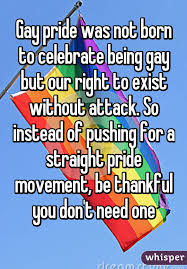
Every year as the date of the local Pride Parade approaches, I start seeing the comments and questions: “If you get a Gay Pride Parade, why can’t we have a Straight Pride Parade?” I can’t decide which is the saddest aspect of this question: 1) that they think this tired old canard is actually being clever, 2) that they don’t understand that 99.9% of all television, movies, news, and other public discourse is geared toward affirming heterosexual life, including straight sexuality (so every day is already Straight Pride Day), 3) that they don’t understand that Queer Pride events are about our very right to exist—an act of defiance against those who want us to be invisible or dead—not merely our right to party, 4) that no one is is stopping them from organizing their own straight pride events (even though I think they’re redundant)?
This year there is a new wrinkle. Some of my less-than-affirming relatives have (after trotting out the thoughts and prayers nonsense) urged me not to go to Pride, because they don’t want me to get hurt if something happens. They make these comments completely oblivious to the fact that the anti-gay memes they share online every day, the anti-gay initiative for which they signed the petition to place on the ballot, the angry calls they say they make to their congressperson after learning of an anti-discrimination law under consideration, and all the rest contributes to the atmosphere of hate that drives people to violence against queers.
And yes, I’ve also gotten, even in light of the most recent publicly visible horror, a few people asking me what’s the point of Pride. “You can get married, now. You won. Isn’t that enough?” Marriage equality was one very tiny battle, by comparison to what remains. We live in a world where:
Religious leaders who claim to preach god’s love think nothing of posting nasty anti-gay messages on their church signs: Vandalized: Georgia Church Sign That Says ‘Satan Made Gays & Transgender’ — and when a local lesbian Christian tried to help clean up the vandalism, the pastor who insists on leaving ht “Satan made gays & transgender” doubled down, insisting the lesbian is not a Christian and that she’s going to hell.
That last one is just the tip of the iceberg. It is still really common for people to react to any depiction of a queer person’s life as a queer person with, “Why do you have to show us all the time? Why can’t you just be who you are without labeling everything?”
The saddest part of this is that those people don’t think they are being homophobic at all. And they never think about the fact that straight people “shove their sexuality” in everyone else’s face all the time. Have pictures of your spouse, significant other, or children on your desk, wall, or phone’s home screen? Mention your wife or husband in casual conversation? Comment on how hot a particular actor or actress is? 99.9 percent of all movies and TV shows depict opposite sex couples flirting, kissing, and more? Routinely ask about family discounts? Expect that, of course, your spouse will be included in the company health insurance plan? Invite us to your wedding or your kid’s straight wedding? Show us pictures of yours or your kid’s straight wedding? Ever use the phrase “no homo”?
Since we get accused of shoving our sexuality in your face if we merely casually mention the existence of our significant other, we get to count all of those things as you shoving your sexuality in our faces.
Why do we need Pride?
We need Pride because people are still trying to kill us.
We need Pride because religious leaders are still cheering on the people who kill us.
We need Pride because people accuse us of “stealing the tragedy” when 49 of us are murdered in a gay night club on a busy Saturday night during Pride month.
We need Pride because people still target gender non-conforming children in schools, and now adults aren’t just making excuses for the bullying, they want to pay the bullies bounties for doing it!
We need Pride because it’s still legal to fire us just for being gay in 28 states.
We need Pride because people are more offended at the idea of selling us a wedding cake than they are about 49 of us being gunned down in a single incident.
We need Pride because people get angry when other people acknowledge our existence.
We need Pride because people get offended if we mention the gender of our significant other in casual conversation.
We need Pride because religious parents still kick their queer children out onto the streets just for being gay, and it isn’t considered child neglect or abuse to do so.
We need Pride because queer kids are born everywhere, not just into families and communities that love and accept them, and they need to know that they aren’t alone.
We need Pride because the world tries to make us hate ourselves, tries to make us be ashamed to love, and most importantly tries to convince us we are utterly alone.
The only way queers like me have been able to stand up and be ourselves is because other queers before us were brave enough to be out—whether it was staging sip-ins to protest laws that made it illegal for a bartender to knowingly allow two homosexuals be served in the bar, or fighting back when police raided a gay club, or picketing in front of federal buildings, or marching in the first ever Pride event in June 1970. Those of us who can stand up for ourselves now, owe a debt to the sacrifices those earlier generations of queers made. We can’t pay them back directly, so we have to pay it forward. We do that by standing up and being counted and being visible for all of the people (especially kids) who can’t, yet.
We need Pride not because we’ve come so far, but because for many there is still a long, long way to go.
A cartoon drawn by Patt Kelley and posted from his twitter account (@pattkelley) More of his work available at http://www.pattkelley.com (Click to embiggen)When horrible things happen, the first reaction of some people is to say that their thoughts and prayers are with who ever is suffering because of the events. It sounds nice. It makes the person saying it appear to be concerned, without actually costing them anything. It is a poor substitute for actually being helpful. This cartoon, which Patt Kelley recently shared on the topic, shows a person on fire, and another person holding a garden hose and spraying water into a bucket rather than putting out the fire. The person with the hose offers prayers, when a means to actually do something about the pain, suffering, and death is right there in his hands.
People insist that there is nothing they else they can do, but frequently they’re wrong. There are things which can be done. Things within the power of the people making that statement. Congress critters of the conservative sort are especially liable, here (but not the only ones). And I don’t just mean in passing laws, though that could often help.
The very same congresspeople who sat in Republican caucus recently and prayed that gays are “worthy of death” made a big show of talking about thoughts and prayers while a lot of the public was up in arms about the Orlando shooting. It didn’t stop them from killing an amendment to extend job discrimination protections to queer people. It didn’t stop them from voting down an amendment to tighten (but hardly close) the so-called gun show loophole. It doesn’t stop them from attending rallies with pastors who call for the death of gays. It doesn’t stop them from telling their supporters that letting trans children use the bathroom that matches their gender identity is dangerous.
They’re not just withholding a water hose. They’re the people who have been splashing gasoline in the direction of every queer person they could for years. They’re the people who handed matches out to lots of people and said, “I don’t condone violence, but god says queers are monsters.”
Thoughts and prayers is more than just a means to look like you care when you don’t. It’s more than just a means to appear helpful while you do nothing. It’s more that just a means to make people focus on your piety rather than the problems of others.
It’s also an attempt to establish an alibi.
If they offer thoughts and prayers, then clearly they can claim they had no idea that all their anti-gay rhetorical was going to encourage another to attack queer people. If they offer thoughts and prayers, then clearly they can also claim that they had no idea that all the anti-trans hysteria they’ve whipped up over bathrooms would make gender nonconforming kids hate themselves to the point of considering suicide. If they offer thoughts and prayers, than clearly they can claim it’s not their fault that queer people grow up filled with fear and self-loathing, driving some to self destructive behavior, while driving some to turn that violence toward others. Clearly, they say, it isn’t their fault that anyone would listen to all the hate they have been spewing and act on it.
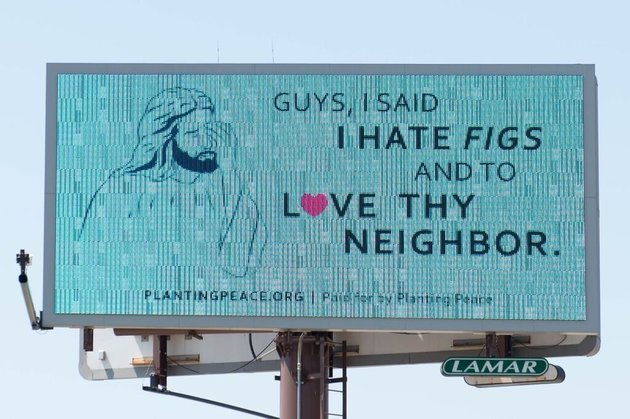
Billboard that went up in Jacksonville, Mississippi in April after the new anti-LGBT law was signed. “Guys, I said I hate figs and to love thy neighbor.” (click to embiggen)I was twenty-three years old, sitting in a pew in a church with my head bowed and my eyes closed when the pastor leading the prayer thanked god for sending the plague of AIDS to the world to eliminate the scourge of homosexuality. He went on at some length during his prayer about how the devil has deceived many and led them into a life of sin. And he went further, talking about how the devil also deceives people who think they are righteous, making some people believe that homosexuality is just a choice, like buying a different brand of car than your neighbor, and that we can be friends with depraved sinners such as homosexuals, and still be good Christians. But that notion, he said, was a lie from the depths of hell itself.
It was hardly the first time I had heard condemnation of homosexuality coming from the pulpit, but the hostility of these pronouncements was much worse than usual. It was also a bit unusual for a prayer to have such a long expository lump. Not completely unheard of, but enough to make several people in the congregation shift nervously. The prayer was going on and on for quite some time.
The subject of the prayer was also at odds with the sermon we had just heard. The sermon had been delivered by a visiting preacher. The church was having a revival week, which meant that a pastor from out of town presiding of the services, and the church was having a service every night of the week, rather than just the usual Sunday morning and evening worship service and Wednesday prayer meeting. And the visiting preacher had just delivered a sermon about the unity of the church. Nothing about sexual immorality or the like.
The preacher leading the prayer was not the same man who had delivered the sermon. He was the lead pastor of the church. And the tone of his prayer sounded more like an argument than a supplication for divine favor.
I was trying not to have a panic attack. If the church had been my home church I would have been in even more distress. But this wasn’t my church. I was at this service because I was the assistant director of an interdenominational teen touring choir, and we had been asked to have our smaller ensembles take a turn each night providing special music for the service. The ensemble I led within the choir had sang two songs earlier in the service, and we were scheduled to sing one more for the altar call at the end.
Anyway, among the reasons that I was upset at this unusually aggressive prayer was that I had been, to use the evangelical terminology of the time, “struggling with homosexual temptation” for years. Not that I had ever told anyone. I was too afraid of what would happen if I actually admitted to anyone in my church or family that I even thought about homosexuality.
And I had done more than dipped my toe into the waters of temptation. There had been a several occasions during the previous ten years during which I had taken the plunge right into the deep end.
At the time of this prayer, it had been at least two years since my last plunge. And that had been with a stranger not just in another town, but an entire different country. No one I knew knew the guy—and truth be told, I couldn’t even remember his name. So I didn’t think anyone knew. But still, it seemed that the pastor was aiming all this anti-gay contempt at someone, and as far as I knew at the time, I was the only homosexual in the room.
It was not the first time (nor would it be the last) that, while sitting in a house of worship I would hear people like me described as depraved sinners and tools of the devil. But this time was the most vehement had yet heard.
Looking back on it, years later, I realize that there probably was an argument going on. The visiting pastor’s sermon about unity could be interpreted as a call for factions of the Christian faith to set aside their differences, while the local pastor clearly thought that some of those factions weren’t really faithful. But I couldn’t be objective enough at the time to work that out. I half expected someone to take me aside to stage an intervention.
Except the intervention would have involved people laying hands on me and praying fervently for god to cast the demons out of me. Which had been something I had been fearing since at least the age of eleven. And that didn’t preclude the possibility that other members of the community might waylay me and just beat me up. That very thing had happened to one of my classmates several years earlier. There had also been classmates kicked out of their homes by their families and sent “away” to stay with some distant relatives or other vague described living arrangements.
The fear of being kicked out of your home, rejected by your parents, siblings, classmates, and neighbors is something that every queer kid growing up in conservative Christian churches live with. A lot of other queer kids know that fear, as well, don’t get me wrong. But when you’re raised to believe that you are among god’s chosen, that anyone who is not a part of this community of faith means that you are destined to drown in hatred and sin, without ever knowing love and eventually spending an eternity in agony, well, it’s traumatic.
It’s not just that the haters are trying to take away the rights of adults, such as myself, who have the means to fight back. They spend years telling some of their own children that god hates them. So there was one bit of that prayer that was correct. This isn’t just a difference of opinion. This isn’t about them saying they want to drive gas-guzzling SUVs, while some of us prefer more fuel efficient cars. They are literally bullying children, sometimes bullying those children to death. And they want the rest of us dead, too: GOP Congressman Who Prayed Gays ‘Worthy of Death’ Weeks Before Orlando Still Has No Apologies.
This is why queer people need to be out of the closet. This is why we need to have Pride parades and festivals and all the rest. This is why it isn’t enough to say “to each their own.” As long as there are kids growing up being taught that god hates them, we need to call out the bigotry for what it is, and stand up for those who aren’t yet able to stand up for themselves.
Michael and I had only been dating about four months when it happened. It appeared to be a day just like any other. Back then he lived and worked in Tacoma. Because he worked in a bar, his “weekend” was in the middle of my workweek. He didn’t own a car, so he would often take the bus up for Tacoma, we’d spend a day or two together, and he’d take the bus back. Sometimes I drove him, but most of the time it was the bus. On this one morning, for various reasons, I drove him into downtown Seattle and dropped him off at one of the big bus stops there, and then went on to my office. When I pulled over to the curb we said “good-bye,” leaned in and gave each other a quick kiss, and he got out of the car. I drove off, sad that it would be several days before I saw him again, but happy about the day we had had.
I was oblivious to the fact that as I drove away, a random stranger at the bus stop started harassing him for being queer. Because he’d seen me kiss Michael.
One of our friends has described my husband has “the most capable guy I’ve ever known.” His job history has included working as a bouncer at a not entirely savory bar. He bikes. When he was younger, he rode bulls in rodeo for fun. He’s not a small man. He can take care of himself.
But none of that matters if someone takes you by surprise. Or if you’re outnumbered. Or if you’re just not as good as them. And don’t think that being armed himself changes that equation. You can’t shoot another person’s bullet down in midair. You can’t safely defend yourself with a gun in a location crowded with bystanders—such as a very busy street in front of a bustling office building on a bright sunny weekday morning.
Even though the guy didn’t physically attack Michael that day. Even though Michael survived the incident to tell me about it after, sixteen years later I still have nightmares about how that situation could have gone down differently. All because I kissed him.
That was only one of the nightmares I’ve had this week, thanks to the news out of Orlando.
Eighteen years later, every time we are out in public and I feel an urge to tell my husband that I love him, or to hold his hand, or give him a quick kiss, I have to do that calculation. Are we safe here? Will someone say horrible things? Will someone threaten us? Will someone do something even worse?
A friend shared someone else’s blog post about why the Orlando shooting has so shaken him this morning, which makes substantially the same points:
If I kiss Matt in public, like he leaned in for on the bike trail the other day, I’m never fully in the moment. I’m always parsing who is around us and paying attention to us. There’s a tension that comes with that… a literal tensing of the muscles as you brace for potential danger. For a lot of us, it’s become such an automatic reaction that we don’t even think about it directly any more. We just do it…
We live constantly with the knowledge that there are people all around us who hate us enough to kill us. And this event isn’t merely a reminder of that, it carries another message:
Additionally, now we just got a lesson that expressing our love could result in the deaths of *others* completely unrelated to us. It’s easy to take risks when it’s just you and you’ve made that choice. Now there’s this subtext that you could set off someone who kills other people who weren’t even involved. And that’s just a lot.
That’s why I’m personally a bit off balance even though (or because, depending on how you look at it) I live in Texas and was not personally effected by this tragedy.
The day Michael and I got our marriage license, after 15 years together, thanks to 54% of the voters of our state saying “yes” to marriage equality.
This is part of why I’m taking this shooting in Orlando so personally: the constant knowledge that there are people who will kill me, my husband, and so many more because of who we love. Worse than that, there are more people who will encourage that hate. They may say they don’t hate us personally, and of course they don’t condone violence, but they also say that violence is the natural consequence of our sin. In the same breath they condemn the violence, they declare the violence a result of divine will, and apparently don’t see the contradiction in that. And there is an even larger group of people who sincerely believe they are not prejudiced against us at all, but they enable guys like the Orlando shooter in thousands of little ways, whether it be opposing hate crime legislation, or anti-discrimination laws, or any form or gun policy reform.
This is why I’m long past the point where I can be silent about the hateful rhetoric of people like Ted Cruz, the Family Research Council, the Pope, and everyone else who says that queers are sinners. This is why I can no long sit silently polite and bite my tongue (yet again) when people say that I’m the bad guy for thinking that maybe a guy with a history of domestic violence who was also on the FBI watch list should not have been able to legally buy an assault rifle with no questions asked.
If your first reaction to me or any queer person you know expressing our feelings about this mass murder is to argue with us about gun policy, or to tell us we’re over reacting, or anything other than, “you seem to be taking this really hard, are you all right?” then you may well be part of the problem.
To answer the question that some people I thought were my friends didn’t ask before launching into attack mode this weekend: No, I’m not all right. I’m mad as hell. And I have more than ample reason to be mad.
It is not unreasonable to be upset at this mass murder. It is not unreasonable to ask questions about why fairly simple, non-draconian measures that are supported by a solid majority of voters—and that have been proven to work in other countries—are constantly being opposed by absolutists. It is not unreasonable to want to hold people who have enabled the hatred responsible. It is not unreasonable to hold people who keep enabling a toxic society that turns young men into festering piles of self-loathing and anger responsible. And it is not unreasonable to hold people who don’t just enable, but encourage, the easy availability of assault weapons to people that even they agree shouldn’t have guns in the first place responsible.
I’m not all right. I’m mad as hell. And you should be, too.
I was annoyed early on in the coverage of the Orlando Pulse nightclub shooting that news sites and individuals on social media all kept claiming that the hate crime was the largest mass shooting in U.S. history. The first reason it annoyed me was because the Wounded Knee Massacre on December 29, 1890 was much bigger. About 300 Lakota men, women, and children were shot to death that day. I understand why no politician alive today wants to acknowledge that. It was the U.S. Army that did the deed, and there is political hay to be made by insisting that it was a battle rather than a war crime, even now 126 years later.
Similarly, the Sand Creek Massacre of November 29, 1864 was also a lot bigger than the Orlando shooting: between 70-163 Cheyenne and Arapahoe men women and children were slaughtered. Again, modern politicians don’t want to talk about it, and certainly don’t want to admit it was a crime, rather than a battle.
That’s not the only thing about this horrific crime that brings out my pedantic tendencies. There has also been a lot of debate about whether this is an act of terrorism or a hate crime. As one friend put it: since the earliest reports that had virtually no details called the attack on a gay nightclub a possible terrorist attack, we knew that that shooter wasn’t white. That’s a not-facetious observation of the systemic racism of police officials everywhere, but there is another serious point, here. A lot of people outside the police want to transform this event into an act of terrorism against America, rather than recognize that the native born American man who decided to slaughter 50 queers in a queer club on a Saturday night during Pride month is a hate crime against the gay community.
As another friend pointed out, all hate crime is meant to terrorize. That’s true. That is the moral and legal justification given for even recognizing hate crime as a category of crime. The intent of the criminal isn’t just to harm the person or persons directly attacked, the intent is to frighten similar people. In this case, to put all queer people on notice that there are people out there who will gladly murder us just for being who we are. And literally for as long as humans have had laws (going back to ancient Sumeria at least!), we have always used the person’s intent as one of the ways to gauge the severity of the crime (cf. the only difference between murder in the second degree and not-guilty by reason of self-defense is the intent of the killer, nothing else).
Of course the politicians and so-called religious leaders who have been trying to deny queer people civil rights, objecting to our lives being even acknowledged, have said that we are immoral and dangerous, and so on want to erase us from this tragedy. They have many reasons for this. The most basic is that they just want to erase us, period, of course. But an even bigger reason they want to erase us is because they don’t want to admit that they have contributed to this crime. Every time they say that it is dangerous for kids to even see us, every time they say we are a danger to children just by being in a public restroom, every time they say that god is going to judge America for giving us some rights, every time they say queers are “ultimately destructive to society,” it encourages hatred and violence toward us.
Others are trying to focus on the shooter’s claims of doing this for the Islamic State. They conveniently want to overlook the fact that this young man was born in New York and grew up here in America. They ignore the fact that the leaders of ISIS long ago said anyone who wants to commit an act of terror in their name doesn’t need to ask permission, and that they will gladly take credit for anything that gets them in a headline, whether they actually had anything to do with it beforehand. This also, once again, conveniently elides over the fact that American evangelical fundamentalist Christians are no less hateful toward queers than radical fundamentalist muslim terrorists: Christian Pastor Celebrates Nightclub Massacre: “There’s 50 Less Pedophiles in This World”. The problem isn’t the Islam or Christianity per se, it is the fundamentalism that’s the problem. The extensive record of radical American Christians preaching hatred for queers is there for all to see.
The ingredients that cooked up this slaughter of 49 queer people are several, yes, but you can identify the big three:
Demonizing of queers by politicians, religious leaders, and others
Toxic masculinity
Easy access to guns
We can do something about all of those things, even though it won’t be easy.
The first requires everyone who doesn’t think queers are evil to confront your elected officials and religious leaders and others during the rest of the year when they make their usual arguments about us. If you’re Christian, tell these other people that they do not speak for you. Make yourself heard. Yes, it means uncomfortably calling out friends and family, sometimes, but we’re not talking about a disagreement over sports teams, we’re talking about the life and death of real people.
The second one is big and complex, but not intractable. First, just let boys be. Speak up when you hear someone tell a boy that he can’t play with that toy because it’s a girls’ toy, for instance.
The last one is difficult to tackle because one particular lobbying group has managed to delude a sizeable fraction of the public into believing that the only thing any of us mean when we say we want to deal with that is a total ban on all guns. Yesterday I made an analogy between the way we used to say that drunk driving was just as impossible to do anything about as gun violence, and how we have since proven that assertion false. A big part of the change that happened in the drunk driving debate was that we allowed a national bureau to compile nation wide statistics on alcohol-related car accidents. So the very minimum that we should do (and there is no excuse not to) is to lift the legal ban on studying gun violence as a public health issue. Studying drunk driving led people to think of options that had never even been discussed before; options that worked. Let us study it, at the very least!
And let the Bureau of Alcohol, Tobacco, Firearms and Explosives use modern data tacking methods, for goodness sake! Give us the tools to try to figure out how guns fall out of the legal sales system. Maybe 90% of the population (and a bigger percentage of the experts) are wrong that closing the gun show loophole and a couple of other measures that my NRA friends get foaming at the mouth over. The truth is that you don’t know we’re wrong, and can’t prove we’re wrong because you’ve made it illegal to study and compile the statistics. Maybe a measure like the Texas law that penalizes people for not promptly reporting the theft of a gun will deter illegal gun trafficking, maybe it won’t. We can’t know until we’re allowed to study it.
And I’m sorry, I don’t often invoke Ronald Reagan, but sometimes he was right: “I do not believe in taking away the right of the citizen for sporting, for hunting and so forth, or for home defense. But I do believe that an AK-47, a machine gun, is not a sporting weapon or needed for defense of a home.” Since this post started out about being pedantic, his terminology was a bit off, but Reagan believed then, and at least 58% of Americans agree with him now, that assault weapons should be banned outright, just as we already ban bombs, grenades, rockets, missiles, and mines. If a civilization requires everyone to be armed and constantly prepared to kill other people, that isn’t civilization.
I’ve ranted enough today. This isn’t just about problems and solutions. This is a human disaster, and real humans died, and many more real humans are hurt and in fear. If we forget that, we stop being human: CNN’s Anderson Cooper Fights Back Tears Reading Orlando Victim Names.
Victims killed in Pulse in Orlando this last weekend. (Click to embiggen) (Facebook/AP/Reuters/Rex)








 Font Folly