Quote from Martin Luther King Jr, Letter From Birmingham City Jail, 1963 (click to embiggen)I always feel a little nervous posting anything on Martin Luther King Jr Day, as I don’t want to co-opt another marginalized community’s hero, day, or message. Especially after seeing several people of color on my various social media feeds caution against talking rather than listening. But during his life, King said more than once that “Injustice anywhere is a threat to justice everywhere,” and I believe we have entered a very dark time in our nation’s history where all of us who believe in equality for everyone need to stand together. So while I may be a white guy, as a queer person I have some experience with oppression and believe that I have a responsibility to use whatever gifts, privilege, and platform I have to promote justice.
A lot of people, not just the moderates that Dr. King talked about in that quote from Letter From Birmingham City Jail, rationalize and deny the existence of bigotry by making appeals to certain fallacies. Academically, we often state those myths as five fallacies:
Individualistic Fallacy: racism/homophobia/antisemiticism/etc is perceived as being only interpersonal, ignoring the systemic structural realities (such as underfunded schools)
Legalistic Fallacy: the belief that abolishing racist/homophobic/religious laws automatically ends the bigotry.
Tokenistic Fallacy: the inference that the presence of members of the marginalized class in influential positions in society proves that all bigotry has ended.
Ahistoric Fallacy: the belief that the denial of basic rights in the past has no lasting effect on subsequent generations (“but slavery is over!”).
Fixed Fallacy: assumes there is one and only one kind of discrimination, not recognizing new forms that emerge in context of societal and legal changes.
There’s an academic paper that explains all of this: WHAT IS RACIAL DOMINATION?, by Matthew Desmond & Mustafa Emirbayer of the University of Wisconsin—Madison, if you want to get into it. It’s rather long and involved, but if you open the PDF at the link and search for Five Fallacies you can jump right to their discussion of the fallacies. The paper is focused on racism, but the fallacies apply to all kinds of bigotry.
All of those fallacies contribute to that preference for an absence of tension rather than a passion for justice that Dr. King talked about. It’s the classic “Can’t You Get Past it/Live and Let Live Fallacy.” Or maybe another name could be the “Respectful Disagreement Fallacy.” It’s the belief that as long as a person isn’t physically attacking you right this moment, and is framing their critiques in polite-sounding language, than it can’t possibly be racist/homophobic/antisemitic/misogynist/etc.
So the bigot talks in dog whistles (coded language that doesn’t sound overtly like bigotry to people who don’t know the code), claims to respect or even feel love for the community targeted by their language, and if we point out that they are being racist or misogynist or antisemetic or homophobic, we’re the ones causing a problem. And people who think of themselves as moderate or enlightened turn on us. They don’t just look the other way from the bigotry and bigoted policies that the community is enduring, they actually enable it.
Which means they’re part of the problem. They’re not being neutral. They’re not seeing things from both sides. They’re not being nuanced. They’re oppressing other people.
I wish there was a simple solution. I wish I had some words of wisdom. Instead, I’m just stuck with this regrettable conclusion, having to try to educate people who don’t think they’re being an enemy.
“Over the past few years I have been gravely disappointed in the white moderate. I have almost reached the regrettable conclusion that the Negro’s great stumbling block in his stride toward freedom is not the White Citizen’s Counciler or the Ku Klux Klanner, but the white moderate, who is more devoted to ‘order’ than to justice: who prefers a negative peace which is the absence of tension to a positive peace which is the presence of justice.”
— Martin Luther King Jr, Letter From Birmingham City Jail (1963)
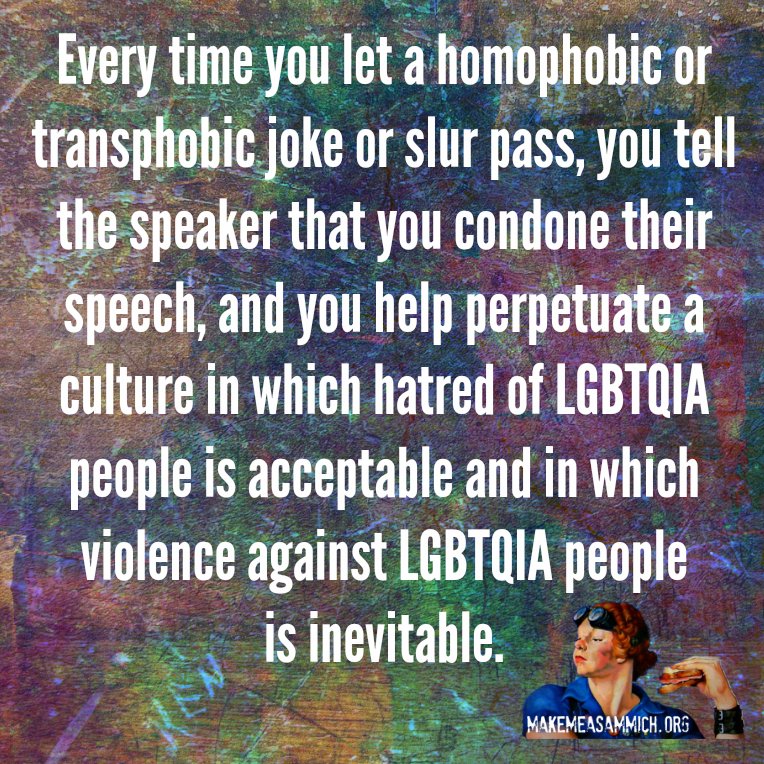
“Every time you let a homophobic or transphobic joke or slur pass, you tell the speaker that you condone their speech, and you help perpetuate a culture in which hatred of LGBTQIA people is acceptable and in which violence against LGBTQIA people is inevitable. ” — MakeMeASammich.OrgSix months ago today an angry man walked into Pulse, a queer nightclub in Orlando, and murdered 49 people. According to the FBI and his own family, during the weeks and months leading up to the attack, he had become more noticeably outraged every time he saw gay men in public together. He plotted the crime carefully. He set up fake profiles on gay hook-up apps and used conversations there to find out which night clubs would have the biggest crowd. It was a carefully crafted anti-queer hate crime.
All of those things are still true. And with hate crimes on the rise since November 8, even more heart wrenching.
Please take to heart the words in the graphic I included at the top of this post: “Every time you let a homophobic or transphobic joke or slur pass, you tell the speaker that you condone their speech, and you help perpetuate a culture in which hatred of LGBTQIA people is acceptable and in which violence against LGBTQIA people is inevitable.” That’s not an exaggeration. If our very existence is nothing more than a joke, that implies our lives and deaths don’t matter. Those attacks and dismissals perpetuate the lie that we deserve pain and suffering. They perpetuate the lie that we shouldn’t exist. They perpetuate the lie that our love isn’t real.
And all of those lies add up to one message that some angry people are all too ready to take to heart: that beating us, shooting us, and killing us isn’t really a crime.
I love autumn. I love the leaves changing colors, the final blooms on lots of flowers, fruit forming on trees, cool drizzly mornings… not to mention decorating for Halloween, planning for Thanksgiving and Christmas, and other fun things.
I don’t like hot weather. Most anyone who knows me knows that. And I also really dislike snow: specifically having to slog through snow, deal with the way many drivers behave in snow (and how some seem to think that snow and ice give them permission to ignore pedestrians altogether), ice-slippery walkways, and so forth. And twice every year, when one of the other of those disliked kinds of weather are happening, and I say something about it, someone (whether it be a reader of my blog, some random twitter commenter, or even a long time friend), will exclaim in utter disbelief. “How can you not love winter? I thought you hated hot weather!?” Or, “How can you complain about this warm weather when you were bitching about snow six months ago?”
It’s like they think it is a binary: you are allowed to hate either heat or cold, and if you dislike one you must love the other. That’s nonsense. What I hear when they decry my supposed inconsistency is, “Why are you objecting to being stabbed in the heart? I thought you despised poison!”
I grew up in the central Rocky Mountains, which is ski country, and where snow season runs from mid-October to mid-May. Every memory I have of going trick-or-treating on Halloween as a child involved wearing snow boots or galoshes, a heavy coat and gloves. Sometimes we skipped whole blocks of houses because the snowplow had been through to clear the street, and the sidewalk was completely blocked by an eight-foot-tall pile of snow, ice, and slush embedded with copious amounts of gravel and asphalt.
Those big plow-drifts were a favorite source of snowball-material for the kinds of bullies that I was always the target of. So while it would be an exaggeration to say that snowball fights are triggering for me, the imagery evoked by alluding to snowball fights is never pleasant for me.
My point is, I have experienced snow. I have literally, as a child, walked to school in minus-fifteen degree weather. If I never have to be in snow again I’ll be perfectly happy.
Yet, I love Christmas and specifically decorating for Christmas. You will see snow-speckled ornaments on many of my trees. I can sing more harmony parts to “Let It Snow” “Sleighride” and “Winter Wonderland” than you can shake a stick at. I’m able to separate my dislike of trudging through snow from actual fun activities one can have in such weather.
Similarly, with hot weather one problem I have is that I come from a long line of pale-pink-bluish freckled people. My skin does not know how to tan. It knows three hues: the pale pink with blue highlights, searing bright red covered with blisters, then when that peels off, pale pink-bluish with orange freckles. Also, I come from a long line of people who develop sun-induced skin cancers (and have even had a small one myself!), so I’m under doctor’s orders to stay out of the sun. Plus, my body just doesn’t deal with high temperatures. I just want to sleep through the hot parts of the day, but day jobs aren’t conducive to that, so I’m cranky, listless, and miserable when it gets hot.
Knowing about how much I hate heat waves and snow, it really should be no surprise how much I love autumn weather. That doesn’t mean that I don’t find some things about the transitions of autumn occasionally inconvenient, annoying, or just startling. Most years, for instance, I don’t switch from my medium-weight jacket to my coat when I ought. I’ll wear the medium jacket for a few weeks and everything is fine. Then one day during the walk home from work, it will be way colder than it had been in the morning, and I’ll wish I’d switched to my heavy coat.
A bit over a week ago I was walking home from work and turned a corner, and was startled at how dark the sidewalk was. When I’d left the office, it had seemed to still be full daylight. The sun was actually at the horizon, but since the first bit of my walk is between tall buildings, I didn’t actually see the sun setting. Yeah, I knew how late it was, and I know that sunset gets a minute or two earlier every day during the fall, but I was thinking about other things (listening to an audiobook, as I recall). Over the course of the walk the sun sank slowly, the light very gradually getting dimmer. By the time I was nearly home, it wasn’t really dark out, yet, but the sky was definitely closer to indigo than azure. And the particular section of street I was turning onto, just a few blocks from home, has a lot of trees on it plus to the west were a pair of taller condominium complexes, casting long shadows over the whole street. It still wasn’t dark, but it was a significant change walking into those shadows, particularly when my mind was in another time and place because of the audiobook.
I literally stopped for a moment, startled at the sudden dimness. It only took a millisecond to realize that I just hadn’t been paying attention to the deepening twilight and the shadows. But it was the starkest reminder I’d had that sunset was getting a lot earlier than it has been. Sometimes it only takes a well-timed turn to throw a gradual change into stark contrast.
When I mentioned to a friend how early sunset was getting, they responded with a bit of a shrug. They weren’t blowing me off, but it felt that way. To be fair, I didn’t give them all the context of how I hit that mark.
But it reminds me that we aren’t all paying attention to the same things. I’ve been watching the slow but very steady embrace of racist, xenophobic, sectarian bigotry by leaders of the Republican Party for the last 36 years. I have called out and warned about the consequences of encouraging voters to blame people with different accents, skin color, religious beliefs, et cetera for the real economic pain that people feel. I have been decrying the stagnation and then contraction of wages, while giving bigger and bigger tax cuts to the wealth. I’ve been pointing out the dangers of dismantling labor unions, giving corporations more and more legal rights. I’ve been watching the slow slide. I’ve been trying to tell friends and acquaintances that the Republican politicians are the very people picking their pockets while placing the blame on immigrants, brown people, queers asking for equal rights, and so forth.
So I am well aware that voting for Romney was voting for all the same bigotry and economic inequality that Trump embodies. Just as voting for McCain was, and voting for Bush, and so on. I have been watching the gradual shift, well aware that the exact same bigotry underlay the policies the Reagan espoused, just more subtle and coded before. So when lifelong Republicans are reacting with horror to Trump, yeah, I’ve been pretty dismissive, telling people they had to be blind or delusional not to have seen this coming; not to have seen that they have brought it on themselves (and the rest of us).
When in fact, they just weren’t paying attention to the same things I was.
It doesn’t change the fact that, yeah, they made this bed. But I shouldn’t be quite so mean that it has taken them longer to notice at least some of the hate and ignorance.
We’ve taken a turn into shadows and muck that that have been gathering and deepening for decades. Now that a few of you have seen it, would you mind grabbing a shovel, and helping those of use trying to clear a path back to the light?
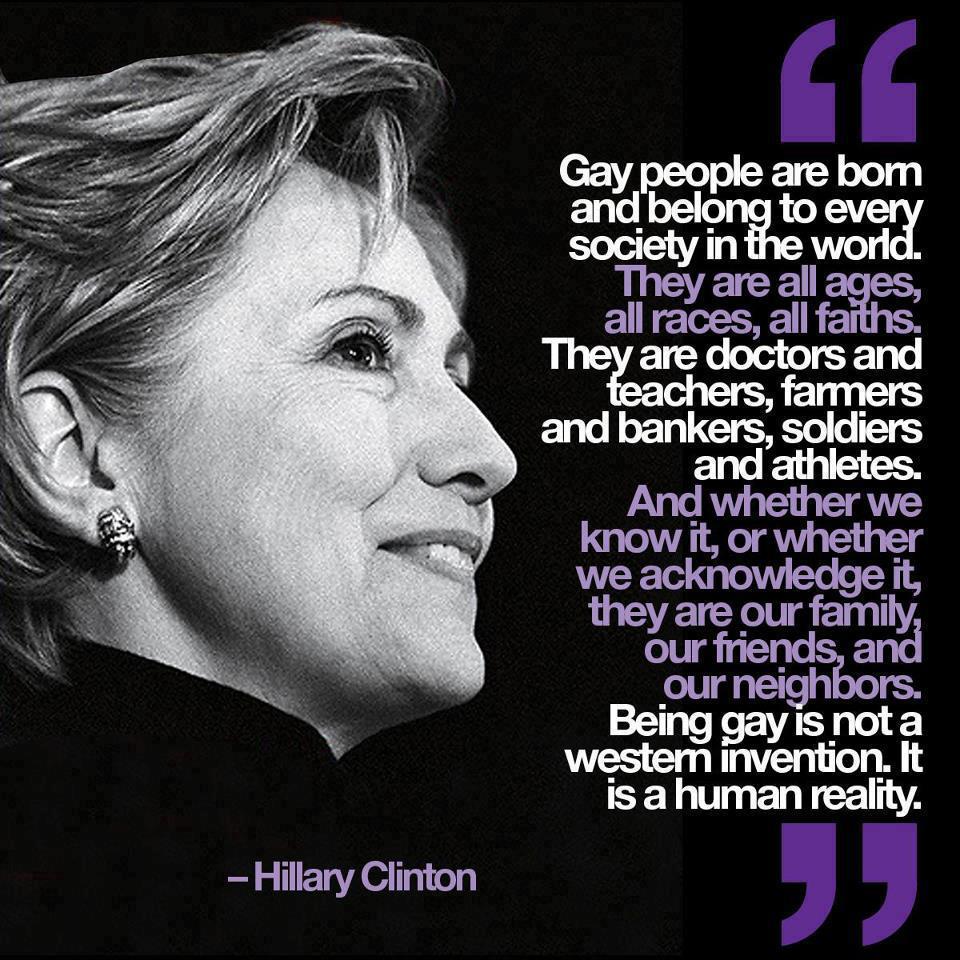
“Gay people are born into, and belong to, every society in the world. They are all ages, all races, all faiths. They are doctors and teachers, farmers and bankers, soldiers and athletes. And whether we know it or whether we acknowledge it, they are our family, our friends, and our neighbors. Being gay is not a Western invention. It is a human reality.” —Hillary ClintonI’ve had a few people ping me to ask if I’m going to watch the first official debate between Hillary Clinton and Trump. Short answer: no. Trump has vowed to appoint to the federal bench only judges approved by the Heritage Foundation. The Heritage Foundation doesn’t just oppose gay marriage, they oppose gay rights of all levels, and still regularly call for overturned the Supreme Court decision that blocked anti-sodomy laws. They don’t just want to end my marriage, they want it to be literally illegal for someone to be queer. And if you happen to be straight or otherwise don’t consider yourself queer: they also think it should be illegal for straight unmarried people to have sex. They aren’t just anti-abortion, they think that it should be illegal for straight people, married or not, to buy birth control.
Whether you believe that a seat is going to open up on the Supreme Court in the next four years (and statistically it is extremely likely it will), there are hundreds of open appointments at lower levels of the federal judiciary that haven’t been filled because the Republicans in the Senate resist confirming anyone Obama nominates for just about anything. If Trump is elected, judges who think that being gay should be illegal (and a whole lot worse) will be appointed. The damage that alone will do to everyone’s civil rights is frightening to contemplate.
I wrote before that Hillary wasn’t my first choice this time. But you know what, she was my second choice, both this time and in 2008. Because (among other things) I remember back in the 1990s when she and her husband made Republican heads explode simply by saying that gay people deserve any legal rights at all. I hear a lot of people still giving her grief for not coming around on marriage equality until 2013, completely unaware of how far ahead of the rest of the Democratic party both she and her husband had been on the matter of gay rights for more than two decades before that. And really, if we insist on punishing politicians who were slow to come around on some of our issues, what incentive do any of them have to change their minds when we advocate for our needs?
And don’t start spouting stuff off about the third party candidates. Johnson, the Libertarian, doesn’t believe in anti-discrimination laws. Like most libertarians, he says discrimination is wrong, but he supports policies that let it happen. Johnson also wants to repeal the minimum wage. He wants to not just rollback the Affordable Health Care Act, but also eliminate Medicare. I could go on, but particularly if you were a Bernie Sanders supporter, it is criminally stupid for you to support Johnson, since literally every single one of his specific policy proposals are the exact opposite of Bernie’s. Every one.
I’ve written before about the many reasons not to support Stein. The quick answer is, she doesn’t have consistent policies, half of her policies are anti-science, and she doesn’t have the experience or political resources to put any of her polices in place if she did get elected. The truth is she’s not a serious candidate, she’s a troll.
Mathematically, voting for Johnson or Stein is exactly the same as voting for Trump. It isn’t a protest, it’s putting a bullet in the head of a lot of your fellow citizen. Also, voting for third parties in our system betrays a fundamental misunderstanding of coalitions and the electoral system.
Virtually every election I’ve ever witnessed has been some kind of referendum on whether I’m a legal person – ever done ground work, going door to door, arguing with people why they shouldn’t vote to make you illegal? I have, and it sucks – and in that way, this election is no different.
The hate is just a lot more broadly aimed this time.
So I’m not watching the debate tonight. It’s bad enough being reminded every two to four years that about half the country is just fine voting to lock me up. This whole thing is yet another referendum on my existence, so why the fuck would I subject myself to that?
This is time to elect Hillary Clinton and then work after the election to mobilize millions of people to make sure she can be the most progressive president she can be.
According to an analysis of roll call votes by Voteview, Clinton’s record was more liberal than 70 percent of Democrats in her final term in the Senate. She was more liberal than 85 percent of all members. Her 2008 rival in the Democratic presidential primary, Barack Obama, was nearby with a record more liberal than 82 percent of all members — he was not more liberal than Clinton.
Let’s start with the first one: why should disagreements keep us from being friends? It depends entirely on the disagreement. My husband and I have been together for 18 years, and we love each other very much. We are also both very geeky nerds who are both fairly well informed on a variety of topics ranging from astrophysics to the old Donald Duck comic books. You can bet there are things we disagree about, and sometimes our discussions get very spirited. In 2008 you should have heard us debating whether to support Obama or Clinton in our upcoming caucus meeting, for instance.
If you think that I don’t deserve equal rights before the law, if you vote for measures to take my civil rights away, if you vote for candidates who have prayed openly that gays deserve death (almost the entire Republican Congressional Caucus just months ago), if you insist in the face of overwhelming medical evidence that being non-heterosexual is a matter of choice or mental illness, you aren’t my friend. And it isn’t even a matter of me not wanting to be your friend: you aren’t being a friend to any queer people by doing those things.
There are some medical studies that ultra-conservatives frequently misquote that draw a causal link between the discrimination and pervasive prejudice against queer people and negative health outcomes. We’ve known since George H.W. Bush’s surgeon general released the first of many other studies that there is a causal link between societal prejudice against queer people and teen suicide (about 1500 queer and non-gendering conforming children and teen-agers commit suicide every year because they are bullied, told that being queer is a sin, et cetera). Discrimination kills.
It’s not just the actualgaybashers who harm us, it’s the anti-gay attitudes and misinformation. Also, nice conservatives who claim that they don’t hate anyone, but also say that queer people don’t deserve legal rights, that our identities are sins, et cetera, create an atmosphere that encourages and excuses the violence.
So, no, when what we disagree about is our right to exist and live our lives as we wish, we can’t be friends. No one should feel obligated to cozy up to people who are actually hurting you. You can be civil to one another, but we’re not going to be friends.
I confess that I find it very hard to keep a straight face when religious conservatives claim that society is no longer a safe place merely because they’re no longer allowed to discriminate against other people, or to spout off their bigotry without someone disagreeing with them. For literally centuries society hasn’t been a safe place for queer people, or for people who don’t subscribe to the dominant religion, or for people who are the wrong ethnicity, et cetera. People were bashed, and lynched, and denied a place to live, denied health care, and so forth—often with the blessings of laws passed by conservative religious people. And you don’t feel safe because people disagree with you?
If people are actually threatening you, that’s bad. I am very sorry, and when I hear that kind of talk I do speak up. But the simple fact is that no one on my side is proposing laws to take away your rights. No one on my side is calling for laws to criminalize your sexuality. And some of the people who are currently asking for compromise and middle ground are the same people (literally in two very specific cases that I could name) who were actively trying to prevent hate crime laws being enacted, or trying to prevent civil union laws being enacting (a decade ago), or voting for candidates who literally were calling for gay men to be put into so-called quarantine camps (in the ’90s).
They are the same people who this year are trying to enact the anti-trans bathroom bills.
Me saying that you’re being a bigot when you call my sexual orientation a sin is not the equivalent of you supporting laws making it illegal for some people to go into public restrooms. Nor is it the equivalent of making it a crime for my husband and I to have sex even in the privacy of our own home. So the middle ground isn’t where you get to actually discriminate against me, and I have to listen respectfully when you express opinions that those laws and their rationales are right.
If you want to end the war between queer people and religious people, here’s what you do: stop attacking queer people, stop rationalizing discrimination, and stop defending the people who attack us. Because we aren’t actively attacking you. What you are perceiving as attack is a little thing called self-defense. We’re just trying to ward off the constant and pervasive and insidious grind of anti-gay rhetoric disguised as pro-family or traditional values.
If you don’t want to be called a bigot, stop being one. There are millions of religious people—people in your religion, whichever it is—who don’t believe that queers are evil demonic beings.
I am friends with religious people. I am friends with conservative people. We don’t agree on everything. We can get into very spirited debates about some of the things we disagree about. But they don’t tell me that I don’t have the right to live my life as an openly queer man. They don’t tell me that it should be illegal for me to live my life as an openly queer man. They don’t tell me that it should be legal for me to be fired, or denied housing, or denied services, or denied medical care, et cetera, et cetera, et cetera. They aren’t sending queer children off to conversion therapy to be tortured. They aren’t demanding that books and movies should have warning labels merely for including any queer characters at all. They aren’t telling me that children should be protected from even knowing of the existence of queer people. They don’t tell me that “I don’t hate gay people—it isn’t your fault that you’re mentally diseased.”
To be friends, there has to be mutual respect. If you think that god is going to destroy this country for treating me equally under the law, you don’t respect me, and you’re not my friend. And yes, there is something wrong with that situation, but it isn’t me.
#WeAreAmerica #LoveHasNoLabelsI find myself in really odd discussions lately on social media. The worst, to be honest, happen on Facebook—usually with relatives. But it’s not just the cousin who keeps insisting that only immigrants object to religious Christmas displays on the public dime. Nor is it merely the aunt who keeps insisting that she doesn’t hate “the gays” or “the transgendereds” but is constantly posting memes and personally penned rants about how god is going to destroy America because of gay rights, and allowing trans people to use a public bathroom leads to rape. It’s not even the folks who argued that their right to sell assault weapons was more important that my right to not want to be gunned down in a gay club.
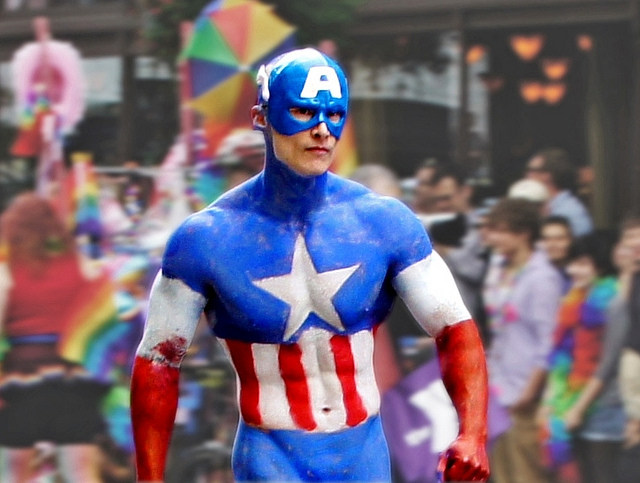
Captain America photographed in the 2012 Seattle Pride Parade (https://www.flickr.com/photos/sea-turtle/)It’s also the folks who post the “Make America Great Again” memes, and unironically talk about how perfect America was in the 60s or 50s or whenever their childhood was. It’s the people who post the “Thank a Veteran” memes while voting for Republican congresscritters who constantly cut funding for veteran’s health care (and everyone else’s healthcare while they’re at it). It’s the people who describe themselves as “patriot” but think that means a very specific rightwing viewpoint. It’s the people who scream “all lives matter!” in the face of overwhelming evidence that the murders of black people, brown people, trans people, or women, or Jewish people, or people perceived to be muslim are never given as much attention by the justice system as other people’s deaths.
I love America. I have a favorite Founding Father (and I can go on at great length about why he’s my favorite), and I have a second favorite (and I can go on at equally great length as to why he’s my second favorite and why I understand that a lot of people prefer him over my fave). I can quote whole sections of the Constitution from memory. I get irritated at people who leave their U.S. flags out in the rain or fly them at night without illumination. I get teary eyed when patriotic music plays. I believe, even though many of the men who signed the document didn’t, that the Declaration of Independence was right when it said that we are all created equal (though I really wish it said people instead of men). I believe that America’s ideals are great, and wonderful, and visionary, and worth fighting for.
But I’m also painfully and personally aware that neither our laws, nor our society, nor most of our institutions live up to those ideals. America has seldom been great if you were not a cis white heterosexual male—preferably protestant (or let’s be honest, with a veneer of being a protestant Christian). If you were lucky enough to fall into that privileged category as a child, or the next best thing, to be the child of such a person and therefore protected by their umbrella of privilege, yes, America seemed really cool when you were younger.
Part of that was all that privilege, but another part was that most real world problems weren’t yours to worry about. Your parents were responsible for keeping a roof over your head and food on the table. If your family wasn’t poor, you spent at least part of your childhood completely unaware of most of the downsides of the world. Similarly if you were lucky enough to have loving, non-abusive parents. So of course life seemed simpler then. It wasn’t any simpler. Violent crime rates were actually much higher (because they have been steadily decreasing for decades), for instance. A lot of diseases we have treatments or even cures for now were completely untreatable. If you weren’t white, male, or straight, the law denied you all sorts of rights many take for granted, and often actually criminalized your existence.
No one who calls themselves an American patriot should sit in silence while injustice, racism, sectarianism, homophobia, or misogyny are being perpetrated in our name. James Madison (called Father of the Constitution, though he preferred to be remembered for authoring the original Bill of Rights) warns us, “I believe there are more instances of the abridgement of freedom of the people by gradual and silent encroachments by those in power than by violent and sudden usurpations.”
It is our silence and indifference that erodes the promise of liberty. It isn’t the immigrant (besides, unless you are Native American, you or your ancestors are immigrants), it isn’t the person who adheres to a different faith than you, or to no faith. It isn’t the lesbian couple trying to buy a wedding cake. It isn’t the trans person wishing to use a public bathroom. It isn’t the African-American mother demanding justice for her 12-year-old gunned down in a playground by police. It isn’t people asking to close some of the loopholes in background checks before guns are purchases. It isn’t the Jewish person asking that we not have a manger scene in city hall. It isn’t the recent immigrant working two jobs and trying to fit in English as a Second Language class while getting their kids through school.
None of those people or events are what has made America anything less than great.
It’s people who call themselves “patriot” who blames any of those other people. It’s the people who call themselves “patriot” and lecture people on line about racism while their own user name is literally a vile racial slur. It’s the people who call themselves “patriot” who sits silents while others denounce people because of their race, religion, sexual orientation, sexual identity, et cetera.
Judging others for being different and denying them the rights of life, liberty, and the pursuit of happiness is not American—love, acceptance, and helping our neighbors is.
We Are America featuring John Cena | Love Has No Labels:
Michael and I had only been dating about four months when it happened. It appeared to be a day just like any other. Back then he lived and worked in Tacoma. Because he worked in a bar, his “weekend” was in the middle of my workweek. He didn’t own a car, so he would often take the bus up for Tacoma, we’d spend a day or two together, and he’d take the bus back. Sometimes I drove him, but most of the time it was the bus. On this one morning, for various reasons, I drove him into downtown Seattle and dropped him off at one of the big bus stops there, and then went on to my office. When I pulled over to the curb we said “good-bye,” leaned in and gave each other a quick kiss, and he got out of the car. I drove off, sad that it would be several days before I saw him again, but happy about the day we had had.
I was oblivious to the fact that as I drove away, a random stranger at the bus stop started harassing him for being queer. Because he’d seen me kiss Michael.
One of our friends has described my husband has “the most capable guy I’ve ever known.” His job history has included working as a bouncer at a not entirely savory bar. He bikes. When he was younger, he rode bulls in rodeo for fun. He’s not a small man. He can take care of himself.
But none of that matters if someone takes you by surprise. Or if you’re outnumbered. Or if you’re just not as good as them. And don’t think that being armed himself changes that equation. You can’t shoot another person’s bullet down in midair. You can’t safely defend yourself with a gun in a location crowded with bystanders—such as a very busy street in front of a bustling office building on a bright sunny weekday morning.
Even though the guy didn’t physically attack Michael that day. Even though Michael survived the incident to tell me about it after, sixteen years later I still have nightmares about how that situation could have gone down differently. All because I kissed him.
That was only one of the nightmares I’ve had this week, thanks to the news out of Orlando.
Eighteen years later, every time we are out in public and I feel an urge to tell my husband that I love him, or to hold his hand, or give him a quick kiss, I have to do that calculation. Are we safe here? Will someone say horrible things? Will someone threaten us? Will someone do something even worse?
A friend shared someone else’s blog post about why the Orlando shooting has so shaken him this morning, which makes substantially the same points:
If I kiss Matt in public, like he leaned in for on the bike trail the other day, I’m never fully in the moment. I’m always parsing who is around us and paying attention to us. There’s a tension that comes with that… a literal tensing of the muscles as you brace for potential danger. For a lot of us, it’s become such an automatic reaction that we don’t even think about it directly any more. We just do it…
We live constantly with the knowledge that there are people all around us who hate us enough to kill us. And this event isn’t merely a reminder of that, it carries another message:
Additionally, now we just got a lesson that expressing our love could result in the deaths of *others* completely unrelated to us. It’s easy to take risks when it’s just you and you’ve made that choice. Now there’s this subtext that you could set off someone who kills other people who weren’t even involved. And that’s just a lot.
That’s why I’m personally a bit off balance even though (or because, depending on how you look at it) I live in Texas and was not personally effected by this tragedy.
The day Michael and I got our marriage license, after 15 years together, thanks to 54% of the voters of our state saying “yes” to marriage equality.
This is part of why I’m taking this shooting in Orlando so personally: the constant knowledge that there are people who will kill me, my husband, and so many more because of who we love. Worse than that, there are more people who will encourage that hate. They may say they don’t hate us personally, and of course they don’t condone violence, but they also say that violence is the natural consequence of our sin. In the same breath they condemn the violence, they declare the violence a result of divine will, and apparently don’t see the contradiction in that. And there is an even larger group of people who sincerely believe they are not prejudiced against us at all, but they enable guys like the Orlando shooter in thousands of little ways, whether it be opposing hate crime legislation, or anti-discrimination laws, or any form or gun policy reform.
This is why I’m long past the point where I can be silent about the hateful rhetoric of people like Ted Cruz, the Family Research Council, the Pope, and everyone else who says that queers are sinners. This is why I can no long sit silently polite and bite my tongue (yet again) when people say that I’m the bad guy for thinking that maybe a guy with a history of domestic violence who was also on the FBI watch list should not have been able to legally buy an assault rifle with no questions asked.
If your first reaction to me or any queer person you know expressing our feelings about this mass murder is to argue with us about gun policy, or to tell us we’re over reacting, or anything other than, “you seem to be taking this really hard, are you all right?” then you may well be part of the problem.
To answer the question that some people I thought were my friends didn’t ask before launching into attack mode this weekend: No, I’m not all right. I’m mad as hell. And I have more than ample reason to be mad.
It is not unreasonable to be upset at this mass murder. It is not unreasonable to ask questions about why fairly simple, non-draconian measures that are supported by a solid majority of voters—and that have been proven to work in other countries—are constantly being opposed by absolutists. It is not unreasonable to want to hold people who have enabled the hatred responsible. It is not unreasonable to hold people who keep enabling a toxic society that turns young men into festering piles of self-loathing and anger responsible. And it is not unreasonable to hold people who don’t just enable, but encourage, the easy availability of assault weapons to people that even they agree shouldn’t have guns in the first place responsible.
I’m not all right. I’m mad as hell. And you should be, too.
I was annoyed early on in the coverage of the Orlando Pulse nightclub shooting that news sites and individuals on social media all kept claiming that the hate crime was the largest mass shooting in U.S. history. The first reason it annoyed me was because the Wounded Knee Massacre on December 29, 1890 was much bigger. About 300 Lakota men, women, and children were shot to death that day. I understand why no politician alive today wants to acknowledge that. It was the U.S. Army that did the deed, and there is political hay to be made by insisting that it was a battle rather than a war crime, even now 126 years later.
Similarly, the Sand Creek Massacre of November 29, 1864 was also a lot bigger than the Orlando shooting: between 70-163 Cheyenne and Arapahoe men women and children were slaughtered. Again, modern politicians don’t want to talk about it, and certainly don’t want to admit it was a crime, rather than a battle.
That’s not the only thing about this horrific crime that brings out my pedantic tendencies. There has also been a lot of debate about whether this is an act of terrorism or a hate crime. As one friend put it: since the earliest reports that had virtually no details called the attack on a gay nightclub a possible terrorist attack, we knew that that shooter wasn’t white. That’s a not-facetious observation of the systemic racism of police officials everywhere, but there is another serious point, here. A lot of people outside the police want to transform this event into an act of terrorism against America, rather than recognize that the native born American man who decided to slaughter 50 queers in a queer club on a Saturday night during Pride month is a hate crime against the gay community.
As another friend pointed out, all hate crime is meant to terrorize. That’s true. That is the moral and legal justification given for even recognizing hate crime as a category of crime. The intent of the criminal isn’t just to harm the person or persons directly attacked, the intent is to frighten similar people. In this case, to put all queer people on notice that there are people out there who will gladly murder us just for being who we are. And literally for as long as humans have had laws (going back to ancient Sumeria at least!), we have always used the person’s intent as one of the ways to gauge the severity of the crime (cf. the only difference between murder in the second degree and not-guilty by reason of self-defense is the intent of the killer, nothing else).
Of course the politicians and so-called religious leaders who have been trying to deny queer people civil rights, objecting to our lives being even acknowledged, have said that we are immoral and dangerous, and so on want to erase us from this tragedy. They have many reasons for this. The most basic is that they just want to erase us, period, of course. But an even bigger reason they want to erase us is because they don’t want to admit that they have contributed to this crime. Every time they say that it is dangerous for kids to even see us, every time they say we are a danger to children just by being in a public restroom, every time they say that god is going to judge America for giving us some rights, every time they say queers are “ultimately destructive to society,” it encourages hatred and violence toward us.
Others are trying to focus on the shooter’s claims of doing this for the Islamic State. They conveniently want to overlook the fact that this young man was born in New York and grew up here in America. They ignore the fact that the leaders of ISIS long ago said anyone who wants to commit an act of terror in their name doesn’t need to ask permission, and that they will gladly take credit for anything that gets them in a headline, whether they actually had anything to do with it beforehand. This also, once again, conveniently elides over the fact that American evangelical fundamentalist Christians are no less hateful toward queers than radical fundamentalist muslim terrorists: Christian Pastor Celebrates Nightclub Massacre: “There’s 50 Less Pedophiles in This World”. The problem isn’t the Islam or Christianity per se, it is the fundamentalism that’s the problem. The extensive record of radical American Christians preaching hatred for queers is there for all to see.
The ingredients that cooked up this slaughter of 49 queer people are several, yes, but you can identify the big three:
Demonizing of queers by politicians, religious leaders, and others
Toxic masculinity
Easy access to guns
We can do something about all of those things, even though it won’t be easy.
The first requires everyone who doesn’t think queers are evil to confront your elected officials and religious leaders and others during the rest of the year when they make their usual arguments about us. If you’re Christian, tell these other people that they do not speak for you. Make yourself heard. Yes, it means uncomfortably calling out friends and family, sometimes, but we’re not talking about a disagreement over sports teams, we’re talking about the life and death of real people.
The second one is big and complex, but not intractable. First, just let boys be. Speak up when you hear someone tell a boy that he can’t play with that toy because it’s a girls’ toy, for instance.
The last one is difficult to tackle because one particular lobbying group has managed to delude a sizeable fraction of the public into believing that the only thing any of us mean when we say we want to deal with that is a total ban on all guns. Yesterday I made an analogy between the way we used to say that drunk driving was just as impossible to do anything about as gun violence, and how we have since proven that assertion false. A big part of the change that happened in the drunk driving debate was that we allowed a national bureau to compile nation wide statistics on alcohol-related car accidents. So the very minimum that we should do (and there is no excuse not to) is to lift the legal ban on studying gun violence as a public health issue. Studying drunk driving led people to think of options that had never even been discussed before; options that worked. Let us study it, at the very least!
And let the Bureau of Alcohol, Tobacco, Firearms and Explosives use modern data tacking methods, for goodness sake! Give us the tools to try to figure out how guns fall out of the legal sales system. Maybe 90% of the population (and a bigger percentage of the experts) are wrong that closing the gun show loophole and a couple of other measures that my NRA friends get foaming at the mouth over. The truth is that you don’t know we’re wrong, and can’t prove we’re wrong because you’ve made it illegal to study and compile the statistics. Maybe a measure like the Texas law that penalizes people for not promptly reporting the theft of a gun will deter illegal gun trafficking, maybe it won’t. We can’t know until we’re allowed to study it.
And I’m sorry, I don’t often invoke Ronald Reagan, but sometimes he was right: “I do not believe in taking away the right of the citizen for sporting, for hunting and so forth, or for home defense. But I do believe that an AK-47, a machine gun, is not a sporting weapon or needed for defense of a home.” Since this post started out about being pedantic, his terminology was a bit off, but Reagan believed then, and at least 58% of Americans agree with him now, that assault weapons should be banned outright, just as we already ban bombs, grenades, rockets, missiles, and mines. If a civilization requires everyone to be armed and constantly prepared to kill other people, that isn’t civilization.
I’ve ranted enough today. This isn’t just about problems and solutions. This is a human disaster, and real humans died, and many more real humans are hurt and in fear. If we forget that, we stop being human: CNN’s Anderson Cooper Fights Back Tears Reading Orlando Victim Names.
Victims killed in Pulse in Orlando this last weekend. (Click to embiggen) (Facebook/AP/Reuters/Rex)
It didn’t take long after people started reacting on social media to the news the at least 50 people were killed in an Orlando, Florida gay nightclub (and at least 53 were seriously injured) by a lone gunman before the arguing started. I made the mistake of sharing a comment about one very specific gun law that actually would have applied to this gunman’s purchase of the weapons used in the crime just a week or so ago, and commenting about who blocked the bill. And I was immediately accused of calling for the total ban of all guns everywhere, and reminded how badly prohibition worked with alcohol and drugs.
It’s a common argument. There are some problems with it. And those problems are most easily illustrated by looking at the topic of drunk driving. See, I’m old enough to remember when people actually argued that nothing at all could be done to reduce the number of deaths due to drunk driving. People have a fundamental right to imbibe alcohol, it was argued. People will find a way to get alcohol, look what happened during prohibition! The only person at fault is the “nut behind the wheel,” it was asserted, and no law is going to deter an irresponsible person! Just as no law or policy or other external force could prevent stupidity.
Editorials were written making the argument that while the traffic fatalities that resulted from the misuse of alcohol were tragic, no meaningful solution could be enacted—certainly not through the law!
I know, because I wrote one or two such editorials.
The first scientific paper drawing a connection between alcohol use and motor vehicle collisions was published way back in 1904 (it’s a little weird to realize that automobiles have been around that long). A much more rigorous study conducted in Sweden in 1932 is generally regarded as the first to definitively show that alcohol impaired drivers were more likely to have accidents leading to significant property damage, injury, or death than sober ones. But even as more studies piled up, the “nut behind the wheel” argument still prevented anything more than token laws that in many states treated driving while intoxicated about as severely as failure to use a turn signal.
In the mid-sixties several events managed to crack the public’s obstinance enough to recognize that automotive design and road design also significantly contributed to traffic fatalities. Congress created the National Highway Safety Bureau (later renamed the National Highway Traffic Safety Administration) and gave it the mission to research the causes of highway fatalities and recommend solutions. Most of Congress and the public expected the Bureau only to bring back recommendations for safety regulations of the vehicles and roads, but the science made it clear that more would be required.
During the 70s, due to recommendations from the Bureau, a series of regulations were enacted improving both the safety of the cars and the roads. There was also a concerted effort to educate the public on two areas: seat belt use, and not driving after drinking. Various studies later found that the education campaigns alone didn’t have much effect. The improvements in vehicle construction and changes to road design did not reduce the number of fatalities annually, though the rate of fatalities as a percentage of total number of miles driven annually did go down. Population growth meant the more people were driving, therefore more miles total driven each year. Bottom line: the first decade of safety improvements had only a minimal effect.
Between 1982 and 1997 is when things took off. Congress made a lot of federal highway money dependent on states enacting more uniform laws about such things as the blood alcohol level that qualified as legally impaired, minimum age for legally purchasing alcohol, and bringing real penalties to bear for the drivers who were caught. Education and treatment programs were mandated, and regulations about the sale and serving of alcohol to individuals were enacted. All of these actions, along with activism and education campaigns from groups like Mothers Against Drunk Driving, combined to do what the PSA campaigns of the 70s alone couldn’t do: the public’s attitude about drunk driving (as measured in surveys) changed, and (more importantly) the number of alcohol-related crash fatalities went down about 10% by 1990.
This prompted the non-profits and government agencies working on the issue to set a goal of reducing the number by another 20% by the year 2000—a goal we hit in 1997! Something that we said we couldn’t possibly do, and for all the same reasons that we are currently told are why absolutely nothing can be done about mass shootings and gun violence in America.
Is a total reduction of alcohol-related crash fatalities by 30% a complete elimination of the drunk driving problem? No. But if we could have fewer multiple-victim shootings next year instead of more, that would be a good start.
I am not proposing a ban on all gun sales. I never have. I’m a former NRA member, myself, for goodness sake! And no serious proposals I have seen have called for that, nor for anything even close to that. The big problem we have right now is that the moment any of us say anything about trying any of the measures which have already been demonstrated to work, people start howling at us about prohibition.
I was told yesterday that the 50 queer latinx lives snuffed out in Orlando yesterday were less important than the right of a dealer to sell an assault rifle to someone on the FBI’s terrorist watch list. I was told that me being angry about an industry lobbying group blocking even one reform bill that would have applied exactly to yesterday’s murder case was rude. I was told that pointing out that the NRA is more concerned with protecting the profits of the gun manufacturing industry than promoting responsible gun ownership was rude.
When I was challenged, I did get rude, yes. Fifty queer people were murdered yesterday in what was actually a quite preventable crime, and I’m not allowed to ask that maybe a measure supported by 90% of the population in the country should be given a try?
Fifty queer people were murdered, and yes, I’m taking it a little more personally than some of the earlier shootings. Maybe it’s a failing on my part that I didn’t get as angry before. But just because I’m taking it personally does not mean that I don’t have a point. We can tweak regulations and close loopholes without destroying freedom—we did it to reduce drunk driving, we can do it to reduce gun violence. Just because there isn’t a single, elegant solution doesn’t mean that we can’t do anything.
“Promote QUEER Visibility. Queer Nation.” (Click to embiggen)I’ve seen a couple of different discussions going around Tumblr about the use of the word Queer to describe members and/or allies of the LGBT/ LGBTQ/ LGBTIQ/ et cetera, et cetera, et cetera community or communities. Some people advise against it because some of the LGBT people are offended by the word. Some people insist the word doesn’t apply if the person being described falls into (or appears to fall into) a specific one of the L, G, B, or T categories. And some people insist that the only people offended are those who want to exclude one portion of the community or another. I find it simultaneously amusing and exasperating to see that this debate still iterating 24 years after I most dramatically confronted my own resistance to the term.
I’ve written before about how, after divorcing my wife and months of counseling and so forth I decided I needed to do something definitive or symbolic about coming out, so I went to a National Coming Out Day march. I didn’t realize until I got there that it was sponsored by Queer Nation, which was controversial for both their radical attitude but mostly (among the LGBT people I knew at the time) just for insisting on using the word “queer.” I marched, because, damn it, it was National Coming Out Day and I was doing it!
For a variety of reasons that don’t bear repeating at this juncture, my late partner, Ray, and a bunch of our friends saw me marching (actually, we were doing the Queer Hokey Pokey at that point) past a restaurant in the gayborhood. For a while I got teased mercilessly by those friends who despised Queer Nation. And while discussing why I wasn’t embarrassed to have marched with Queer Nation, I went from being ambivalent about that word, to saying, “I am going to call myself Queer if I want to, and fuck you if you don’t like it!” to one friend who was getting in my face about it.
I had been teased and bullied just as much as he had with that word (and many others) as a child. So I understood the reasons that friend (and many other people) didn’t want to embrace the term. But I had also been teased and bullied with a lot of other synonyms for “homosexual” including “gay.” And some of my friends who were girls or young women during those years had been harassed and bullied with the word “lesbian.” So if we could use those two words to describe ourselves proudly—hell, the official name of the Seattle Pride Parade at the time was the “Lesbian, Gay, Bisexual, Transgender Pride Parade, Freedom Day March and Rally”—then why couldn’t we use the word “Queer?”
Another reason I happen to prefer the term Queer is because of intersectionality and bi-erasure. I’m gay. I’m a man who loves other men. I am not bisexual, despite having once been married to a member of the opposite sex (no, seriously, I mean it!). My husband is a man who is married to me, a man. We’ve only legally been married a bit over 3 years, but we’ve been together for more than 18 years. People assume my husband is gay. He is not. He is bisexual. Saying that he is gay, at least to me, feels as if it is erasing part of his identity. And I love all him, not just half of him, so I take it kind of personally.
I have a rather large number of friends who are bisexual who have married members of the opposite sex. People assume they are straight. They aren’t. Some of them have told me they aren’t terribly bothered by that assumption, but some of them really chafe under the label. I have friends who have transitioned after marrying a partner who was opposite sex when they married, and they’ve stayed together since. Calling either of them gay or lesbian again, at least to me, feels like I’m erasing part of their identity or history. I have a few polyamorous friends who present as straight, and describe themselves as mostly straight… but who sometimes have threeways with their primary partner and one of the partners of their primary who happens to be of the same gender.
And then there’s one straight friend who once told me, “Describing myself as a straight ally doesn’t feel true, because I think I have a queer perspective—and I feel a closer connection to LGBT people—even though I don’t want to have sex with another guy.”
And as I mentioned recently, in the ’90s everyone in the LGBTQ community who wasn’t a cis white male seemed to be offended if we tried to use “gay” as an umbrella term for the whole bunch. So, for the record, I’m a cis white (and old and fat) same-gender-loving man who identifies as queer, uses queer to encompass the whole community (including allies who consider themselves part of the community), and I don’t intend to stop. I mean, yeah, if you tell me that you, specifically don’t like the term, I will try not to call you that… But I refuse to stop using the term in front of you. Because it is who I am.








 Font Folly