Normal is overrated — more adventures in dictionaries

Bugs Bunny making a silly face with the words “I've done a lot of things over the years, but acting normal isn't one of them.”
“I’ve done a lot of things over the years, but acting normal isn’t one of them.”
The first time I experienced mental health therapy was in middle school, after I was injured by a bully severely enough that the school nurse said I needed to be taken to the hospital. Later, in the infinite wisdom of a typical school administrator, I, the perennial victim of bullying, was threatened with expulsion if I didn’t go to counseling and if the counselor did not report I was making progress. They never said progress toward what, but it became clear as the twice-monthly went on through the rest of that school year and the next, that what she was trying to do was teach me to act like a normal boy. I don’t think she ever used the phrase “normal” to my face, but she certainly did when explaining things to my parents.

There were many reasons why I didn’t behave like a “normal” boy. And usually when I have written about this topic before I have focused on how as a queer kid I was gender non-conforming. But that wasn’t the only problem. There are queer kids who did a better job than I ever did of blending in. And there are lots of not-queer kids who were bullied for being different in other ways. I had other strikes against me.

One of my relatives, for instance, described me as “a lost adult trapped in a child’s body” when referring to my childhood. One reason several people perceived me in that way as a child is because my intelligence was several standard deviations above average. That had two very distinct effects on my behavior. One was that I often understood and knew things people didn’t expect a child to know, but the other was that there were very few of the kids my age that I got along with, so I kept forming close relationships with adults. And that increased the gap between myself and most of the kids my age.

Now, the word “normal” derives from the Latin normalis, which means made according to a right-angle or square. But ask most people what normal means and you’ll probably get something close to what Oxford calls sense 3: “Constituting or conforming to a type or standard; regular, usual, typical; ordinary, conventional. Also, physically or mentally sound, healthy.” Interestingly, that usage of the word in English only came about in the early 1800s. When in first came into the language, in the late 1400s, it referred exclusively to a regular verb. Then in the mid 1600s its meaning expanded to refer “Right-angled, standing at right angles; perpendicular.” Which is how it entered the lexicography of mathematics.

I was interested in science for as long as I can remember. We can blame my mom the science fiction fan for that. When I was a baby, she literally read aloud whichever Robert Heinlein or Ray Bradbury or similar book she had checked out from the library. And mathematics is something I fell in love with early in school. We moved around a lot because of my dad’s job in the petroleum industry, but as luck would have it, the school district where I attended first grade and a portion of second was one that won awards for excellence year after year. They gave me a great start.

For instance, the explanation my second grade teacher in Fort Collins had given me of the Distributive Property, was how I got labeled a freak on the first day (three schools later) that I attended school in Cheyenne Wells. It was late spring in Third Grade when we moved to Cheyenne Wells, and they were just getting to things like the Distributive Property of Multiplication. The teacher tried to explain it to class, but her explanation wasn’t very good. And during the period when we were supposed to be going through a worksheet and helping each other with the problems, the teacher overheard me explaining the the kid next to me how it works, so she brought me to the front of the room and made me explain it to the whole class. And then they all knew I was a Math Freak, a Brain, and the Teachers new Pet.

It wasn’t just the first school, of course, it was also the fact that I loved to read so much, that whenever I was given a new set of books at school, I would read them all the way to the end on my own as soon as I could. And half the time that I spent in the library I was tracking down non-fiction books about topics that came up in the science fiction, mystery, and adventure books that I loved. And most of the time throughout grade school and middle school, I would rather sit in a corner and read than run around the playground or do other things the rest of the kids were doing any time we were turned loose.

That always failed to endear me to the other kids.

Despite the fact that at heart I was an introvert, I also loved explaining things to people. Which often came across as me being a show off or know it all.

As an adult, I work in a technology field writing and designing documentation and help systems explaining how systems work. So all of those characteristics eventually became useful, eventually.

But there was no amount of counseling from that therapist—or mentoring from my middle school wrestling coach (and pre-algebra teacher!), or the other attempts by specific teachers who tried to take me under their wing to steer me through the shoals of bullying—that would make a smart, queer, introverted, book- and science-loving, know-it-all pass for normal in a typical primary or secondary school.

Which isn’t a slam on the other kids, but rather the way we herd children together by age and leave them to their own devices to work out social dynamics. The theory is that we learn to get along with diverse people that way, but the system creates an artificial social environment that encourages some of our worst behaviors.

I survived. I not only came out of the system free of bitterness and resentment, I often find myself in the position of defending public schools from the distorted statistics some people wave around trying to prove other options are better (spoiler alert: the statistics are on traditional public school’s favor). And when it comes to bullying, private schools and charter schools don’t handle those situations one iota better. In fact, for marginalized kids, they are much, much worse, statistically.

But I digress.

Learning to get along is a worthwhile goal. Conformity and trying to pretend you’re something you’re not, are toxic and destructive. I wish we were better at teaching the former, rather than enforcing the latter.

What the heck does it mean when someone writes “coffee-colored skin”

A coffee mug with the word, “There is no such thng as strong coffee, only weak people.”
“There is no such thng as strong coffee, only weak people.” (click to embiggen)
I am both a coffee and a tea guy. I drink coffee mostly in the mornings to wake up, and tea in the afternoons to keep going. And most of the time when I drink coffee it’s just black, no sugar, no cream. The no sugar part is only partially because I’m diabetic. I seldom used sugar in my coffee during the decades before I was diagnosed. On the other hand, because my family is all from the south, I used to always put sugar or honey in my tea all the time. But now I’ve learned to enjoy it without. None of this means that I never put cream or similar additives in my coffee, it’s just most of the time I don’t.

I think the first time I ever read a story when the author described a character’s skin as “coffee colored” I was about 12 or 13 years old. And I remember pausing and thinking, “Is it plain coffee, or coffee with cream? And if it’s with cream, how much?” Because, for instance, I had one aunt who put almost a half a cup of milk or cream in her cup if she had it before pouring the coffee in, whereas one grandmother who made coffee only put a small dollop in hers, so the coffee was very dark. The description completely bounced me out of the story for several minutes while I puzzled over that. I eventually went back to reading the tale, but I had a difficult time visually the character, because I couldn’t decide how dark her skin was supposed to be.

I don’t remember the story, so I can’t go back and check, but don’t think any character other than her had their skin color described.

A few years later I was reading another story where the author described a character’s skin as coffee-colored, and also described another character’s skin as the color of cream. And I immediately imagined the second woman as albino, because I had a few classmates with that condition, and it was the only skin I had ever seen literally that color, right? I only thought that for a few minutes, then realized the author was being a bit metaphorical.

Anyway, a little later in the novel I noticed that most of the male characters had not had their skin described. One guy had been described at one point as “bronzed” and there was a reference to another man as being “red-faced” but their physical descriptions were not as detailed as the women. I was fifteen or sixteen years old at this time, and midway through the book I had started developing a crush on one of the male characters (though I didn’t quite realize it, since I was still deeply closeted and in denial about my own sexuality) and found myself being actively annoyed at the author for not giving my more of a description of him. Which I wanted to know purely for accuracy, and not at all for any lustful reasons, ahem.

Even with the frustration, it would be a few more years before I finally realized there was a pattern in lots of books, particularly when written by men: describe the women’s looks using various food metaphors, but virtually never describe the men in detail, unless those characters were supposed to be comical or villainous or otherwise disliked. Then, of course, the men would have various physical features that emphasized their inferiority to the blue-eyed hero.

And the hero was almost always blue-eyed, wasn’t he? Which should be another clue. Of course, I was a pasty-skinned blue-eyed cisgendered nerd myself, so it took me longer than it should have to notice just how skewed all these treatments, in the narrative, of characters of various genders and races were.

To answer the question in the title of this post: What does it mean when an author describes a character as having coffee-colored skin? Well, it means that the author is falling back on a cliche that is deeply steeped in racism. And since these descriptions are almost always reserved for women in those narratives, and the women’s characterizations all center on how attractive or unattractive the women appear to men in the story, it is also steeped in a whole lot of sexism and misogyny.

So you should avoid doing it.

And this isn’t about political correctness. It’s about bad and cliched writing. Seriously, I am not the only reader who will come across a description like that and stop to wonder what kind of coffee. Or if you use another food, no matter what it is, there will be some readers who are unfamiliar with it.

But it’s also pretty creepy to describe characters as food, as if they’re meant to be consumed—as if their appearance is the only thing they have to contribute to the narrative.

I know that I sometimes under-describe. I’m a more minimalist storyteller where my focus is on what the characters say and do; I only include description when I feel I have to. But, nothing should be in your story if it doesn’t advance the plot, develop or reveal a character’s personality, foreshadow events to come in the plot, and so forth. And 99.9% of the time, a character’s appearance has nothing to do with those things. Yeah, you need to set a scene, and you want the reader to imagine the character while reading about them. But how much detail does someone really need to follow your story?

Let the reader fill in the details that don’t matter to the plot.

And don’t perpetuate cliches, whether racist, misogynist, heteronormative or not.

Thoughts & Prayers, again

“My thoughts and prayers are with the Senators that voted down gun control. My thoughts: do your job. My prayer: you're voted out of office.” —Betty White
“My thoughts and prayers are with the Senators that voted down gun control. My thoughts: do your job. My prayer: you’re voted out of office.” —Betty White

I’m on a mini vacation, so I haven’t been paying as much attention to the news as usual since posting last Friday’s round up of links. So one of the first things I looked at when waking up this morning was my blog site, where I saw a whole bunch of hits on one of my posts from June 2016: Why thoughts and prayers are worse than inadequate which filled me with dread. It did not take long to find comments and news articles about the shooting in Vegas: Las Vegas shooting: At least 58 dead, 515 hurt in Mandalay Bay shooting.

I could rant about the usual suspects saying now is not to time to discuss control, and the usual BS about thoughts and prayers.

Again.

This cartoon by Kristian Nygard (which can be found at Optipess.com) gets shared a lot. (click to embiggen)

I’ve already said so much on the topic of gun violence and our society’s refusal to do anything about it: They used to insist that drunk driving couldn’t be reduced, either and Oh, lord, the leaping! and #TwoMenKissing and why the Orlando Pulse shooting was a punch in my gut

I’m angry. I’ll be calling my congresspeople (even though they’re all progressive Democrats). But I’m not going to write about this yet again. I’m feeling a lot like Alvin McEwen of the Holy Bullies and Headless Monsters news blog: “I can’t preach or talk about anything in my usual critical stance, folks. Nor do I feel like putting out news briefs. God, I feel so very bad over the entire thing. It’s a kind of sadness that takes away all of your purpose and makes you ask why. Nothing else. Just why. But I find that when things like this happen, it helps to let the feeling wash over you. Don’t try to keep them inside. And do something light.”

So, I’m going to go do something light before getting back to work

“Thoughts and prayers do nothing! Maybe it's time to actually do something about it”
“Thoughts and prayers do nothing! Maybe it’s time to actually do something about it”

Welcome October!

This is how I feel, even though the trees outside our windows are all evergreen.
I got to spend some quality time each day of the weekend sitting out on the veranda with a mug of either coffee or tea, and it was glorious. On Saturday afternoon I was out there with the laptop and a pile of marked up pages an got some good editing time in. The sky suddenly got dark as the clouds thickened, and I decided to take the paper and laptop inside before it started raining. And I barely made it. It started raining as I was carrying things through the door. And then, I grabbed a new mug of hot tea and the iPad and went back out to do some other writing while the rain splattered on the edge of the deck. There is an eave over the deck. If the rain is light, only the edge of the deck where my flowers in pots are gets wet. But if it’s raining hard, a bit more water splatters a further in.

Anyway, I love the rain. I love autumn. I love the trees changing color. I really like being able to go out on the veranda.

I haven’t posted a goal update since the first of August, for a couple of reasons. One, I was still reassessing some of the goals, as the move was such a big disruption. Another reason was related to the move, and I’ve felt both frustrated and embarrassed about it. Several things went missing during the move.

Some of the missing things were trivial: a silly hat that often call my writing hat, a couple of books purchased just before we started the move, and a set of old stories and art discovered during the packing that I thought would make a fun submission to one of the APAzines I participate in. But other things weren’t: the galley proof of my novel with all my copy editor’s comments, a notebook with all of my notes for one of the roleplaying games I run, another notebook with notes of the other roleplaying game I run, a pile of editing comments on new scenes I had written for the novel in galley proof, and the file with my notes on places to submit short stories.

While we were still unpacking boxes, we just assumed they were in a box we hadn’t gotten to. The fact that I thought I had put most of those things in the same box and one of the boxes I marked as needing to be unpacked early made me a little extra crazy, because we had opened all the boxes with that sort of marking. After we got the last box unpacked, both my husband and I searched through closets and so forth, but no luck.

Then last weekend, literally a few minutes before midnight on my birthday, I pulled a plastic file box off a shelf to file a new insurance policy (that had been sitting on the coffee table since I opened the mail a week or so before). And when I opened this plastic box which I thought was full of legal documents and such, I found all the missing things: my silly fez, the edits, the gaming notebooks, the old art and stories, the books, the other files… it was all there. All the legal documents that I thought were in the plastic box were in a banker’s box on the next shelf over.

The embarrassing part is that during all of my searching for the missing things, I kept not opening the plastic file box because I was sure it was full of legal documents. And the fact that when I looked in the banker’s box and saw that it was full of file folders full of various documents never made me twig to the possibility that there weren’t legal documents in the plastic box is where the embarrassment comes in.

Anyway, since two of my big goals for the year required me finding a couple of those missing things, it was hampering my progress. Now that the missing things have been found, I’ve been busy all week working on edits. There’s a lot still to go, but I’m in a much better position, now.

I’m still reassessing the goals, particularly as I work on a new, um, project that I hope will help me finish more of the writing related tasks faster. But I’m not ready to talk about that other than to a few others just yet.

So, I am still working on my goals for the year. I’ve mentioned before how much I love autumn. I’ve also mentioned that autumn often feels more like a new year to me than New Year’s Day. So maybe it’s a good thing I’m still reassessing. New season means new beginnings.

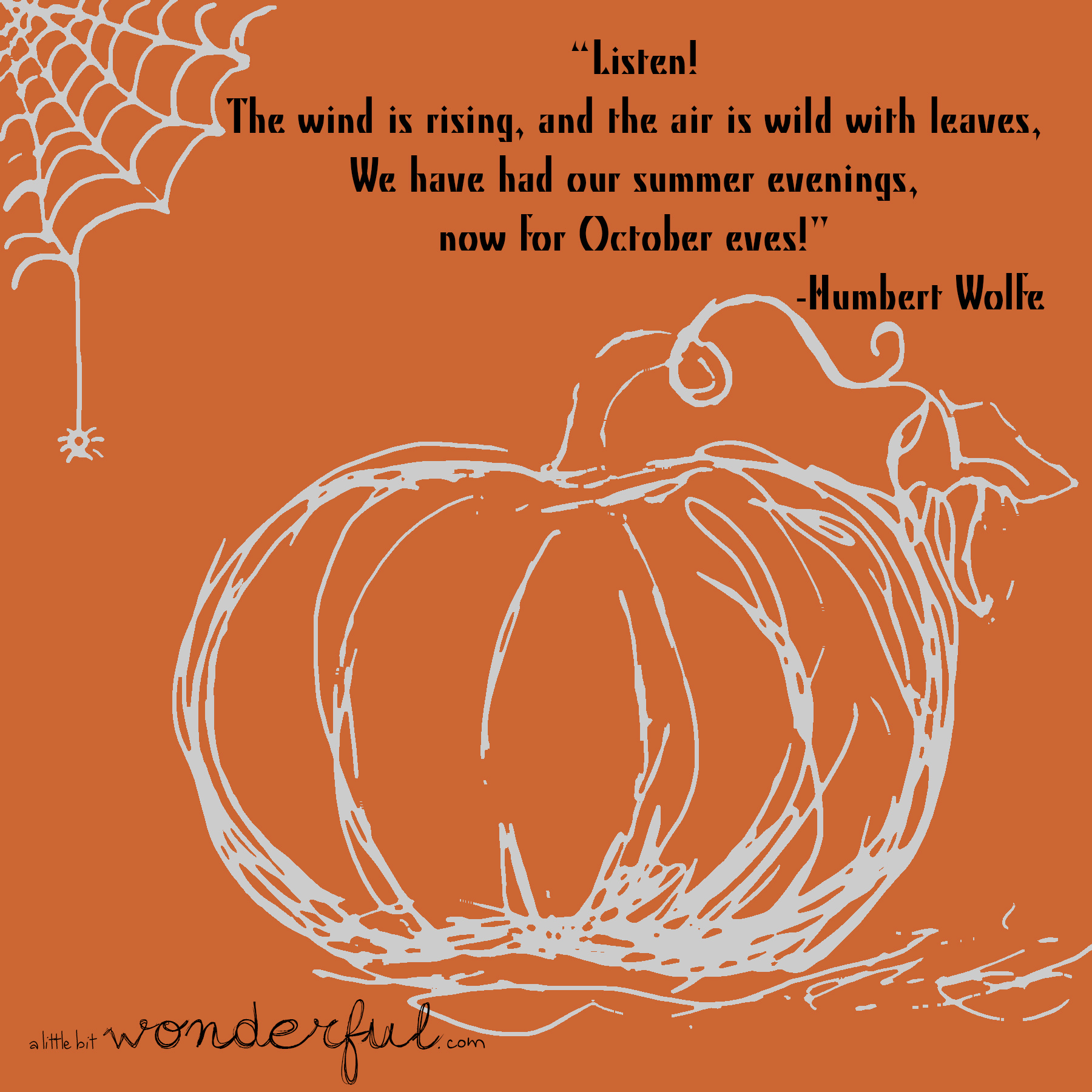
“Listen! The wind is rising, and the air is wild with leaves, We have had our summer evenings, now for October eves!” —Humbert Wolfe
“Listen!
The wind is rising, and the air is wild with leaves,
We have had our summer evenings, now for October eves!”
—Humbert Wolfe

Weekend Stuff 9/30/2017: Every unhappy family…

This isn’t going to be my typical Saturday post where I talk about news stories that either I missed for this week’s round up of links or new developments. I’ve already made a couple of pretty personal posts this week, between my birthday and remembering my late husband on his birthday just a few days later.

And tomorrow would be my dad’s birthday, if he were still alive. Which doesn’t make me sad, by the way. It fills me with a bit of dread, because I suspect there will be communications from some of my relatives that I’d rather not get. I can’t use the phrase that one friend made me practice saying right after Dad died so that I wouldn’t make people who were just offering condolences but didn’t know our history wouldn’t feel bad: “We weren’t close. We’d hardly talked in forty years.” Depending on which family member is reaching out, that comment is likely to get an angry, “Well, whose fault is that?”

“Forgiveness is created by the restitution of the abuser; of the wrongdoer. It is not something to be squeeeeeezed out of the victim in a further act of conscience-corrupting abuse.” —Stefan Molyneux
And I’m dreading it because I got such comments (and confrontations) on Father’s Day and on his previous birthday. Maybe I need to memorize this Stefan Molyneux quote and say that back to any of them who trot out the admonishments that it isn’t healthy for me not to grieve or not to forgive or whatever. The former is the mostly darkly funny, because I did grieve the total lack of a loving, functional father decades before my actual dysfunctional dad died. I took myself to therapy because I realized that many of his abusive behaviors and attitudes were manifesting in my own relationships. I didn’t want to turn into him, so I got therapy and dealt with it, and yes, part of my healing process was letting myself grieve for the relationship that could have been. To grieve for kind of childhood I didn’t have.

I know most of them are doing it because they worry about me. unfortunately, some are doing it because they need validation for their own feelings, or validation of the rationalizations that let them look the other way while those of us living with him were subjected to the abuse. Anyway, being angry at them doesn’t solve anything. I will probably do what I did with most of the messages that came on Father’s Day: ignore them.

But, completely unrelated: I was pointed to some cartoons by an artist I had not previously been aware of, and while checking out his web site, I found this interesting thing he created last March: My Mother Was Murdered When I Was a Baby. I Just Found a Photo of Her Funeral for Sale Online. It reminded me that there are many other ways that one’s childhood can be dysfunctional. But also, it reminded me of a bit of advice I received from one of my lesbian aunties (not an actual aunt) back around the same time I was seeing the therapist. My childhood was bad, yes, but I survived it. Not everyone who suffers domestic violence does. So, while I’m grieving what I didn’t have, I should remember to be thankful that I lived to make a better adulthood for myself.

Friday Links (lessons from history edition)

Kim Davis protested at work, refusing to do her job as county clerk and denied her fellow citizens their right to marry. And she was a conservative here. But let some football players protest the murders of unarmed people of color by police (who are never held to account) and that's unconscionable!
Kim Davis protested at work, refusing to do her job as county clerk and denied her fellow citizens their right to marry. And she was a conservative here. But let some football players protest the murders of unarmed people of color by police (who are never held to account) and that’s unconscionable!
It’s the fifth Friday in September. We are fast running out of the superior month that his the home of superior babies.

This has been a really weird week in part for reasons I can’t go into here. But the weather turned hotter than I like for a few days, and that seems to send plants into another frenzy of pollenating, so we both had nasty sinus symptoms. On the other hand, I’ve been getting a lot of writing done.

Anyway, here are the links I gathered this week, sorted into categories as accurately as I could.

Links of the Week

A historian explains why the founding fathers would be baffled by conservatives’ obsession with flag worship.

The Economist – If tech firms were utilities.

Science!

Science Fiction & Fantasy’s Most Delightful Government Agencies.

Secret Documents Rewrite the Discovery of Neptune.

Why octopuses are building small “cities” off the coast of Australia.

Scientists Have Just Created a ‘Super-Antibody’ That Can Kill 99 Percent of HIV Strains.

This Week in Natural Disaster

In Battered Puerto Rico, Governor Warns of a Humanitarian Crisis.

Hurricane Maria: Puerto Ricans Plead for More Federal Aid to Devastated Island.

Science Fiction, Fantasy and Speculation!

The Submissions Men Don’t See .

This week in Seattle

FBI: Violent crime up in Seattle and Washington in 2016, but murders specifically down.
“While violent crime increased in Seattle and Washington state last year compared to 2015, the city and state both saw double-digit decreases in the number of murders and non-negligent manslaughters committed during the same time period… criminologists warned the new numbers may not indicate the start of a long-term trend because violent crime remains well below rates seen in the 1980s and early 1990s. And even compared to a decade ago, violent crime in 2016 is 18 percent lower than it was in 2007, and the murder rate is 6 percent lower than it was then…”

The Sorriest Bus Stop Championship: Seattle vs. Munhall.

And “winner” is: Congrats, Seattle — You Have the Sorriest Bus Stop in America.

The Origami Butterflies Around Seattle Parks Appear to Be an Anti-Choice Campaign.

This week in awful people

Four People Charged In Relation To Death And Mutilation Of Transgender Teen.

News for queers and our allies:

Andrew Garfield thinks it’s ‘outrageous’ we still have to fight for LGBT rights.

This week in Writing

Self-Editing Tips: Because No One’s Perfect.

Making Your Characters Want Something ~ It’s Important.

This Week in Tech

This Web Service Banned The Daily Stormer. Why Won’t It Drop Another Neo-Nazi Recruitment Forum?.
“In this country, you’re allowed to be as hateful as you and want that is protected. But that doesn’t mean you’re allowed to use every private company’s service to promote that hatred.”

Culture war news:

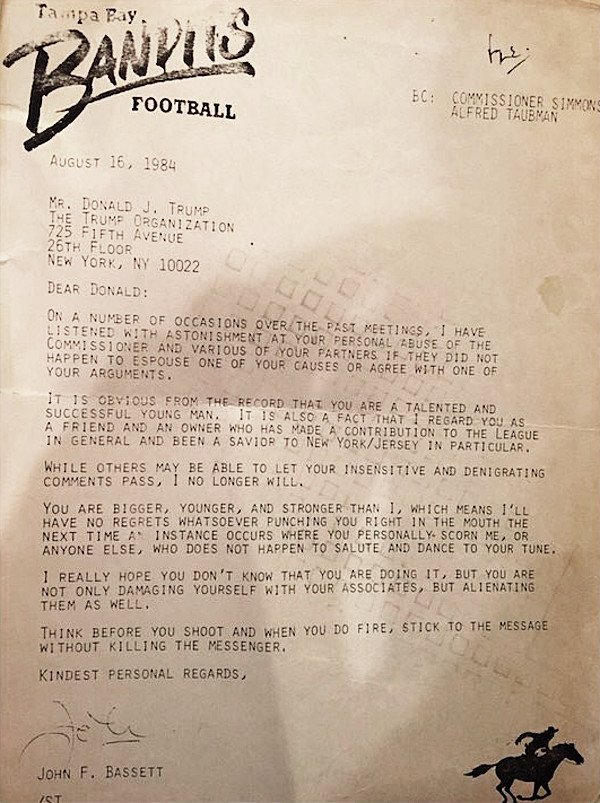
A very interesting letter from another team owner back in the days when Donald was a sports team owner. (Click to embiggen)
Why the Overrepresentation of Black Americans in Professional Sports Is Not a Good Thing.
“…anyone who has taught in a US high-school system knows that this balance is strictly imposed on black males. Intellectuality is not just discouraged but not even recognized. When you reinforce this attitude by underfunding education, the remaining opportunities for black success are not found in the classroom but in the gym.”

Nearly a quarter of Americans think homosexuality should still be illegal.

ACLU sues Michigan over gay adoption screening.

This Week Regarding the Lying Liar:

“A billionaire makes up pay for his gold weekends and tells us we can't have food, health, science, or art.”
“A billionaire makes up pay for his gold weekends and tells us we can’t have food, health, science, or art.”
George Clooney just slammed President Trump in a very NSFW fashion.

Trump’s failed Puerto Rico golf course has cost the territory’s taxpayers more than $32 million.

News about the Fascist Regime:

Joke’s over: Sean Spicer hires a defense lawyer with a particularly interesting set of skills.

This week in Politics:

Dine and Dash: Santa Fe restaurant manager says Gov. Susana Martinez skipped out on bill.

For Mitch McConnell, it’s the beginning of the end.

Senators prepare subpoena Manafort to appear at hearing.

This Week in Racists, White Nationalists, and other deplorables:

FBI: White nationalism is as much of a threat as ISIS.

Farewells:

Hugh Hefner, Who Built Playboy Empire and Embodied It, Dies at 91.

What Is Playboy Without Hugh Hefner?.

How Hugh Hefner’s Incredibly Complicated Legacy Got Cast as Female Sexual Liberation.
“He published features that supported abortion rights years before Roe v. Wade, and his Playboy Foundation made gifts to rape crisis centers, abortion support services, and the ACLU’s Women’s Rights Project. Hefner also fought for First Amendment protections—a predictable cause for the publisher of a nudie magazine—ran some brilliant interviews, and gave money to civil-rights causes… At the same time, Hef’s magazine explicitly trashed women who stepped outside his feminine ideal.”

Hugh Hefner Championed Gay Rights And Racial Equality When Few Others Would.

Things I wrote:

Happy Fall to All of Y’all!.

If he talks like a racist, tweets like a racist, defends other racists….

Confessions of an aging homo devil.

Confessions of a sentimental fool.

The Night Was Sultry, part 1—adventures in opening lines.

Videos!

Stranger Things | Love in the Upside Down:

(If embedding doesn’t work, click here.)

“Toys” Official Video (Parody of “Boys” by Charli XCX) (very, very NFSW):

(If embedding doesn’t work, click here.)

Seth Meyers Mocks Trump’s Lie That There Wasn’t A Trumpcare Vote Because A Senator Is Hospitalized:

(If embedding doesn’t work, click here.)

The Night Was Sultry, part 1—adventures in opening lines

The movie Throw Momma From the Train begins with a writer who is having severe writer’s block. He keeps typing the opening line, “The night was…” and then he can’t decide. Was the night hot? Was it moist? Was it hot and moist? And since the movie was made before the era of cheap personal computers, we watch the character, portrayed by Billy Crystal, typing on a physical piece of paper, then tearing it out and throwing it away again and again and again and…

We learn that he’s been stuck unable to write for years since his ex-wife stole his previous novel, got it published under her name, then said novel became an international bestseller. Now the wife is living the high life in Hawaii. In his day job, he teaches creative writing at a community college, and one of his students misunderstands a conversation they have about writing as a proposal that the student kill the teacher’s ex-wife, and the teacher will kill the student’s abusive (and senile and otherwise seriously ill) mother. Various horrible misadventures ensue, culminating at a moment when the two are discussing opening lines again, the teacher talks about the whether the opening line should be “The night is hot” or “The night is moist” or “The night was humid” or “The night was foggy” at which point the ill mother says, “The night is sultry!” Which is, of course the word that combines both meaning the teacher had been trying to go for.

I could write multiple blog posts about the movie: about the problematic way it handles the declining mental and physical health of the mother; about the problematic way it portrays most of the women in the story; about the many myths of writing it perpetuates. But today’s topic is going to be opening lines. Or, more broadly, openings in stories, because it’s about more than just the first sentence.

Among the things the movie does get right is how frustrating and utterly debilitating writer’s block can feel.

As awful as it feels, you should never get as frozen on the opening line as Crystal’s character does in the movie. A completed draft of a story with a bad opening sentence is better than a blank screen with nothing because you can’t think of the perfect opening. And the truth is that most of the classic opening lines in literature—the ones that get quoted in all those articles about the best opening lines—weren’t in the first, second, or even third draft of that story. The writer figured them out later, once they’d wrestled with the entire story for a while.

There are several things to consider about the opening of your story that are more important than picking just the perfect word. Even the opening sentence isn’t necessarily important. If you’re working on a short story, then eventually, yes, you need to come up with a nice hook in the opening sentence. But if you’re writing a novella or a novel, you will wind up worrying more about the opening paragraphs. Readers expect a longer story of have more characters, subplots, and complexity, so they’re more likely to stick through several paragraphs before they need to be hooked.

The first question is where to begin. This may seem like an easy one, but let me tell you from my years reading the slush piles of several small publications, many people don’t have any clue where to begin the story. “But I started at the beginning!” is the usual response I would get when explaining to someone they had started at the wrong place. There is the classic of beginning in the wrong place: an alarm clock rings, the character wakes up and the author expects the reader to slog through many paragraphs (or pages) of description of the character brushing their teeth, eating breakfast and so on. But thats not the only way that writers start at a spot that seems like the beginning.

I encountered the best (or worst) example of how not to do this back when I was a university student. For reasons too complex to go into here, I was taking a Creative Writing class that was aimed at a much less advanced writer than I was, but that I needed to finish before I could get into other classes. And the professor had seen my work and knew it was too basic, so she had let me into the class on the condition that any time it was my turn to comment on someone else’s story I would tell the whole truth of what I thought. Yes, that’s right, she made me the designated bad guy. Anyway, one day a guy is reading a story, and it begins by describing the trophies and mementos of high school on his desk and shelves at home. At the bottom of the first page he finally mentions the game ball from a football game, his most prize possession, and then he starts describing the football game beginning from the opening kickoff. It was absolutely the most boring sh*t for nine more pages until finally he came to the line, “We had to move the ball 20 yards in 8 seconds.” Which should have been the opening.

The reasons why the first 10 pages of this story were awful was because first: none of the rest of the mementos from his school year had the slightest thing to do with the story. Second: to anyone who knows anything about football, knowing that our narrator has the game ball already tells us the ending—to wit, the narrator is going to make the play that wins the game. Third: even to a hard core football fan, a narration of a game whose ending we already know is just not interesting enough to sustain 10+ pages of following. The beginning of this kind of story is going to be where the drama hits. In that case, “We had to move the ball 20 yards in 8 seconds.”

Which isn’t to say that explaining any other parts of the game are worthless, you just need to hook the reader first. That line is something that even a non-football fan recognizes as a challenge. Then your second sentence can be explain that this was a game against your big cross-town rivals, and how every year for as long as you can remember this was the game that everyone attended, and then explain which position on the team the narrator plays, and then summarize some of the game up to that point, in order to set the scene and introduce characters. Up until that “We had to move the ball 20 yards in 8 seconds” moment, it was just one more sportsball game being played by people the readers doesn’t know or care about. And laid out in that order, the reader doesn’t know why he ought to care.

But if you first hook the reader with the drama, then you can fill in details. And the reader will understand that this is all stuff to help them understand the answer to the questions the opening lines raised: Who is this? Will they succeed? If they succeed, how will they?

So the first rule about opening lines is: the beginning isn’t necessarily the chronological beginning of your character’s day or involvement in the events, it is the moment where the protagonist is confronted by the problem. Some people like to put it this way: start the story the moment your character is hit in the head with a brick, not back at the moment someone started manufacturing the brick.

Which isn’t to say that every story has to begin with dramatic action… but we’ll get into that in part 2!

Confessions of a sentimental fool

This is Ray's new resting place since the move. His urn guarded by teddy bears, tigers, penguin, and a mouse.
This is Ray’s new resting place since the move. His urn guarded by teddy bears, tigers, penguin, and a mouse.
I keep trying to finish some more posts about writing, but between the actual writing and real life, there hasn’t been as much time for the blogging. Among the real life issues I always have to deal with this time of year is a kind of seasonal depression. Not really seasonal, at least not in the sense that it is triggered by neuro-chemical responses to changes in sunlight. The approach of my birthday always reminds me of my late husband, Ray, since his birthday is just a couple days after mine. His birthday was a great excuse to get him silly cards or new cute plushies and so on. And mine was a great excuse for him to give me many many cards (so many cards—I learned early in the relationship it would never be a contest, he would always find a half dozen more great cards for me for any occasion) and silly toys and so forth.

So the usual pattern is that around the time I realize that my birthday is coming up (which is also the beginning of Gene-Isn’t-Allowed-To-Buy-Himself-Things Season) until the anniversary of his death mid-November, I’m more prone to feeling down, being cranky, and getting deeply sentimental and/or crying over inconsequential things.

This year has, thus far, not been too bad. Yeah, there’s still a month and a half to go, but usually if it’s a bad year I’ll have had several bouts of surprise cries by the time his birthday gets here. This year, it’s just been a little tearing up over things.

Floppy tiger makes the best helper!
I have various ways of dealing with the mood swings. Sometimes when I’m trying to write or work on some other project that requires concentrating, but I find my mind wandering down sentimental pathways, I recruit Elton. Elton was one of Ray’s favorite tigers. He’s soft and floppy (which means it’s easy to pose him in various settings). It’s amazing how getting him out and setting him next to me at the computer, or draping him over something so he’s watching me will help. It’s like whenever I look at the tiger I can hear Ray’s voice saying, “Hey, Buster, shouldn’t you be writing?”

I had thought the mood swings and depression might be worse this year, since this is the first fall since Ray died that I’m no longer living in the last home we shared together. That hasn’t been the case. Perhaps because sentimentality is often triggered by familiar sights and sounds. When I step outside on my way to work each morning, for instance, I don’t see the rose bush he planted any longer.

I will say that one of the advantages of the new place and the way we have replaced some furniture has given me a great opportunity to put a lot of the plushies in new locations. And because many locations are determined by the size and pose of a particular plush to fit at a particular place, that’s brought a bunch that used to be half hidden at the old place out where they’re easier to see. And because at the old place we tended to leave a plushie where it was until some compelling reason arrived to rearrange a bunch, the ones I’ve owned longest (and therefore are most likely to have memories of Ray associated with them) were more often half buried by others.

Maybe the new setting is why most of the random reminiscing has been of the warm fuzzy feelings kind and less of the sobbing in sorrow sort.

In any case, if Ray were here, about this time tomorrow he would be asking me, “So, how are we going to decorate for Halloween?” It’s because of the way Ray encouraged the kitschy decorator in me that I’ve long referred to the entire period from late September through at least New Year’s (and often all the way until Easter) as Decorating Season. That’s right! It’s not just Halloween and Christmas we can decorate for! Decorative gourds and cornucopias and cartoon turkeys can be deployed during November, hearts and cupids or just red and pink roses from late January until Valentine’s day, then you have St Paddy’s and Easter. I probably won’t go all out on all of them, but I see that several of our neighbors have already put Halloween things in their windows, so I need to get at least my new Spooky Banner that I bought last year (And because the building was being shown to prospective buyers, I wasn’t allowed to put up until the day before Halloween) up where people can see it.

Because as soon as I saw that first pumpkin and spider in a neighbor’s window, I heard Ray’s voice in my head ask, “Hey, Buster, shouldn’t you be decorating?”

Confessions of an aging homo devil

“Old age ain't no place for sissies.” —Bette Davis
“Old age ain’t no place for sissies.” —Bette Davis
One of the less toxic stereotypes ascribed to gay men is an intense fear of getting old. When I was a mostly-closetted queer guy in my 20s I heard it frequently from other gay men. “Oh, no! He turned 30, that’s 60 in gay years!” and so on. The explanation of the stereotype is that gay men are obsessed with young and/or young-looking romantic partners, and fear they will stop being desirable themselves once they pass some arbitrary age. Even back then, I thought it was a bit strange to say that this was a gay-only thing, because for how long have middle-aged and older actors been paired with actresses significantly younger than themselves playing their spouses, love interests, et cetera? And back when I was a kid and a teen, it was very common in comedy TV shows and movies to have at least one woman who was obsessed with her own age to insist in face of overwhelming evidence that she was only 29 years old. Seems to me that heterosexual men are pretty youth-obsessed, right?

Please note that I said this stereotype is only somewhat less toxic than many others about queer men.

So a few years ago when I mentioned in blog post that it was my birthday and my age (it was 53 or 54, but I don’t feel like going on an obsessive search to try to find the specific post), some random person I didn’t know commented about how broken-hearted I must be, since everyone knows that fags are all obsessed with being young. I typed a reply to the effect that no, I actually considered myself quite lucky. But then I decided that rather than argue with a troll the better thing to do was to simple delete the troll’s comment and move on.

But I keep running into people making this specific observation, or variants of it. A gay activist who is a frequent guest on news programs passes the age of 50 and all the anti-gay hatemongers start referring to him as an “aging activist.” This is pretty rich coming from a completely white-haired anti-gay pastor who is pushing 70, let me tell you. If a 50-year-old is “aging,” what do we call a 68-year-old, hmmmmm?

So, I’m still a couple years from 60, yet, and I know that I frequently make references to my age, mostly because 1) I am older than the average people active on the internet, 2) I’m older than the average age of people active in the various fandoms I participate in, and 3) I frequently find myself being a little boggled at people who otherwise seem really well informed being completely unaware of (or deeply misinformed about) fairly major things that happened in the world when I was, say, in my 20s.

I was still very closeted in my early 20s when the AIDS crisis began. This mysterious illness was striking gay men down, and not only did the White House Press Secretary laugh and make a fag joke when a reporter asked about the first Center for Disease Control alert about the illness, but all of the rest of the reporters in the room joined in on the laughter. One night at a church service I was sitting with my head bowed when a pastor went on a long digression in his prayer thanking god for sending the scourge of AIDS to punish the wickedness of gay people and wipe them from the face of the Earth. 10 years later, as an out gay man, I found myself going to memorial services of men sometimes younger than I. One particularly bad winter, 16 different people we knew died in a single three-month period. It really did seem that every gay person was doomed. And it didn’t seem to matter that we all now knew to practice safe sex—because condoms can break, and so on.

As much of an optimist as I’ve always been, in the face of all the overwhelming chilling life experience, I seriously doubted that I would live to see my 50s.

So, I am not in the slightest bit sad or embarrassed to have reached the “ripe” age of 57. I’m not sad that my beard is mostly white, because I’ve earned every one of these grey hairs! I’m not ecstatic that some of the medical issues I’ve always had are getting worse as I get older. I’m not joyful when I read about the death of someone (famous or not) that I’ve known and admired for years. I know that that is going to happen more often, that’s just the natural consequence of the passing of time.

Getting older has its drawbacks, yes. But the alternative is worse, right? So I say, “Bring it on!”

Among my role models growing up was a very cantankerous paternal great-grandmother (who taught me how to listen in on the neighbors’ on the party line phone, among other fun things) and an even more ornery maternal great-grandfather (whose jobs when he was younger had included driving souped up cars, including sometimes outrunning the police, to deliver illegal alcohol during Prohibition). Both of them said and did things around us kids back then that embarrassed their own children (my grandparents and great-aunts and great-uncles), and I fully intend, if I’m lucky enough to live as long as them, to similarly embarrass some of my younger relatives and acquaintances.

On ocassions such as birthdays, one is often asked to share some words of wisdom. I’m going to give you two pieces of advice, one from each of the aforementioned great-grandparents:

“Life is too short to carry grudges or worry about what other people think of you.”

“Never let the revenuers piss on your parade.”

If he talks like a racist, tweets like a racist, defends other racists…

The so-called President of the United States thinks that the angry, violent, racist men on the left who advocate genocide are “fine people,” but the men on the right exercising their right to peacefully protest injustice are “sons of bitches.”

Most of the news media seems to be talking about the #TakeAKnee hashtag because Donald Trump went on a rant last night calling for NFL players who take a knee during the national anthem to be fired. And a certain number of the deplorables are chiming in and angrily calling for those football players to stop injecting politics into football.

And of course I have some opinions on that.

First, insisting that people stand for the national anthem? That is injecting politics into sports. The act of playing the national anthem and unfurling the flag at the beginning of games has been injecting politics into sports for decades. There are many Americans whose religion, for instance, forbid standing for the anthem or saluting the flag. And that’s their right, as humans and as Americans. And I say that as a former Boy Scout who gets angry at people flying their flags in the rain, attaching flags to they car ariels and letting them get ragged and dirty.

Second, you want to talk disrespecting the flag? Anyone who has ever defended the Confederate Flag is disrespecting the U.S. flag each time they do it. That’s right. So, Donald disrespected the flag when he defended the Confederate Flag-waving people. He disrespected the U.S. flag each time he defending the swastika-waving neoNazis. He disrespected the U.S. flag each time he criticized people calling for the removal of Confederate monuments.

Third, the brave men and women of our armed forces who risk their lives, and in far too many cases gave their lives, did so not to defend a piece of fabric or a song. They died defending the ideas that flag stands for. When I cry during the national anthem (and I do every time I hear it), I do so not because of that piece of fabric or the song itself, but because of the ideas that flag and that song are supposed to stand for. And among those ideas are that people have a right to protest. People have a right to petition their government. People have a right to demand justice. People should expect that their lives will be valued equally no matter the color of their skin. And the reality is that our society doesn’t do that latter. Men of color are at least nine times more likely to be shot and killed by police than anyone else. That is neither justice nor equality. It is unAmerican to claim otherwise. So, no, taking a knee during the anthem doesn’t disrespect members of the military, either.

Fourth, Hurricane Maria just devastated Puerto Rico, which is an American territory inhabited by 3,411,307 U.S. citizens. The hurricane wiped entire towns off the map, knocked out electricity to the entire island, has disrupted the public drinking water system. That we know of 13 people died during the storm, but with so much of the infrastructure wiped out, the death toll is probably higher. But even worse, many more could die because of things ranging from a dam that is failing and continued flooding, not to mention what the destroyed roads and lack of power means about deliver of food, medicine, and other essentials or getting sick and injured people to medical attention. ‘If anyone can hear us … help.’ Puerto Rico’s mayors describe widespread devastation from Hurricane Maria What with more than 3.4million Americans in imminent danger, what has the so-called president said about the devastation or how the federal government will respond? Not one single word. He can go on rants about sports figures and reports who say things he disagrees with, but can’t be bothered to comment on millions of his fellow citizens in danger.

And why, exactly, has he been silent on Puerto Rico? Could it be because in the minds of most the people there are just a bunch of brown folks and therefore not “real Americans?”

The President of the United States doesn't think the the 3.4million Americans in Puerto Rico who are without power, safe drinking water, and more because of Hurricane Maria deserve even a mention on Twitter.
The President of the United States doesn’t think that the 3.4million Americans in Puerto Rico who are without power, safe drinking water, and more because of Hurricane Maria deserve even a mention on Twitter.

One of the other things people were talking about this week was a commentator on ESPN calling Donald a White Supremacist. And a lot of people who think they are being open-minded are arguing that that isn’t an appropriate label. But Donald himself said so. Remember in the aftermath of the Charlottesville protests? When Donald was defending his ludicrous “both sides” claim, he got into an argument with a reporter who pointed out that all of the violence recorded was from the neo-Nazis. Donald said, “but what about when the Black Lives Matter folks came at us… I mean, when they came at them…” Loose lips sink ships, as my Grandpa used to say. Donald said himself that he was one of the neo-Nazis… (and that isn’t the only time).

And while we’re at it:

He appointed Jeff Sessions as Attorney General, a Republican Senator who, ten years ago, was considered by even his fellow Republicans too racist to be a judge.

He pardoned a sheriff who was convicted of disobeying court orders in order to racial profile and otherwise deliver justice by policy in racially-motivated ways.

On the same day that the African-American commentator called out the president for giving encouragement to white supremacists, the newly chosen Miss America called out the president for the same thing. But Miss America is white, so guess which critic the president went nuclear on in with twitter storms, and having his press secretary call for a firing, et cetera?

When addressing the United Nations, Donald literally said he intends to wipe out North Korea. A country that is home to 25million people, the vast majority of whom do not support the actions of their dictator, but rather are victims of the dictator’s regime. Killing 25million people (who happen to be asian) to destroy an entire country? That’s genocide.

He defends racists. As a businessman, he tried to keep black families out his properties. He has said multiple times that he “doesn’t want black people” counting his money, when explaining about some of his hiring practices. He attacks people of color for peacefully demonstrating or stating opinions. He appoints racists. He appoints white supremacists. He enacts (or tries to enact) racist policies. When talking about neo-Nazis and White Supremacists he sometimes refers to them collectively as “us”.

And I could go on and on.

Donald Trump is a racist. That is a fact. He encourages white supremacists. He has been endorsed by the Ku Klux Klan and other white supremacist groups. Not only did he not disavow those endorsements, he accepted them and praised them. If Donald Trump isn’t a white supremacist, then why call them “fine people”?