“If we want to control the spread of COVID-19, the United States must adopt a new testing policy that prioritizes people who, although asymptomatic, may have the virus and infect many others.
We should target four groups. First, all health-care workers and other first responders who directly interact with many people. Second, workers who maintain our supply chains and crucial infrastructure, including grocery-store workers, police officers, public-transit workers, and sanitation personnel. The next group would be potential “super-spreaders” — asymptomatic individuals who could come into contact with many people. This third group would include people in large families and those who must interact with many vulnerable people, such as employees of long-term-care facilities. The fourth group would include all those who are planning to return to the workplace. These are precisely the individuals without symptoms whom the CDC recommends against testing.”
“Modern-day “capitalism” in America is to flatten the risk curve for people who already have money, by borrowing from future generations with debt-fueled bailouts for companies. We have consciously decided to reduce the downside for the wealthy, thereby limiting the upside for future generations.”
“The ability of major companies to receive funding before smaller businesses has emerged as the latest flashpoint in a program that has left many involved dissatisfied since its hurried launch on April 3.”
“Our response to the epidemic is unethical and harmful to health, just like our health system is during normal times. Fundamentally, “choice” of health insurance creates a dizzyingly complex and inefficient morass that reaps profits for insurance executives and shareholders—while creating huge financial barriers to care.
The solution is straightforward: universal single-payer health insurance, or Medicare for All, would cover everyone with the same high-quality care, progressively financed.”
“When Covid-19 reached Italian shores, it found a country in the midst of a private-sector transformation that has been turning the country’s single-payer health care system into an Italian version of Biden’s beloved “public option”—and putting millions of people at risk in the process.”
“Only in America could a billionaire make US pay for HIS golf weekends and tell us WE can’t have food, health, science, or art.”
(Click to embiggen)I don’t know how young I was, precisely, when my parents decided to talk to me about my imaginary friend. It was sometime before I started kindergarten, but I don’t know how long. I also don’t know if either of them thought I was already too old for that sort of thing, because the conversation very quickly went south, as I explained, quite emphatically, that I didn’t have an imaginary friend. I was talking, I said, to the voices in my head.
That was not a phrase my dad was at ALL happy to hear come out of his son’s mouth.
What I understood, even then, was that the voices were different parts of me. I was processing things by having a discussion with myself. I knew that the voices weren’t really voices. I knew that the voices were just different ways of looking at the situation I was thinking about or considering. I didn’t think that I was getting messages from god or something. I knew that all I was doing was thinking.
But I didn’t quite have the conceptual framework to explain that. So what my dad perceived was that I was confessing to suffering from severe delusions or some other mental illness… and you may recall from some earlier blog posts about my evil grandmother, Dad was raised by a woman who believed two contradictory myths about mental illness: 1) that it isn’t a real illness, and 2) mental illness was a form of immorality that was evidence of bad blood in a family. And my evil grandmother had opposed my parents’ relationship (and tried to engineer a divorce after they married many times), because she believed my mom’s family was nothing but bad blood (with the odd exception of one maternal great-grandmother that I have never quite unpacked).
In short, Dad went ballistic. I was never, under any circumstances, to tell another person about these voices! And if he caught me talking to myself in circumstances where anyone outside the immediate family heard, I would be punished. And yes, than means that several times over my elementary school career, I got a beating because a teacher mentioned at parent-teacher conference or report guard about me talking to myself at school or on the playground.
It wasn’t something I was doing on purpose. Being inside my head is like sitting in a crowded conference room. There are constant conversations going on inside there about everything from what I am seeing or listening to at the time, any number of work and personal projects, anything I have read recently, and so on.
No amount of shaming and beating would stop my brain from working that way.
I did become increasingly careful about trying to keep the conversations inside my head. To this day, under many circumstances, if someone overhears me talking to myself, I feel extremely embarrassed.
But inside my head, the committee just keeps going on.
And the voices have their own personalities, usually represented by taking on the voice of various actors/characters from various movies/TV shows/et cetera. Some have changed. For most of my childhood and well into my twenties, the practical and sensible voice sounded like Walter Cronkite. Somewhere around season three or four of Star Trek: the Next Generation that voice morphed into Patrick Stewart’s voice.
The most dramatic change was the voice that thinks most of the socially inappropriate and sexual innuendo-laden thoughts. From puberty until one particular fateful night in my late teens, the voice always sounding like comedic actor, Paul Lynde. Then, when two older friends took me to see The Rocky Horror Picture Show for the first time, suddenly that voice became Tim Curry as Dr Frank N Furter and it has never changed.
I started writing at a fairly early age, too (5 year old me tried to write a collection of stories based on my stuffed animals, entitled “Uncle Bunnys” {note misspelling} which thankfully is lost to the mists of time). And as I began creating my own stories, various characters I created became new voices in my head. And some of them love commenting on my real life, so I don’t just hear them when I’m thinking about stories or trying to write them.
They also, I should note, love to comment on the actions of fictional characters in any movie, show, or story that I take in.
The worst is when I am working on one of my one stories, and then a character of my own that doesn’t even exist in that world feels the need to chime in and tell the character I’m writing at the moment that they are doing it wrong. Whatever it is.
For many years I have had to warn new co-workers that when I’m deep in a problem, I mutter to myself a lot. And if the computer or software I’m working with (or something I’m reading) vexes me, my muttering swears like a sailor. One coworker I shared a cube wall with for a few years laughed when I warned him, “Join the club!” And yes, after that we got in the habit of commenting on each other’s muttered swearing when we heard it.
Some years ago when I was explaining this, someone asked how it was possible to think if there are voices always going on. I tried re-explaining that the voices were me thinking, but they didn’t quite get it. So I wound up asking a question that I’m sure he thought was me being flippant: “How on earth to you manage it without any voices?”
More seriously, I think the part I was failing to convey is that when I get in a groove on a task, most of the voices go quiet. I’ve made a decision and now I’m executing it.
I also realized that this might be why I’ve have always done a better job at writing or drawing or painting if I’m listening to music. It’s like any of the excess processing power my brain might otherwise use to second guess what I’m doing has been taken up with processing the song I’m listening to.
But that’s just a guess. In the end, it’s all just me.
And seriously, I have a hard time understanding sometimes how anyone whose brains don’t work this way manage to figure anything out.
There are a couple of things to note about those recordings of those press conferences. First: listen to them laugh. They all laughed. The so-called liberal press in 1982 was laughing and joking about fags after one of their colleagues asked a question about an epidemic which, at that time, appeared to kill one-third of the people who got it—because it seemed at the time that most U.S. victims were gay. Second: Lester Kinsolving, the journalist who asked the question (and continued to ask about it for the next several years) was not a liberal journalist. He was highly critical of gay rights activists, who he continued to call “the Sodomy Lobby” for decades after this on his radio show and in his published op-ed pieces. Note at the second press conference he expresses the opinion that the epidemic might be spread through casual contact. He wasn’t asking this question because he felt much sympathy, himself, for the gay people who were dying.
You may notice in that short documentary that Kinsolving is listed in the newspaper clippings as “The Rev. Lester Kinsolving.” Kinsolving was an episcopal priest, and though the U.S. Episcopal Church today is recognized as one of the early denominations to come out in favor of gay rights, in the 1980s no so much.
Once again, here’s some news that either broke after I assembled this week’s Friday Five, or is a new development in a story I’ve linked to or commented on previously. Plus more commentary than goes in my Friday Five posts.
Or maybe not? Member of defiant Central church dies from coronavirus illness. Oops! No one saw that one coming, I guess. Virginia pastor who defiantly held church service dies of coronavirus. Or this one, either. I heard a clip on one of the news podcasts I listen to, where a woman who was leaving one of these church services kept repeating that she couldn’t get sick, because she was covered in the blood of Jesus, just like everyone else in the congregation. When the reporter asked her about people she might encounter afterward who weren’t church members, she replied that if they were covered in the blood of Jesus like she was, they had nothing to worry about.
I can’t find any passage in the Bible where Jesus claims his followers are immune to communicable diseases. It just isn’t there.
And while we’re on the topic of misinformed people trying to spread misinformation, Watch Dr. Tony Fauci debunk Laura Ingraham’s comparison of HIV treatment to treating coronavirus – Dr. Fauci: “Laura, this is different. HIV/AIDS is entirely different”. I have pointed out some similarities in that way that some people are reacting to this epidemic and how they reacted to (and still are) the AIDS epidemic. But that was about attitudes of people toward the victims. Not about how the two diseases spread. AIDS is not infectious through casual contact. HIV take years, many years, to become a threat to the person’s life. And eventually, we developed treatments that let people go even longer without getting sick, and it turns out that those some treatments make the person no longer capable of infecting others (as long as they stay on the meds). A vaccine would still be preferable to the regime of taking a cocktail of anti-viral drugs for decades.
This disease is communicable through casual contact. Because this virus is new to humans, there aren’t large fractions of the population carrying anti-bodies to older strains of the bug like there is for flu. There is no vaccine like there is for some strains of flu. And there is no effective treatment. None: Malaria Drug Study Halted Over Heart Arrhythmias.
And let’s close with this reminder of what our narcissistic president sees as being the important part of a disaster that has killed tens of thousands of his citizens and put more than twenty million out of work:
My hay fever symptoms have been bad all week. This causes the daily panic of my reminding myself that I’m checking my temperature regularly and checking my symptoms against the list from the CDC. It so happened that also this week I was rubbing oil into the wooden veranda furniture as I do every spring and winter to keep the wood safe from the elements. So during my lunch break today I carefully rubbed off all the excess oil from the previous couple of days of work with a dry cloth. Then in the evening I went out to turn on the grill for our first grilled dinner of the year, and I noticed the wooden table looked odd. Between noon and five so much pollen had gathered on the table, I could write in it with my finger. No wonder I had the worst sinus headache in months Thursday!
Meanwhile, welcome to the Friday Five. This week I bring you: the top five stories of the week, five stories of interest to queers and our allies, five stories about the pandemic, five stories about the deplorable alleged president, and five videos (plus notable obituaries and some things I wrote).
Many, many years ago a friend was going on and on about this hilarious book he had been reading, and by the end of the conversation had pressed his copy of the paperback in my hand to take home and give it a try. I tried to read it. I really did, but I found it off-putting almost immediately. I think I got about a third of the way through it before I decided it just wasn’t for me. So I gave it back to my friend and confessed that I just hadn’t been able to get into it. He shrugged and we started talking about another book altogether.
About two years later—after I had transferred to university in Seattle—I was involved in a conversation with a couple of different friends who were enthusing about a book and its sequel that they both quite enjoyed. One of them had a copy of the second book with him, and suggested I give it a try. “You don’t need to have read the first book to get this one,” he assured me. The cover looked suspiciously familiar, but I didn’t quite put two-and-two together.
Until later that week when I was trying to read it, and realized that the author of the book was the same as the other book from two years ago, and the protagonist that I had despised before was the main character of this book, too. So I gave it back, thanking my friend from loaning it, but admitting that I hadn’t liked it.
About three years later, on our regular gaming night, a group of friends which included the two guys who had tried to get me into the series before were going on and on and on about this latest book in the series. One of them, however said, “Oh, wait, you already tried these books before, didn’t you?” But one of the other guys chimed in to say that the first three books in the series had not been anywhere near as good as the latest, and the next thing I knew I was borrowing someone’s copy of the eighth book in the series.
Admittedly, the main character of book eight was a completely different character who wasn’t quite as irritating as the other guy had been, but I still found myself getting bogged down and rolling my eyes a lot at things in the book until finally I once again gave up.
A few times over the next eight years, some subset of friends or acquaintances in various fannish or gaming situations would talk about the series, including explaining which were their favorites and which they could take or leave. And at least one more time during this interval I picked up another book in the series, but it just didn’t grab me.
I found myself after that in a conversation with another friend about the series. She was a little bit surprised that I didn’t like it, as she thought a lot of the themes the author explored were things I enjoyed. We ended up having a very long conversation about books other people had recommended that we didn’t like, and why we thought that was in various cases. This last conversation happened around the same time that my first husband, Ray, was undergoing chemotherapy. Or maybe it was during one of his surgeries? What I know is that the conversation happened in a waiting room at a medical facility where she was hanging out with me specifically to give me emotional support and distract me a bit.
A few months later, Ray died —just two weeks before Thanksgiving. Just before Christmas, my friend dropped by one day to drop off a Christmas present, but more importantly, to loan me a few books. Most of the books in the pile I recognized as series that I had been interested in trying one day. And then one of the books was in the series that people had been trying to get me to try for a long time.
She pulled it out of the pile and said, “I’ve been thinking a lot about that conversation we had about why you didn’t like other books in this series. The more I think about it, I think if any of the books will appeal to you, it’s this one. Give it a try. I won’t be offended if you don’t like it.”
It was one of the books I stuck in my suitcase when I went to spend about a week at Mom’s for the holiday. Mom tended to go to bed a lot earlier than I did, at least on the nights that weren’t filled with holiday things with the family. So the first night after Christmas, I was laying in her guest room, trying to occupy myself quietly until I was ready to sleep. And I opened up the loaned copy of Terry Pratchett’s Wyrd Sisters. I had intended to just force myself to read it for an hour or so until I got sleepy. Because I was not at all confident that I’d like it any more than any of the other Discworld books I had tried before.
The next thing I knew, I was on the last page of the book. The sun had risen outside. I had stayed up all night, eagerly turning pages to find out what happened next!
I re-read the book from beginning to end two more times before that vacation was over. Shortly after getting home, I was telling my friend how much I loved it and that I knew I needed to get my own copy. A couple days later she dropped by and loaned me the next book from the series with the same character, Witches Abroad. And while at the end of Wyrd Sisters I was a big fan of Granny Weatherwax, Nanny Ogg, Magrat, and Greebo the world’s scruffiest cat, by the end of Witches Abroad, I was ready to say that Granny Weatherwax was the greatest fictional character ever created.
It was at this point that the friend advised me that there was an earlier book starring Granny Weatherwax, but it was “written while Pratchett was still figuring out the world, so it’s almost like she’s a different character who happens to have the same name.”
Over the course of the next few months I read all of the witches books in the Discworld series which existed at that time (Wyrd Sisters, Witches Abroad, Lords and Ladies, and Maskerade). By this time I was dating Michael, and he was as surprised as many other friends had been that it had taken me so long to start reading these books. It was his copy of the first Granny Weatherwax book, Equal Rites, that I finally read. And I could see that my other friend had been correct, if I’d read it before I had come to love the more fully realized Granny, I would definitely not have liked it.
Having reached the end of the witch books available at the time, I was eyeing some of the other books in the series, when the friend who had picked Wyrd Sisters for me said, “Skip the earlier guard books. Start with Feet of Clay, then if you like the characters try circling back to the beginning.”
And that’s how I eventually wound up reading (and buying my own copies of) almost the entire Discworld series mostly out of order. Because the earlier ones did make more sense once I had gotten into the mindset of the series overall.
The earliest books in the series feel like broad parodies of epic fantasy novels. They have their funny moments, but when the jokes clunk, they remind me (at least) of the non-parody fantasy books that I love and make me wish I was reading one of those.
Wyrd Sisters, in my humble opinion, was the first time that one of the discworld books became full-on satire. Parodies always contain satirical elements, but a full literary satire doesn’t lampoon or ridicule an individual person or work—it uses the elements of irony and humor to lampoon society as a whole.
Several of the books immediately following Wyrd Sisters strayed a bit back into more broad parody elements, but by Reaper Man and Witches Abroad, Pratchett had finally found the groove of holding up a mirror to the reader and the world we live in rather than poking fun at individual works.
This post was originally supposed to be about Witches Abroad, why I love it, and how it changed the way I looked at the world, so maybe I should get to those specifics.
The premise: the tiny mountain kingdom of Lancre is served by three witches: Granny Weatherwax, Nanny Ogg, and Magrat Garlik. There are many other witches who live in neighboring and not quite so neighboring communities, but these three form the core of most of the witches books. Nanny Ogg is the ultimate grandmother—she has outlived a rather large number of husbands, has sons working in various jobs in her hometown and the neighboring communities, a large number of daughters-in-law who fear her, and innumerable grandchildren. She loves to drink and is famous for singing a particularly naught song. Magrat is the youngest of the coven, and is prone to trying new and modern things like crystals and meditation. Granny is older, has never married, and would never, ever be described as nice. But she is also the undisputed leader of their coven, and the one that everyone turns to when the situation gets dire.
This particular book is kicked off when a witch who lives in a neighboring county dies, and leaves a powerful magic wand (and the fairy godmothering duties that go with it) to Magrat. And she writes her will in a way that she knows will provoke Granny and Nanny to insist on going with Magrat to help the girl she is now the godmother to.
The middle of the book involves adventures the three witches have traveling through unfamiliar lands (with a lot of funny events along the way). But there is also a growing sense of trouble, as it becomes clear that the goddaughter in the far-off land is under the influence of someone who is quite dangerous, indeed.
When they find the girl (living in a sort of parody of New Orleans), they quickly discover that the other godmother is someone known to Granny and Nanny: Lily Weatherwax, Granny’s older sister.
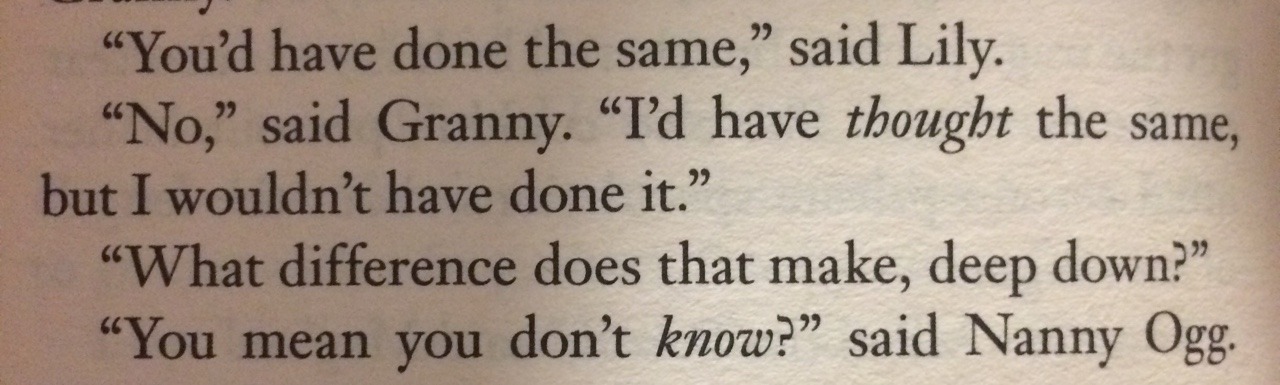
The image I included above is a bit of dialog from Witches Abroad.
“You’d have done the same,” said Lily.
“No,”“ said Granny. “I’d have thought the same, but I wouldn’t have done it.”
“What difference does that make, deep down?”
“You mean you don’t know?” said Nanny Ogg.
—from Witches Abroad by Terry Pratchett
Lily does not fit the mold of villain when we first meet her. She is nice and charming. She claims her only goal is to ensure everyone is happy and get what they want. It becomes clear fairly quickly that what Lily really wants is for everyone to act happy and cheerful and more than content with whatever their lot in life is.
I mentioned above that Granny isn’t nice. She is sharp-tongued and blunt. She is ruthless when going up against someone who is causing harm to others. But she isn’t one of those characters who is rough and mean on the outside and turns out to have a soft squishy golden heart. Granny is granite all the way through, but it is a granite of morality.
In the above quote, Lily had just given her explanation for why she uses her magic to force people into the roles she deems them suited for. She has explained how people make foolish mistakes, live inefficient lives, and waste a lot of time and effort of frivolities, often causing themselves misery and trouble along the way. Isn’t it better, she argues, for someone like her who can see how they could be happier, to make sure that they are?
When Granny objects, that’s what causes Lily to say, “You’d have done the same.”
It is this exchange that shows the core of Granny’s hard, granite soul. She knows that she is capable of doing immoral things. She has had those unkind, cruel, manipulative thoughts. But she refuses to give in to them. She can be harsh-spoken, but she is always harsher to herself, and she knows that kindness isn’t about how we talk to people, but what we actually do for them.
In more than one of the books, Granny defines evil not as maliciousness nor cruelty nor depravity. No. Evil, she tells us, begins when you start thinking and treating people like things.
The book hits on many other ideas along the way, but I think the heart of it was the revelation that how you treat and care for each other is what matters. And there isn’t a grey area between treating everyone as a person entitled to dignity and consideration, and treating them as expendable.
(click to embiggen)I thought that I had tapped the Schedule button on this post last night, so after finishing a somewhat grueling day at work (yes, even when working from home work can be grueling and frustration — but I keep repeating the mantra, “I’m glad I have a job. I’m glad I have a job. I’m glad I have a job…”), making dinner, chatting with my husband, and otherwise winding down from the day, I expected to log in to see how some stats on the blog before I finished a post for Thursday… and here this was not posted. So I decided to re-write the intro to reflect my doofus-ness
So other people have been posting about the Hugo ballot since it came out. This isn’t an exhaustive list, by any means, but I found all of these posts interesting and informative.
Over at FiveThirtyEight dot Com they have this wonderful explanation in comic strip form of why mathematically modeling epidemics and pandemics is so difficult:
There’s a photo on that page of a person holding one of the dead hornets and my god, it looks scary!
And it is scary, this thing’s sting can be fatal to humans who have no allergy to bees.
The hornets love to attack honey bee hives, eat not just the adult bees, but all the larva and pupae, as well. So it’s more bad news for agriculture if this species gets established.
There’s an app you can put on your phone to report sightings of invasive species. It’s also got lots of fascinating information about the invasives and how they disrupt ecosystem. Check it out!
Whether you celebrate Easter as a holiday to eat chocolate, or a fertility rite to welcome spring, or a holy day, or a day to wear your finest hat—or if you just like bunnies—I hope you have a wonderful Easter!





















 Font Folly