(click to embiggen)Time for some stories that either didn’t make the cut for this week’s Friday Five, or came to my attention after I composed the Friday Five post, and/or represent new developments in stories I’ve commented on previously. With more commentary/ranting from me than usually appears in a Friday Five post. And we have some doozies this time! Pour yourself your favorite calming beverage and buckle up, because it’s going to be a bumpy ride.
First, I’ve linked to stories earlier about how some (evil) people have argued that letting part of the population die to keep the economy going is an idea to consider. Well, that’s not the only awful thing people have proposed regarding medical treatment for Covid-19 patients: Autistic support group ‘told it needed Do Not Resuscitate orders’. Or as one blog buddy put it: “Anyway, kill crazy normies control medical rationing.” So the assumption this medical group was making is that people who aren’t neurotypical, if they became sick with Covid-19 are not worthy of the most intensive medical care, because supposedly their lives aren’t as valuable as other people’s. Sure, the story ends by saying the letter had been withdrawn after people protested, but…
Let’s move on to another kind of misinformed medical idiocy: Kansas Republicans Undo Governor’s Coronavirus Order Prohibiting Large Religious Gatherings. That’s right! Because quarantines are a plot to block other people’s religious freedom. And spare me the a-hole pastors saying “We’re willing to die for our faith!” That isn’t what this is about! It isn’t about you deciding whether to risk your life, it’s you deciding to put every single person you come in contact with afterward at risk! Because you can carry the virus and be contagious for days before you feel any symptoms. And one person can cause a lot of illness:
Meanwhile, the grifter-in-chief is making really bad decisions: Federal Support Ends For Coronavirus Testing Sites As Pandemic Peak Nears. He’s lied about how anyone who wants a test can get one. He’s lied several times claiming he hasn’t heard anyone calling for more testing for weeks. And now, it appears, that he’s stopping the federal funding of tests for no other reason than, if fewer people are tested, the number of known infections won’t go up as fast as the actual infection rate. In other words, he’s cooking the books. He’s treating this thing like it’s all about ratings, and not actual lives.
And it’s worse than that: Supplies could be delayed due to confusion from the White House, companies say. The headline is a bit misleading. It’s not confusion, it’s that certain people in Trump’s circle are telling companies not to ship supplies to blue states. In other words, politicizing the pandemic. Which shouldn’t surprise us, because they’ve been falsely accusing Democrats of that for months, and one of the few things you can count on this alleged president and his thugs to do is accuse other people of the crimes they are actually committing themselves.
(click to embiggen)It’s the second Friday in April. And if we weren’t in the middle of a global pandemic, I would be writing this post in a hotel room because tonight would have been the first day of NorWesCon.
I decided not to cancel my vacation days, particularly given how stressful the previous couple of weeks of work had been. So Thursday morning when my alarm went off, instead of hitting the snooze and deciding whether to get up or doze for a bit, I turned it off and slept almost until noon. Goofing off for a day is just what I needed. There’s some household chores we’ve been neglecting that I want to work on the next few days, as well as some art and writing projects. Not sure how much I’ll actually get to, though.
Meanwhile, welcome to the Friday Five. This week I bring you: the top five stories of the week, five stories of interest to queers and our allies, five stories about the pandemic, five stories about deplorable people, five sci fi related stories, and five videos (plus notable obituaries and some things I wrote).
(click to embiggen(Earlier in the week I answered a question which had been posed elseweb in a post entitled, “Why do American right-wingers hate trains?.” That post had started life as a long answer that I almost sent as a comment on another person’s blog. The portion of the original comment which I turned into that 1000+ word post was much longer. Which is why I realized it really belonged on my blog. Among the things I cut out were a couple of anecdotes that illustrated some of my points. I’m not sure how informative these may be, but I think this one might be worth a few chuckles.
A few years ago I was riding the bus home from work and my cell phone rang. I looked at the screen and saw that it was a call from a relative I don’t hear from often. I declined the call, because I always feel self-conscious having a personal conversation in a place like the bus where total strangers can overhear (whether they want to or not). And often the bus environment is just loud enough that I can’t understand everything the other person is saying and they keep asking me to repeat myself because the background noise plus my aforementioned self-consciousness means they can’t hear me.
Once I was home, I called them back, leading with an explanation that I was sorry I hadn’t answered, but was afraid the bus was too noisy to have a conversation. The relative reacted with shock.
“Why are you riding the bus? What happened to your car? Were you in an accident? Is everyone all right?”
I explained that I have always used a combination of bus and walking to get to work.
“But why? You have a car!”
So I explained my reasons which are: 1) Not driving myself to the office every day means less wear-and-tear on the car; 2) Dealing with traffic can be stressful, and particularly after a stressful day at work it’s nice to let the bus driver deal with the traffic; 3) it is a whole lot cheaper to take the bus than to pay for downtown parking.
“Why can’t you just park your car at work?”
Then I had to explain that I could park my car in the garage under the office building if I wanted… but it isn’t cheap.
“Why are you working for someone who charges you to park at work?”
I proceeded to explain that, for one, my employer doesn’t own the building—they only rent a few floors of it. Two, if I do choose to park there monthly, my employer pays a portion of the cost, but not the whole thing, and the remainder is still quite a bit more than a bus pass. Three, there is no free parking in the downtown portions of most cities, because real estate is too valuable to have parking lot-sized portions of it not being used to generate income. Therefore, no matter who I worked for in Seattle, I’d be paying for parking.
“How expensive is it to park there?”
I told her how much (at that time) my portion of the cost would be each month to park in the building where I worked.
She whistled loudly. “That’s more than my mortgage payment! And that’s just to park your car for a month? How can that be?”
I wasn’t sure how she would react if I told her that the cost to park the car in that downtown garage for a month was less than one-tenth of the rent I was paying at that time for a two-bedroom apartment in another neighborhood. So this was when I said, “Things are more expensive in the city. But we shouldn’t be talking about my commute. You called me for a reason. What’s up?”
This is hardly the first time I have had a variant of that exact conversation with a relative or former classmate or old friend who still lives in one of the small towns or suburbs where various parts of my childhood occurred.
On a couple of occasions the conversation has included a long digression about how awful it must be to ride the bus, since the bus must be full of drug addicts and homeless people and the mentally ill and so on. When I say pleasant experiences on the bus far outweigh unpleasant ones they clearly have difficulty believing me.
And with some of the relatives/former classmates/old friends, if I explained how many unpleasant bus experiences (particularly in the first decade or so I was taking the bus) were because some not-homeless, not-mentally-ill, not-drugged-out guy suddenly suspected I was a faggot and deciding he needs to tell me how much he loathes my kind… well, that would have kicked off an entirely different kind of bewildered and awkward conversation.
The questions about buses and parking are relatively benign examples of a phenomenon that Foz Meadows very succinctly called an onion argument:
“When it comes to debating strangers with radically different perspectives, you sometimes encounter what I refer to as Onion Arguments: seemingly simple questions that can’t possibly be answered to either your satisfaction or your interlocutor’s because their ignorance of concepts vital to whatever you might say is so lacking, so fundamentally incorrect, that there’s no way to answer the first point without first explaining eight other things in detail.”
They illustrate a bigger problem. The frames of reference between rightwing folks and others is so disjoint that it’s really no surprise that we seem to be constantly talking past each other.
While I knew I could just buy a membership and vote, I never actually did it until the Melancholy Canine Kerfuffle motivated me to get involved.
And I’ve been happily nominating, reading the packet after the ballot comes out, and voting ever sense.
Which *drum roll* brings us to—the finalists for the 2020 Hugo Awards and the 1945 Retro Hugo Awards have been announced!
2020 Hugo and Astounding Awards
Best Novel
Only two of the books I nominated made it to the final ballot, but three more were already in my to-be-read pile, so this is a very strong selection, and I suspect I’ll have a very hard time picking in this category.
The City in the Middle of the Night, Charlie Jane Anders (Tor; Titan)
The Ten Thousand Doors of January, Alix E. Harrow (Redhook; Orbit UK)
The Light Brigade, Kameron Hurley (Saga; Angry Robot UK)
A Memory Called Empire, Arkady Martine (Tor; Tor UK)
Middlegame, Seanan McGuire (Tor.com Publishing)
Gideon the Ninth, Tamsyn Muir (Tor.com Publishing)
Best Novella
Again, only two of the novellas I nominated made this list, but a couple more were ones I would have nominated if I could nominate more than five. And the other two I’ve heard good things about, so, I’m looking forward to the Hugo packet.
To Be Taught, If Fortunate, Becky Chambers (Harper Voyager; Hodder & Stoughton)
“Anxiety Is the Dizziness of Freedom”, Ted Chiang (Exhalation)
The Haunting of Tram Car 015, P. Djèlí Clark (Tor.com Publishing)
This Is How You Lose the Time War, Amal El-Mohtar & Max Gladstone (Saga)
In an Absent Dream, Seanan McGuire (Tor.com Publishing)
The Deep, Rivers Solomon, with Daveed Diggs, William Hutson & Jonathan Snipes (Saga)
Best Novelette
The further you get down the ballot ballot in the printed fiction categories, the less possible it is that any individual reader has seen a significant fraction of all the stories in that category published in a single year. So I’m not surprised that only one single entry is one that was on my ballot. But several that I haven’t read yet have been written by authors I know are really good, so…
“For He Can Creep”, Siobhan Carroll (Tor.com 7/10/19)
“Omphalos”, Ted Chiang (Exhalation)
“Away with the Wolves”, Sarah Gailey (Uncanny 9-10/19)
“Emergency Skin”, N.K. Jemisin (Forward)
“The Blur in the Corner of Your Eye”, Sarah Pinsker (Uncanny 7-8/19)
“The Archronology of Love”, Caroline M. Yoachim (Lightspeed 4/19)
Best Short Story
I think this is the first time, ever, that four of the stories in this category are ones I had read before the ballot came out. This looks like, again, a great set of nominees.
“Do Not Look Back, My Lion”, Alix E. Harrow (Beneath Ceaseless Skies 1/31/19)
“As the Last I May Know”, S.L. Huang (Tor.com 10/23/19)
“And Now His Lordship Is Laughing”, Shiv Ramdas (Strange Horizons 9/9/19)
“Ten Excerpts from an Annotated Bibliography on the Cannibal Women of Ratnabar Island”, Nibedita Sen (Nightmare 5/19)
“Blood Is Another Word for Hunger”, Rivers Solomon (Tor.com 7/24/19)
“A Catalog of Storms”, Fran Wilde (Uncanny 1-2/19)
Best Series
This is still a very new category, and it’s difficult to know which series are eligible in a give year. Only two of the entries on this list were on my nomination ballot, but I’m familiar with a couple more, and know that they are very good.
Winternight, Katherine Arden (Del Rey; Del Rey UK)
The Expanse, James S.A. Corey (Orbit US; Orbit UK)
Luna, Ian McDonald (Tor; Gollancz)
InCryptid, Seanan McGuire (DAW)
Planetfall, Emma Newman (Ace; Gollancz)
Wormwood, Tade Thompson (Orbit US; Orbit UK)
Best Related Work
This category is always odd, because it is intentionally a miscellaneous category intended as, among other things, a place to nominate new artforms. Anyway, three things I nominated made it here, so obviously I think it is good. I am delighted that Jeannette Ng’s speech made the list, even though it never occurred to me that it was eligible. On the other hand, I think that other things on the list are more deserving of the trophy. But then, I have to admit that half the reason I’m delighted that the speech is here is precisely because of the people who are furious that it got nominated.
Joanna Russ, Gwyneth Jones (University of Illinois Press)
The Pleasant Profession of Robert A Heinlein, Farah Mendlesohn (Unbound)
“2019 John W. Campbell Award Acceptance Speech”, Jeannette Ng (Dublin 2019 — An Irish Worldcon)
The Lady from the Black Lagoon: Hollywood Monsters and the Lost Legacy of Milicent Patrick, Mallory O’Meara (Hanover Square)
Becoming Superman: My Journey From Poverty to Hollywood, J. Michael Straczynski (Harper Voyager US)
Worlds of Ursula K. Le Guin
Best Graphic Story or Comic
When I was younger I was reading comic books as they came out, before they were collected into graphic novels. I tend to wait, now, so I’m not as up on what all is out there, like I used to be. This year while I was trying to fill out my nomination ballot, I learned that almost everything I’d read in the last year had been published earlier, so I didn’t nominate many. Only one title below is one that I have read recently (and nominated). But I’m familiar with several of the writers and artists of the other titles, so I’m looking forward to reading them.
Die, Volume 1: Fantasy Heartbreaker, Kieron Gillen, illustrated by Stephanie Hans (Image)
The Wicked + The Divine, Volume 9: Okay, Kieron Gillen, illustrated by Jamie McKelvie & Matt Wilson (Image Comics)
Monstress, Volume 4: The Chosen, Marjorie Liu, illustrated by Sana Takeda (Image)
LaGuardia, Nnedi Okorafor, illustrated by Tana Ford, colours by James Devlin (Berger Books/Dark Horse)
Paper Girls, Volume 6, Brian K. Vaughan, illustrated by Cliff Chiang & Matt Wilson (Image)
Three things I nominated made this list. Two others I have reason to believe are really good. One… one is going under No Award on my ballot already. But I don’t think anyone who knows me will be surprised that the number one slot on my ballot is going to Good Omens…
Avengers: Endgame
Captain Marvel
Good Omens
Russian Doll, Season One
Star Wars: The Rise of Skywalker
Us
Best Dramatic Presentation, Short Form
Only one episode I nominated made it to the list. A couple of the other series, I nominated different episodes than are here.
Doctor Who: “Resolution”
The Expanse: “Cibola Burn”
The Good Place: “The Answer”
The Mandalorian: “Redemption”
Watchmen: “A God Walks into Abar”
Watchmen: “This Extraordinary Being”
Best Editor, Short Form
Editor categories are always hard to predict. Three of the editors I nominated made it here. Two of the others I am familiar with their work already. It will be interesting researching the others.
Neil Clarke
Ellen Datlow
C.C. Finlay
Jonathan Strahan
Lynne M. Thomas & Michael Damian Thomas
Sheila Williams
Best Editor, Long Form
The last couple of years what I have tried to do in this category is find out the editor of the novels I nominated. This year, I was only able to find out who was one of the editors of the five novels I nominated. She made it to the list. I really wish the book publishers would make it easier to find who the editors are. It was only after the ballot was released today that I found out that one single editor who wasn’t on my ballot edited two things I nominated. They didn’t make it to the list, and I firmly belief part of the reason is because people like me can’t find out who edited the books we love!
Sheila Gilbert
Brit Hvide
Diana M. Pho
Devi Pillai
Miriam Weinberg
Navah Wolfe
Best Professional Artist
Several great choices. I suspect the ones I’m not familiar with already are good, as well.
Tommy Arnold
Rovina Cai
Galen Dara
John Picacio
Yuko Shimizu
Alyssa Winans
Best Semiprozine
Three of my nominees made it to the list. The other three entries on the list are all things that almost made it. I just read/listen to a LOT. Every one of these publishes good stuff, so another really strong category.
Beneath Ceaseless Skies
Escape Pod
Fireside
FIYAH
Strange Horizons
Uncanny
Best Fanzine
Only one of the things I nominated made it to the list this time, but three more are publications that I quite love, and the other two I’ve never perused before, so I’m looking forward to exploring new things.
The Book Smugglers
Galactic Journey
Journey Planet
nerds of a feather, flock together
Quick Sip Reviews
The Rec Center
Best Fancast
Three of my nominees made the list. I’m familiar with a couple of the others and they almost made the cut. So, once again, a strong category.
Be the Serpent
The Coode Street Podcast
Galactic Suburbia
Our Opinions Are Correct
Claire Rousseau’s YouTube channel
The Skiffy and Fanty Show
Best Fan Writer
I was so happy watching the livestream when this category was announced. Three of the entries were also on my nomination ballot. Two of those are Blog Buddies! And the other three are people whose work I am at least partially familiar with and have enjoyed their work, so this is a category I’ll have a difficult time ranking.
Cora Buhlert
James Davis Nicoll
Alasdair Stuart
Bogi Takács
Paul Weimer
Adam Whitehead
Best Fan Artist
Good list!
Iain Clark
Sara Felix
Grace P. Fong
Meg Frank
Ariela Housman
Elise Matthesen
Lodestar for Best Young Adult Book (Not a Hugo)
Only one book I nominated made it to the list. But part of the problem there is that three other books that did make it were in my to-be-read pile at nomination time and I don’t feel right nominating if I haven’t read it. This is another really strong list and I’m looking forward to finishing a few books and reading two more.
The Wicked King, Holly Black (Little, Brown; Hot Key)
Deeplight, Frances Hardinge (Macmillan)
Minor Mage, T. Kingfisher (Argyll)
Catfishing on CatNet, Naomi Kritzer (Tor Teen)
Dragon Pearl, Yoon Ha Lee (Disney/Hyperion)
Riverland, Fran Wilde (Amulet)
Astounding Award for Best New Writer (Not a Hugo)
This is another really strong list!
Sam Hawke*
R.F. Kuang*
Jenn Lyons
Nibedita Sen*
Tasha Suri*
Emily Tesh
*Second year of eligibility
1945 Retro Hugo Nominees
The Retro Hugos are… weird. At final ballot time I seem to never pick the winners. I know that part of the problem with the Retros is that enough voters vote by looking for familiar names, so when an early story by someone who later became really good is on the ballot, even when that is one of the worst stories that later-famous author ever wrote, and clearly the weakest story on the Retro ballot, it still wins.
That said…
I’m happy that Leigh Brackett has several nominations.
I am even more happy that C.L. Moore is nominated in several categories!
I am delighted that a movie based on a story by Oscar Wilde made it into one of the Dramatic Presentation categories.
Related, a non-fiction book by H.G. Wells is also nominated. Wouldn’t it be awesome if Oscar Wilde and H.G. Wells won Retro Hugos at the same time? I’m just saying!
I am not surprised that Edgar Rice Burroughs appears more than once, but remember he owned his own publishing company by this point, and was churning out work at an insane pace.
The f-ing fascist was nominated in one of the editor categories. I really hope that my fave, Raymond Palmer finally gets one of the Retro Hugos, but we all know it is almost guaranteed to go the fascist, so…
Best Novel
“Shadow Over Mars”, Leigh Brackett (Startling Stories Fall ’44)
Land of Terror, Edgar Rice Burroughs (Edgar Rice Burroughs, Inc.)
The Golden Fleece, Robert Graves (Cassell)
“The Winged Man”, E. Mayne Hull & A.E. Van Vogt (Astounding Science Fiction 5-6/44)
The Wind on the Moon, Eric Linklater (Macmillan)
Sirius, Olaf Stapledon (Secker & Warberg)
Best Novella
“The Jewel of Bas”, Leigh Brackett (Planet Stories Spring ’44)
“A God Named Kroo”, Henry Kuttner (Thrilling Wonder Stories Winter ’44)
When it first happened, I figured it was just the usual stupidity from the guy. Someone mentioned it to him, and as a narcissist suffering from some form of severe dementia, he has a constant need to say stuff that make it sound like he knows what he’s talking about. But after being debunked a few times, and after at least one person died trying to self-treat with it, why did he start talking about it again?
Well, it turns out it’s about greed, because of course it is: Pharma-Funded Group Tied to a Top Trump Donor Is Promoting Malaria Drug to the President. That’s right, some of the companies who make the drug that doesn’t work against this thing are donating money to Trump. So, of course, he’s going to tout it so people will buy it and put money in the pockets of people putting money in his pocket!
This shouldn’t surprise us, because Trump’s entire financial career has been about stealing from his investors, contractors, employees, and charities. It has also been about tricking other people into paying for his projects and making it look as if he was the person who raised the money or donated or whatever. All those seasons of his reality show, when at the end the winner (or a charity) got a big novelty check that made it look as if Trump was paying them? Every penny actually came from the network. Neither Trump or any of his businesses contributed so much as a dime. He was paid, the network paid for the production and everything related to it, the network paid the actual award money, and on those occasions when a Trump business was mentioned or a picture of one of his buildings was shown, the network paid said business a royalty.
Trump is also really good about blaming other people, no matter how implausible the blame is: Trump Earns “Pants On Fire” Rating For Insane Claim He Inherited “Broken” Virus Tests From The Obama Admin. So Trump is now claiming that the reason we have been so behind on testing is because Obama left behind thousands or millions of “broken” test kits. Big problem with that lie: when Obama was President, know one knew that the virus which causes Covid-19 existed, yet. So no one had tried to make kits, yet. The problem is that Trump didn’t think the disease was serious (or that it would hurt anyone he cared about), nor was he willing to take and pay for kits from any of the foreign entities that had developed them as the disease swept through parts of China and other countries, nor was he willing to put any money into developing our own.
Unfortunately, his base doesn’t seem to be smart enough to do anything but swallow the lie. Even when the evidence is overwhelming:
How Trump and Kushner Failed on Testing and Ventilators: A Closer Look:
(click to embiggen)I was reading a very interesting blog post elseweb (discussing yet another post somewhere else on another topic) where one of the regular commenters asked in response to some off-hand remarks in the other post and related comments, “What is it that American right-wingers have against trains?” And several other people (a few of whom I know aren’t from the U.S.) gave some answers that contain parts of the explanation. I typed a really long comment going into great detail based on debates I’ve been having with fellow Americans (of varying degrees of being more conservative than I) on the topic. I realized a really long comment doesn’t belong in someone else’s blog’s comments when I have my own place to publish it. So I copied the text out and posted a much shorter summary there. Now, with additional editing, it can be a posted here.
As I said, this comes from years of debating issues such as bus service, various ballot measures to build or extend light rail or commuter train service and related policies. It’s also grounded in my own experience growing up in rural and suburban U.S. communities.
For a bit of cultural context: to graduate from high school in this state back in the year I graduated one of the courses you had to complete was a Civics class. And there was an entire chapter in the state-approved textbook my high school was using at the time called “America’s Love Affair with the Automobile.” I very distinctly remember that there was an essay question on one of the tests in which we were to describe the procedure for changing a flat tire.
This knowledge was considered to be of the same level of importance as how to register to vote, read a voter’s pamphlet, and fill out a ballot.
So, to get back to the question about trains…
Cars represent self-determination and self-reliance. They are seen as being more flexible than trains, because they aren’t limited to running on a track. Cars are also perceived as being the responsibility of the individual owning it. You choose how often to buy a new car. You decide what kind (and how costly) of car you want to own. You pay for your gas and maintenance. And so on.
On the other hand, all types of mass transit are perceived (at least by those of a more conservative bent) as being primarily for the use of people who are too poor to afford a car of their own. Transit is therefore perceived as being paid for primarily through taxes, and specifically the taxes of folks who are not so poor as to need public transit. Add in another myth popular with that crowd—that the vast majority of poor people are only poor because they are lazy, immoral, or both—therefore taxpayer-funded transit being used mostly by people who don’t deserve it.
Whenever I have tried to point out that virtually all roads which cars drive upon in this country are built and maintained entirely by the taxpayer, people are unpersuaded. Because of another myth—this one is believed by people of virtually every political stripe—which is the myth that roads are paid for by taxes on gasoline. Therefore, it is believed (incorrectly) that people who own gas-burning cars are paying for all of the roads all by themselves.
While it is true that most gas taxes are spent on highway projects and the like, what people fail to grasp (or fail to remember once it’s explained to them) is that gas tax revenue is not sufficient to pay for highways, and none of it (at least not in any state where I have lived) is ever used for surface streets within towns and cities. The portion of highway costs that aren’t covered by the gas tax comes from the general tax revenue, of course. And all other road construction, likewise, is paid for by all tax payers, not just the ones buying gasoline.
On the very rare occasion that I have convinced someone in one of these discussions on the latter point, we get to yet another myth that is widely held by conservatives in this country: poor people don’t pay taxes—at all. Again, while if one makes less than a certain amount of money, one does not pay federal income tax, that isn’t by any means the only taxes there are. If you are earning a paycheck so small that there is no federal income tax withheld at all, one still pays social security tax, medicare tax, and state unemployment tax
And that’s still not the entire tax picture. Most states have a sales tax. So everyone who buys things pays those taxes. Most states have property tax, and if you don’t own the property yourself, your landlord is charging you rent to cover those property taxes, it’s just indirect. Depending on the jurisdiction, there are many other taxes that folks who earn too little to owe federal income tax do, indeed, pay.
I’ve skipped over another bit of the issue, though it is implied in one of the earlier points. A lot of right-wingers (because they believe that the only reason one is poor is because one is lazy, immoral, or both) adhere to the firm conviction that any service which makes life less than completely miserable for poor people simply encourages them to continue being poor. Therefore, buses, light rail, commuter trains, and so forth are seen as things that encourage laziness and immorality.
There are a lot more aspects to all these misconceptions. The idea that cars are more flexible than trains overlooks the fact that roads are no easier to move than train tacks. And that most cars aren’t suitable for extended off-road use. Even for those cars which are, most car owners would not be happy with what extended off-road use does to their paint job. And since 80% of the population lives in cities, the only way 80% can get more flexible than existing roads is to drive through other people’s yards. Not a good kind of flexibility!
The above misunderstanding about gas taxes also contributes to why so many right-wingers sneer at electric cars and hybrids, for another instance.
And so on.
But, really, most of it comes down to that dogma I talked about near the beginning: cars represent self-determination and self-reliance, while mass transit (especially trains) are perceived as a tax-payer giveaway to people too poor (read lazy/immoral) to afford a car.
And thats why right-wingers in America hate trains.
I had a different post that I thought I’d scheduled for today, but I saw that it was still in draft status and decided to reschedule for Monday because of another weird dream.
This is the second Sunday morning in a row where I have dreamed of the same friend who died two years ago. I figured it is worth sharing because I suspect other people’s subconsciouses are not that unlike mine.
Dream began with I and most of the friends I world normally expect to see at NorWesCon next weekend walking somewhere together. I think at first we were going to a grocery store, but then the trip morphed into a rendezvous with the friend who died for lunch.
We met her and wound up in a very long line to get to the order window of this odd little building that had big chalkboards outside with the menu on it. Being a dream, I couldn’t really read the menu. My other friends were all talking excitedly about the thing they were going to order, but I couldn’t quite understand what food each of them were talking about. And because the menu was unintelligible, I couldn’t figure out even what kind of food the place was offering.
So I asked her what she recommends.
“I can’t tell you what to pick.”
I repeated that I was asking for a recommendation.
Once again it’s time for some news that either came in too late for this week’s Friday Five, or is a new development in a story I’ve commented upon previously, or otherwise didn’t quite make the cut before. As you can tell form the title of the post, I’m going to be talking about a lot of bad people here. If you would like a laugh, instead, scroll down to the bottom and click on the video. And learn something while you’re at it!
First up, you remember that there are a few Senators and Congresspeople who made suspiciously timed decision to sell of stock after getting classified intelligence briefings on the coronavirus threat? There is a bit more news on that front: U.S. Sen. Kelly Loeffler’s most recent financial disclosures show that millions of dollars in stocks were sold on her behalf at the same time Congress was dealing with the impact of the coronavirus. She continues to insist that these transactions were carried out by her financial advisor without any discussion with her, but the more news comes out the less credible that seems. She and her husband (who happens to the CEO of the New York Stock Exchange) didn’t just happen to sell off stocks in industries sure to take a big hit when the pandemic hit U.S. shores, but they also coincidentally bought up a lot of stock in companies that manufacture medical face masks and the like.
Right, coincidence!
Even though we now know that she had been briefed on the grim statistics of how quickly the disease would spread, how many millions would eventually get sick, and how high the death toll could go, she was making public statements to constiuents and donors that there was nothing to worry about.
The Strategic National Stockpile of critical medical equipment was created by an Act of Congress in 1998. And the act specifies that the purpose is to make sure those critical medical supplies are ready to be deployed to any state or territory where a critical public health crisis arises.
“Gangsters don’t hire family members because they’re qualified. Gangsters hire family members because they’re less likely to talk to the FBI.” (Click to embiggen)I know he’s an idiot. No, seriously. He’s what certain types of really stupid people think is a smart person. Which means he’s good at lying on his feet and using words that sound like he knows what he’s talking about. But he’s an idiot and a con artist, who couldn’t pass a basic security check and is in office (in violation of The Federal Anti-Nepotism Statute) because Trump wants him there. His motives are not public service, his motives are always his own personal gain, and the personal gain of his patrons. And ordering someone to change the government website that describes the reserve doesn’t change the law.
Remember, Kushner is the idiot who did this: Inside Jared Kushner’s coronavirus research: A wide net on a giant Facebook group. That’s right, he had access to all the experts at the National Institutes of Health, the Centers for Disease Control, and so forth, but what did Jared do? He called his brother’s father-in-law who happens to be a doctor.
“He took advantage of some of the most vulnerable people in our society. He targeted elderly investors and individuals attracted to his Christian ideals and then stole from them.”
—lead prosecutor Alexis Goldate
Yeah, great Christian values, there.
Okay, enough about bad people. Here is a helpful video for those who need a face mask for their next excursion. I hope it at least makes you chuckle:
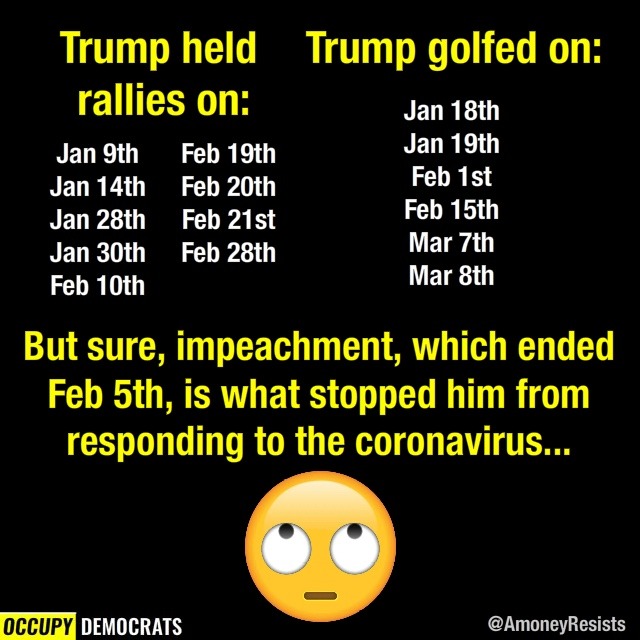
Click to embiggen! “Trump held rallies on: Jan 9th, Jan 14th, Jan 28th, Jan 30th, Feb 10th, Feb 19th, Feb 20th, Feb 21st, Feb 28th… Trump golfed on: Jan 18th, Jan 19th, Feb 1st, Feb 15th, Math 7th, Mar 8th… But SURE, impeachment, which ended on Feb 5th, is what stopped him from resonding to the coronavirus until late March…”We’ve reached the first Friday in April.
I’ve started on Camp NaNoWriMo, but my word count so far is pathetic. On the other hand, at one point on Thursday evening I realized that it was like the umpteenth time that day that I had shared a whiny story related to my work (I’m working from home in an industry that is considered essential, whereas my husband was furloughed last week and we’re both trying to adjust to being housebound together more than ever before)… so I recognized the expression on his face as being less than thrilled at my topic of discussion. So I said, “I need to stop talking about work, or you’re going to either divorce me or strangle me.” And he responded with: “Oh, I won’t DIVORCE you…” Which made me observe: “I see strangling is still on the menu…”
He did not contradict my conclusion.
So… I put on my headphones, picked one of my more compelling playlists, and started working on this post while trying very hard to resist any urge I had to pause and talk to him.
Meanwhile, welcome to the Friday Five. This week I bring you: the top five stories of the week, five stories of interest to queers and our allies, five stories about the pandemic, and five videos (plus notable obituaries and some things I wrote).








 Font Folly