It’s time for another post about news which either didn’t make it into this week’s Friday Five, or is an update to a story included in a previous Friday Five or Weekend Update, or is otherwise related to some stories I’ve commented upon previously.
You may have heard that the Boy Scouts have filed for bankruptcy. Depending on where you heard it, you might believe that this is related to plummeting membership since the organization changed its code so that kids won’t be kicked out just for admitting they are gay (in a half measure policy the automatically kicks them out as soon as they turn 18, and makes it very easy to get them excluded for quite flimsy reasons). Because the rightwing anti-gay organizations are all screaming that that is what happened.
That is absolutely not what’s going on.
Scouting membership has not dropped since the rule went into effect in 2014. Both the national organization and local chapters are doing well financially.
The problem is that more than 2700 former scouts have come forward about being sexually abused by scoutmasters for many decades—long, long before anyone was contemplating letting openly gay kids into the organization. Sexual abuse lawsuits against other large organizations who failed to protect kids from sexual predators (such as USA Gymnastics) have resulted in large settlements. The national scouts claim they are filing for bankruptcy in order to set up a victim’s compensation fund and protect the assets of local chapters.
As a former scout myself I have a some sympathy for letting the local chapters continue to function. There are a lot of kids in these troops who have a lot to gain from its continued existence. But, as a former scout, I also remember that the Scout Law includes the lines: “Try to help others be happy” and “Do what you think is right despite what others might be doing or saying.”
They now know that thousands of people that were in their care are miserable and traumatized by things that happened to them within their organization. Their lawyers are saying to take this legal tactic that limits the consequences they will face for misdeeds. Other organizations have used the bankruptcy courts in the same way. How can someone who has taken the Scout Oath and studied the Scout Law possibly believe that dodging some of the cost this way is the right thing to do? Is a way to help others be happy?
The problem is bigger than the Boy Scouts of America. Large institutions, particularly hierarchical organizations tied to the notion of patriarchy, enable abuse. Other parts of the Scout Law urge scouts to obey the rules of their troop, to respect and obey leaders, and to put the needs of others ahead of their own. Those principles can easily be used by manipulative abusers to convince victims that it would be wrong to come forward. If you’re not the victim, your instinct it to protect the organization when you hear any rumors or allegations. If you know and respect the person accused, you’re much more likely to disbelieve the accuser.
And so on.
Religious institutions also attract certain types of people that become abusers. Let’s not forget that the Boy Scouts are a religious organization, the Scout Oath begins, “On my honor I will do my best to do my duty to God and my country and to obey the Scout Law…” One of the reasons that there are so many closeted gay priests and pastors in the most anti-gay churches is that when those priests and pastors were young men struggling with their sexual orientation, they saw doing god’s work as a way to make a bargain: I’ll become a priest, lord, so you can take these feelings away. Similarly, if someone is sexually obsessed with children. Same bargain: I’ll dedicate my life to god, surely he will make these feelings go away?
There is a lot of tragedy in every corner of these messed up situations. But I think it’s most important to focus on the children and young people who were victims of the abusers. The assets of the organization, and the future financial well-being of the organization, should not take a priority.
This week has been mostly dry and sunny here, which means it has also been very, very cold!
Meanwhile, welcome to the Friday Five. This week I bring you: the top five stories of the week, five stories of interest to queers and our allies, five stories about why we don’t need another arrogant billionaire running for president, five stories about the deplorable thug occupying the White House, five stories about other politics, and five videos (plus notable obituaries and some things I wrote).
(Click to embiggen)For longer than I’ve been alive one of the lines of dispute within what we would now call the LGBT+ Equal Rights movement can be characterized as the Gay Assimilationists vs the Radical Queers. Gay Assimilationists tend to define equality as the integration of non-heterosexual people within existing cultural norms and institutions, while Radical Queers tend to define equality as changing cultural norms and institutions so that all sexual orientations, genders, and presentations of such are welcomed and supported. The Radical Queers reject integration because they see it as embracing and approving of the toxic values that created sexual and gender-based oppression to begin with.
This divide, or course, exists on a spectrum. The beliefs of most people within the community fall somewhere between the extremes, but, enough are on one side or other of the middle that arguments happen. For instance, I’ve been accused of being an assimilationist because Michael and I got legally married once we were able to do so, and I watch football. I’ve also been called out in the other direction because I wear earrings, the color purple, rainbows, and call myself ‘queer.’
The tension between these two ideas plays out in many (and sometimes weird) ways—and not just within the community. There are still plenty of people (straight and not), who insist that LGBT+ rights advocates should be civil, and politely make their case about why we deserve equality. They wrongly insist that the radical approach never works. They completely ignore the actual history of the movements: decades of work by so-called homophile organizations in the U.S. and Europe politely advocating for decriminalization—always careful for the men to dress in suits and ties, and the women to were skirts and blouses—and never making any progress. It was the riots by drag queens, transgender people of color, and the like that finally made any change happen at all.
Yes, the other approach works well for raising money and countering backlash to each step forward. So both approaches have their place in the long running battle for equality.
Which isn’t to say that only the non-conforming people matter, or that there is some sort of meaning to the question of whether one person is gayer than another (despite some people trying to drag that distinction into some political races this year), it’s mostly a recognition of the old proverb that the “the squeaky wheel gets the grease.” Both kinds of LGBT/queer person are valid and just as “gay” as the other.
In the last few years as a small number of mostly-gender-conforming male professional athletes have decided to come out of the closet, you see various media people calling them trailblazers whose bravery will somehow make it easier for non-heterosexual kids to be themselves. Ignoring that fact that the actual trailblazers were blazing those trails for many years. It’s not the macho professional male athlete coming out in the twenty-teens who is leading the way, they are trailing far, far in the dust behind the femmy boys and glittery street queens and butch dykes and trans people of all types who led the way at Stonewall and in the years immediately following. And as has been demonstrated many times, no matter how unthreatening, conventional, and mainstream non-heterosexual people are, as soon as they dare to come out of the closet someone is ready with the slurs and attacks.
The two philosophies I mentioned at the beginning (Assimilationist/Radical) roughly map to two distinctive kinds of experiences many queer people lived through growing up:
Some of us never fit in. We were bullied by classmates (as well as adults) for the way we talked, or the way we walked, or the things we expressed interest in.
Others blended in so well that when they eventually did come out, people who knew them when they were younger express genuine and emphatic shock.
Make no mistake: neither kind of kid had it easy. The ones who did blend in realized, at some point, that they were different, and they lived in just as much fear as those of us who couldn’t figure out why we were constantly being called all those homophobic slurs. Both kinds internalized homophobia leading to feelings of self-loathing.
Those of us who couldn’t blend in are somewhat more likely to focus on trying to make society more accepting of all differences, while those who did blend in seem to be more likely to think our goal should be to convince straight people that we are no different from them.
But it isn’t an exact correlation.
I’m saying all of this for context. Now, let’s move on to my point: any time in the last few months that I have criticized the policies and statements of presidential hopeful Pete Buttigieg I get accused of saying he isn’t gay enough. As if that phrase even means anything. That’s not what’s happening. My beef with Buttigieg is very few of his statements about policies would sound amiss coming out of the mouth of 2016 Republican presidential candidate, Jeb Bush. Most wouldn’t sound amiss coming out of the mouth of 2012 Republican nominee, Mitt Romney.
Mayor Pete is not a progressive politician. He doesn’t advocate positions that I believe will move us forward. At best, his detailed policies look to undo most of the harm Trump has done, and otherwise only promise to not to let things get much worse.
We can do better than that.
Now, I have some theories about why he doesn’t see how harmful late stage capitalism is to most working class and middle class people of every gender, orientation, and race. And I have some theories on why many of his responses as mayor to issues related to marginalized communities were tone deaf or outright dismissive. The quickest summation is: he is unaware of how the privileges he has had (being a man in our society, being white, having university-educated parents, being from a family well-to-do enough to send him to private school, and then to Harvard, and yes, being the kind of gay who can pass for straight when he wants) has protected him from the problems those less fortunate have had to deal with.
That doesn’t mean that I don’t think he’s gay enough. That does means I don’t think he is either self-aware enough nor empathetic enough to be a good president.
Click to embiggenA couple of years ago I was chatting with a new co-worker, who noticed the photo of my husband on my desk. The picture was taken on our wedding day. Michael was wearing his top hat and other formal wear, and a friend was helping him tie his cravat. The co-worker asked who the person in the picture was, I said it was my husband, and the co-worker asked, “How long have you been married?” And I said that we had been together (at that point) nearly 20 years, but had only legally been married for 5 years. The co-worker looked confused, and then asked, “Why did you wait so long?” To which I replied, “Because it wasn’t legal for us to get married until 2012.” The co-worker’s eyes went wide, and then they said (in what I interpreted as a very embarrassed tone of voice), “Oh, right. Um, yeah, that makes sense.”
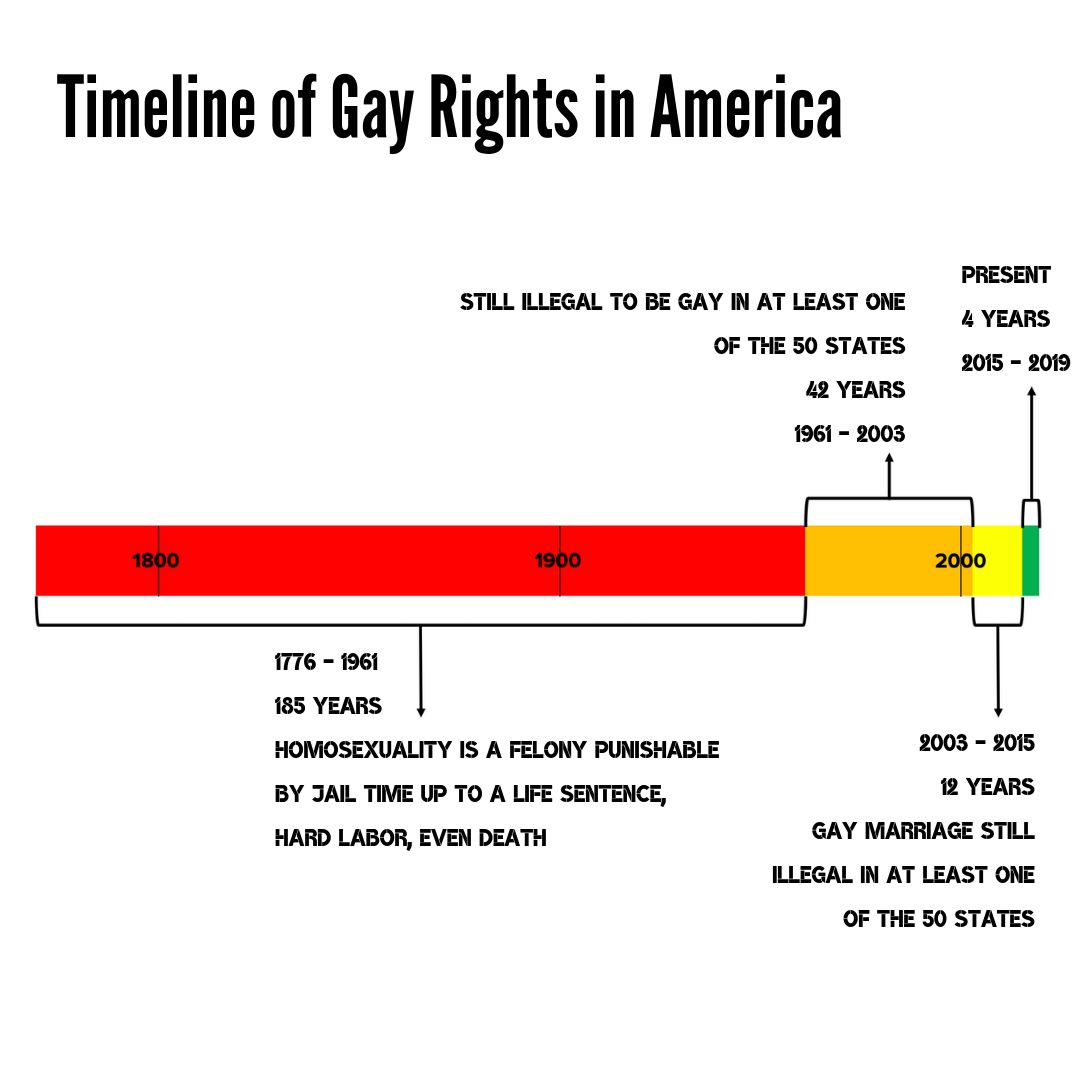
And that 2012 date was for the state of Washington. For the majority of the U.S. marriage was still not available to same sex couples until the Supreme Court ruling in 2015.
I told you that story so I can tell you this one:
A couple of weeks ago I was busy at work updating documents. I had to type the day’s date several times, and one of those times it struck me, “Oh! Wow! Today’s the anniversary of our first date.” It was, specifically, the 22nd anniversary of our first date. As it happened, we already had plans to meet a bunch of friends a couple of days later, at which event I was already planning to hand out some Christmas presents that had not be collected at the party, and a birthday present, and other things, so during my lunch break that day, I ran out to a store and also purchased an anniversary card to give to Michael, along with a silly present to give him with the card (I also ordered a couple the more substantial gifts online).
As it happened, that same day, while typing the date into a database at his workplace, Michael also remembered that it was the anniversary of our first date. He went online later and ordered an anniversary present for me. And, yes, we do that kind of weird parallel thinking a lot, and every time it happens, I remember all the times that close friends said (that year that we finally got to marry for real) that it was a little strange to think of us as newlyweds, because we had seemed to be an old married couple for so very long before hand.
I understand that not many people who have been in long-term relationships remember the exact date of their first date, nor the date of when they first met, et cetera. One reason that we do is because for most of history, queer relationships have been excluded from the societally-approved institutions related to anniversaries. So, for a few years, we celebrated the anniversary of our first date as our anniversary as a couple.
Then, the company I was working for decided to allow same sex partner benefits but only if you registered with some sort of government agency, and it so happened that the City of Seattle was offering such a registry (though it conveyed no legal benefits), so we filed the appropriate paperwork so I could get Michael on my medical and dental… and then a few years after that the State of Washington offered a similar registry, though initially with virtually no legal rights, but we signed up for it anyway, and so on…
So, technically we have a bunch of anniversaries… but which one to celebrate? And that question isn’t trivial. Go back to the story I started with. Without really thinking about it, a person who had just met me had asked how long I’d been married. That is an extremely common question for people who are just getting to know each other to ask once they find out you are in a relationship. And humans are social animals, and social customs often have a much stronger impact on one’s success, health, and similar things than mere laws.
I’m proud of the fact that we’ve been together for 22 years—if for no other reason than that I know what a complete jerk I can be sometimes (I really don’t know why he puts up with me sometimes!). I’m also extremely happy that we were able to get legally married at last, and getting to spend that day with so many friends that we love was just incredible.
There are still people who think that long-term queer relationships don’t exist, or are so rare that they don’t matter. The fact that the people most likely to publicly declare that are pundits and politicians who have divorced and re-married many times (and often have been proven to have engaged in a lot of affairs along the way) for some reason almost never gets reported. Let alone the sociological and psychological damage we’re all operating under because of decades of bullying, discrimination, hatred, and simple erasure.
That graph I include above is informative, but also a bit misleading. That last bit of the graph shouldn’t be green, IMHO, because it is still legal in at least 28 states to fire someone (or refuse to rent a home to them, et cetera) just because they are gay. And don’t get me started on all the state and local officials in various places that are trying to undo the marriage ruling, or at least ignore it.
Some people, like the co-worker in my opening anecdote, simply aren’t aware of how recent any legal or societal acceptance has been (and are also frequently clueless about how much still exists). In some cases, that lack of awareness are exacerbated by the histrionics that some bigots have gone into every single time we made any progress at all. It’s easy to think that because the bigots were screaming about us destroying marriage for two decades before we actually started getting that right to marry, that we’ve had the right longer. And a lot of people still don’t realize that in 28 states it is completely legal for an employer to fire someone simply because they suspect they might be gay.
We’ve come a long way, but there’s a long way to go. Fortunately, several of us have demonstrated that we’re in it for the long haul.
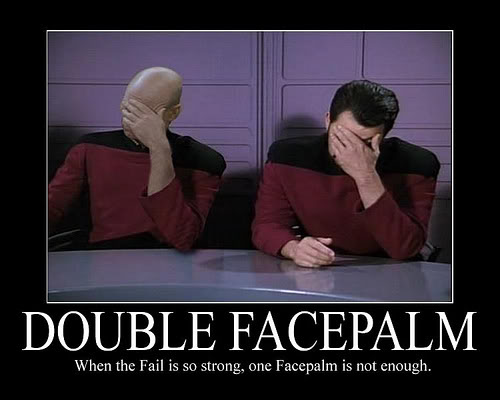
When the fail is so strong, one facepalm isn’t enough…There’s a particular story that I’ve seen shared on social media here and there, where a woman relates some feedback she got in a college creative writing class. The woman wrote a story in which a rape victim takes revenge on her rapist. The professor indicated that the story didn’t work because the writer hadn’t established sufficiently that the rapist was evil. The writer points out that it is well established that the fictional man in the story has raped the fictional woman in the story. “Yes, yes,” the professor agrees, “But before you kill him, you need to show that he is really evil.” Most of the male students in the class agree, with multiple people suggesting that the writer could show the rapist being cruel to a dog, so that we recognize that he’s not just a rapist, but actually evil.
I had no trouble believing this anecdote, because I have gotten into more than one argument over the years with people (almost always cisheterosexual men) insisting that just because a character in a particular movie or television series or book raped someone, it doesn’t mean that he’s bad.
What’s most appalling about the anecdote is that a really large number of men think that kicking a puppy is ten-thousand times more evil than sexually assaulting a woman.
But on a less intense level, it’s also pathetic that a number of movies and stories without any rape at all have chosen to show the villain kicking or shooting or otherwise attacking a dog/puppy just to drive home the point that this character is really, really evil. It isn’t just dogs. In the original Terminator, for example, one of the ways the director hammers home that the titular character is a heartless killer is to show a close up of the robot callously stepping on a child’s toy, destroying it.
Puppies and toys aren’t the only kind of shorthand which lazy writers have used to indicator a character is not just a bad person, but despicably, unredeemably bad. One of the other ways that has been used a lot is queer-coding of villains. Queer-coding is where certain behaviors, mannerisms, or means of talking that hint that the character isn’t heterosexual (or possibly not cisgender). It frequently has been used with villains. People often point to villainous characters in Disney films (Jafar, Ursula, Scar) but it’s been around longer than that. Alfred Hitchcock’s movie, Rope is a frequently cited example.
And some works don’t even bother with coding. For instance, Frank Herbert’s novel, Dune, (and the sequels) explicitly depicts the most depraved and evil characters as gay. There is one character who slowly develops bisexual curiosity as she is corrupted, and then goes full queer as her moral corruption reaches its pinnacle.
Full disclosure: I didn’t even notice the correlation between queerness and evil in the Dune books (which I have loved since my early teens), until someone pointed out to me in my mid-to-late-twenties that I, a queer writer, was doing the same thing in stories I was writing at the time. It’s a pervasive culture notion, coming out of the homophobic belief that simply being non-heterosexual is a deep moral failing.
Queer-coding and overt queer-villaining still happen, but more people (and not just queer people) in the audience are willing to speak up and object when it happens. But the sort of writers/directors/et al who feel they need to hammer the depravity of their characters home seem to have switched to a new shorthand: incest.
In my review of a recent episode of Star Trek: Picard I blamed Game of Thrones for this problem. I stand by my explicit statement (as well as the implicit one) that the series (television and books) commits a huge number of literary and ethical sins, but I do have to admit that the encroachment of the incest meme as shorthand for very evil goes back further than that. In Cora Buhlert’s review of the same episode of Picard she points out the incest=villain trope goes back at least to 1974’s movie, Chinatown.
And obviously incest has been mentioned in fiction and folklore for a long time, including the Greek story of Oedipus, Arthurian legend (Mordred sometimes being depicted as the product of an incestuous tryst between Arthur and his sister or half—sister), and more than a few times in the Old Testatment. Though it is worth mentioning that one of the times it happens in the Old Testament the narrative is less than condemning of it.
But in most of those tales the incest plays out as a tragedy. Real life incest is also almost always tragic (since most often it is part of an abusive relationship). So, I’m not saying that incest should be off-limits in narrative fiction, because real human failings are fair game for your fictional works. I’m just annoyed that it seems recently that it’s being thrown in as a lazy way to show that a character is particularly twistedly evil. And it’s not necessary.
You can show the character doing evil things. Physically choking her subordinate tells me plenty about the character of the evil sister of the Hot Romulan, for instance. Sending death squads after people shows us that the character is evil. The narrative didn’t have to make them siblings for any part of the story to work. There are millions of ways you can have your villain behaving cruelly or coldly or viciously to demonstrate that they are a despicable, vile, dastardly, abominable, loathsome person.
Don’t use shorthand to indicate a character is evil. Write the story in such a way to show us the character is evil. But keep it in character, make sure that everything you show the reader also moves the plot along, and so forth. And if a reader is the sort of person who doesn’t recognize that coldly ordering someone’s death (or whatever things that happen in your story that are in character for your villain) is a bad person, maybe your story isn’t for them.
Continuing my reviews of Star Trek: Picard with episode 4, “Absolute Candor.” And this week I even managed to write the basic review before reading anyone else’s! I do link to two three I read after scheduling this post at the end, though. Anyway, back to my review: I enjoyed the episode. I’ve been enjoying all of them, thus far. But there is a bit of a caveat, this time. I’ve seen some reviewers complaining about how slowly the series plot was progressing, which I didn’t agree with. The first three episodes did, in my opinion, a very entertaining job of introducing us to a lot of new characters, filling in on events that have happened during the 20 years since the last film featuring Jean-Luc Picard, and setting up a lot of possibilities for ways the story could go. I thought the pace was just about perfect for all the stuff those three episodes had to do.
The first three episodes were directed by Hanelle Culpepper, who has an impressive resume directing a lot of different genres of television, including some Star Trek: Discovery. This episode was the first directed by Jonathan Frakes, who played Commander Will Riker on the the Next Generation, and has directed at least two Trek films and a lot of television episodes, including several Trek related shows. So, given how the last episode ended with the new crew warping away from Earth, I expected this episode to pick up the pace.
That’s not what happened. Very little movement occurs on the main plot. What we see is all interesting and introduces another new character—with some action and excitement including some explosions in space—but it didn’t really advance Jean-Luc’s plot that much. Soji’s part of the story got a little more depth, so there is that.
Despite this criticism, I did enjoy the episode, but it definitely is not competing for the spot of my favorite of the season.
Past this point there be plot spoilers. So if you don’t want to be spoiled, don’t read on.
And we’ve reached the second Friday in February (which is also Valentine’s Day), and tomorrow is the third Saturday.
The rain went away for a few days, now it seems to be back, and I’m quite happy with that. So long as we don’t get any more wind knocking over trees and leaving us without power for 16 hours.
Meanwhile, welcome to the Friday Five. This week I bring you: the top five stories of the week, five stories about science, five stories about politics, and five videos (plus some things I wrote).
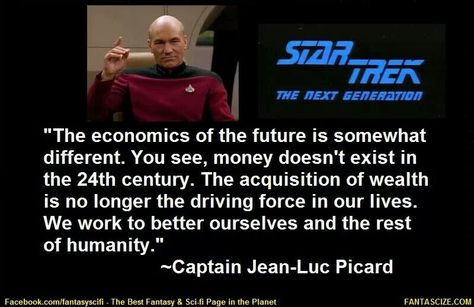
One of the times that a character on screen claimed that the Federation doesn’t use money.Since I’ve been obsessively reading reviews and such of the new Star Trek: Picard series, I’ve seen many people commenting on parts of the plot that clearly contradict the claim Jean-Luc himself made in one of the TV episodes of Star Trek: the Next Generation:
“The economics of the future is somewhat different. You see, money doesn’t exist in the 24th Century. The acquisition of wealth is no longer the driving force of our lives. We work to better ourselves and the rest of humanity.”
—Captain Jean-Luc Picard
Many other times in the various series and the movies, statements have been made to the effect that they don’t use money in the Federation.
In the latest series, one source of tension between Jean-Luc and his former aide, Raffi, is that when they both left Star Fleet after the Utopia Planitia shipyards disaster, Jean-Luc was able to retire to his fabulous chateau and vineyards and live among wonderful antique furniture and the like, while Raffi ended up in what is essentially a mobile home parked in the desert.
If they really don’t use money in the 24th Century, and the accumulation of wealth is meaningless, how does such a thing happen?
That’s not all. Captain Rios, the pilot with the unlicensed ship that Raffi finds for Jean-Luc is being hired. We don’t know the terms, but Rios does comment at one point that he is expensive.
This is hardly the first time that important plot points in stories of the Star Trek universe have contradicted the assertion that money doesn’t exist in the beautiful future of the Federation.
Let’s turn back in time to the 13th of October in the year 1966, when the Original Series episode, “Mudd’s Women” was first broadcast. The Enterprise responded to a distress call and beams four survivors from a ship that is about to crash into an asteroid. One man and three unnaturally beautiful women. The man claims he was escorting the women to a distant colony to get married. It quickly transpires that the man has given a false name, and that he is Harcourt Fenton Mudd, a con-man with an extensive criminal record.
Now, if there really is no concept of money or wealth, what, exactly does a con-man do to get convicted of Grand Theft and Grand Larceny (among other things)?
Rather than the episode just ending with the discovery of Mudd’s identity, there is a complication. The ship’s dilithium crystals (the power source of the ship) are failing, so they must divert to a nearby mining colony to get replacements. But Mudd contacts the miners secretly and strikes a deal to provide the miners with the three brides instead in exchange for them demanding the ship release Mudd before they’ll provide the crystals, right?
So this is another thing. One of the explanations that is often given (on screen and not) to why money and economic disparity has ceased to exist is that replicator technology means that the Federation is no longer a scarcity economy. But then, why do we need mean living on dangerous worlds mining dilithium? The usual answer is creating dilithium crystals takes more energy that an equal amount of dilithium can supply.
But it’s not just dilithium. In another first season episode of the series, “The Devil in the Dark” the Enterprise goes to a pergium mining colony because of a mysterious creature killing engineers. Eventually Kirk and Spock determine that the lone creature is a Horta, set to guard thousands of eggs until the next generation hatches, but because the Horta are silicon-based lifeforms, the miners mistook the eggs for geological anomalies. Anyway, again, if replicators can make anything, why are the miners so delighted, after making peace with the Horta, at all the “other valuable minerals” the newly hatched creatures help them find?
Then there’s an episode from season 2 of the original series, “The Trouble with Tribbles” in which Cyrano Jones, an intersteller trader, is selling adorable purring critters called Tribbles (among other things), and the creatures’ incredible fertility issues cause various problems (and solve one). But he’s selling the Tribbles early in the episode, then at another point a bar owner is unwilling to extend him any more credit and certainly doesn’t want more Tribbles since the Tribbles he already bought have multiplied so much…
Again, selling and bar credit clearly imply some sort of money system, right?
The Next Generation introduced a new alien race, the Ferengi, who were fleshed out significantly in the series, Star Trek: Deep Space Nine. Ferengi society is built all around the Rules of Acquisition (the first of which, “Once you have their money… you never give it back,” I quote in the title of this post). Now the Ferengi and their obsession with business and acquiring wealth were usually hand-waved with the point that the Ferengi were not part of the Federation, and yet one is able to operate on a Federation Station for 7 seasons of Deep Space Nine without any problems.
And there’s that hilarious scene from the movie, The Search for Spock where McCoy is trying to hire a criminal pilot to take him to the Mutara system. “Mutara system is forbidden. Need permits many, which means money, more.”
I could keep pulling out examples. I understand that the real explanation is that script writers are creating stories that will appeal and be understood by contemporary humans who live in societies where money and the acquisition of health are extremely important. These are story situations and character types that the audience will understand without a lot of explanation.
For an in-universe explanation, I’m going to have to get a little cynical. I think that the various statements about not using money and such are ideals that the Federation official aspires to, and tries to make reality by providing needed services, housing, and so forth, to everyone. In other words, it’s not the money doesn’t exist, it’s that in theory you don’t need it to survive. Some sort of exchange system where credits are tracked or whatever exists, and clearly the concept of private property still exists. But most everyone has bought into the myth that it’s not needed.
If it seems unreasonable to believe that people would buy into this myth, consider this: how many millions of Americans (including a lot of very serious and highly educated pundits and such) insist that racism is all in the past, because we eliminated slavery! And then passed civil rights laws! And isn’t just Americans, of course, who go along with and repeat things that aren’t quite true.
If anyone has a better explanation, I would love to hear it!
I had explicitly planned to write my review of the third episode of Star Trek: Picard before I read any reviews by other people. But the night after the new episode dropped, during a wind storm (after five weeks of record-breaking rain here north of Seattle), several large trees went down about a block from our house. And those enormous evergreen trees took out a bunch of power lines. The upshot was that literally while I was writing the first sentence of what was to be my not-influenced-by-others review, suddenly the lights (and most everything else electronic) went dead here. By the time I had shut down the devices plugged into Uninterruptable Power Supplies in our house, reviewing the latest episode was the last thing on my mind. Our power wasn’t restored for about 16 hours, by which time we were off at a social event with a bunch of friends… so I have once again read a couple of other people’s reviews of the episode before I completed mine.
First, the non-spoilery review: Another good episode. The story continues to grow more interesting. We get a lot of good character development. We see more ways that the intervening years have changed Jean-Luc. There was an exciting fight. We see a new starship. And at the very end of the episode, Jean-Luc and his new motley crew go to warp speed.
Past this point there be plot spoilers. So if you don’t want to be spoiled, don’t read on.
Another in my series of posts recommending web comics that I think more people should read.
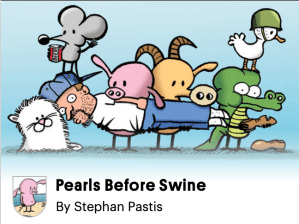
Pearls Before Swine by Stephan Pastis This is another of those comic strips that I don’t need to check regularly because so many people are always posting strips, and when they do, I go catch up. The heart of the series are two characters, a clueless Pig and an arrogant Rat, and they comment on just about everything. It’s hard to describe that subject matter beyond “human foibles and society.” The author says his goal is to poke fun at humans’ unending quest for the unobtainable, and that’s probably why so many other reviewers describe it as a cynical comic. I don’t find it cynical, but I must admit that my basic optimistic temperament may be skewing my perspective. Or maybe I’ve just known too many cruel jerks who describe themselves as cynical that my definition of cynical is off. In any case, Pearls Before Swine certainly mocks human foibles without crossing into mean-spirited territory.
Comics I’ve previously recommended: Some of these have stopped publishing new episodes. Some have been on hiatus for a while. I’ve culled from the list those that seem to have gone away entirely.
Kyle’s B&B by Greg Fox is hard to describe. The main character, Kyle, is a gay Canadian who owns a bed and breakfast that seems to be constantly occupied by hot queer guests. Many, many hot queer guests! There is some romance, and a lot of jokes about things ranging for sub-cultures in the queer community, to gardening and pop culture and… well, a lot of stuff. If you like Greg Fox’s work, you can purchase his books here
Good Bye to Halos by Valeria Halla. Fenic is trans and gay. The comic begins when Fenric is a teenager. Fenric’s father says that it is no longer safe for him there, and then pushes him through a portal and Fenic finds herself in a place call Market Square and unable to get back. She is befriended by an anthropomorphic lion and learns that Market Square is a place where queer kids from many worlds/dimensions find themselves when they are abandoned or lost. Later, as Fenic gets older and assumes that her father is never coming to rescue her, the adventures become increasingly fantastical. If you like the artist’s work, you can support her on Patreon.
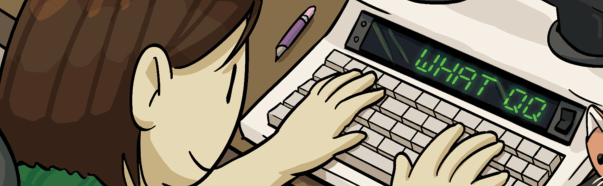
What QQ by Carlisle Robinson. This is one of several comics created by Carlisle Robinson, a deaf trans masculine queer artist. If you like Carlisle’s work, consider supporting the Patreon
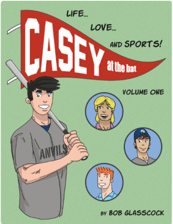
Casey at the Bat by Bob Glasscock. 20-something Casey was dumped by the man he thought was the love of his life, then a friend convinced him to try out for a local gay softball league as a way to meet new people. And thus begins the comic. Casey At the Bat describes itself as a lighthearted slice-of-live romantic comedy, that just happens to start a young gay man. The strip is entertaining and does mostly stick to the less serious topics. If you enjoy this comic (which is more about romance and friendships than it is about sports—though there is some of that, too) you can purchase collection of the comics here.
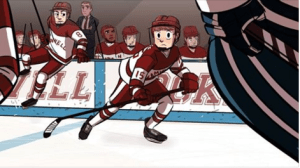
Check, Please! by Ngozi Ukazu is the story of Eric “Bitty” Bittle, a former junior figure skating champion from a southern state who is attending fictitious Samwell College in Massachusetts, where he plays on the men’s hockey team. Bitty is the smallest guy on the team, and in the early comics is dealing with a phobia of being body-checked in the games. He’s an enthusiastic baker, and a die hard Beyoncé fan.
“Manic Pixie Nightmare Girls” by Jessica Udischas is a hilarious web comic that tells of the adventures of Jesska Nightmare, a trans woman trying to make her way in our transphobic world. The comics are funny, insightful, and adorably drawn. The sheer cuteness of the drawing style is a rather sharp contrast to the sometimes weighty topics the comic covers, and I think makes it a little easier to keep from getting bummed out to contemplate that the strips aren’t exaggerations. If you like the strip, consider supporting the artist through her patreon.
Life of Bria by Sabrina Symington is a transgender themed comic that ranges from commentary to slice of life jokes and everything in between. Even when commenting on very serious stuff it remains funny—sharp, but funny. It’s one of the comics that I would see being reblogged on tumblr and lot and I’d think, “I ought to track down the artist so I can read more of these.” And I finally did. And they’re great! If you like Symington’s work, you can sponsor her on Patreon and she has a graphic novel for sale.
Nerd and Jock by Marko Raassina This is a silly webcomic about a Nerd and Jock who are good friends and like to have fun together. Frequently the joke of the strip is to take a cliché about jocks and nerds and twist it in some way. It’s cute. I happen to really like cute and low-conflict stories sometimes. If you like this comic, consider supporting the artist on Patreon.
Assigned Male by Sophie Labelle is a cute story about a transgirl (we meet her at age 11) and goes from there. Some of the strips are more informational or editorial than pushing the narrative forward, but they are in the voice of the main character, so it’s fun. The artist also has a Facebook page of the site, and is in the process of moving to a domain of her own (though currently it still doesn’t have the actual comic strips available). I mention this so you will not be put off by the words “old website” she’s added to the banner. If you like her comic and would like to support her, she has an Etsy shop were four book collections of the comics and other things are for sale.
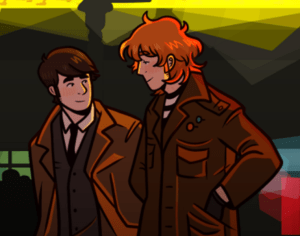
Stereophonic by C.J.P.“Stereophonic” by C.J.P. is a “queer historical drama that follows the lives of two young men living in 1960s London.” It’s a very sweet and slow-build story, with good art and an interesting supporting cast. But I want to warn you that the story comes to a hiatus just as a couple of the subplots are getting very interesting. The artist had a serious health issue which was complicated by family problems, but has since started posting updates to his blog and Patreon page, assuring us that the story will resume soon. If you like the 300+ pages published thus far and would like to support the artist, C.J. has a Patreon page, plus t-shirts and other merchandise available at his store.
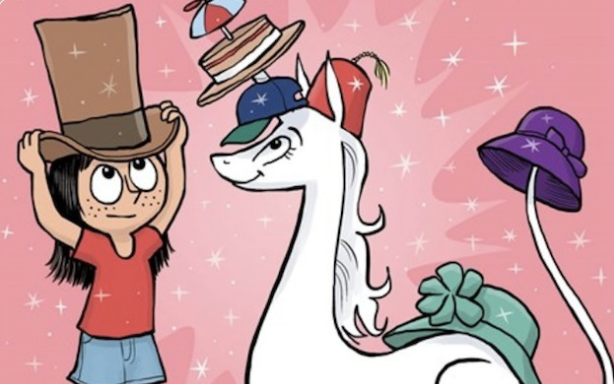
Phoebe and Her Unicorn by Dana Simpson concerns the adventures of 9-year-old Phoebe Howell. One day, Phoebe skipped a rock across a pond, and the skipping rock hit a unicorn named Marigold Heavenly Nostrils in the face. This happened to free the unicorn from her own reflection, so she granted Phoebe one wish. Phoebe wisely wished that Marigold would become her best friend. If you like the comic, you can buy the books here and enamel pins and other stuff here.
The Young Protectors: Engaging the Enemy by Alex Wolfson begins when a young, closeted teen-age superhero who has just snuck into a gay bar for the first time is seen exiting said bar by a not-so-young, very experienced, very powerful, super-villain. Trouble, of course, ensues.
“Deer Me,” by Sheryl Schopfer tells the tales from the lives of three friends (and former roommates) who couldn’t be more dissimilar while being surprisingly compatible. If you enjoy Deer Me, you can support the artist by going to her Patreon Page!
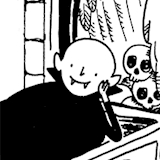
Madeline McGrane is a cartoonist and illustrator who is from Wisconsin and lives in Minneapolis. She posts vampire-themed comics and other art on her tumblr blog. My favorites are the vampire comics about three child vampires. They’re just silly. Her black and white comics are minimalist and really work well with her style of humor. Her color work is a bit more complex. If you like her work and want to support her, she has a ko-fi.
The Junior Science Power Hour by Abby Howard. is frequently autobiographical take on the artist’s journey to creating the crazy strip about science, science nerds, why girls are just as good at being science nerds as boys, and so much more. It will definitely appeal to dinosaur nerds, anyone who has ever been enthusiastic about any science topic, and especially to people who has ever felt like a square peg being forced into round holes by society.
Scurry by Mac Smith is the story of a colony of mice trying to survive a long, strange winter in a world where humans have mysteriously vanished, and food is becoming ever more scarce.
And I love this impish girl thief with a tail and her reluctant undead sorcerer/bodyguard: “Unsounded,” by Ashley Cope.
Fowl Language by Brian Gordon is a fun strip about parenting, tech, science, and other geeky things. The strips are funny, and he also has a bonus panel link to click on under the day’s strip.
The Last Halloween by Abby Howard is the creepy story of 10-year-old Mona who is reluctantly drafted to save the world on Halloween night. This is by the same artist who does the Junior Science Power Hour. She created this strip as her pitch in the final round of Penny Arcade’s Strip Search, which was a reality game show where web cartoonists competed for a cash prize and other assistance to get their strip launched. Though Abby didn’t win, she started writing the strip anyway. If you like the comic, you can support Abby in a couple of ways: she has some cool stuff related to both of her strips in her store, and she also has a Patreon.
Last Kiss® by John Lustig Mr. Lustig bought the publishing rights to a romance comic book series from the 50’s and 60’s, and started rewriting the stories for fun. The redrawn and re-dialogued panels (which take irreverent shots at gender and sexuality issues, among other things) are syndicated, and available on a bunch of merchandise.
Sharpclaw by Sheryl Schopfer. The author describes as “fantasy comic that blends various fairy tales into an adventure story.” The first story is about twin sisters who both have the potential to be sorceresses. One pursues magic power, the other does not. If you enjoy her work, you can support the artist by going to her Patreon Page!
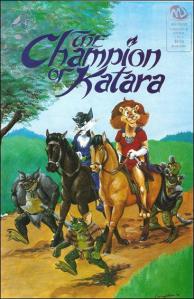
“Champion of Katara” by Chuck Melville tells the tale of a the greatest sorcerer of Katara, Flagstaff (Flagstaff’s foster sister may disagree…), and his adventures in a humorous sword & sorcery world. If you enjoy the adventures of Flagstaff, you might also enjoy another awesome fantasy series set in the same universe (and starring the aforementioned foster sister): and Felicia, Sorceress of Katara, or Chuck’s weekly gag strip, Mr. Cow, which was on a hiatus for a while but is now back. If you like Mr. Cow, Felicia, or Flagstaff (the hero of Champions of Katara) you can support the artist by going to his Patreon Page. Also, can I interest you in a Mr. Cow Mug?
Private I, by Emily Willis and Ann Uland is a comic set in 1942 Pittsburgh in which queer gumshoe Howard Graves is trying to sort out a collection of bewildering clues and infuriating eccentric suspects. It’s an interesting take on a lot of noir tropes. It handles the queer elements well—being outed or caught by the wrong people can spell the end of not just one’s career, but possibly life–without being all grim-dark. If you like the comic and want to support the creators, check out their Ko-fi.
The Comics of Shan Murphy As far as I can tell, Shannon Murphy doesn’t post a regular comic on the web. But among the categories of illustration on her site are comics. Her art styles (multiple) are really expressive. And she just writes really good stuff. If you like her work, considered leaving a tip at her ko-fi page.
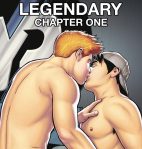
The Young Protectors: Legendary by Alex Woolfson. This is just a new story arc for the Young Protectors comic recommended above. However, Alex is changing up the artists he’s working with in this arc, and the focus is decidedly different. This new arc begins by exploring the changed relationship between our protagonist, Kyle (aka Red Hot) and one of his teammates, Spooky Jones. The story is NSFW, although unless you are a patron of Alex’s Patreon, you see a lot less of the explicit artwork. It isn’t porn, per se, and it isn’t a romance. If you check out the page, you’ll see that Alex has written several other comics, some of which are available to purchase in hard copy. And, as I mentioned, he’s got a Patreon account.
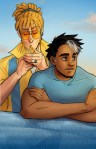
If you want to read a nice, long graphic-novel style story which has published its conclusion, check-out the not quite accurately named, The Less Than Epic Adventures of T.J. and Amal by E.K. Weaver. I say inaccurate because I found their story quite epic (not to mention engaging, moving, surprising, fulfilling… I could go on). Some sections of the tale are Not Safe For Work, as they say, though she marks them clearly. The complete graphic novels are available for sale in both ebook and paper versions, by the way.
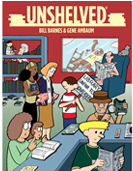
“Unshelved” by Gene Ambaum & Bill Barnes recounts the adventures of a teen services librarian named Dewey. The web site is also an online book club, with reviews, links, and samples of various recommended comics and other books. This should not be a surprise, since one of the creators of the strip, Gene Ambaum, is a librarian in real life. The strip is funny, and is available for free syndication on non-commercial websites. They’ve printed a number of collections of the strip and have various other cool things related to the love of reading and libraries for sale on their online store.
Oglaf, by Trudy Cooper and Doug Bayne is a Not Safe For Work web comic about… well, it’s sort a generic “medieval” high fantasy universe, but with adult themes, often sexual. Jokes are based on fantasy story and movie clichés, gaming tropes, and the like. And let me repeat, since I got a startled message from someone in response to a previous posting of this recommendation: Oglaf is Not Safe For Work (NSFW)!
Note: Usually when I do one of these posts, I include the slightly shorter reviews of all the comics I’ve recommended previously. I do periodically go through those lists and remove comics that have vanished entirely. For now, I’m leaving in those that have stopped publishing new episodes but still have a web site.
But the list is getting awfully long, and I’m not sure how useful the older links are. I’m still thinking about it. Feel free to comment if you have strong thoughts on the topic.
Note the Second: For the first several years that I was making these posts, I foolishly inserted the title graphic for each comic using the WordPress defaults—so that when a reader clicked on the graphic, they would see the graphic full size. What I should have been doing was changing the setting so that clicking the graphic would take you to the home page of the comic being reviewed. Which I have been doing for a while with new reviews. But most the the mini reviews under each new review had the old behavior. Which I was reminded of when I saw that about half the clicks on my blog the day Sunday Funnies, part 39 posted were people clicking on the images. So I spent the time to fix them from that entire post. And will be using this fixed list from now on. I wasn’t a quick simple fix, so I’m not likely to go back and fix the 38 older editions of this blog series any time soon.
 It’s time for another post about news which either didn’t make it into this week’s Friday Five, or is an update to a story included in a previous Friday Five or Weekend Update, or is otherwise related to some stories I’ve commented upon previously.


















 Font Folly