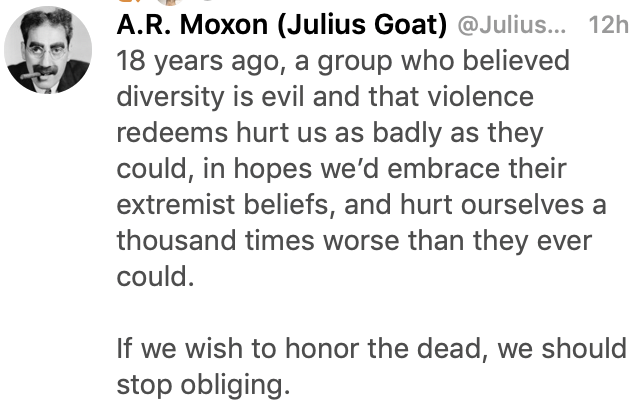
“18 years ago, a group who believed diversity is evil and that violence redeems hurt us as badly as they could, in hopes we’d embrace their extremist beliefs, and hurt ourselves a thousand times worse than they ever could. If we wish to honor the dead, we should stop obliging.”“Trump was the first man in history to be in three places at once. On 9/11, Donald was downtown being a first responder WHILE he was in NJ watching Muslims celebrate WHILE he was in Trump Tower calling TV stations to brag about his building now being the tallest! ”“In remembrance of Mark Bingham, a heroic gay man who sacrificed his life on United Flight 93.”
I finished a post about a very silly topic which I intended to publish on this Wednesday, and it was only when I was scheduling it that I remembered what the date would be. So I decided to do something else. Way back on the first anniversary of 9/11 I wrote a post on another blog that I eventually reposted here on one of the later anniversaries: “Living for 9/12.” It’s hard for me to muster the scant amount of optimism I caught in that post this many years on, because the terrorists won. We’ve embraced the hate. For 18 years we have whittled away at our own liberty, and have not made ourselves one bit safer.
We have, in fact, made ourselves less safe. The hatred we have embraced has given us a plethora of home-brewed domestic terrorists who continue to carry out the agenda of those 19 shitheads who hijacked those jets and killed 3000 people.
One day in the summer of 1981, I was walking around the inside of a huge church sanctuary in Virginia, every now and then stopping to clap once, then listen to the echo. It was something I did just about every day that summer—each day in a different church. I was a member of an evangelical inter-denominational youth choir. I was one of the singers, but I was also the Lead Sound Technician. And while a bunch of the singers were carrying in the sound equipment, our risers, and other parts of our touring program, I would do this exercise to figure out where I wanted to place our speakers and where to aim them. I took this part of the job very seriously.
I was 20 years old. I was a deeply closeted gay guy who for several years had been struggling to reconcile my love of science and my sexual orientation with the religion I had been raised in (Southern Baptists) which is extremely anti-gay, anti-evolution, anti-birth control, anti-modernity, et cetera and ad nauseam. Only eleven years before that day had the Southern Baptist Convention adopted its resolution on race, which was intended to end segregation in Baptist Churches themselves. At the denomination’s founding in 1845, 12 of its 14 statements on faith had been explicitly in favor of slavery, the segregation of the races, and the supremacy of the white race.
That 1970 resolution didn’t make Baptists pro-equality. The very church that my parents had been members of when I was born, for instance, split after the resolution. A number of members forming a new “Bible Baptist” church the aligned itself with one of the other conventions that had split from the Southern Baptist in the previous couple of decades. And at the 1972 convention the convention adopted a resolution condemning public school de-segregation.
One of the pastors leading that charge to re-assert the church’s racist past in 1972 was Jerry Falwell, Sr. Falwell was the pastor of Thomas Road Baptist Church in Lynchburg, Virginia. He was also the host of the syndicated radio program, the Old Time Gospel Hour, which my grandmother listened to faithfully, where he frequently preached against the civil rights movement, women’s rights, gay rights, and a boatload of other topics. In 1971 he founded Liberty University, which to this day still forbids students of differing races to date. And in 1979 he founded the so-called Moral Majority, a political organization bent on supporting conservative Republicans and rolling back what rights women, racial minorities, and queer people had won in the 70s.
In the mid-80s Falwell infamously lost a lawsuit to one of his former classmates from Baptist Bible College, Jerry Sloan. Sloan had come out of the closet after leaving Baptist Bible College, and had become active with Metropolitan Community Church, which was one of the few explicitly gay and lesbian inclusive denominations at the time. Sloan and Falwell participated in a television debate about, among other things, gay rights. After Falwell insisted that he wasn’t at all prejudiced against gay people, Sloan quoted Falwell as having publically called the MCC “brute beasts” and “a vile and Satanic system.” Further, he said Falwell had predicted “one day they will be utterly annihilated and there will be a celebration in heaven.”
Falwell said that it was a lie. And when Sloan said he had it on tape, Falwell bet him $5,000 (on television with millions of witnesses) he couldn’t produce it. When Sloan did produce the tape, Falwell refused to pay. So Sloan sued him, won the $5,000 plus court fees, and he donated it all to a queer community center: Falwell Pays $8,900 to Homosexual Activist.
Jerry Falwell, Sr, was a bigot and a liar (not to mention a chisseler for not paying his bet). And he became a multi-millionaire by preaching hate and promoting hate through his radio show, university, and his political organizations. And I, for one, did not shed a single tear when he died in 2007.
So, back to 1981. Earlier in that year, the Director of the touring choir mentioned that he was “this close” to getting us a tour date at Falwell’s Thomas Road Baptist Church. And without thinking, I blurted out, “if you do, I quit.” The Director was flabbergasted and tried to explain how much exposure we would get there—and possibly be on the Old Time Gospel Hour. I said, “I refuse to have anything to do with that evil man. I refuse to do anything that implies I support his divisive, hateful theology.”
A member of the board of directors who was literally helping me untangle some microphone cables when this exchange happened, chimed in, “Me, too. Falwell preaches the opposite of Christ’s teaching, and if you’re going there, I’m resigning from the board and pulling my kids out of the choir.”
The director made some sort of joke to diffuse and change the subject. Later he made sure to inform both of us that he had decided on his own against pursuing the Thomas Road gig because the strict dress code would, among other things, force us to change our uniform and force a lot of the guys to get extremely short haircuts. I like to think that excuse was his way of saving face, and that my threat had been effective.
And so while later that summer in 1981 we did perform at a Baptist Church in Lynchburg, Virginia, it wasn’t Falwell’s—it was a beautiful historical building, which is still there, though it has since merged with another church and changed its name and denomination. And I’m glad I didn’t have to quit the chorus over it.
You may remember that the two pool boy scandals of which I’ve written before — besides having a lot of sexual innuendo — involved Falwell, Jr. finding ways to finance multi-million dollar real estate deals for the benefit of the handsome young men after spending a lot of time flying each young man to various luxurious places along with Falwell and his wife on their private jet.
The new article (interestingly enough written by a journalist who attended Liberty University) lists other financial deals, including loans of $300,000 and more to Falwell’s friends, funneling lucrative contracts related to the university to businesses owned by his son, and more. Plus, apparently Falwell is very fond of talking about his sex life with colleagues. With a lot of crude details of the things he and his wife do.
And most tellingly, in one incident involving the guy many of us have referred to as “the other pool boy” (though he was employed as a personal trainer when he met Falwell, Jr). Junior texted pictures of his wife in sexual fetish costumes—to a bunch of staff members, plus the trainer. He claimed afterward that he had meant to just send it to the trainer (I believe that), but he also tried to claim to the people accidentally included on the wayward message that the purpose of sharing the pictures was not actually sexual. No! Falwell, Jr sent the personal trainer pictures of Mrs. Falwell in fetish gear because the trainer had helped her lose a lot of weight.
Um, yeah, no I don’t believe that.
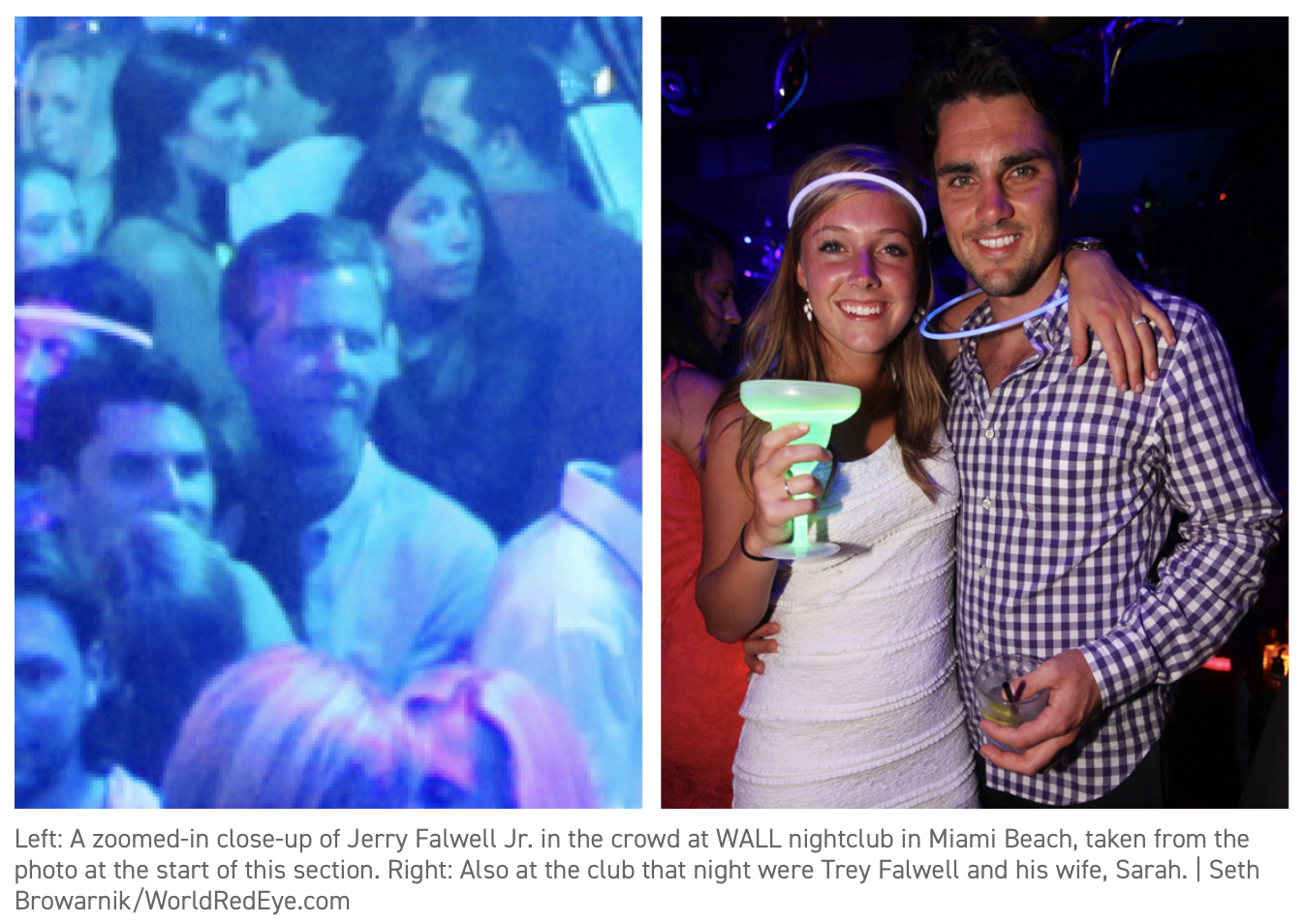
Remember: Junior’s largest salary comes from being president of a religious school that forbids drinking and dancing, among other things. So why are he and his son partying at south Miami nightculbs? (click to embiggen)Listen, hot-wifing, threeways, and cuckold fantasies are all perfectly healthy sexual things that a committed couple who are into ethical non-monogamy should be able to engage in without shame. But when you run a couple of massive non-profit organizations (and draw more than a million dollars in salary between those jobs) that explicitly condemn homosexuality, family planning, women’s rights, sexual liberty, drinking, and dancing (yes, dancing!)—well, then this kind of scandal becomes of interest to the public. Because remember, those non-profit organizations are tax exempt, and therefore all of these shenanigans are being subsidized by our tax dollars.
On top of that, Falwell, Jr effectively swung the evangelical base of the Republican party firmly behind Trump (and all of the evil, non-Christ-like policies that has unleashed on us). And apparently he did so because Trump’s fixer, Michael Cohen, made a blackmailer with more of those kinds of pictures of Mrs. Falwell go away.
You should go read the Politico story. It is full of fascinating details (and keeps the sexual stuff, as much as it could be, more tasteful than I would). The amount of information that people were willing to give the reporter is amazing, given that Liberty University and the associated businesses famously have very strict non-disclosure agreements that claim to stay in force even after a person leaves.
Listen, some of those financial deals are clearly prosecutable crimes. Junior’s using tuition funds and donations to finance his jet-setting lifestyle and that of his friends—and probably sex partners.
“We’re not a school; we’re a real estate hedge fund,” said a senior university official with inside knowledge of Liberty’s finances. “We’re not educating; we’re buying real estate every year and taking students’ money to do it.”
Given that he’s been flying some of these people across state lines in his private jet to close some of these deals, Junior maybe should have thought twice before calling the Feds.
Maybe he thinks that his buddy, Trump, will bail him out. After all, Trump’s very fine lawyer, Michael Cohen, helped get rid of that pesky blackmailer right? Except now Cohen is cooling his heels in federal prison, convicted of financial crimes on Trump’s behalf. Trump hasn’t shown any sign of being willing to pardon Cohen. Or any of the four other people Mueller got to plead guilty to related crimes, nor the four people Mueller got convicted, nor the 19 other people still under indictment whose cases are on-going.
So, Junior may need to start prepping for some less luxurious accommodations than those he is currently accustomed to.
Note:
(Part of the title of this post comes from the hymn, “Up from the Grave He Arose (Low in the Grave He Lay),” by Robert Lowry. It was hymn number 113 in the 1956 Baptist Hymnal.)
This picture is actually from a thunderstorm in 1999 (c) Patrick Haggerty/Associated PressI don’t deal well with warm weather. I have sometimes phrased this as, “I melt at 80 degrees or higher.” For most of the 43 years that I’ve lived in western Washington state, that hasn’t been a big problem, because we usually only get a week or so of weather in the high-80s and up most summers. The previous few years (as the average temperature of the atmosphere has been climbing), have been a different story. Last summer and the summer before we had several weeks of the high weather accompanied by smoke from wild fires in Eastern Washington and British Columbia. Smoke so severe that health officials weren’t just recommending that some people might want to wear masks, but urged everyone to wear particular masks for days on end.
It was awful! The sky was a sick yellow color, the sun was a hellish red color, everything stank of smoke, my sinuses were swollen as if the worst hay fever day was coinciding with a sinus infection, and it was so hot I just wanted to curl up in a deep freeze somewhere.
And the two things — higher average temperatures and smoke — were related. Because wild fires are both more likely and harder to contain because of the heat and how dry all the plantlike growing in the wilderness was.
This summer we had something that was more like the summers of old (which are going to continue to be less likely as we go). We had a week of really hot weather, then a few days of cool weather, a week or too of kinda hot weather, a few days of cool, and then another week of really hot weather, with a bit of a cool down to only sort-of hot weather, and so on.
Then, Saturday night, this happened: Hundreds of ‘insane’ lightning strikes bring chaos to Seatte. And while the actual storm was a bit disturbing, it was part of a big shift in the weather pattern, as we move out of the summer pattern and more toward fall. The long-term forecast is we won’t hit 80 degrees Fahrenheit
again this year, which has me cheering. And the short-term forecast is periods of occasional rain today and tomorrow, partly sunny Wednesday, and then back to rain.
I love the rain. Really. I like listening to it coming down. I like hearing the sound of tires on the wet roads. I like to go outside and stand in it for a while… I’m just really happy.
Another upside to the slightly closer to normal weather over the summer is that I didn’t have as many awful hay fever days. I still had a lot of bad hay fever days and I was taking extra meds a lot, but it wasn’t nearly as bad as the last several summers.
Of course, I’m not out of the woods there, yet. A lot of flowering plants, some trees, and many grasses will keep pollinated for the rest of this month and into October. And when the pollen starts to subside, all the ferns (which grow all over the place in our damp client) will start sporing. And then some time in November as the ferns stop filling the air with their spores we’ll have mushrooms and toadstools popping up everywhere and the air will be filled with fungal spores and molds until (if) we get a hard freeze.
But it’s a lot easier to deal with hay fever when I’m not also feeling like the air is baking my body as a walk around.
Click to embiggenIt’s Friday! Friday! Friday! Friday! And it is the first Friday in September, the month in which superior babies are born!
We managed the impossible deadline… and much earlier than the previous two, which made the three-day weekend much more pleasant than I was afraid it would be. The weekend itself was very relaxing.
So, welcome to the Friday Five. This week I bring you: the top five stories of the week, five stories of interest to queers and our allies, five stories about deplorable people, five stories about why we should impeach someone already, and five videos (plus things I wrote and notable obituaries).
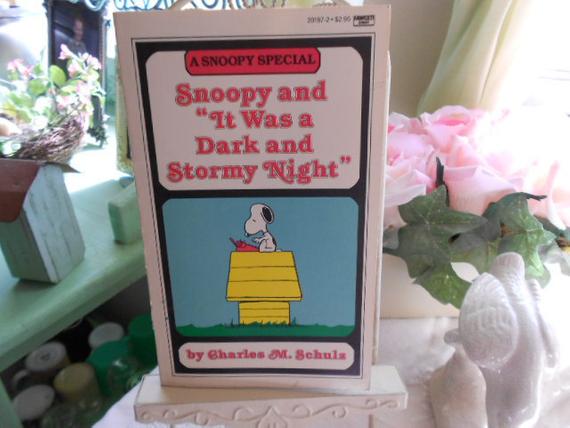
This, alas, is not my copy of this book. I don’t know what happened to my copy. I moved several times during my 20s and early 30s, and I think the book disappeared in one of the moves.So I’ve seen this one post on Tumblr many times where people are just outraged, really outraged, that the Bulwer-Lytton contest exists. And I keep refraining from chiming in to explain that they don’t understand, because 1) I am afraid it will just come across as Mansplaining, and 2) if they really don’t understand, they will never understand the truth. So I’m going to explain it on my blog. And since my blog cross-posts to tumblr, if any of them connect the dots, I can just block their comments on my blog.
So, first, the misunderstanding. They are all upset because “It was a dark and stormy night” seems to be a good opening line to any story. And you know what?
They are right.
Those 7 words are a great opening line. Edgar Allan Poe and Madeleine L’Engle both used the same seven words as openings to stories that went on to acclaim.
So what’s the problem?
There are a lot of contests out there where people are challenged to compose a horrible opening sentence to a fictitious novel, and those contests are named after Edward Bulwer-Lytton, first Baron Lytton, because of a horrible opening sentence he wrote for a novel called Paul Clifford published way back in 1830. The problem is that Baron Lytton didn’t put a period after night… his actual opening sentence went on for a whopping 58 words total.
Fifty-eight words! With at least two parenthetical clauses (depending on how you count, it can be four or five!)!
Full disclosure: I once won a Bulwer-Lytton contest for an opening line to a fictitious sci-fi novel, and I am personally acquainted with two other people who won such contests.
So, let’s look at the actual opening sentence, shall we?
It was a dark and stormy night; the rain fell in torrents—except at occasional intervals, when it was checked by a violent gust of wind which swept up the streets (for it is in London that our scene lies), rattling along the housetops, and fiercely agitating the scanty flame of the lamps that struggled against the darkness.
If Lytton had just allowed his editor to change that semi-colon to a period… except he would have had to re-word the following phrases a bit, too, and he refused. So that’s the real problem. He wouldn’t concede that his opening sentence should have been both 1) multiple sentences, and 2) re-worded.
The most egregious sin in the sentence that Bulwer-Lytton insisted on, in my opinion, is that “(for it is in London that our scene lies)” because it breaks the fourth wall (which no other part of the novel does). Plus there were much more elegant ways (and with fewer words!) to convey the information. For example, consider this as an opening:
It was a dark and stormy night.
Rain fell in torrents—interrupted at intervals by violent gusts of winds. The winds swept up the London streets and rattled the housetops—fiercely agitating the scanty flames of the lamps that struggled against the darkness
I’m not the greatest editor in the world, but my first attempt at cleaning up the fifty-eight word run-on sentence to three sentences totalling forty-four words. And not one single nuance was lost with that reduction in word count!
My rewrite represents a reduction of words to about 76% of the original. And my primary skill set is developmental editor. I suspect a grammatical editor could reduce the word count by at least another 25% without losing a single instance of meaning.
And that is the point of the Bulwer-Lytton contests: quite often succinct is far superior to verbose. And a lot of people mistake elaborate vocabularies as being superior to concision.
I mean, knowing lots of words is cool, and sometimes elaboration is better than minimalism. So I get it. But no one is saying “It was a dark and stormy night” is a bad opening line. On the contrary, we’re saying that Bulwer-Lytton should have stuck with that and moved on.
Finally, for full disclosure, this is the sentence with which I once won a Bulwer-Lytton contest:
Lance Lace, skulking in the shadow of a spaceport warehouse, checked the charge on his blaster and wondered—for not the first time that night—what all of this had to do with the pair of pliers and water-soaked lace panties found in the pockets of the murdered Rigellian.
Twitter user @SobaFett posted this picture of the crowd at today’s Straight Pride rally https://twitter.com/SobaFett/status/1167845221113180160Was it really just this last Monday that I posted about the only one dozen people who turned out for the so-called Straight Pride parade in Modesto? That group (led by the guy who accidentally admitted that they were a racist group when arguing at a city council meeting) failed to get a permit, but the Patriot Front, American Guard, and Proud Boys (all neo-nazi groups) in Boston did get a permit… and boy, they had dozens show up!
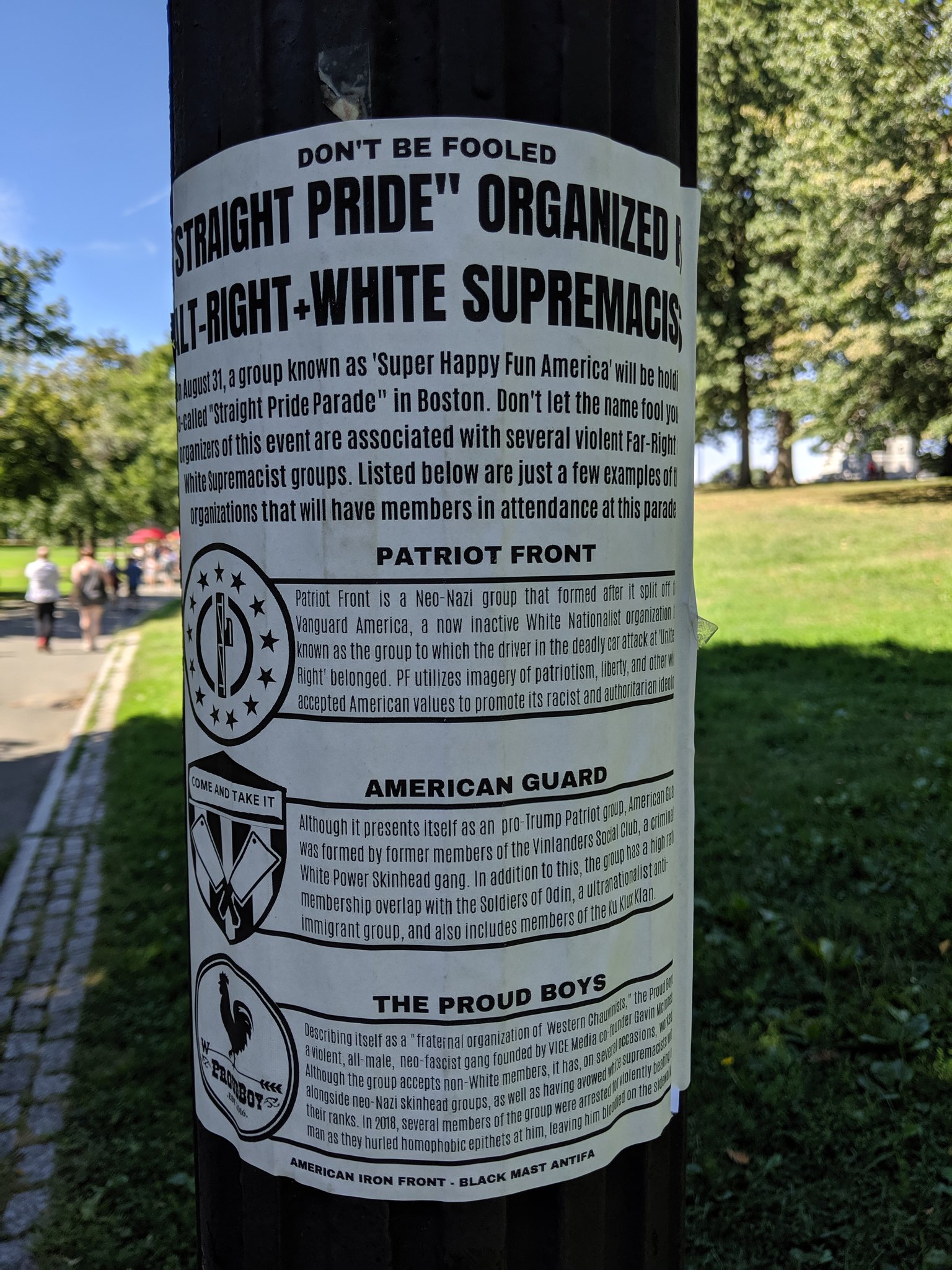
Someone put up these fliers around the parade route in Boston.Since I opined on this whole topic just a few days ago, I’m not sure if I want to say more. Other than to point out that the so-called Straight Pride Parade’s grand marshal, Milo Yiannopoulos, should only be remembered for when he cheerfully explained how beneficial it is to gay boys to be sexually molested by adults.
I realize the purpose of the event is to troll and get attention. But the old adage about not feeding the trolls is just like the useless advice that some adults give bullied kids: if you don’t react, they’ll stop bullying you. That advice is useless because the bully gets just as much enjoyment from the laughter of the bystanders as he does from any reaction of the target. So ignoring them completely isn’t what works. We have to counter lies with truth. But I don’t need to repeat myself, especially when this article explains why straight pride isn’t needed: On Eve of Straight Pride, Equal Rights Group Debunks ‘Heterophobia’.
In other news: Another Ex-Gay Torture Leader Denounces Movement. It’s a story some of us have heard a thousand times: bullied gay kid growing up in a religious family tries to pray his gay away, becomes involved in an ex-gay ministry, leads a double life pretending to be straight while secretly pursuing illicit relationships, and now he wants to apologize and admit he was gay all along.
Except McKrae Game didn’t just become involved in an ex-gay ministry: he helped found one, and did a lot of the (hypocritical) counseling himself.
Listen, I do feel sorry for Game’s younger self. I get it. I, too, was raised in Southern Baptist churches. I was teased and bullied at school and at church as a child because people thought I was gay. I prayed and cried and pleaded with god for years. And also, similarly to this guy, when I confessed to a good friend (who happened to be a young woman) that I thought I might be gay, I let myself be talked into giving a different orientation a try. Yes, I got married to a woman and then eventually divorced and came out.
So I certainly understand the sort of self-destructive toxic self-loathing that drives a queer person to try not to be queer.
But…
I never claimed to be straight. The lie I tried to live for a few years wasn’t much better, because I wasn’t bisexual any more than I was straight. But I didn’t try to tell other gay people that they could be cured. I didn’t found an organization that wouldn’t just spread that lie, but would sell the lie to other struggling queer people.
And maybe I just lucked out in that the first person I confessed my fear aloud to wasn’t anti-gay. Maybe I just lucked out that the attempts by family and church to intervene in my teen life weren’t as forceful and sustained as one of my cousins was subjected to.
But the thing that I keep coming back to with guys like McKrae Game is: it became his job to do this harmful and ineffective “treatment.” I said some pretty shitty things when I was a teen-ager and younger, trying to deflect people’s suspicions. I owe some people that I will likely never see again apologies for that.
But this guy charged the people he was lying to. Like other ex-gay leaders, he made people pay him for the lies he was telling. And some of those people killed themselves because praying didn’t make their feelings go away.
In the article he seems to understand that:
“Most people in the gay community have treated me ridiculously kind,” Game said, “liking me for me now and not who I was. And I hope they just give me the chance to talk to them so I can hear them out and apologize.”
Game said he realizes that for many an apology won’t be enough. And that he’ll likely be apologizing for the rest of his life.
Yes, yes he will.
Enough about that. Let’s close with this bit from June, when Stephen Colbert commented on the Straight Pride when the group first applied for their permit:
Stephen Colbert: What The ‘Straight Pride’ Parade Won’t Have:
This is not a movie. Photographer Jasper Reyes took the picture of part of the demolition of the Alaska Way Viaduct here in Seattle. (Click to embiggen)I really can’t believe that it is Friday! The last Friday in August. So summer is winding down. And this weekend is a holiday. Yay!
But first, I have to get through another impossible deadline at work. One the plus side, while I was compiling this I was also watching the Seahawks win the final game of the pre-season. Which was fun. Even if the gane doesn’t count.
So, welcome to the Friday Five. This week I bring you: the top five stories of the week, five stories of interest to queers and our allies, five science stories, five stories about a hopeful future, five stories about why we should impeach someone already, and five videos (plus things I wrote and notable obituaries).
If you search the web for the history and definition of cyberpunk, most places will tell you it is a dystopian sub-genre of science fiction which came into being in 1983 when Bruce Bethke published a short story by the name. Most definitions of the subgenre focus on a society controlled by computers and cybernetic technology. But I think a better definition is stories in which the main characters are marginalized and/or alienated, living on the edge of a generally dystopic society, where daily life has been transformed in invasive and sometimes grotesque ways by rapid technological change—a world where everyone’s access to information is controlled (usually by moneyed interests who in turn don’t realize the information and technology are controlling them) and information about individuals is used against them. These are the themes common across works that most people agree are cyberpunk.
Because cyberpunk was identified as a sub-genre in the 1980s, computers and their possible misuse figured prominently in early works. As computers became more ubiquitous in the real world, later works have tended to focus on the products of all the information technology. The hallmark of cyberpunk is stories which show that despite technological advances, the quality of life has degraded precipitously. Cyberpunk protagonists face off against the dehumanizing forces of technology, trying to reassert the worth of human imagination and connections.
Neuromancer by William Gibson (published in 1984) is said to be the first cyberpunk novel. Although other people have argued that Philip K. Dick’s 1968 novel, Do Androids Dream of Electric Sheep? is a contender for the first cyberpunk novel, even though it was written years before the term cyberpunk was coined. And clearly one of the themes of that book is that we must understand how technology encroaches on life in order to understand what technology is, and that is a very cyberpunk notion. There is certainly no doubt that the movie based on Dick’s novel, Blade Runner is cyberpunk, which could be another argument in its favor.
I am quite happy to include Do Androids Dream of Electric Sheep? within the sub-genre of cyberpunk, but I don’t believe it was the first cyberpunk novel. The first cyberpunk novel was written 114 years earlier than Dick’s novel, and 130 years before Gibson’s. The first cyberpunk novel was published in 1854, written by none other than Charles Dickens. It was a novel called Hard Times — For Our Times. I recognize that this seems an extraordinary claim, but bear with me.
Hard Times is not one of Dickens’ most famous works. It is one of the shortest novels he wrote. And unlike many of his more well-known novels, not a single sub-plot has any humor in it. Some characters get happier endings that others, but no one gets a classic happy ending.
The book is set in the fictitious industrial town of Coketown. The story opens with one of the villains of the piece, Mr. Gradgrind, a school board superintendent, quizzing a young woman (Cecilia Jupe) at the school about the definition of a horse. When Ceclilia describes it as a magnificent creature, he berates her for not knowing the zoological definition. Gradgrind is convinced that all education should be facts, only facts. Gradgrind lays out his belief that all of life can be understood if you simply know the facts and averages, and that things such as art, music, or imagination are wastes of time. Later in the book we will learn that Gradgrind has named one of us own children after Rev. Thomas Malthus (famous for writing about overpopulation problems and tangling his mathematics with his moral philosophy), which I think is telling.
Another important player in the book is Mr. Bounderby, a wealthy mill owner who is the employer of many of the other characters in the novel. Bounderby and Gradgrind are friends and business associates. Bounderby wants to marry Gradgrind’s daughter, Louisa, even though she is more than 30 younger than he. Bounderby is also big on numbers and calculations—he makes all his decisions—both business and personal—based on cold facts and numbers. We also learn that Bounderby is the sole shareholder of the only bank in Coketown. As the plot of the novel develops, it turns out that Bounderby has financial ties to just about everyone in the city.
Much of the plot concerns itself with the toll that factory work takes on workers and their families, which we mostly see through the eyes of Stephen Blackpool, one of the workers. Dickens portrays the dehumanizing effects of industrialization, particularly when the same people who own the means of production also control both the flow of capital and information. He also has a subplot about an attempt by the mill workers to unionize. Unfortunately this is the weakest subplot of the novel, because Dickens didn’t seem to understand how unions work.
A driving force of many of the subplots is Bounderby’s network of spies. He uses his financial power over people to force them to spy on their neighbors, families, and co-workers, and report to Bounderby so that, for instance, he can prevent the workers unionizing.
So, how does this map to my definition of cyberpunk?
All the sympathetic characters (Louisa, Cecilia, Stephen) are marginalized in various ways, either because of their economic status or because their lives are under the control of others because of their gender or familial dependent status. Coketown is definitely a dystopia, and many aspects of the various social and economic forces he describes are worse than actually existed at the time of writing, so it can be argued it is a near-future dystopia, at that. Many of the difficulties and challenges the sympathetic characters face are because of the invasive way the industrial revolution has disrupted social norms. The quality of life has degraded significantly, and many characters remember relatively recent times when things were better. Between them, Bounderby and Gradgrind control what information most of the inhabitants of the town have access to. Bounderby actively uses information he gathers through is spies to blackmail or otherwise harm characters who don’t do as he wishes.
In short, the protagonists face off against the dehumanizing forces of technology, and at the end, only those who have been able to reconnect with human connections, emotions, and imagination get a sort-of happy ending.
Dickens doesn’t explicitly say that the tale is set in the near future, even though I argue that was his intent. He’s clearly trying to show where the utilitarian philosophy that was becoming prevalent among the movers and shakers of his time will lead. But if that isn’t enough to make you think of this as, at least, proto-science fiction, there is also Bounderby’s obsession with numbers and calculations. What Bounderby is talking about when he says he makes life decisions based on numbers and calculations sounds an awful lot like an algorithm. And what are computer programs but algorithms? The way he explains his philosophy to Gradgrind at one point would not sound out of place coming from a character in one of Isaac Asimov’s stories involving psychohistory (Foundation, Foundation and Empire, Second Foundation, et cetera).
The dehumanizing aspects of technological advance is a theme that shows up in later works by Dickens. His last completed novel, Our Mutual Friend similarly warned against the loss of humanity to the cold demands of industrialization.
The way we think of genre now wasn’t how writers, readers, or publishers thought of stories in Dickens’ time. Dickens didn’t think of his Christmas ghost stories, for instance, as being a different kind of writing than his less fantastical ones. I know I’m making a stretch, here, but I think it is useful to try to look at stories—new ones we love today, and those that came before—from new angles. Cyberpunk’s core is the negative impacts of technology on individuals and society—cyberpunk is always about a dystopia. Whereas steampunk, despite having a similar name, at its core is optimistic.
Given that contrast, this particular novel, and several others Dickens wrote after, falls more clearly on the ancestral tree of works such as Neuromancer and Blade Runner than Boneshaker or Morlock Night. Maybe what Dickens wrote wasn’t cyberpunk, but I feel quite safe calling him one of the grandparents of cyberpunk.
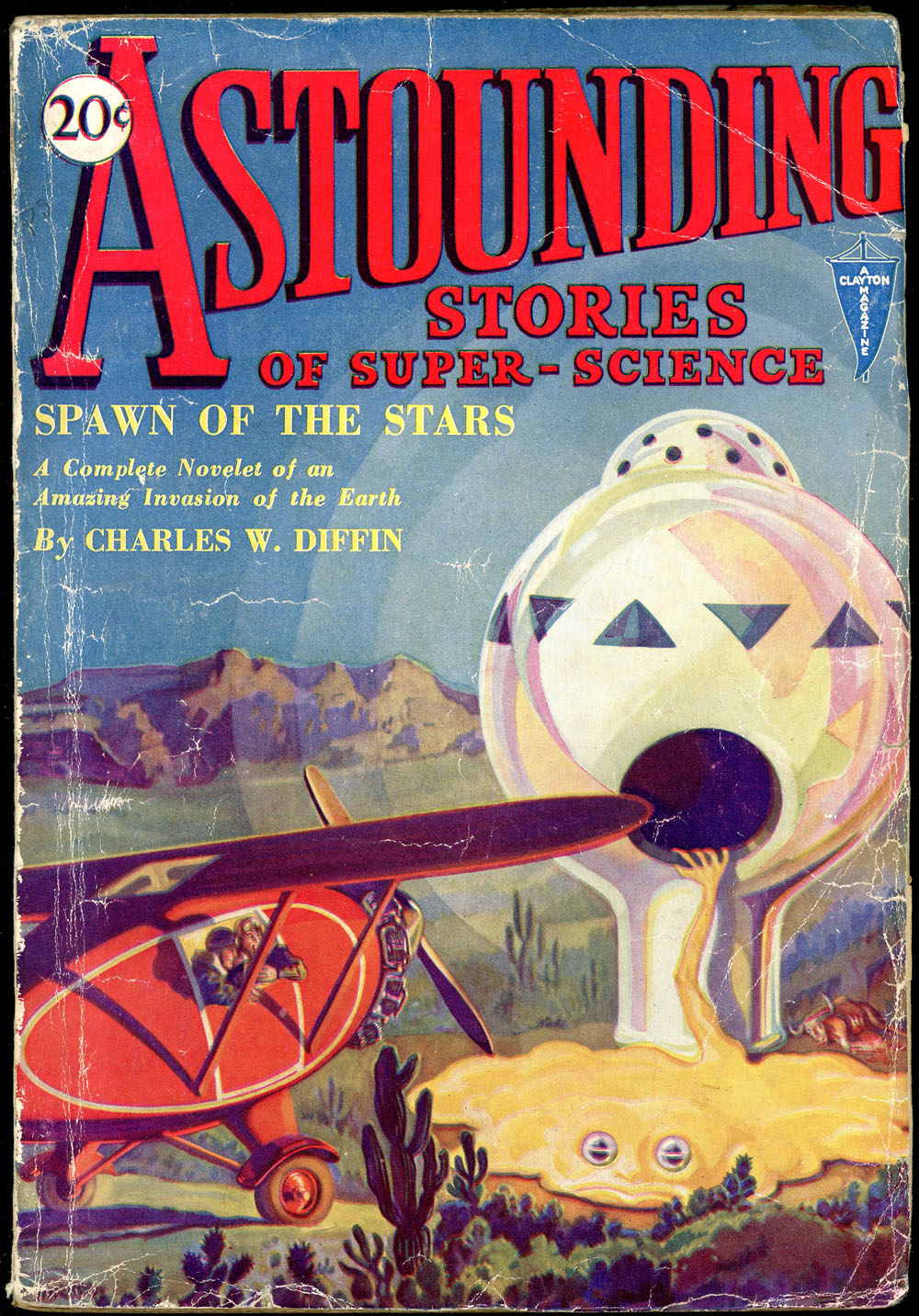
The February, 1930 cover of Astounding Stories of Super-Scinece, cover art by H. W. Wesso. In 1930 the magazine’s editor was Harry Bates.Just last week I commented on the kerfuffle in sci fi fannish circles about how problematic some of us think it is to have one of our major awards named after an extremely racist (and misogynist, classist, xenophobic, anti-democracy advocating authoritarian) and long deceased editor. I only linked to a fraction of the commentaries and arguments posted online since the acceptance speech that kicked this off. And while the kerfuffle has raged on there has been a very significant development: A Statement from the Editor.
As we move into Analog’s 90th anniversary year, our goal is to keep the award as vital and distinguished as ever, so after much consideration, we have decided to change the award’s name to The Astounding Award for Best New Writer.
So, Dell Magazines has decided to rename the award. They pledge that the award recipients will continue to be selected in the same way as before, and pledge to work with WorldCon going forward to implement the change. This might seem like really swift action on the company’s part, but another article published just the day before this announcement, the current editor is quoted as saying that he has been having this conversation within the company since shortly after he read an early draft of Alec Nevala-Lee’s book about the Campbell era: Astounding: John W. Campbell, Isaac Asimov, Robert A. Heinlein, L. Ron Hubbard, and the Golden Age of Science Fiction.
As many people have pointed out, there have been previous op-eds, letters, and even petitions suggesting changing the name of the award, so it is hardly a new idea.
This decision has been no less controversial than the aforementioned speech. And I find it particularly amusing that one of the arguments being put forward by people who don’t want to change the award’s name is that changing names is bad and it somehow erases history.
This argument is particularly amusing in light of both an award an an editor tied to the magazine formerly known as Astounding.
When the magazine just began publication in 1930, the full title was Astounding Stories of Super-Science, as you can see by the image of the ‘zine’s second issue included above. A few years later, the title was shortened to Astounding Stories. Then, shortly after Campbell took over as editor, he renamed the magazine Astounding Science Fiction, which is the name it operated under until 1960, when Campbell changed the name to Analog Science Fact & Science Fiction.
That last name change was handled in an interesting way, graphically. For a few months both the name Astounding and Analog could be seen, with Astounding fading more and more each month. There was also a lot of variation with the rest of title, sometimes appearing as Science Fact & Fiction, sometimes Science Fact/Fiction, and sometimes with the ampersand or slash replaced by a glyph that looked like an inverted U with a line through it which Campbell said meant “analogous to.”
Which gets us to another faulty argument being made against the new name: calling it the Astounding Award still makes the name honor Campbell, and why isn’t that problematic? First, Astounding was published for seven years before Campbell became editor, and the previous two editors weren’t quite as ideologically driven in their story choices as Campbell. Second, Campbell was the one who wanted to stop calling the magazine Astounding all along. And third, while Astounding is one of the names of the publication in question, it’s also an adjective which is a synonym for wonderful or amazing.
Based on a lot of comments I’ve seen from the irritated ones, most of them don’t actually know that much about Campbell. They certainly haven’t read any of his notorious editorials. I suspect that for most of them, they know that he published Heinlein and Asimov and the like—and I suspect they haven’t read many of those author’s works, either. Campbell’s sort of a Rorschach test in that way: they see what the want to see. And frankly, the main thing they know is that those darn Social Justice Warriors and uppity people of color and decadent queer fans are critical of Campbell, therefore he must be defended at all costs no matter how illogically.
I didn’t start regularly reading sci fi zines until shortly after Campbell’s death, and even then, the magazines I preferred were Galazy and The Magazine of Fantasy and Science Fiction. Most of what I knew about Campbell in my early years came from the autobiographical bits that Isaac Asimov included in his anthologies (especially The Early Asimov) but even Asimov’s portrayal of him did not ignore some of Campbell’s eccentricities and flaws.
I recall Asimov seeming least happy about Campbell’s insistence that if aliens appear in a story, they absolutely must be shown to be inferior to humans in some way. It so bothered Isaac, and Isaac felt that he owed Campbell first shot at any of his stories, that Asimov simply stopped writing aliens at all. Asimov’s future history galaxy-spanning society was inhabited by humans and their robots and that was it.
Campbell had a lot of other rules about stories that pushed the field of science fiction into a specific idealogical corner. One in which rich, white, aggressive men were always on the top of the heap, and where the working class, poor, less educated, and women and people of color were always on the bottom—and always in need to the leadership of the folks on top.
For all that Campbell is often regarded as a proponent of keeping science in science fiction, one has to note that Campbell meant physics and chemistry. Sciences such as geology, paleontology, anthropology, linguistics, and sociology weren’t part of the Campbellian vision.
Society changes. Our understanding of the universe and our place in it changes. Science fiction as an art form and the fannish community of Campbell’s peak years wasn’t very welcoming to women, queer people, people of color. Yes, there were always fans and creators within the sci fi community who came from those other communities, but it was clear that we weren’t meant to be heroes. That our stories never mattered. That our role was always to be supporting characters or sit quietly and marvel at the competence of men like Campbell.
And that’s neither true of the real world, nor is it something an ethical person should aspire to.
So, yes, the name change is a good thing. Because one of the things I love about good science fiction, are those moments that astound me.
Instead of finishing my binge watch of The Boys a glance at twitter is forcing me to update a previous post. Remember how Jerry Falwell, Jr. and is wife decided for some completely unfathomable reason to hand over $1.8 million dollars to be a gay-friendly flophouse in Miami as a gift to provide an income to a hunky pool boy they met at a very expensive hotel (and how they kept flying him around on their private jet)? Well, it turns out he isn’t the only one: Another ‘Pool Guy’? Falwell Jr’s Personal Trainer Scored $2M From Liberty U To Buy A Gym.
I’m just going to pull a few paragraphs from that latter story:
The support Falwell provided to the two young men, Granda and Crosswhite, has some parallels. Both were aided in business ventures and both have flown on the nonprofit university’s corporate jet.
One difference: When Falwell helped Crosswhite, he used the assets of Liberty, the tax-exempt university he has led since 2008. Among the largest Christian universities in the world, Liberty depends on hundreds of millions of dollars its students receive in federally backed student loans and Pell grants…
…As Liberty’s leader, Falwell draws an annual salary of nearly $1 million, and is obligated to put the university’s financial interests before his own personal interests when conducting Liberty business.
“The concern is whether the university’s president wanted to do his personal trainer a favor and used Liberty assets to do it,” said Douglas Anderson, a governance specialist and former internal audit chief at Dow Chemical Co, who reviewed both the transaction and Liberty’s explanation of it at Reuters’ request. That would be bad governance, he said. “At a minimum, the terms suggest the buyer got a great deal and Liberty got very little.”






 Font Folly