Just one of the many cool graphics you’ll find if you click on the first story…It’s Friday! It’s August! How did that happen?
Sunday was the hottest day of the years, and Monday was still pretty bad, but the weather took a turn for the much more pleasant after that. We had drizzle yesterday and today! I’m so happy! I usually do my Friday Five on Thursday night and schedule it to publish in the morning, but I only got it half done because it’s been a crazy week and I decided to binge some things off the DVR. Anyway, only took a few minutes to finish up today.
Let me present to you this week’s Friday Five: the top five (IMHO) stories of the week, five stories of people behaving badly, the top five videos, and a few of notable obituaries (plus my blog posts).
(click to embiggen)Monday evening when I left the office I noticed the slightly smoky or hazy look right away. I thought, at first, that perhaps a big truck with a load of gravel or something had just driven by and left a lot of dust in the air? Or maybe something had blown up a bunch of dirt from one of the several large construction sites near our building, you know. But as I proceeded to do my semi-random walk1, it became apparent that there was a slight haze everywhere, include, when I could see it, on the horizon. This was a bit worrying, especially remembering last year and the long stretch of days when we were blanketed in smoke from region wildfires, turning the sun a scary red, and sending everyone with hay fever and/or asthma into a bad way.
But the closest wildfires I had heard about in the news were in California. Also, since we’ve been in a heatwave, I have been paying attention to weather reports and prevailing wind directions, if for no other reason to pick which direction to aim the fans in the windows at home. And the wind had been coming from the north or northwest very consistently for days, which is the wrong direction to bring California smoke to us.
There was a silver lining to the globe-spanning smoke: it was blocking enough sun to pull region temperatures down by 1-4º Fahrenheit. Given that Sunday was the hottest day of the entire year, even a few degrees of cooling is greatly appreciated!
Wednesday morning while I was waiting for my bus, and then later walking from the bus to the office, I kept feeling phantom raindrops. My weather apps showed 0% chance of rain, and the radar showed nothing nearby. Also, the clouds didn’t look right for rain. At one corner, while waiting for the crosswalk to change, I was looking up at the cloud cover and I figured it out.
It wasn’t clouds. It was June Gloom in August. June Gloom is often a bank of fog on the region which doesn’t look like fog on the crowd, it looks like 100% cloud cover, but the bank only extends a thousand feet or so up. The air is very moist and cool, and water droplets aren’t falling from the sky, but they do occasionally form in the air around you.
And that’s a great feeling after a heatwave, let me tell you!
For the next several days, at least, the daily high temperatures are forecast only in the 70s, which is much more pleasant than we’ve had for a while. And we’re supposed to get some rain. I don’t know if it will be enough to get the creek and river levels back up from their current very low levels. And the long term forecast has some high 80s again next week, so we aren’t completely out of the woods, yet.
But I’ll gladly take several days of normal temperatures and a little rain.
Footnotes:
1. Since home is now too far from work to walk home, in an effort to replace that lost exercise, I set me watch to an open-ended outdoor walk, and walk around downtown, letting whichever crosswalk is showing WALK when I get to each corner2, until the watch says I’ve walked a mile, than I turn and head toward the bus stop.
2. I say semi-random above because, for instance, the first three blocks are not random. I walk straight up the steepest hill three blocks until I get to the mostly-flat part of downtown. And there are two major thoroughfares after that which I treat as bounding boxes. If I hit either of those and the crosswalk is green, I don’t cross, but instead circle the block and head back.
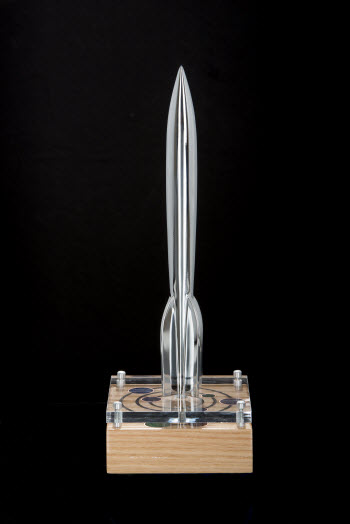
The 2016 trophy, awarded at MidAmericaCon II, designed by Sarah Felix. photographed by Fred Teifeld.In some previous years I posted my ballot (or some other indication of my choices) on the blog, in part because some followers had asked me to. But this year was difficult in the most wonderful ways. I kept fiddling with my choices in all of the categories because so many of the nominees were so good. I really enjoyed all the stories that I read (the fact that a bunch of works and creators that I nominated made it in various categories didn’t hurt this year). Still, between all the categories there are 114 nominees, and out of that whole bunch there is exactly one that I didn’t think deserved the award.
So, to re-iterate, the hardest part this year was picking which things to put in first place in each category, since I thought pretty much everything this time around was award worthy.
Technically I still have several hours after this post will publish when I can go back in and move things around on my ballot, but I really think I need to stop dithering and just leave it.
Two categories that I almost always decide on last are the Editor, Long Form, and Editor, Short Form. For short form, usually if I recognize which publication an editor worked on, and I’m familiar with it, I feel confident I can rank them. It’s when I don’t know the publication well that I feel a little less certain.
Editor, Long Form is easy if, like this year (and as I recall last year) every nominee provides a list of all the books that they worked on that were published in the year under consideration. Then I have something to judge them on. This category was previously one of the hardest for me in the nominating phase, until I read a suggestion on someone’s blog: look at the list of the books you’ve decided to nominate, go to the publisher’s web site for each, and find out who the editor of that book was.
I’m kicking myself for not thinking of this during the nomination phase with regards to professional artist. If a book that I know is eligible has a great cover, I should nominate that artist. So, next year I hope to have more than one nominee in that category!
Anyway, it’s been a fun couple of months reading the stuff that made the ballot. Now that I’ve finished my voting, I can go back to reading other things in my big to-read pile!
(Click to embiggen)It’s Friday! Already the fourth Friday in July.
Another week of hotter than normal temps here, which we’re managing to get through, but I’m spending a lot more time sitting out on my veranda after dark sipping tea or ice water or LaCroix or gin & tonic…
But enough about us. Let me present to you this week’s Friday Five: the top five (IMHO) stories of the week, five stories of people behaving badly, the top five stories concerning queer people, the top five videos, and a few of notable obituaries (plus my blog posts).
I need to do a bit of a follow up to my previous post about the issues at Worldcon. I didn’t touch on everything that happened, and since the issue blew up, Mary Robinette Kowal, whose tweet from years ago on a related subject I quoted in that post, has agreed to help redo the programming. Kowal has been running the programming tracks at the annual Nebula conferences for a while, and she had posted a nice summary of their process for trying to put together a program that appeals to many parts of the community. So many of us are provisionally hopeful that the situation will be a bit better at the actual convention than they appeared just days ago.
I have also been reminded that sometimes it is difficult to tell the difference between ignorance and actual malice. Now, I was thinking that most of the bigotry that seemed to be motivating the issues were likely unconscious—all of us are often unaware of just how many prejudices we have absorbed from society. Alis Franklin, in particular, has pointed out another explanation for much of the problem:
“This all feels very much like people used to running a small-town parochial con with an established member-base suddenly getting in a twist because they have to accommodate (gasp) outsiders.”
And she’s likely on to something. A lot of this does sound like the people in programming are speaking from their past experience running their local convention, where they believe they know their audience and what those attendees expect. But even if that is the case, I still suspect that their local crowd includes a lot more queers, people of color, and other folks who are interested in topics that their local con doesn’t recognize in programming—because as I said, we’re everywhere, and we’re all used to being excluded and dismissed; so much so that when we raise an issue and are shut down, we often just hold our tongues thereafter.
On the issue of the one pro whose submitted bio was edited to change all of eir pronouns to “he” and “him”, and the insistence for a few days that this was a bio taken from the web (when no one can find such a bio and they can’t provide a link), that gets into the conscious versus unconscious bias. Either the person who copied the bio was simple too ill-informed about non binary people and nontraditional pronouns, and simply assumed it was some kind of extremely consistent typo (which I think is a stretch), or they’re one of those people who balk at pronouns to the point of refusing to use any they don’t agree with and decided to change the bio and then claim it was a mistake if they were called on it.
I don’t know if the same staffer is the one who decided not to use another pro’s usual publication bio and photograph, and instead write a different bio using information that usually was not released publicly and use a photo taken from the pro’s private Facebook. In any case, it is difficult to construct an “honest mistake” excuse for that one. And if it is the same staffer, I think that is more than adequate proof that the changed pronouns on the other bio was an intentional aggression.
In several of the discussions online I’ve seen a lot of people not understanding what the problem was with requesting semi-formal wear for the Hugo ceremony. Foz Meadows summed it up better than I did:
”…the fashion at the Hugo Awards ceremonies tends to be a welcoming, eclectic mixture of the sublime, the weird and the comfortable. Some people wear ballgowns and tuxedos; some wear cosplay; others wear jeans and t-shirts. George R. R. Martin famously tends to show up in a trademark peaked cap and suspenders. Those who do dress up for the Hugos do so out of a love of fashion and pageantry, but while their efforts are always admired and appreciated, sharing that enthusiasm has never been a requisite of attending. At an event whose aesthetics are fundamentally opposed to the phrase ‘business casual’ and whose members are often uncomfortable in formalwear for reasons such as expense, gender-nonconformity, sizeism in the fashion industry and just plain old physical comfort, this change to tradition was not only seen as unexpected and unwelcome, but actively hostile.”
I also note that a few days ago Mike Glyer posted a link to a letter from decades back from E.E. “Doc” Smith (the author of the Lensmen books, among others) when the 1962 WorldCon asked for all the ladies attending the award ceremony to wear long formal gowns. Smith commented that his wife had not owned formal wear since entering retirement and thought it was unreasonable to expect people to go to such an expense.
Which is a nice segue to this: until the 34th WorldCon (MidAmericaCon I, 1976 in Kansas City, Missouri) the Hugo Awards were given out at the end of the convention banquet. The banquet consisted of eating (obviously) while the guests of honor gave speeches. Fans who couldn’t afford the extra expense of the banquet were allowed in (usually in a separate area such as a balcony) for the awards portion. The awards ceremony was separated from the banquet in 1976 for a couple of reasons, but one was to make it easier for everyone who wanted to attend to do so. The conventions had gotten so large that the fraction who wanted to see the award ceremony was too much for the banquet halls of typical convention hotels to accommodate, and there had always been the problem of people who couldn’t afford the banquet ticket. I wanted to close with that because I have seen a number of people arguing that the people who are feeling unwelcome because of this con’s actions are making unreasonable demands to change traditions of the conventions.
The traditions change over time for many reasons. It isn’t about change for the sake of change, it is change of the sake of practicality and realism. People have, in the past, believed that science fiction and fantasy was only created by straight white guys, and was only loved by other straight white guys. That has never been true, but the illusion was maintained through a variety of societal forces and some willful ignorance. It has become increasingly difficult to maintain that willful ignorance, and besides, ignorance is never a good look on anyone. It’s not about whether fandom is diverse, it is about to what lengths some people are willing to go to ignore, silence, or push out that diversity.
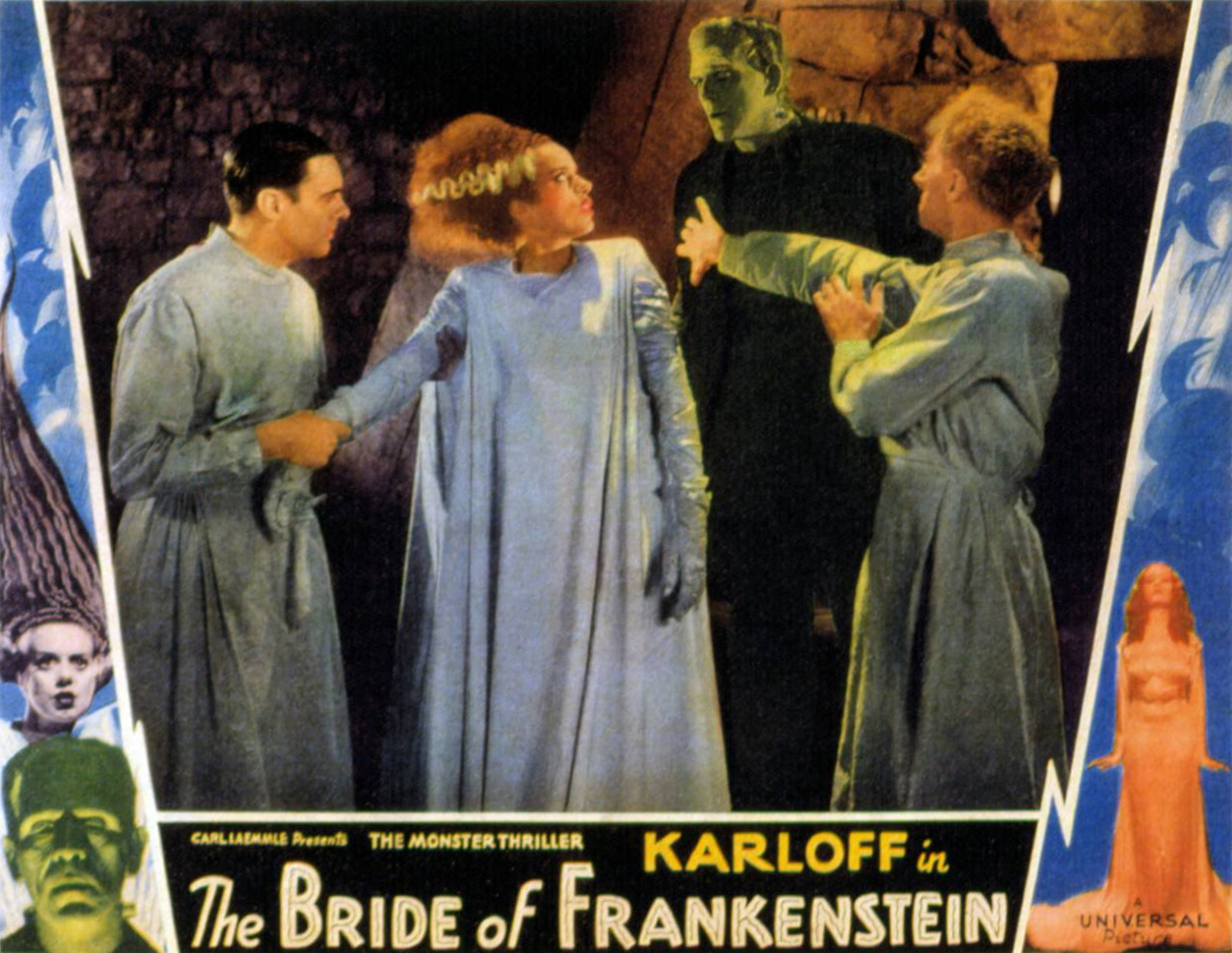
James Whale who directed Universal’s Frankenstein in 1931 and Bride of Frankenstein in 1935 was an openly gay director in the 20s and 30s, just one example of a queer person who created classics in the genre. The movies were adapted from the book Frankenstein written by Mary Wollstonecraft Shelley, a woman, who is credited with creating the science fiction genre with said book.So a problem that had been brewing for a while with this year’s WorldCon came to a head this weekend. There had been hints and rumblings. I’d heard that many pros were mentioning having problems communicating with some members of staff. Then there was the request to all the Hugo nominees to wear semi-formal wear to the award ceremony, so it would be “elegant and professional looking.” That one rang alarm bells for me because almost everytime I’ve ever heard anyone use the term “professional looking” it was a dogwhistle for everything from “please don’t be obviously gender non-conforming” to “please don’t look like the kind of person who can’t afford a bespoke suit” to “please don’t dress ethnic” and so on—in other words, trying to enforce some homogeneity.
So how things came to a head: a professional writer who has been nominated for a Hugo this year was told they weren’t going to be on programming because “there is a kind of creator who appeals to Hugo nominators, but are totally unknown to convention attendees.” The email also managed to misgender the pro and… well things went downhill, after the pro and their spouse posted some of this information online. The programming people contacted the spouse, asked the spouse to convey their apology and expressed disappointment that they went public instead of handling this privately.
And that prompted many many other writers and creators to come out of the woodwork, posting their own many attempts to deal with similar issues (such as, “why did you discard the bio my publisher sent you, and pull information from my private Facebook account instead?” “What do you mean that people like me aren’t of interest to convention attendees?”)—indicating that a whole bunch of people had been trying to address this privately to no avail.
Only when it became public and dozens of authors who were on the programs wrote in to either withdraw, or at least suggest that other, newer, less well known writers could take their place on some panels, did the con chair issue a real apology (there had been a “we’re sorry if anyone’s offended” style non-apology the night before).
Because the thing is, the people who were being excluded weren’t just new writers to the field, it was overwhelmingly the queer creators, the non-white creators, and the women creators. And at one point, the programming person explicitly said, “Do you expect a WorldCon to be like WisCon?” WisCon being famously more feminist-friendly and queer-friendly than most other conventions.
Other people have written about this situation, and probably better than I, but there’s a part of this whole thing that just really presses my buttons, and it aligns with a theme I’ve written about many times on this blog: to wit, queer people, trans people, people of color, women, and people of many religions and cultures have been fans of sci-fi/fantasy (and created sci-fi/fantasy) for as long as it has existed. We aren’t new. We aren’t exotic. We aren’t fringe or band-wagoners. We’ve always been here, we just have seldom been allowed to be visible. As Mary Robinette Kowal observed at least four years ago:
“It’s not about adding diversity for the sake of diversity, it’s about subtracting homogeneity for the sake of realism.”
—Mary Robinette Kowal
Let’s go back to the explanation that was being given before the backlash forced them to scrap their programming plans and start over: “There is a kind of creator that appeals to the Hugo nominators who is not known by the convention attendees.”
I have at least three responses to that:
First, nominators are attendees. In order to nominate for the Hugo Awards and in order to vote for the winners, one must purchase a membership to the convention. And you know who else are attendees? The pros who are coming to the con that the con com doesn’t want to let on the program. Sure, not every attendee participated in the nomination process, and not every one of them nominated ever finalist, but some fraction of the attendees did. And the number of people who nominate is more than large enough to be a statistically significant sample of fans. So it is an entirely misleading and useless distinction to try to draw between attendees and nominators.
Second, this argument is a form of gaslighting. I’ve seen some people compare it to the old TrueFan arguments (and the more recent Real Fan claims from melancholy canines), and those are good comparisons, but I think a better model is the Moral Majority. I know I hark back to that particular group a lot, and I admit I know so much about them because they originated in the denomination in which I had been raised and they came to national prominence literally as I reached legal voting age, so my earliest election experiences included being told again and again that, because I disagreed with them, I was a member of the implied immoral minority.
This is the same kind of argument: “attendees” are implied as being the vast majority of fans, and these majority of fans don’t find “that certain kind of creator” interesting, unlike the “nominators.” The nominators are, by inference, supposed to be viewed as a fringe, extremist minority whose interests can’t possibly overlap with the implied majority. And just as the Moral Majority’s very name contained two lies (they were neither moral nor a majority), this notion that type of fans who are not interested in a “certain kind of creator” must consititute such an overwhelming majority that virtually no programming to appeals to anyone else is worth having.
Third, the majority/minority part isn’t the only form a gaslighting being attempted. Because here’s the thing: in most of the Hugo categories, it is not people who are nominated, but works of sci-fi/fantasy. The authors are referred to as nominees, but technically it is a specific novel, novella, novelette, short story, et cetera that is nominated. But that phrase, “a certain kind of creator who appeals to the nominators” puts the emphasis on the creator and the creator’s identity. In other words, they are arguing that the nominators really didn’t like the specific story, but have chosen the story to fulfill a quota or something.
In other words, the person who made this statement believes that the story nominated doesn’t really deserve to be nominated, and believes that the nominators don’t believe that either. It’s the same racist/homophobic/transphobic/misogynist arguments that the melancholy canines were making. A “certain kind of creator” is a dogwhistle. The nominators may want queer/trans/women/people of color, but “normal” people don’t. That’s what that statement says. And this is why I still fervently believe the person who said that should be fired from the con com.
Fourth, finally, they are arguing that attendees are only interested in seeing creators they already know and love. Completely ignoring the fact that most fans want to both see old favorites and to find new writers/stories/shows/what-have-you that might become favorites. One of my favorite parts of attending conventions are when I am exposed to new authors I’d never heard of before, and new works that I’d never seen. I’m always writing down names of authors and stories and ‘zines and so forth, and then going to look them up after the con.
Many of the authors who are currently in my personal list of favorites, are people who I learned about at a convention panel. Yes, once they become a favorite, I will look for their names in the programming grid and try to see some of their events, but I’m not just there to see the folks I already know.
The conventions where I ran programming were all smaller than WorldCon, but I have run programming at conventions. I know it is hard work. I know it can feel like thankless work. But one of my goals with that programming was to provide convention attendees opportunities to learn new things, to find new artists or writers and so forth that they didn’t previously know about; to introduce the work of many people to new audiences, while also giving fans a chance to see the people whose work they already liked.
If you don’t see that both of those goals should equally drive the programming of a sci fi or fantasy con, then you absolutely should not be working on programming. Go work for a commercial convention where the only point is to sell autographs. Do not volunteer for a World Science Fiction Con.
This cartoon by Herb Block (Herblock) was first published in The Washington Post in 1968. It isIt’s Friday! Already the third Friday in July.
My writing continues quite slowly. I didn’t have a superlong work week this week, though since I worked late into Friday, the weariness bled through the whole weekend and I don’t quite yet feel recovered.
But enough about me. Let me present to you this week’s Friday Five: the top five (IMHO) stories of the week, five stories of people behaving badly, the top five videos, and a couple of notable obituaries (plus my blog posts).
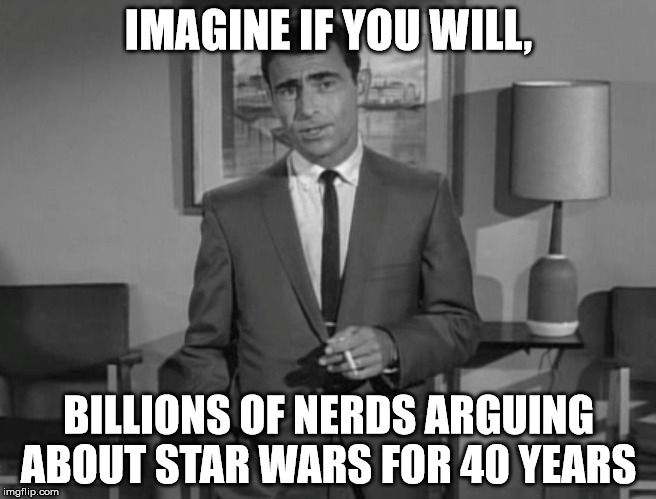
(click to embiggen)I’ve started this blog post many times, but I either find myself wanting to pull my hair out at the mental gymnastics the haters (who claim to be TrueFans) keep putting themselves through to try to make their arguments that up is down and two billion plus one billion equals zero… and I keep giving up. When the craziness first came to my attention, back in those bygone days when the first trailer for The Force Awakens sent them into a tizzy of anger and outrage, I figured it was just an age thing. Right? I was 17 years old when the original Star Wars came out, and I had watched the Watergate scandal unfold and take down a corrupt president a few years before. I understood that the Empire was a corrupt government founded by people who had, at one point, been treated just as any other politician proposing what ideas that some people disagreed with who turned out to be fascists who destroyed the old government, and that the Rebellion was being led by the remnants of what had been the opposition party before all of that. In other words, I understood that every single plot element in the original Star Wars was about politics.
These other folks, who whine and rage about the new movies, I just assumed they were closer to the median age of the typical internet user. Their first exposure to Star Wars had been to see it on a TV at home, possibly when they were too young to remember the first time. It was just something that was always there. Whereas I saw it as a great movie that changed the way the genre was perceived as well as creating a seismic shift in all of pop culture, to them it had always been there. And they had been too young to understand that the word “empire” was inherently political, just as the phrase “rebel spy and a traitor” was also inherently political.
Oh, how naive I was just a few years ago. I hadn’t realized that the problem was much deeper than that.
Before I go on, a few other people have examined in depth a couple of the issues at hand, and rather than try to construct the same analysis, you should go check these out:
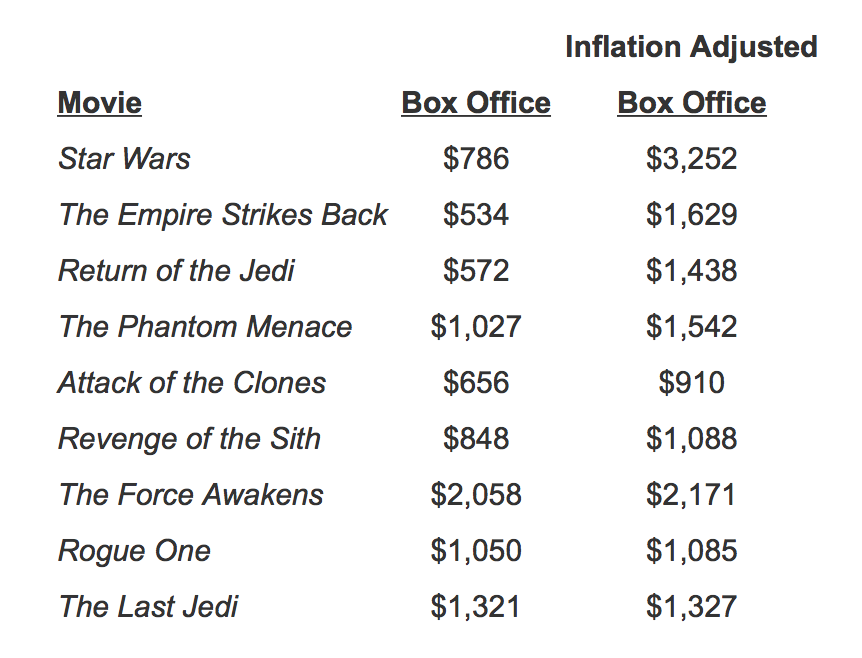
The latter post, by the Aaron Pound, is extremely helpful in this discussion if for no other reason the two tables showing how all of the movies in the Star Wars franchise have done at the box office, and comparing them to other franchises (expressed in millions of dollars):
Please note: when adjusted for inflation, the original Star Wars made three-and-a-quarter billion dollars at the box office—that’s $3,252,000,000! Notice, also, the big drop-off that The Empire Strikes Back suffered, and then how the number went down a bit more for the third movie, The Return of the Jedi.
Now let’s look at the other chart (also in millions of dollars):
Aaron assembled this second chart to show how a single-character movie in a large franchise fares in comparison to the main courses, if you will. The Avengers and its sequels have made a whole lot more money than each single-character movie in the Marvel universe, and so we shouldn’t be surprised when Solo made a lot less money than The Force Awakens. Unfortunately, at least some execs at Disney didn’t understand this, otherwise they wouldn’t have authorized re-shooting almost the entirety of the film, bringing the cost of making Solo up to approximately $250 million (and then spent about $150 million promoting).
For the record, I liked Solo a lot. But I went into it knowing that because it’s a prequel, it will not cover any new ground. They had to show us how Han and Chewie meet, they had to show us how Han wins the Falcon from Lando in a card game, they had to show us the Kessel run. Those beats have to be hit. And because we’ve seen Han’s story play out in the original trilogy and The Force Awakens we already know who the love of his life will be, and he won’t meet her in this movie. Right? And when we meet Han in the original movie, he’s an established smuggler and scoundrel who owes money to at least one dangerous crime lord, so we can expect that this prequel will be some sort of criminal action-adventure movie. Therefore, it is nearly impossible to make this a movie that’s going to blow anyone’s mind.
They delivered a solid heist movie that did show us parts of the universe that the other films have mostly glossed over. It isn’t a bad movie, it’s just the sort of movie more likely to make $400 million than $1 billion, which can’t justify the amount they spent making it.
The angry guys who insist that this is more proof that some how the franchise whose main movies are earning more than a billion each is betraying true fans and so forth, don’t understand how the blockbuster movie industry works, compared to, say, the book publishing industry, or the gaming industry, and so forth. A cadre of true fans can make books profitable, but any group of “true fans” in any genre is simply too small a group to generate a billion dollars in revenue for a single movie.
Because the “true fans,” the kind of fans who argue about the economics of the cloud cities or who are dying to see the back story of characters in the original films are going to number in the thousands, at most. Whereas to make the sort of money that The Force Awakens made, you don’t just need millions of people buying tickets, you need at least 100 million.
And when you consider that the so-called “true fans” who are making this argument are the same guys who are angry that one of the leads of the new movies is a black man, and are furious that the primary protagonist is a woman, and are absolutely livid that another lead character is a chinese woman—well, that just means this is an even smaller fraction of the audience than simply people who are nostalgic for the original trilogy.
And with that belief system, well, it’s clear that they aren’t aligned with the light side of the force, either. That ain’t the force you’re feeling, guys—it’s hate.
Making sun tea on my veranda.A while back I was reading with more than a bit of amusement a conversation on tumblr where some Americans (by which I mean people from the U.S.), specifically some of my fellow southerners, were trying to explain sweet tea to some British folks. There were a few Brits who had spent some time in the U.S. also chiming in. I’m not sure if the most amusing bit was how many of the Brits were scandalized that most Americans don’t own tea kettles, or how horrified they were to learn about southern sweet tea. Southern sweet tea is not the same as tea which has had sugar or honey added. Southern sweet tea is an altogether different phenomenon. Just for a hint of what I mean, there is a recipe for Tea Punch (a different drink, but likely the granddaddy of sweet tea) from shortly after the American Revolution that includes this: “Make a pint and a half of strong tea in the usual way, then pour it boiling over a pound and a half of sugar…”
In the movie version of Steel Magnolias Dolly Parton’s character observes that “sweet tea is the house wine of the south.” Which is true, though there can be weird nuances. For one thing, there are people who disagree about which parts of the country constitute the south. Seriously! I once had a temporary co-worker from Georgia sniff very disdainfully at I and another co-worker after we mentioned that our families came mostly from Oklahoma and Texas, that “those aren’t part of the south, those are in the West.” I have also heard people from North or South Carolina insist the Florida is not part of the south. I’ve been told by one acquaintance who grew up in New Orleans that “N’Orleans doesn’t really do sweet tea!” Whereas a friend whose family comes from other parts of Louisianna once commented after sampling my sweet tea, that I didn’t have nearly enough sugar in it. Some people insist that Sweet Tea states should get their own designation, with arguments about whether the “tea line” encompasses all of Texas, or only East Texas, for instance.
I grew up on sweet tea, and I learned how to make it from my mom and various grandmothers and one grandfather, and each of them had a slightly different recipe. They were all good in their own ways, but they were also very different. Many families guard their sweet tea recipes, sometimes referring to them by names like, “Great Aunt Pearl’s Sweet Tea.” So, before we get any further, I’m going to warn you right now that no, I absolutely will not tell you my Great-grandma S.J.’s Sweet Tea recipe, nor Great-grandma I’s, nor my Nice Grandma’s Sweet Tea recipe nor her Sun Tea recipe (which is a different beast altogether).
What I will do is tell you my Evil Grandmother’s Sweet Tea recipe. One reason why is because she frequently told it to other people outside the family. Another reason is because I don’t think hers was the best, but it will give you an idea of how these go.
My Evil Grandma insisted that Sweet Tea was best made in an aluminum pitcher. She had a 2-quart aluminum pitcher for just that purpose. To make her tea, you fill a whistling tea pot with water and set it to boil. While it is going, you measure out four and a half cups of sugar into the bottom of the aluminum pitcher, then you add a half teaspoon of baking soda. You let the kettle get to a loud whistling, then pour the still boiling water into the aluminum pitcher. Stir furiously until the sugar dissolved, then count out fourteen Lipton flow-through tea bags, put them in the pitcher, stick a lid on it, and put it into the fridge for one hour. Then, take the pitcher out, pull out the tea bags, but make sure you squeeze them so all the dark tea gets into the pitcher. Top off the pitcher with however much tap water is needed to fill, and stir some more (because some of the sugar probably precipitated out). Put it back in the fridge for at least another hour. Now, you can serve it over ice.
Now that you’ve read the one recipe that I am willing to disclose, we can analyze it a bit. Most of the sweet tea recipes I have acquired over the years use tea bags, not loose tea. And very often people have strong feelings about which ones to use. I have seen, for instance, recipes that call for specific brands and varieties of tea bags–specifying X bags of specific brand of black tea plus Y bags of a specific brand of mint tea plus Z bags of a specific brand of orange pekoe, for instance.
I will neither confirm nor deny having witnessed two relatives almost come to blows over an argument about whether an Earl Grey tea is ever suitable for sweet tea (with a third relative opining that Earl Grey is all right in a sun tea as long as you have a few other kinds with it, but really should only go in to sweet tea if you have nothing else).
Why do some recipes include baking soda, you may ask? Tea leaves contain tannic acid which is very bitter. When you steep most teas for more than, say, 2 minutes, you can get a lot of tannic acid in the tea. Some people swear that a small amount of baking soda (which is an alkaline compound and will neutralize an equal amount of acid) mellows out the tannic acid flavor. I’ve also heard people claim that the baking soda helps with dissolving more sugar into the water.
Many recipes specify how to boil the water. There are people who insist the sugar must be in the pitcher that the hot water or hot tea is poured into. Others say that most of the sugar should be mixed with the water as it is brought to a boil.
My Evil Grandma’s sweet tea was very dark, nearly the color of coffee. A lot of people say that is two strong, the tea should have more of a rich reddish color than a deep brown.
Because most of my life has been lived outside of the sweet tea states, I got used to drinking the rather weak and completely unsweetened tea served here. Also, in my late twenties when I realized just how rampantly adult-onset diabetes stampedes through my dad’s family, I made the decision to mostly stop sweetening my tea or coffee. And now that I am diabetic, I don’t make sweet tea ever.
And while we’re on the subject of diabetes, I want to point out that all of the sweet tea recipes from my mother’s side of the family called for way more sugar than any that I learned from Dad’s side, yet Dad’s family is where almost all the diabetes is. So don’t come at me on that.
While I don’t make sweet tea, I still make and drink a lot of tea and have many fond memories of sitting down with friends and family, everyone with a frosty glass of tea, on hot summer days. So the last few weeks, after my husband brought home a one gallon glass jug, I’ve been experimenting with sun tea recipes, based only loosely on my Nice Grandma’s. Put the collection of specific tea bags in the water, set it out in the sun for an hour, then remove the bags and let the jug chill in the fridge. The one thing to remember about sun tea is that since the water is never brought to a boil, it is more susceptible to bacterial contamination, so you want to finish off the whole batch in no more than two days.
It’s not quite the same, but drinking the cold, unsweetened tea that I’ve made this way, brings all those fond memories back. As Fred Thompson observed in his book, Cornbread Nation,
“Sweet tea—your mother’s sweet tea—means you are home.”
I really wish I could blame Camp NaNoWriMo on how little blogging I’ve been doing, but it’s all down to the string of more than 10-hour days as we zero in on yet another ridiculous deadline at work. And now the heat is back, and I don’t deal well when the weather gets hot.
Anyway, here I present this week’s Friday Five: the top five (IMHO) stories of the week, the top five videos, and a couple of notable obituaries (plus my blog posts).





 Font Folly