“Fake Rule: The generic pronoun in English is he. Violation: “Each one in turn reads their piece aloud.” This is wrong, say the grammar bullies, because each one, each person is a singular noun and their is a plural pronoun. But Shakespeare used their with words such as everybody, anybody, a person, and so we all do when we’re talking. (“It’s enough to drive anyone out of their senses,” said George Bernard Shaw.) The grammarians started telling us it was incorrect along in the sixteenth or seventeenth century. That was when they also declared that the pronoun he includes both sexes, as in “If a person needs an abortion, he should be required to tell his parents.” My use of their is socially motivated and, if you like, politically correct: a deliberate response to the socially and politically significant banning of our genderless pronoun by language legislators enforcing the notion that the male sex is the only one that counts. I consistently break a rule I consider to be not only fake but pernicious. I know what I’m doing and why.” —Ursula K. Le Guin, Steering the Craft: A Twenty-First-Century Guide to Sailing the Sea of Story“Dear Mr Radziewicz, I can imagine myself blurbing a book in which Brian Aldiss, predictably, sneers at my work, because then I could preen myself on my magnanimity. But I cannot imagine myself blurbing a book, the first of the series, which not only contains no writing by women, but the tone of which is so self-contentedly, exclusively male, like a club, or a locker room. That would not be magnanimity, but foolishness. Gentlemen, I just don’t belong here. Yours truly, Ursula K. Le Guin”
I’ve written about two of Le Guin’s books that were instrumental in my life: Timebomb from the Stars – more of why I love sf/f and The Original Wizard School – more of why I love sf/f. Please note I said in my life, not just in my understanding of science fiction/fantasy or how to write. Her stories did that, too—but Le Guin’s books were particularly important to teen-age me trying to learn how to be comfortable in my own skin.
As I said in one of the earlier blog posts, she may not have explicitly meant her story to help a queer kid learn to accept himself, but that’s what her tales did for me. Also, every time I re-read one of Le Guin’s books, I notice ideas that she develops in the story that have become such an intrinsic part of how I look at stories, that I have forgotten she was the one who introduced me to the idea. The ideas in her tales weren’t messages that slap you in the face, they are simply a part of the story in such a way that you accept them. They aren’t “Ah ha!” moments, but more like, “Of course!”
I don’t know how to express how heavy my heart is because of her passing. Tuesday afternoon, when my husband got home from work, he asked me if I had been paying attention to the news or twitter, then told me that Ursula K. Le Guin had died, and I just said, “No! Oh, no!” emphatically. It struck me harder than a celebrity death has in a long time. Once I was finished with work, I cued up the audiobook in which Ursula read her own translation of the Tao Te Ching, because I just needed to hear her voice for a while.
I was a little surprised how upset I was, until I read John Scalzi’s column above. I hadn’t realized it, but she was a spiritual mother to me, despite my only ever meeting her at a book signing. And he’s right. It takes time to mourn a mother.
Some days, the best thing a guy can do is shut up and let other people talk. So, without further ado:
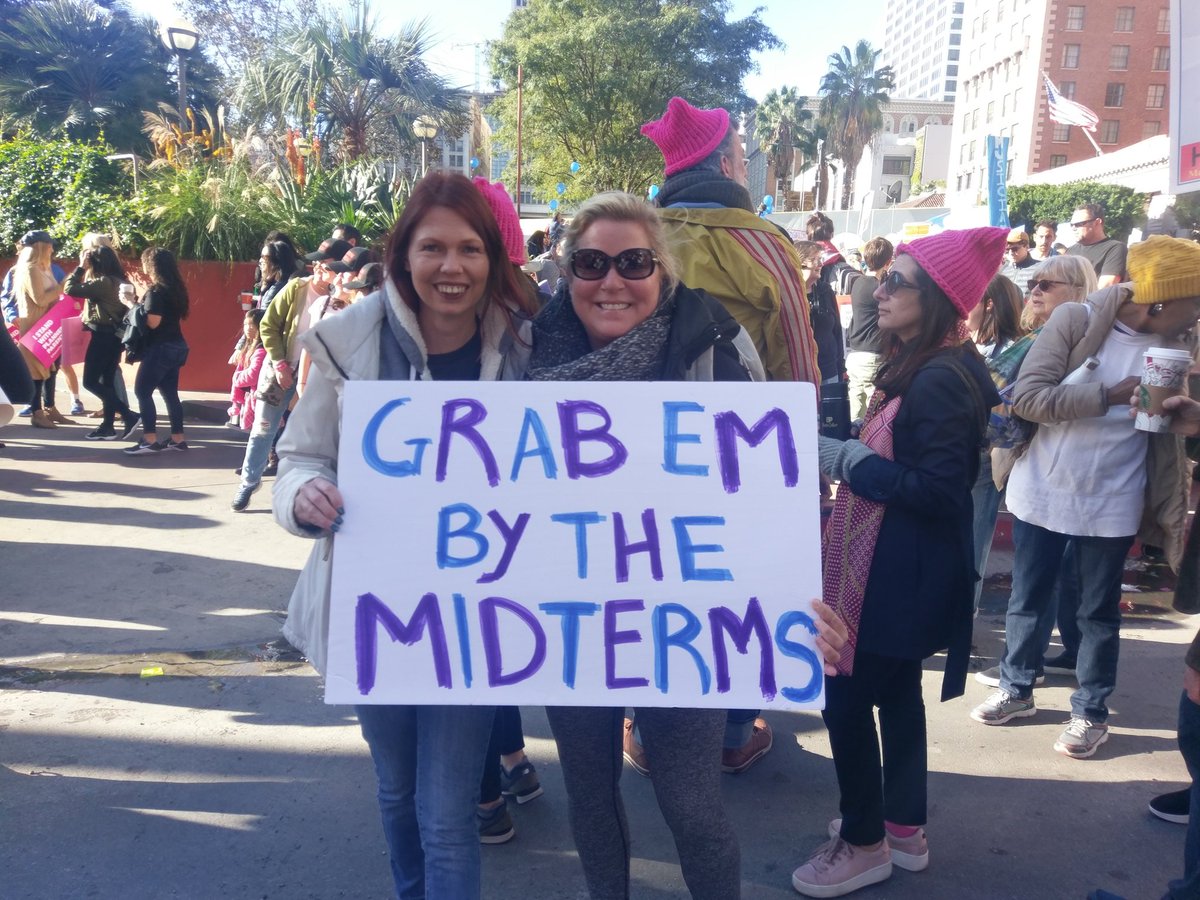
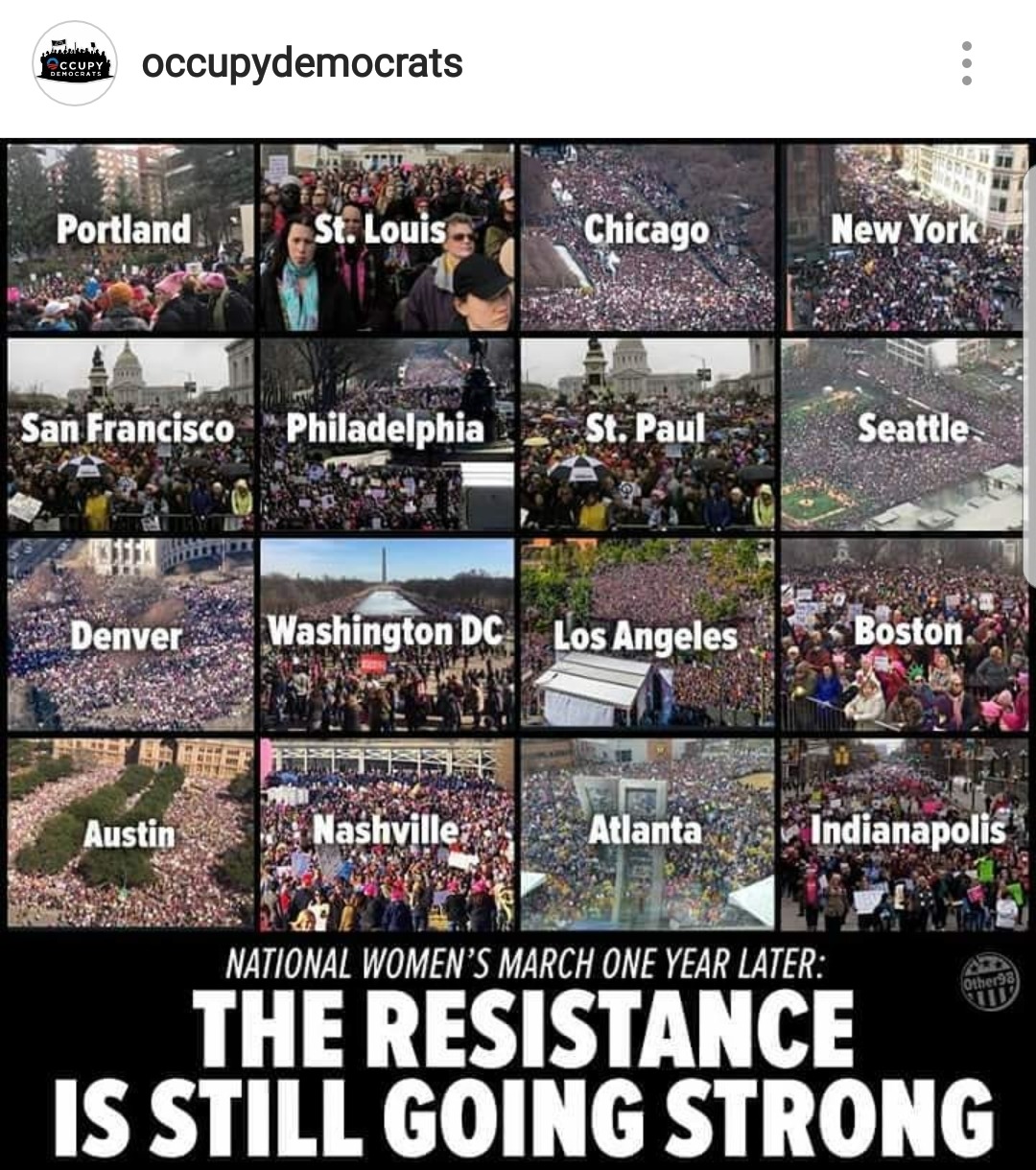
“Never doubt you are valuable & powerful & deserving of every chance in the world.” Little girl’s sign quotes Hillary.“So bad even introverts are here.”“We are the Resistance”“Don’t forget Princess Leia was also a Senator and a General.”“Grab ’em by the midterms”“National Women’s March One Year Later: The Resistance is Still Going Strong.”
“1 year later, 10x more outrage”It seems fitting that the anniversary of the tyrant’s inaugural and the women’s march would coincide with a government shutdown that has come about entirely through the Republicans’ incompetence. They have a majority in both houses of congress, and while in theory the Democrats could filibuster the spending resolution, they haven’t had to, yet, because the Repubs can’t get all of their own people to vote for the bill! It’s just symptoms of the problems ushered in when the tyrant who lost the popular vote slipped through the Electoral College and the white supremacist wing of the Republican base felt free to take off their civil disguises. Now Republicans who would normally be willing to make a deal are scared of being primaried out by angry Trump supporters.
If there’s one thing Democrats and Republicans (some publicly, many others privately) agree on, it’s that the president’s negotiating style has made it much harder for the two sides to reach a deal. Trump has veered wildly from one extreme to the other—telling lawmakers in one meeting that he’d sign any DACA bill Congress sent him, then issuing a list of hard-line demands in the next. His vulgar reference to African nations, among others, as “shithole countries” while rejecting a bipartisan DACA proposal blew up the negotiations at a critical juncture.
Republicans have begged the president to tell them exactly what he’d accept in an agreement and then stick to it. But Trump hasn’t delivered.
I’ve seen people arguing that marches don’t do anything, but they’re wrong. They said that same thing in 1993 about the March on Washington for Lesbian, Gay and Bi Equal Rights and Liberation, because congresspeople who had opposed queer rights didn’t all spontaneously change their minds afterward. But that isn’t the point of these demonstrations. When more the 800,000 queer people trekked across the country to stand up and protest, it did more than send a message. It demonstrated, for one thing, that there were a lot more of us than most people realized. More importantly, it demonstrated to us that we weren’t alone. It inspired hope in the individual queer communities among people who didn’t go. And those that did came back energized and inspired, and they did stuff! We organized new groups. More of us volunteered for local political campaigns. We staffed phone banks, we opened our wallets. We began to believe that if we worked together we could convince the rest of society to come around to our way of thinking. We didn’t have immediate success, but progress noticeably accelerated after that.
Last year’s Women’s March was the first time after the election that I felt hope again. And I’m the kind of person who normally never gives up hope. At a deep, fundamental level my brain does not believe in the no-win scenario, right? But when Trump won the electoral college, all of that crashed down.
Until I saw the hug crowds, vastly outnumbering the inaugural crowd not just in Washington D.C., but in cities all across the country.
There are more of us than they realized. There are more of us than we believed.
It’s from that moment of inspiration that moment such as Run For Something was born. The march inspired people back in their communities to get involved. Not just to wear a pink hat and make protest signs, but to join political action groups, to staff phone banks, to support progressive candidates, and to run for office. We got the dramatically different results in the Virginia elections this year than before in no small part because there were dozens of districts where previously the Republican had run unopposed again and again that finally there was an alternative!
And last year’s march can take credit for that.
“Trump ends first year with lowest average approval rating” – ever!The fact that the tyrant is such an incompetent, creepy, and transparently bigoted cretin is also a contributing factor. I’ve seen a few experts make the claim that White House ineptitude and biases are solely to blame for their failures. But that ignores the fact that what we are protesting is this administrations bigotry and callous disregard for facts or other people, and overarching greed—in other words, their biases and ineptitude. We’re fighting a good fight, and the fact that the opposition is not fighting well is not unrelated. However, there is a lot of fight left to go. We have to keep the momentum going not just in the Congressional election next fall, but in local elections, and continuing to make those phone calls to congress, and showing up at protests and more. But it’s a fight we can win.
I think I might be over the cold. I crossed some tipping point on Wednesday afternoon, the fever went away, most of the symptoms had faded. Thursday morning I woke up feeling fine. So I went into the office—I put in a full day and never hit that wall of exhaustion that happened the previous time I went into the office. I don’t feel 100% well, yet, but I also don’t have anything I can point to as a symptom other than still feeling a little tired.
Enough about that!
Welcome to my Friday Five: Only the top five (IMHO) stories of the week and videos (plus notable obituaries and a recap of my blog posts).
I am, indeed, one of those people who think there is a song from a musical for every situation. Some people consider this a stereotypical gay thing, but I know way more gay people who never liked theatre (musical or otherwise) than do (and there are plenty of straight people writing, performing, or buying tickets to Broadway musicals and the like). Oh, yes, there are arguments made about the kind of misfit who is drawn to the exaggerated and colorful worlds portrayed in musical theatre, and that’s why there are enough queer people into it to create the stereotype. But I think there’s more than a little bit of a chicken-and-egg aspect to that.
Regardless, I have a lot of musical soundtracks in my music collection, along with orchestral scores for my favorite movies and TV shows. And I have been known to surf to TuneFind.com while watching something when a particularly good piece of music is used to accompany a scene in one of my favorite shows, so I can buy a copy of the song for myself. And I’ve blogged before about how I create playlists specifically for certain writing projects.
I’ve had more than one friend comment, upon seeing the list of songs in one of my play lists, “How can you write while listening to songs with lyrics?” First, if a song has wound up in one of my playlists, it’s usually a song I’m already familiar enough with that I don’t have to pay attention to the lyrics to parse the meaning of the song. Even with very voice-forward songs, while I’m writing I’m not processing the music as words, but as mood music.
Second, if a song is fairly new to me—I heard it for the first time, liked it a lot, bought it, and added it to my current writing playlist—I may pause while writing the next time it comes up. Far more likely, I will have heard the song a few more times before I’m next writing because I listen to the playlists at least as often when I’m not writing as when I am. While riding the bus to work, while working at my desk at my day job, while walking in the evening before heading home I’ll be listening to the current writing playlist, in part to get my subconscious working on the story while I’m dong these other things. I’m more likely to be in the mood to be productive on a personal writing project after a long workday if I’ve been listening to a playlist that I associate with the personal writing..
I need to make a small digression about my longer bus commute. I have tried several times to write on this bus route as I used to back on the Route D—the ride’s longer; I should be able to get more writing done! Unfortunately, the other difference is that the physical road seems to have a lot more potholes and irregularities. It’s really annoying, because the bouncing and dipping is pretty much constant. So there I am, holding my phone in my hand with one of my writing apps up but we’re constantly bouncing, so my thumbs keep hitting the wrong part of the screen. I get half a word typed and then get five incorrect letters in a cluster because of a particularly bad bounce, so I try to delete and there’s a bunch of smaller bounces and half my attempts to tap the backspace hit another key near it instead.
I can read (though sometimes that’s a little difficult). I can take notes. But when I’m writing, once my head is in the scene want to just get out this sentence and on to the next and the next. But I can’t get the flow going because of the dang bouncing. I tried to ignore the wrong letters and keep going one time, but I spent way more time correcting the gibberish once I got home and transferred it to the laptop that I realized bus writing is just not possible for most of the Route E.
Which has made the writing playlists take on a new importance. Since it is very difficult to write on the new bus route, what I do instead is listen to the current project’s playlist while either re-reading recently written scenes or going through my notes on the project.
One reason I have writing playlists is because music conveys emotion. It doesn’t just convey emotion, it generates emotion. When we hear a song we know well, it may remind us about a particular event, or a person, or just a time in our lives. And it doesn’t always have to be because we are remembering that song happening to accompany a particular memory. Sometimes a song that was written long after a particular event in your life manages, somehow, to evoke your memory of the experience.
Another reason I have writing playlists is going to sound strange to some. Dialog is, in my opinion, the heart of most stories. Dialog conveys information, and illustrates relationships of the people talking, and gives you a sense of the personalities of each speaker. A good dialog is like music. It isn’t just about the literal or contextual meaning of the words, but also the rhythm. Some phrases flow easily from one’s mouth, whereas badly written dialog will tie your tongue in a knot if you try to read it aloud. For me, listening to music while I write helps me find rhythms. The dialog just works better if I have a good set of songs going.
And another reason that I have writing lists is, I don’t like to write in silence. I can write in silence. But it’s difficult, sometimes. Maybe it’s because during my childhood, when I first started writing (I literally decided that I wanted to be a writer when I grew up at the age of six, and was regularly pounding out page after page of stories on my mom’s Easter Pink Smith-Corono Silent Super typewriter by the age of ten) there was alway a lot of noise. Other people in the house doing things of their own. Dad watching a ballgame in the living room, while my sister was playing in her room and Mom was doing something in the sewing room. And there were often neighbors outside making noise.
“Jazz Hands!”
And for a lot of those years I would be back in my room, with the door closed, tapping away on those keys with the radio playing as I tried to learn the magic of dialog that sounded like real people, and scenes that moved the story along. Sometimes, an especially good song would come up and I might have to stop typing to sing along. And yes, sometimes I got up and danced around my room as I did so. But when the song ended, I’d go back to the typewriter. Giddy with the joy of the dancing, and feeling renewed determination for my hero to save the day.
Songs never mean the same thing to other people. So sharing my playlists probably doesn’t help any of my friends write. Though I have had one or two of them say that they were glad I introduced them to a particular song or artist when I share a list. And I know I have found great new songs when other people share their own lists. But while it may be futile to expect that one of my playlists will effect you the way they do me, I’m going to share four songs from my current novel editing playlist. The full playlist is nearly 60 songs. These aren’t a representative sample, but they are particular favorites. Three of these songs I associate with a specific character in my fictional universe–evoking a particular aspect of their personality, or even expression something that character believes are feels. One of them describes the past relationship between a pair of characters.
Enjoy!
Darling Lili– Whistling Away The Dark (HD) – JULIE ANDREWS :
I have two more writing-related posts half written, one of which I hoped to queue up for Tuesday, but I was cranky, exhausted, and still sick when I got home from work. So I’m just going to whine about feeling sick and how I cope and related things. Which means that this post is going to be, as one friend calls them, a “what I had for breakfast post.” I probably won’t talk about breakfast, but if you’re not interested in just mundane stuff, don’t click through: Continue reading Confessions of a whiny patient→
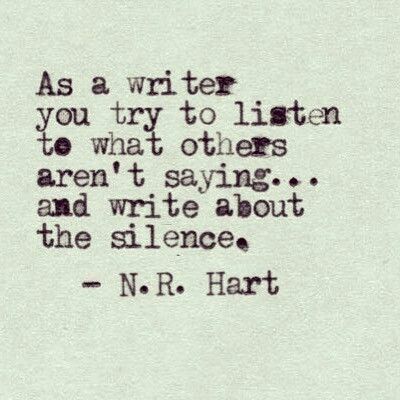
“As a writer you try to listen to what others aren’t saying… and write about the silence.” —N.R. Hart
A few months back James Palmer posted A Message About Message Fiction that hit several of the points that I have tried making before about writing, including the notion that from one perspective, all fiction is message fiction. Which isn’t to say that every story is meant to convey an ideology or convince the reader to accept a particular thesis. Writers, just like all other people, perceive the world via minds that have been molded by a lifetime of experiences; they craft narratives in frameworks built from their beliefs, memories, hopes, fears, and a plethora of thoughts and ideas encountered throughout their lifetime.
A story cannot exist without such a framework.
But seeing the world through the writer’s eyes is not—or should not be—the same as being indoctrinated with an ideology. I’ve seen many people try to make the distinction between message fiction and fiction which happens to have a message. I never found their arguments persuasive, coming to the conclusion that they were talking about a difference without a distinction. I thought I was through talking about this, but then a friend asked a question about metaphors and how you craft them. At the time, I was too busy explaining that that isn’t how my process works (I never plan a metaphor on purpose; other people have to point them out to me in my story afterward) to notice that while he was talking about metaphors, he also expressed the desire to craft a story that didn’t beat a notion over the reader’s head, but rather left them thinking about things afterward. It didn’t leap out to me until I was re-reading our text exchange later, while looking for a link he’d sent me earlier.
That seemed like an important distinction: preachy message fictions delivers an answer, whereas good stories raise questions.
Yes, the way the author poses the question may tilt toward a particular answer, but that isn’t the same thing as insisting on that answer.
I’m a little embarrassed that this particular means of drawing a distinction didn’t occur to me before, because my own writing process has always been about looking for answers to questions. Sometimes the question is, who are these two characters jabbering away in the back of my head? but it’s always a question. If the seventh son of a seventh son is fated to have great luck, what about the seventh daughter of a seventh daughter (or seventh son of seventh daughter, or seventh daughter of a seventh son)? What if a dragon sought redemption? What if a prophet/seer was always right–and she insists that freewill is real? What if a god retires? What if the foretold apocalypse literally can not be averted?
I start with questions like that and then write to try to find an answer. That’s my process, I really am writing to try to find out how the story ends. In longer stories, there is usually a point long before I reach the end where I realize what the ending will be, and then I spend time figuring out how I get from what I have to the end, but I almost never know how a story will end when I start it.
Just because that’s the way I work, I am not saying that that’s the way everyone else ought to write stories. A friend of mine who is also one of my favorite writers usually can’t start a story until he knows the ending. He spends a lot of time thinking about the situation until he figures out how everything will go. That process works for him and creates great tales. But when we’ve talked about his process, he doesn’t talk about metaphors or messages: he talks about actions and consequences, and whether the reader will enjoy the ride. So even then, the focus isn’t on trying to convince the reader to agree with something.
While working on earlier drafts of this blog post, I went back and re-read a lot of the articles and blog posts about message fiction that I had read when wrestling with this question previously. When I examined the specific examples cited in each one, I found that most of those articles that tried to draw a distinction between message fiction and fiction with a message really were just constructing rationalizations to commend messages they agreed with and condemn the messages with which they disagreed. So my earlier conclusion, that it was a difference without a distinction was completely wrong. There was a distinction, but it wasn’t being explicitly (or honestly) delineated.
Some of my favorite stories (whether novels, short stories, or movies) have been tales that blew my mind by making me see something I had never seen before. They made me question my own assumptions. And the ones that did that didn’t just push forward an agenda, they problematized assumptions. What I mean is, they took a set of assumptions—whether the author’s or those held by a significant proportion of society—and examined problematic implications of said assumptions. They created a situation where I could see more than one side of the issue; in other words, they made more than own perspective on the problem appear reasonable.
In other words, they are stories where, at some point in the process, the author was exploring. Which is, in my not-so-humble opinion, an essential part of art. Message fiction doesn’t explore, it dictates. And that isn’t art, at all.
My husband and I have both come down with nasty colds, though we have very different symptoms. I haven’t gotten much writing done outside of work all week.
Welcome to my Friday Five: Only the top five (IMHO) stories of the week and five videos (plus notable obituaries and a recap of my blog posts).
The Bully’s Pulpit: On the elementary structure of domination. From a few years ago, but ever informative: “Psychologists had long assumed that mean kids were taking out their insecurities on others. No. It turns out that most bullies act like self-satisfied little pricks not because they are tortured by self-doubt, but because they actually are self-satisfied little pricks. Indeed, such is their self-assurance that they create a moral universe in which their swagger and violence becomes the standard by which all others are to be judged; weakness, clumsiness, absentmindedness, or self-righteous whining are not just sins, but provocations that would be wrong to leave unaddressed.”
So, I was in either my late 30s or early 40s before I learned what pot smoke smelled like. It was at a convention in a particularly maze-like hotel and I commented to my husband about a weird odor I had run into out in the hall. He asked about where it was, then laughed and said he’d walked through that section of the hall a few minutes before and it was reeking of pot smoke. “Oh,” I said, sheepishly. The next time someone sat near me on the bus and had that particular stale pot smoke odor, it took all my willpower not to exclaim ‘So that’s what that smell is!’ because I’d encountered it many times before, but never knew what it was.
Over the years I’ve had numerous opportunities to vote on various aspects of marijuana law–each time I voted in favor of decriminalization or legalization. When some early attempts in our state to decriminalize pot outright through initiative failed, activists took new tactics. There was a successful city initiative to make simple pot possession the lowest priority of law enforcement, for instance. That one had a lot of interesting side effects. The city attorney at the time had vehemently opposed the initiative, so after it passed, he actually drastically increased the number of cases they prosecuted. So the next time he was up for re-election, a guy ran against him who vowed to enact the initiative… and he won by a big margin, and proceeded to dismiss cases and so forth.
The first statewide initiative to make pot a lower priority failed, but we passed a medical marijuana initiative eventually. Then finally in 2012 we legalized recreational pot completely. And while there are still some cities that have banned legal pot stores, and a few groups still trying to get weed re-criminalized, the industry appears to have done well.
Despite voting in favor of people having access to weed a bunch of times, I’ve still never actually used it, myself. Caffeine and cocktails remain my personal drugs of choice.
Last spring when we were looking for a new place to live, I didn’t even notice the first time we came to this apartment building that there was a pot store just around the corner. At least one of our friends commented on it as if it were an exotic thing. Another friend pointed out that there is about one every five or ten blocks on the major thoroughfare nearby, that they aren’t really that uncommon. It’s just another of the businesses I walk past every morning on my way to the bus, right?
I don’t remember when it was that I first started noticing the odd business trucks that would park on the street in front of our building on work-from-home days. The first time I saw the Roto-rooter type trunk, for instance, I wondered if one of my neighbors was having plumbing troubles. It seemed as if every work-from-home day I would notice, when I went to refill my coffee mug, and thus walked past the dining room window, that there was some weird delivery truck out there, such as the bottled water truck, or the plumbing related truck, or (this was the one that really confused me) the pool cleaning company’s truck.
One sunny day a few months ago I was getting another mug of coffee when I saw a bottled water delivery truck pulling over to park at the curb in front of our building. So I stopped to watch and see where the drive went. Did one of my neighbors have a water cooler in their apartment, perhaps? The guy got out of his truck, looked around with a definitely surreptitious air, and then turned and walked to the corner. At the corner, he turned left. Which is when I finally made the connection.
It was maybe five minutes later he came walking back, then climbed into the truck, started the engine and drove off.
Now I understood. A guy’s at work, driving around doing his job, and while it might be okay to have your truck seen parked at a coffee shop or fast food place in the middle of the day, you might not want to be seen popping into one of the local pot stores to pick up some stuff for the weekend. Sure, it’s legal, and yes, you are allowed to take breaks on the job, but there’s still a bit of a worry about how it might be perceived. So, you don’t ever pull into the store’s parking lot with the company truck. But, if there is a residential street which often has plenty of empty curb space in the daytime just around the corner from one of the pot shops in the part of town where you work, well, on the occasional Friday you may stop and park there and go on a short walk, right?
It probably would be obvious to anyone else, but it just didn’t occur to me until I watched the one guy go around the corner.
Ah, well, at least now when I give my coffee mug a warm-up on work from home days and notice an odd truck outside, I just smile instead of wondering why they’re there.
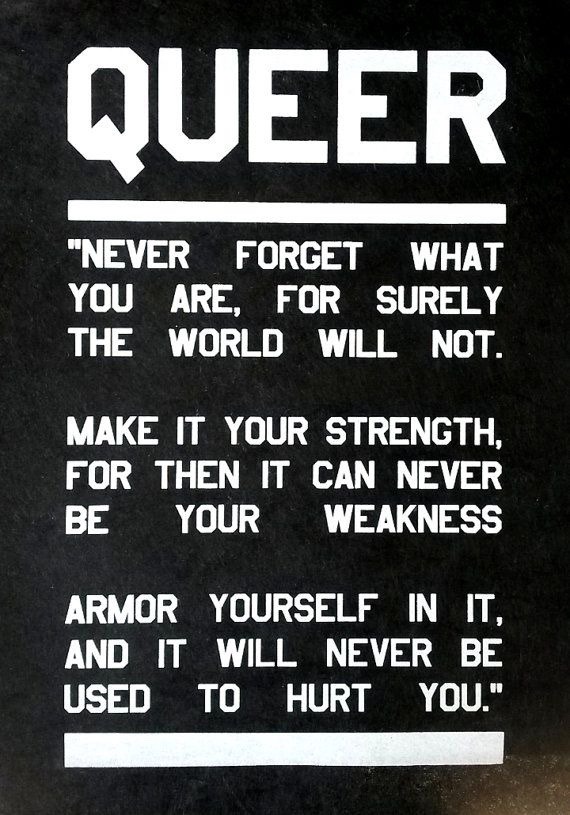
“QUEER: Never forget what you are, for surely the world will not. Make it your strength, for the it can never be your weakness. Armor yourself in it, and it will never be used to hurt you.”
One of the things I love about tumblr is how easy they make it to share something cool, interesting, or informative you find on someone else’s tumblr blog with your followers, while maintaining a history of who all has shared it and where it was originally posted. Especially of someone says something that I’ve been thinking or trying to write a post about, but here is someone else’s words saying this thing I’ve been thinking for a while so well. And I know that now if I try to finish my own blog post, even if I try not to phrase things the same way as this other person, I’m going to repeat key phrases and so forth. So I’d much rather quote the whole thing, then add a few comments of my own.
The thing I hate about coming out is the way society expects it to go down.
When gay people come out, more often than not they are expected to almost have to beg for their families love, and if they receive it without having to, they are expected to be over the moon and rejoice and be thankful and think, “what loving family and friends I have”.
The way coming out should go down is the exact opposite.
Families and friends should almost have to beg for your love, and should most definitely be apologetic for the homophobic shit they most likely put you through whilst you were still in the closet. They should be like, “I’m sorry I was a bigoted prick all these years, I hope you can still love me and forgive me”.
The thing that bothered me the most when I came out was that my families reaction was just, “of course we have no problem, we love you no matter what”… when what I really wanted was an apology. An apology for having been ignored for years, an apology for having to sit though homophobia not only by them, but by my extended family and their friends. But what I got was, “of course it’s not a problem, now lets not talk about it again and lets not bring up all the horrible shit that we said to you openly or allowed to be said about gay people openly because we don’t want to feel bad”.
It bothers me so much to this day how much society loves to praise straight people for being so accepting of gay people but no one ever praises gay people for accepting and loving their families through the years despite all the homophobia.
—the only living boy in new york
While the beginning of the post focuses on coming out, that isn’t the only part of a queer person’s life this is limited to.
Yes, it is more than just annoying that people who spent years regurgitating anti-gay myths and homophobic stereotypes around us when we were closeted (and in many cases ridiculed us directly using homophobic slurs) act as if they are doing us a favor by being tolerant or accepting when we do come out. But the truth is that they are never as tolerant as they think they are. The homophobia becomes a bit more subtle. They use dogwhistles rather than bluntly bigoted language.
If we point out that something they said is unintentionally homophobic, we get accused of being too sensitive. If we point out that a politician they support advocates homophobic policies, or that a charity they support has actually contributed to the deaths of queer teens, we’re told that we’re overlooking all the good things because of one little bad thing. Never mind the queer people are denied needed healthcare, or lose their jobs or homes, and so forth. It’s not important.
And we’re supposed to be grateful?
The same people who accuse us of being too sensitive throw hissy fits because some businesses say “Happy Holidays” in their advertising rather than “Merry Christmas.” They’re the same people who tried to organize boycotts of businesses that chose to provide health care coverage to the partners and kids of their queer employees. They’re the same people who do call for boycotts if a movie and television show includes a queer character (usually supporting character who is given little screen time and is never shown with a same sex partner except in such ambiguous ways that the casual viewer will think it’s just a friend or a sibling).
And they expect us to explain why something is offensive, no matter how many times we’ve already explained it. Besides the fact that if they applied the teeniest tiniest bit of empathy they should be able to see it on their own. Heck, they get angry at us if we hold hands with our partner in front of them, and think it is horribly thoughtless of us not to realize they were uncomfortable, but don’t expect them to know they shouldn’t tell an AIDS joke in front of us!
It’s exhausting.
And I don’t have an answer. Except to urge you, if you think that you are a supportive friend or co-worker or family member of a queer person, to stop and check yourself. If you start looking at your own words and actions from an outside perspective, you may be in for a sobering surprise.
I’ll give you a couple of suggestions for some ways to do this:
1. If you’ve ever said, “no offense!” to an LGBT+ acquaintence…
2. If you’ve ever said, “I’m not talking about you, of course, I’m talking about those bad people” or “Present company excepted”…
3. If you’ve ever dismissed anything as being politically correct…
4. If you’ve ever said, “I’m not homophobic, but…”
5. If you’ve ever noticed that your queer relative declines your social invitations again and again…
…you may not be nearly as accepting as you think you are.







 Font Folly