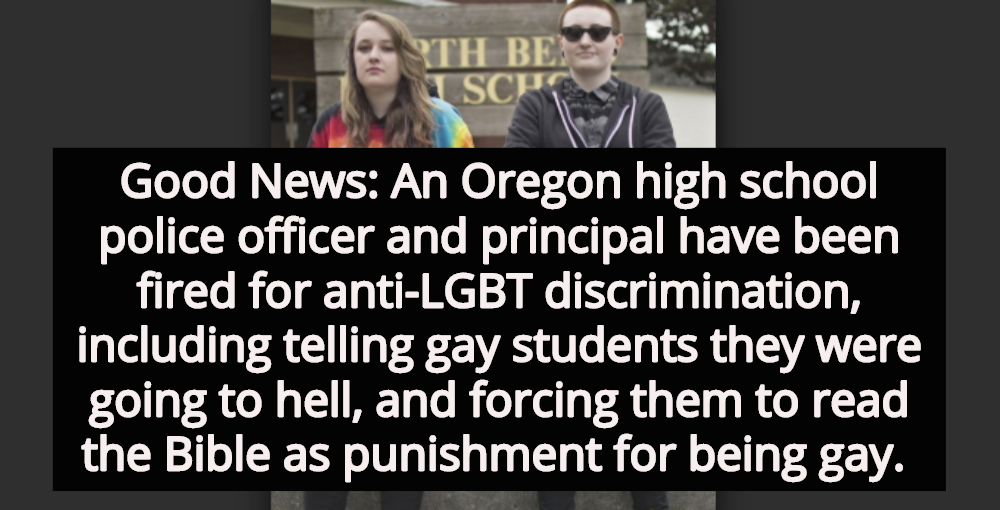
For some background: Gay teen says she went to school resource officer after getting bullied — and he told her she’s going to hell. The “resource officer” is a local police officer assigned to the school supposedly for the purpose of protecting the students. But he wasn’t the only problem. The principal of the school punished gay kids who reported incidents of being harassed (including at least one incident where the principal’s son nearly ran two of the other kids down with his car while yelling anti-gay slurs). Teachers who tried to help the kids in varying ways were retaliated against by the Principal and the district Superintendent, and so on.
So the Oregon Department of Education sent in an investigator. The local officials admitted to several issues, including that they had forced the gay kids to read and recite passages from the Bible as part of their punishment. The ODE investigator issued a report finding that the actions of the officials probably constituted illegal discrimination under Oregon law as well as a violation of the U.S. Constitution’s requirement of separation of church and state. A final finding was pending, but the state ordered to school district to come to a settlement with the kids and their parents by the end of April. They didn’t.
During that time, many more former and current students came forward, with more incidents of anti-LGBT and racial discrimination. Meanwhile, the ACLU was pursuing a lawsuit against the district.
District dismisses Resource Officer and requests local police assign a new officer
District will create a diversity committee (keep in mind that teachers already tried to set up a Gay-Straight Alliance and were stopped by the principal) which will hold celebrations for Coming Out Day and Ally Week and will issue an annual report on how the school is doing on issues of diversity, inclusion, et cetera
District will hire an anti-discrimination expert to help them craft policies to appropriately respond to harassment and discrimination
District will donate $1000 to a local queer support group
Additionally, as a result of the state investigation, the district will be under supervision of the state ODE for at least five years while all of this is monitored. The remaining bit of less than awesome news from my point of view on this is that even though the state’s investigation and the discovery process of the lawsuit found that the district Superintendent knew about all of this and committed some of the retaliation from teachers who tried to help the queer kids, he isn’t being fired. Maybe everyone assumes with the state breathing down his neck he’ll behave?
I get such a bee in my bonnet on these stories because of my own experiences being bullied as a kid. More than one teacher and administrator told my parents that until I acted like “the other boys” or “normal” there was nothing they could do to prevent the bullying incidents. Never mind that some of the worst bullying came from teachers. In middle school I was called “faggot” and “sissy” by four specific teachers far more often than most of the other kids. And then there was the time I was the one threatened with expulsion for being bullied again and again, unless I attending regular counseling sessions where, apparently, the counselor was trying to teach me to act like a normal boy.
A lot of people think that those kinds of days are behind us, but these incidents happening for the last several years at this school are merelyone of manysuchcases. Fortunately, the ACLU keeps coming in to represent the students, and again and again the districts wind up paying big penalties for their discrimination, bigotry, and bullying. As Dan Savage has asked (many times) when will public school administrators get it through their thick heads?
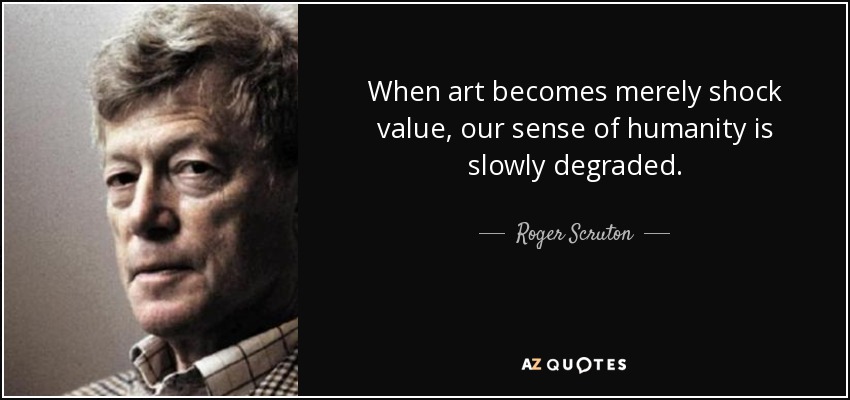
“When art becomes merely shock value, our sense of humanity is slowly degraded.” — Roger Scruton
We hear it all the time: “How dare you call me racist! I don’t hate anyone! I was just making an observation.” And there’s: “It is so rude of you to call me a homophobe! I’m just advocating for my beliefs {that queer people don’t deserve legal rights/to exist openly in public spaces if at all}. You’re the real haters!” Let’s not forget: “Can’t you take a joke? You’re trying to silence me!”
People behave like jerks, make threatening remarks, harass people, advocate for policies and propositions that will cause actual harm to others, and then get angry if other people take offense. They try to hide behind the idea of free speech—they’re just expressing themselves, and everyone has a right to do that, right? But the defense is built on one or more false equivalencies. The most basic is equating disagreement with censorship. If you say that all Freedonians are criminals, and I point out that isn’t true, and show the statistics to prove it, you haven’t been silenced. If other people decide the don’t want to listen to your rants about the evils of the Freedonians anymore, they stop inviting you to their social events and if you show up uninvited they ask you to leave, that also isn’t silencing you. The right to express an opinion doesn’t obligate other people to listen. Then there’s the false equivalence that accurately describing some of their statements as bigoted is just as bad as the bigotry we’re decrying. And so on.
But the defense that really annoys me is the, “But I’m only joking!”
I have several responses to that. The first is: every bully and abuser who ever lived has tried to claim that they were only joking, or they were just playing around. They didn’t meant to cause those bruises or broken bones or to break that laptop or whatever. It’s a lie. Maybe the bully and the bully’s audience were laughing, but real harm is being done.
The second response is: the fact that you think a particular topic is suitable for joking demonstrates the ignobility of your intentions. They only way that one can think the sexual assault is a joking matter is if they either don’t think the sexual assault is a bad thing, or if they think the victims of sexual assault are worth less than other people. There are topics that go beyond the pale, understanding that requires moral fiber and empathy. Not knowing that tells us you possess neither.
The third response is that doing something like “ironically” pretending to believe neo-Nazi ideology is indistinguishable from actually doing it. In other words, if you’re pretending to be an asshole, it doesn’t sound or feel any different to your targets than when a “real” asshole behaves that way. It also has a very scary normalizing effect. The more people feel it is acceptable to express racial bias, for instance, the more likely some of them are to act on the racial bias.
And my fourth response is that jokes are supposed to be funny. Calling entire classes of people inferior, saying they are a waste of space and so on isn’t funny. The objection that is usually raised around this point is that they are just trying to make people think, and they have to shock people out of their complacency to do that. I’ll agree that good political humor pokes at us to get us to think outside the box, but these guys aren’t quite getting it.
Several classic George Carlin one liners. (Click to embiggen)
Let’s look for a moment at the work of a comedian who was often characterized as offensive. The Late George Carlin said things that shocked some people’s sensibilities. Go listen (many recordings abound) to his notorious “Seven words you can’t say on TV or the radio” routine and tell me that wouldn’t give people in the Religious Right conniptions. And sure, you can pull out individual lines from his routines and make him sound almost like some of this current generation of jerks with their racist or homophobic or misogynist rants on their Youtube channel. But that’s taking him out of context. Look over the classic Carlin corpus (excluding the last few years where he seemed to turn into a prophet of doom and things got a little weird) and you’ll find the most prevalent underlying theme is summed up in one of his best one-liners:
“Have you ever noticed that anyone driving slower than you is an idiot and anyone driving faster than you is a maniac?”
While the line works great on its own, it was actually the introduction to a longer bit, where he went on to make humorous observations about foolish and dangerous and weird things that people do while driving. It ranged around for a bit, and the audience laughed. You could certainly characterize the routine as making fun of bad drivers. And that doesn’t seem all that different from someone else having a comedy routine where they make fun of women, or immigrants, or queer people, right? But that’s not what the routine does. Every version of it I ever heard him perform varied a bit, but all stuck to one underlying theme. And it’s in that line I quote. That line isn’t just a joke, it’s a thesis statement.
Read it again: “Have you ever noticed that anyone driving slower than you is an idiot and anyone driving faster than you is a maniac?” Explicitly it says that we classify and judge people in categories like stupid and maniac by extremely subjective criteria. But implicitly it is also saying that sometimes all of us are idiots, and sometimes all of us are maniacs. Because implicitly everyone that we observe is an idiot for driving too slow, knows they we are maniacs. And every person that we can see is a maniac for driving too fast, can observe that we’re driving slow and therefore we are idiots.
Yes, the point of his routines is that some people do very foolish things and isn’t it ridiculous that such people exist? But by the time he has covered the subject, there is a point where he says something that hits close to home. We, the listeners, see ourselves in some part of that routine. In that way, his routines adhere to the classic definition of political humor: to hold a mirror up to society.
That is humor with a purpose. That is how you jostle people out of their complacency. You hold up a mirror, so that we look into it and see our own foibles and flaws. But what these other guys are doing? They aren’t working with mirrors. No, they are putting targets on other people, aiming their fans at those targets, and encouraging the fans to pull their triggers.
That is why the rest of us don’t listen to their rants. We disinvite them from our events. We tell them that their behavior is not welcome at our conventions or on our forums and so forth. That isn’t censorship, that is making a choice of who we will associate with. It’s deciding that we don’t need jerks and abusers in our lives.
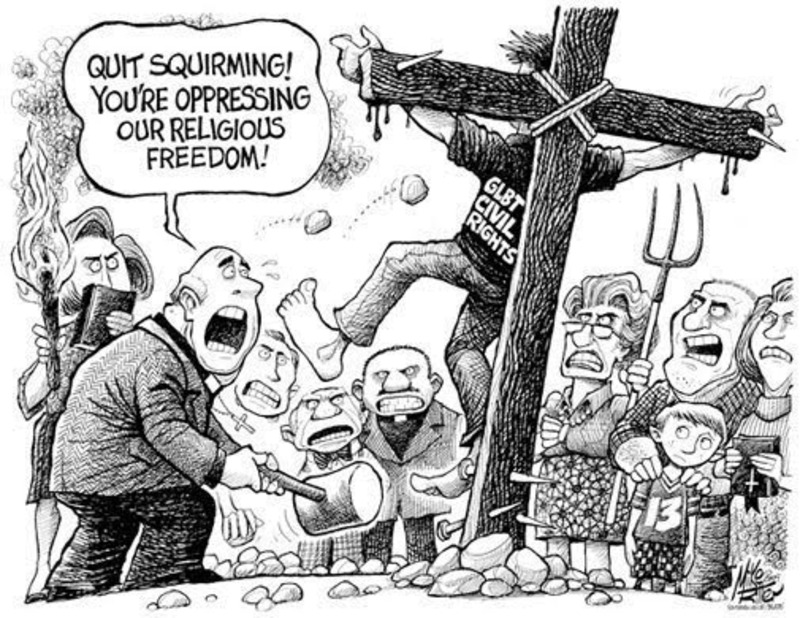
“Quit squirming!” (click to embiggen)I have a half-finished “Adventures in dictionaries” post that I meant to have ready for today, but I realized that my quick dismissal of the Nashville Statement yesterday isn’t really adequate, given the significance of the statement. I originally dismissed it as just more of the same old hate from same old haters, and made a reference to the fact that a couple of the primary signers of the thing are so-called religious leaders who have been embroiled in scandals covering up sexual abuse within their own religious organizations. Those things are both true, but there is an aspect of the thing that I had overlooked yesterday.
So, in case you missed it, a group of conservative evangelical organizations have banded together, calling themselves The Council on Biblical Manhood and Womanhood, and they issued this multipart statement of faith, most of which is exactly the same old ant-gay, anti-trans, anti-equal rights for woman, stuff that we are used to hearing from these bigots. But this time there is one important difference.
That difference is Article X:
WE AFFIRM that it is sinful to approve of homosexual immorality or transgenderism and that such approval constitutes an essential departure from Christian faithfulness and witness.
WE DENY that the approval of homosexual immorality or transgenderism is a matter of moral indifference about which otherwise faithful Christians should agree to disagree.
In other words, they are now explicitly and emphatically saying that anti-LGBT bias is an essential part of being a christian, and anyone who does not subscribe to their anti-LGBT beliefs are not christians.
Now, for some years many of us on the queer and queer-affirming side of this divide have been pointing out that they have boiled christianity down to nothing more than the hatred of the gays. Politicians who in no other way support what any reasonable person would call Christ-like values, nor who love in anyway according to christian values are given high ratings, endorsements, and money by these organizations as long as they oppose marriage equality, trans rights, and so on.
There was that amusing Tumblr post I linked to awhile back where someone made a joke about homophobes, and scores of angry christians swarmed on the post calling it anti-christian hate. Then the original poster had to point out that the word “christian” didn’t appear anywhere in joke. It literally said “homophobe” but, “you guys went ahead and read yourselves in there.”
But whenever we accuse them of throwing out all of Jesus’s teachings (in the Bible, Jesus never said a single word, not one, about homosexuality) and replacing them with a hatred of us queers, they have emphatically denied it.
Until now.
I’ve seen some folks say to just ignore it, because they don’t officially speak for anyone. But here’s one of the problems I have with that. In May of 1845 a bunch of conservative Baptist churches sent representatives to a meeting in Augusta, Georgia, and issued a 14-point statement of why they were separating from the rest of the Baptist Churches. Twelve of the fourteen points in that statement were affirming the institution of slavery in various ways, along with the segregation of the races and the inherent superiority of the white race. That was the birth of the Southern Baptist Convention, years before the civil war.
Even after the war, that group continued to fight for white supremacy and racial segregation, until 1971… at which time the finally endorsed desegregation and shifted their focus to abortion, women’s rights, and gay rights. They were the core of the Moral Majority. They remain a core consituency of the Republican Party in general and Donald Trump in particular.
I know this, because I was raised in that church. I’ve always been proud of the fact that my own grandfather was one of the delegates to the 1971 convention where racial segregation was finally removed from the official doctrine of the church. I was less proud of how many members of our home church at the time quit to form a new Bible Baptist Church over the issue of racial segregation.
So, 172 years after issuing a similarly bigoted statement, pain and suffering are still being inflicted on some segments of the population. I have trouble not fearing something similar here from the signatories of the Nashville Statement. Adopting hate and sticking to it didn’t make that group whither away. It grew, until it became (and remains) the largest Protestant denomination in North America.
Until now, they have always stopped short of explicitly saying that the christians who disagree with them on this issue aren’t really Christian. I think this represents a new battle line from people who feel emboldened by the election of Donald Trump. I don’t think this is just the same old, same old. These are the same people who, when we point out that the teachings of Jesus contradict them, claim that Jesus’s various admonitions about love and compassion only apply to fellow christians. They’ve been sanctioning the murder of abortion providers for decades, as well as the bashing and murder of queer and trans people. This statement puts targets on many more people.
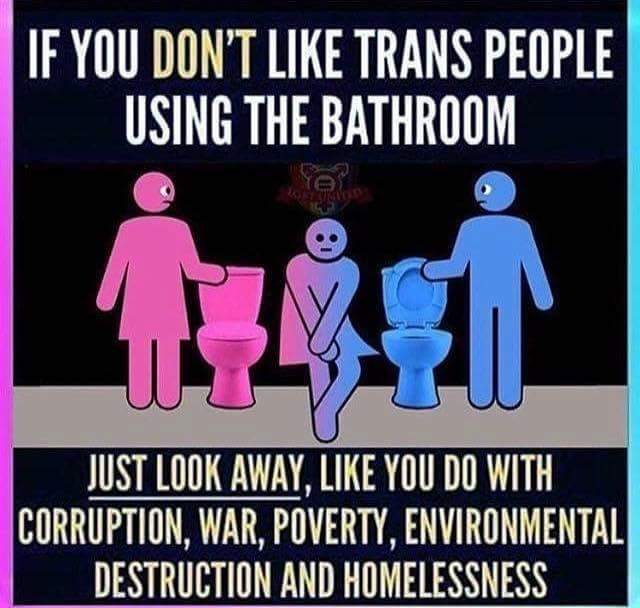
“If you don’t like trans people using the bathroom, just look away like you do with corruption, war, poverty, environmental destruction, and homelessness.”Midway through my second grade year my family moved from Colorado to Nebraska. My dad’s job in the petroleum industry meant that we moved a lot (ten elementary schools in four states). I had a number of unpleasant experiences the first week at the new school. I misunderstood several things. The teachers and other school officials simply didn’t tell me about several rules. And the other kids weren’t exactly welcoming to the new kid. when I say unwelcoming, that’s putting it mildly. The second or third day there, I was cornered in the bathroom by several boys only some of whom I recognized from my classroom. They wanted to know if I was the idiot who got in the wrong line at the lunch room. I don’t remember everything that was said to me, but they communicated as only grade school bullies can that I was a stupid sissy—a freak who didn’t belong with the real boys.
The school was far more regimented than either of the previous grade schools I had attended. There were rules and assigned times for everything. We were sent to the restroom at three specific times each day, for instance. And my new bullies singled me out for taunting and humiliation every single restroom break.
I didn’t want to explain what was happening. Previous incidents of being bullied by other kids had always resulted in my dad yelling at and beating me for being a pushover. When I attempted to stand up for myself as he’d said, I got in trouble at school, which resulted in more yelling and beating. So I couldn’t let my parents know what was happening in the bathroom. And I knew I couldn’t let the teachers know, because eventually they would inform my parents.
So I stopped going to the bathroom.
I convinced my mom to let me walk home for lunch instead of eating at the school cafeteria. I don’t remember how I convinced my parents, but I did. I used the restroom at home in the middle of the day. At school, when we were marched off at our appointed times midmorning and midafternoon, I would loiter outside the restroom until we were collected and taken out to recess. Since I was eating at home, I skipped the midday restroom trip. I changed my drinking habits. I stopped using the drinking fountain at school, because if I didn’t drink water I wouldn’t need to pee as often. And so on.
I managed to avoid going into the restroom at that school almost entirely for the rest of the time we lived in that town. I still got bullied on the playground, in the classroom, and so forth. But because teachers were always nearby, the kind of bullying that happened was slightly less horrible that what could happen when a bunch of the mean boys had you trapped in a room that the adults seemed to never enter.
When we moved to a tiny town in Wyoming next, I wasn’t able to avoid the restrooms. The town we moved to didn’t have a school, so we rode a bus to a town almost an hour’s drive away. I can still remember how scared I was at what would happen the first time I went into that school’s bathroom. That school was less regimented, so I as usually able to get by with only one trip per day, and I could time it so I wasn’t using the restroom when a lot of the other boys were. Similarly with the town back in Colorado but near the Kansas border that we moved to for the last part of my third grade. And the next town, and the next.
Even when I was in high school, I learned to avoid certain bathrooms and certain times of the day. Because yes, even in my teen years, there were guys ready and eager to demonstrate to the class faggots just how despised we were, and the boy’s restroom was a place that they could do so with impunity.
I’m not trans. I don’t pretend to speak on behalf of the trans community. But I am very familiar with that cold fear that strikes like a fist in the gut when walking into a public restroom and someone looks at you in a less than friendly way. I’m a grown ass man in my mid-fifties, and there are still moments of anxiety any time I am in a public restroom and there are other people in there with me. There are little checklists that part of my brain runs through. Am I behaving the way I’m supposed to? Is this person going to interpret something I do in the wrong way?
Heck, part of me still freaks out if a straight co-worker strikes up a conversation in the restroom at the office! Making eye contact or saying anything to the wrong guys was the surest way to get bullied when I was a kid, and it doesn’t matter how many years ago that was, the conditioned reflexes are still there—the surge of stress hormones and keying up of fight or flight response happens every time.
So these bills and court fights about where or whether trans people can use restrooms at school and other public accommodations strike close to home. I get really upset that people think keep portraying the queer people as the dangerous ones in public restrooms.
Everyone needs to eat, drink, breathe, and yes, people also need to pee from time to time. We have public restrooms for that. A number of places in our country have had laws and policies that explicitly allow people to use the restroom of the gender they identify with for many years, and there has never, not once, been an incident of a trans or otherwise queer person using those policies to assault anyone in a restroom. The only incidents of people going into a restroom to harass women have been straight anti-gay people doing it to try to make headlines in order to justify these bathroom bills or to yell at a woman who doesn’t want to sign their anti-trans petition.
Seriously.
This isn’t about privacy. It isn’t about protecting women or girls. It is about making it impossible for trans people to exist in public spaces at all. It is about punishing trans and gender non-conforming people. It is about giving bigots an excuse to harass queer people or anyone who seems maybe a little queer.
“Neo-Nazi: a member of an extreme right-wing political group that has ideas similar to those of Adolf Hitler’s Nazi party, including hatred of jews and people of non-white races…”So I’ve seen some admonishments going around along the lines of, “stop calling everyone who disagrees with you a Nazi!” and other variants of the good ol’ Godwin’s Law1. Never mind that Godwin himself said, “If you’re thoughtful about it and show some real awareness of history, go ahead and refer to Hitler when you talk about Trump. Or any other politician.” I’ve specifically run into this admonishment lately in discussions about various people who have been advocating various racist, xenophobic, misogynist, and homophobic opinions along with laws and policies intended to harm people based on their race, ethnicity, religion, gender, sexual orientation, or gender identity.
In other words, there are a lot of public figures and pseudo-celebrities and wannabe pundits out there who are advocating neo-Nazi opinions and neo-Nazi policies, but we aren’t allowed to call them Nazi. Because that’s rude. Or it’s hyperbole. Or something.
Never mind that these proponents of opinions and policies that exactly (sometimes word-for-word) repeat actual neo-Nazi publications and demands Have previously called any woman who objected to their sexist pronouncements “feminazis.” Or that any of us who called out their racist or misogynist or homophobic statements were called “PC-nazis.” And then if we objected to that, they would make arguments about why the word “nazi” isn’t actually an insult. When it’s used back at them, suddenly we’re the ones who have crossed a line.
Some of these guys have demanded apologies, and even gotten retractions from some publications, insisting that just because they have said things like “In response to concerns from white voters that they’re going to go extinct, the response of the Establishment—the conservative Establishment—has been to openly welcome that extinction” or “Behind every racist joke is a scientific fact” or “some degree of separation between races is necessary for a culture to be preserved” that it is ridiculous to think that means they’re white nationalists or neo-nazis. We’re the bad guys for even suggesting such a thing! They aren’t bad guys for advocating forced deportment or relocation or so-called “peaceful ethnic cleansing3”
Milo Yiannopoulos, for instance, has called for at least the separation of people by race, ethnicity, and religion. He has also spouted various racist, misogynist, and transphobic beliefs. He has sent hordes of his internet followers to harass women with rape threats and racist attacks. He has said all sorts of awful and false things about trans people and has encouraged his fans to attack and harass them. And not just in general, he has handed out private address and contact information of specific trans people and suggested that someone should teach them some manners.
Yiannopoulos then defends himself by insisting that he’s simply stating an opinion. And besides, he’s gay, so how could he possibly be a bigot? Not only is he gay, but he’s white gay man who only has sex with black men, so he can’t possibly be racist (never might that racial fetishization is deeply entwined with racial hatred). And by the way, he doesn’t endorse all the white nationalist policies of a bunch of his friends (even though he frequently makes some of the same arguments they do), he just thinks they’re interesting people. So it’s wrong to call him a white nationalist or a neo-nazi of a nazi sympathizer.
Bull.
He’s an editor of a news site which describes itself as the platform of the alt-right. The alt-right is a term coined by white supremacist Richard Spencer in order to make white supremacy seem more like just another political option4. He argues racial opinions of white nationalist are reasonable–not just that they have the right to hold the racist opinions, but that those statements are fact rather than opinion. He attacks people on the basis of their religion, ethnicity, or gender identity. He defends not just the right of the neo-Nazis and white nationalist to hold their opinions, but he actively campaigns to write those opinions into law. One day those same white nationalists who currently enjoy having his support may well turn on him, just as the historical Nazis eventually rounded up their own gay members and executed or imprisoned them. But right now he’s a white nationalist and a nazi-apologist. That’s a fact.
Then there are the people who angrily argue that they aren’t defending neo-nazis or white supremacists just because they are telling people like me to shut up about them. Seriously. “You must let them advocate genocide without calling them on it” isn’t defending them? Of course, the most recent person to send me that message personally also slipped in two bigoted dog whistles5 before I blocked him
Then, of course, there are the free speech arguments. Okay, I’m an advocate for free speech. You have the right to your opinion, and you have the right to express it. But I, as a private citizen, am under no obligation to give you a platform. I am under no obligation to sit quietly and listen. I am certainly under no obligation to sit quietly and listen while you advocate policies that will cost me my job, my home, and my health care. I’m allowed to argue. I’m allowed to boycott. I’m allowed to call you a neo-nazi. I’m allowed to shun and shame people who enable your advocacy of hate.
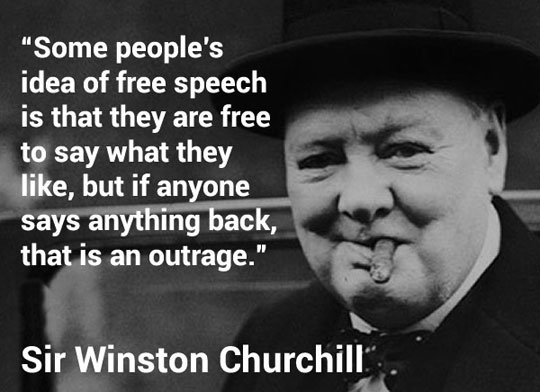
“Some people’s idea of free speech is that they are free to say what they like, but it anyone says anything back that is an outrage.” — Sir Winston ChurchillDisagreement is not censorship. Boycotting is not censorship. Shunning is not censorship. Calling you a bigot or similar is not censorship. Calling you an idiot is not censorship. Staging a protest when you come to my community to preach your hate is not censorship. Boycotting businesses that give you a platform to preach your hate is not censorship. Repeating word-for-word things you say (particularly if you go on TV or stand up on a stage to address supporters) is not censorship nor misrepresenting you. Pointing out which of your statements are factually wrong is not censorship. Even going so far as to call you a liar (particularly when it has been documented numerous times that you repeat false information again and again) is not censorship.
Free speech means you can express your opinions if you like. Free speech does not mean that those opinions have to be taken seriously, or treated reverently, or accepted without argument.
To circle back to the original point, if you:
repeat neo-nazi and white supremacist slogans,
advocate the same programs of racial, ethnic, religious, misogynist, and/or homophobic discrimination and oppression as neo-nazis and white supremacists,
attack anyone who disagrees with neo-nazi and white supremacist proposals or hate speech,
thank the avowed neo-nazis and white surpremacists when they repeat your words and deeds and hold you up as an example on their white supremacist video blogs, news sites, and/or conferences,
are publicly and unapologetically friends with neo-nazis and white supremacists after they have repeatedly (often in your presence) called for the extermination of people based on their race, ethnicity, religion, sexual orientation, and/or gender identity,
then you are a neo-nazi. And no one should apologize for calling you a bigot, a nazi, a white nationalist, a white supremacist, or a nazi sympathizer. Because you are all of those things. And that is a fact.
Footnotes:
1. Godwin’s Law was first articulated by author and attorney Mike Godwin: “As an online discussion grows longer, the probability of a comparison involving Hitler approaches 1.” In other words, if an argument goes on long enough, someone will eventually evoke the horrors of World War II, the Holocaust, et cetera. While it is phrased as if it were a law of mathematics, it’s really just an adage based on observation2. As Godwin himself has stated, it was intended as a tool to remind people not to resort to unnecessary hyperbole. He also wanted people to not trivialize the Holocaust. He has pointed out on several occassion that sometimes such comparisons are quite apt.
2. Godwin’s Law gets abused a lot. People have interpreted it to mean that if someone ever makes a comparison to Hitler, naziism, et cetera, that this immediately invalidates all of their arguments. Part of this comes from rules that were established on some Usenet groups in the 1990s by which if a thread reached the Hitler comparison, the thread would be ended. Note that this was a convention that some people chose to adopt. Godwin’s Law is not an actual law nor does it articulate anything that even approaches a logical fallacy.
3. This oxymoronic term is deployed frequently and unironically by actual neo-Nazis such as Richard Spencer, the president of a literal white supremacist “think tank” among other things. He has also called for non-peaceful ethnic cleansing, for example: “humanity doesn’t need the Black man, and having concluded that, we must decide how efficiently to dispose of them.”
4. There some subjects upon which people can legitimately disagree. Details of tax policy, for instance. But when one side is literally calling for the mass murder of the other side (or mass incarceration, or denial of fundamental human rights), then we are no longer talking about a disagreement.
5. Dog-whistle: coded language that appears to mean one thing to the general population but has an additional, different or more specific resonance for a targeted subgroup. For instance, in American politics the phrase “states’ rights” seems to be a mere reference to the Constitutions delineation of some powers and rights belonging the states (and other to the people or to the federal government), but signaled the politician’s commitment to segregation and institutionalized racism. “Real Americans” is frequently used to refer to conservative white Christians. Similarly, calls to “cut entitlements” are understood by the target audience to mean that “undeserving minorities” will be kicked off public assistance (when it fact it means that everyone will lose their benefits in order to funnel more tax money to the uber-rich and corporations).6
6. The dog-whistles in question in this particular exchange made it clear the guy arguing with me was both anti-semitic and homophobic. I thanked him for identifying himself just before blocking him.
“…even if [the trump voter] isn’t a racist, ableist, xenophobic, misogynist sexual predator, he was fine voting for one…. [my life] would be better off without someone who places trump’s showmanship over common human decency…” (click to embiggen)Someone’s at it again. Telling us that the people who gladly voted for the man who swore to take away health care from millions, swore to give religious people the right to discriminate against queers, and swore to kick millions of brown people out of the country—could be persuaded not to vote that way again if only we would talk to them and listen to their side of things.
It seems so reasonable. Simple. Just talk. Listen to their side. We always argue for tolerance, right? Listen to their side of things. Maybe we’ll learn something. And once they see we’re willing to listen, they can be persuaded to see things from our perspective.
Bull.
Seriously, I’m a queer man in my late 50s. I grew up in tiny rural communities attending Southern Baptist Churches. You think I haven’t heard at least a billion times the perspective of the people who think religious freedom means a right to discriminate against me? You think I haven’t heard millions of times why queers don’t deserve civil rights protections? You think I haven’t heard millions of times how they perceive black people, brown people, people with accents, people who don’t attend the same churches as they do?
I have had no choice but to listen for decades!
You cannot talk someone who doesn’t think you’re their equal into accepting your right to autonomy. They may claim that they respect you. They may call you their friend. They may think of you as an exception to the truth they hold deep in their hearts about the inherent inequalities of different types of people. But the only thing that’s going to do is that you will be the person they trot out as proof that they aren’t prejudiced when someone else calls them on it. I know because it’s happened many times to me, personally.
Sure, when I’ve argued that queer people need to live their lives out and proud (if they can safely do so), I have cited the studies that show that actually knowing queer people makes other people more likely to support our rights. But it makes them more likely. It isn’t a magic formula that is guaranteed to change any specific person’s mind.
My evangelical upbringing is especially relevant to this particular argument. Despite making fun of a disabled person, talking about pussy-grabbing, and openly calling for violence against people who disagree, Donald got 80% of the evangelical vote. That’s better than George W. Bush every managed!
And those folks are absolutely convinced that they don’t hate anyone. They will angrily tell you just how much they love you in the same breath that they say that if your rights are protected, that will offend god so much that he will destroy America. They don’t see the contradiction between those statements. When it comes to things like women’s rights and racial issues, they just as emphatically insist that they aren’t bigots. They just know, because they think it’s in the Bible, that women are meant to be subservient to men, and that brown people are meant to be subservient to white people. If they aren’t quite willing to say that last part out loud, what they will fall back on is the separate but equal dodge on race, because god intended the races to be separate, they say.
It’s a weird theological argument: god wouldn’t have made you a woman, or a African-American, or Latino, or whatever, if you weren’t meant to fulfill certain roles in life. Maybe he sees inherent moral weaknesses in your soul. It isn’t at all logical, and most of them can’t articulate it beyond the notion that they believe it’s in the Bible. But that’s what you’re up against: god said it, god did it, god intends it. And no amount of talking or listening or being friends with people whose life experience belies that is going to shake their resolve. They may feel doubts. They may even confess to you that they realize you are a good person despite being in a category they have been taught is inherently not. But they will then shrug, say it’s god’s doing, and they’ll cheerfully vote for any candidate who affirms their ideas.
Even if that candidate also says a lot of things that completely contradict the teachings of their church. Because once they decide that a candidate is god’s choice, they can hand-wave everything away with the old “he works in mysterious ways.”
It’s an exhausting battle.
So, yes, be kind and civil. If you have the time and energy to attempt to be friends with someone, you can. But don’t kid yourself that doing so is more effective than calling your congressperson, or going to a protest, or joining a boycott, or going to town hall meetings, or donating to organizations that protect our rights. And please, don’t let the people in your life who think it’s okay to take away your rights think that you endorse those ideas.
Because you’re just empowering them to hurt others.
Quote from Martin Luther King Jr, Letter From Birmingham City Jail, 1963 (click to embiggen)I always feel a little nervous posting anything on Martin Luther King Jr Day, as I don’t want to co-opt another marginalized community’s hero, day, or message. Especially after seeing several people of color on my various social media feeds caution against talking rather than listening. But during his life, King said more than once that “Injustice anywhere is a threat to justice everywhere,” and I believe we have entered a very dark time in our nation’s history where all of us who believe in equality for everyone need to stand together. So while I may be a white guy, as a queer person I have some experience with oppression and believe that I have a responsibility to use whatever gifts, privilege, and platform I have to promote justice.
A lot of people, not just the moderates that Dr. King talked about in that quote from Letter From Birmingham City Jail, rationalize and deny the existence of bigotry by making appeals to certain fallacies. Academically, we often state those myths as five fallacies:
Individualistic Fallacy: racism/homophobia/antisemiticism/etc is perceived as being only interpersonal, ignoring the systemic structural realities (such as underfunded schools)
Legalistic Fallacy: the belief that abolishing racist/homophobic/religious laws automatically ends the bigotry.
Tokenistic Fallacy: the inference that the presence of members of the marginalized class in influential positions in society proves that all bigotry has ended.
Ahistoric Fallacy: the belief that the denial of basic rights in the past has no lasting effect on subsequent generations (“but slavery is over!”).
Fixed Fallacy: assumes there is one and only one kind of discrimination, not recognizing new forms that emerge in context of societal and legal changes.
There’s an academic paper that explains all of this: WHAT IS RACIAL DOMINATION?, by Matthew Desmond & Mustafa Emirbayer of the University of Wisconsin—Madison, if you want to get into it. It’s rather long and involved, but if you open the PDF at the link and search for Five Fallacies you can jump right to their discussion of the fallacies. The paper is focused on racism, but the fallacies apply to all kinds of bigotry.
All of those fallacies contribute to that preference for an absence of tension rather than a passion for justice that Dr. King talked about. It’s the classic “Can’t You Get Past it/Live and Let Live Fallacy.” Or maybe another name could be the “Respectful Disagreement Fallacy.” It’s the belief that as long as a person isn’t physically attacking you right this moment, and is framing their critiques in polite-sounding language, than it can’t possibly be racist/homophobic/antisemitic/misogynist/etc.
So the bigot talks in dog whistles (coded language that doesn’t sound overtly like bigotry to people who don’t know the code), claims to respect or even feel love for the community targeted by their language, and if we point out that they are being racist or misogynist or antisemetic or homophobic, we’re the ones causing a problem. And people who think of themselves as moderate or enlightened turn on us. They don’t just look the other way from the bigotry and bigoted policies that the community is enduring, they actually enable it.
Which means they’re part of the problem. They’re not being neutral. They’re not seeing things from both sides. They’re not being nuanced. They’re oppressing other people.
I wish there was a simple solution. I wish I had some words of wisdom. Instead, I’m just stuck with this regrettable conclusion, having to try to educate people who don’t think they’re being an enemy.
“Over the past few years I have been gravely disappointed in the white moderate. I have almost reached the regrettable conclusion that the Negro’s great stumbling block in his stride toward freedom is not the White Citizen’s Counciler or the Ku Klux Klanner, but the white moderate, who is more devoted to ‘order’ than to justice: who prefers a negative peace which is the absence of tension to a positive peace which is the presence of justice.”
— Martin Luther King Jr, Letter From Birmingham City Jail (1963)
We’ve all heard it before when certain topics come up:
“I don’t see color. I see people.”
“I don’t care how you pray. All religions lead to god.”
“I don’t like labels like ‘gay’ or ‘straight.’ We’re all human.”
“When I look at you I don’t see a man or a woman. I see a friend.”
“It doesn’t matter who you vote for. The important thing is to participate.”
They are usually intended as a statement of support for marginalized people. It’s a way to say, “I’m not intolerant!” It sounds so warm, fuzzy, and affirming, right? Obviously if we don’t perceive a person as different, we must perceive them as equal? Right?
Well, not really. I suspect that most everyone reading this felt at least a little bit uncomfortable reading one of those statements. Or at the very least wanted to quibble with one. Which one rubs you the wrong way and why it does will be different from person to person, but the truth is that each of the statements is just as problematic. Even the ones you agree with.
First, let’s talk about labels. The person who ordered blood tests and prescribed medicine for me when I was sick is a doctor. The person who gives me assignments at work is my boss. The man I stood beside and said “I do” about when the officiant asked is my husband. The woman who gave birth to me is my mom. The man who adopted and raised my mother and her sister was my grandpa. We don’t have trouble with labels 99% of the time. Labels are how we communicate and make sense of just about everything in the world.
We only notice labels when those labels are perceived to promote or impede an agenda that we have a vested interest in. We only want to ignore labels when acknowledging them makes us uncomfortable. If, for instance, we benefit from a particular societal preference, acknowledging that difference implies that maybe our success isn’t solely due to our individual merits.
Ignoring labels is an act of denial or dismissal. Race, gender, religion, socio-economic status, sexual orientation are essential ingredients in our identity, whether we acknowledge it or not. Because we are confronted with and shaped by societal expectations from the day we are born. Just look at how outraged a lot of people got a few years ago when one couple tried to raise their baby genderless and refused to tell strangers the child’s sex. Or the many, many studies that have shown are very differently people interact with a baby depending on what gender they’ve been told the child is.
“To overcome racism, one must first take race into account.”
—Supreme Court Justice Harry Blackmun
The truth is that society discriminates against people based on race, gender, sexual identity, socio-economic status, religion, and many other factors that the people who are most likely to claim they don’t care about labels would agree shouldn’t make one unequal in the eyes of the law. We can’t make society more equitable if we don’t acknowledge both the inequalities and the things which trigger the unequal treatment.
So trying to ignore these labels—specifically either saying or implying that ignoring them is a better idea than using them—is a way to try to silence members of marginalized groups. It’s telling them that their lived experience of being discriminated against is less important than your comfort. And quite often it is often a way to say that you’re perfectly okay with the inequality as long as it doesn’t affect you.
Second, claiming that you don’t care. The more often someone repeats a statement that they don’t care about something, the harder it is to believe them. If they really didn’t care, they wouldn’t say anything. This has been demonstrated most clearly recently by people who get defensive about video games, claiming that the games aren’t sexist; besides, if you don’t like them, don’t play them. Then the same people threw a hissy fit and called for boycotts when someone cast four women to play the leads in the new Ghostbusters movie. If sexism and representation didn’t matter to them, they wouldn’t have gotten upset.
Now, I’ve had people claim that the only reason they say anything is because we keep talking about it (whichever category it is). This has happened to me personally most often in relationship to sexual orientation. The cliché that I have heard millions of time is, “why do you have to keep shoving your sexually in my face?” Most ironically it came from the co-worker who had plastered an entire wall of his office with pictures of himself, his wife, and their five children—and he was objecting to a single picture of my late first husband (in an ugly Christmas sweater, no less) that I had discretely tucked in a frame on my desk where most of the time no one but me could see it.
Humans are social animals. We often are defined by our relationships to other people. People mention spouses, children, parents, friends, niece and nephews, and so forth all the time, without thinking about it. Studies have shown that if people we work with are reluctant to share these sorts of real life details, that they are perceived as stand-offish and not team players. It affects the likelihood that they will get raises, get promotions, and even the likelihood that they will be the person chosen to be let go if there are layoffs. So queer people are caught in no-win situation. If they are honest and open about who they are, they get accused of shoving their sexuality on people. If they evade the topics, they’re not team players.
If labels really don’t matter, then you shouldn’t mind hearing about them.
Third, claiming that you don’t want to take sides, you just want to live and let live. Why does this have to be a conflict, you may ask? Or “being intolerant of bigotry isn’t very tolerant,” you may say. This is a false equivalency. It is logically identical to saying that the person who reports a theft to the authorities is making a victim of the thief.
“If you are neutral in situations of injustice, you have chosen the side of the oppressor. If an elephant has its foot on the tail of a mouse and you say that you are neutral, the mouse will not appreciate your neutrality.”
—Bishop Desmond Tutu
When inequalities exist, live and let live just perpetuates injustice. You aren’t being tolerant or neutral or impartial, you are actively supporting the side of the bigot. You are aiding in the oppression. You aren’t helping the oppressed, you are doing quite the opposite.
“Life’s most persistent and urgent question is, What are you doing for others?” —Marin Luther King, Jr.Stop telling me what you don’t care about or don’t see. Show me what you’re doing to make the world a better place.


![“...even if [the trump voter] isn't a racist, ableist, xenophobic, misogynist sexual predator, he was fine voting for one.... [my life] would be better off without someone who places trumps showmanship over common human decency...” (click to embiggen)](https://fontfolly.net/wp-content/uploads/2017/02/sallyrefusestobegaslit.jpg)


 Font Folly