“A life is like a garden. Perfect moments can be had, but not preserved, except in memory. [Live Long And Prosper]”
Leonard Nimoy, 1931-2015
(Source: Leonard’s final tweet after leaving the hospital four days ago.)
“A life is like a garden. Perfect moments can be had, but not preserved, except in memory. [Live Long And Prosper]”
Leonard Nimoy, 1931-2015
(Source: Leonard’s final tweet after leaving the hospital four days ago.)

This debate was triggered one time by a particular piece of classical music which included religious text, and we wound up setting aside some time at the spring retreat to discuss the issue. There was a large group discussion, then we broke into small groups, then back to the large group again. A very curious fact came to light during this process: every single one of us who felt strongly that we wanted to perform this piece, in part because as an out queer group our performance would be “taking it back” had been raised in conservative Christian families, and had experienced various traumatic events at the hands of people claiming to be acting on god’s behalf… Continue reading Pulling the trigger (warning)
Brandon Ambrosino, writing for Vox, asks, “Why are Christian movies so painfully bad?” He’s writing specifically about the recently released movie, “Old Fashioned,” though he mentions a few other recent examples. The full article is worth a read, but I want to focus on a couple of points:
As Daniel Siedell, Art Historian in Residence at The King’s College in New York City, notes, “For [Evangelical Christians], culture is a tool, a more effective way of getting at political realities, or winning the battle of ideas in the public arena.”
Siedell uses the following analogy with his students to explain what he means.
Imagine a gorgeously wrapped gift sitting under a beautifully decorated Christmas tree. The presentation of the package, while pretty, is nowhere near as valuable as what’s inside.
Now, he says, extend that idea to Christian art. The artistic qualities of a work become the unnecessary wrapping paper. As such, it doesn’t really matter how good or bad they are.
That’s why it doesn’t matter that Old Fashioned is often very boring. It doesn’t matter that the script bursts at the seams with overwrought dialogue, or that the actors (outside of lead actress Elizabeth Roberts) offer phoned-in performances.
Ambrosino eventually disagrees with this point, but I don’t think he does so as vehemently as he should. Quality is not just the packaging. Quality is an inherent property of the entire work of art. When you think you can make a work of art and treat the artistic qualities of the work as superfluous, you are not making art. Period. I understand the mind set of the evangelicals, believe me! I was raised in that sub-culture, and once people noticed I had what they considered Talent, everything I wrote and did was evaluated through that lens of whether they felt it was proclaiming the message of Christ.
I tried to make one of Ambrosino’s points at the time: if the quality of what we produce is a turn-off, it doesn’t matter how important the message is. People will never listen to your message if they are bored by your story/movie/what have you. But it always fell on deaf ears.
Part of the problem with both my argument then and Ambrosino’s now is that we’re conceding something that we know is wrong. In order to try to make the argument that they should try to be better at making art in order to get their message across, we are buying into the fallacy that art is merely a means to deliver a message. It’s their argument:
Brian Godawa, Christian screenwriter, thinks it’s important to note that Christian films aren’t the only ones that are explicitly preachy. All films, says Godawa, “have messages to some degree or another, and writers and directors know full well they’re embodying those messages in their storytelling.”
I’ve written before that it is impossible to create art that is true to yourself without your values informing the work. That’s not the same thing as a message. I know that I’m a big believer in hope, so my stories, even when I write things I considered very dark, always have some hint of a glimmer of hope. But that isn’t the same as a message. I don’t write a story because I wish it will make other people feel the same way about hope as I do. I write stories because the stories want to be told. My own perspective will always be to look for that glimmer of hope, so I see the stories that way.
But each reader will have his or her own perspective, as well. And even though I am the storyteller, it’s their story, too. Their interpretation of what the story means (to them) is just as valid as mine.
And while I often have very strong opinions about the stories, art, and music I love; I understand that they are my opinions. I may think that your opinion about that particular piece of art is utterly wrong, but I will defend your right to express it. I may debate you about it, but I expect you to argue back.
That’s the difference between trying to send a message and letting your belief inform your artistic endeavors. I don’t consider it a failure if a reader doesn’t agree with me at the end. I don’t even consider it a failure if some readers don’t like the story at all. I especially don’t consider it a failure if a reader feels compelled to tell me just how much they hated one of the characters, or that they are angry at me about how the story ended.
Because in order to hate a character, you have to believe in the character. In order to be angry about how the story ended, you have to become invested in how it ends.
Don’t get me wrong, I love hearing from readers who tell me they liked something, or that they found a particular character adorable. Someone told me that recently about a pair of characters in one of my stories, and I just about died from pure happiness. But you know what? A few years ago when one reader wrote to tell me, in regards to a particularly ruthless character I had written about, “I don’t trust him at all!” and others wrote to tell me how much they loved the same character, I just about died from glee.
The people who are delivering messages want one and only one reaction to their story. You must agree with them. If you don’t agree with them, you have failed to learn the lesson they are so desperate to teach you.
And that’s completely backwards from how it ought to me.
 Particularly in the online world, February 14th is a terrible mine field. You can’t go online without running into angry rants and bitter commentary about those of us who are happy on this day. If you make the mistake of actually admitting that you are happy and wish other people a happy day, someone’s feelings will be hurt. If you try to avoid the topic altogether, someone will ask you why you’re not waxing eloquent about your husband/boyfriend (or wife/girlfriend or whatever significant others you normally talk about). When I avoided saying anything anywhere online at all one year on February 14, I got an angry message accusing me of being too busy celebrating with my boyfriend to even spare a moment to help some of my single friends feel less unloved.
How can you possibly answer that?
Not that I don’t understand where all these mixed feelings come from. I do. I haven’t always been in a relationship. I got so used to being in the emotional space of being single and not terribly happy about it, that it’s still something of a shock to me every morning to wake up and discover I’m not alone. Even after seventeen wonderful years with Michael. So, yes, I understand what it’s like to be single.
I know what it felt like seeing people happily paired off when I wasn’t. I knew the pain of being completely smitten with someone who was in love with one of my best friends. I knew the double-pain of having a crush on a guy and not being able to share my misery with anyone else or seek sympathy from anyone because not even my closest friends knew I wasn’t straight. So I understand, really, I do, why just seeing Michael and I together being happy can cause someone else heartache.
There were times I felt that heartache. There were times I said something to one of my friends that might have made them feel guilty for being in a relationship. There were times I lashed out, making a snide remark to make them hurt as much as I did. So I understand where the negative comments come from.
I’ve had the incredible luck (and luck does have more than a little bit to do with it) of falling madly and deeply in love with someone who loved me back. When you find that kind of relationship it’s impossible to keep it to yourself. You want people to know what a great person your significant other is. You want to share the joy with your family and friends. Even when you’re a gay man living in a very homophobic society, it’s very difficult to be in love and keep it a secret. So I understand why people want to talk about their relationship with other people they care about.
I don’t need the calendar to remind me to tell Michael I love him. I don’t need a holiday to give me an excuse to buy him presents. More than once we’ve celebrated Valentine’s Day by just taking an exhausted nap together. I don’t think we have ever remembered to make reservations for a dinner at a restaurant on the big day. Michael scolds me for buying flowers on the day because prices are always jacked up. Just a few days ago I asked him if he wanted his Valentine’s gift then (since it had arrived that day), or wanted me to wait until the actual day.
I don’t believe in the so-called coupled ideal. I don’t believe that there is one and only one soulmate out there for everyone. I don’t believe that no one is capable of loving more than one person at a time. And I don’t believe that everyone would be happiest if they were in a relationship with their “one true love.”
But I refuse to feel guilty for being in love. When I was single and made other people feel guilty, their guilt didn’t alleviate my loneliness by one iota. When I lashed out and hurt their feelings, it didn’t get me one step closer to happiness. All that happened was they were hurt, and I wallowed in self-pity.
So, it’s Valentine’s Day. The eve of the Ides of February, which was the beginning of an ancient Roman celebration of fertility and purity (hard for some people to believe those go together). Some parts of the Roman festival were rather shocking to the prudish sensibilities of the early Catholic church, which is probably the reason that a pope declared Feb. 14 the Feast of St. Valentine in 498 AD. The oldest surviving Valentine Greeting (a love letter which specifically mentions St. Valentine’s Day as a day to celebrate one’s love) is a letter written by the Duke of Orleans to his wife in 1415, while she was imprisoned in the Tower of London (take that, everyone who claims the holiday was invented by greeting card companies; in fact it was the other way around).
For the last several years, the biggest celebration we’ve done on Valentine’s Day is meeting up with a bunch of friends to celebrate our friend Jared’s birthday. It’s an evening of laughter and love with a diverse group—some single, some not. The important thing is that we’re together and not mired in bitterness nor guilt.

Not that I have any strong feelings about it
Anyway, I had this post in progress, and then I took a break to skim through Tumblr where I saw a pair of short posts by Neil Gaiman that made all of the points I was making, only much more succinctly.
So I abandoned the post. But then comes news of a new Harper Lee novel-fifty-four years after the publication of her first novel, the Pulitzer Prize-winning To Kill a Mockingbird. And that made me think about the idea of a one time runaway hit in a new way… Continue reading Runaway hits
 I get reminded in weird ways how old I am, sometimes. For instance, there was a discussion happening between some of my online acquaintances about Star Wars, specifically about the original movies (where young Luke Skywalker is the protagonist). I made a comment about what a freak I was considered to be by classmates because I had seen the show more than 13 times. And the comment made no sense to the people in the discussion.
So I had to explain that I was talking about when it first came out, and was only available in theatres. This was in 1977, when I was a teenager. Worse than that, it didn’t play in any of the theatres in the smallish town where I lived until about four or five months after it first came out. The closest place that had a big screen and a decent sound system where the movie was playing was more than an hour drive away—not only not in the same town were I lived, but not in the same state!
When you’re a high school student you don’t have a lot of disposable income, so the gas money and cost of tickets wasn’t a trivial expense. I carpooled (either using my old beater car or letting one of my friends drive) twelve times over the course of the first summer the film was out in order to see it. And then in the fall I went once to the truly crappy local theatre that finally got it, dragging a few friends I had never been able to talk into taking the longer trip.
Also at that time period, while home VCRs technically existed, they cost thousands of dollars and were huge, heavy things. Video rental stores didn’t become a common type of business for a few more years, when the technology got a little cheaper. And even then, the players were expensive enough that many people would rent both some movies and a machine from the store in order to have a movie night at home.
Cable television existed only in cities and larger towns. When cable first came to our small town, I was 19 or 20 years old, and it consisted of 15 regular channels, plus the premium channels of HBO or Showtime (Cinemax, Stars, and the like didn’t exist, yet). I write “or” because while very few people I knew had cable at all, most of those who did had only the 15 basic channels, and no one splurged on more than one movie channel. No one.
And, of course, DVDs literally didn’t exist, yet. Let alone the internet.
I had to wait three years before The Empire Strikes Back came out—by which time I was a freshmen in college. Then another three years after that before any of us got to see Return of the Jedi.
I saw all three of those movies, during their respective opening weeks, in the same big theatre in Beaverton, Oregon. It was like a religious pilgrimage for me, by then. I’d been hooked at 17 years old, and the passion still burned with the intensity of a billion suns when I was 23.
This is one of the reasons that, when I hear some of my friends complaining about how many months it will be before the new season of My Little Pony comes out, I don’t always give them as much sympathy as I probably ought.
On the other hand, I’m just as bad. The last episode of Justified season five aired eight months ago, in April, and I’ve been dying while waiting for season six to begin… which it will in January 2015. That’s less than 30 days from now. Inside, 23-year-old me is laughing so very hard at current me because I’m agonizing over having to wait merely months for the next chapter in a saga. And this is hardly the only series or movie that I have such lamentations about.
So, while part of me rolls my eyes at younger fans, another part of me is rolling my eyes at me, too.
Of course, we should remember that 173 years ago, back in 1841, people are said to have lined up for blocks in London waiting for a new edition of a weekly magazine called Master Humphrey’s Clock so they could read the next chapter of Charles Dickens’s The Old Curiosity Shop. Even more fun were the stories of people meeting English travelers disembarking from ocean liners in New York at the time, to ask whether Little Nell lived, since American publication of the stories was several weeks behind the British chapters.
As they say, times change, but human nature doesn’t.
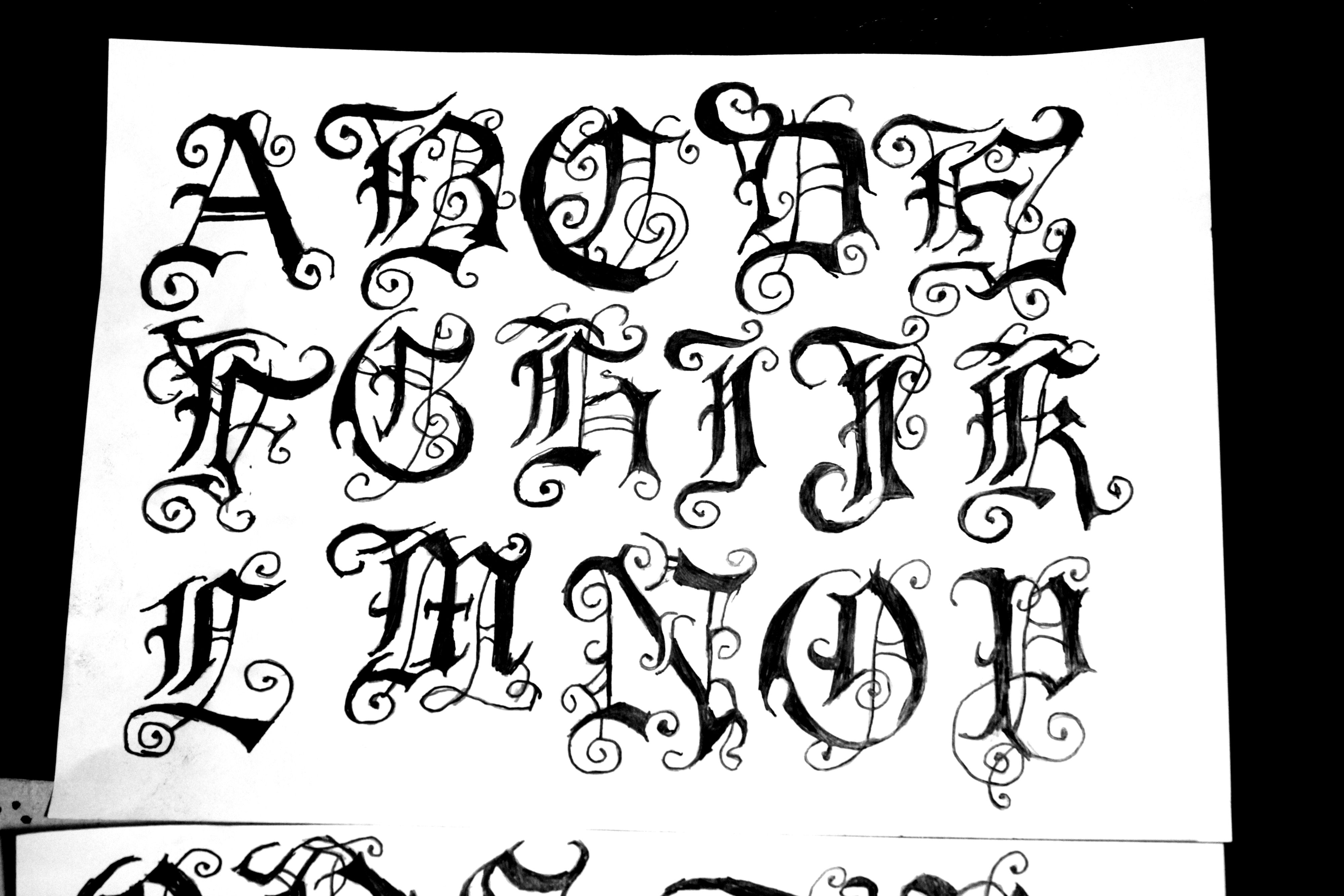
Font names can be very misleading. Say the word ‘gothic’ to most people, and they think of large, imposing old houses with lots of gables, or people dressed all in black with lots of skulls and other symbols of death and horror on their jewelry. And if you search on Gothic Fonts you will be pointed to a lot of fonts that look like this:

I’m not even sure where to begin. Pastor Manning’s most recently posted youtube video explains how NASA’s Voyager spacecraft proves that homos are perverts, with a long digressive rant about rectums. Pastor Driscoll’s supporters have been trying to distance themselves from recently unearthed postings on the church’s forums in which Driscoll explained that god created each woman as a special home for a particular penis.
You can’t make this crazy stuff up!
 Font Folly