Tag Archives: fandom

Stark raving nerd

I didn't manage to collect many badge ribbons this year, alas. But then, I forgot to bring my ribbons to hand out, and trading is where I usually get half my ribbons!
I didn’t manage to collect many badge ribbons this year, alas. But then, I forgot to bring my ribbons to hand out, and trading is where I usually get half my ribbons!
My previous NorWesCon post covered Thursday and most of Friday, but there was a lot more to the convention. My husband had had to work the first two days of the con, and didn’t get to the hotel until Friday evening just before we gathered for dinner. He hasn’t been feeling well since his trip to Missouri last week, so he wound up back in the room trying to sleep while I hung out in the bar with Matt kibbitzing on writing until it was time to meet Sheryl and Jon for the Burlesque show. It’s been several years. The last time I attended one at NorWesCon, a friend of mine was friends with several of the performers and had been the seamstress for at least one performers’ costume. I think that might have been more than 10 years ago.

The burlesque show is essentially a series of strip tease acts, often with sci fi/fantasy themes. And usually most of the performers are women, so you might understand why I, as a queer man, don’t attend often.

But they are fun shows, and more about performance and comedy than sex, so I probably ought to go more often. Matt was carded at the door, which was amusing. Jared, who was not attending, happened to text me having just realized I was at NorWesCon and asked me to take pictures. So I teased him about the fact that I was about to watch a strip show where they didn’t allow photography and too bad he wasn’t with us. There was more teasing, of course.

After that I headed back to the room to collapse into bed. Michael was asleep when I got there, but a few hours later when I woke up with a painfully stuffed head because of allergies he was awake. Not voluntarily, by any means. He was feeling even less well. He took another shower, and we commiserated about our various symptoms. After letting some fresh air into the room and waiting for more meds to kick in, I was able to get back to sleep, but apparently Michael didn’t. Before going to breakfast we discussed how to proceed since he was feeling so sick, couldn’t get comfortable in the hotel bed, and the small shower stall wasn’t conducive to soaking (which would have helped his knee which is still recovering for the recent injury).

The upshot was that he headed back home on the train. I tracked him until he was home. He had planned, when he left, to do a long soak in the tub, but he said by the time he was back he just collapsed into bed and sleep the rest of the day.

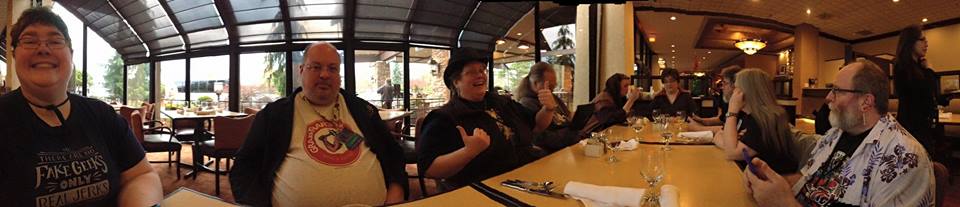
Auntie, Kehf (as Aunt Baru), Keith, Juli-sans-e, me, Jeff, and Geojlc at dinner.
l to r: Auntie, Kehf (as Aunt Baru), Keith, Juli-sans-e, me, Jeff, and Geojlc at dinner. (Click to embiggen)
So he wasn’t there when a big bunch of us had dinner and Julie and Jeff teamed up to take these panaramic pictures of us.

Geojlc, Mike M, Julie avec e, Mark trying to hide behind his hand, Auntie dressed as a Tatoinne Animal Control Officer, Kehf (still as Aunt Baru), Keith, Juli-san-e, and me again.
l to r: Geojlc, Mike M, Julie avec e, Mark trying to hide behind his hand, Auntie dressed as a Tatoinne Animal Control Officer, Kehf (still as Aunt Baru), Keith, Juli-san-e, and me again. (Click to embiggen)

After thoroughly confusing the wait staff multiple times with our orders and requests, I was sent off to my room to get my box of games and meet up and Juli and Keith’s room. We wound up playing four games of Give Me the Brain, none of which I won before deciding to call it a night.

Sunday morning I was a little slow getting up. I always have a hard time packing up the room on my own. It’s not just that two of us pack faster and can carry more per trip, it’s mostly that my husband is really efficient at this sort of thing, and keeps me focused. I have a number of friends who describe their distractabiliy as a super-power (to the point of at least one calling herself Distract-a-Girl!), but I think my brain is an entire horde of distract-a-minions. So even though I had a lot fewer things to pack than usual, it took me about three times as long to get everything out into the car and confirm I hadn’t left anything in the room.

Which made me a couple minutes late for the Why Representation Matters panel. But I’m glad I made it, not just because it was the third or fourth excellent panel that I got to see the fabulous Lisa Bolekaja in, but also because Paul Constant, whose book reviews I have been reading for many, many years was on it, and I finally got to hear his voice to place to the reviews. And it was an excellent panel.

I went to a lot of good panels, and really enjoyed all of them. Our last NorWesCon, a couple of years ago, had been less than fabulous for a variety of reasons, one of them being that, other than Auntie’s Seattle Opera Costume Department Trunk Show panel, none of the panels I went to felt worth my time (which is why I walked out of a couple). This year there were many hours where I had to choose between several panels that looked really interesting. I know the concom has been making efforts the last few years to shake thing up in programming, bring in some new blood, and so on. So that seems to have paid off. It also doesn’t hurt my perspective that I skipped two years. And this year I wasn’t a panelist, I wasn’t running a fan table, nor helping run someone else’s fan table, and otherwise had no obligations at all.

I didn’t even do my usual trick of stealth covering a volunteer shift or two in a department that is run by one of my friends.

I did hang out with my friends, though some of them less often than I would have liked. I introduced Keith to a new cocktail. I had buffalo wings just about every night. I got nicely squiffy at least one night. I did a pretty good job on my blood sugar all weekend. I picked up a pony plush, a set of pony key right charms, a sonic screwdriver earring, an Ash vs Evil Dead t-shirt, and birthday presents for two friends. I was given a Grumpy Cat as Dungeon Master t-shirt.

I met some cool new people, wrote down a lot of links to interesting web sites and have added a bunch of books to my “need to get this” list. Not to mention several new authors to follow.

For many, many years I would always buy our memberships for the next convention before we left. Three years ago, at the end of the con neither of us was certain we wanted to attend the next year, which is what led to us skipping in 2014 and ’15. I had a good time this year, but I had forgotten to ask Michael before he left Saturday what he thought. So Sunday morning I sent him a text (not certain whether he was awake or not). He replied about 20 minutes later that yes, we want to come back next year. So I’ve purchased our memberships for NorWesCon 40, and look forward to attending next year!

This, by the way, was the most awesome thing shown at the Movies and Previews panel Friday morning at the con:

It's a Mad Mad Mad Max Fury Road – Trailer from Monkey Blood on Vimeo.

(If embedding doesn’t work, click here.)

It’s a nerd, nerd, nerd, nerd world!

NorWesCon 39
NorWesCon 39
So I’m at NorWesCon. I really missed this con last year.

My plan had been to pack Wednesday night so I could load the car and leave relatively early in the morning. But I was so tired when I got home from work that I had to take a nap. I slept for several hours, woke up with a nightmare (a really nasty one, too; I was frankly surprised that I hadn’t woken my husband, since it was the sort where I often start talking loudly in my sleep). So I got up and tried to write for a bit, then went back to sleep. And had another nightmare. Then woke up to hear my husband in the shower (he’s working Thursday and Friday and isn’t joining me at the con until Friday evening). I said goodbye to him as he left for work at his usual oh-god-o-clock in the morning, fell asleep, and had yet another nightmare.

All different nightmares, none of them anything to do with anything that I can think of. The important part is that while technically I was mostly asleep for a total of about 13 hours, I didn’t really feel fully rested. So I hadn’t packed and I wasn’t at my best, mentally.

Then I had a weird problem with backing trying to back up the laptop before I left. The upshot was, I didn’t leave the house to head to the convention until almost noon. Still, I got to the con hotel while there were still parking spots available. I managed to get one very close to the wing where my room turned out to be totally by luck.

I found Kehf fairly quickly, got the room keys squared away, then went to get in line to pick up my badge and only when I got up to the cashier did I learn of the new-ish (since I haven’t been here for two years) policy about bringing your signed statement with a bar code, so I had to go get in another line to get that printed out, then get back in the original line. And I wouldn’t have been grousing when I got to the second line if I hadn’t gotten to witness a con staffer essentially yelling at another attendee for the horrible sin of having not seen the email telling them to bring the signed statement.

Having been a con staff member at several different-sized conventions, who once unloaded on a particularly bothersome attendee, I know that I live in a glass house–and therefore should not hurl stones. (In my defense, that incident happened when I came down very sick at the con, and it turned out I was running around doing my programming director job while running a 104º fever, but it still means I was less than professional while being staff, so I get it.)

Anyway, Matt and Sheryl commiserated in line with me, and invited me to meet them for some lunch when I got out of line. I think my grousing was at least as much due to a less-than perfect blood sugar situation as anything.

We ate, then went off to panels. Sheryl and I had picked the same panel at 5, while Matt and I had picked the same one at 6. One was on “Any Tool Can Be a Weapon” which was a good discussion. The other was a writing panel, specifically ways to figure out your own methods to be productive. Also a good panel.

I had accidentally said yes to two different people for dinner (I thought I was agreeing to Friday night in one). I wound up hanging in the bar with Keith, Juli sans-e, and Mark. We saw Edd and waved him over, then saw Kehf and Auntie and waved them over. I also got to visit with Julie avec-e and Mike. Amy dropped over for a bit and introduced me to “Adult Wednesday Addams” and how did I not know about this before!

After we had hung out for a while, I went back to the room intending to get some writing done, but mostly wound up catching up on social media and taking care of some of the Camp NaNoWriMo prep. Speaking of which, if you have a creative project that you would like to work on in April, you should look into Camp NaNoWriMo. It’s a little bit more low key than National Novel Writing Month. Unless you want it to be a competition. In which case, we can do that, too.

Friday was mostly about running to panels, though I did wander the dealer’s den with Mark. I picked up some cool sonic screwdriver earrings and also found birthday presents for two friends. Woo!

Most of the panels I went to during the day were writing related. I still think the most interesting new thing I learned was at the weapons panel Thursday afternoon. But I got useful and intriguing stuff at all of Friday’s panels, too.

My husband took the train from Seattle after he got off work Friday, so I feel a bit less disjointed. It is weird; we’ve only spent a few minutes alone at the con, but knowing he’s here at the hotel with me makes me feel less incomplete. It is weird being one of two introverts (who are learned extroverts) in a relationship. There’s probably several blog posts in there, now that I think about it.

The upshot is, I am really glad to be back at NorWesCon after skipping a few years. And there are still two days of awesomeness to go!

Performative badass—fannish or otherwise

200_sThere once was a fan artist whose schtick at conventions was to viciously attack and destroy plushies. He had a particular hatred for plush toys based on animated characters from programs that he disliked: Smurfs, for example. People would intentionally bring such plushies to his table in dealer dens or artist alleys and watch him scream and shout and foam at the mouth (not always figuratively)… and tear the thing to shreds.

A lot of people thought this was funny. Not just a teeny bit funny, but funniest thing ever in the history of funny things.

The first time I saw it, I was horrified. I was on the other side of the room, looking at some artwork in an artist’s portfolio, when I heard an angry shout. I barely got turned around to see what was happening before this man was standing up, screaming angry insults at what looked like a cowering young man. He lunged across the table, grabbed something (I couldn’t tell if it was a teddy bear, or what), screamed more angry insults punctuated with the phrase “Die! Die! Die!” and proceeded to shred the thing.

This was in the late 1990s, so I didn’t have a cell phone. If I had, I would have been calling 911. I thought this stranger had literally lost his mind. I thought someone was being assaulted.

And half the room (it was a dealer’s den at a smallish/medium-sized convention, so maybe 35-40 dealer’s tables, maybe a couple hundred people in the room) started laughing. “What the heck?” I said aloud. A fan I didn’t know standing next to me said, “Oh, that’s just so-and-so killing another Smurf.”

It was his schtick or signature move. Something he was known for. Everyone knew it was just an act. Several people assured me that he was really quite a sweet guy. He only did it when he knew the person wanted the plushie destroyed. It was all in good fun.

Unless, of course, you weren’t in on the joke. Like me. My heart was pounding like a trip hammer during the display. I was trying to figure out how to get over there and pull the person whose toy was being attacked out of danger. I was wondering why the hell no one else was doing anything. And I bet I wasn’t the only person in the room who didn’t know about this guy and his act.

Over the next few years I had other interactions with the same guy. Online he tended to be a curmudgeon and a crank. If he knew who you were and considered you an established person in fandom, and you happened to disagree with him, his arguments would be snarky, but he’d concede that you had the right to an opinion. If you weren’t in that category, he was a full-fledged asshole.

In person at conventions where I was staff, he behaved in a civil if gruff manner in our exchanges as long as things were going his way. He groused and grumbled and sometimes threatened if things weren’t. When I wasn’t staff, or when I wasn’t clearly identified as such, how polite he acted depended on whether there was an audience, and how big. If the dealer’s den was relatively quiet and he was browsing at my table or the table next to mine, he was soft spoken and almost friendly. If there was a crowd around, he would find reasons to declaim opinions, usually negative opinions, loudly and with colorful language.

I had a very hard time believing that he really was a sweetheart. Yes, some of his behavior was an act. The destroying plushies thing, once you had witnessed it a few times, had a rhythm and repeated sequence of phrases. He was performing. It was part of his brand. Exactly how behaving like a deranged ax murderer toward harmless toys was a brand worth perpetuating I wasn’t very clear about, but that’s what it was.

Performance or not, that doesn’t mean that everyone who witnesses the performance enjoys the experience. Particularly, like me the first time, if you aren’t in on the joke. Even once I was in on the joke, it was still upsetting. I’m a collector, and one of the things I collect is plushies. Anyone who has been to our house has seen that we have otters and tigers and teddy bears and other cute plush animals lined up on top of the bookcases and stashed in other locations. Some of those plushies have a lot of sentimental value. There’s a particular floppy tiger plush that was one late husband’s, for instance. There is a particular mouse in a Christmas scarf that my late husband gave me one Christmas that I have an incredibly strong emotional attachment to. Every time I have witnessed the performance of the destroy the plushie routine at a convention, part of me has wondered how does he know that the person carrying that thing past his table was in on the joke and wanted it to happen?

Call me a softy, but thinking of that happening to an unsuspecting person’s possession by mistake is almost as upsetting as seeing the act without warning was the first time.

If you’ve been involved in any fandom for any significant length of time, you’ve met or seen someone like kill-the-plushies guy. He or she has a schtick, whether it be:

  • partially disrobing in public spaces, declaiming loudly about body positivity, and daring people to be offended;
  • or making sexual gestures and comments at anyone and everyone while commenting to the significant other of said person about how lucky they are to have “that”; 
  • or pontificating loudly about people who don’t have respect for the classics while denigrating some new popular thing;
  • or spinning long humorous tales about how clueless some people are;
  • or being exaggeratedly offended at something and going on long, grandiloquent rants;

…and so forth. 

I’ve been thinking about that guy (and many other fans and pros I’ve known who have a reputation that their badass or angry or asshole behavior is just a schtick or a joke they do), while reading reactions and continued attempts at defending the things that happened to Mike Oshiro at ConQuesT.

Many of the defenders are using variations of the “it’s just a joke” excuse, of course. But there are other similar elements, as well. The fellow panelist who briefly defended himself (then deleted his comments) on the original post by saying, “We’ve been on panels together at conventions before” and “I thought we were friends” is essentially saying, “You should have known it was just an act. I’m really a sweetheart.”

But I think that the notion that he or she is really a sweetheart once you get to know him was also part of the brand. It is just as much a performance as the outrageous behavior. The outrageous behavior is only accepted by some of the audience because they know it’s only an act. They are making a choice when to treat someone with respect, and when to be a badass.

And the fact that often their attempt at apology is to simply say, “But I didn’t mean it that way. I thought you were in on the joke” is all the proof you need that the “sweetheart” part of the act is the least accurate representation of their true nature.

Problematic conventioners, take two

Secret Masters Of Fandom unoffical beanie.
So the Mark Oshiro post has kicked off a lot of discussions all over the place. In other words, I was not the only person who linked to it and commented. One of the more interesting revelations is that one of the ConQuesT concom members was so upset that the rest of the committee refused to do anything that she resigned from the con a few months back. She posted her version of the situation here.

File770 has an extensive post, with links to several other comments and additional information, and a very long comment thread (which has remained mostly civil): Mark Oshiro Says ConQuesT Didn’t Act On His Harassment Complaints.

I’m more than a bit disappointed in how many people are still jumping to the defense of a couple of the harassers with re-treads of the “can’t you take a joke”/“But everyone knows she didn’t mean anything by it.” One version of that which has surfaced a few times in regards to the person who has a history of taking her pants off at panels is, “she does that all the time; I’m not offended by it; Therefore it isn’t offensive and there’s something wrong with you if you think there is.”

This is an old defense that has been used to excuse sexual harassment and sexual assault for decades. A woman complains that she was made uncomfortable by someone who kept commenting on some part of her anatomy, kept crowding in on her, et cetera, and people say, “Oh, so-and-so does that all the time, but he’s harmless!” By which, presumably they mean so far as they know he has never murdered anyone, or raped anyone at knifepoint. This completely ignores the fact that the leering, crowding, groping, or whatever that he does do makes the person feel very uncomfortable, unsafe, and completely obliterates any enjoyment she gets out of the activity/convention/party/panel whatever.

Similarly, the pants situation this time isn’t just about whether it is offensive for a woman to stand around wearing a pair of mens boxers as outerwear, it’s whether after dropping her pants bumping into and continuously rubbing up against another panelist who has previously indicated he isn’t comfortable with that behavior is an acceptable way to behave. Never mind whether it is conducive to a serious discussion about tolerance for a panelist to do that on stage at the panel.

To switch sides for a moment: I’ve been on the other side of the “is it offensive” debate. There are still people (they got quoted in some of the news stories after the last Hugos, for instance), who angrily insist that even including a platonic gay relationship in a story/movie/TV series is deeply offensive to them. Heck, there were calls for boycotts because a black actor was cast as a stormtrooper in the new Star Wars movie, not long after the calls for a boycott of one of the official Star Wars tie-in novels because it included a gay character. I totally understand that someone merely saying that something is offensive is not justification for utterly banning that something. For those people, seeing me simply giving my husband a quick peck on the lips before heading into a panel room completely squicks them out. And I refuse to stop being who I am just because some bigots think they have a right to live in a diversity-free world.

So, I understand that the woman who takes her pants off may be trying to make a statement about body positivity, and about women being in control of their own bodies and having a say in how they dress. I understand that I don’t have a right to veto her choices about herself. But if I happen to be on the panel with her, my lack of a veto over how she dresses doesn’t mean that I have no right to be upset if she rubs up against me, leers at me, and otherwise tries to turn me into a prop for her performative critique of societal norms. My lack of a veto over her sexuality or identity doesn’t mean I have to participate at that level.

Related to all of this, our local furry convention seems to have finally self-destructed: What really killed RF2016 was RF2011 to RF2015. Yes, I said finally. I know it isn’t nice to pile on when someone is already down, but there were very clear warning signs early (as the person, a recently resigned conchair, who wrote that post-mortem alludes to) that the concom had serious problems. The ones mentioned in the post are bad, but they were the tip of the iceberg from my experiences: as an attendee, as a dealer, as a panelist, as someone who offered to help on staff, and as someone who filed multiple reports of times the convention didn’t adhere to their own policies. The thing that actually brought them down was failing to deal with misbehaving attendees, but that was only a symptom of a deeper problem—just the most obviously expensive symptom.

These things don’t have to kill conventions, though.

Last summer, after the incident of the drunken writer contacting the local police to file a false report that one of the WorldCon guests of honor (with whom he had a political disagreement) was a dangerous person who might commit violent acts at the con, Lydy Nickerson posted a lengthy post about her own experiences as a staff member dealing with problems at conventions over the years: Harassment: What do we do? It’s really well done. She lays out a lot of real scenarios and explains the options and how to take some mitigating circumstances into account and so on. It is really worth a read.

Convention problems and problematic conventioners

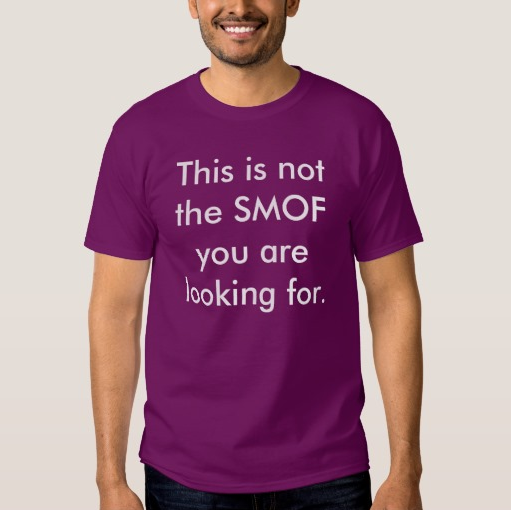
SMOF = Secret Masters Of Fandom . Shirt by the DannyBirtStore www.zazzle.com/thedannybirtstore
SMOF = Secret Masters Of Fandom . Shirt by the DannyBirtStore http://www.zazzle.com/thedannybirtstore (Click to embiggen)
Recently a lot of stories have appeared on my various social media streams about problems at sf/f conventions. Problems at conventions are nothing new, and are certainly not unique to fandom. I’ve written before about bad behavior that matches or beats any fandom convention horror story at professional trade shows and even an evangelical Bible conference I’ve attended.

At least one specific post over the weekend warrants some commentary: Mark Does Stuff – TRIGGER WARNING: For extended, detailed… | Facebook. Mark Oshiro was invited as a Guest of Honor to ConQuesT, where he and his partner were sexually and racially harassed both on and off panels, treated very strangely by con staff (including the chair) at Opening Ceremonies and the GoH dinner, and so on. It is not a pleasant story to read, and even more infuriating to see how the con staff many times assured him things would be taken care of, then months later told that no action would be taken on any of his complaints.

He concludes the tale with this explanation for why he’s going public:

Harassment is unfortunately a part of my experience at SF/F conventions. Not at all of them, but at most of them, something happens to me. I’m an outspoken queer Latinx, and it’s inevitable. However, since ConQuesT, every con staff that I’ve had to make a report to has dealt with my report quickly and fairly. At ConFusion this year, the concom dealt with my incident report in two hours. Meaning they spoke to the person and that person apologized to my face within two hours. At that point, it almost seemed comical that over half a year had passed, and both ConQuesT and Kristina Hiner did nothing at all.

That’s why I’m talking. I did what I was supposed to. I kept quiet, I trusted the system in place, and it completely failed me. I will not be attending ConQuesT this year or for the foreseeable future. (I’m going to WisCon for the first time instead!) I don’t feel safe there, and ultimately, that’s why this bothers me so much. There are people who are part of that community who were actively hostile to me, and when I reported them, the message was sent loud and clear:

We don’t care about you. At all.

It left me wondering why a convention would invite someone to be a guest of honor, then treat them this way. I can come up with a number of explanations, but even the most benign ones still leave no excuse for not dealing with the harassment incidents.

A certain number of responses (both at Mark’s original post and on various blogs reacting to it) trot out the usual blame the victim/blame no one defenses. 1) Surely if Mark had simply politely asked the harassers to stop everything could have been avoided, and 2) Con staff can’t prevent bad behavior and certainly can’t be expected to anticipate everything that might go wrong.

The first defense, besides ignoring Mark’s account that he did ask and otherwise signal his discomfort multiple times, completely overlooks the fact that speaking up for yourself, no matter how politely, often leads to even worse consequences than the original harassment. When folks are confronted about their offensive behavior, they frequently deny and escalate. One example happened in the comments of Mark’s posting (which was subsequently deleted, but not before someone took a screencap of it).

The second defense contains truth, but is also very misleading. Three of the problem people named in the post have been known to say and do those (or substantially similar) things at previous conventions. The panelist who took her pants off and kept bumping up against Mark and making weird faces even said, at the time, that she had gotten in trouble for doing that sort of thing on panels at that very convention previously! Con staff can’t predict the future, but surely they can remember problems from previous years?

I get it. I’ve worked on convention staff many times. My jobs have ranged from very low level gopher to being in charge of programming and vice-chair. I understand that the con staff is all-volunteer, always overworked, always understaffed, always juggling lots of things, and frequently doing all of this on too little sleep and without enough time. I understand that no one has time to vet every panelist. I get all of that.

And I’ve been on the other side. I’ve said and done things I realized later that I shouldn’t have. I’ve had to go apologize to people. I’ve been in situations where I should have apologized but wasn’t able to for various reasons. And sometimes when I’ve been confronted about something I said and did, instead of taking the complaint to heart, I’ve denied and gotten defensive—aggressively defensive. So, I understand and empathize with those people, too.

Some folks are defending the other panelists by trying to say it was all in good fun, or it wasn’t meant that way (whatever that means). You know, that’s exactly what bullies say when they get called out. “I was just joking around. I didn’t mean anything by it.” You can hurt people without intending to. You can make people uncomfortable without intending to. Your intent doesn’t change how the person felt while you were behaving that way. Just as saying you didn’t mean to break something doesn’t magically repair the broken thing.

If you sincerely didn’t realize what you were doing was making someone feel uncomfortable or unwanted or despised, it is all right to mention that in your apology. But the rest of the apology has to be sincere. “I didn’t realize how my actions affected you at the time. Now that I understand, I deeply regret what I said and did. It was wrong to put you in that position. I will try not to do that to you or anyone else ever again.” Something like that is a real apology and shows that you value the other person.

While the “Can’t you take a joke?” sort of reactions just confirms your utter disregard for anyone other than yourself.

Bikini armor madness

I’d had a half-baked idea for a follow-up to yesterday’s blog post, but then a friend posted a link to a tumblr that covers several of the ideas I was going to talk about in a much more funny way:

Bikini Armor Battle Damage The whole tumblr is awesome, but I want especially to draw your attention to three posts:

Not understanding the difference between fictional women and real women

Female Armor Bingo – includes downloadable PDF, rules, and links to t-shirts, mugs, and so forth with the bingo card image.

Bikini Armor Battle Damage: Female Armor Rhetoric Bingo – the perfect companion!

Thank you, Sheryl, for the link yesterday! You’d think, since I already follow The Hawkeye Initiative, Fake Geek Guys!, and Fake Nerd Guys that I would have already known about this, but no, I had missed it!

Meta-labels and Sub-genres – loving sf/f in all its forms

https://thehopefulheroine.wordpress.com/2014/01/02/dont-judge-a-book-by-its-genre-an-intro/ (Click to embiggen)
I had two different ideas for this week’s “Why I love sf/f” post. Unfortunately, the one I had gotten furthest along in was turning into a mash-up of last week’s and the one before. The other one showed a bit more promise, and then I saw this post on the Over The Effing Rainbow blog: [Sci-Fi Month] Guest post: Aliette de Bodard – Science-fiction, fantasy, and all the things in between.

Go read it, because she says what I wanted to say, only better!

I went through a long phase where I preferred science fiction over fantasy with a bit of self-delusion along the lines that somehow fantasy was “just making any old thing up” while science fiction required an understanding of science! Likewise, I often expounded the notion that hard sci fi was superior to all others because you were constructing your what-if scenarios inside even more demanding parameters. Somehow I was able to express those beliefs at the same time that I would read and re-read any Andre Norton book I could get my hands on because I always loved them. I’m not sure why it took so long for me to recognize the cognitive dissonance between the kinds of stories that moved me most, and the sorts of stories which didn’t but which I claimed were superior.

Some of it is pure stubbornness: you express an opinion at one point, and then you feel obligated to keep justifying your original statement. But when I finally started to recognize this particular contradiction, that didn’t seem a sufficient explanation. Until I had an epiphany.

The epiphany came from an unusual source. I was watching a recording of a question-and-answer session that sex advice columnist and gay rights activist Dan Savage was having after giving a talk at a university. A young woman had a question about why guys her age would be friendly and sometimes flirty with her and other woman she knew who weren’t “model thin,” but always distancing themselves before things got beyond friendship. Yet she found older men pursuing her. She feared that the older men were desperate because of some other flaw she hadn’t uncovered, and that younger guys were merely shallow.

Dan pointed out a couple of things. One was that every week since he’d become an advice columnist he received at least a couple of letters from straight guys who confessed that they were really attracted to bigger women, but terrified to admit it because they thought it meant something was wrong with them. In an aside, he said that he got similar messages from some gay guys about their attraction to big guys. He said the thing nearly all the letters had in common was that the letter writer was either in their teens or their twenties. At that age, Dan said, guys are still very focused on winning the approval of other guys. So they are much more concerned with appearing to be interested in the things they think others expect them to be interested in.

His conclusion was that a lot of the guys she thought were sending mixed signals were doing just that. They were genuinely attracted to her, but when they recognized what was happening, they bailed because they thought they weren’t supposed to be attracted to that kind of body. So his advice was to go ahead and take men who did express interest at their word, and if they didn’t otherwise set of alarm bells, there was nothing wrong with dating them. But also, she would find when she got a bit older, that there were plenty of guys who always had found her attractive, they just had to grow up enough to stop worrying about the approval of their friends.

I realized that I had started espousing those opinions about sci fi vs fantasty, and hard sci fi vs so-called soft science sci fi, and very cerebral sci fi vs action/adventure sci fi when I was in my teens, and I hardened those opinions in my early twenties. At the time it seemed that the fans I most admired all held that opinion. And the way that libraries often classified various books seemed to reinforce that. All of the “soft” sci fi and fantasy was filed in the young adult section or the children’s section of libraries that divided things up that way. Only the hard sci fi and certain kinds of action/adventure sci fi was over in the adult sections. Clearly fantasy and so forth was for less mature, and therefore less sophisticated, readers.

Bull.

“If you’re going to break a rule, break it good and hard. My personal motto!”
—Aliette de Bodard

Especially since science fiction is supposed to be not just exploring limits, but pushing beyond frontiers into the unknown, we shouldn’t look down on things that vary from the familiar. That’s the whole point, right? It’s timid to worry about whether a story is supposed to go this way, or whether we’re supposed to like a particular kind of story, et cetera.

Isn’t science fiction and fantasy supposed to be about boldly going where no one has gone before?

Ancient Tomes and Living Fossils – how I love sf/f isn’t the only way

“Kids these days will never know the joys of oil lamps and chamber pots”Jason Sanford set off small internet firestorm with a series of Twitter comments that he then collected on his blog as: The fossilization of science fiction and fantasy literature. Some people were upset because they thought he was implying that the classics of sci fi were garbage, when all he actually said was that younger people are reading, watching, and playing newer works and there’s nothing wrong with that. He’s since added a follow-up to clarify his point which included this important bit of context:

A few years ago I was on a SF/F panel about bringing new readers into the genre. I mentioned that SF needed more gateway novels, at which point the other author on the panel snorted and said we don’t need new gateway novels … the Heinlein juveniles are still perfect.

That is the type of attitude which people should fear because it will kill our genre. But new readers not discovering SF/F through the classic authors you grew up on — that’s nothing to worry about.

His critique was not aimed at the classics themselves, but rather at older fans and pros who belittle younger people who first learned to love science fiction and fantasy by encountering newer works, or who lecture people who aren’t familiar with many works published 70 or more years ago, or gripe that “real” fandom is greying and dying off.

Reading the original post and some of the fallout left me feeling a bit guilty for ways that I have no doubt come across that way myself. I do react with great incredulity when a friend, regardless of age, isn’t familiar with a book, series of books, or movie that I consider a classic, for instance. I try to get people to watch some of the old movies or read the old books that I loved.

It also made me wonder about the series of posts I’ve been doing for Throwback Thursday the last 6+ months, the “more of why I love sf/f” posts. I started those posts as a personal antidote to the sturm und drang over the affair of the melancholy canines. Because I read a lot of sci fi blogs, and because I was determined to read all the Hugo-nominated works before filling out my ballot, I knew I was likely to spend a lot of time being outraged and otherwise upset about things people were saying about some types of sci fi. So I decided it would be a good idea to write a weekly post in which I would only talk about something I loved from the genre. Since I like having a regular deadline, I needed to pick a day, and it occurred to me that if I focused on works that were influential in my formative years, then I could post them on Thursdays and tag them as Throwback Thursdays.

So I gave myself that assignment.

These posts have been about things I loved in science fiction and fantasy. I’ve written about works that spoke to me in important ways when I was a kid. Many times I’ve mentioned how a particular story or movie or series gave me hints that someday, when I wasn’t a closeted queer kid living among anti-science and anti-gay evangelicals, life would get better. None of which is meant to imply that people who aren’t familiar with or don’t like any of the things I’ve written about are any less real fans than I am, nor that there is anything wrong with treasuring different authors or works.

Not that anyone probably has, but I think it’s important to acknowledge that I’m an old white guy, and what I experienced growing up is going to be very different for fans who aren’t guys, or white… or whose teen-age years are much more recent than mine.

It’s also important to realize that a lot of things that we loved when we were younger don’t always hold up when we’re older. Before I started the “more of why I love sf/f” posts, I’d written about reading some books by a favorite author from my teens and early twenties, and how difficult some of her books were for me to read, now. Some are fine, but some of them have definitely not aged well. And I felt really bad for not liking some of them as much as I did when I was younger.

Because I’m doing National Novel Writing Month (my project is to finish the revision on two of my fantasy novels) there will be a lot fewer blog posts of any kind from me. And those “more of why I love sf/f” posts take more time than others of similar length, because I research the work and author in question. Yes, I’m writing about things I loved, but in some of the cases they are books or shows I encountered before my teens, so I want to make certain I’m remembering them correctly.

I will resume the posts after November. And I will probably continue to focus on books and stories from my younger days. I mean, I averaged reading more than seven novels a week through most of middle school, for goodness sake! There is a lot of potential material to write about!

Applause from the wrong side

images (1)I was listening to the recent episode of the Cabbages and Kings podcast, Seeing Yourself In The Narrative and found myself nodding emphatically in agreement when the guest, Cecily Kane, observed that “when dudes write fanfic, it isn’t called fanfic.” In the podcast she was referring to a certain Hugo-winning novel from a couple of years ago. I’ve previously linked to an article Laurie Penny wrote, Whose wankfest is this anyway? The BBC’s Sherlock doesn’t just engage with fan fiction – it is fan fiction that makes a similar point.

Everyone claims that they evaluate a book, or movie, or other work of art based on the quality of the work, and not the identity of who made it. But that isn’t true. A woman writes a Star Trek-inspired story in which characters who were not involved romantically on screen are, or the characters cross-over with the characters of another fictional series, and it’s relegated to fanfic archives and looked down upon by serious people. A guy who has had several science fiction novels published writes a Star Trek-inspired story in which the fictional characters cross-over into the real world and discover a strange relationship between the real and fictional world, and it’s awarded a Hugo.

Knowing who did it changes our perception of the quality and importance of the work. Even though we don’t like to admit it.

For example, I have justified my enthusiasm for a movie or television series that everyone else I know thinks is terrible—and that I agree is badly written and/or poorly directed—simply because a particular actor or actress was in it. Similarly, there is an author (who I have written about before) whose activities promoting anti-gay laws and fundraising for anti-gay organizations caused me to pledge long ago that I will never again buy anything that he has written; and when asked my opinion of his stuff, I mention the reasons why I boycott him.

That’s a bit different than the blanket sort of de-valuation that either Kane or Penny were discussing in the above linked items.

And it isn’t just who produces it that matters in the way the powers that be evaluate a work of fiction. Even more important then who is writing it is who we (which is to say, the collective consciousness) believe is the intended audience. Red Shirts wasn’t dismissed out of hand as fan fiction not merely because it was written by a guy, but even more because it was perceived as being aimed at the dude-bros of geekdom. Many things in the story were crafted to appeal specifically to the guys who love space battles and love arguing about whether Han Solo or Captain Kirk would come out triumphant in various arenas of competition.

I want to pause for a moment and point out that I liked Red Shirts, just as I like BBC’s Sherlock. I’m a guy who grew up watching the original Trek series (during it’s original primetime run 1966-69) as well as reading Sherlock Holmes stories. Because I’m also a queer guy, I don’t entirely match the target audience, but I’m close enough for it to resonate. My point isn’t that those sorts of work are inherently bad. It’s that other work which is at least as good (if not better) gets relegated to various ghettos of the arts not because those works are inherently less worthy, but because they are perceived as being intended for the “wrong” audience.

If you have a girl or a woman as your lead character, your story won’t be marketed as serious science fiction or fantasy or mainstream fiction. Instead it will be channeled into Young Adult, or Romance, or some other “specialized” category. Heaven forfend that you have a queer protagonist! That is going to be perceived as a niche work at best.

How do we fix this? The first step is, if you really love science fiction or fantasy, make an effort to find works that don’t fall into that so-called mainstream audience. When you find something that you think is good, buy it, recommend it, look for other things by the same author and buy those as well. If you’re active on Goodreads, post positive reviews of these discoveries. If you bought the book from an online source that lets you rate and review works, write a review. All of those places have algorithms for recommending works to other people, and most of the algorithms are more likely to recommend a work if it has a lot of reviews.

If the work is published in a magazine, whether it be a paper publication or online, write in to say how much you liked the particular story. Let the people who published it and the person who wrote it know that you liked it! If they know there is an audience for that sort of story and that sort of protagonist, you’ll see more of that kind of thing.

If you find yourself wishing there was more work that has a particular kind of protagonist or is set in a particular kind of world, consider writing it yourself. Sometimes the only way to get more good art that includes us is to do it ourselves. And that’s okay. Because no matter how unusual you may think it is, I guarantee you that someone else out there is looking for it, too.

We are all Hugo…

Ambassador Kosh, Babylon 5 © PTN Consortium.
I promise that after today there won’t be anything about the recent sci fi fandom kerfluffle on this blog until Friday links. Absolutely none. However, there are several interesting conversations happening in the immediate aftermath which I want to share and make at least some comment upon.

Since we now have the rest of the nomination results, it is possible to see what works would have been on the ballot if not for the slates. Here is one such guess: Alternate Timeline Hugo Awards. This list includes some very interesting things that I wish we had had a chance to vote on.

The next headline isn’t entirely accurate. While George disapproves of any slate voting scheme, the purpose of his reviving his Hugo Losers party and this year handing out his own awards was to try to protest the deep schism and animosity: George R.R. Martin Holds Additional Ceremony After the Hugo Awards to Protest ‘Sad Puppies’. Years ago Martin founded the original Hugo Losers party, where people who were up for a Hugo that year could get together and tell each other they should’ve won… to wallow a little, yes, but also to commiserate, laugh at themselves and each other, et cetera. He let other people take over organizing it for years, but this year because of all the animosity flying around from every direction, decided to take it back. He rented a bar, invited anyone who has ever lost to the party. This year’s winners were also invited, but had to wear a conehead if they stayed. George had a bunch of trophies made, which he called Alfies, in honor of the late great Alfred Bester, and handed them out to people who would have been on the ballot, based on the nominating numbers, if you remove the slates. He handed out a few additional ones of his own choosing. By all reports, people had a good time.

Why We Need Queer Escapist Lit. I get tired of having to defend wanting to see characters that are like me in my favorite genre. But we have to keep doing it.

The false narrative that a lot of people on both “sides” of this issue often fall into is the idea that people of color, women, and queer people have only recently begun reading and/or creating sci fi/fantasy. This helps explain a big part of why that’s wrong: We’ve Always Been Here in the Fandom. Why the WIRED article on the Hugos misses the mark.

Equally problematic is that the frame of reference of people on one side is so utterly disjoint from the frame of reference of people on the other side, that a lot of our attempts to debate have merely resulted in us talking past each other. Hugos & Puppies: Peeling The Onion.

“When it comes to debating strangers with radically different perspectives, you sometimes encounter what I refer to as Onion Arguments: seemingly simple questions that can’t possibly be answered to either your satisfaction or your interlocutor’s because their ignorance of concepts vital to whatever you might say is so lacking, so fundamentally incorrect, that there’s no way to answer the first point without first explaining eight other things in detail.”

There are other differences, of course: On the SF/F genre and a-holes.

“We all have conservative friends and acquaintances who aren’t a-holes, and we don’t seem to have a big problem with them unless they’re crazy bigots like [Vox Day]. We have a problem with a-holes.”

On the Hugo Awards controversy, Sad Puppies, and why there are no winners here.

“…I haven’t voted in several years, when I did I voted for stories that I loved (plus, to be honest, stories written by my friends)—as do most readers. If readers deliberately voted for stories about gay characters and people of color, perhaps it’s because [those stories] speak of “alienation,” which a great many readers of science fiction happen to have experienced (readers of science fiction tend to be natural outsiders).”

This may be my favorite read today: How the 2015 Hugos proved against all odds that SF is becoming more international and more diverse. There is just so much here to like. She links to some of the same posts I have above, but also to a whole lot of others. She pulls long quotes from people and does some analysis and rebuttal. One of my favorites is in response to a Sad Puppy supporter who agreed to be interviewed for one of the news site’s stories, but didn’t want his name used:

“In many ways this quote by the unknown puppy clearly illustrates the attitudes that already became obvious in Brad Torgersen’s infamous “Nutty Nuggets” post. A lot of puppies don’t just want works they don’t like to be excluded from the Hugos, they deny works they don’t like the right to exist period. They don’t want these works to be published, they don’t even want them to be written at all.”

She segues away from the Puppies and spends most of her post talking about the works that did win. I especially like this point:

[B]oth Hugos in the two fiction categories that actually were awarded went to translated works by non-anglophone writers, which is a first in Hugo history. Coincidentally, both are also the first Hugo wins for their respective countries of origin… I’m happy that they won, because their wins show that the Hugos are becoming a more truly international award. And yes, it’s problematic that a white Dutchman and a Chinese man, two writers who have nothing in common apart from the fact that English is not their first language, are both subsumed under the header “international SF”. But given how Anglo-American dominated the Hugos and WorldCon have traditionally been, it’s still a great step forward.

I’m skipping a lot. Her full post is really worth that read. I hope you give it a look.

Those of us who love science fiction and fantasy are going to be talking about this a lot over the course of the next year. Both the Sad and Rabid Puppies are vowing to be back. Vox Day, leader of the Rabids, is specifically threatening to leave a “smoking hole” where the Hugos once were. So the rest of us are going to have to make sure we participate in both the nomination portion and voting portion of the process next year.

Because the avalanche may have already started, but contrary to the Vorlon proverb, in this landslide, each pebble has a vote, and we can make them count.