Tag Archives: lgbt

Why we need Pride

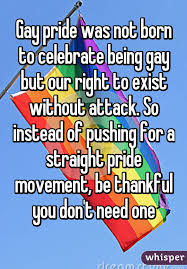
12480058_240x240_FEvery year as the date of the local Pride Parade approaches, I start seeing the comments and questions: “If you get a Gay Pride Parade, why can’t we have a Straight Pride Parade?” I can’t decide which is the saddest aspect of this question: 1) that they think this tired old canard is actually being clever, 2) that they don’t understand that 99.9% of all television, movies, news, and other public discourse is geared toward affirming heterosexual life, including straight sexuality (so every day is already Straight Pride Day), 3) that they don’t understand that Queer Pride events are about our very right to exist—an act of defiance against those who want us to be invisible or dead—not merely our right to party, 4) that no one is is stopping them from organizing their own straight pride events (even though I think they’re redundant)?

This year there is a new wrinkle. Some of my less-than-affirming relatives have (after trotting out the thoughts and prayers nonsense) urged me not to go to Pride, because they don’t want me to get hurt if something happens. They make these comments completely oblivious to the fact that the anti-gay memes they share online every day, the anti-gay initiative for which they signed the petition to place on the ballot, the angry calls they say they make to their congressperson after learning of an anti-discrimination law under consideration, and all the rest contributes to the atmosphere of hate that drives people to violence against queers.

And yes, I’ve also gotten, even in light of the most recent publicly visible horror, a few people asking me what’s the point of Pride. “You can get married, now. You won. Isn’t that enough?” Marriage equality was one very tiny battle, by comparison to what remains. We live in a world where:

That last one is just the tip of the iceberg. It is still really common for people to react to any depiction of a queer person’s life as a queer person with, “Why do you have to show us all the time? Why can’t you just be who you are without labeling everything?”

The saddest part of this is that those people don’t think they are being homophobic at all. And they never think about the fact that straight people “shove their sexuality” in everyone else’s face all the time. Have pictures of your spouse, significant other, or children on your desk, wall, or phone’s home screen? Mention your wife or husband in casual conversation? Comment on how hot a particular actor or actress is? 99.9 percent of all movies and TV shows depict opposite sex couples flirting, kissing, and more? Routinely ask about family discounts? Expect that, of course, your spouse will be included in the company health insurance plan? Invite us to your wedding or your kid’s straight wedding? Show us pictures of yours or your kid’s straight wedding? Ever use the phrase “no homo”?

Since we get accused of shoving our sexuality in your face if we merely casually mention the existence of our significant other, we get to count all of those things as you shoving your sexuality in our faces.

Why do we need Pride?

  • We need Pride because people are still trying to kill us.
  • We need Pride because religious leaders are still cheering on the people who kill us.
  • We need Pride because people accuse us of “stealing the tragedy” when 49 of us are murdered in a gay night club on a busy Saturday night during Pride month.
  • We need Pride because people still target gender non-conforming children in schools, and now adults aren’t just making excuses for the bullying, they want to pay the bullies bounties for doing it!
  • We need Pride because it’s still legal to fire us just for being gay in 28 states.
  • We need Pride because people are more offended at the idea of selling us a wedding cake than they are about 49 of us being gunned down in a single incident.
  • We need Pride because people get angry when other people acknowledge our existence.
  • We need Pride because people get offended if we mention the gender of our significant other in casual conversation.
  • We need Pride because religious parents still kick their queer children out onto the streets just for being gay, and it isn’t considered child neglect or abuse to do so.
  • We need Pride because queer kids are born everywhere, not just into families and communities that love and accept them, and they need to know that they aren’t alone.
  • We need Pride because the world tries to make us hate ourselves, tries to make us be ashamed to love, and most importantly tries to convince us we are utterly alone.

The only way queers like me have been able to stand up and be ourselves is because other queers before us were brave enough to be out—whether it was staging sip-ins to protest laws that made it illegal for a bartender to knowingly allow two homosexuals be served in the bar, or fighting back when police raided a gay club, or picketing in front of federal buildings, or marching in the first ever Pride event in June 1970. Those of us who can stand up for ourselves now, owe a debt to the sacrifices those earlier generations of queers made. We can’t pay them back directly, so we have to pay it forward. We do that by standing up and being counted and being visible for all of the people (especially kids) who can’t, yet.

We need Pride not because we’ve come so far, but because for many there is still a long, long way to go.

Why thoughts and prayers are worse than inadequate

A cartoon drawn by Patt Kelley and posted from his twitter account (@pattkelley) More of his work available at www.pattkelley.com (Click to embiggen)
A cartoon drawn by Patt Kelley and posted from his twitter account (@pattkelley) More of his work available at http://www.pattkelley.com (Click to embiggen)
When horrible things happen, the first reaction of some people is to say that their thoughts and prayers are with who ever is suffering because of the events. It sounds nice. It makes the person saying it appear to be concerned, without actually costing them anything. It is a poor substitute for actually being helpful. This cartoon, which Patt Kelley recently shared on the topic, shows a person on fire, and another person holding a garden hose and spraying water into a bucket rather than putting out the fire. The person with the hose offers prayers, when a means to actually do something about the pain, suffering, and death is right there in his hands.

People insist that there is nothing they else they can do, but frequently they’re wrong. There are things which can be done. Things within the power of the people making that statement. Congress critters of the conservative sort are especially liable, here (but not the only ones). And I don’t just mean in passing laws, though that could often help.

The very same congresspeople who sat in Republican caucus recently and prayed that gays are “worthy of death” made a big show of talking about thoughts and prayers while a lot of the public was up in arms about the Orlando shooting. It didn’t stop them from killing an amendment to extend job discrimination protections to queer people. It didn’t stop them from voting down an amendment to tighten (but hardly close) the so-called gun show loophole. It doesn’t stop them from attending rallies with pastors who call for the death of gays. It doesn’t stop them from telling their supporters that letting trans children use the bathroom that matches their gender identity is dangerous.

They’re not just withholding a water hose. They’re the people who have been splashing gasoline in the direction of every queer person they could for years. They’re the people who handed matches out to lots of people and said, “I don’t condone violence, but god says queers are monsters.”

Thoughts and prayers is more than just a means to look like you care when you don’t. It’s more than just a means to appear helpful while you do nothing. It’s more that just a means to make people focus on your piety rather than the problems of others.

It’s also an attempt to establish an alibi.

If they offer thoughts and prayers, then clearly they can claim they had no idea that all their anti-gay rhetorical was going to encourage another to attack queer people. If they offer thoughts and prayers, then clearly they can also claim that they had no idea that all the anti-trans hysteria they’ve whipped up over bathrooms would make gender nonconforming kids hate themselves to the point of considering suicide. If they offer thoughts and prayers, than clearly they can claim it’s not their fault that queer people grow up filled with fear and self-loathing, driving some to self destructive behavior, while driving some to turn that violence toward others. Clearly, they say, it isn’t their fault that anyone would listen to all the hate they have been spewing and act on it.

Why would anyone ever think they wanted that?

Why do you think god hates anyone?

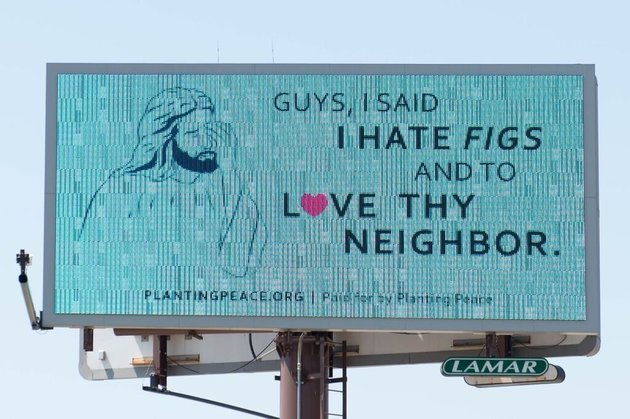
Billboard that went up in Jacksonville, Mississippi this week after the new anti-LGBT law was signed. “Guys, I said I hate figs and to love thy neighbor.”
Billboard that went up in Jacksonville, Mississippi in April after the new anti-LGBT law was signed. “Guys, I said I hate figs and to love thy neighbor.” (click to embiggen)
I was twenty-three years old, sitting in a pew in a church with my head bowed and my eyes closed when the pastor leading the prayer thanked god for sending the plague of AIDS to the world to eliminate the scourge of homosexuality. He went on at some length during his prayer about how the devil has deceived many and led them into a life of sin. And he went further, talking about how the devil also deceives people who think they are righteous, making some people believe that homosexuality is just a choice, like buying a different brand of car than your neighbor, and that we can be friends with depraved sinners such as homosexuals, and still be good Christians. But that notion, he said, was a lie from the depths of hell itself.

It was hardly the first time I had heard condemnation of homosexuality coming from the pulpit, but the hostility of these pronouncements was much worse than usual. It was also a bit unusual for a prayer to have such a long expository lump. Not completely unheard of, but enough to make several people in the congregation shift nervously. The prayer was going on and on for quite some time.

The subject of the prayer was also at odds with the sermon we had just heard. The sermon had been delivered by a visiting preacher. The church was having a revival week, which meant that a pastor from out of town presiding of the services, and the church was having a service every night of the week, rather than just the usual Sunday morning and evening worship service and Wednesday prayer meeting. And the visiting preacher had just delivered a sermon about the unity of the church. Nothing about sexual immorality or the like.

The preacher leading the prayer was not the same man who had delivered the sermon. He was the lead pastor of the church. And the tone of his prayer sounded more like an argument than a supplication for divine favor.

I was trying not to have a panic attack. If the church had been my home church I would have been in even more distress. But this wasn’t my church. I was at this service because I was the assistant director of an interdenominational teen touring choir, and we had been asked to have our smaller ensembles take a turn each night providing special music for the service. The ensemble I led within the choir had sang two songs earlier in the service, and we were scheduled to sing one more for the altar call at the end.

Anyway, among the reasons that I was upset at this unusually aggressive prayer was that I had been, to use the evangelical terminology of the time, “struggling with homosexual temptation” for years. Not that I had ever told anyone. I was too afraid of what would happen if I actually admitted to anyone in my church or family that I even thought about homosexuality.

And I had done more than dipped my toe into the waters of temptation. There had been a several occasions during the previous ten years during which I had taken the plunge right into the deep end.

At the time of this prayer, it had been at least two years since my last plunge. And that had been with a stranger not just in another town, but an entire different country. No one I knew knew the guy—and truth be told, I couldn’t even remember his name. So I didn’t think anyone knew. But still, it seemed that the pastor was aiming all this anti-gay contempt at someone, and as far as I knew at the time, I was the only homosexual in the room.

It was not the first time (nor would it be the last) that, while sitting in a house of worship I would hear people like me described as depraved sinners and tools of the devil. But this time was the most vehement had yet heard.

Looking back on it, years later, I realize that there probably was an argument going on. The visiting pastor’s sermon about unity could be interpreted as a call for factions of the Christian faith to set aside their differences, while the local pastor clearly thought that some of those factions weren’t really faithful. But I couldn’t be objective enough at the time to work that out. I half expected someone to take me aside to stage an intervention.

Except the intervention would have involved people laying hands on me and praying fervently for god to cast the demons out of me. Which had been something I had been fearing since at least the age of eleven. And that didn’t preclude the possibility that other members of the community might waylay me and just beat me up. That very thing had happened to one of my classmates several years earlier. There had also been classmates kicked out of their homes by their families and sent “away” to stay with some distant relatives or other vague described living arrangements.

CkxNItoUYAADQocThe fear of being kicked out of your home, rejected by your parents, siblings, classmates, and neighbors is something that every queer kid growing up in conservative Christian churches live with. A lot of other queer kids know that fear, as well, don’t get me wrong. But when you’re raised to believe that you are among god’s chosen, that anyone who is not a part of this community of faith means that you are destined to drown in hatred and sin, without ever knowing love and eventually spending an eternity in agony, well, it’s traumatic.

It is a bit astonishing that any of us survive it, to be honest. We’ve known for a long time that queer teens are much more likely to attempt suicide than their straight peers, and we know that teens who come from queer-rejecting families are eight times more likely to attempt suicide queer peers who reported no or low levels of family rejection.

It’s not just that the haters are trying to take away the rights of adults, such as myself, who have the means to fight back. They spend years telling some of their own children that god hates them. So there was one bit of that prayer that was correct. This isn’t just a difference of opinion. This isn’t about them saying they want to drive gas-guzzling SUVs, while some of us prefer more fuel efficient cars. They are literally bullying children, sometimes bullying those children to death. And they want the rest of us dead, too: GOP Congressman Who Prayed Gays ‘Worthy of Death’ Weeks Before Orlando Still Has No Apologies.

This is why queer people need to be out of the closet. This is why we need to have Pride parades and festivals and all the rest. This is why it isn’t enough to say “to each their own.” As long as there are kids growing up being taught that god hates them, we need to call out the bigotry for what it is, and stand up for those who aren’t yet able to stand up for themselves.

Why Does God Hate Me? – Gay Short film (LGBT):

(If embedding doesn’t work, click here.)

Weekend Update 6/18/2016: Compassion, mourning, and an epic vogue battle

Ernesto Vergne prays at a cross honoring his friend Xavier Emmanuel Serrano Rosado and the other victims at a memorial to those killed in the Pulse nightclub mass shooting a few blocks from the club early Friday, June 17, 2016, in Orlando, Fla. (AP Photo/David Goldman)
I’m going to be an emotional wreck because of the Orlando shooting for a while. Usually on Saturday I’ll post a few news items that I would have included in Friday Links if I had found them in time along with more commentary than links usually get in the Friday post. Or I post links to stories with new developments related to a story posted previously, also with more commentary.

Most of today’s links are things that made me cry, not because they’re about something awful, but because the story is about something wonderful and loving that people have done in response to something awful. Two of the links were sent to me by one friend. After the second one I replied back, “You keep sharing things that make me cry. Don’t stop.”

What happened when an Orthodox Jewish congregation went to a gay bar to mourn Orlando.

I included this one in yesterday’s post, but it’s worth sharing again to remember that we’re human, and we’re most human when we show each other compassion: Jetblue passengers write letters to Orlando victim’s grandmother.

LGBT community raising millions for Orlando victims.

These Are Some Of The Heroes Of The Orlando Shooting.

Some people are either outright ignoring the fact that this happened in a queer club, on a Saturday night, during Pride month, and otherwise was clearly a hate crime. Many of the jerks trying to further the myth that Islam is attacking America or freedom or whatever. Never mind that of the last thousand or so mass shooting in America, two were committed by muslims, and the other 990-some have been committed by white Christians. Anyway: The Other Group Mourning The Orlando Massacre: LGBT Muslims.

Gay rabbi: We can all mourn Orlando, but this was terrorism against gay people.

Orlando shooting prompts outpouring of blood donations. It’s a good thing all these straight people feel such compassion, seeing how gay men are banned for donating blood. Some pedants point out that technically gay men are allowed to donate blood if they swear they haven’t had sex for an entire year, but as one of my local TV stations reported, Some Seattle blood banks still ban all gay men from donating even if they meet the no-sex in 12 months criteria. I bring this up because the vast majority of medical experts agree that the 12-month rule is ridiculous. Straight people can (and do, lots more than you think) carry the virus that causes AIDS, and no one has suggested a 12-month ban on them. Also, a lot of bi people are closeted, and some so closeted that they would never admit it even in a confidential medical situation, so they’re not going to say. And all blood donated is screened precisely because people may not know that they’ve been infected or may lie about their sexual activity for the reasons stated above.

Enough about that. Another of the “it’s not a hate crime” craziness has been a claim that it can’t be a hate crime because maybe the shooter was a closeted gay man. First, if you don’t understand that a society in which the phrase “closeted gay man” describes a real phenomenon, then nearly all queer people live with a lot of internalized homophobia because of societal pressure, you’re really in a deep state of denial. Also: FBI ‘Increasingly Skeptical’ That Orlando Shooter Was Gay and Closeted.

The case that he was a closeted gay man was built on the fact that he had a user profile on at least one gay hookup app, and reportedly had been seen in the club previously, angrily drinking alone and sometimes becoming belligerent. Oh, and one old college classmate thinks he might have been gay and might have hit on him once. We already know that at least one of the conversations that shooter had on the hookup app with a local gay man consisted of the shooter asking, repeatedly, “what are the most popular gay clubs” and “where could I find the biggest crowds of gay people?” This would hardly be the first time that someone planning an anti-gay hate crime used a hookup app or online gay chat services to scout out potential victims. Or hung out at gay clubs to get the lay of the land. And the old classmate? Please! Both gay and straight men misread signals all the time.

But, we need to end this on a high note, so: Orlando Shooting Vigil In London Turns Into Epic Vogue Battle.

Dancing with my pride

“Still Here, Still Queer, Still Dancing!”
“Still Here, Still Queer, Still Dancing!” (click to embiggen)
I make a lot of playlists. I buy new music, I listen to it a few times, then I start picking out other songs from my library that I think go well with the new music for one reasons or another, and soon I have a playlist or three. Or I’ll be having a conversation with someone, and some turn of phrase someone uses will sound like it ought to be the name of an album or band or something, and the next thing I know I’m constructing a playlist of songs that fit the title. Not to mention the many playlists I put together to help with my writing. I have playlists for specific recurring characters in my stories, and playlists for particular stories, and more importantly playlists for particular plot/character arcs within a story.

And every year during May I start constructing a Pride playlist. It’ll be a mix of new songs and old. What they usually all have in common is that they are songs I like to dance to, and resonate in some way with the celebratory side of being out and proud but especially loud. Or, as Miss Coco Peru might said, a life lived out, proud, loud and just a little bit ridiculous.

Some years I feel like putting in songs that are a bit more dirty and flirty, while other years my include some ballads and either more serious or slightly darker in tone. I also throw in songs that are by artists I’ve been thinking about a lot this year. Which is at least part of the reason you’ll see both Prince and David Bowie make an appearance.

Not all of these songs will mean the same thing to you or even evoke the same feelings, of course. And you may see some familiar titles that make you ask, “How can he dance to that?” Don’t just look at the title, but try to find the exact remix by the same artist. You may find that the cover version of an old pop song you think you know has been transformed into something completely different in the particular track I’ve listed.

Anyway, this is my 2016 Pride Playlist:

  1. “Let’s Go Crazy (Special Dance Mix)” – Prince & The Revolution
  2. “Feelin’ Free” – Sirpaul
  3. “Spectrum (feat. Jo Lampert & Gyasi Ross)” – Ryan Amador
  4. “Rebel Rebel” – David Bowie
  5. “Reach out for the Stars” – Yehonathan
  6. “Revolution (feat. Levi Kreis)” – Matthew David
  7. “What’s It Gonna Be?” – Shura
  8. “Genghis Khan” – Miike Snow
  9. “Get Your Sexy On” – Lovestarrs
  10. “I Wanna Boi” – PWR BTTM
  11. “The Boy Who Couldn’t Keep His Clothes On” – Pet Shop Boys
  12. “Just Stand Up!” – Beyoncé, Mary J. Blige, Rihanna, Fergie, Sheryl Crow, Melissa Etheridge, Natasha Bedingfield, Miley Cyrus, Leona Lewis, Carrie Underwood, Keyshia Cole, LeAnn Rimes, Ashanti, Ciara & Mariah Carey
  13. “How Deep Is Your Love” – Calvin Harris & Disciples
  14. “For You” – Quentin Elias
  15. “The Good, the Bad and the Dirty” – Panic! At the Disco
  16. “Desire” – Years & Years
  17. “We Don’t Have to Dance” – Andy Black
  18. “Feel So Good [Orignal Edit]” – Sean Ensign
  19. “Eddie Baez Donna Summer She Works Hard for the Money” – Eddie Baez Presents
  20. “Only Love Survives (Timothy Allan & Mark Loverush Remix)” – Ryan Dolan
  21. “You’re So Beautiful (White Party Version) [feat. Jussie Smollett]” – Empire Cast
  22. “Breathe Life” – Brian Kent
  23. “Try Everything” – Shakira
  24. “Halo (Gomi Club Remix)” – Beyoncé
  25. “You Are Unstoppable (7th Heaven Remix)” – Conchita Wurst

Whatever music you prefer, never forget: dance with joy, dance with abandon, dance without worrying what anyone thinks, because life is too short to waste time sitting still!

#TwoMenKissing and why the Orlando Pulse shooting was a punch in my gut

d790a0602a60bb6dc97326d6fe8334a0Michael and I had only been dating about four months when it happened. It appeared to be a day just like any other. Back then he lived and worked in Tacoma. Because he worked in a bar, his “weekend” was in the middle of my workweek. He didn’t own a car, so he would often take the bus up for Tacoma, we’d spend a day or two together, and he’d take the bus back. Sometimes I drove him, but most of the time it was the bus. On this one morning, for various reasons, I drove him into downtown Seattle and dropped him off at one of the big bus stops there, and then went on to my office. When I pulled over to the curb we said “good-bye,” leaned in and gave each other a quick kiss, and he got out of the car. I drove off, sad that it would be several days before I saw him again, but happy about the day we had had.

I was oblivious to the fact that as I drove away, a random stranger at the bus stop started harassing him for being queer. Because he’d seen me kiss Michael.

One of our friends has described my husband has “the most capable guy I’ve ever known.” His job history has included working as a bouncer at a not entirely savory bar. He bikes. When he was younger, he rode bulls in rodeo for fun. He’s not a small man. He can take care of himself.

But none of that matters if someone takes you by surprise. Or if you’re outnumbered. Or if you’re just not as good as them. And don’t think that being armed himself changes that equation. You can’t shoot another person’s bullet down in midair. You can’t safely defend yourself with a gun in a location crowded with bystanders—such as a very busy street in front of a bustling office building on a bright sunny weekday morning.

Even though the guy didn’t physically attack Michael that day. Even though Michael survived the incident to tell me about it after, sixteen years later I still have nightmares about how that situation could have gone down differently. All because I kissed him.

That was only one of the nightmares I’ve had this week, thanks to the news out of Orlando.

Eighteen years later, every time we are out in public and I feel an urge to tell my husband that I love him, or to hold his hand, or give him a quick kiss, I have to do that calculation. Are we safe here? Will someone say horrible things? Will someone threaten us? Will someone do something even worse?

A friend shared someone else’s blog post about why the Orlando shooting has so shaken him this morning, which makes substantially the same points:

If I kiss Matt in public, like he leaned in for on the bike trail the other day, I’m never fully in the moment. I’m always parsing who is around us and paying attention to us. There’s a tension that comes with that… a literal tensing of the muscles as you brace for potential danger. For a lot of us, it’s become such an automatic reaction that we don’t even think about it directly any more. We just do it…

We live constantly with the knowledge that there are people all around us who hate us enough to kill us. And this event isn’t merely a reminder of that, it carries another message:

Additionally, now we just got a lesson that expressing our love could result in the deaths of *others* completely unrelated to us. It’s easy to take risks when it’s just you and you’ve made that choice. Now there’s this subtext that you could set off someone who kills other people who weren’t even involved. And that’s just a lot.

That’s why I’m personally a bit off balance even though (or because, depending on how you look at it) I live in Texas and was not personally effected by this tragedy.

The day Michael and I got our marriage license, after 15 years together, thanks to 54% of the voters of our state saying “yes” to marriage equality.

This is part of why I’m taking this shooting in Orlando so personally: the constant knowledge that there are people who will kill me, my husband, and so many more because of who we love. Worse than that, there are more people who will encourage that hate. They may say they don’t hate us personally, and of course they don’t condone violence, but they also say that violence is the natural consequence of our sin. In the same breath they condemn the violence, they declare the violence a result of divine will, and apparently don’t see the contradiction in that. And there is an even larger group of people who sincerely believe they are not prejudiced against us at all, but they enable guys like the Orlando shooter in thousands of little ways, whether it be opposing hate crime legislation, or anti-discrimination laws, or any form or gun policy reform.

This is why I’m long past the point where I can be silent about the hateful rhetoric of people like Ted Cruz, the Family Research Council, the Pope, and everyone else who says that queers are sinners. This is why I can no long sit silently polite and bite my tongue (yet again) when people say that I’m the bad guy for thinking that maybe a guy with a history of domestic violence who was also on the FBI watch list should not have been able to legally buy an assault rifle with no questions asked.

If your first reaction to me or any queer person you know expressing our feelings about this mass murder is to argue with us about gun policy, or to tell us we’re over reacting, or anything other than, “you seem to be taking this really hard, are you all right?” then you may well be part of the problem.

To answer the question that some people I thought were my friends didn’t ask before launching into attack mode this weekend: No, I’m not all right. I’m mad as hell. And I have more than ample reason to be mad.

It is not unreasonable to be upset at this mass murder. It is not unreasonable to ask questions about why fairly simple, non-draconian measures that are supported by a solid majority of voters—and that have been proven to work in other countries—are constantly being opposed by absolutists. It is not unreasonable to want to hold people who have enabled the hatred responsible. It is not unreasonable to hold people who keep enabling a toxic society that turns young men into festering piles of self-loathing and anger responsible. And it is not unreasonable to hold people who don’t just enable, but encourage, the easy availability of assault weapons to people that even they agree shouldn’t have guns in the first place responsible.

I’m not all right. I’m mad as hell. And you should be, too.

There is so much to be pedantic about amidst this horrible news

13432397_10153874492626137_2143268961484960249_nI was annoyed early on in the coverage of the Orlando Pulse nightclub shooting that news sites and individuals on social media all kept claiming that the hate crime was the largest mass shooting in U.S. history. The first reason it annoyed me was because the Wounded Knee Massacre on December 29, 1890 was much bigger. About 300 Lakota men, women, and children were shot to death that day. I understand why no politician alive today wants to acknowledge that. It was the U.S. Army that did the deed, and there is political hay to be made by insisting that it was a battle rather than a war crime, even now 126 years later.

Similarly, the Sand Creek Massacre of November 29, 1864 was also a lot bigger than the Orlando shooting: between 70-163 Cheyenne and Arapahoe men women and children were slaughtered. Again, modern politicians don’t want to talk about it, and certainly don’t want to admit it was a crime, rather than a battle.

That’s not the only thing about this horrific crime that brings out my pedantic tendencies. There has also been a lot of debate about whether this is an act of terrorism or a hate crime. As one friend put it: since the earliest reports that had virtually no details called the attack on a gay nightclub a possible terrorist attack, we knew that that shooter wasn’t white. That’s a not-facetious observation of the systemic racism of police officials everywhere, but there is another serious point, here. A lot of people outside the police want to transform this event into an act of terrorism against America, rather than recognize that the native born American man who decided to slaughter 50 queers in a queer club on a Saturday night during Pride month is a hate crime against the gay community.

As another friend pointed out, all hate crime is meant to terrorize. That’s true. That is the moral and legal justification given for even recognizing hate crime as a category of crime. The intent of the criminal isn’t just to harm the person or persons directly attacked, the intent is to frighten similar people. In this case, to put all queer people on notice that there are people out there who will gladly murder us just for being who we are. And literally for as long as humans have had laws (going back to ancient Sumeria at least!), we have always used the person’s intent as one of the ways to gauge the severity of the crime (cf. the only difference between murder in the second degree and not-guilty by reason of self-defense is the intent of the killer, nothing else).

Of course the politicians and so-called religious leaders who have been trying to deny queer people civil rights, objecting to our lives being even acknowledged, have said that we are immoral and dangerous, and so on want to erase us from this tragedy. They have many reasons for this. The most basic is that they just want to erase us, period, of course. But an even bigger reason they want to erase us is because they don’t want to admit that they have contributed to this crime. Every time they say that it is dangerous for kids to even see us, every time they say we are a danger to children just by being in a public restroom, every time they say that god is going to judge America for giving us some rights, every time they say queers are “ultimately destructive to society,” it encourages hatred and violence toward us.

Some religious leaders get it: Florida Catholic bishop: ‘It is religion, including our own,’ that targets LGBT people. And thank you, Bishop Lynch for at least admitting that. But what are you going to do about it?

Others are trying to focus on the shooter’s claims of doing this for the Islamic State. They conveniently want to overlook the fact that this young man was born in New York and grew up here in America. They ignore the fact that the leaders of ISIS long ago said anyone who wants to commit an act of terror in their name doesn’t need to ask permission, and that they will gladly take credit for anything that gets them in a headline, whether they actually had anything to do with it beforehand. This also, once again, conveniently elides over the fact that American evangelical fundamentalist Christians are no less hateful toward queers than radical fundamentalist muslim terrorists: Christian Pastor Celebrates Nightclub Massacre: “There’s 50 Less Pedophiles in This World”. The problem isn’t the Islam or Christianity per se, it is the fundamentalism that’s the problem. The extensive record of radical American Christians preaching hatred for queers is there for all to see.

The ingredients that cooked up this slaughter of 49 queer people are several, yes, but you can identify the big three:

  • Demonizing of queers by politicians, religious leaders, and others
  • Toxic masculinity
  • Easy access to guns

We can do something about all of those things, even though it won’t be easy.

The first requires everyone who doesn’t think queers are evil to confront your elected officials and religious leaders and others during the rest of the year when they make their usual arguments about us. If you’re Christian, tell these other people that they do not speak for you. Make yourself heard. Yes, it means uncomfortably calling out friends and family, sometimes, but we’re not talking about a disagreement over sports teams, we’re talking about the life and death of real people.

The second one is big and complex, but not intractable. First, just let boys be. Speak up when you hear someone tell a boy that he can’t play with that toy because it’s a girls’ toy, for instance.

The last one is difficult to tackle because one particular lobbying group has managed to delude a sizeable fraction of the public into believing that the only thing any of us mean when we say we want to deal with that is a total ban on all guns. Yesterday I made an analogy between the way we used to say that drunk driving was just as impossible to do anything about as gun violence, and how we have since proven that assertion false. A big part of the change that happened in the drunk driving debate was that we allowed a national bureau to compile nation wide statistics on alcohol-related car accidents. So the very minimum that we should do (and there is no excuse not to) is to lift the legal ban on studying gun violence as a public health issue. Studying drunk driving led people to think of options that had never even been discussed before; options that worked. Let us study it, at the very least!

And let the Bureau of Alcohol, Tobacco, Firearms and Explosives use modern data tacking methods, for goodness sake! Give us the tools to try to figure out how guns fall out of the legal sales system. Maybe 90% of the population (and a bigger percentage of the experts) are wrong that closing the gun show loophole and a couple of other measures that my NRA friends get foaming at the mouth over. The truth is that you don’t know we’re wrong, and can’t prove we’re wrong because you’ve made it illegal to study and compile the statistics. Maybe a measure like the Texas law that penalizes people for not promptly reporting the theft of a gun will deter illegal gun trafficking, maybe it won’t. We can’t know until we’re allowed to study it.

And I’m sorry, I don’t often invoke Ronald Reagan, but sometimes he was right: “I do not believe in taking away the right of the citizen for sporting, for hunting and so forth, or for home defense. But I do believe that an AK-47, a machine gun, is not a sporting weapon or needed for defense of a home.” Since this post started out about being pedantic, his terminology was a bit off, but Reagan believed then, and at least 58% of Americans agree with him now, that assault weapons should be banned outright, just as we already ban bombs, grenades, rockets, missiles, and mines. If a civilization requires everyone to be armed and constantly prepared to kill other people, that isn’t civilization.

I’ve ranted enough today. This isn’t just about problems and solutions. This is a human disaster, and real humans died, and many more real humans are hurt and in fear. If we forget that, we stop being human: CNN’s Anderson Cooper Fights Back Tears Reading Orlando Victim Names.

Victims killed in Pulse in Orlando this last weekend.
Victims killed in Pulse in Orlando this last weekend. (Click to embiggen) (Facebook/AP/Reuters/Rex)

Who’s offended? Why?

Promote QUEER Visibility. Queer Nation.
“Promote QUEER Visibility. Queer Nation.” (Click to embiggen)
I’ve seen a couple of different discussions going around Tumblr about the use of the word Queer to describe members and/or allies of the LGBT/ LGBTQ/ LGBTIQ/ et cetera, et cetera, et cetera community or communities. Some people advise against it because some of the LGBT people are offended by the word. Some people insist the word doesn’t apply if the person being described falls into (or appears to fall into) a specific one of the L, G, B, or T categories. And some people insist that the only people offended are those who want to exclude one portion of the community or another. I find it simultaneously amusing and exasperating to see that this debate still iterating 24 years after I most dramatically confronted my own resistance to the term.

I’ve written before about how, after divorcing my wife and months of counseling and so forth I decided I needed to do something definitive or symbolic about coming out, so I went to a National Coming Out Day march. I didn’t realize until I got there that it was sponsored by Queer Nation, which was controversial for both their radical attitude but mostly (among the LGBT people I knew at the time) just for insisting on using the word “queer.” I marched, because, damn it, it was National Coming Out Day and I was doing it!

For a variety of reasons that don’t bear repeating at this juncture, my late partner, Ray, and a bunch of our friends saw me marching (actually, we were doing the Queer Hokey Pokey at that point) past a restaurant in the gayborhood. For a while I got teased mercilessly by those friends who despised Queer Nation. And while discussing why I wasn’t embarrassed to have marched with Queer Nation, I went from being ambivalent about that word, to saying, “I am going to call myself Queer if I want to, and fuck you if you don’t like it!” to one friend who was getting in my face about it.

I had been teased and bullied just as much as he had with that word (and many others) as a child. So I understood the reasons that friend (and many other people) didn’t want to embrace the term. But I had also been teased and bullied with a lot of other synonyms for “homosexual” including “gay.” And some of my friends who were girls or young women during those years had been harassed and bullied with the word “lesbian.” So if we could use those two words to describe ourselves proudly—hell, the official name of the Seattle Pride Parade at the time was the “Lesbian, Gay, Bisexual, Transgender Pride Parade, Freedom Day March and Rally”—then why couldn’t we use the word “Queer?”

Another reason I happen to prefer the term Queer is because of intersectionality and bi-erasure. I’m gay. I’m a man who loves other men. I am not bisexual, despite having once been married to a member of the opposite sex (no, seriously, I mean it!). My husband is a man who is married to me, a man. We’ve only legally been married a bit over 3 years, but we’ve been together for more than 18 years. People assume my husband is gay. He is not. He is bisexual. Saying that he is gay, at least to me, feels as if it is erasing part of his identity. And I love all him, not just half of him, so I take it kind of personally.

I have a rather large number of friends who are bisexual who have married members of the opposite sex. People assume they are straight. They aren’t. Some of them have told me they aren’t terribly bothered by that assumption, but some of them really chafe under the label. I have friends who have transitioned after marrying a partner who was opposite sex when they married, and they’ve stayed together since. Calling either of them gay or lesbian again, at least to me, feels like I’m erasing part of their identity or history. I have a few polyamorous friends who present as straight, and describe themselves as mostly straight… but who sometimes have threeways with their primary partner and one of the partners of their primary who happens to be of the same gender.

And then there’s one straight friend who once told me, “Describing myself as a straight ally doesn’t feel true, because I think I have a queer perspective—and I feel a closer connection to LGBT people—even though I don’t want to have sex with another guy.”

And as I mentioned recently, in the ’90s everyone in the LGBTQ community who wasn’t a cis white male seemed to be offended if we tried to use “gay” as an umbrella term for the whole bunch. So, for the record, I’m a cis white (and old and fat) same-gender-loving man who identifies as queer, uses queer to encompass the whole community (including allies who consider themselves part of the community), and I don’t intend to stop. I mean, yeah, if you tell me that you, specifically don’t like the term, I will try not to call you that… But I refuse to stop using the term in front of you. Because it is who I am.

We’re here, we’re queer, and we’re FABULOUS!

Weekend Update 5/28/2016: Haters show true colors

"The call volume for Trans Lifeline [suicide hotline] has doubled since HB2 was passed. This shitty law has a body count."
“The call volume for Trans Lifeline [suicide hotline] has doubled since HB2 was passed. This shitty law has a body count.” (Click to embiggen)
Last week I skipped a bunch of links I’d gathered for my weekly Friday Links post because I was getting a little too outraged just reading some of the headlines. I wound up including four of them in the follow-up post, along with a bit of better news related to one of them.

This week wasn’t quite as bad, but I also made an effort to spend less time browsing certain news sites just to avoid a bit of that. And this time I missed a couple of links that I meant to include, but somehow omitted:

Why the conservative war against transgender rights is doomed to fail lays out nicely why demographics are already against them. Yes, they’re winning some victories and causing more than a bit of pain, but they also have less public support than they believe. Even in North Carolina, which is fighting hard to protect its anti-trans law, less than half the voters support said law.

But crazy people will continue to say crazy things: Louie Gohmert: No Gay Space Colonies! I wasn’t aware that anyone was proposing a queer space colony, but Texas Republican Louis Gohmert is ready to stand agains this imminent threat. He says if Earth is ever under threat of destruction by an asteroid, Congress needs to make sure we don’t waste any resources putting queer people or queer animals on the space ark. Never mind that Gohmert has voted the gut the space program time and again, so the likelihood that if we detected such a threat that we would be able to assemble and launch such an ark in the time we had is exceedingly low.

And for anyone who is trotting out the argument that queer folks aren’t oppressed in our society, or at least are much less so than other groups, let’s remember that this happened this week: U.S. House Republicans read ‘death to gays’ Bible verse before voting against LGBT rights law. He was actually leading the caucus in a prayer, and quoting from a translation of the Bible that converts some text that in the original greek does not explicitly reference homosexuality into rather explicit hate speech. So this congressman was actually publicly praying for the death of gay people. And while some Republicans walked out of the meeting in protest, most didn’t. And as noted in this article, when contacted for comments, not one single Republican has apologized.

But they don’t hate us. How can we possible think that?

Who is excluding who, now?

images (3)When I was a child, none of the words I knew to describe being a non-heterosexual were good words. Pussy, sissy, fag, queer, dyke, homo—they were all insults. Homosexual was both clinical and pejorative, at least the way everyone I ever heard use it said it. It was clinical, all right, and it was clear the people saying it thought it described a terrible sickness. The least insulting was gay. Which isn’t to say that it wasn’t hurled as an insult, it’s just we were also told it was what those people preferred to be called. Though even the people who admitted that much were pretty angry about it. I actually had more than one teacher in school talk about how terrible it was that those perverts had stolen a word that used to mean not just happy, but a particularly carefree and whimsical kind of happy, and then used it to describe their sad, loveless, deviant lives.

And a lot of those words got used on me.

Throughout grade school I didn’t think that the sexual part applied to me. I knew that I said the wrong things and acted the wrong way, so that’s why everyone (except the nicer teachers and nicer church leaders) called me a sissy and a crybaby and so on. I wasn’t tough enough or whatever, but there was nothing sexual going on.

By the time I was in middle school and puberty had come roaring into my life I realized that all of those people had been on to something. And it terrified me. The worst thing I could imagine happening to me was for someone to get proof that the words fag, queer, homo, and gay described me in more than merely a metaphorical way.

So in my mid-twenties, the fact that I was finally able to say aloud to a friend, “I think I might be gay” was a giant leap. Overcoming the aversion that I felt to all of those words, equally, had been a titanic struggle lasting more than a decade. Over the next few years I was able to say I was “gay” a bit more confidently. I didn’t cringe inside if someone called me “gay,” at least if it wasn’t in an angry tone of voice.

I was actually starting to feel all right with the label by my thirties.

Which was when I started getting yelled at about it, again—but not by straight bigots. No, the people who were angry about my use of the word were lesbians. “How dare you call me that word!” and even more viciously, “How dare you assume that you can use that word as an umbrella term to include all non-heterosexual people!”

I was literally yelled at a few times, before I developed the habit of saying “lesbian and gay.” And almost right away people started growling at me not to leave out the bisexuals or the trans people!

I’m not exaggerating when I say that some of my fellow non-heterosexual got angry and yelled. It was clearly very important to them.

So I just about died laughing a few days ago when I saw some trans activists in my twitter stream angrily assert that it was people like me—cisgender, white, gay, and male—who were the ones that had excluded lesbian, trans, and bi people from the “clearly superior umbrella term, gay.”

No.

We didn’t exclude them. They were the ones who angrily and emphatically told us that we couldn’t use “gay” to describe them. During the late 80s and 90s, just as I was starting to get mostly all right describing myself as gay, I was being told that doing so was exclusionary. I was the bad guy for wanting to have a simple term than encompassed all of us.

It was during that time that Queer Nation came into being. Queer Nation was one of many groups formed to make a more aggressive push against homophobia and specifically homophobic violence at the time when both the violence and the media’s negative portrayal of homosexual people was escalating. The AIDS crisis wasn’t just killing us in vast numbers, it was fueling even more hatred than we’d experienced before (which is saying something!) Just one of Queer Nation’s goals was to take back the word “queer”; to make it a label we embraced with pride instead of an insult.

I was, at the time, ambivalent about that. So were a lot of the gay, lesbian, and bi people I knew. At the time, I was only slightly acquainted with a couple of trans people (or so I thought, but that’s a story for another post), so I wasn’t sure how they felt about it. I certainly understood why some folks were leery of the notion…

Then I decided I needed to participate in a National Coming Out Day march. And I only discovered after I had arrived at the assembly point (and made arrangements to meet friends on the Hill near the end point) that it was sponsored by Queer Nation. It was later, while being teased by some of those friends, that I moved out of the ambivalent stage to being vehemently in favor or taking back the word queer.

I’m queer. I’m a cisgendered white man who sleeps with other men. I’m also a queer nerd who loves Star Trek and Star Wars (and I bet I can still beat anyone who cares to challenge me on a trivia contest based on the original Star Wars: A New Hope) and Lord of the Rings (alas, I am no longer fluent in Quenya and Sindarin, Tolkien’s fictional elvish languages). I’m a queer geek who majored in Mathematics at University and have worked for decades in the telecommunication software industry. I’m a queer Taoist who is a both a recovering Baptist and recovering atheist. I’m a queer man very happily married to a bi man. I’m a queer writer who is still dismayed at how many of my earlier published works didn’t pass the Bechtdel test (but hope I’ve gotten better). I’m a queer godparent and uncle who squees over baby pictures and keeps cheering on the mostly straight romances on my favorite shows. I’m a queer man who watches football as faithfully as my favorite sci fi and mystery series.

I’m a queer, fat, old, white-bearded guy who welcomes any gay, lesbian, bisexual, trans, asexual, non-binary, poly, straight ally, pansexual, aromantic, and any other kind of human who thinks all of us deserve equal dignity and rights regardless of gender, orientation, and so on, to join me under this umbrella term. And if you prefer another label, that’s fine, but please don’t try to claim that I have ever excluded you. Okay?