Tag Archives: lgbt

Gay It Forward, part 2

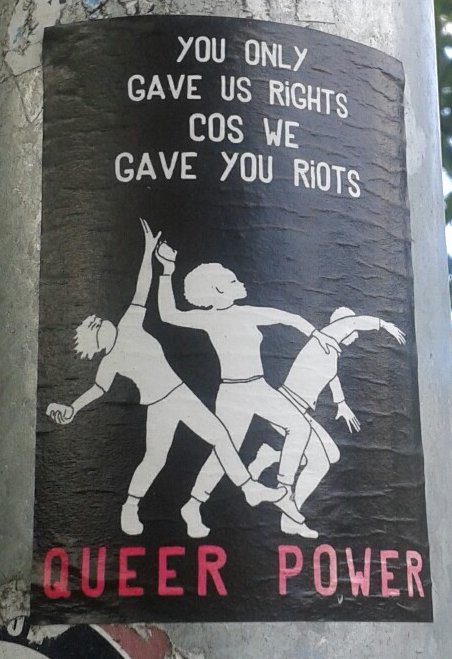
“You only gave us rights because we gave you riots. Queer Power”
“You only gave us rights because we gave you riots. Queer Power” (Click to embiggen)
The original Stonewall protest was a riot. Some people want us to forget that. They want us to be polite, not to make waves, and not to upset or scare “ordinary” people. But make no mistake: the only reason we queer people have any legals rights now is because we refused to be quiet, we refused to be invisible, we refused to go quietly.

By “we” I don’t mean to imply that I was actually at the Stonewall Inn on that fateful night, or for several nights after where the street queens and homeless gay teens and butch lesbians and angry sissies kept coming back out on the streets and demanded their right to exist. I was 8 years old living in a small town in Colorado (and if I recall correctly crushing hard on Robert Conrad as Secret Service agent James West). I wouldn’t even hear about the events of the summer until more than ten years later. But that summer the people who were standing up to the police and demanding the simple right to be out in public without being harassed, weren’t the quiet ones. That wasn’t entirely their choosing. Heroes of the time such as Marsha P Johnson or Silvia Rivera were exactly the sort of gender non-conforming queer who had spent their entire lives being literally unable to hide. When the police raided that night, they took their usual tack of grabbing the people who looked least “normal” to single out for a beating and arrest.
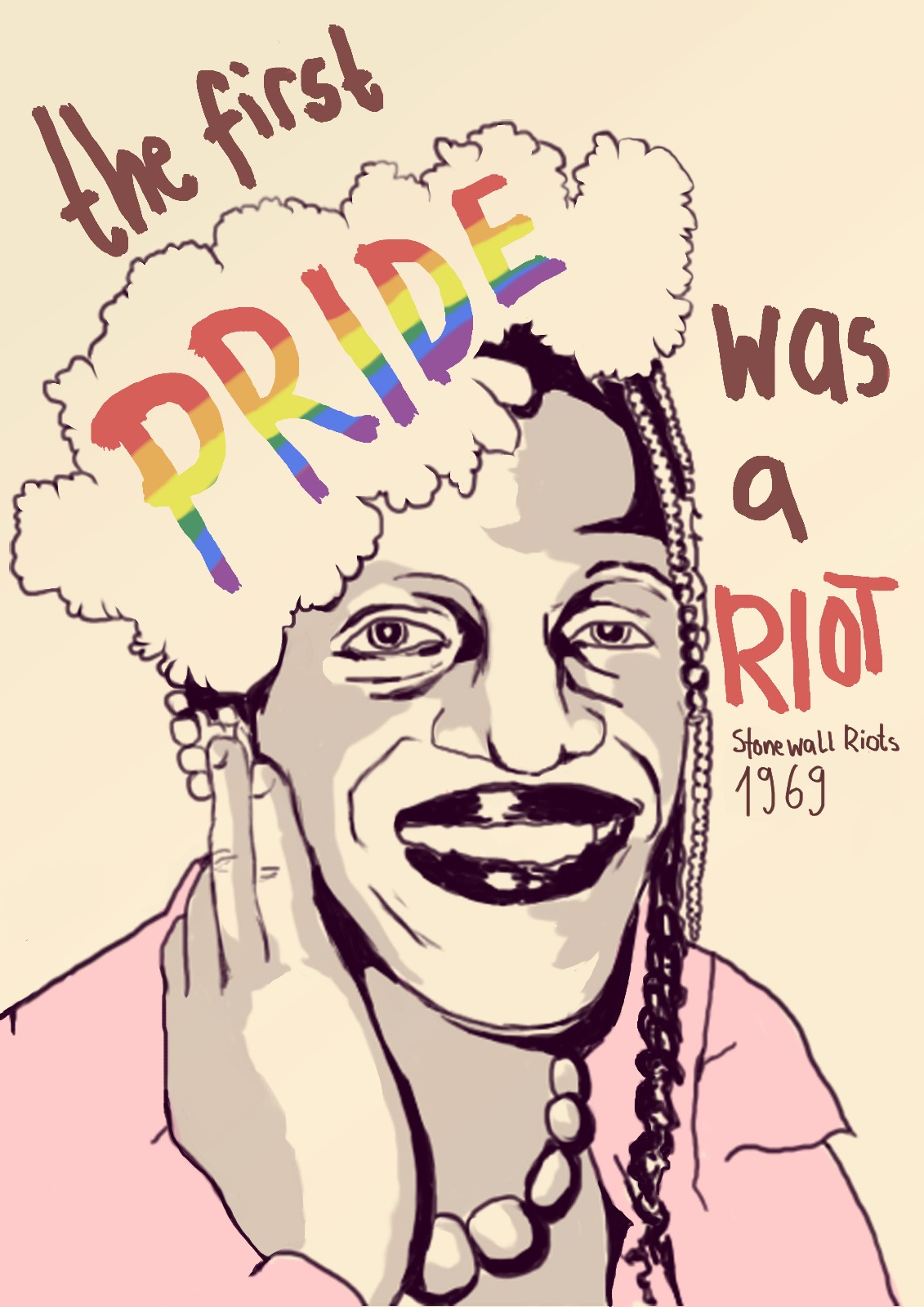
“The first PRIDE was a riot.” And a nice caricature of Marsha P. Johnson, the street queen often credited with throwing the first brick at Stonewall. (Click to embiggen)
Their only crime was being at a bar and being obviously queer-looking and/or queer-acting. Just for some context: it wouldn’t be until 1973 that a court would rule as unconstitutional laws banning people from wearing clothing “typical of the opposite sex” (which included women wearing pants). The police had a lot of leeway in deciding what constituted not dressing in clothes appropriate to one’s gender. And that’s how these raids would go. Cops would surround the bar, then come in, turn on the lights, order everyone to line up and produce their identification. Anyone who was “cross dressing” would be arrested (and usually get roughed up on the way). It was not uncommon for male cops to grope the butchest lesbians while making lewd remarks to try to get them to react, so they could be arrested for resisting.

Ultimately, the cops and other authorities were targeting people who were different.

There had been raids before, but almost never before had the crowd turned on the police. Normally everyone who could run away did, and those who couldn’t tried not to be the few who would get beaten. But that night, the patrons decided not to cooperate, and things went downhill rather fast.

Again, no one, including many of the people who actually were there, knows why the crowd reacted differently that night. Just as no one knows for certain why the police were raiding the Stonewall Inn that night. The leading theory is that the mafia-connected owners of the Inn were suspected of making more money than they admitted to from blackmailing well-to-do customers, and were therefore not bribing the cops and liquor inspectors as much as they should have been. But because all of that was highly illegal, we’ll never know. The riots went on for several nights. Then, in the weeks afterward, several of the people that had been there formed politcal groups to fight for queer rights: The Street Transvestite Action Revolutionaires and the Gay Liberation Front.

Let’s pause here to talk a bit about terminology. Transgender, transvestite, and cross-dressing were terms that at that time were used inter-changeably by people within the community, even though today it’s considered offensive to act as if those terms refer to the same thing. There is still some controversy about which of the street queens should be considered transgender, for instance. It’s an argument I don’t want to get into right now.

And it’s really beside the point. The people who were at the forefront of the Stonewall Riots, and who organized the first new gay rights afterwards were mostly trans (or otherwise genderfluid/non-conforming) people of color. It was the most marginalized who led the way.
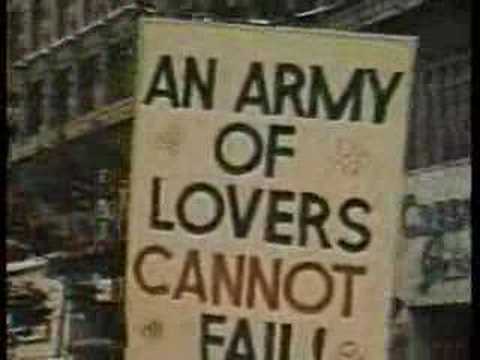
Protest sign from a photo of an early Pride march: “An army of lovers cannot fail.”
“An army of lovers cannot fail.” (Click to embiggen)
I’m not trans, myself, but from a very early age I was called “sissy,” “pussy,” “faggot” and worse (by members of my own family and teachers, no less). I was four years old the first time that my dad angrily beat me while calling me, among other words that I didn’t know the meaning of, “cocksucker.” And at four I didn’t know what a drag queen was, let alone a gay or lesbian person. I wasn’t intentionally acting whatever way it was that made that the go-to insult to throw at me. I didn’t mean to be the kind of boy that caused teachers to tell my parents later, after one of the most severe bullying incidents at school, “As long as he walks like that and talks like that, how else do you expect the other boys to react?”

Whichever of my mannerisms trigger people’s gaydar, they’re not under my control. I tried so hard to act like the other boys and not get noticed. Yet, again and again I failed. So it’s both ignorant and unfair to say that the people who got targeted by cops in those raids could have prevented it if they just stopped flaunting things. Long before Marsha P Johnson wore her first outrageous flowered hat out in public, as a little boy growing up in Elizabeth, New Jersey, she had been beaten and bullied. There came a point when she decided to stop hiding who and what she was and embrace it.

Similarly, it’s both ignorant and unfair to say that people shouldn’t dress outrageously or otherwise let their freak flag fly at Pride. The only reason that so-called “straight-acting” gays have found it safe to come out at all (whether it be former NFL players or rugby players or button-down executives) is because the “queens and trannies and freaks” of previous generations decided to stand up and fight back. I’m not saying it is easy for anyone to come out, but many of the community didn’t have a choice about whether people knew—the only choice they had was whether to let themselves be beat down, or to fight back and be proud of who they were.

“We kept fighting after Stonewall. We're still fighting the AIDS Crisis. We kept fighting after Anita Bryant. We kept fighting after Jesse Helms. The struggle is far from over. I'll keep fighting. Will you?”
“We kept fighting after Stonewall. We’re still fighting the AIDS Crisis. We kept fighting after Anita Bryant. We kept fighting after Jesse Helms. The struggle is far from over. I’ll keep fighting. Will you?”
So embrace the fairies, the leather daddies, the cycle mamas, the butches, the fems, the sissies, the nellies, the drag kings, the street queens, the gym bunnies, the queer nerds, the bis, the pans, the aces—every gender, every race, every freaky and fabulous corner of the big wild Queer Community. The old Isaac Newton quote is that he could only see further than others because he stood on the shoulders of giants. We’re only able to be here and see a bright future because we’re standing on the shoulders of those fabulous freaks. And as someone else once observed, if you think someone is normal, you just don’t know them well enough.

We’re all queer! We all belong here! Let’s march into a brighter future together!
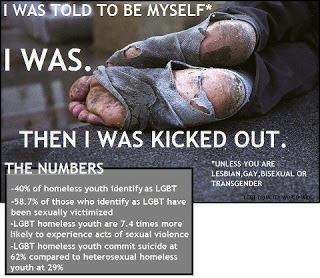
Gay it forward

Source: thedesmondproject.com/Homelessness-Info.html (Click to embiggen)
The Department of Justice estimates that about 1.7 million teen-agers are homeless in America at any time. Of those, about 40% identify as queer (that’s 680,000 kids). According to research by the True Colors Fund and similar groups, the single biggest cause of those queer teens being homeless is family rejection because of their sexual orientation or gender identity. But note that the next most common reasons are abusive homophobia or transphobia in their school, church, or community, even when their parents don’t go to the extreme of kicking them out.

Growing up in Southern Baptist churches in mostly redneck communities, I knew from a very early age that I didn’t belong. I was constantly breaking unspoken rules I didn’t understand. Nearly everyone–not just my physically abusive father, but other relatives, church leaders, many of my teachers, and a lot of the kids at school–made it abundantly clear that I didn’t act like a normal boy, and that if I didn’t figure out how to man up, there would be even more severe consequences than the beatings, teasing, and humiliations I was already enduring. I was taught–not just at church, but also at public school in health and science classes–that homosexuality was a severe mental disease that turned the people who had it into pedophiles, rapists, and worse. Homosexuals, they said, were evil creatures who deserved to die gruesomely.

When puberty hit, I finally realized that those two messages were one and the same. Puberty hit like a Tomahawk missle, blasting away my hopes of growing up to have what I had been taught was a normal, successful life. Because suddenly I realized that those odd fascinations I had had with certain men and boys wasn’t just friendship, they had been crushes. And now my hormones and body were reacting to the guys my emotions had been before. All of that added up to the horrifying conclusion that I could never man up enough not to deserve the scorn, ridicule, physical assaults, and even worse. It was no longer a matter of trying to figure out what I was doing wrong–it became a matter of life and death that I hide the truth about what I was from everyone I knew.

After fighting my feelings and having a couple of furtive relationships with other guys my age who were just as scared, I came to know with all my being that three things were absolutely true: If the wrong people found proof about what I was, I would be rejected and certainly come to an untimely and probably gruesome death alone and unloved. If I couldn’t stop having these feelings and acting on any of those urges, I would spend eternity in hell. And absolutely nothing I did–no amount of tearfully pleading with god, reading the Bible cover to cover three times, stealing my dad’s porn magazines and trying to make myself feel attraction to the women in them, et cetera–would make those feelings go away.

I was doomed. It wasn’t a matter of if, merely when.

Despite knowing I was doomed, my basic temperament just doesn’t accept no-win situations. So part of me kept trying to convince the rest of me that we could fake it as long as it took. I also had certain glimmers of encouragement I’ve written about before in science fiction. One thing I didn’t have was any role model or even a hint that there might be another kind of life possible.

There were no openly gay people in any of the communities we’d lived in until I was in my 20s. There were no openly gay characters in TV or movies or the like until at least my mid-teens. Oh, there were characters that seemed to be gay, but they were always either the comic relief or someone you were supposed to despise. When a few openly gay characters started showing up, they were never regular characters or even heroic. They were still either comedic characters, or victims. Very occasionally one would appear on a single episode to make a message about tolerance. But they were always alone and there was no sense they had a life or friends, let alone a love life!

And then I saw a news story about a gay pride event that changed my life. I had seen some news stories before about the gay protest marches, but they had been brief, and were always accompanied by images of either very angry people with protest signs, or outrageous images selected to portray all the queers as freaks. This story did include some of those images, but there was more of an attempt to give the queer people a chance to speak. They showed brief clips from interviews with several people, but the moment that stuck in my head was when a pair of middle-aged men who were interviewed mentioned that they had been together for nearly 20 years. They were boyfriends, and they had been together for years.

That single bit of data changed everything. I was 19 or 20 years old. I had had a few secret relationships and flings with guys. They had all been steeped in anxiety and fear of what would happen if we were caught. These other closeted gay guys were the only queer people I had met, and they were all, so far as I knew, just as certain that we were going to burn in hell for eternity because of what we were. Though some of the fiction I’d read by then mentioned gay or bisexual people in relationships, it had all be in various sci fi settings where things were very different than the real world.

But there. on the TV in a news program two men who weren’t sci fi characters were comfortable saying on camera that they were boyfriends and had been for years.

It was several more years before I would even utter aloud to anyone the words, “I think I might be gay,” but knowing that there were actual, flesh and blood queer people out there who were in love and having relationships is what let me hold on to hope for a few more years and gave me the strength to finally come out.

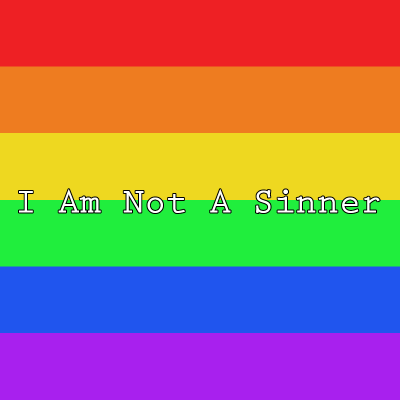
“I a not a sinner”
“I a not a sinner”
And that is another reason I support Pride Parades and all sorts of other out gay events. Because there are tens of thousands of frightened queer children out there scared to death to be who they are. Worried that their own parents will reject them or worse. And because we know that every year hundreds of those kids commit suicide because they have no hope. As long as we have our crazy, flashy, glittery, contentious but fabulous pride parades and festivals and so on, then news sites will run stories about them. It doesn’t matter that the coverage may be slanted. Some of those frightened kids will see those stories. Some of them will click on those images. They will know that they aren’t alone. If we can give some of them hope, then our mission has been a success.

All of us who are living our lives out and proud got here because of the hard, brave work of the drag queens, trans activists, marching gays and lesbians and so forth who came before us. We owe them a debt we can’t repay directly. So we have a duty to not just pay it forward, but gay it forward.


Edited to Add:

If you can, give a donation to help queer kids who have been rejected by their families and kicked out on the street : True Colors Fund or The Ali Forney Center are good places to start. Many communities have local programs focusing on teen homelessness and particularly queer teen homelessness; a quick Google search with the name of your city or town, and the words “queer teen homeless” should point you in the right way. And if you want to hlp support transgender kids, please donate to: National Center for Transgender Equality.

Seriously, it’s all Greek — more adventures in dictionaries

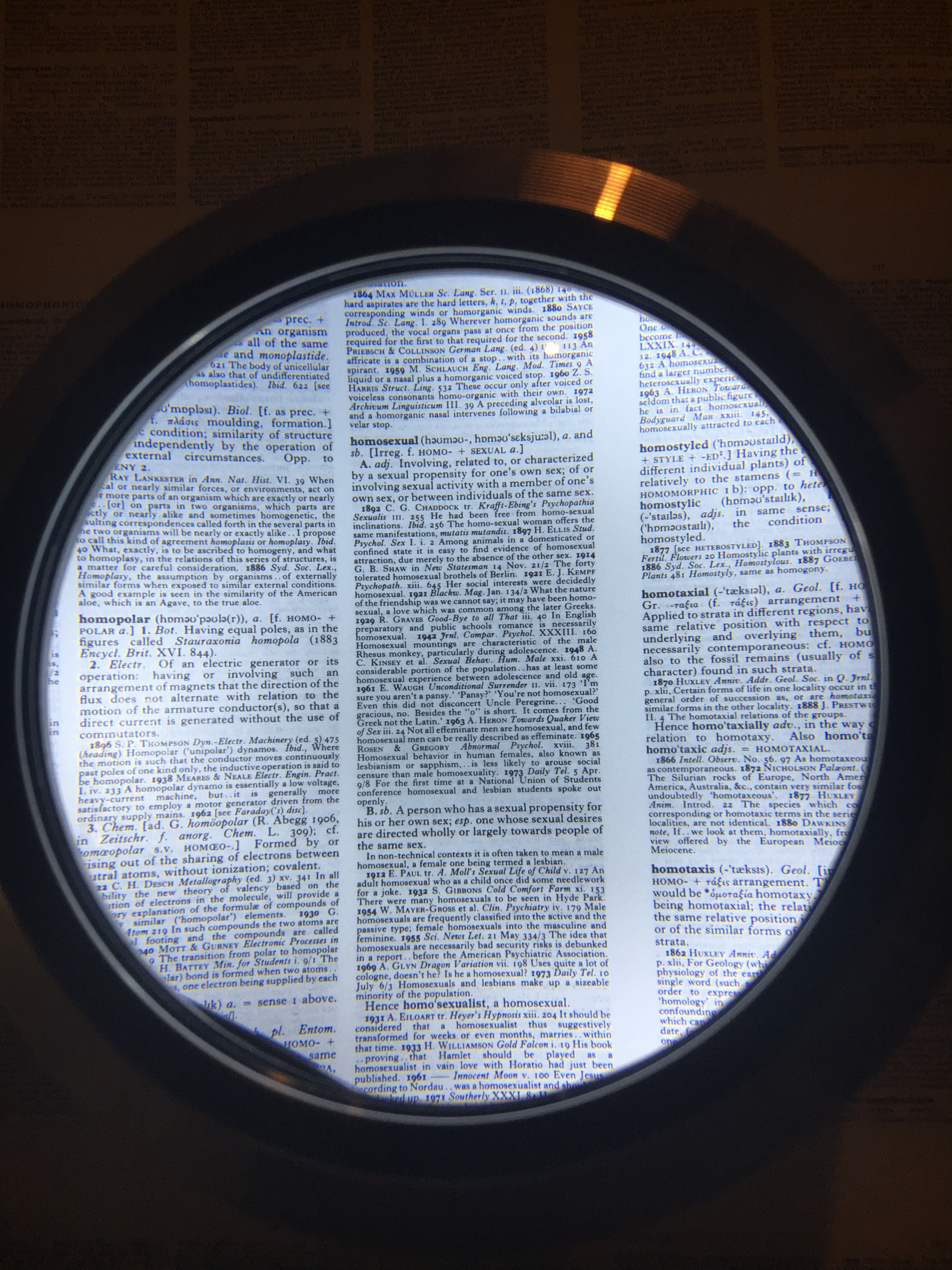
“...involving, related to, or characterized by a sexual propensity for one's own sex; of or involving sexual activity with a member of one's own sex, or between individuals of the same sex.”
“…involving, related to, or characterized by a sexual propensity for one’s own sex; of or involving sexual activity with a member of one’s own sex, or between individuals of the same sex.” (Click to embiggen; I got a new self-lighting magnifier for my Compact Oxford—isn’t it neat?)
It happened after a committee meeting for the Seattle Lesbian and Gay Chorus when we had devolved to chatting. I don’t remember exactly what was being discussed, but one of the women got upset when I used the word “gay” to refer to the entire community. “That excludes women,” she said, icily. I apologized and said I didn’t mean to do that, it was just fewer syllables and sometimes I just wished there were a shorter way to refer to everyone, and homosexual is so clinical. She interrupted, leaning in and getting much angrier. “Another word for men! Geeze, how can you do that?” When I protested that it was a clinical term originally coined to refer to both men and women she really got upset, insisting, “Homo means man! Yeah, yeah, it’s like mankind means everyone because men think they’re all the matters!”

At this point I was no longer feeling defensive, I was feeling angry. So I explained that while if one were speaking Latin, “homo” meant man, but the word wasn’t built from Latin roots, it was from Greek roots, and in Greek, homo means “the same” which is why the doctor who first coined the term picked it, as he had written about extensively that he was describing people who were attracted to and formed attachment to member of the same sex, in contrast to hetero which is greek for “other or different.” So “heterosexual” meant someone attracted to the other sex, while “homosexual” meant someone attracted to the same sex. Also, the doctor in question was himself non-heterosexual and spent much of his life trying to prove that homosexuality was not a mental illness.

Suffice it to say that she did not appreciate my lecture.

That was not the last time I got into that argument, by any means.

Other times when I’ve pointed out the difference between the Greek root and the Latin word which sounds the same, people have countered that “a lot of people think it means male!” To which I replied that a many people think the world is flat, but I’m not going to stop using the word “world” because some people are ignorant.

Don’t get me wrong—I understand that perception is important, but here’s the thing: if I point to a crowded room full of people of many different genders and say “they’re all homosexual” not one English speaking person in the whole world is going to think I’m only referring to the men. No one will be confused. Yes, a few of the women in the crowd may raise the same incorrect objection as the person in my first paragraph, and some bisexual or pansexual people in the crowd will make an equally incorrect objection (there is no portion of homosexual that means exclusively with one’s own gender, just that there is a propensity toward one’s own gender). I will grant that if there are any asexual people in the crowd they will have, linguistically, a valid bone to pick with my sweeping generalization.

The thing is, I don’t happen to like using the word homosexual because it sounds so clinical, and despite the word being coined by a pro-homo doctor, originally, it was quickly adopted by the parts of the medical establishment who insisted we were mentally ill or depraved. But I also don’t like using it to refer to the community because no matter how you slice it, it does exclude asexuals, as well as trans people who are also straight.

If I’m in a situation where queer isn’t accepted, I will sometimes punt to “non-heterosexual,” but that has the problem of defining us by what we aren’t, rather than what we are.

There are people who object to the term because it places emphasis on sex, while we often argue that the real issue is love. I have some small amount of sympathy for that line of reasoning, though it often digresses into rather sex-negative prudery. And while there is a difference between love and sex, for most non-asexuals, the two things are tangled together pretty tightly. I am attracted to other men. The initial attraction is, to be honest, about hormones and desire. For me, at least, love is a choice I make as I get to know a person. Yes, there are feelings and admiration and so forth, but I have feelings for lots of people who I don’t choose to commit myself to. I admire lots of people I don’t choose to commit myself to.

This attempt to separate the sex from sexual orientation also ignores another important reality: heterosexual relationships are just as much about sex as queer relationships are. Don’t believe me? What were the only legal arguments that anti-gay people had left by the time the case had reached the U.S. Supreme Court: that marriage was exclusively about reproduction, and that heterosexual people would never make the lifelong commitments necessary to raise the resultant children is legal marriage wasn’t reserved for straights (no, that argument makes no sense, and yes, that’s really what they wrote in their legal briefs!). Yes, the people who claim that we’re the perverts obsessed with sex argued that it was wrong to define marriage as a loving relationship geared toward mutual support (yes, that was also in their legal brief).

But I’ve digressed enough. The word “homosexual” does not simply refer to men, it comes from the Greek word homo meaning “the same.” Neither does the word refer to any exclusivity in that sexual orientation. Also, although hetero means “other or different,” neither heterosexual or homosexual linguistically imply only two genders. Heterosexual literally means sexual activity with someone of a different sex, not the opposite sex. So not only isn’t the word sexist, it also doesn’t deny the existence of genderfluid or intersex or third sex people.

And now you know!

Why do I keep having to explain why we need Pride?

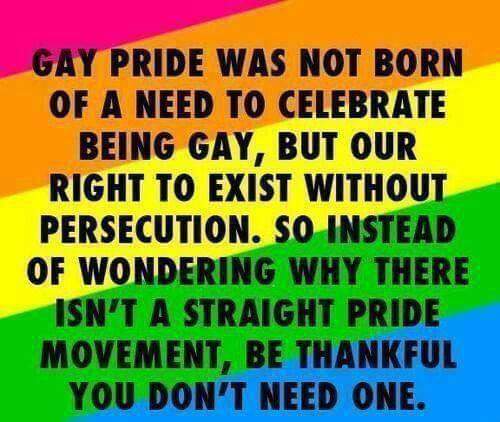
“Gay pride was not born out of a need to celebrate being gay, but our right to exist without persecution. So instead of wondering why there isn't a straight pride movement, be thankful you don't need one.”
“Gay pride was not born out of a need to celebrate being gay, but our right to exist without persecution. So instead of wondering why there isn’t a straight pride movement, be thankful you don’t need one.”
It’s that time of year again. The perennial question arises: “If you get a Gay Pride Parade, why can’t we have a Straight Pride Parade?” I can’t decide which is the saddest aspect of this question: 1) that they think this tired old canard is clever, 2) that they don’t understand that 99.9% of all television, movies, news, and other public discourse is geared toward affirming heterosexual life, including straight sexuality (so every day is already Straight Pride Day), or 3) that they don’t understand that Queer Pride events are about our very right to exist—an act of defiance against those who want us to be invisible or dead—not merely our right to party?

And some people seem to be most hung up about the fact that we have parades and festivals. Especially the parade seems to bug them. They are always quick to say that they don’t have a problem with gay people, but the truth is that what bothers them is us being visible. When they ask us why we have to flaunt who we are, what they are really saying is why can’t he be quiet and stay hidden and not remind them that anyone who is different than they exist.

And you know how you can prove this? Ask them if they have ever raised the same objections to St. Patrick’s Day parades. The earliest St. Patrick’s Day parades in colonial times were about Irish Nationalism, since all of Ireland was under British rule at the time. By the mid- and late 1800s the St. Patrick’s Day parades were about Irish equality in the U.S., since anti-Irish and anti-Catholic sentiment was quite high, and yes often encoded in laws and government policy. While the anti-discrimination purpose of the parades has faded away, the parade is still about taking pride in one’s Irish heritage. If a person doesn’t object to Irish pride parades (which is exactly what St. Patrick’s Day parades are), but they do object to LGBTQ+ Pride parades, the only logical reason can be that they object to the Lesbians, Gays, Bisexuals, Trans, and all other Queers in particular, and not the idea of a parade celebrating identities in general.

I can pretend that the question isn’t a passive-aggressive exercise of bigotry and give you some simple answers. Why do we need Pride?

None of those reasons apply to straight people. No one bullies straight children just because they are straight or gender conforming. No parents kick their straight children out on the street because they are straight. No one is targeting sports bars to kill straights because they saw a man kiss a woman somewhere. No preachers are going on the air to say that straight people deserve death. No one is passing laws saying gender conforming children aren’t allowed in public school bathrooms. No one is passing laws trying to ban straight people from adopting children or getting medical benefits for their partners. Straight people and straight people’s sexuality (ever seen a romantic comedy?) is the subject of at least 99% of all movies, television shows, et cetera. So straight people don’t need pride. But if you really think you do, no one is stopping you from organizing your own parades (though I’ve argued before that you already have those, too).

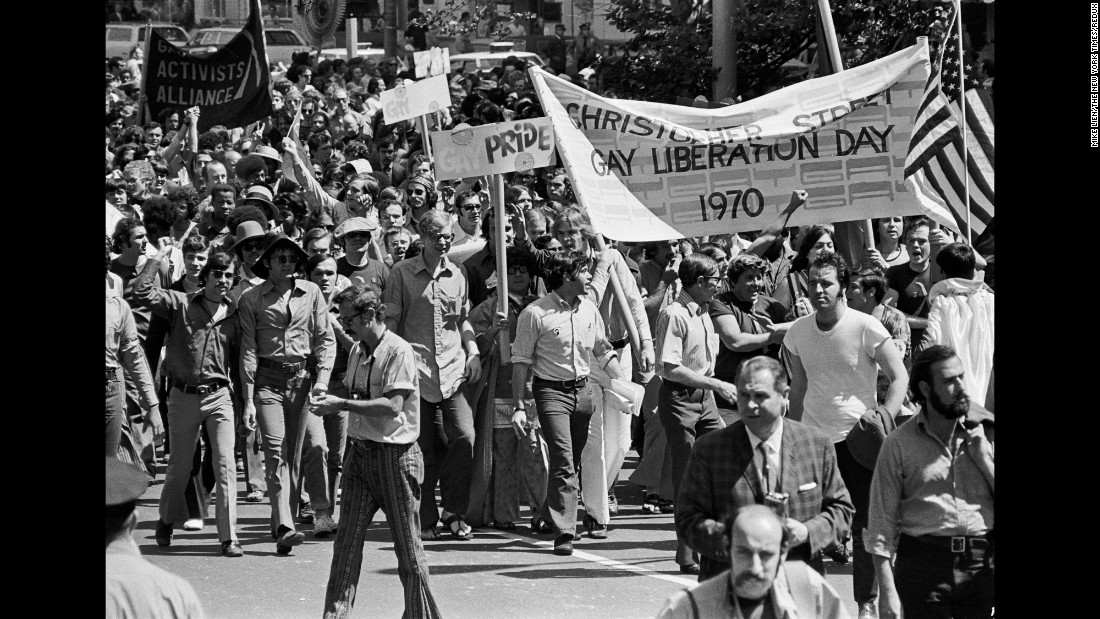
The reason queers like me have been able to stand up and be ourselves is because other queers before us were brave enough to be out and brave enough to protest when necessary. Be it staging sip-ins to protest laws that made it illegal for a bartender to knowingly allow two homosexuals be served in the bar, or fighting back when police raided a gay club, or picketing in front of federal buildings, or boycotting industries whose spokespeople lobbied for laws to take away our rights, or protesting laws making it a crime for us to be intimate with the person of our choosing, or marching in the first ever Pride event in June 1970. Those of us who can stand up for ourselves now owe a debt to those earlier generations of queers. We can’t pay them back directly, so we have to pay it forward. We do that by standing up and being counted and being visible for all of the people (especially kids) who can’t safely be out themselves, yet.

We need Pride not because we’ve come so far, but because there is still a long, long way to go.

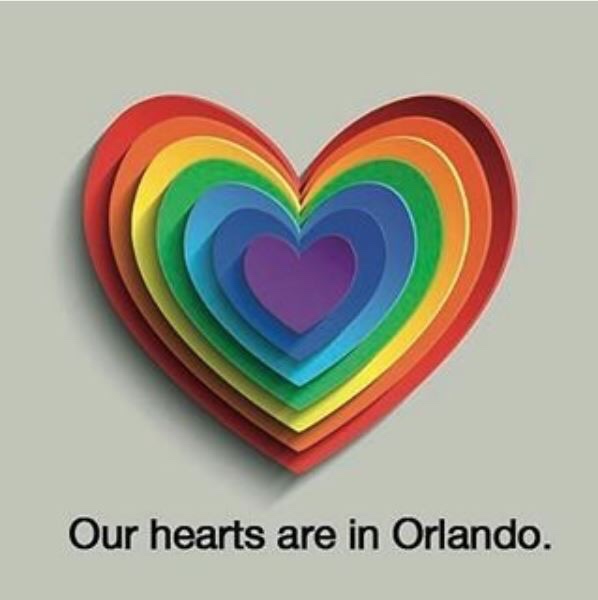
One year later, Pulse nightclub massacre is still a punch in the gut

“Our hearts are in Orlando.”
One year ago, on June 12, 2016, a killer snuck a gun into a busy gay night club on Latino night and opened fire, killing 49 people and wounding many others. In the immediate aftermath Republican politicians expressed sympathy for the victims, insist that even though a gay club was targeted during Pride month that it wasn’t actually an anti-gay hate crime, and then days later voted down gay rights protections. Those politicians weren’t the only ones to try to claim that the act wasn’t an anti-gay crime. We’ve had people gin up evidence (which has been thoroughly debunked) that the killer was secretly gay himself. We’ve had people and politicians try to claim the killer was part of an organized Islamic terrorist organization, and that has been thoroughly debunked as well.

The killer’s own father said that his son had been ranting for weeks about how angry he was to see gay men kissing each other in public. He spent weeks using a fake profile on a gay hook-up app quizzing gay men to determine which gay club would have the biggest crowd and which night of the week it would be busiest. It was an anti-gay hate crime. That doesn’t mean it wasn’t also terrorism, because that’s what all hate crimes are: the intent is to instill terror in the targeted community by singling out individuals for bashing or worse.

I wrote shortly after the massacre to explain why this crime hit me so hard even though I live on the other side of the continent and don’t personally know anyone killed. My whole life I’ve lived with the fear and knowledge that there are people who hate queers enough to attack me and kill me, but I haven’t often had to think of that hatred being a danger to those around me. The killer’s father isn’t the only one who talked about what had enraged his son. Others who knew the killer have talked about his increasingly angry outbursts about gay people. Seeing two men kiss made him go kill 49 people in a busy gay nightclub during Pride month.

It’s one thing to know that bigots hate me enough to kill me. It’s much worse to be shown that some hate me enough to commit a massacre.

And it’s upsetting to know that some people who claim to be friends—and relatives who have said they love me—are unable or unwilling to understand that this killer’s actions are a symptom of society’s messed up attitudes about queer people and about guns.

That is what people who claim this is just one lone nut, or that it isn’t really about queer people, or that there is nothing society can do that will make these crimes less likely to happen are actually saying.

One year later, it’s still a gut punch.

It leaves one wondering what we can do.

  1. There are organizations you can donate to: Scissor Sisters and MDNR honor Pulse victims with ‘Swerlk’ lyric video: Proceeds from the song’s sales and royalties will be donated to the Contigo Fund which, “offers financial support to organizations working to heal, educate and empower LGBTQ and Latinx individuals, immigrants and people of color, as well as those working to end all forms of bigotry in Central Florida”.
  2. We can attend memorials: Thousands Expected At Pulse Memorial Events In Orlando.
  3. You can commit to acts of kindness and urge others to: Elected officials on Monday announced that June 12 officially would be dedicated as “Orlando United Day — A Day of Love and Kindness.”.
  4. We can remember the victims: Orlando Sentinel Marks One-Year Anniversary of Pulse Nightclub Massacre: In print, a special 16-page section; online, free access for all.
  5. We can try to help the healing process: Faces of healing, one year after the Pulse Nightclub massacre.

Mostly, please just recognize that this was a hate crime, fueled by our society’s abhorrence of gay people and helped by our irrational obsession with prioritizing gun rights over human rights. It wasn’t an act of anti-american terrorism. It wasn’t merely the actions of one disturbed individual. It is a symptom of very American dysfunction. It is a hate crime, and all hate crimes are meant to instill terror in the hearts of the targeted community. If you are a straight person who still insists this wasn’t an anti-gay hate crime, please answer this question honestly: was this crime a gut punch of terror for you? Was it?

I have been relieved that most of the coverage of this crime focused on the victims. Too often the coverage of mass shootings focus so much on the perpetrator that it’s as if he’s a hero, instead of a despicable excuse for a human being. I think I have managed, despite writing about this incident many times, never mention to the name of the killer. Instead, we need to honor the memories of those slain: Orlando nightclub shooting: Read about the victims.

Victims killed in Pulse in Orlando this last weekend.
Victims killed in Pulse in Orlando June 6, 2016. (Click to embiggen) (Facebook/AP/Reuters/Rex)

Edited to Add: Several people have written very eloquently about the day:

Commentary: Pulse, and the Beautiful, Sad, Joyful Tradition of Queer Grief

I Couldn’t Write About The Pulse Attack Until Today

A Letter to My Queer Family After Orlando

Sunday Update 6/11/2017: More words and pictures

I’ve mentioned before that I collect images and memes and such as potential illustrations for Friday Links posts or political commentary, and I’m always collecting more than I wind up using. So every now and then I’m going to do a post like this where I just publish a bunch.

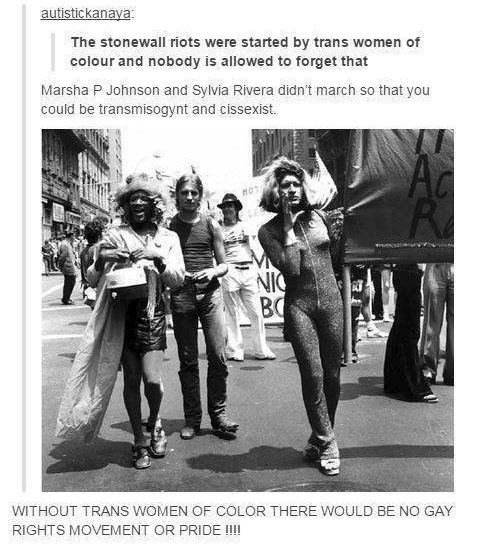
“The Stonewall Riots were started by trans women of colour and no one is allowed to forget that.”
“The Stonewall Riots were started by trans women of colour and no one is allowed to forget that.” (Click to embiggen)
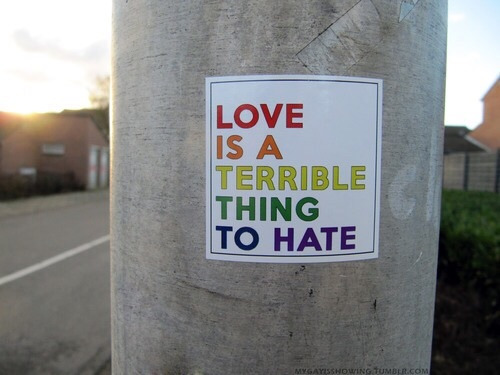
“Love is a terrible thing to hate.”
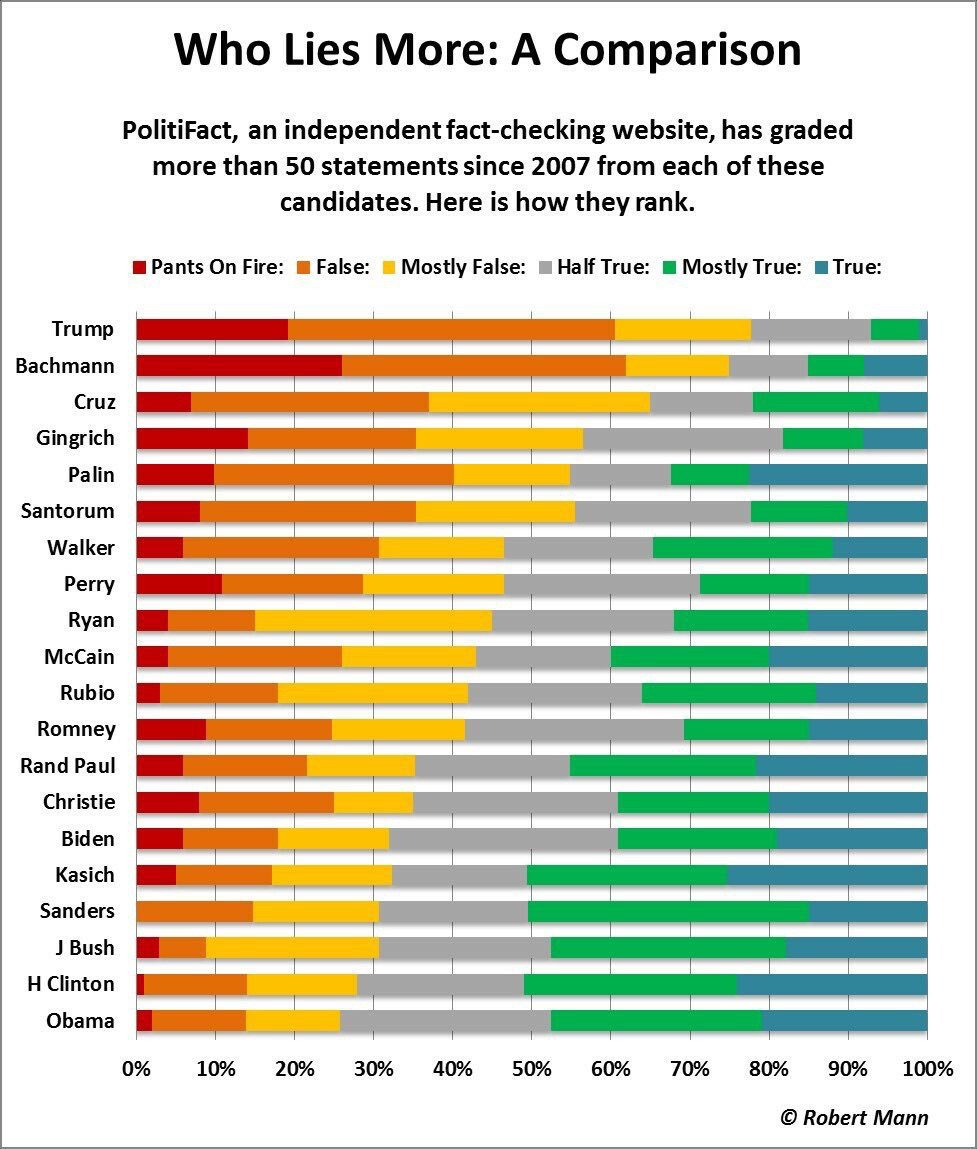
“Who lies more?” Please stop repeating the lies that all of them do it. One end of the political spectrum fails fact checks far more often than the other.
“Who lies more?” Please stop repeating the lies that all of them do it. One end of the political spectrum fails fact checks far more often than the other.(Click to embiggen)
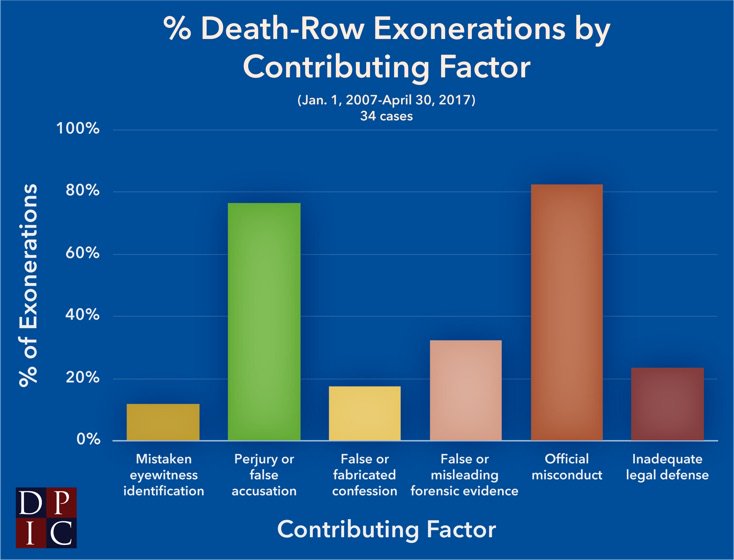
“Percentage of Death-Row Exonerations by Contributing Factor.” Gee, several of those categories constitute official malfeasance.
“Percentage of Death-Row Exonerations by Contributing Factor.” Gee, several of those categories constitute official malfeasance. (Click to embiggen)
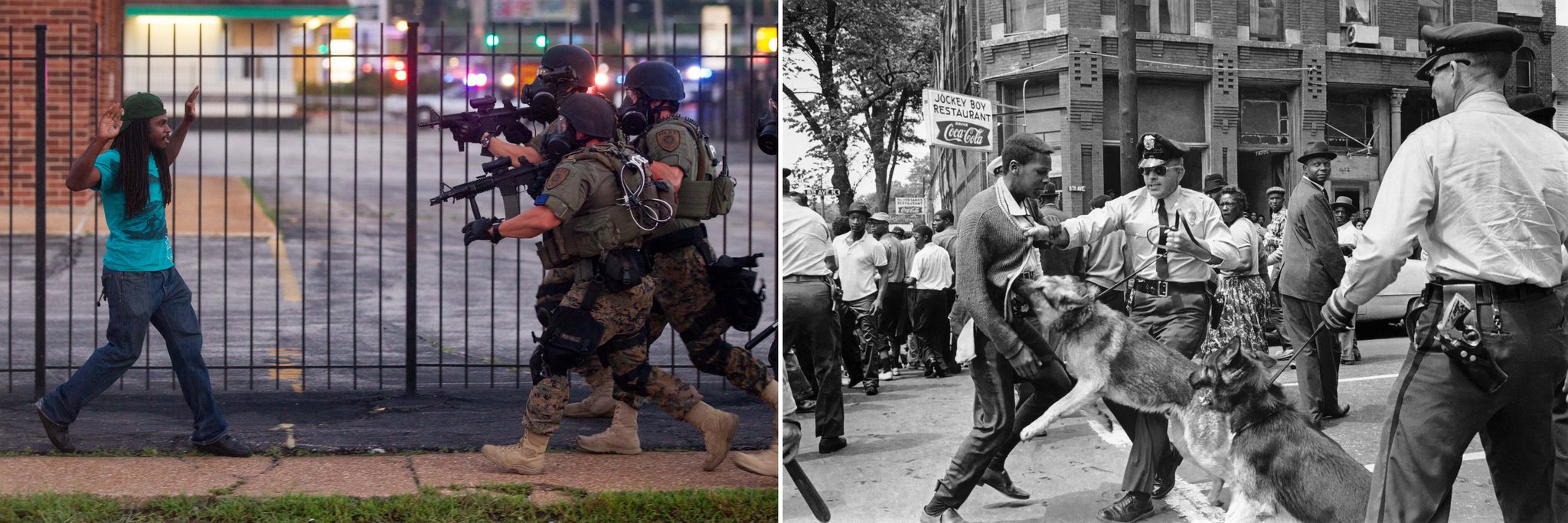
This is what “Make America Great Again” meant to far too many of Donald's supporters (and staff, and Donald himself, to be honest).
This is what “Make America Great Again” meant to far too many of Donald’s supporters (and staff, and Donald himself, to be honest). (Click to embiggen)
“When I find myself in tweets of trouble, Mother Russia comes to me, speaking words of wisdom... covfefe!”
“When I find myself in tweets of trouble, Mother Russia comes to me, speaking words of wisdom… covfefe!”
“You only gave us rights because we gave you riots. Queer Power”
“You only gave us rights because we gave you riots. Queer Power” (Click to embiggen)
“We kept fighting after Stonewall. We're still fighting the AIDS Crisis. We kept fighting after Anita Bryant. We kept fighting after Jesse Helms. The struggle is far from over. I'll keep fighting. Will you?”
“We kept fighting after Stonewall. We’re still fighting the AIDS Crisis. We kept fighting after Anita Bryant. We kept fighting after Jesse Helms. The struggle is far from over. I’ll keep fighting. Will you?”
“Pride 2017”
“Pride 2017”

“You’re not going to believe someone like that, are you?”

About a month ago a political scandal reared its head in Seattle. An anonymous man filed a lawsuit against Mayor Ed Murray—our fist openly gay mayor, a man who served many years in the state legislature as an openly gay man—alleging that decades ago when the plaintiff was 15 years old, Murray had paid him for sex. Because of the age of the plaintiff at time, if the allegations are true, it would have been consider sexual assault, child rape, et cetera because the younger man was below the age of consent.

It was difficult to know how to respond to the allegations. The lawsuit was filed just six weeks before the filing deadline to run for mayor. The law firm representing the plaintiff is headed by a notorious anti-gay activitist. False accusations of sexual predation on underaged boys are lodged against gay men all the time. The lawyer handling the case has since behaved as if this is a crazy PR stunt rather than a case. For example, going online on local news sites to make long and very unlawyerly comments on stories about the case, or filing “motions” with the court that have nothing to do with the case but contain long press release-style recounting a of rumors about odd things that have happened around the mayor.

Three more accusers have stepped forward, two of whom had tried to make similar allegations some years ago, but were unable to convince police in Portland, Oregon in 1984 to file charges, and more recently even the local Republican-leaning paper felt there wasn’t enough evidence to print their story of being abused in a group home where Murray worked in the 80s. The paper rushed to publish the 9-year-old interviews as soon of the law suit was filed.

To be clear, among the reasons I leaned toward thinking the allegations are probably false is that in 1984 police in Portland, Oregon were not exactly known for being pro-gay, neither was the Multnomah County Prosecutor. At the time, Murray was an openly gay man with a degree in Sociology working with troubled youth. Not exactly the sort of person you would expect the police or prosecutors to go easy on in regards to charges of child rape. That led me to think that in the 1984 investigation it wasn’t merely a lack of corroborating evidence, but that there was actually evidence refuting the charges.

On the other hand, my own experience of surviving physical and emotional abuse from a parent, and how people didn’t believe me (even people who witnessed some of the abuse), as well as the many accounts of survivors of various kinds of abuse whose allegations are dismissed out of hand, the stastistics about rape victims being disbelieved, and so forth, made me reluctant to leap to the conclusion that the allegations were false.

But then there was the way Murray chose to defend himself. Rather than simply deny the allegations and say that he was looking forward to his day in court (the statute of limitations for criminal charges is long past, so it’s a civil lawsuit), Murray and his lawyer initially attacked the two non-anonymous accusers for their criminal records and drug histories. He suggested that the lawsuit was being filed for political purposes, and questioned why the plaintif was suing anonymously and waited so long to file.

Attacking the credibility of accusors is a classic abuser tactic. It doesn’t prove that Murray did it, but if he was able to dispel the scandal this way, it would have a chilling effect on abuse survivors who have less-than-perfect pasts.

The original plaintif then revealed his identity and explained that he had remained quiet all of these years because he didn’t want his father to know that he had worked as a prostitute during his teen years. His father having recently passed away, the plaintiff felt free to come forward now.

Certainly the attorney’s odd behavior (which has actually provoked sanctions from the judge) makes one wonder what his motives are for taking this case on contingency. Murray isn’t fabulously wealthy, so I’m not sure any judgement earned is going to justify the months of work the lawyer will undertake between now and the trial date (scheduled for next year). Since the initial filing of the case came off as a mini media circus, he clearly wasn’t hoping for a quick settlement to make the scandal go away. But no matter how impure the lawyer’s motives may be, it doesn’t mean the underlying allegations are false.

The four men in question have far from spotless records. But the other thing they have in common is that all four were, as teens, in very bad situations. It isn’t unexpected that coming from such a background they would find themselves turning to crime and drugs just to get by. And it is very difficult to break out of such a cycle once it is started. Vulnerable people, particular vulnerable teens, are exactly the sorts of victims certain types of abusers seek out, precisely because “respectable” people are disinclined to believe them.

On yet another hand, Murray is notoriously thin-skinned. He’s infamous for shouting at people who disagree with him, not to mention shouting at his own staff members when things don’t go his way. That means he’s exactly the sort of person who, if he is innocent of the charges, would react by attacking his accusers. But routinely shouting at people who work for you is also indicative of a particular kind of abusive person…

Fortunately, many prominent people were willing to make public statements about how the Mayor’s defense tactics cast a chilling effect on abuse victims and rape victims and so forth. The calls for him to at least drop his re-election campaign all focused on that, leaving the truth or faleshood of the allegations for a jury. So, yesterday he announced that he won’t seek re-election, though he plans to serve out his term.

If the allegations are false, it is sad that a man who has devoted so much of his life to furthering the cause of civil rights for queer people has had his career ended by them. If the allegations are true, it’s sad that his victims weren’t believed and that they felt unable to come forward publicly sooner. And it’s going to be infuriating when (not if) the usual anti-gay a-holes use this as an example that queer people are evil.

I hope the charges aren’t true, but if they are, I hope that a jury figures that out and that at least some form of justice is served. Because everyone, no matter their class, status, or past, deserves justice.

Weekend Update 4/29/2017: Show me what a man hates and I’ll tell you what he is

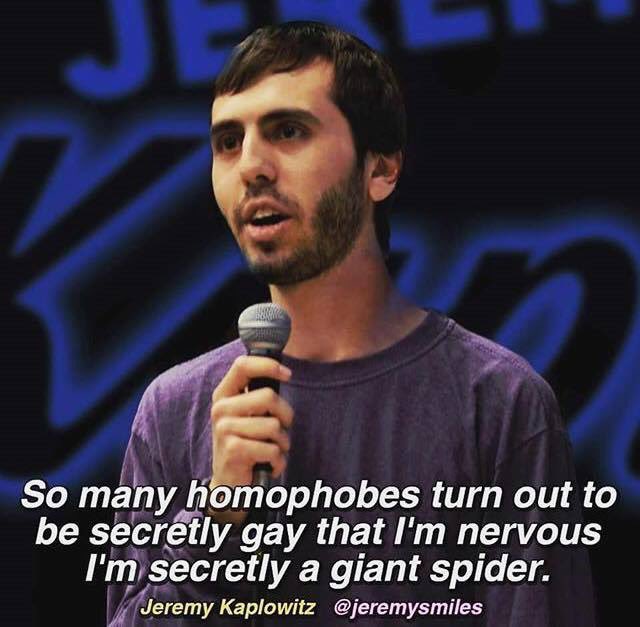
“So many homophobes turn out to be secretly gay that I'm nervous I'm secretly a giant spider.”—Jeremy Kaplowitz
“So many homophobes turn out to be secretly gay that I’m nervous I’m secretly a giant spider.”—Jeremy Kaplowitz
We are deep in the shack nasties as we’re trying to get moved, but a couple of things popped up in the news since I posted this week’s Friday Links that I just have to comment. First up, Study confirms some men use anti-gay and sexist & homophobic jokes to shore up their masculinity. Many of us have observed this anecdotally, but it’s nice to have some new science on it. “The study, from researchers at Western Carolina University, assessed how heterosexual men responded to various forms of humor when they felt their masculinity was being questioned. The men who placed more value on how they conform to expectations of masculinity were more likely to embrace humor that denigrated women and gay men if they felt they had to prove that their masculinity was in check.” Note that the study specifically looked at how the men responded to jokes and then what sorts of comments they might make while discussing humor in general. So the context was reading, writing, and discussing humor. The study is therefore revealing a single manifestation of a deeper phenomenon—the more insecure a man is in is own masculinity, the more likely he is to denigrate women and queers. Note also that the study shows the other side of the effect: a guy who feels secure in his masculinity was less likely to bash women and queers.

Keep that in mind as you read these news stories:

Tennessee Passes ‘Natural and Ordinary Meaning’ Bill Which Will Strip Rights From Same-Sex Couples, Women

Rep. Randy Weber Tearfully Begs God To Forgive America For The Sins Of Legal Abortion And Marriage Equality

Fox Contributor: Gay Men In Bars Should Expect To Be Assaulted And Women Shouldn’t Breastfeed In Church

The Alabama Legislature Voted To Let Adoption Agencies Turn Away LGBT Parents

Kentucky Judge Refuses to Hear Any Case Involving a ‘Practicing Homosexual’ Wanting to Adopt a Child

Chechnya’s President Vows To Eliminate Gays By The Start Of Ramadan

Gee, what has all of these men so angry at gay men, lesbians, and women?

Also, remember that it isn’t just one study from this year. Here are a few more: Homophobic Men Most Aroused by Gay Male Porn for 2011, and Study Reveals Homophobic Men Are, In Fact, More Likely To Be Gay from 2014, and Scientific American: Scientific American: Homophobes Might Be Hidden Homosexuals – A new analysis of implicit bias and explicit sexual orientation statements may help to explain the underpinnings of anti-gay bullying and hate crimes from 2012, and Homophobia correlated with Homosexual Arousal from 2010, and let’s not forget from 1996 Is Homophobia Associated with Sexual Arousal? (spoiler: yes), and… and…

Draw your own conclusions.

One last thing, the new study that I cited at the beginning? It also showed that test subjects who showed, on a pre-study survey, a higher degree of Precarious Manhood Beliefs, and then were exposed to information that affirmed that a man being able to see things from a women’s perspective and a woman being able to see things from a man’s perspective were both good things? They were less likely to verbally bash women or queers. Which seems to back up the notion that all this misogyny and homophobia within the culture is causing harm. Gee, who’d a thunk?

The incredibly true confessions of a totally queer sci fi geek

“Half naked... staring at phallic spaceships... totally straight, right?” © Syd Barrett (Click to embiggen)
“Half naked… staring at phallic spaceships… totally straight, right?” © Syd Barrett (Click to embiggen)
The Hugo Award Finalists were announced yesterday. This is the first year with two rules changes that were enacted to try to prevent certain angry reactionary (misogynist racist homophobic) parties from slate-nominating a bunch of horrible stuff onto the ballot. The pups took over entire categories of the ballot two years ago (but we No Awarded all of those categories), and slightly less-destructively last year. The good news! They only got one nominee in on a few categories (plus two nominees in one), and even then, several of their slate pics were works that almost certainly would have gotten on the ballot without their help. I don’t want to re-hash the two puppy camps, their arguments and so forth here, because plenty of pixels have been spilled on that already. For this queer old fan, a big reason science fiction and fantasy holds a big place in my heart is because its promise of better worlds and a better future was how I survived the bullying, bashing, hatred, and rejection of my childhood. That there are people who so despise people like me being included in works of sf/f that they’ll organize a bloc-voting scheme is more than a little infuriating.

But there are a few things to talk about on this year’s finalist ballot and the new rules. Mike Glyer at File 770 does some number sifting in an attempt at Measuring the Rabid Puppies Effect on the 2017 Hugo Ballot. David Gerrold, science fiction author (including perhaps most famously the Star Trek Original Series script, “The Trouble with Tribbles”) and 2015 World Con Guest of Honor sums up a lot of my throughs in a post of Facebook, part of which I excerpt here:

“My seat-of-the-pants analysis (I could be wrong) is that the Hugos are in the process of recovering from the 2015 assault, precisely because the Worldcon attendees and supporters see themselves as a community.

“There’s a thought buried in that above paragraph — that communities unite to protect themselves when they perceive they are under attack. This works well when the attack is real, such as Pearl Harbor. But it can also have negative effects when hate-mongers such as Bryan Fischer and Pat Robertson (both of whom were in fine form this week) invent a scapegoat (LGBT people) for unwarranted attacks in an attempt to unite the community around their own agendas.

“So while those who have a long history of participation in Worldcons will see this unity as a good thing — those who identify themselves as the aggrieved outsiders will see it as more evidence that the establishment is shutting them out.

“Myself, I see it as a collision of two narratives — one that is based on 75 years of mostly healthy traditions, and one that is based on a fascist perception of how the world works.

“Most important, however, is that most of this year’s ballot suggests that we are seeing a return to the previous traditions of nominations based on excellence. Most of the nominations are well-deserved, and my congratulations to the finalists.”
—David Gerrold

I would characterize the two narratives as:

  • one thinks that a better tomorrow includes the notion that Infinite Diversity in Infinite Combinations is a good thing, and
  • the other that thinks the world was a better place when the heroes were always white men, while women only appeared in stories for the two purposes of being rescued by the hero and being his reward for a job well done.

But Gerrold’s wording works well, too.

Anyway, because of the drubbing they received the last two years and the rules change, one of the puppy groups essentially folded up shop. The other, realizing that the rules made it nearly impossible for them to take over entire categories, went with a more limited ticket this year. As mentioned in one of the links above, this resulted in them naming about 7% of the nominees, and a few of their picks are complete piles of steaming meadow muffins. Which means in every category we have four or more excellent choices to evaluate and choose from. Not everyone sees this year’s ballot as good news. One puppy apologist tries to claim that this year’s balloting numbers proves that the Hugos have driven off half the fandom (here’s a Do Not Link to his post if you want to read it). Now this is a person who claims that we’ve been telling Christian and conservative fans that they aren’t welcome. Whereas all that has happened is that more than a token number of people of color and an occasional LGBT person has made it onto the ballot.

Anyway, his reasoning is dubious on a mathematical level. First, he shows that the number of nominating ballots dropped by between 42-46% in some categories, and that sounds dire. Until you remember that the number of nominators surged last year way above the usual number precisely because after news got out about how the puppies had piddled on the ballot in 2015, a bit more than 2300 fans who had not previously been voters bought supporting memberships and voted in 2015. The overwhelming majority of those new voters resoundingly voted No Award in the categories the puppies had taken over. Fewer of those fans returned to nominate in 2016 for variety of reasons, but not all of them, by any means. Again, the majority handed the puppies a resounding rebuke and we passed two rules changes that made the bloc voting scheme less likely to succeed.

Statistical analysis of the nominating and voting in 2015 and 2016 showed that the number of puppy voters was probably no more than about 250 people those two years. That many people nominating in lockstep could take over the entirety of some down-ballot categories, but it couldn’t win. The larger of the two puppy groups gave up this year—not posting recommendations, not writing their angry blog posts, and generally not bringing a lot of attention to the cause. Their 250 people could not account for more than a fraction of the 1600 nominator drop that happened this year. Most of those 1600 who didn’t participate are from that group of fans who joined for the explicit purpose of opposing the puppies, and now believe that the rule changes and so forth have taken care of the problem.

Analysis of the partial numbers we have from this year’s nominations indicates that the remaining puppy voters number between 65 and 80 people. That’s a 68% drop-off in their group, a far more significant number, I think.

There have always been fewer nominators than voters. Nominating (filling in five blanks in each category) is harder work than voting (choosing from a small list of finalists in each category). And in order to vote or nominate you must purchased at least a supporting membership to WorldCon. A lot of fans don’t have the extra money laying around to buy a membership to a WorldCon that they aren’t attending. So you have to be pretty devoted to the ideas of sci fi/fantasy and/or feel a certain amount of sentiment toward the Hugo Awards themselves to participate year in and year out. Folks who normally don’t spend those funds on that felt something we loved was under assault, and we shifted our priorities a bit to make a stand.

The puppies whipped up some reactionary anger by referring to certain past winners as being motivated by nothing more than Political Correctness, and spinning a very distorted narrative that some of their favorite authors weren’t winning because of an anti-conservative or anti-christian agenda. An angry desire to give the middle finger to so-called PC elites might motivate people to spend some money and do some copy-and-pasting once or twice, but it’s hard to sustain that anger.

I love science fiction and fantasy. I think of it as a literature of hope and imagination. Even dystopian sf, in my opinion, touches on that hope for a better tomorrow even while it portrays a dire future. I am not the only fan, by any means, who was drawn to the literature because I felt like an outsider who didn’t belong in the mundane world of the present. Sf/f has always attracted outcasts of all sorts, which is why many more fans (not just the people of color, the women, and the queers) felt it was worth defending. I know that at least some of the puppies feel as if they are outcasts, though their argument is difficult to back up with facts. White male authors still make up a disproportionately overwhelming majority of the published works, and usually a majority of the nominees for these sorts of awards. They aren’t in any danger of being excluded. I’ve voted for books and stories in the past written by people I knew I disagreed with politically, because the story was good. It isn’t the political views of the author (and not usually of the story, though some of the examples in 2015 were so heavy-handed at hitting the reader over the head with politics and religion that I started to wonder if it wasn’t supposed to be a parody).

I want sf/f to be welcoming, yes. But not so welcoming that people who have literally called for the extermination of writers who include queer characters in stories to feel welcome. Or call an author who happens to be African a savage. I do have my limits.

See, I want the awards to recognize cool stuff written by people who really love telling stories. I like it when the ballot includes stories and authors I’ve not previously heard of. I like it even better when those stories make me want to read more by that person in the future. I don’t want “inclusive” stories or “diverse” stories for the sake of diversity, I want stories that look like the real world, where cisgender people and trans people and people of color and straight people and not-straight people and people of many different religions and people of no religion and people of different abilities are all included. Not to meet a quota, but because that’s how the real world is now! Yeah, as a queer man I’m happy when I see queer characters in a story, but it isn’t enough on its own to make me vote for it.

More adventures in straightsplaining—bless your heart

“Go ahead! Explain to us how you, a straight person, know more about homophobia than we do.”
“Go ahead! Explain to us how you, a straight person, know more about homophobia than we do.”(Click to embiggen.)
In a recent post I commented on the case of Andrew Shirvell, a former Michigan assistant attorney general who lost his job because he mounted a harassment and stalking campaign (using state resources) against an openly gay college student. During the post I commented on how Shirvell pings everyone’s gaydar and talked about the roots of his particularly vicious and obsessive homophobia. And a new commenter decided to explain to me how very homophobic it is for me to characterize Shirvell’s mannerisms and speech patterns as prissy.

Oh, straightsplaining again! Hurrah! Thank you, so much, anonymous straight person, for explaining homophobia to me. How foolish of me to think that my 50+ years of surviving the slings and arrows of homophobia gave me any understanding of it.

Okay, let me clarify a few things:

Fact the First: you are correct, not every gay man is a sissy. Bully for you for being so open-minded!

Fact the Second: there are actual studies that show that, while not all queer men are sissies, at least 75% of boys who exhibit the characteristics causing them to be labeled “sissy” during childhood grow up to come out as queer.

Fact the Third: no matter what their actual sexual orientation, every boy who ever lived in our society who exhibits any of those gender-nonconforming behaviors was bullied because of them.

So, whether you believe that Shirvell is a closet case or not, my assertion that homophobic bullying is part of the root of his insanely over the top obsessively vicious homophobic campaign against that college student is still valid. You’re barely technically correct that we don’t know Shirvell’s orientation for certain (though I’m 99.99999% certain that he is queer of one sort or another). But the sheer level of sissy behavior one sees in any of the video interviews Shirvell gave back when he was defending his campaign tells me that he wasn’t just bullied occasionally as a child, but quite viciously and continuously. And we know from many studies that enduring that kind of bullying is one of the sources of adulthood excessive homophobic attitudes and behavior.

While we’re on the topic of those studies: those studies also show that the more virulent an adult man‘s homophobic attitudes and opinions are, the more likely it is that their body will exhibit involuntary arousal at the sight of scantily clad men. In other others, the more homophobic, the more likely that they are a self-loathing closet case. Add that to the study above, and it’s possible that my 99.99999% assessment is too low.

Fact the Fourth: I was a sissy. My childhood bullies included not just my classmates, but many of the adults in my life: family members, some teachers, and many adults at church. Yes, during my early teen years I was verbally homophobic. In my later teen years the only reason I wasn’t was not because I had become enlightened, but rather because as I had given in to my hormones a number of times, I wasn’t willing to be a hypocrit. But I was still convinced that I was going to go to hell for giving in to those feelings. So I understand Shirvell’s situation.

I do feel sorry for Shirvell the child. I know he had a horrible experience, even though I don’t know all the details. However, he’s an adult, now. He’s been exposed to information about sexual orientation, including the medical studies that it is not a choice (and therefore, since part of the theological definition of sin is being a willful disobedience, that means homosexuality cannot be a sin). He’s had more than enough time to start coming to terms with his childhood trauma and at least make the decision not to be the kind of bully that made his childhood hell. He has very emphatically chosen not to do so. Shirvell the adult deserves not one iota of sympathy. Not one.

Fact the Fifth: Please understand, I’m not stereotyping Andrew Shirvell as a gay man, I’m stereotyping him as a self-hating closet case—and he’s given us so, so much ammunition. It’s not just about the way he prances or speaks, it’s what he says as he’s ranting about the imagined sexual depravities of the targets of his homophobic rants—he simply sounds like he spends an inordinate amount of time imagining queer sex.

And there isn’t a plausible heterosexual explanation for that.


Note: Comments on this entire blog have always been moderated. Specific commenters have been whitelisted, but everyone else’s comments sit in a queue until I approve them. And I don’t see any point in approving comments that are insulting, or obviously coming from sock puppets or—such as the comment alluded to here—indicate the person isn’t interested in listening.