Tag Archives: life

Over prepared

I come from a long line of worriers. Some of them were world-class fretters, constantly obsessing over the most unlikely things. I’m not a fretter. The worrying tendencies manifest in me as being over prepared.

For instance, even though the battery of my smartphone normally has no problem lasting through a day at work and an evening of dinner with friends afterward, I have a case that contains a spare battery which can recharge the phone from absolutely dead to more than 80%. Plus, in my backpack I carry adapter cables so that I can recharge either the phone inside the case, or the phone and case simultaneously using USB ports on a computer. And I carry a small adaptor for charging directly if there is no computer. And finally, The backpack also contains an external battery and adaptors that, if there is no power at all, can recharge my smartphone and power a dead laptop for about four hours.

And I’m not sure I have enough of my bases covered.

I know this is paranoid overkill.

The backpack has a spare two day supply of my prescription meds just in case. Plus a collection of over-the-counter allergy meds, tylenol, and other minor medications. During the cold part of the year there’s a pair of gloves and a stocking cap always in there, along with a pair of sunglasses that will fit over my eyeglasses. In the warm parts of the year the gloves and hat are replaced by a slightly rain-proof windbreaker.

And you don’t want to know how many pairs of eyeglasses I have and where…

I also misplace things. All the time. I can lose, find, and re-lose a set of keys ten times in less than ten minutes. So I have spares of lots of things, because sometimes you don’t have time to spend twenty minutes figuring out where something is.

I know that preparing for hypothetical difficulties is an attempt to control the future. Which is uncontrollable. On the other hand, the quirks it manifests as for me aren’t disruptive to other people’s lives, doesn’t interfere with my ability to interact with friends and family, and it means I’m not stressing over things I can’t control. At least I’m not likely to worry myself into a heart attack.

Besides, watching me unpack my backpack looking for something causes some of my friends great mirth. And the world can always use more laughter.

Right?

Things out of our control, part 3

A couple weeks ago I was refilling my coffee mug at work when a co-worker asked if I had heard the news about a former co-worker. I said “no,” expecting to hear something about a new job. Instead he told me that the guy’s 24-year-old daughter had committed suicide just a few days before.

“Oh, no!”

I had never met the daughter. I vaguely remembered pictures of a wife and a couple of kids at different ages on the guy’s desk. But the news immediately dissipated my good mood and left me feeling as if there ought to be something I could do to help. I immediately tried to remember the faces in those pictures on his desk.

But there wasn’t, really, anything I could do beyond offering condolences. When tragedy strikes in the family of someone you know well, you can offer to help run errands, offer emotional support, or maybe drop off a casserole. When I was a kid living in small towns, whenever tragedy struck anyone, you made a casserole and delivered it to the family, so they could eat without someone having to go to the trouble of making a meal. If you didn’t feel you knew the people well enough to deliver it yourself, you might get a group together from the church and a couple of people who knew the family better would be deputized to deliver the food.

It’s a bit different now in the city. People don’t expect that sort of thing, and if it’s a co-worker rather than a personal friend, you often don’t know where they live. I know which suburb this guy lived in, but that was it. And we were co-workers for only a bit over a year, he left for a job at another company almost three years ago. We never had any contact outside of the office. If I did track his address down and showed up with a dish of food, it would be weird and awkward.

Plus, now you have to worry about whether people eat meat, and if they don’t are they ovo lacto vegetarians, pescatarians, or full-on vegan? Maybe his wife had to have only gluten-free food. Or maybe someone has a food allergy.

It still leaves you feeling as if you ought to be able to do something to help.

That same impulse is what most of us feel when we see news such as the bombing at the Boston Marathon, or the shooting at the school in Newton, and so forth. We feel powerless, and if we don’t know anyone directly affected, we can’t even offer condolences or emotional support.

I saw a lot of people on various media and forums admonishing anyone who seemed to be obsessing about the news. To be fair, it was usually admonishing people for repeating unsubstantiated rumor and speculation, but a lot of those admonishments certainly implied that there was something wrong with being anxious to learn more. In those discussions there were lots of references to fear: you want more information because at least subconsciously you want to assess the risk of how likely more people might be in danger, et cetera.

But I think another thing that fuels the need for more information is that feeling of wanting to help. When I heard about the suicide of the former co-worker’s daughter, during my urge to make a casserole, I tried to remember whether he had ever mentioned which neighborhood he lived in. Maybe we had enough information between several of us to at least have flowers sent, you know?

After the bombing in Boston, it was heartening to hear the news of how many people turned out to donate blood, to give money to a couple of funds to help with people who were stranded, and the set up a way for locals to offer places to stay for the stranded folks.

If feeling about this event leave you wanting to help, remember that you can always donate to the Red Cross. Even donating or volunteering at your local Red Cross can help make sure that resources will be available to help in the next disaster or crisis.

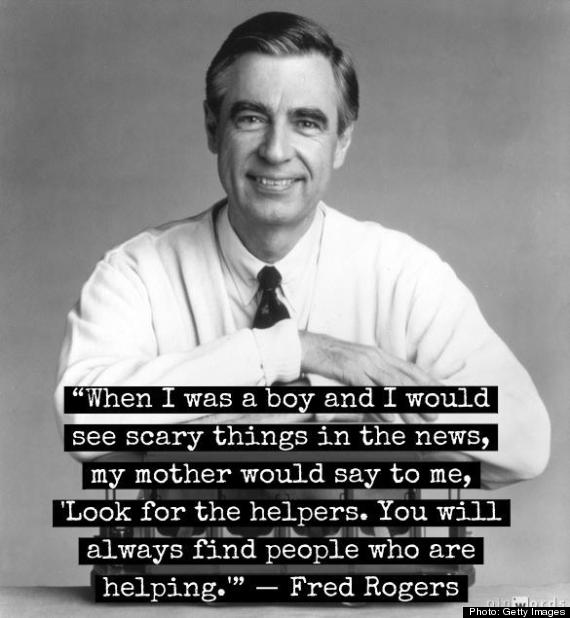
Mr. Rogers says to look for the helpers.

A beach, a blanket, and a song

I’m not quite old enough to remember the original Mickey Mouse Club. It was cancelled almost exactly a year before I was born. Three years after cancellation, the original hour-log recordings were edited down to half-hour segments that were shown in syndication for a few years, and my Mom said I watched it fairly faithfully. I don’t know how much of my memories of the show are from that exposure, because those edited episodes was re-re-released into syndication around the time I was in middle school. I watched some of those episodes, though if my friends caught me, I claimed that I was just watching it to humor my younger sister.

I was already an Annette Funicello fan before. I remember her most from the Beach Party movies co-starring her and Frankie Avalon. When I was in grade school, before modern cable systems, when most places had only three or four stations, there always seemed to be one of those stations that ran movies in the afternoons. Silly comedies were a staple of those afternoon movies, so Beach Party, Muscle Beach Party, Bikini Beach, Pajama Beach, Beach Blanket Bingo, and How to Stuff a Wild Bikini made frequent appearances.

The movies were extremely silly, with outlandish plots. Despite being movies about kids spending a summer at the beach and the ensuing romantic soap opera, a lot of them had at least one sci fi/fantasy element (the professor’s ability to paralyze someone by touching a “nerve-cluster” at the temple, the “improved” chimpanzee that could surf and dance better than a human, a Martian teen-ager sent to the beach as an advance scout for an interplanetary invasion, a mermaid falls in love with one of the surfers, and Frankie hires a witch doctor is to send a sea nymph to the beach to keep the other guys away from Annette while he’s in the Navy).

Not exactly high-concept, but probably a big part of the appeal to grade-school-aged me.

She was in a few of the sillier Disney films of the sixties, as well (The Shaggy Dog, The Misadventures of Merlin Jones, and The Monkey’s Uncle).

In all of those movies she played the wholesome good girl. The girl any boy would be lucky to have. Setting aside all the levels of sexism in that, it meant when I was a kid, I wanted to be her. I didn’t consciously admit it. I’m sure that to some of the adults in my life they assumed that I learned all the lyrics to all of her songs, et cetera, because I had a crush on her. (And for the record, I didn’t have a crush on Frankie; his pretty boy persona was totally not my type.)

So I’ve always had very fond memories of Annette and was sad to read that she died. I’m a bit miffed that news of her death has been overshadowed by reporting about the death of a certain former British Prime Minister. I certainly understand why the latter is considered more newsworthy.

Good-bye, Annette. I hope that somewhere you’re strolling along a beautiful beach, surrounded by love and music.

Taxes

We once again put off doing our taxes.

I don’t mind paying taxes. Really. Unlike some people, I recognize that we’re generally safe in our homes and can count on our money being useful to purchase goods and services because of government functions ranging from the local police and fire departments all the way out to federal reserve and the armed forces. That’s not the grumble.

For most of my life (with a couple of exceptions), my taxes have been fairly simple. Unfortunately, for the last three years that hasn’t been the case. Because when voters in my state approved “everything but the name marriage” domestic partnerships a few years ago (and full-fledged marriage last year), they granted community property rights to us, but the federal Defense of Marriage Act forbids the IRS from calling it a marriage, we’re required to file as Single, but we’re also required to report each other’s income.

The first year this was true caught everyone by surprise (a lot of IRS employees didn’t understand why these strange returns were coming in, and sent back letters threatening fines for “frivolously false” filings), so none of the usual free online services (nor the paid software) knew how to handle it. It took Michael and I several hours to sort things out. And if some gay rights organizations hadn’t posted instructions and links to the correct obscure IRS documents, it would have taken a lot longer.

Last year, which was the second year this was required for citizens of a bunch of states, the software services (and some of the walk-in-and-pay-us places) still couldn’t handle it. But since we’d done it once before, and had saved copies of everything, we were able to do it ourselves with much less hassle.

This year, the third year (and with even more states qualifying), I had been pleased to read some reviews that indicated at least one of the common software solutions could handle it.

The reviews lie.

Once I did figure out what the misleading instructions actually meant (both the software interface and the instructions extremely poorly designed), the software would literally not let me back to the dialog box where I needed to change the number unless I deleted the entire form and started over.

Fortunately, they have a simple form on their website to request a refund.

If I had just set out to do it ourselves as before, I would have had a much less cranky afternoon.

The really dumb thing is that most of the reason why I would like to use the software is because both of us have atrocious handwriting. With any luck, the Defense of Marriage Act will finally be gone next year, and we’ll be able to just do the simple “Married Filing Jointly” form.

Wouldn’t that be nice?

It is April, and sometimes I am a fool…

…but I am not posting an April Fools’ Day joke.

I have done a few. In college as member of the editorial board of two different campus papers, I helped produce a few April Fool’s Day editions. On my old LiveJournal I am still rather proud of the post I wrote explaining why I had decided to become a Gay Republican and start actively working to oppress myself.

If I were to do an April Fool’s Day post, I would adhere to the following rules:

  • I plan it out in advance, giving myself time to edit it a time or two before it is posted.
  • The topic is not something that will make people worry (nothing about fake injuries or illness, not pretending to be angry at my friends, anything like that)
  • The butt of the joke needs to be me

I have, over the years since I started blogging, only come up with a few that met those conditions. Even though I tried to pick things that I didn’t think would upset someone, I managed to do so two of those times—the opening sentence of the Gay Republican joke made one friend think that Michael and I were breaking up, and one of my fellow bibliophile friends fell for the one where I Michael and I decided to throw away all 6000+ books in our house.

The point of a joke is to make people laugh. If they aren’t laughing, it isn’t funny.

I am fond of a good news April Fool’s Pranks. Among my favorites:

NPR: Portable Zip Codes

NPR: Exploding maple trees

Garden News: Dinosaur vine

And I can’t find a link to this one: one of the local radio stations did a story claiming one of the island out in Puget Sound had come loose from its moorings and was floating wildly around the Sound. They kept giving updates throughout the afternoon as the island was sighted in different places, along with attempts to try to capture it and tow it back.

Forgotten or Unknown?

Our collective memory can be frightfully shallow.

Take, for instance, an on-line discussion I was in recently where there were people who weren’t aware that not that many years ago it was illegal to be gay. By which I don’t just mean that the notion of gay marriage didn’t exist, but that if the authorities found out you were gay, they could send you to prison. I had to tell them of an acquaintance who had been arrested for indecency back in 1970 for kissing his boyfriend in the wrong neighborhood. That meant that he didn’t just have a criminal record, but a sexual offense (albeit a misdemeanor).

Note that he was not arrested for rape, attempted rape, or anything like that. Chris was 21 years old, his boyfriend was 24, they were consenting adults who had just left a gay bar together. It was late at night, and they were making out in the boyfriend’s car near Chris’s dorm at the University of Washington. Yes, they were here in a city with a reputation as being ultra liberal. But they were two men kissing, and that was something society could not abide in 1970!

If I recall correctly, Chris said his boyfriend lost his job because of the arrest, and had a difficult time finding a new one. Chris didn’t begin to run into problems getting hired himself until a few years later, after he graduated and started looking for more substantial jobs than the starving-student-type of employment he’d had before.

He wound up working as a hair stylist, saved up his pennies, and eventually opened his own shop. It hadn’t been what he’d meant his career to be, but he made do.

Contrast that with something I witnessed during my own college days (some years later): one of my dormmates convinced a bunch of us to go with him one night to a park that was near the school. I have completely forgotten what the purpose of the excursion was, now, but we got a bit lost and stumbled upon a guy and a gal who were having sex under a tree.

It was long after dark, they were off of any paths, behind some bushes, and they were clearly trying not to be seen or heard.

We hurried away before the angry guy could do more than yell at us.

Not much further, we encountered a cop, who stopped us and asked us what we were doing in the park after dark. There was a point where I thought we were all going to be showing him our student IDs or something, but something one of the guys said made the cop grin and ask us if we had run into anyone doing something they oughtn’t. And then he made a reference to the size of the girl’s breasts.

It was clear he had seen them, as well, but had decided not to do anything about it. I think he implied that he had been sent to the park because of complaints about such activity, and he thought it was a waste of time, since no one was being hurt.

I suspect the cops reaction would have been very different if it had been two guys.

I’ve been running into a lot of people, when discussing issues such as marriage equality, the Violence Against Women Act, or wage disparity, who are completely unaware of just how recently things that they currently think of as mere fruatrations were either mandated or at least aided and abetted by the law.

For instance, up until the mid 70s, a married women did not have a legal right to withhold sex from her husband. Even if they were living separated, in the midst of divorce proceedings, and he had been witnessed physically abusing her many times, if he forced her to have sex she couldn’t get him convicted of rape. Heck, most of the time she couldn’t get him charged. Finally, a woman who had attempted to get the rape included in the assault charges against her husband (ex-husband by the time it went to trial), managed to appeal the decision not to include the charges up to a federal judge who agreed: if she says “no,” it’s rape.

That didn’t cause a sudden change in the law or practice in this regard, but it was the very first recognition that in the U.S. legal system that a wife’s body wasn’t literally and entirely the property of her husband to do with as he pleased. And that only happened a mere 36 years ago.

There are still laws on the books related to that notion. My favorite are the “alienation of affection” laws. If you look up the topic online now, all you will find are articles that refer to the versions of the laws as they have been altered in response to legal challenges. So wikipedia, for example, says that the laws allow a spouse to file a lawsuit against a third party alleged to be responsible for the failure of the marriage.

The original laws allowed only the husband to file a lawsuit against another person for “malicious conduct that contributed to or caused the loss of affection.” The most common malicious conduct was, of course, seducing her into having an affair. For a long time a wife could not file a similar lawsuit against someone she believed she could prove had acted to alienate her husband’s affections. In the last several decades, most of these laws that have remained on the books have been revised to be gender-neutral, which I suppose is an improvement.

The problem is that while the original justification of the laws was assumption that a wife’s body (and affection, et cetera) were the property of the husband and he could expect the legal system to protect his property rights, the gender-neutral versions still assume a property rights relationship. If you need the law the force your partner to love you, that is not love. Okay, successful lawsuits under these laws don’t end up with orders to anyone to go back to loving their spouse, but when the law is able to inflict punishment because someone has fallen out of love, the principle is the same.

There’s going to be a lot of talk on the news and around the web this week where people are emphatically insisting the marriage has been an unchanging institution for all of human history, and that’s pure nonsense. In the last five decades alone in this country we have redefined marriage in several ways:

  • so that it includes interracial couples,
  • so that it includes persons previously considered less than full citizens because of certain mental and medical conditions,
  • so that even prisoners on death row must be allowed into the institution if they want, and,
  • so that a wife’s body is not treated as the legal property of her husband.

Over the course of five decades before that we have legally redefined it so that a couple who have realized the marriage was a mistake could end it without having to prove that one spouse was abusive, or go through other legal hoops to satisfy society that the marriage was over.

In the century before that we have legally redefined it so that people didn’t have to get the approval of a church (and before that, the official state church) in order to get married, allowing people who were raised in different faiths to get married, as well as allowing those of no faith at all in.

In the last few centuries we’ve redefined marriage in a way that almost no one realizes was never an integral part of the institution: we made marriage about love. For most of human history marriage has been a matter of creating/reinforcing family alliances, securing the orderly inheritance of property, and/or politics. The notion that two people would meet, fall in love, and decide all on their own to get married has only been around for a few centuries.

So any so-called defenders of traditional marriage who mention a relationship of mutual love and respect is not talking about a very old tradition, at all.

Yes, the notion that two people of the same gender might be the ones who fall in love is new for a lot of people, but when looked at in comparison to all the other ways that marriage has changed, it’s actually only a very minor refinement.

Abyss gazing

It was 1986 and I was twenty-six years old, attending a regional science fiction convention with a bunch of my friends. One of the guests of honor was an author (we’ll call him Mr. C) that two of my friends were very fond of. I had read a couple of his short stories and thought they were good, but he hadn’t really wowed me.

But hearing Mr. C talk about the writing process, his influences, and so forth, made me much more intrigued. It didn’t hurt that when another panelist made a disparaging joke about my favorite science fiction author (who was not in attendance), Mr. C rather emphatically jumped to the defense of my favorite author.

After that panel, one of my friends commented that Mr. C’s takedown of the other panelist had been mean. It was true. Mr. C had ended the rebuttal with something along the lines, “…and it infuriates me when writers who don’t have a fraction of his understanding of how to write or a sliver of his talent make thoughtless critiques.” But, she had called my favorite author a fossil, I pointed out. Once one makes an ad hominem attack, you invite something similar in return. Since it was my favorite author being defended, I was more than a bit prejudiced.

So I wound up standing in line with one of my friends, clutching a pair of just-purchased books of Mr. C’s work, waiting for his autograph. That is the one and only time I have met Mr. C in person. He was pleasant enough, despite having had to smile, listen, and sign however hundreds of times.

After the convention, I tried to read one of the books. It was a collection of his short stories, which included the couple I had read before. They weren’t bad by any means, but after reading a few in a row, an unsatisfying feeling was developing. I sat the book down, not quite sure why I wasn’t enjoying the reading.

A few weeks later, I picked it up again and started on the next story. Again, the story itself was well written and interesting. I read another, then started on the next after that and, well, a few paragraphs in I realized that same feeling of wrongness was building up.

I did eventually finish the collection, but it took a few months, reading only a few stories at a time. And by the end I couldn’t really say that I’d enjoyed them all, but I also couldn’t put my finger on their shortcomings.

The other book was a novel. A novel for which he had won a lot of awards. It was based on one of the short stories in the previous collection. And the short story in question had been one of those I had enjoyed more than the others. Plus, I had friends who swore this book was a masterpiece. And it had garnered all those awards, so it had to be good, right?

I couldn’t finish it. I don’t think I’d even gotten a quarter of the way through before I found myself intensely disliking it.

I tried explaining what I didn’t like about it to one of my friends who loved it. As we were talking, I kept finding myself talking about abstract concepts, rather than actual events in the story. My friend said it sounded more like my baggage than the story. So I started explaining how a similar philosophical assumption underpinned one of the short stories. And that’s when I finally managed to connect the dots and say what was bothering me about all of the stories.

There was a fundamental notion forming the foundation of all the tales: if you don’t know your place and stay in it, horrible things will happen to you. A corrollary was that if you prevented someone else from achieving what was “rightfully” theirs, even more horrible things would happen to you.

When I articulated that, my friend began to argue. That wasn’t what was going on at all, he said. So then I made a guess at how the book I hadn’t finished would end. Specifically what would happen to certain characters.

My friend blinked. “How did you know?”

“Because, if you don’t know your place and stay there, forces, whether they be social, cultural, or fate, will strike you down. And if you stand in the way of someone else’s destiny—”

My friend grinned and interrupted. “Oh, wow! You’re right! That’s so messed up, because it’s like the opposite of what the main character says, but it’s really what happens!”

“Mr. C believes in hierarchical, patriarchic societies in which you behave according to societal expectations, and people who have the temerity to want to choose their own way of living are evil,” I said.

My friend shrugged and said, “You’re probably right. But I still love the stories.”

“Whoever fights monsters should see to it that in the process he does not become a monster. And when you gaze long into an abyss the abyss also gazes into you” — Friedrich Nietzsche

Just a few years later, a controversy erupted in a forum dedicated to Mr C on the (now long defunct) Prodigy network. The controversy was about a protagonist in another of Mr. C’s novels who experimented with gay sex midway through the book. Some people were angry Mr. C had included an “abomination” as a sympathetic character. Others thought people who thought gay people were abominations were bigots.

As the arguments raged, Mr. C waded in with a rather long discussion about the sin of homosexuality, why he felt he had to include it in the book (his reasoning, as I recall, was that in any community where people amass power there will be people who must dominate, possess, and destroy others, and of course homosexuality is all about dominating and destroying each other), and then had the gall to claim that anyone who called him homophobic were themselves bigots. Because he didn’t hate any gay people. They were just sinners, and if they refused to repent and stop being gay, well, they would face consequences.

His comments were quoted far and wide. And he got angrier and angrier as people “mischaracterized” his comments. He repeated, again and again, that he didn’t hate gay people. He wound up writing (in 1990) a long essay and getting it published in a magazine that catered to the members of the church Mr. C had been raised in, in order to explain his side in context.

While the essay repeatedly said that he did not condone violence against sinful people, it talked about how just as children must be punished in order to learn right from wrong, then adults will face greater penalties when they continue to act outside the bounds of propriety. He talked abstractly about the “day of grief” that each homosexual would eventually experience if they did not repent. He talked about the horrible consequences homosexuals face if they refuse to adhere to propriety. But he was not advocating violence even then, he said. If the faithful, such as himself, had been compassionate but firm in condemning the sin, they would “keep ourselves unspotted by the blood of this generation.”

It’s an old lie that bigots of a religious persuasion tell themselves all the time. They don’t advocate or condone violence, it’s just that god’s law causes these things. And when it happens, they pretend that the people who did resort to violence never took all the words of condemnation as permission to commit violence.

Think about it: if it’s god’s will that homosexuals should experience a “day of grief”; if god’s law demands that “blood of this generation” must be shed, then the person who inflicts the violence is doing god’s will. They are a special tool of god!

Heck, it isn’t just permission to commit violence: it’s encouragement!

I had already guessed most of this about Mr. C before he began writing publicly about his reasons for opposing the decriminalization of gay sex and other topics back in 1990. And so I had already made my decision not to buy any more of his books. I didn’t post rants about him, nor try to organize boycotts of his work. If I was asked, I would say that I disagreed with what I perceived to be the underlying philosophy espoused by his work.

Once he did make his very public statements, I felt it was appropriate to go a step further and point out that Mr. C was a hypocrite and a bigot who advocated against the rights of myself and others. I would suggest that perhaps there were other writers whose works were more deserving of people’s money, but wouldn’t go further.

In the years since, he has continued to write and speak out against gay rights of all sorts, eventually becoming an officer for a large organization that says it is out to protect “traditional marriage.” They try to portray themselves as narrowly focused on marriage, but anyone paying attention to their rhetoric and some of the other causes they support, can see that they want to roll back the few rights gay people have won. He donates his own money to the cause, he has organized efforts that have raised millions of dollars for the cause. He has claimed victory for every anti-gay amendment, law, proposition, or initiative that has been passed in the last ten years.

He has, now, gone far beyond the point of simply stating his opinion and trying to persuade others to it. He has gone beyond that disingenuous tactic of saying he was opposed to violence while providing double-speak that actually encouraged it. He has helped spread distortions and outright lies about all gay, lesbian, bisexual, and transgender persons. His organization has refused to obey public disclosure laws regarding their election activities in several states. He continues to fight to prevent gays, lesbians, trans people, and bisexuals full equality before the law. He continues to put forward arguments to take away what rights have been extended.

So, for that reason, yes, I agree with the people who have been disappointed that DC Comics hired him to write a prominent new Superman series. Yes, I support the comic book shop owners who have said they will not sell comics written by him. I support the artist who decided not to illustrate his stories after learning of Mr C’s views and activities. I urge everyone I know not to buy things he writes, not to go see the movie that is being made of his most famous novel.

I re-iterate: this isn’t just about a difference of opinion regarding marriage equality. For over 20 years he has advocated for restoring laws that made it a crime for consenting adults to have gay sex in the privacy of their own homes, and against laws that protect people from being fired, evicted, or denied medical care just because they are gay. And he has done more than just advocate those things, he has taken action to make them happen. It is not hypocritical of us to advocate a voluntary boycott of his work, it is hypocritical of him and his apologists to decry a voluntary boycott while they are campaigning for laws that will take away jobs, housing, health care, and more from entire classes of people.

Orson Scott Card is a hypocrite and a bigot who uses distortions and outright lies to hurt innocent people. Those are the facts.
Tilting at windmills

For some reason this year the time change is messing with me more than usual.

I’ve been going to bed early, falling asleep, and so far as I know sleeping soundly through the night. Yet when the alarm goes off in the morning, either I just lay there unconcious until Michael gets up and turns it off, or I stumble over, turn it off, and collapse back into bed for another hour.

I keep my alarm clock at the far side of the room precisely so that I have to get out of bed to turn it off. If I keep it on the bedside, I will just hit snooze again and again and again some days. I also have the clock radio portion set to turn on news about an hour before the alarm. Ordinarily, this nudges me toward wakefulness before the alarm goes off.

We used to have Michael’s alarm clock set to go off about a half hour after mine, just in case. Maybe we should go back to doing that, at least until we both stop feeling so dead in the mornings.

Neither of us are morning people, can you tell?

I’ve always felt a little guilty that I don’t hate Daylight Saving Time as much as some of my friends do. It’s the kind of thing you would expect me to rant about: the supposed energy-saving practice that actually decreases productivity, causes measurable increases in injuy-causing accidents, measurable increases in illness (usually attributed to stress), and so on.

If I keep feeling this crappy every morning for much longer, I’m going to to stop being so resigned and equanimical about Daylight Saving Time.

Not that anyone else’s rantings about it have had any effect. I’m feeling like that version of Rimmer from the first Emohawk encounter on Red Dwarf, wanting to organize a committee and bring out the big guns: a full on leafletting campaign.

Who’s with me?

Catching-time

According to the Shropshire Word-Book, written by Georgina Jackson and published in 1879, “It is called catchin’ time when in a wet season they catch every minute of favourable weather for field work.”

We have a weird relationship with time. When I was a kid, adults in my life put a lot of importance on how early one got up in the morning. If you were the sort of person who regularly got up at dawn (or earlier), you were obviously a morally upstanding, productive member of your community. If you slept in a bit later, but still got up “early” and started your workday sometime well before 9am, you were still a good person, though perhaps not quite as good and hard-working as the people who got up earlier. If you slept in until “all hours of the day,” there was something seriously wrong with you, and you were clearly leading a life of decadence bound for a (deservedly) horrible end.

Exceptions were made for people who had jobs that required them to work “graveyard” shifts, and the like, but even then, there were implications that this was only-just tolerated as a necessary evil.

I became especially cognizant of this in my early twenties, when I was juggling part-time college with multiple part-time jobs, one of which was a night job. A number of my relatives could not understand why I thought it was all right to sleep in past nine just because I had worked late, then stayed up to finish homework, and didn’t have to be at class or work until afternoon. They would quote folk proverbs and Bible verses at me about how early risers were healthy and successful, and only the wicked “slept the day away.”

Which, unless one is working in agriculture or some other vocation where sunlight is literally necessary to the work at hand, is nonsense.

While the human wake-and-sleep cycle is moderated by sunlight, it is part of a complex system of neuro-chemicals and hormones. The release of some of those chemicals are stimulated by the detection of sunlight, but it isn’t exactly the same in every person. There really are some people who are biologically wired to be morning people, some that aren’t, and even some who are definitely night people.

I am not one of those morning people. Getting me up and about before sunrise is a seriously unpleasant chore, no matter how early I go to bed. Even when I do get up regularly at a particular hour after a good night’s sleep, my brain never feels as if it is firing on all cylinders until a couple of hours after sunrise. In the summertime that’s no problem, but in winter—when sunrise at my latitude doesn’t happen until nearly 8 am—that makes working a 9-to-5 office job less than ideal.

Which is why I’m grateful that at least some flextime is fairly standard in my industry for my kind of work.

The flip side is that in the summer, when sunrise is much earlier, it’s a lot easier for me to get into the office and productive earlier in the day, and more likely that I will leave the office earlier, so that I can enjoy the sunny evenings.

Which is why I have a lot less hatred for the arbitrary annual movement of the clock forward and back than many of my friends. I understand perfectly well that the amount of sunlight we get in the summer is the same, no matter what any of us arbitrarily set our clocks to. But, because the official business world does follow that convention, and even in a flextime environment, one is expected to stay at the office until that hour hand creeps into the vicinity of the 5, the artificial temporary movement of that hour to earlier in the solar day gives me more time to appreciate and enjoy the sun when I am awake and out of the office.

So, it works for me. I’m sorry that it does nothing more than annoy some others.

March Forth!

It was spring of my first year in college. I walked into the Math Lab, where I worked, and the administrative assistant looked at me and declared, “March forth!”

“What?”

“It’s the only date on the calendar that is also a command,” she said. “March forth!”

Puns have never really been my thing. I find some of them cute—occasionally even clever—but I almost never think of them on my own. So the joke had never occurred to me. She was flabbergasted that I’d never heard the pun before.

That “March forth!” is an imperative was moderately amusing. I tried in subsequent years to think of something to do with it. Because just pointing out that the day sounds like a command lacks something. And truth be told, about half the time I don’t remember the joke at all until March fifth, by which time it’s too late.

I don’t remember anyone that I ever told the pun too having ever heard it before I mentioned it.

A few years ago, at my previous employer, I wound up on a committee charged with setting up some parties and other fun activities to prop up morale in the work place. Right after someone suggested some activity involving people wearing the shirts of their favorite football team, another co-worker suggested Combat Boot Day. None of us knew what it was.

“When I was in college there was this other girl in my dorm who got us all to wear boots—like Doc Martins or something that could pass for combat boots—on March the fourth. Because it’s March Forth Day. And you March in groups to classes together. And at the end of the day we had a party back in the dorm.”

I had to tell about the admin assistant at my college job who had first told me the March Forth pun and had acted surprised when I didn’t know about the day. But she also hadn’t told me anything to actually do to observe it.

The co-worker said her dorm-mate said it had been an annual thing at her high school. “It was weird, but kind of fun to march around and have people be confused. But now that I say it, I don’t know how we make that an office activity.”

Then I read this rather heartbreaking article: Trauma Sets Female Veterans Adrift Back Home. And I thought, “Okay, here’s something I can do.”

So, this March Forth, I would like to urge everyone to go donate to The National Coalition for Homeless Veterans.

March forth, and spread the word.