Tag Archives: news

Rough, manly sport, part 3

“I’m a 34-year-old NBA center. I’m black and I’m gay.”

Jason Collins isn’t the first professional athlete to come out of the closet. But he is the first male member of one of the “major league” sports to come out while he is still playing in that league. For many reasons it shouldn’t matter. But as Martina Navratilova (who came out as lesbian while still competing in professional tennis years ago) asked, “How many LGBT kids, once closeted, are now more likely to pursue a team sport and won’t be scared away by a straight culture?”

The Atlantic has a great article about why sports journalist haven’t reacted much to any of the WNBA players who have come out over the years, while Jason’s coming out has prompted reactions ranging from publications congratulating him to a reporter insisting that God doesn’t approve.

The thing I found most interesting and troubling in the Atlantic’s article is a quote from a spokesperson for the gay student sports advocacy group, You Can Play. He talks about how incredibly hard it is for them to find straight female professional athletes who will join any of their campaigns. Straight women athletes spend so much energy battling the assumption that they are lesbian, that they don’t want to do anything that might imply they are.

And the reason people assume that woman playing basketball, softball, soccer and the like “must be” lesbian is because basketball, baseball, football, and hockey are considered the epitome of masculinity and machismo. Which is why so many people are threatened by the notion of a gay man playing those sports. And it is threatening. You wouldn’t have players issuing statements that “they wouldn’t be welcome” if they weren’t threatened.

Even the mild, “don’t they realize sex is private?” reaction is a sign of feeling threatened. If sex is private, why do straight athletes introduce people to their wife and kids? And before you say that marriage isn’t about sex, I want to point out that the group fighting most viciously to keep gays and lesbians from getting the right to marry argued in front of the U.S. Supreme Court just last month that the primary reason marriage needs to remain a heterosexual right is because only heterosexuals can unintentionally procreate. The argument doesn’t make any logical sense, but all of their arguments insist that the sole purpose of marriage is procreation, in other words, sex. And if you’re okay with straight male athletes being seen in clubs with women, dating women, living with women, getting married to women and have children with them, then you don’t sincerely believe that sexuality is private.

And then there’s the football player who was tweeting about how immoral and against god’s law gays are, which is why he doesn’t want any on his team. Because that player has been living with a woman to whom he is not married for a few years—a woman who he has been arrested for battering, and who has kicked him out of the house more than once for fooling around with another women. And why is he worrying about other people’s morality, again?

Those bad reactions should really be the only answer anyone needs to the question of why such announcements are needed. People shouldn’t have to lie about who they are. People shouldn’t feel afraid to be who they are with their own teammates. Everyone should be equally free to talk about their girlfriends, boyfriends, spouses, et cetera.

Since we aren’t there yet, you do have to consider who’s really the more courageous: the one gay guy on the team who finally is tired of living the lie, or straight guy surrounded by other straight guys who is threatened to the point of anger at the notion of having a gay teammate?

Live your life with honesty

My scouting career was like a patchwork quilt. I joined Cub Scouts in second grade. I don’t think I was a particularly outstanding member of the troop, but I’m also not sure how outstanding any 8-year-olds really are.

In third grade we moved twice during the school year (and once during the summer between the end of third grade and the beginning of fourth). One of towns we moved to didn’t have any scouting troops, it was just two small. Another we didn’t stay long enough to finish unpacking before Dad’s company said, “No, we need that oil rig back in Colorado. Time for y’all to pack up your families again.” That town may well have had a troop, but we weren’t there long enough to find out.

I don’t remember much about the troop I joined when we moved to Ft Morgan, Colorado. I do remember having to say good-bye again just before Thanksgiving. But what I really remember is how shocked I was, once we settled into the next town, that there was only one troop and it was associated with a church that (at the time) Southern Baptists considered a cult rather than a denomination. The feeling was more than a bit mutual. I was informed that the only way to join the troop would be for our family to convert to the other church.

That was only the beginning of a lot of bizarre experiences that most people think could never happen in America as we tried to get by in a town where more than 95% of the population belonged to the same church. Those experiences convinced me at an early age of the true value of separation of church and state.

That would come later. At that point, I was simply dumbfounded to learn that I wasn’t welcome. I hadn’t really understood, before then, how closely the Boy Scouts were tied to churches. Yes, my original troop had been sponsored by the church my family belonged to, but several of the boys in our troop weren’t members of our church. My subsequent troops had been similar. I’m not sure if it was because all of the towns were so small that each had only one troop that drew from all the churches in town, but I had never before felt that my membership as a scout had been dependent upon being a member in good standing of an “acceptable” church.

By the time we were once more living in a town that had a troop which wouldn’t exclude me because of which church I belonged to, puberty had hit and finally told me in no uncertain terms that all the bullies at each school who had called me “faggot” and “queer” had been on to something. I don’t know if the Scouts explicitly had the no gays rule at the time, but it was quite clear to me that “boys like me” weren’t going to be welcomed by “boys like them.”

A frame from the Family Research Council "Stand With Scouts" video.
A frame from the Family Research Council “Stand With Scouts” video.
So the current controversies about Boy Scouts of America polices strike close to home. I wasn’t kicked out for being gay. I wasn’t ever formally kicked out at all. But I certainly felt the sting of rejection, and can’t completely understand why there are so many people who claim to have the well-being of children in mind while they are being coldhearted and bloodyminded. It’s bad enough that people believe and repeat the lies that all gays are pedophiles, that all gay kids are predators, et cetera, but some of them seem compelled to lie about anything and everything to further their bigoted agenda.

The notorious Family Research Council has posted a video calling for people to stand firm on the Scout’s ban on gay members. The script of the video is full of all the usual lies and distortions, but also the image I’ve included here. A bunch of people in some sort of meeting room, with the Boy Scouts’ emblem on the wall, and a sign visible on the left that says “2013 Planning Meeting.”

Except it’s a lie.

U.S. District Court photo originally from LegalGeekery.com.
The original photo was found, by Jeremy Hooper of the Good As You blog, to be from a 2009 story published at LegalGeekery.com, where it is identified as the federal district court for the District of Massachusetts.

It’s clear that someone swiped the original picture, cropped it a bit, then Photoshopped the BSA emblem in place of the U.S. District Court seal and the fake 2013 meeting sign on top of the closed circuit TV screen.

You can say that the stolen image is pretty trivial. Nothing they did to the image itself causes any harm to any gay scouts, but it’s still a lie. And it’s just one of many lies in the video. Why, if their cause is so just, must they lie so much?

They like to quote the part of Scout Law that calls for every scout to be “morally straight.” But when my old scout handbook explained that particular phrase, the explanation begins, “By morally straight we mean you are to live your life with honesty…”

So why does the Family Research Council—an organization that has been caught lying again and again about matters both great and (as in this case) exceedingly trivial—get to advise anyone on morality?

My week to complain about news coverage

I thought it was bad enough when a New York Times article asserted that authorities are looking into connections between the Boston Marathon Bomber and Al Qaeda because the bombs used a design which was once posted on an Al Qaeda website.

That is bad reporting. Or at least bad thinking. Spectacularly bad. The design was posted on line several years ago. That alone means that anyone in the world could have the design. They don’t need to have any connection to the people who posted it. Because it was posted online. But that isn’t the half of it. Pressure cooker bomb designs were being published long, long before Al Qaeda existed. A version is in the Anarchist’s Cookbook, for instance, published back in 1971 (and reprinted again and again).

But no, CNN couldn’t let NYT out-do them in thoughtless reporting. They had to report an unconfirmed rumor as if it were an absolute fact, spending well over an hour repeating the rumor, finding pundits who knew absolutely nothing about what was actually happening to speculate on what sort of person the allegedly identified suspect might be.

As sources such as CBS and NBC reported that the FBI was saying these reports were false, CNN just got more insistent, announcing that the FBI had already arrested the suspect, describing the suspect as “a dark-skinned male” and reporting other details which supposedly came from anonymous law enforcement sources who allegedly claimed that they had triple-checked the facts.

The FBI finally had to issue a very specific (and rather scolding) statement that there had been no arrest, reminding news media that reporting unconfirmed reports sometimes has rather devastating unintended consequences, and strongly suggesting that media personnel should confirm rumors themselves in the future.

In a less serious example, a South Florida gay newspaper published an editorial some call scathing (the word they are actually looking for is ‘petulant’) about pop singer Adam Lambert. The editorial isn’t really scathing about Lambert, rather, the editor turns his venom on his own associate editor for running a story on the pop singer while the chief editor was on vacation. The editor thinks that people who are interested in pop stars are shallow. Though he seems particularly angry at this specific pop star. Not only that, the editor is pissed off because his associate editor got the scoop that Lambert had broken up with his boyfriend, causing so many people to come to their web site to read the story, that it crashed their server.

Okay, let me get this straight: you make money selling ads on your web site and in your paper. You make more money the more people come to read your web site. You’re angry that your underling got an entertainment scoop that brought millions more readers to your web site than usual. Have I got that right? And your underling got that scoop because this pop star you don’t like was in your city performing as the headliner at the community’s Gay Pride Festival.

You’re a Gay Newspaper, and you’re upset that your employee wrote a story about the headliner for the city’s big annual Gay Festival?

I get it. He’s just a pop star. But sometimes people want to read about the people whose music they like. And sometimes they want to read about people whose music they dislike. And if a musician draws a really big crowd to a local event, people expect to read something about the event and the musician in the local paper, particularly when the event is thrown by the very community your publication claims to serve.

When I was editor at two different college newspapers, I often published stories about things that I was not the slightest interested in myself, because I knew some of the readers would be interested. That’s your job when you’re publishing a community paper.

Just like it should be your job, when reporting on a national network, to actually try to confirm your rumor with someone other than the original person who told you the rumor.

Just like it should be your job, when reporting about a specific news event, to apply a little bit of intelligence and logic.

Should be.

Not exactly a surprise

I was laying half asleep the other morning, the clock radio playing one of the local NPR stations (we have three), when I heard a story about the special office within our state’s department of motor vehicles responsible for making driver’s licenses for undercover cops.

The licenses are real, valid licenses, it’s just the identity that’s fake. The reason officers going undercover need valid licenses is so that the identity “holds up.” Right? If it’s a fake, the number and name on the license won’t be in the system, or the number won’t match the fake name. It would be a bit too easy for the bad guy they’re hoping to take down to find the undercover cop just by running a license.

I was laying there thinking it was cool that we had such an office. Then the story took an odd shift, because the reporter was surprised to find out that federal agencies obtain licenses for fake identities of their undercover people from states that have these programs. Again, it makes sense, and in our system, it’s states that issue most driver’s licenses and IDs, right? You only get a federal ID if you are a federal employee or a dependent of a federal employee. Which would kind of give it away.

All this has come to light because the state DMV has never obtained official approval from the legislature for this program. And the program was set up many decades ago (presumably with the approval of whoever was governor at the time), and since the identities are supposed to be secret, it’s just kept going without all the subsequent governors being fully involved. They decided that they ought to have official legislative approval, so there’s a bill moving through the legislature now to authorize the office to continue to provide these false identities to law enforcement agencies.

The reporter seems quite worked up that one of the federal agencies that obtained IDs was the CIA. It seems that when the first public information request was made, that the person responsible revealed which federal agencies obtained how many licenses. Which was a violation of the agreement that the office had with the feds. So there is a bit of a kerfuffle about that.

But I’m not sure why the reporter is so breathlessly wondering why the CIA needs so many false identities. I think I’m particularly confused because I’ve been following this reporter for years. He’s been covering government affairs stories in Washington and Oregon for several different radio stations and the national NPR news organization for a long time, and normally he seems very savvy and informed.

What is the big deal that the CIA has agents who need false identities? Has this guy never watched Alias, or Covert Affairs, or even the original Mission: Impossible? Those shows are all dramatic exaggerations, but yes, some agents are going to need more than one cover in the course of a career. Sometimes more than one in a year.

And sometimes you’re going to need a cover ID for someone who isn’t an agent, someone who’s gotten into trouble and needs to be relocated. I know the CIA doesn’t handle witness protection, but sometimes there really are defectors in real life. Someone who knows valuable things and wants to leave his or her country, bring their family with them, but their home government isn’t letting them.

I think the story was worth doing. It’s interesting to know that there is a process for this sort of thing. And it’s even very slightly newsworthy that the agency mistakenly released the CIA numbers, and then had to retract.

But the rest of it isn’t news. If you have any sort of understanding of how the world works, it shouldn’t even come as a surprise.

Things out of our control, part 3

A couple weeks ago I was refilling my coffee mug at work when a co-worker asked if I had heard the news about a former co-worker. I said “no,” expecting to hear something about a new job. Instead he told me that the guy’s 24-year-old daughter had committed suicide just a few days before.

“Oh, no!”

I had never met the daughter. I vaguely remembered pictures of a wife and a couple of kids at different ages on the guy’s desk. But the news immediately dissipated my good mood and left me feeling as if there ought to be something I could do to help. I immediately tried to remember the faces in those pictures on his desk.

But there wasn’t, really, anything I could do beyond offering condolences. When tragedy strikes in the family of someone you know well, you can offer to help run errands, offer emotional support, or maybe drop off a casserole. When I was a kid living in small towns, whenever tragedy struck anyone, you made a casserole and delivered it to the family, so they could eat without someone having to go to the trouble of making a meal. If you didn’t feel you knew the people well enough to deliver it yourself, you might get a group together from the church and a couple of people who knew the family better would be deputized to deliver the food.

It’s a bit different now in the city. People don’t expect that sort of thing, and if it’s a co-worker rather than a personal friend, you often don’t know where they live. I know which suburb this guy lived in, but that was it. And we were co-workers for only a bit over a year, he left for a job at another company almost three years ago. We never had any contact outside of the office. If I did track his address down and showed up with a dish of food, it would be weird and awkward.

Plus, now you have to worry about whether people eat meat, and if they don’t are they ovo lacto vegetarians, pescatarians, or full-on vegan? Maybe his wife had to have only gluten-free food. Or maybe someone has a food allergy.

It still leaves you feeling as if you ought to be able to do something to help.

That same impulse is what most of us feel when we see news such as the bombing at the Boston Marathon, or the shooting at the school in Newton, and so forth. We feel powerless, and if we don’t know anyone directly affected, we can’t even offer condolences or emotional support.

I saw a lot of people on various media and forums admonishing anyone who seemed to be obsessing about the news. To be fair, it was usually admonishing people for repeating unsubstantiated rumor and speculation, but a lot of those admonishments certainly implied that there was something wrong with being anxious to learn more. In those discussions there were lots of references to fear: you want more information because at least subconsciously you want to assess the risk of how likely more people might be in danger, et cetera.

But I think another thing that fuels the need for more information is that feeling of wanting to help. When I heard about the suicide of the former co-worker’s daughter, during my urge to make a casserole, I tried to remember whether he had ever mentioned which neighborhood he lived in. Maybe we had enough information between several of us to at least have flowers sent, you know?

After the bombing in Boston, it was heartening to hear the news of how many people turned out to donate blood, to give money to a couple of funds to help with people who were stranded, and the set up a way for locals to offer places to stay for the stranded folks.

If feeling about this event leave you wanting to help, remember that you can always donate to the Red Cross. Even donating or volunteering at your local Red Cross can help make sure that resources will be available to help in the next disaster or crisis.

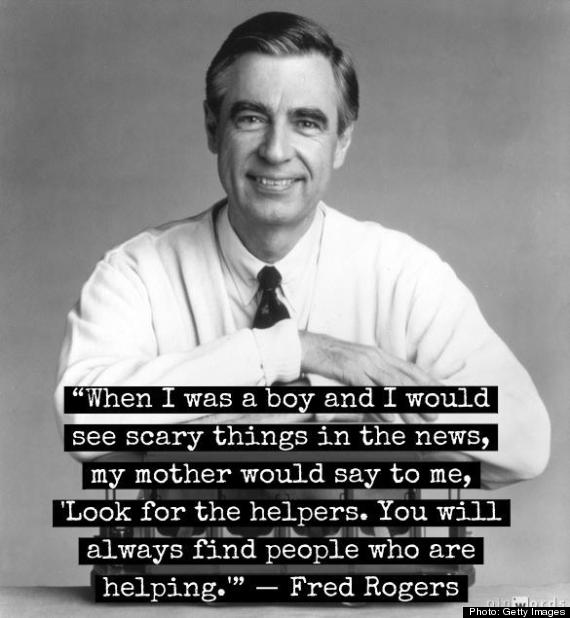
Mr. Rogers says to look for the helpers.

A beach, a blanket, and a song

I’m not quite old enough to remember the original Mickey Mouse Club. It was cancelled almost exactly a year before I was born. Three years after cancellation, the original hour-log recordings were edited down to half-hour segments that were shown in syndication for a few years, and my Mom said I watched it fairly faithfully. I don’t know how much of my memories of the show are from that exposure, because those edited episodes was re-re-released into syndication around the time I was in middle school. I watched some of those episodes, though if my friends caught me, I claimed that I was just watching it to humor my younger sister.

I was already an Annette Funicello fan before. I remember her most from the Beach Party movies co-starring her and Frankie Avalon. When I was in grade school, before modern cable systems, when most places had only three or four stations, there always seemed to be one of those stations that ran movies in the afternoons. Silly comedies were a staple of those afternoon movies, so Beach Party, Muscle Beach Party, Bikini Beach, Pajama Beach, Beach Blanket Bingo, and How to Stuff a Wild Bikini made frequent appearances.

The movies were extremely silly, with outlandish plots. Despite being movies about kids spending a summer at the beach and the ensuing romantic soap opera, a lot of them had at least one sci fi/fantasy element (the professor’s ability to paralyze someone by touching a “nerve-cluster” at the temple, the “improved” chimpanzee that could surf and dance better than a human, a Martian teen-ager sent to the beach as an advance scout for an interplanetary invasion, a mermaid falls in love with one of the surfers, and Frankie hires a witch doctor is to send a sea nymph to the beach to keep the other guys away from Annette while he’s in the Navy).

Not exactly high-concept, but probably a big part of the appeal to grade-school-aged me.

She was in a few of the sillier Disney films of the sixties, as well (The Shaggy Dog, The Misadventures of Merlin Jones, and The Monkey’s Uncle).

In all of those movies she played the wholesome good girl. The girl any boy would be lucky to have. Setting aside all the levels of sexism in that, it meant when I was a kid, I wanted to be her. I didn’t consciously admit it. I’m sure that to some of the adults in my life they assumed that I learned all the lyrics to all of her songs, et cetera, because I had a crush on her. (And for the record, I didn’t have a crush on Frankie; his pretty boy persona was totally not my type.)

So I’ve always had very fond memories of Annette and was sad to read that she died. I’m a bit miffed that news of her death has been overshadowed by reporting about the death of a certain former British Prime Minister. I certainly understand why the latter is considered more newsworthy.

Good-bye, Annette. I hope that somewhere you’re strolling along a beautiful beach, surrounded by love and music.

Damage control

A few years back a church bought a recently vacated big box retail building about 8 or 9 blocks from my house and converted it to a worship center. The church was a regional megachurch, not affiliated with an existing denomination. I had heard a little bit about it, but wasn’t terribly familiar at the time. I’ve since learned a bit more.

Although they try to wrap their message in language that sounds hip and liberal, and they clearly aim their marketing at a younger demographic, it is anti-gay, anti-women’s rights, and anti-all-the-other-usuals. The head pastor drives a couple of Mercedes-Benzes. His sermons each week are broadcast on giant screens in the neighborhood worship centers. Dissenters in the congregation are kicked out and all church members who wish to remain in good standing (included the kicked-out person’s spouse, if applicable) are instructed to shun the person.

There is a beautiful historic church building in downtown Seattle, with a gorgeous doomed main building. The building is on the eastern edge of downtown, close to Capitol Hill, which has long been known as the city’s gay neighborhood. Years ago the Seattle Lesbian & Gay Chorus (of which I was a member) was one of about a dozen community musical groups that rented space in the church for weekly rehearsals. Every year they asked all the groups that rehearsed to participate in a Christmas concert. It was wonderful to sing under that big beautiful dome. But also sad to see how small the audience was. The congregation had been shrinking for decades, finding it increasingly difficult to even keep the lights on, let alone maintain the structure. The big beautiful building is on a prime piece of downtown property, and it seemed inevitable that the building would be torn down.

A few months ago, the megachurch announced that it would be leasing the property, moving its downtown neighborhood worship center from a converted warehouse space to the building. Their announcement included the statement, “being closer to Capitol Hill is a blessing as we are serving and ministering to those who are infected with AIDS on the hill.”

There were so many things wrong with that sentence. I’m not sure where to begin.

First, it is literally not possible to be infected with AIDS; you can be infected with HIV, the virus that causes AIDS, but not AIDS itself. AIDS is a specific constellation of symptoms which are a late-term manifestation of an HIV-infection. It is a common misperception, but no one who was actively involved in any serious program to serve or care for HIV-positive people would not be aware of the distinction.

Second, it isn’t the 1980s. AIDS has not been cured, but thanks to the various new drugs, most people in the U.S. who are infected with the HIV virus do not have AIDS. Further, thanks to the drugs, a person can live thirty or more years without experiencing any symptoms. People do still die from the disease, and being on the drugs for decades is no picnic, but there are no longer thousands of people in every gay neighborhood living in near-hospice-care situations counting down the days (and T-cells) until they move into an actual hospice. Some studies, in fact, are beginning to indicate that a person infected with the virus living in a first world country, who begins treatment early, doesn’t even have a statistically significantly shortened lifespan because of it.

Third, while a higher proportion of white people infected with HIV are gay or bisexual than are straight, it is by no means a majority of gay people who are infected. Most gay people, like most straight people, don’t have the virus. In many places in the U.S., one’s ethnicity is a better predictor of HIV infection than whether one is gay and out of the closet.

Fourth, this specific church is anti-gay. Gay members are not allowed. Anyone is welcome to attend, but gay people are not allowed to become members until they become ex-Gay. No one wants to be “ministered to” by someone who thinks you are an abomination. And in the year 2013 if you are the kind of person who thinks that a gay neighborhood is filled with AIDS patients, you are the kind of person who thinks gay people are an abomination. You may not say it aloud, and you may deny it if confronted, but that level of ignorance is only achieved by assiduous avoidance.

Fifth, the statement is in the present tense. In other words, the church claimed to already be involved in some sort of service ministry to people with the disease. The fact that they are obviously unaware of my first, second, and third points shows the statement was a lie. Furthermore, not one single news article or press release in which the church had touted its various charity activities which mentioned anything about AIDS or HIV service could be found before this one statement. Not one.

Sixth, while that building is located close to one part of Capitol Hill, to the extent that the hill remains a gay neighborhood (more on that in a bit), most of the gayborhood is centered on the Broadway business corridor, about a mile walk (most of it uphill), from the church’s location. The church is not really conveniently located close to most of the homos on the Hill. And the Hill isn’t quite the great gay village it once was. The majority of queer people living in the Seattle metropolitan area live outside the Hill. The Hill is still very queer, don’t get me wrong, but one of the reasons the Pride Parade had to move off the Hill is because the neighborhood literally can’t hold all the gay people who want to attend the parade. I don’t live on the Hill, and I almost never go there, for instance.

Seventh, during my years of observation of their worship center in my neighborhood, the attendees drive in from somewhere else, attend the events on their property, and then leave. They aren’t part of the local community. They don’t seem to make the slightest effort to even get to know the local community. This last point may not be entirely fair. I’m a flaming homo, after all, and I don’t really want to get into any meaningful conversation with them. But from what I’ve read on other neighborhood blogs, it seems to be the case there, too. So I don’t see how moving the downtown meeting place a few blocks closer to Homo Hill is going to foster much in the way of interaction, constructive or otherwise, with the locals.

When the news broke, a lot of neighborhood blogs and the snarky, ultra-liberal alternate weekly newspaper raised similar points.

When contacted to explain at least in what way the church was “serving and ministering to those infected with AIDS” the church spokesperson became flustered and said someone would have to get back to the news people. They then issued a statement that claimed they were in “beginning stages of volunteering with the Lifelong AIDS Alliance.” Except the Lifelong AIDS Alliance has policies against proselytizing, which the church stated explicitly as its intention in its answer. Also, the Lifelong AIDS Alliance had received only one phone call from the church months before with no follow-up, and a second one less than an hour after the newspeople started asking questions. Volunteer applications had never been submitted from anyone identifying themselves as a church member.

When this was pointed out, the church backtracked. They made excuses. They bobbed and weaved, saying that they intend to help and repeating that bit about being in the beginning stages.

It’s not nice to laugh, but really, the sheer transparency of the lies, let alone the ludicrous depth of ignorance, demands it. I know, they don’t think they were lying. Someone had made a phone call, right? They planned to do something, right? I bet some of their members have even donated money to the charity. Or, at least went out to dinner at one of the restaurants participating in the annual Dining Out for Life fundraiser. That’s the same thing as serving and ministering to those poor AIDS victims, right?

It has been months, now, and there has been no further talk of any such ministry by the church. I’m not sure whether they were embarrassed about the whole thing, or just realized that there was nothing to gain from any effort. I know that people will say that at least some of them had their hearts in the right place. Jesus said to take care of the sick, right? But see, when the first thing that springs to mind when you find out your church is moving closer to a gay neighborhood is AIDS, that right there says all that needs to be said about how ignorant, bigoted, and self-deluded you are. If you feel god calling you to minister to people suffering and dying from AIDS, don’t move around an affluent city on the west coast, go to Africa, or south/southeast Asia.

This megachurch isn’t the only institution having a hard time grappling with its own ignorance and bigotry, as Stephen Colbert explained in this clip (click on Stephen’s name to watch):

It is April, and sometimes I am a fool…

…but I am not posting an April Fools’ Day joke.

I have done a few. In college as member of the editorial board of two different campus papers, I helped produce a few April Fool’s Day editions. On my old LiveJournal I am still rather proud of the post I wrote explaining why I had decided to become a Gay Republican and start actively working to oppress myself.

If I were to do an April Fool’s Day post, I would adhere to the following rules:

  • I plan it out in advance, giving myself time to edit it a time or two before it is posted.
  • The topic is not something that will make people worry (nothing about fake injuries or illness, not pretending to be angry at my friends, anything like that)
  • The butt of the joke needs to be me

I have, over the years since I started blogging, only come up with a few that met those conditions. Even though I tried to pick things that I didn’t think would upset someone, I managed to do so two of those times—the opening sentence of the Gay Republican joke made one friend think that Michael and I were breaking up, and one of my fellow bibliophile friends fell for the one where I Michael and I decided to throw away all 6000+ books in our house.

The point of a joke is to make people laugh. If they aren’t laughing, it isn’t funny.

I am fond of a good news April Fool’s Pranks. Among my favorites:

NPR: Portable Zip Codes

NPR: Exploding maple trees

Garden News: Dinosaur vine

And I can’t find a link to this one: one of the local radio stations did a story claiming one of the island out in Puget Sound had come loose from its moorings and was floating wildly around the Sound. They kept giving updates throughout the afternoon as the island was sighted in different places, along with attempts to try to capture it and tow it back.

Oppression Olympics

As a gay person, I am aware of (and have experienced) a certain amount of discrimination. In many situations I have been in a category that could be described as “second class citizen.”

As a white male, I am aware of the privilege that society confers on some people just because of outward appearances and how easy it is for us to not even notice it is happening. I have no doubt that I have found doors open to me that weren’t to others because I happen to be pale and male.

It is very easy, while discussing any issue involving rights, discrimination, and related topics to fall into an unproductive cycle of arguing with each other about who does and doesn’t benefit from various areas of privilege and which among them is “truly able” to understand the oppression of others. This form of circular firing squad is sometimes referred to as the “Oppression Olympics.” Arguing over who is the most oppressed, or just trying to explain that one is properly aware of the oppression of others, wastes an incredible amount of time and energy.

Because two cases involving one aspect of non-heterosexual rights were before the Supreme Court this week, and because people determined to deny certain rights to those non-heterosexuals have staged marches and rallies in the nation’s capital in response to those cases, every news outlet has been covering the cases, the rallies, and so on. Every organization involved in the battle for or against non-heterosexual rights is posting videos, news releases, and so on. Everyone of us who follows this thing are linking to those stories, videos, and other postings—including me.

I understand it can get a bit tiring for people who are not invested in the story du jour. I do.

So a bunch of people were linking to a particular tumblr post this week whose purpose was to make sure the debate about equality doesn’t just devolve to marriage equality. This is a noble goal that I support, but one of the points made on the post epitomizes a major flaw in this ongoing internal debate:

examine what marriage as an institution has historically looked like. marriage isn’t even good for most white folks if they don’t fit into a heteronormative, able-bodied supremacist, upper-ruling-class, nuclear family frame

This is a nod to the argument that some people make that marriage is bad because it’s only useful to people who what to mimic or pass as straights, or only useful to people who are not racial minorities, et cetera.

There is more than one argument going on in this, some of them contradictory. Let’s tackle a couple of them:

One of the implicit points in this boils down to: “your proposal [marriage equality] does not solve this host of other problems, so we should not pursue it.” This is the equivalent of the FDA saying, “Your new antibiotic doesn’t cure cancer, Parkinson’s disease, or celiac disease—it only treats infections by some bacteria that have grown resistant to other antibiotics—therefore we cannot approve your drug.” Marriage equality removes only one barrier to a host of legal rights in our system, and it’s true that there are a lot of rights that aren’t effected, and it’s true that there are a lot of people who still can’t get at those rights or have no interest in those rights, but that doesn’t mean that that particular barrier should remain in place.

The more obvious part of the argument, “what marriage as an institution has historically looked like” is even more ridiculous. This argument is virtually the same false argument the anti-gay people make: cherry-picking some aspects of the historical and religious meanings of marriage, and insisting that any discussion of civil marriage is exactly the same thing. The anti-gay people argue that allowing same-sex partners to access the legal rights associated with civil marriage will somehow magically destroy the sacred power of the religious meaning of marriage. These non-anti-gay folks argue that allowing same-sex partners to access the legal rights associated with civil marriage will somehow magically force all the nasty bad aspects of the historical meaning of marriage onto people who don’t want it. Neither is true. Because we are not talking about going back in time, and we are not talking about any religion’s sacred vision of marriage. We’re talking about civil marriage, which is the legal recognition of a decision citizens make as to who counts as their legal next-of-kin, and a collection of legal rights and responsibilities that go along with that designation.

The entire “it’s not even good for” argument is based upon this historical aspect, rather than on the actual practice or laws of marriage today. To return to my FDA analogy, claiming that marriage is only of interest to “able-bodied supremacist, upper-ruling-class” people is the same as someone saying, “I oppose the use and development of antibiotics because the medieval practice of bleeding proves that all medicine is harmful.” The folks who spout this argument about marriage are the anti-vaxxers of the civil rights movement.

Another argument implied in there is the notion that too much energy is going to the marriage equality fight when there are other, more important problems we could be solving. The “more important” argument has been used forever to thwart civil rights progress. It has probably been the most common argument thrown in the face of feminists for decades. There will always be something someone thinks is more important, but that’s not sufficient reason to halt all pursuit of this. Besides, many of those more important, more complicated issues will be slightly easier to tackle after achieving victory here. After each incremental improvement, society at large has to get used to the new normal. Once used to one change without the collapse of society, it is easier to see the ridiculousness of other forms of discrimination. It’s like each improvement lowers all the other hurdles a fraction of an inch.

I’ve ranted plenty about the frustrations of an incremental approach. But I also recognize that every now and then, when enough of the little improvements have accumulated, a kind of tipping point is reached, and society is ready to take a much bigger leap. I’d love to have the leaps happen more rapidly. That isn’t going to happen if we don’t take the baby steps when we can get them.

There are reasons that the first couple in line to get a marriage certificate when Washington, D.C. recognized marriage equality was a pair of working class African-american women. They were not trying to transform into white heterosexual elitists. They want the legal protections (hospital visitation rights, medical decisions on behalf of partner, housing lease transfer, all the rights with joint parenting, sick leave for care of partner, bereavement leave, wrongful death benefits, et cetera) that come with marriage. Yes, it’s about choosing who to share your life with, but it’s also about the law respecting that decision.

Occasionally someone does the math to calculate what it would cost a gay couple to have drawn up and properly registered the legal documents—power of attorney, durable power of attorney (which is not the same thing), property deed with right of survivorship, wills, and so on—to grant the fraction of those rights that the law allows for someone other than the spouse. The last one I saw was $15,000. And that is for only some of the rights that come with marriage! Compare that to the $64 Michael and I paid for our marriage license, and it becomes crystal clear that marriage equality is not an upper-ruling class supremacy issue. In fact, it is the opposite. Not fighting for marriage equality is pro upper-ruling class supremacy.

So while, yes, there are people in the lgbt community who aren’t in favor of marriage equality, they are no less wrong to do so than the screaming Bible-thumpers.

But enough of this serious talk! I’d much rather listen to Stephen Colbert and Jon Stewart break the marriage equality debate down, wouldn’t you?

If only it were only a joke

We can pick apart the illogical arguments forever (and if feels like we have been!), but in reality, the opponents are as reasonable as this: