Tag Archives: people

More social media thoughts

© 2010 6B Studio
Vintage Social Media. © 2010 6B Studio
One of the things I listen to semi-regularly is The Blabbermouth podcast sponsored by Seattle’s own snarky weekly alternative paper, The Stranger. In my most recent Friday Links post I included an article from the Stranger about former Stranger contributor Lindy West’s decision to leave Twitter, as well as linking to Lindy’s article written for the Guardian explaining why she had decided to leave Twitter. Lindy’s writings for various publications have appeared in many editions of my Friday Links over the last few years. She’s funny and insightful and writes about topics I like.

She was on the Blabbermouth podcast after writing about her decision to leave Twitter, and one of her comments there hit on a topic I’ve found myself thinking about a lot. “One of the things that makes Twitter so useful is because it’s the place everyone is.” I made a similar observation about LiveJournal last week. It was so useful for many years because it was the place everyone was. To different degrees and Facebook and Twitter have supplanted that particular aspect, but they’ve done so in very different ways.

Facebook has become, for many of us, a place we’re obligated to be on if we want to have any hope of getting news from family members. Facebook in particular has some serious drawbacks in this regard. A few years ago I missed my niece’s wedding because rather than send out invitations of any sort, my niece mentioned the date on Facebook. And she expected everyone who she wanted to be there to see it and attend. When I tried to explain later that Facebook only shows some of the things you post to some of your friends, she didn’t understand, because other people saw it and showed up. One of the professional writers I follow on Twitter recently pointed out that her official Facebook author page has 8000+ followers, and those followers have lately been sending messages asking when a particular new book is coming out. But the announcement answering the question which she put up on that page was only shown, according to Facebook’s own states, to 136 of those 8000 followers. If she wants more of them to see it, she needs to pay Facebook to promote the announcement. And maybe for something you’re trying to sell that’s a not unreasonable expectation, but the same sort of distribution algorithms are applied to people’s announcements of deaths in the family, weddings, et cetera, et cetera, et cetera.

And both Twitter and Facebook have issues of mixing all of our communities together, so we wind up offending each other whether intentionally or not with various political and religious comments.

Not that this is something new because of social media. We have a tendency to blame the new technology for dysfunctional behavior that are simply manifestations of human nature. For instance, two times recently things have come up that reminded me of a particular instance of dysfunctional family communication:

Back in the late 80s, when I was still mostly closeted as a queer man, I was informed by at least three relatives (one of my grandmothers, an aunt, and my mom) that one of my cousins (specifically, a first-cousin-once-removed1) who I hadn’t seen in years (but we had spent a lot of time together as kids) had died. Which was a bit upsetting on its own, more so because we were the same age, so he was in his late 20s. But the other upsetting bit was that both mom and my grandma told me, in very hushed tones, that they had heard it was from complications of AIDS, which of course we weren’t supposed to mention to anyone outside the family2. My aunt went much further, telling the lurid tale of how the cousin had been incommunicado and secretive for a few years, and then how his mother (who lived in northern California) had gotten a call from a hospital in San Francisco, and she had barely made it to his death bed before he died, and isn’t that a horrible scandal?

As if I needed more reason to be worried about how my family might take the news that I thought I might be gay, right?

Over the years, any time I happened to mention a story from my childhood involving that particular cousin, various family members would either say what a tragedy it was he had died so young, or change the subject, or in at least one case act as if they didn’t remember his existence4.

Then a few years ago this same aunt posted an old photo on Facebook of a whole bunch of us cousins from a big family get-together that happened in the 70s, and she tagged all of us that were in it with our Facebook accounts. Including D–. To say I was confused is an understatement. So I sent a friend request to this person with the same name as my supposedly dead cousin. And he accepted and the next thing I know I’m looking at photos of him and his husband, along with recent pictures of a holiday get-together with some other members of that branch of the family, including a few who had talked to me personally about his tragic death years ago.

What actually happened? (You’ve probably already guessed.) He came out of the closet back when we were both in our 20s. His immediate family did not react well, at all. At least one of his parents begged him to essentially go back into the closet. When he refused, a decision was made to disown him and treat it as if he had died, and some of the family members went along. Others thought he really had died (and since many of us lived far away and hadn’t been in touch for a while, it was easy for us to believe). He lived his life maintaining contact with those few immediate family members who were supportive.

As time went on and attitudes shifted, less effort was made to maintain the ruse. Until now another form of denial has set in, where almost none of the family members (who are still alive, anyway) who went along with the original ruse wants to even admit it happened.

I came out of the closet in my early 30s, and so far as I know no one on this side of the family told people I had died5. But there was a period of about six years or so when I was estranged from most of my closer family members. The main parallel to my cousin’s situation is that a narrative has been adopted with a bunch of the family that I’m the one who cut everyone off for reasons none of them could fathom, and it was only after my first husband died and I became involved with Michael—who many of them now adore6—that I came back.

Cousin D– and I have had some interesting conversations since all this. It’s been particularly weird this last year during all the election hype where some family members have been saying and sharing extremely homophobic things, while expressing shock and dismay that we don’t feel loved or safe around them because of it8.

All of which is to say: it isn’t just social media algorithms that hide information. It isn’t social media that makes humans react irrationally to news or opinions or decisions we don’t agree with. It isn’t social media that makes some people gaslight others by insisting something we experienced together never happened, or didn’t happen the way we remember it. It isn’t merely because of social media that we put ourselves in bubbles where we never see information that challenges our assumptions. Social media and modern communication in general can make some of that happen faster and have further reach. But our tools have these sorts of functions (hiding information, proliferating misinformation, et cetera) because those are things that we humans sometime chose to do to ourselves and to each other.

And when I say “we” I am very intentionally including myself. There’s more to say on this topic, but I think I’ll try to tackle that in a separate post.


Footnotes:

1. I was lucky enough to have all four of my great-grandmothers live until I was at least in my teens (one actually lived until I was in my 30s!). And all of my great-grandparents had rather large families that tended to try to keep in communication. So I knew most of the siblings of all of my grandparents, as well as their kids and their grandchildren. Some family gatherings when I was a child were huge!

2. The reasoning being that because dying of AIDS meant that he was probably queer, and having a queer family member was something to be deeply ashamed of. There was also an uncle who died of complication of AIDS in this same time period, but anytime that Uncle B– was mentioned after that, someone was quick to point out that he had contracted the virus through intravenous drug use3, which was also a shame and a tragedy, but clearly, since we were allowed to talk about Uncle B–‘s death and the drug use, but not this cousin, not nearly as shameful.

3. At least that’s the family story. Uncle B– served time in prison more than once in his tragically short life, and he was a much smaller than average man, and if you know anything about prison rape culture, you know there was more than one probable vector for B–‘s infection.

4. There was one particularly weird moment about 15 years back when we were going through great-grandma’s photo albums that had been in storage for a long time. We happened upon a picture of the cousin and someone asked who that was, and I said, “so-and-so’s youngest son, D–” and my aunt listed off the names of all of the cousin’s siblings and said, “That’s the only kids they had! They never had a son named D–.”

5. On that side of the family. On my dad’s side of the family people weren’t allowed to mention my name within earshot of several family members. I had this confirmed by multiple sources, but mostly just ignored it for a variety of reasons, not the least being that I was already persona non grata long before I came out for the incredible betrayal of telling the judge overseeing my parents’ divorce that I didn’t want to live with my physically abusive father.

6. I honestly don’t understand why their brains don’t explode from the cognitive dissonance. They do genuinely seem to love my husband, and claim to love me, but they actively pray that we’ll somehow magically be cured of our queerness and leave each other to marry nice christian girls. They also mention us by name as proof they aren’t homophobic while explaining how we’re going going to burn in hell for eternity and deserve any hate crimes that might befall us7

7. That was literally the last post I saw on Facebook from one relative before I blocked her in November—not even being metaphorical.

8. I understand the concept that we can disagree about things and still be friends. But that depends entirely on the nature of the disagreement. When the disagreement is whether I get equal protection under the law, or whether I’m allowed to get health care or any other service, or whether it is okay for me to be the victim of hate crimes, or even whether I have a right to live9, then no, you aren’t my friend.

9. When you post or endorse statements that homosexuals are deserving of death, or if you claim that merely allowing us to live openly and enjoy some legal rights is going to cause god to destroy the nation, you are giving encouragement to gay-bashers to kill us. And then when juries refuse to convict our murderers (which happens a lot) on various flimsy grounds, that just proves my point.
Thanksgiving with Grandma Wanda, and other news updates

If you haven’t seen this story, or the viral images of the wrong number text message that led to a Thanksgiving meeting of former strangers: a woman send Thanksgiving dinner details to the wrong number. The guy who gets it replies, “Who is this.” The woman says, “Your Grandma.” The guy sends a selfie, “I don’t think you’re my Grandma.” She sends back a selfie and apologizes for the wrong number. He jokes, “Can I still have a plate?” and she says, “Of course! That’s what grandma’s do, feed everyone!”

And they kept texting and she said she was serious he should come to Thanksgiving dinner, and he didn’t have local family, and then, well, this happened:

Thanksgiving with Grandma Wanda: Accidental Text That Was Meant to Be.


In other news, after the phenomenal crowdsourcing campaign, the Green Party in Wisconsin has filed for a re-count and a paper ballot reconciliation:

Green Party files for Wisconsin recount, audit.

And:

Clinton campaign: We are taking part in the recount.

cw8d-5oxuaaglhhI admit, I was one of the people saying I didn’t trust the Green Party’s effort. After asking the world to donate 2.5 million so they could demand recounts in three states, they changed the small print on the fundraising page several times, and changed the goal they were asking for several times. The fine print was the sorts of disclaimers you would expect, in one sense: they couldn’t guarantee the recounts would happen; if excess money was raised the part would keep the money to promote “voter integrity options” that sort of thing. But the wording kept adding more loopholes.

But the thing was, the first filing deadline (Wisconsin) was Friday. They had exceeded the original ask significantly, and the clock was literally ticking down, and they had not filed a petition for a recount. It was at a point where the Wisconsin Elections Commission was making snarky comments on it’s website and twitter account, because the Greens kept blasting out more money beg messages but hadn’t filed: Wisconsin Elections Commission Basically Calling Jill Stein Out for Not Filing Recount Petition Yet.

So I don’t think I was being unreasonable (or mean) when I retweeted another editorial that made the observation that the Green Party money beg was starting to seem as if it might be a scam. The word “seem” was in the title, so even if you didn’t click through and read the piece, (which was nuanced and balanced) it should have been obvious that I was only claiming suspicion.

As I exchanged words with some others on twitter afterward, I repeatedly said that if the Green Party actually filed all three petitions before the deadlines in each state, that I would agree that they weren’t merely fundraising for themselves off the issue.

The party did file a petition in Wisconsin before the deadline (as the above headlines show), so that’s one down. I understand that the rules in each state about the petitions vary. And that sometimes an incorrectly worded form can cause a filing to be rejected. I don’t know if any of the remaining states have a process by which the initial filing can be amended or corrected after it is filed.

And heck, even the states don’t always know. The Wisconsin Elections Commission said they had their own lawyers double-checking the procedure while they were awaiting the petition. Turns out there’s a contradiction in the state law: one part says that the petitioner has to deposit money to pay for the recount when they file, another part says that the Commission has to give the petitioner an estimate of the cost of the recount after receiving the petition and the petitioner has to pony up the money within a very short timeline after getting the estimate. So, I understand that trying to make certain all the i’s are dotted and t’s are crossed means they can’t just slap down a petition right away.

Completely unrelated to all of this: while there are reasons to be skeptical about the vote count in some places, I’m not holding out a lot of hope that any of these recounts will change any results. Part of that is based on past experience. And the lack of clear evidence of wrong doing is the reason that organizations such as the Clinton campaign is loathe to expend the millions of dollars required for a recount. I’ve blogged more than once about the Republican gubernatorial candidate in my state several years ago who paid over a million dollars for a recount and audit, and succeeded only in discovering that there had been a total of four fraudulent ballots filed in the race–and all four had voted for him, not his opponent. So he and the party spent a lot of money to actually reduce their own vote count, and thus lose slightly worse…

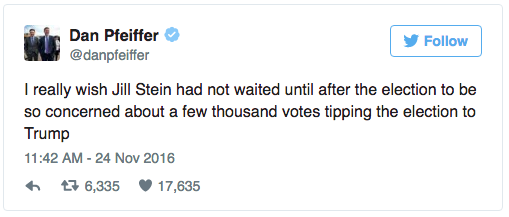
“I really wish Jill Stein had not waited until after the election to be so concerned about a few thousand votes tipping the election to Trump” —@danpfeiffer
But I have to agree with Dan Pfeiffer, if the Green Party had done what so-called third-parties used to do: endorse the major party candidate who supported most of their agenda (earlier in the campaign the eventual Green nominee had claimed she would endorse Bernie Sanders if Bernie got the nomination, and since Hillary’s voting record when they were both in the Senate matched Bernie 90+ percent of the time you’d think that would be close enough). I get it, when I was younger I used to think that what we needed was more active third parties. That was before I understood a couple of very important things: while the Constitution says nothing explicitly about parties, the way the electoral college is set up to elect presidents means that we have a Constitutionally-mandated two party system; and for most of history both major parties are coalitions of unofficial smaller parties already.

Anyway, I don’t think that recounts and audits are ever a bad idea. So even if these efforts don’t change anything, I’m glad that we’re going forward with at least one, and hope at least two more.

Exploding phones and misjudging customers

Okay, now I may begin to feel sorry for Samsung. I mean, it was sort of cool that a company which has been making money be copying Apple’s look (and producing demonstrably inferior equipment) was losing tons of money and taking a hit to their reputation because of exploding phones, but now it’s even worse: Samsung Recalling Almost 2.8M Washers Due to Impact Injuries. During the spin cycle the drums become detached, crashing into other parts of the machine, causing parts of the outer body to break off and fly away hard enough to have caused broken bones in some cases. Exploding washing machines!

In case you missed the earlier news: one of Samsung’s new phones started exploding, catching fire, and similar things, prompting the TSA and agencies in other countries to ban them from air travel. Samsung did a recall and replacement of some of the models, and the replacement phones also caught fire, resulting in a complete recall of all models: It is the consensus in the tech world that Samsung execs rushed the Galaxy Note 7 into production with a seriously shortened test cycle because of rumors that the iPhone 7 would be a dud–which made them think they could grab a bunch of the market. The reasoning being that rumors were the size and shape of the iPhone 7 wouldn’t change much from the 6s… because people only buy new phones because they come in new shapes, not because of improved cameras or other interior features.

Other people were predicting bad iPhone sales because Apple removed the headphone jack. What has actually happened is that millions of the new iPhones sold the first weekend, and since then Apple has been selling the phones literally faster than they can manufacture them. Apple did report the first year-over-year revenue drop (but still 9 billion dollars of profit) for the most recent quarter, but the new iPhone went on sale at the very end of that 90-day period, so the new phone sales had little to do with the numbers.

Samsung appears to have done worse than shot itself in the foot with this attempt to take advantage of an opportunity that was never there.

There’s a certain type of tech person, the sort who gets a full-time job writing about technology for general interest news sites, for instance, that looks at technology from an extremely skewed point of view. They aren’t the only people who do this, but let’s stick to them for the moment. They seem to be incapable of looking at a product as anything other than a bulleted list of features. And they are especially bad at imagining that anyone in the world would ever use a particular product differently than they do.

I know this because there have been plenty of times that I fall into that mental trap (and the related one of not remembering that people aren’t going to like and dislike the same sorts of things in stories/movies/et al as I do).

Even though way back in the day I had been addicted to my old Apple ][e, I was less impressed with the original Macintosh. Then I got a job testing software and hardware and writing customer documentation for a company that sold software that ran on DOS-based PCs (Windows didn’t exist, yet), and I became obsessed with being about to control every little thing on my PC. I would tweak configuration files to modify which utilities and portions of the operating system would be loaded into which parts of the memory, for instance. I looked at Mac users as people who didn’t really understand the equipment they were using.

Then Windows came along, and over the years the PC world became more and more like the Mac. I don’t just mean the GUI interface and pointing-and-clicking, but more and more of the nitpicky details of how the system was configured were hidden away from the user—not just hidden, but the systems worked in ways that it was not longer necessary to know that stuff to use the product.

The really big change for me, though, was meeting my husband. In all of my relationships before Michael, I was the person who knew the most about computers in particular, and technology in general. Michael knew at least as much as me, and had an even better knack at troubleshooting and coaxing seemingly broken equipment into working again. And… he started managing my computer. And I found, suddenly, that I had a helluva lot more time to actually work on my writing when I wasn’t acting as the in-house IT department.

Then, because he was tired of spending so much time troubleshooting my Mom’s computer (a series of used PCs coupled with her habit of clicking on absolutely any link she received in an email thus infecting the computer literally with thousands of pieces of malware), we bought her an iMac. And I picked up an old used Macbook that ran the same version of the OS as her machine, so when she couldn’t remember how to do something, I could fire up my machine and walk her through it over the phone. And then I started using the Mac laptop as my convention machine because it was, frankly, easier to use than my Windows laptop.

And during that long journey, I discovered on a new level something that I had constantly found myself (as a technical writer) arguing with engineers at work: the customer cared about what the machine allowed them to do, not how the machine did it.

Right now, people are griping about the headphone jack being removed from the iPhone (interestingly, Motorola dropped it from some smart phones earlier this year, several other phone makers have announced phones without headphone jacks coming soon, but no one is complaining about them). And they’re complaining that Apple is changing its laptop lines to use only USB-C ports supporting USB and Thunderbolt (again, something that a bunch of Chromebooks did earlier, and at least one PC laptop maker has announced they’re doing next). And I understand those gripes, I do.

But so for not one single person—not one—has presented any argument that isn’t the logical equivalent of arguments that were used to protest the removal of floppy disk drives from computers. They are the same arguments that were raised in protest when Apple replaced serial and parallel ports on the iMac with USB years ago. They are the same arguments people made about why compact discs shouldn’t be replaced with downloaded music files. They are the same arguments people made when cassette tapes and vinyl records were replaced with compact discs. The same arguments that were made when VHS tapes were replaced with DVDs. And the same arguments that were made when cable replaced antennae on the roofs of houses and apartment buildings.

And I suspect they are logically equivalent to the arguments that were made when electricity replaced oil lamps.

My five-and-a-half year old Macbook Pro has an ethernet port that I have never, ever used or needed. The Macbook I owned for a bit over three years before that also had an ethernet port that I believe I used exactly once. My current Macbook Pro has an SD card slot that I never used until late last year when I bought an adapter that allowed me to fit a micro SD card in flush with the side of the computer (rather than sticking out as the SD cards do) so I could have a supplemental drive to move some files onto because I’m having trouble getting by on the size of hard disc I currently use. The laptop also has a combo mini video port/thunderbolt 2 port which I use about once every couple of weeks to connect my second backup drive to. I have never, ever used the video port of the port. Nor have I ever used the optical audio port built into the headphone jack.

But I paid for the circuitry and more to support all of those ports as part of the price of the laptop. And I had to pay for those because a small fraction of the other owners of these laptops want them.

I am anxiously waiting for my new Macbook Pro to ship. It will have four USB-C ports. I’m going to have to buy three adaptors in order to use my current accessories with the new machine. Wait, actually, only two. I keep forgetting my external drive uses both Thunderbolt and USB 3.0. But those are the only adaptors I will need. And I’m only going to need them for a while, because some of these accessories are even older than my current laptop, and they probably should be replaced pretty soon, before they die on their own at an inconvenient time.

jfydsJust as the original USB was a huge improvement over the serial, parallel, and SCSI ports they replaced, USB-C is a big improvement over the others. If you want technology to get better, you have to let go of the older parts. It doesn’t matter how noble horse drawn carriages look nor how jaunty a coachman appears when snapping a buggy whip, no one born in the last 60 years is willing to give up their cars, light rail, heaters and defrosters inside the cars, or streets free of random piles of horse shit because someone misses buggy whips.

Amazing and heart-wrenching: Cracked explains this election so accurately it hurts

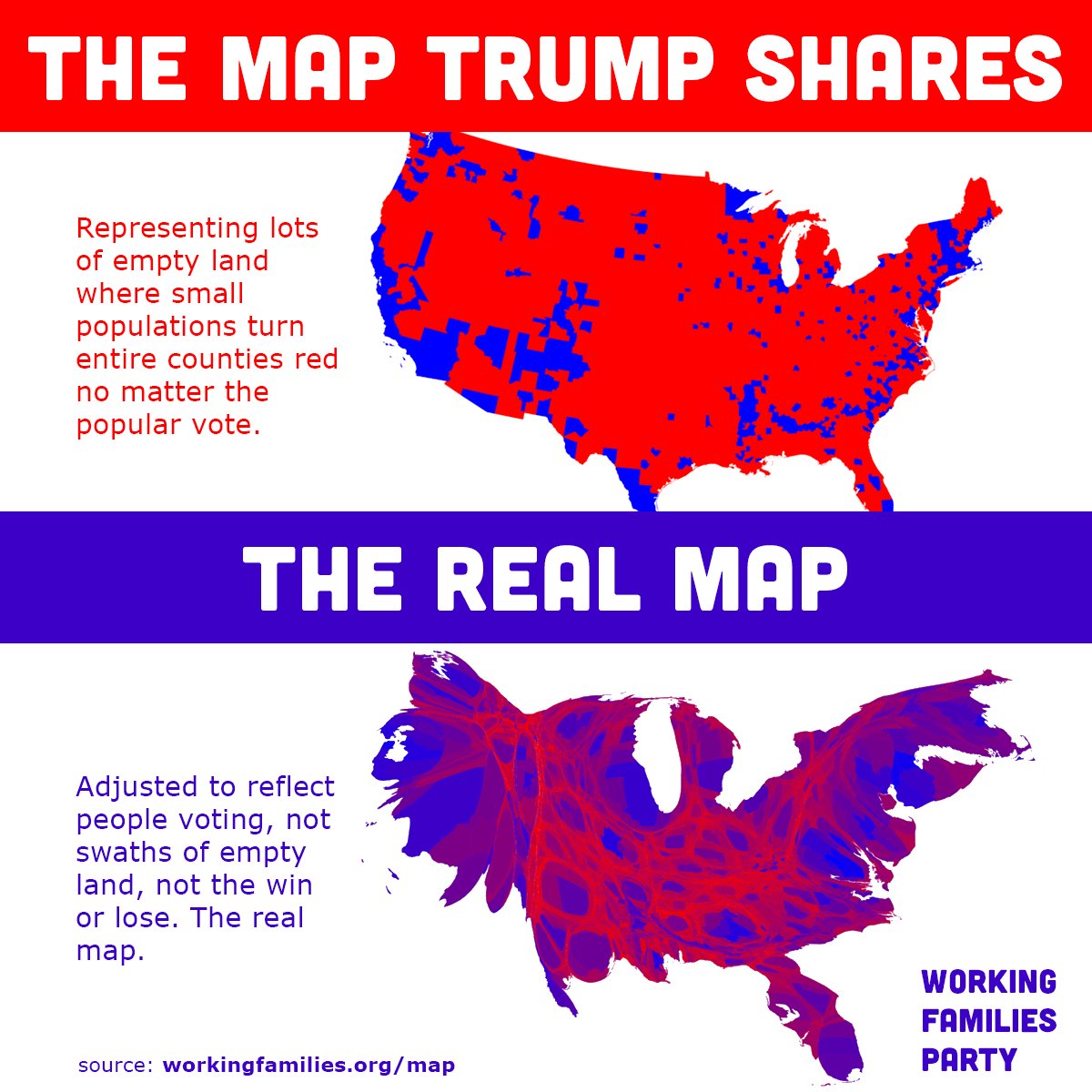
How the 2012 election went by county (source: Mark Newman / University of Michigan). It looks as if Romney should have run, until you realize that more the 60 percent of the population of the entire country lives in those tiny blue area.
How the 2012 election went by county (source: Mark Newman / University of Michigan). It looks as if Romney should have won, until you realize that more the 60 percent of the population of the entire country lives in those tiny blue areas.
I read a few stories yesterday, long after my weekly Friday Links post went up, which I was thinking about for a Weekend Update post, which has also become almost a weekly tradition here. But then this morning, while I was trying to get awake enough to check my blood sugar and take my morning meds, I saw an old friend had retweeted: “Probably the very best thing to read to understand Trump’s popularity, is this Cracked (!) piece. Amazing:” How Half Of America Lost Its F**king Mind. The article is amazing.

Go read it.

Go read it now.

I’ll wait.

If I had seen this article (which Cracked published on Wednesday) earlier, it would have been the link of the week, no question. I’ve written previously on this blog about several of the things that David Wong, the author of the piece, pulls together, but all of the pieces of the puzzle hadn’t quite come into focus for me in this way before. There are a couple of teeny quibbles I have with the article. He lumps the suburbs in with cities in most of the article, for instance, while one of his few citations of statistics (that 62% of the population lives in the cities) ignores that fact that cities plus suburbs actually add up to 80% of the country’s population.

But all of them really are just quibbles.

For me, the most frustrating part of the perception gap he describes has been trying to bite my tongue as people I love—in some cases the very people who taught me to love my neighbors and try to understand other people—aren’t just voting for Trump, but they are absolutely convinced that voting for him is the most Christian and reasonable thing to do. Sometimes in the same breath that they say they are so, so sorry that my queer self and my husband didn’t drive a couple hundred miles to attend their Independence Day barbecue, they talk about how marriage equality and letting trans people use public restrooms are literally causing an Apocalypse.

And they really don’t understand why I don’t feel safe in their community!

Don’t message me saying all those things I listed are wrong. I know they’re wrong. Or rather, I think they’re wrong, because I now live in a blue county and work for a blue industry. I know the Good Old Days of the past were built on slavery and segregation, I know that entire categories of humanity experienced religion only as a boot on their neck. I know that those “traditional families” involved millions of women trapped in kitchens and bad marriages. I know gays lived in fear and abortions were back-alley affairs.

I know the changes were for the best.

Try telling that to anybody who lives in Trump country.

I have tried to explain that the Good Old Days were only good for some people. I have tried to explain that Black Lives Matter is not a movement bent on killing white cops. I have tried to explain that the rate of violent crime is actually lower here in the city than where they live. I have tried to explain that gender inequality is real. I have tried to explain that gay bashing isn’t something that only lunatics do, but something they are themselves doing verbally to me all the time.

And they can’t hear it. They can’t see it.

They blame Obama for their economic troubles because things got really bad after the 2008 Great Recession started. They don’t care that it started while Bush was president, to them the hurt came after Obama was elected, so it’s obviously his fault. They also believe it’s all his fault because of all the insane, often racially-motivated misinformation they receive from the only news sources they think they can trust. They honestly don’t believe that any of the facts they are relying on are actually racist distortions, so they get very angry when we characterize a lot of the blatantly racist memes that they regurgitate as bigoted.

Even putting the pieces together the way Wong does, however, I couldn’t understand how in the case of my specific relatives, they don’t experience pain from the cognitive dissonance of telling me how much they love Michael and I—specifically that they realize we are truly meant to be together—but they also think that the Supreme Court ruling making our marriage legal throughout the land is a literal attack out of hell?

I guess, using Wong’s analogies, they see us as the cute supporting characters among the elites of the Capitol City in the Hunger Games? We’re sympathetic and they will shed a tear over our corpses when the revolution comes, but they have every intention of storming the city, hurling the bricks and firing whatever weapons they have, because it’s the only way to save their way of life?

Then, as I was writing the paragraphs above and re-reading Wong’s article, I had an epiphany. Wong does a good job of using the imagery and cultural shorthand of The Hunger Games, but I think he missed another important touchstone. I saw it the third time I read this bit:

In a city, you can plausibly aspire to start a band, or become an actor, or get a medical degree. You can actually have dreams. In a small town, there may be no venues for performing arts aside from country music bars and churches. There may only be two doctors in town — aspiring to that job means waiting for one of them to retire or die. You open the classifieds and all of the job listings will be for fast food or convenience stores. The “downtown” is just the corpses of mom and pop stores left shattered in Walmart’s blast crater, the “suburbs” are trailer parks. There are parts of these towns that look post-apocalyptic.

I’m telling you, the hopelessness eats you alive.

Downtown is just the corpses of mom and pop stores… just the corpses of mom and pop…

Economically, to them, the world as become The Walking Dead.

Everywhere they look they see the shambling, murderous horde searching for more living flesh to consume. We, the liberal elite city dwellers with our city jobs and smart phones and environmentally friendly cars (if we haven’t already gone carless), are already infected. Maybe we don’t look like walking corpses, yet, but they know what we’re going to turn into eventually. They don’t like what’s going to happen to us, but they fear even more it happening to them, and to their children who haven’t already been infected.

Yeah… now I’m getting a clearer picture.

The heartland isn’t, and other myths of diversity

When the Grist published this in 2014, they captioned it: “Obama famously denied that there’s a red America and blue America, but it turns out he was wrong. There’s red America, a sparsely populated but vast landscape of rural and suburban areas, and there’s blue America, the “urban archipelago” upon which the left’s constituencies — single women, minorities, cosmopolitans — cluster.”  (Original image source: 2012 election results, by county, Mark Newman, University of Michigan)
When the Grist published this in 2014, they captioned it: “Obama famously denied that there’s a red America and blue America, but it turns out he was wrong. There’s red America, a sparsely populated but vast landscape of rural and suburban areas, and there’s blue America, the “urban archipelago” upon which the left’s constituencies — single women, minorities, cosmopolitans — cluster.”
(Original image source: 2012 election results, by county, Mark Newman, University of Michigan)
In 2004 my state had one of the closest races for Governor ever. On election night, it appeared that the Republican candidate, former state senator Dino Rossi, was the winner—but by only 261 votes. When all counties had finished counting ballots (but before the results were certified), former state Attorney General Christine Gregoire had pulled ahead of Rossi by a mere 42 votes. At one point during the recounts1 her lead was only 10 votes, but when things were officially certified, her lead had reached 129 votes.

The Republican National Committee paid a lot of money to finance a legal challenge to the certified count, insisting that lots of illegal ballots had been counted. The case is famous for the result that after spending millions and sorting through all the voter rolls the Republicans did find exactly 4 illegally cast ballots: all four of them had been cast for Dino Rossi, because each of the illegal ballots had been cast by ex-convicts who had not had their right to vote restored2. Each of them had voted for Rossi because they are angry at Gregoire for (essentially) doing a very good job during her years in the state’s Justice Department.

In other words, the Republicans spent a lot of money proving their guy’s loss was worse than it appeared, and ironically revealed to the public that the Democratic candidate was perceived as much tougher on crime than the Republican, at least in the eyes of some criminals.

Throughout the next four years3 certain angry people in our state kept insisting that the election had been stolen by evil democratic minions in King County, mostly because they couldn’t understand that winning in the mostly populous county in the state by about 70% is going to beat winning in a bunch of the least populous counties by less than 60%. And boy, did I get an earful from some of my ultra-conservative relatives about all the “crooked liberals” in Seattle at the next several holiday gatherings.

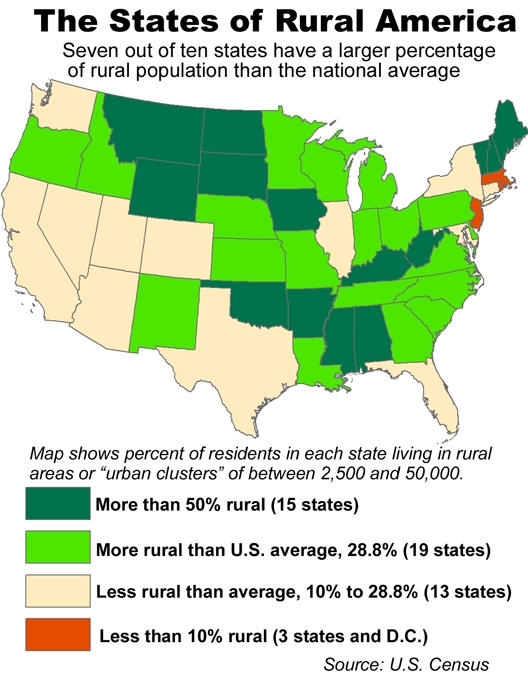
Seven out of ten states have a larger percentage of  rural population than the national average. (Click to embiggen)
Seven out of ten states have a larger percentage of rural population than the national average. (Click to embiggen)
This is by far not the only time I’ve heard conservative people claim that when any election doesn’t go their way it’s because of ballot-stuffing in the cities. It’s hard for people to grasp the sheer scale of the differences in population density. Many counties in the U.S. have population densities of 1 or 2 people per square mile, while cities can reach densities of more than 50,000 per square mile (the New York City metropolitan area, for instance). It’s also hard to grasp the difference in ideology. People who live in rural areas are far more likely to vote Republican and otherwise support conservative politics. People who live in cities are far more likely to lean the other way. It’s not just that they’re leaning, it’s also how far they lean. You’re much more likely to find a majority of moderate conservatives in the suburbs than in small towns and unincorporated communities, for instance. And you’re much more likely to find the sorts of arch-conservatives who embrace the alt-right label those small towns and unincorporated communities4.

There are many reasons for this divide. One simple one is migration. People growing up in those communities who don’t feel as welcome are more likely to move to the city. People who feel out of place in their small towns who go to cities (usually to attend college or look for work) discover not that everyone in the city agrees with them, but they can find communities or social circles where their differences are accepted and affirmed, and decide not to go back. Those of us who are queer understand this quite well, though we aren’t the only ones.

Another difference is a natural consequence of the density. Living a city, it is impossible not to come into contact on a daily basis with people who are culturally, ethnically, religiously, and/or politically different than you. You interact with them, seeing that that are just people like yourself, merely with different experiences and beliefs. You learn to empathize with those perspectives. For a lot of us, it makes us more open to the other points of view than we may have been before.

This was all brought to mind recently when an acquaintance was freaking out a bit about this article: More Americans move to cities in past decade-Census. It wasn’t that he didn’t know that more of the population of the country lives in cities than in non-urban areas. What freaked him out was how many more do. He though it the city-country divide was something like 60-40. It’s not. It’s 80-20.

Let me repeat that: 80% of the U.S. populations lives in cities, suburbs, and large- and medium-sized towns. Only 20% live outside of those urban areas.

Some articles about this topic get confusing, because not everyone agrees on where the dividing line between urban dweller and not should be. The Census Bureau uses the following definitions:

  • Urbanized Areas (UAs) of 50,000 or more people;
  • Urban Clusters (UCs) of at least 2,500 and less than 50,000 people;
  • “Rural” encompasses all population, housing, and territory not included within an urban area.

Some people want to quibble with that definition and divide the line differently. I’ve also seen some articles that include the urban clusters population in the rural, thus defining what most folks would agree is a quite large town as “rural.”

We also have a lot of misconceptions about how diverse communities are, racially and otherwise. This article talks a bit about that with some fun observations: ‘Normal America’ Is Not A Small Town Of White People.

There is also the phenomenon of entire states that are far more rural than others (and the source of the second map I linked): 2012: Nearly three out of ten Americans live in a rural area or a small city. But in most states, the percentage of rural residents is far greater.

Politicians of certain stripes are fond of talking about “real Americans” which is sometimes code for white, straight, and at least pseudo-Christian5. But it also often refers to people who live in small towns or on farms, with the implication that that makes up the majority of the population. Which gets us back to the reason many conservatives who don’t live in the largest cities think those cities are doing questionable things with ballot boxes. A lot of them don’t even understand that the majority of the population lives in cities. They think the urban dwellers are a minority somehow oppressing them.

It’s also why most of them don’t realize that their small communities are being subsidized by the taxes paid by city dwellers, not the other way around. But that’s a whole other can of worms.


Footnotes:

1. Which could have been avoided, because there were several thousand voters in my county who cast write-in votes for a former County Executive whom Gregoire had defeated in the primary, not aware that the state Constitution specifically forbids write-in votes to be certified for a candidate who lost in the Primary.

2. In Washington state, if you have been convicted of a felony you lose your right to vote. After you have served your time, you may petition to have your voting rights restored. But you have to actually file and make a court appearance to do it.

3. Four years later in the Rossi-Gregoire rematch she won by a more decisive 53% to 47%.

4. Not that you don’t find very liberal people in small towns, nor very conservative ones in the heart of the city. There are always outliers everywhere.

5. By which I mean people who give lip service to being Christians, and get foaming at the mouth angry if someone objects to a Ten Commandments monument in a courthouse, but otherwise don’t act as if they understand a single word Jesus ever said.

I ain’t afraid of no dude-bros, or just call me a Ghost Girl, too!

Salty snacks that literally are named Salty
Photo courtesy of the awesome @OsakaJack
In addition to writing about how much fun I had both times I went to see the new Ghostbusters movie on this blog yesterday, I’ve also mentioned it several times on Twitter over the weekend. I’ve mentioned the movie by name, I’ve tweeted: about how much I liked it, how much I love the character of Holtzman, what a good job Chris Hemsworth did playing a bimbo, and recommended that other people see it. And the only reactions I’ve received are either people agreeing with me or saying they want to check it out. I have even mentioned more than once that I went back to see the movie a second time.

On the other hand, a friend of mine mentioned that she was getting in line to see the movie again, and immediately her tweets were replied to by a bunch of random internet guys spewing various derogatory comments. Accusing her of getting in line again to “make up for it being a flop” (which it isn’t; Sony is very happy with the numbers), for instance. Explaining to her why she shouldn’t like it, and so forth. Several people have jumped in on it, including some guys claiming to be friends and not disagreeing with her, but upset that she isn’t tolerating the other dude’s opinions.

Why are her tweets getting that response and not mine? I did a little checking around on Twitter and saw several other male friends who have commented how much they liked the movie, and none of them are getting arguments from random internet dudes. But several women I am acquainted with have posted virtually identical comments about the movie, and they’re getting harassed.

And make no mistake: if you tell someone that they are “silencing”dissent when they don’t agree with you after you come into their space (which is what you are doing when you reply to someone’s tweet or blog post, et cetera) and tell them that their feelings are wrong, then you are harassing them. And when you’re a guy trolling through social media looking for women expressing opinions that so you can correct them, you are a mansplaining douche. I know you’re going around looking for women to argue with, because you’re ignoring nearly identical statements from other guys. You may not consciously realize you’re doing it, I’ll grant that, but when you see both my comments and my friend’s, but you only argue with her? Yeah, you’re being that kind of jerk.

And please, Internet dudes, don’t try to mansplain away another dude’s mansplaining.

You don’t have to like the movie. That’s fine. But don’t try to convince someone who has already seen the movie and loves it that they don’t actually like what they like. And don’t try to prove that the movie is bad. When you do that (when we do that) we’re being jerks.

And I say “we” because I slip up and do it, too. A lot. I have explicitly asked certain friends to tell me when I cross the line from trying to discuss something to bullying someone for disagreeing with me. It’s a behavior many of us learned growing up. When someone disagrees, we push back. It is so easy to go from pushing back to pushing down. 

Yeah, we made our opinion known publicly. You’re allowed to have a different opinion and express it in public. But don’t be a dick about it. Being a dick is not going to persuade the other person to agree. It isn’t. And here’s the thing: if what they like isn’t hurting you, there’s no reason to try to persuade the other person.

I push back hard on certain political topics because actual people die because of some policies that some people support. People dying, people living in poverty, people suffering injustice, people not being able to get health care… those are all things worth arguing about. But a goofy comedy? Let it go.

I want the new Ghostbusters movie to succeed because I loved it and I want to see more movies like it made. So yes, I’ve recommended it and told people how much fun I had and in some cases I’ve offered to buy people a ticket to see it. Because I genuinely believe they will enjoy the movie, perhaps as much as I did, but even more because I want us all to be able to enjoy more movies like this. I want little girls such as the one whose father posted a picture of the Ghostbusters costume she made with her existing toys to see movies like this and know they can be the hero, too. And yes, I want little boys to see this movie and know that their sisters and girl classmates and neighbors can be just as much a hero as they can. I want everyone to know that they can be someone’s hero.

Even you, dude bros. I want you to be heroes. And the first step is to stop being a mansplaining jerk. Salty is great when we’re talking about snack food (especially parabolic potato chips), but not in social interactions.

It’s my country, too

#WeAreAmerica #LoveHasNoLabels
I find myself in really odd discussions lately on social media. The worst, to be honest, happen on Facebook—usually with relatives. But it’s not just the cousin who keeps insisting that only immigrants object to religious Christmas displays on the public dime. Nor is it merely the aunt who keeps insisting that she doesn’t hate “the gays” or “the transgendereds” but is constantly posting memes and personally penned rants about how god is going to destroy America because of gay rights, and allowing trans people to use a public bathroom leads to rape. It’s not even the folks who argued that their right to sell assault weapons was more important that my right to not want to be gunned down in a gay club.

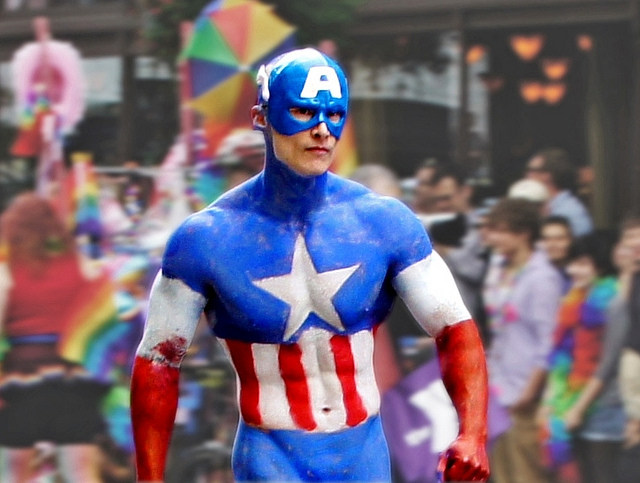
Captain America photographed in the 2012 Seattle Pride Parade (https://www.flickr.com/photos/sea-turtle/)
It’s also the folks who post the “Make America Great Again” memes, and unironically talk about how perfect America was in the 60s or 50s or whenever their childhood was. It’s the people who post the “Thank a Veteran” memes while voting for Republican congresscritters who constantly cut funding for veteran’s health care (and everyone else’s healthcare while they’re at it). It’s the people who describe themselves as “patriot” but think that means a very specific rightwing viewpoint. It’s the people who scream “all lives matter!” in the face of overwhelming evidence that the murders of black people, brown people, trans people, or women, or Jewish people, or people perceived to be muslim are never given as much attention by the justice system as other people’s deaths.

I love America. I have a favorite Founding Father (and I can go on at great length about why he’s my favorite), and I have a second favorite (and I can go on at equally great length as to why he’s my second favorite and why I understand that a lot of people prefer him over my fave). I can quote whole sections of the Constitution from memory. I get irritated at people who leave their U.S. flags out in the rain or fly them at night without illumination. I get teary eyed when patriotic music plays. I believe, even though many of the men who signed the document didn’t, that the Declaration of Independence was right when it said that we are all created equal (though I really wish it said people instead of men). I believe that America’s ideals are great, and wonderful, and visionary, and worth fighting for.

But I’m also painfully and personally aware that neither our laws, nor our society, nor most of our institutions live up to those ideals. America has seldom been great if you were not a cis white heterosexual male—preferably protestant (or let’s be honest, with a veneer of being a protestant Christian). If you were lucky enough to fall into that privileged category as a child, or the next best thing, to be the child of such a person and therefore protected by their umbrella of privilege, yes, America seemed really cool when you were younger.

Part of that was all that privilege, but another part was that most real world problems weren’t yours to worry about. Your parents were responsible for keeping a roof over your head and food on the table. If your family wasn’t poor, you spent at least part of your childhood completely unaware of most of the downsides of the world. Similarly if you were lucky enough to have loving, non-abusive parents. So of course life seemed simpler then. It wasn’t any simpler. Violent crime rates were actually much higher (because they have been steadily decreasing for decades), for instance. A lot of diseases we have treatments or even cures for now were completely untreatable. If you weren’t white, male, or straight, the law denied you all sorts of rights many take for granted, and often actually criminalized your existence.

And it’s not as if things are perfect and enlightened now: Millions of Americans Have Nothing to Celebrate on the Fourth of July

Otters wish you a happy Independence Day (© 2013 Monterey Bay Aquarium)
I mention America’s flaws not because I hate America, but because I love it and wish that we would live up to our ideals. As Elie Wiesel (the Holocaust survivor and Nobel Peace Prize laureate who died Saturday) said, “There may be times when we are powerless to prevent injustice, but there must never be a time when we fail to protest.”

No one who calls themselves an American patriot should sit in silence while injustice, racism, sectarianism, homophobia, or misogyny are being perpetrated in our name. James Madison (called Father of the Constitution, though he preferred to be remembered for authoring the original Bill of Rights) warns us, “I believe there are more instances of the abridgement of freedom of the people by gradual and silent encroachments by those in power than by violent and sudden usurpations.”

It is our silence and indifference that erodes the promise of liberty. It isn’t the immigrant (besides, unless you are Native American, you or your ancestors are immigrants), it isn’t the person who adheres to a different faith than you, or to no faith. It isn’t the lesbian couple trying to buy a wedding cake. It isn’t the trans person wishing to use a public bathroom. It isn’t the African-American mother demanding justice for her 12-year-old gunned down in a playground by police. It isn’t people asking to close some of the loopholes in background checks before guns are purchases. It isn’t the Jewish person asking that we not have a manger scene in city hall. It isn’t the recent immigrant working two jobs and trying to fit in English as a Second Language class while getting their kids through school.

None of those people or events are what has made America anything less than great.

It’s people who call themselves “patriot” who blames any of those other people. It’s the people who call themselves “patriot” and lecture people on line about racism while their own user name is literally a vile racial slur. It’s the people who call themselves “patriot” who sits silents while others denounce people because of their race, religion, sexual orientation, sexual identity, et cetera.

Judging others for being different and denying them the rights of life, liberty, and the pursuit of happiness is not American—love, acceptance, and helping our neighbors is.

We Are America featuring John Cena | Love Has No Labels:

(If embedding doesn’t work, click here.)

Clickbait, clickbait everywhere, and not a byte to think

clickbait-will-shock-you-meme-698x698Clickbait is everywhere. It could be argued, of course, that anything posted by any of us who blog or tweet or comment is clickbait. We post it because we want it to be read, right? But when I say “clickbait” I mean headlines that are intentionally provocative and sensational, usually misleading, or at least failing to deliver what is promised. Neil Gaiman tweeted a particularly amusing clickbait headline that uses both him and George R.R. Martin to lure you to the web site: Is Neil Gaiman in town to help GRRM with edits on THE WINDS OF WINTER? And the opening paragraph of the story (which absolutely does not tell you anything about either Neil, George, nor the next Game of Thrones book) even admits that the story is nothing but clickbait. As Neil’s tweet observed, “At least it’s a clickbait headline that has the decency to squirm and grin and admit it…”

Other clickbait is less honest. Such as just about any headline about Apple. A lot of people have been griping about how underhanded Apple is being, or how they’re punishing users for going to cheaper alternatives with the “Error 53” stories. Some of the headlines cram entire editorials and a half dozen inaccuracies in the one headline, such as “Apple remotely bricks phones to punish customers for getting independent repairs.” Only one word in that headline is not an outright lie. Yes, only one.

But why are phones from Apple giving some users an Error 53 and refusing to work? What could possibly be the cause? Oh, if only there was some explanation… oh wait, there is:

“We protect fingerprint data using a Secure Enclave, which is uniquely paired to the Touch ID sensor,” said an Apple spokesperson in response to complaints from users. “When [an] iPhone is serviced by an authorized Apple service provider or Apple retail store for changes that affect the Touch ID sensor, the pairing is re-validated. This check ensures the device and the iOS features related to Touch ID remain secure. Without this unique pairing, a malicious Touch ID sensor could be substituted, thereby gaining access to the secure enclave. When iOS detects that the pairing fails, Touch ID, including Apple Pay, is disabled so the device remains secure.”

I tracked down this information, but I didn’t have to, because I already knew the answer as soon as I saw the first headline. I knew because I actually read about the new features of my phone when they added Touch ID two years ago. They described the security feature, and how the Touch ID sensor was paired with the security chip. And this information wasn’t buried in fine print somewhere. They actually talked about it in the keynote speech where they introduced the iPhone 5s, for goodness sake! Plus it is on the iPhone section of the Apple web site. They have videos about the Touch ID feature up that include all of that information.

It was obvious immediately when I read the first Error 53 story what was going on: if you change the home button, it isn’t the same one that was paired with the security chip, so it will stop working.

This is not Apple punishing third party vendors or being underhanded. Even iFixIt, a site infamous (and very disliked by Apple Corporate) for putting up detailed instructions on how to fix things yourself without going to Apple says it makes sense that the phone’s operating system should try to detect tampering and react in some way to protect the users’ data. They don’t think completely disabling the phone is the best outcome, but admit that something along this line should happen.

I do agree with the suggestions some have made that what the phone should do is simply disable Apple Pay and the TouchID features when this mismatch is detected, rather than disable the whole phone.

To get back to that sample headline, here are the inaccuracies: Apple isn’t remotely bricking any phones. One of the events that will trigger the phone to do a self-diagnostic is upgrading the iOS software, which is why some of the phones aren’t getting the error right away. It’s all happening internally, not a remote command being issued by Apple. The error isn’t just happening when unauthorized dealers do the work. iFixIt reports a couple of cases of this happening after authorized dealers made the repair, and in some of those cases it was subsequently fixed by the authorized repair place re-doing the repair. There is a very clear and understandable security reason why the system should check for any tampering related to Touch ID in general (since most users use that to protect all their personal data on their phone), and Apple Pay in particular (since the user’s money and banking information are involved).

What would deserve outrage was if the iPhone didn’t do anything in these circumstances. Not the other way around.

But writing accurate headlines about Apple doesn’t generate the clicks.

Weekend Update 1/16/16: Wrong on so many levels

The elderly woman sporting a dress, pink lipstick and matching earrings (left) has been identified as the local senior center's middle-aged male van driver David Robert
Screenshot from the Guardian article, pics from Latino Public Radio and Facebook. Click to embiggen.
As always, some really interesting (or hilarious or both) news always pops up after I post my Friday Links which I think shouldn’t wait until next week but this time it’s an extra special doozy: Rhode Island city official resigns after forcing a man dress up in DRAG as old woman for a photo op at a senior citizen center. I think Talking Points Memo first broke the story yesterday, but the Guardian has the most comprehensive version. Go, read it, then come back, because this is just too hilarious.

The story I linked mentions the official defending herself on Facebook by re-posting something a friend wrote. Jezebel has the full text of the defense. Here’s the best part:

It is just like Sue to protect the seniors she served. I commend her for thinking of the safety of the frail seniors. It was 26 degrees last Tuesday and slippery by the snow pile (which was a prop as there was no snow)! Knowing Sue, I’m sure she was also thinking of the possibility of putting a “real” senior in harm’s way should someone recognize that person and go to their home to take advantage of them. I commend Sue and the staffer for putting safety first!

Anyone who attends PR events knows they are staged. Political press events are often staged; ribbon cuttings; ordinance /law signing ceremonies; to name a few. In politics campaign ads are staged with the perfect demographic representation in the mix. How is this any different?

First, comparing this to a campaign ad brings in a really big difference: campaign ads are paid for by private money raised by the candidate’s election committee. The salaries of all the city employees involved in getting this event together are paid for by tax payers. That’s a big difference. Yes, press conferences and photo ops are staged, but there’s a difference between people who may hate each other’s guts smiling for the camera because they all support the program or event in question, and people pretending to be someone they aren’t.

The photo op didn’t need a senior citizen for it to work. The kids shoveling snow, even if it was staged snow, got the idea across. I’ve even seen similar press events myself where the official doing the talking said something along the line of, “We haven’t had much snow this week, so we had to gather some up to show you how it’s going to work.”

To me, it’s a combination of all the bad decisions in this:

  • pressuring or asking an employee to dress in drag
  • thinking that a middle-aged man in bad drag is the way actual older women look
  • literally putting a label on the middle-aged man in drag that says “senior home resident” – If it had actually been a resident, they wouldn’t have put a label on her! No one else in the photo op is wearing a label. Why should there be a label on her?
  • claiming this was to protect the real senior home residents from either the cold, or slipping, or harassment?

A bunch of teen-agers shoveling snow in front of a building that actually is a senior citizen home and already has a gigantic sign identifying it as such is all the photo op needed. People would have gotten the idea. This was just a lot of really dumb decisions that added up to no real benefit for anyone.

And maybe it’s because I have friends who are trans and non-binary so I spend a lot of time thinking (and being irritated) about the ways people think of drag and queer and trans and women’s issues, but this whole thing skeeves me out on that level, too. The bus driver hasn’t been identified as gay, but you can see from the pictures the Guardian come up with of him that even if he isn’t, a lot of people probably assume he is. So this turns into “ask the fag to dress up as a woman—he must know how, right?” situation.

This situation is wrong on many, many levels, not the least of which is anyone trying to cast the person who made all these decisions as the victim.

When bad things happen look for the heroes

This is Adel Termos pictured with one of his children.  Mr. Termos sacrificed himself by tackling a suicide bomber in Beirut on Thursday.
This is Adel Termos pictured with one of his children. Mr. Termos sacrificed himself by tackling a suicide bomber in Beirut on Thursday.
Really bad things are happening around the world. And not just the ones that your national media is obsessing over.

One Day Before Paris, There Was a Massive Terrorist Attack the Media Ignored “It’s not just Paris we should pray for, it is the world.”

There Is Only One Way to Defeat ISIS “We must hold accountable our Middle Eastern “allies”—the states and bankers and political elites—who persist in funding mass murder.”

Paris Was Not The Only City to Be Hit With A Terrorist Attack This Week.

This Is the Hero Who Sacrificed His Own Life to Save Hundreds From ISIS Terrorists. “…the attacks in Paris and Beirut are only the latest in a wave of terrorism that has swept the globe in recent months. Only weeks ago, a Russian airliner was downed near Egypt’s Sharm el-Sheikh resort in what was likely a bomb attack. In July, Egyptian soldiers killed nearly 100 militants in the Sinai during skirmishes there. Meanwhile in the Turkish capital of Ankara, nearly 100 were killed in explosions.”