Tag Archives: personal

When the roll is called up yonder, or queer confessions of an ex-evangelical

Me wearing part of the uniform for the interdenominational youth touring choir I was a member of for many years.
Just a few months ago I was trying to explain to a friend who lives in the U.K. the weird hypocritical dogma of the typical American fundamentalist Christian, and wound up mentioning that although I disagreed vehemently with many things that Billy Graham preached, I always felt his basic faith was sincere. This is in contrast to my opinion of Graham’s son who has taken over running the ministry, who both on air and in-person came across as an especially unethical used car salesman.

Even so, I was a bit surprised at my reaction to the news that the 99-year-old Billy Graham, oft described as “America’s Pastor,” died yesterday. Let’s make no mistake: while Graham was unusual among Southern Baptist ministers in the 1950s to embrace desegregation (“there is no segregation at the foot of the cross”) and at least gave lip service to decrying racism, he was an unrepentant homophobe. Statements he made over the years included: “Let me say this loud and clear, we traffic in homosexuality at the peril of our spiritual welfare.” Or: “Is AIDS a judgment of God? I could not be sure, but I think so.” Graham claimed to be non-partisan, but often came down on the Republican side of many issues. “At 93, I never thought we would have to debate the definition of marriage. The Bible is clear — God’s definition of marriage is between a man and a woman.” And it’s really hard to justify some of the comments he made while discussing Jews and the media with President Nixon in the 1960s.

But Billy could preach! Oh, how he could preach! It’s difficult to explain to someone who didn’t grow up in an evangelical community in the 50s, 60s, or 70s the cherished place Graham inhabited in the hearts of the faithful, semi-faithful, and faithful-adjacent. Graham wasn’t just held up as an example of a good man and great preacher, people were so certain he was inspired by god, that quoting him sometimes had a stronger effect than quoting from the scripture.

As a teenaged Southern Baptist (very closeted) queer boy in the 70s, I was perhaps more acutely aware of how much Graham was revered than most. While many saw my flare for the dramatic as a troubling hint of queerness, others saw it as a calling from god to become a preacher. The combination of that theatricality with my ability to memorize and recall huge sections of the Bible, as well as a facility with language, and being quick-thinking on my feet had people talking about what a great preacher I would make when I was still in grade school. Once I was older, and had more experience thanks to musical groups, drama club, and the debate team, well, it surprised no one when elders of the church started trying to convince me to get ordained in my late teens.

At the same time, completely unbeknownst to me, Mom and several women in our church were meeting once a week to pray that god would “rescue” me from the temptation of homosexuality. I hadn’t come out to anyone, at all, at the time. And while there are been some very furtive sexual relationships with a few boys my age during middle school, by the time people’s suspicions had risen to that point I was celibate, secretly praying even more fervently than they were, and doing everything I possibly could to be straight.

Which is precisely why, when I was approached about ordination, I started meeting with one of the associate pastors and studying to become a minister. Like millions of religious queers before me, for some time I thought that embracing “full-time Christian service” might be the only way to make my feelings for other guys go away.

I should mention that in Southern Baptist churches at the time, ordination was something that happened usually at your local church before you went off to Bible college. Which is the reverse of the way most other denominations do it. So I was still a teen in my first year attending community college while meeting with the pastors and deacons of our church several times a week to study and pray about my future.

I wish I could say that what caused me to back out was an epiphany about my sexual orientation resulting in self-acceptance replacing the self-loathing I had been taught all my life. That tipping point wouldn’t come for a few more years, yet. I also wish I could say that it was learning that the origins of the Southern Baptist denomination were much more racist and pro-slavery than I had been taught. That shocked me a little bit, but I was already quite familiar with the fact that only a few years before this the Southern Baptist Convention had finally denounced segregation of the races.

What did bring me to my senses were two conversations that happened close together, each with a different deacon in our church.

In the first, the elder in question took issue with my continued interest in science, particularly my interest in astronomy and evolution. He was quite unimpressed by my argument that a god who could plan and carry out a plan involved 15 billions years of stellar evolution eventually leading to humans was a far more impressive feat then simply waving a magic wand and making everything at once. While he referenced the Baptist principle that interpreting the scripture was something each person must do on their own, he also made it clear that my adherence to scientific fact was not an asset for a pastor.

In the conversation with another deacon, I mentioned an article I had read recently in which I learned that Fred Rogers, famous as Mister Rogers on PBS stations, was an ordained Presbyterian minister, who considered his work producing the children’s show his ministry. I thought it was a great example of how doing god’s work could take many forms The deacon had a very different view. First, he pointed out that (in the opinion of typical Southern Baptists), Presbyterians were “soft” on Biblical inerrancy. Further, if Rogers was actually doing god’s work, he would use that daily television show to tell children directly the story of Jesus. Since he didn’t do that, he wasn’t doing god’s work, according to this deacon. Finally, he said, “You know that Billy Graham was raised Presbyterian? He joined the Baptists because we’re actually doing god’s work.”

And those two conversations were the final nails in the coffin of me becoming a Baptist minister. The epiphany I had after those conversations was that all of the church leaders who had been urging me to become a minister didn’t really see the makings of a pastor in me. Instead, they thought that anyone who had Talent, whether it be intelligence, a gift for language, or whatever, who didn’t use that to evangelize wasn’t doing god’s work. That simply being a good person and doing what you can to make the corner of the world you were in a better place and to love your neighbors wasn’t enough.

I didn’t call things off until the end of the Sunday evening Church service where, as part of the process, I delivered a sermon and otherwise conducted the service. I still think that my John 16:33 sermon is an incredible work of art. But even as I was giving it, I knew the whole thing was a mistake. I suspect if I hadn’t called it off, that the deacon who was so concerned about my love of science would have done what he could to derail things. Regardless, there were a few more times over the next couple of years that leaders in that church and related churches came to me and asked me to prayerfully reconsider become a preacher.

I had learned my lesson: if the evangelical faith couldn’t accommodate both scientific fact and Mister Rogers, well, it didn’t have a place for me, either. I didn’t find my real place until several years later, but that’s a story for another day.


Note: The title comes from the hymn “When the Roll Is Called Up Yonder” by James M. Black, hymn #482 in the 1956 Baptist Hymnal.
It can’t be too late for common sense about guns, right?

I’ve written about the most recent incident last week, and laid out how all the usual arguments for why we can’t do anything about mass shootings have been trotted out by other industries and proved incorrect a while ago: They used to insist that drunk driving couldn’t be reduced either. I had some more stuff I was going to follow up with, but almost everything I wanted to say is summed up by Emma Gonzalez, one of the survivors of last week’s school shooting in Parkland, Florida: Teen who survived massacre rips Trump to pieces in emotional takedown. I’m just going to quote a bunch of that article:

[S]he responded directly to Trump’s tweet, which blamed students at the school for not reporting on the shooter’s behavior before the event.

“We did,” Gonzalez said, “time and time again, since he was in middle school.”

“We need to pay attention to the fact that this isn’t just a mental health issue,” she continued. “He wouldn’t have harmed that many students with a knife.”

“How about we stop blaming the victims for something that was the shooter’s fault?” she demanded, and called out those who do deserve to shoulder that blame.

“[The people] who let him buy the guns in the first place. Those at the gun shows. The people who encouraged him to buy accessories for his guns to make them fully automatic. The people who didn’t take them away from him when they knew that he expressed homicidal tendencies. And I am not talking about the FBI. I am talking about the people that he lived with, I’m talking about the neighbors who saw him outside holding guns.”

The NRA gave $30,000,000 dollars to the Trump Presidential campaign alone, not to mention the tens of millions to various senators and congresspeople. Last year, when Congress passed a law making it easier for mentally ill people to buy guns (and Cadet Bonespur signed it), the NRA sent out a bulletin to all of its members bragging about it.

The NRA routinely pours millions into defeating laws that NRA members themselves claim to support. When gun sales plummeted last year after Cadet Bonespur was inaugurated, they spent a bunch of money producing advertisements that portrayed Black Lives Matters protesters and such as dangerous violent people. The ads were blatant calls for white supremacists to buy more guns and prepare for a race war.

The NRA as an organization is demonstrably not promoting responsible gun ownership and hasn’t been for decades. It’s only goals are to protect and increase gun manufacturer profit; and if any of its leaders aren’t racist (a highly difficult proposition to prove), they are all absolutely fine fanning the flames of racial fear to keep the money rolling in.

So, anyone still supporting them is supporting an organization that sees mass murders of children and racial tension as marketing tools. You aren’t nobly defending a moral principle if you support them.

It’s time to end this bloody charade.

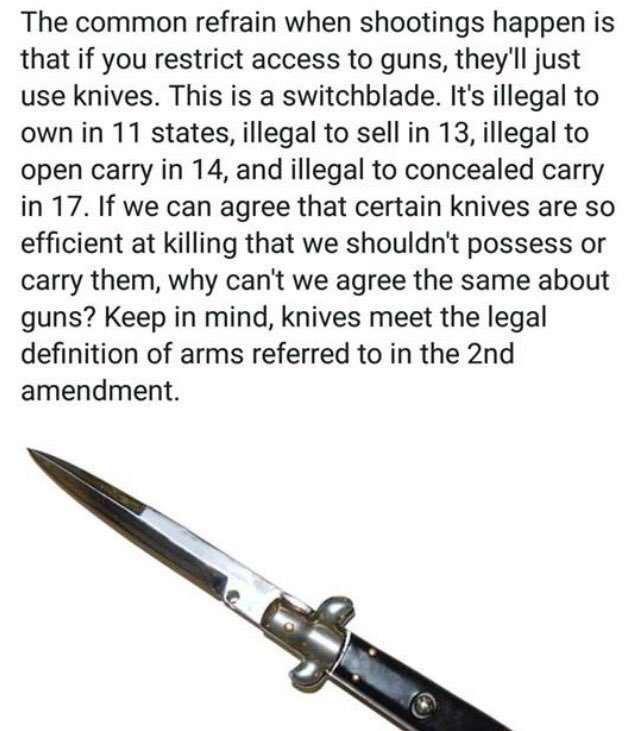
“The common refrain when shootings happen in that if you restrict access to guns, they'll just use knives. This is a switchblade. It's illegal to own in 11 states, illegal to sell in 13, illegal to open carry in 14, and illegal to concealed carry in 17. Itf we can agree that certain knives are so efficient at killing that we shouldn't possess or carry them, why can't we agree the same about guns? Keep in mind, knives meet the legal definition of arms referred to in the 2nd amendment.”
“The common refrain when shootings happen in that if you restrict access to guns, they’ll just use knives. This is a switchblade. It’s illegal to own in 11 states, illegal to sell in 13, illegal to open carry in 14, and illegal to concealed carry in 17. Itf we can agree that certain knives are so efficient at killing that we shouldn’t possess or carry them, why can’t we agree the same about guns? Keep in mind, knives meet the legal definition of arms referred to in the 2nd amendment.”

Great-grandma’s Gun

My sister and I with Great Grandma St, John. I'm 9, my sis is 4, and Great-grandma is 74 in this picture.
My sister and I with Great Grandma St, John. I’m 9, my sis is 4, and Great-grandma is 74 in this picture.

I have often found myself in weird discussions/arguments with people who assume that because I favor many extremely liberal policies, I must be one of those evil anti-gun people. So before I get into this tale, let me begin by saying that I used to be a card-carrying member of the NRA. I have owned guns. I have fired guns. I have almost never fired guns on a gun range, because we didn’t have many in the Rocky Mountain towns where I grew up. I was taught how to shoot a gun by being taken out into the wilderness by my father and grandfather and firing it for a couple of hours at various things we set up as targets. Then after the third of fourth weekend of doing that being told I needed to go shoot a rabbit or two if I wanted to eat that night.

Long before we got to that point there had been many, many gun safety lectures, because there were lots of guns (mostly hunting rifles) in the homes of most of my extended family. I knew how to take apart, clean, and put back together a bolt-action rifle and how to re-load bullet cases (by which I mean, measure out gunpowder, put it into a spent casing, align a new bullet and insert it with a hand operated press, and install a primer cap) years before I was allowed to hold a loaded gun and shoot it.

There were winters when the only reason there was enough food on the table for the whole family was because some of us had gotten a deer or elk during the appropriate season (not to mention rabbits, pheasants, and grouse). I should also mention that I was raised to look down my nose in disdain at people who hunted pheasant and other birds with a shotgun. As my Grandpa said, “If you can’t hit a flying grouse or dove or pheasant with a rifle, you have no business pointing a gun at anything.”

I should also mention, in case it isn’t obvious from the part about learning how to turn spent cartridges back into bullets, missing was considered wasteful. We couldn’t afford to waste a lot of bullets getting the food.

But as the title of this post suggests, today I need to tell you the story of Great-grandma’s Gun… Continue reading Great-grandma’s Gun

Coffee, coffee, everywhere — and why half of what you know about it is wrong

“There is no such thing as strong coffee, only weak people...”
“There is no such thing as strong coffee, only weak people…”

I have been drinking coffee since I was 12 or 13 years old—in other words, for 45 years! During that time the amount and types of coffee I drink has varied. Growing up in a working class family in the central Rockies, meant that for many years the kind of coffee I drank would be sneered at by a lot of coffee afictionadoes. Cheap, canned ground coffee for the percolator, instant coffee for when you don’t have the time to make a full pot. My father and both grandfathers had the kinds of jobs where they took a lunch box and a big thermos full of coffee with them each day they went to work.

So for more than 45 years I’ve been around coffee and coffee lovers, as well as consuming a lot of coffee myself. And I have spent a good portion of those 45 years having to debunk commonly held beliefs about coffee’s affect on one’s body. I thought I had heard everything, but a couple of years ago when the topic of coffee came up in an online discussion, someone made a joke about coffee making you poop. Or, I should say, I thought they were making a joke. But I encountered it a few times again over the next few months, and then it seemed that everyone on the planet knew as an absolute certainty that coffee is a natural laxative of such power that if forces you to run to the bathroom a few minutes after finishing the cup.

This puzzled me in part because 1) I had never experienced this effect, and 2) while some of the men who drank a lot of coffee around me when I was a kid would occasionally make crude comments about how many times they had to take a piss because of the coffee (and that they didn’t want a third cup because they didn’t want to take another piss soon), no one had ever mentioned needing to take a dump. And I guarantee you that a couple of my uncles would have had some very colorful jokes based on it if they had ever observed a correlation between drinking coffee and needing to poop.

So, I did some research, and while it is easy to find a lot of web pages that promote the idea, if you restrict your reading to pages that cite medical studies, you find out that, yeah, it’s a myth. There was one study in the 1990 that seemed to show an increase in the muscle movements of the colon a few minutes after drinking coffee—but only in about 28% of the subjects. And, most medical people who commented on the study were quick to point out that the study didn’t demonstrate that this increase in activity was enough to create a laxative effect. Another study a few years later couldn’t reproduce the results with coffee alone—they only measured the increase if the person drank the coffee (either regular or decaf) along with a meal of at least 1000 calories. That would seem to indicate that maybe it isn’t the coffee that’s the issue, it’s filling up the stomach and kicking the digestive system into full gear that causes the movement further down.

Lots of people insist that drinking coffee makes them need to go. Among the many critiques raised by other researchers concerning these studies and the anecdotal evidence is people are overlooking the possibilities of both a pavlovian effect and habits. If you generally drink coffee shortly after waking up most days (because you set up the automatic coffee maker on a timer each night, for instance), and you usually eat dinner at roughly the same time each night, your body may just be ready to go by morning. The coffee is a coincidence.

As the article I linked to above also mentions, the oft repeated notion that drinking coffee, tea, and other beverages containing caffeine actually dehydrates you is also a myth. Coffee, it turns out, is not a diuretic.

I want to pause here and point out that I’ve heard the admonition against drinking coffee because it supposedly dehydrates you from nurses and other medical personnel ten times more often I hear it from anyone else. This is the reason that anytime someone starts telling me that one should eat or do this, or refrain from eating or doing that because their doctor told them that I have to fight not to roll my eyes before urging them to do some of their own research.

My favorite is that people still cite studies from the 1950s that showed a correlation between coffee drinking and heart disease (among other things). Because those original studies made two errors that created a false correlation: they didn’t control for tobacco use, and they didn’t separate data by the gender of the subject.

Turns out that back when smoking was much more prevalent than it is today, there was a high correlation between coffee use and smoking. In other words, people who drank a lot of coffee were more likely to also be heavy smokers. Once you think about the neurological properties of caffeine and nicotine, that makes sense, both substances are mood regulators. Anyway, turns out that most of the statistic correlation vanished once you accounted for the smoking.

A tiny bit of statistical correlation remained, but if you then separated the data and compared only coffee drinking men to non-coffee drinking men, and similarly only comparing coffee drinking women to non-coffee drinking women, the correlation completely vanished. Why? Well, coffee drinking men on average drink between 10-20 percent more coffee today than the average woman. Given that on average men outweigh women by a bit more than 10 percent, and the amount of caffeine one must consume to produce a given result varies by body mass, it makes sense that coffee drinking men will consume at least 10% more coffee than women. Completely separate from any lifestyle questions, it is a biological fact that merely being male increases one’s chances of developing heart disease or high blood pressure.

This is a great reminder that correlation doesn’t necessarily mean causation.

There have been many more recent studies that have shown there is no link between coffee consumption and coronary artery disease or stroke. That is, no link between regular coffee and those diseases. Oddly enough, people who drink a lot of decaf seem to have a slightly increased risk of certain types of coronary disease, though at this time no one knows why.

Anything that people indulge in—if it isn’t perceived as a necessity for survival—comes under a lot of scrutiny from others. There are always people who thinking you shouldn’t indulge in the activity at all, or that you shouldn’t do it more than they do, and so on. So that’s one reason coffee accumulates these misperceptions and why people repeat them indefinitely. More generally, people place a lot more weight on their own perceptions and anecdotal evidence of people who agree with them than they do to logic, statistics, and reproducability.

The science indicates that coffee doesn’t have most of the negative effects most people associate with it. So you can enjoy it guilt free. And if you’re one of those people who don’t enjoy or use it or all, that’s absolutely fine. Just stop ragging on other people for doing it. None of us are giving you grief for your oxygen habit, are we?

“Coffee: a warm, delicious alternative to hating everybody every morning forever.”

She Knew What She Was Doing and Why – Ursula K. Le Guin

“Fake Rule: The generic pronoun in English is he. Violation: “Each one in turn reads their piece aloud.” This is wrong, say the grammar bullies, because each one, each person is a singular noun and their is a plural pronoun. But Shakespeare used their with words such as everybody, anybody, a person, and so we all do when we’re talking. (“It’s enough to drive anyone out of their senses,” said George Bernard Shaw.) The grammarians started telling us it was incorrect along in the sixteenth or seventeenth century. That was when they also declared that the pronoun he includes both sexes, as in “If a person needs an abortion, he should be required to tell his parents.” My use of their is socially motivated and, if you like, politically correct: a deliberate response to the socially and politically significant banning of our genderless pronoun by language legislators enforcing the notion that the male sex is the only one that counts. I consistently break a rule I consider to be not only fake but pernicious. I know what I’m doing and why.” —Ursula K. Le Guin, Steering the Craft: A Twenty-First-Century Guide to Sailing the Sea of Story
“Fake Rule: The generic pronoun in English is he.
Violation: “Each one in turn reads their piece aloud.”
This is wrong, say the grammar bullies, because each one, each person is a singular noun and their is a plural pronoun. But Shakespeare used their with words such as everybody, anybody, a person, and so we all do when we’re talking. (“It’s enough to drive anyone out of their senses,” said George Bernard Shaw.) The grammarians started telling us it was incorrect along in the sixteenth or seventeenth century. That was when they also declared that the pronoun he includes both sexes, as in “If a person needs an abortion, he should be required to tell his parents.” My use of their is socially motivated and, if you like, politically correct: a deliberate response to the socially and politically significant banning of our genderless pronoun by language legislators enforcing the notion that the male sex is the only one that counts. I consistently break a rule I consider to be not only fake but pernicious. I know what I’m doing and why.”
—Ursula K. Le Guin, Steering the Craft: A Twenty-First-Century Guide to Sailing the Sea of Story
“Dear Mr Radziewicz,
I can imagine myself blurbing a book in which Brian Aldiss, predictably, sneers at my work, because then I could preen myself on my magnanimity. But I cannot imagine myself blurbing a book, the first of the series, which not only contains no writing by women, but the tone of which is so self-contentedly, exclusively male, like a club, or a locker room. That would not be magnanimity, but foolishness. Gentlemen, I just don’t belong here.
Yours truly,
Ursula K. Le Guin”

Ursula K. Le Guin, Acclaimed for Her Fantasy Fiction, Is Dead at 88.

The fantasy and science fiction community pays tribute to Ursula K. Le Guin.

Ursula K. Le Guin, the spiritual mother of generations of writers; John Scalzi pays tribute.

I’ve written about two of Le Guin’s books that were instrumental in my life: Timebomb from the Stars – more of why I love sf/f and The Original Wizard School – more of why I love sf/f. Please note I said in my life, not just in my understanding of science fiction/fantasy or how to write. Her stories did that, too—but Le Guin’s books were particularly important to teen-age me trying to learn how to be comfortable in my own skin.

As I said in one of the earlier blog posts, she may not have explicitly meant her story to help a queer kid learn to accept himself, but that’s what her tales did for me. Also, every time I re-read one of Le Guin’s books, I notice ideas that she develops in the story that have become such an intrinsic part of how I look at stories, that I have forgotten she was the one who introduced me to the idea. The ideas in her tales weren’t messages that slap you in the face, they are simply a part of the story in such a way that you accept them. They aren’t “Ah ha!” moments, but more like, “Of course!”

I don’t know how to express how heavy my heart is because of her passing. Tuesday afternoon, when my husband got home from work, he asked me if I had been paying attention to the news or twitter, then told me that Ursula K. Le Guin had died, and I just said, “No! Oh, no!” emphatically. It struck me harder than a celebrity death has in a long time. Once I was finished with work, I cued up the audiobook in which Ursula read her own translation of the Tao Te Ching, because I just needed to hear her voice for a while.

I was a little surprised how upset I was, until I read John Scalzi’s column above. I hadn’t realized it, but she was a spiritual mother to me, despite my only ever meeting her at a book signing. And he’s right. It takes time to mourn a mother.

Confessions of a musical junkie (or, a crazy writer and his crazier playlists)

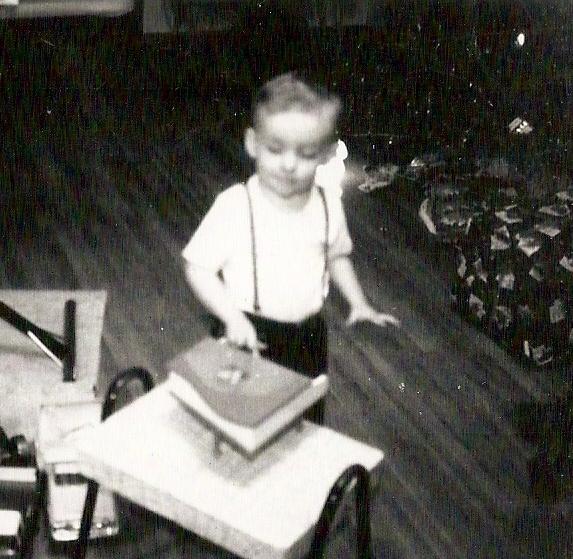
Three-year-old me at Christmas with my toy piano.

I am, indeed, one of those people who think there is a song from a musical for every situation. Some people consider this a stereotypical gay thing, but I know way more gay people who never liked theatre (musical or otherwise) than do (and there are plenty of straight people writing, performing, or buying tickets to Broadway musicals and the like). Oh, yes, there are arguments made about the kind of misfit who is drawn to the exaggerated and colorful worlds portrayed in musical theatre, and that’s why there are enough queer people into it to create the stereotype. But I think there’s more than a little bit of a chicken-and-egg aspect to that.

Regardless, I have a lot of musical soundtracks in my music collection, along with orchestral scores for my favorite movies and TV shows. And I have been known to surf to TuneFind.com while watching something when a particularly good piece of music is used to accompany a scene in one of my favorite shows, so I can buy a copy of the song for myself. And I’ve blogged before about how I create playlists specifically for certain writing projects.

I’ve had more than one friend comment, upon seeing the list of songs in one of my play lists, “How can you write while listening to songs with lyrics?” First, if a song has wound up in one of my playlists, it’s usually a song I’m already familiar enough with that I don’t have to pay attention to the lyrics to parse the meaning of the song. Even with very voice-forward songs, while I’m writing I’m not processing the music as words, but as mood music.

Second, if a song is fairly new to me—I heard it for the first time, liked it a lot, bought it, and added it to my current writing playlist—I may pause while writing the next time it comes up. Far more likely, I will have heard the song a few more times before I’m next writing because I listen to the playlists at least as often when I’m not writing as when I am. While riding the bus to work, while working at my desk at my day job, while walking in the evening before heading home I’ll be listening to the current writing playlist, in part to get my subconscious working on the story while I’m dong these other things. I’m more likely to be in the mood to be productive on a personal writing project after a long workday if I’ve been listening to a playlist that I associate with the personal writing..

I need to make a small digression about my longer bus commute. I have tried several times to write on this bus route as I used to back on the Route D—the ride’s longer; I should be able to get more writing done! Unfortunately, the other difference is that the physical road seems to have a lot more potholes and irregularities. It’s really annoying, because the bouncing and dipping is pretty much constant. So there I am, holding my phone in my hand with one of my writing apps up but we’re constantly bouncing, so my thumbs keep hitting the wrong part of the screen. I get half a word typed and then get five incorrect letters in a cluster because of a particularly bad bounce, so I try to delete and there’s a bunch of smaller bounces and half my attempts to tap the backspace hit another key near it instead.

I can read (though sometimes that’s a little difficult). I can take notes. But when I’m writing, once my head is in the scene want to just get out this sentence and on to the next and the next. But I can’t get the flow going because of the dang bouncing. I tried to ignore the wrong letters and keep going one time, but I spent way more time correcting the gibberish once I got home and transferred it to the laptop that I realized bus writing is just not possible for most of the Route E.

Which has made the writing playlists take on a new importance. Since it is very difficult to write on the new bus route, what I do instead is listen to the current project’s playlist while either re-reading recently written scenes or going through my notes on the project.

One reason I have writing playlists is because music conveys emotion. It doesn’t just convey emotion, it generates emotion. When we hear a song we know well, it may remind us about a particular event, or a person, or just a time in our lives. And it doesn’t always have to be because we are remembering that song happening to accompany a particular memory. Sometimes a song that was written long after a particular event in your life manages, somehow, to evoke your memory of the experience.

Another reason I have writing playlists is going to sound strange to some. Dialog is, in my opinion, the heart of most stories. Dialog conveys information, and illustrates relationships of the people talking, and gives you a sense of the personalities of each speaker. A good dialog is like music. It isn’t just about the literal or contextual meaning of the words, but also the rhythm. Some phrases flow easily from one’s mouth, whereas badly written dialog will tie your tongue in a knot if you try to read it aloud. For me, listening to music while I write helps me find rhythms. The dialog just works better if I have a good set of songs going.

And another reason that I have writing lists is, I don’t like to write in silence. I can write in silence. But it’s difficult, sometimes. Maybe it’s because during my childhood, when I first started writing (I literally decided that I wanted to be a writer when I grew up at the age of six, and was regularly pounding out page after page of stories on my mom’s Easter Pink Smith-Corono Silent Super typewriter by the age of ten) there was alway a lot of noise. Other people in the house doing things of their own. Dad watching a ballgame in the living room, while my sister was playing in her room and Mom was doing something in the sewing room. And there were often neighbors outside making noise.

“Jazz Hands!” - ICanHasCheezeburger.Com
“Jazz Hands!”

And for a lot of those years I would be back in my room, with the door closed, tapping away on those keys with the radio playing as I tried to learn the magic of dialog that sounded like real people, and scenes that moved the story along. Sometimes, an especially good song would come up and I might have to stop typing to sing along. And yes, sometimes I got up and danced around my room as I did so. But when the song ended, I’d go back to the typewriter. Giddy with the joy of the dancing, and feeling renewed determination for my hero to save the day.

Songs never mean the same thing to other people. So sharing my playlists probably doesn’t help any of my friends write. Though I have had one or two of them say that they were glad I introduced them to a particular song or artist when I share a list. And I know I have found great new songs when other people share their own lists. But while it may be futile to expect that one of my playlists will effect you the way they do me, I’m going to share four songs from my current novel editing playlist. The full playlist is nearly 60 songs. These aren’t a representative sample, but they are particular favorites. Three of these songs I associate with a specific character in my fictional universe–evoking a particular aspect of their personality, or even expression something that character believes are feels. One of them describes the past relationship between a pair of characters.

Enjoy!

Darling Lili– Whistling Away The Dark (HD) – JULIE ANDREWS :

(If embedding doesn’t work, click here.)

Mame – Bosom Buddies – Angela Lansbury and Bea Arthur:

(If embedding doesn’t work, click here.)

Bad Influence – P!nk (Music Video):

(If embedding doesn’t work, click here.)

Shrek 2 – Holding Out For a Hero – Jennifer Saunders:

(If embedding doesn’t work, click here.)

Confessions of a whiny patient

(click to embiggen)

I have two more writing-related posts half written, one of which I hoped to queue up for Tuesday, but I was cranky, exhausted, and still sick when I got home from work. So I’m just going to whine about feeling sick and how I cope and related things. Which means that this post is going to be, as one friend calls them, a “what I had for breakfast post.” I probably won’t talk about breakfast, but if you’re not interested in just mundane stuff, don’t click through: Continue reading Confessions of a whiny patient

Confessions of the sometimes clueless

“You can do it” —Coffee

So, I was in either my late 30s or early 40s before I learned what pot smoke smelled like. It was at a convention in a particularly maze-like hotel and I commented to my husband about a weird odor I had run into out in the hall. He asked about where it was, then laughed and said he’d walked through that section of the hall a few minutes before and it was reeking of pot smoke. “Oh,” I said, sheepishly. The next time someone sat near me on the bus and had that particular stale pot smoke odor, it took all my willpower not to exclaim ‘So that’s what that smell is!’ because I’d encountered it many times before, but never knew what it was.

Over the years I’ve had numerous opportunities to vote on various aspects of marijuana law–each time I voted in favor of decriminalization or legalization. When some early attempts in our state to decriminalize pot outright through initiative failed, activists took new tactics. There was a successful city initiative to make simple pot possession the lowest priority of law enforcement, for instance. That one had a lot of interesting side effects. The city attorney at the time had vehemently opposed the initiative, so after it passed, he actually drastically increased the number of cases they prosecuted. So the next time he was up for re-election, a guy ran against him who vowed to enact the initiative… and he won by a big margin, and proceeded to dismiss cases and so forth.

The first statewide initiative to make pot a lower priority failed, but we passed a medical marijuana initiative eventually. Then finally in 2012 we legalized recreational pot completely. And while there are still some cities that have banned legal pot stores, and a few groups still trying to get weed re-criminalized, the industry appears to have done well.

Despite voting in favor of people having access to weed a bunch of times, I’ve still never actually used it, myself. Caffeine and cocktails remain my personal drugs of choice.

Last spring when we were looking for a new place to live, I didn’t even notice the first time we came to this apartment building that there was a pot store just around the corner. At least one of our friends commented on it as if it were an exotic thing. Another friend pointed out that there is about one every five or ten blocks on the major thoroughfare nearby, that they aren’t really that uncommon. It’s just another of the businesses I walk past every morning on my way to the bus, right?

I don’t remember when it was that I first started noticing the odd business trucks that would park on the street in front of our building on work-from-home days. The first time I saw the Roto-rooter type trunk, for instance, I wondered if one of my neighbors was having plumbing troubles. It seemed as if every work-from-home day I would notice, when I went to refill my coffee mug, and thus walked past the dining room window, that there was some weird delivery truck out there, such as the bottled water truck, or the plumbing related truck, or (this was the one that really confused me) the pool cleaning company’s truck.

One sunny day a few months ago I was getting another mug of coffee when I saw a bottled water delivery truck pulling over to park at the curb in front of our building. So I stopped to watch and see where the drive went. Did one of my neighbors have a water cooler in their apartment, perhaps? The guy got out of his truck, looked around with a definitely surreptitious air, and then turned and walked to the corner. At the corner, he turned left. Which is when I finally made the connection.

It was maybe five minutes later he came walking back, then climbed into the truck, started the engine and drove off.

Now I understood. A guy’s at work, driving around doing his job, and while it might be okay to have your truck seen parked at a coffee shop or fast food place in the middle of the day, you might not want to be seen popping into one of the local pot stores to pick up some stuff for the weekend. Sure, it’s legal, and yes, you are allowed to take breaks on the job, but there’s still a bit of a worry about how it might be perceived. So, you don’t ever pull into the store’s parking lot with the company truck. But, if there is a residential street which often has plenty of empty curb space in the daytime just around the corner from one of the pot shops in the part of town where you work, well, on the occasional Friday you may stop and park there and go on a short walk, right?

It probably would be obvious to anyone else, but it just didn’t occur to me until I watched the one guy go around the corner.

Ah, well, at least now when I give my coffee mug a warm-up on work from home days and notice an odd truck outside, I just smile instead of wondering why they’re there.

Confessions of an equivocator with delusions of ruthlessness

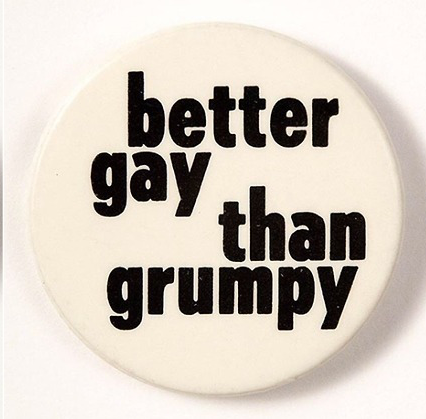
“Better gay than grumpy.” (click to embiggen)

There’s a lot of things I didn’t finish during my Christmas vacation. I have three very different half-written blog posts that I wanted to squeeze in before the end of the year. I spun my wheels for many reasons, one being that I wasn’t sure that the particular mood or perspective on the issue under discussion was something I wanted to put out there. This is similar to one of the reasons that I didn’t do any updates about my goals for the last few months. After completing the move, I re-evaluated the goals, because two of the big goal categories had been centered on the move and things that we had to take care of before moving. And certain parts of the new goals weren’t topics that I felt were appropriate to share in a public blog post.

The other problem I had was that I was trying to get my Patreon creator’s page sorted out. I’d set it up with an introduction and some levels and things, but the rewards or whatever you want to call them were contradictory, and not necessarily things that I could really commit to on a monthly basis. So I was trying to get that plan sorted out. And it occurred to me that a monthly blog post about my goals and how I was doing on them was more appropriate there, and is a fairly common sort of benefit to get at a low level of patronage. So it would defeat the purpose of the Patreon if I were sharing those posts for free at this blog, right?

Then there was just the craziness and stress of work, the holidays, the continuing existential crisis posed by our current political system, trying to figure out how to take care of ourselves for the holidays without have to navigate the minefield of my trump-supporting and often homophobic relatives, and NaNoWriMo and my actual writing (which is what a lot of the goals, particularly the ones that ought to be shared on Patreon are in aid of), and so on…

Not to mention the panic kicked off when Patreon announced the big change in fees that caused thousands of patrons to rescind their pledges and the creators to start scrambling for alternatives before the policy was rescinded!

The upshot is that I’m still trying to find a new rhythm to get my workweek, writing, and social life in synch…. Continue reading Confessions of an equivocator with delusions of ruthlessness

We need a rainbow Christmas…

“I would suggest you make the Yuletide gay, but you clearly don't need any encouragement.”
“I would suggest you make the Yuletide gay, but you clearly don’t need any encouragement.”
We need a rainbow Christmas,
Right this very minute!
Egg nog at the brunch bar
With lots of bourbon in it!

Yes we need a rainbow Christmas,
Right this very minute!
My lyrics may be getting slurry,
But Santa dear, we’re in a hurry!

Fling ’round the glitter!
Put up more twinkling lights than the whole Vegas strip!
No need for fruitcake,
We’ve got a great big table of deliciousness,
here!

Cause we’ve grown a little rounder,
Grown a little bolder,
Grown a little prouder,
Grown a little wiser,

And I need a toasty lover,
Snuggling by the fire,
I need a rainbow Christmas now!

We need a rainbow Christmas now!

Merry Christmas!

© 2017 Gene Breshears
Happy Christmas! Shabbat shalom! Blessed Yul! Happy Hogswatch! Joyous Kwanza! Festive Festivus! Feliz Navidad! God Jul! Mele Kalikimaka me ka Hauʻoli Makahiki Hou! Beannachtaí na Nollag! Buon Natale! Priecīgus Ziemassvētkus un laimīgu Jauno gadu! Felix Dies Nativitatus!