“People with goals succeed because they know where they’re going.”When I set my goals for this year, I pledged to do monthly updates, since the years I’ve done that has resulted in better results than years I haven’t. This year has been complicated by the move, my husband’s surgery, and more craziness in my work schedule than usual. So there was a month that I didn’t post an update because we were swamped in the actual move. Then I declared June a reset month as we still had a lot of unpacking to do and were still trying to settle into new routines. By the end of June I’d realized that I really needed to reassess and reframe some of the goals, which is why in July’s update I only talked in really general terms.
The big goals now are mostly the same, but I’ve tweaked them a bit and decided to rearrange their priority:
Take care of us: reduce and prioritize. The move has changed a lot of things, and left us with a bunch of new tasks. People kept warning me before the move that it always takes longer to unpack than you think, for instance. And so far they’ve been right. It’s important to remember to take rests, not to let ourselves stress about things, and so on. However, not having the house quite as organized as we would like and so forth contributes to our stress level. So I’m going to count everything we do to further the unpacking and organizing of the house in this category, too. Which means this is no longer a separate main goal.
Don’t get mad, stay busy. My tasks are: write about things I love; listen to music and audiobooks more and podcasts less; spend at least half of my lunch break writing; set specific monthly writing/editing goals in each check-in.
Write, submit, and publish. More than half the year is gone and I’ve only submitted to two places. I have consolidated all of my notes for the revisions to the first novel. I spent much of July trying to get the editing/revision pass finished. While I need to work on finding other places to submit shorter work, I also need to get the big stuff done.
My specific tasks for June and July were:
Get back into the rhythm of editing the novel. Only so-so. I got work done, but I haven’t got new habits. Considering eight weeks of unplanned overtime as a mitigating factor, I’m going to consider this a mixed success.
Write at least two blog posts each month about things I like, rather than rants or commentaries. Done. Two one month and three the other!
Get the iris bulbs, monitors, and other things that we want to give away handed off to people who said they wanted them. We got a lot of stuff handed off, but there are still several people who wanted iris bulbs that I haven’t hooked up with since digging up the irises. So, half done.
Go through the rest of the Christmas decoration bins and finish that purge. Done! Finished! Completed! They are out of here, and the small number of boxes we had room for in the walk-in closet contain all the Christmas ornaments we kept.
Write something that isn’t in one of the novels. Sort of. I’ve written several things that I’m calling “prose skits.” They are stand alone vignettes that don’t have a traditional plot an resolution. But all of them are at least related to my fantasy novel series thus far.
Make significant progress on revising the first novel. Another sort of. I got through several more chapters, but a lot less than I hoped for.
It’s a mixed bag, but there was at least some progress on every task.
So, for August my tasks are:
Revise, revise, revise the novel.
Write at least two blog posts about things I like, rather than rants or commentaries.
Write at least two blog posts about the writing process.
Complete my action items from the last Corporate Board meeting.
Get more stuff handed off and finish cleaning out the veranda.
Get gaming sessions scheduled.
Review calls for submissions and figure out something to write for one of them.
Fair Warning: This post falls into the “what I had for breakfast” category for some people. If you don’t want to read me rambling about things I like about our new home, things I’m getting used to about our new home town, how the move motivated us to take care of overdue tasks, and related topics, you’ll want to skip this. I’ll get back to the craft of writing, my love of all things sf/f, and various culture war issues soon.
So, in case you haven’t been following: we had to move from the place in Ballard that I had lived in since 1996 (and that Michael had shared with me since 1998) this year. On the one hand, it wasn’t our decision to move; on the other, the process by which the new owners of our old building went about it, we had many months notice to prepare and plan. On the gripping hand, we had to also fit in my husband’s surgery and recovery time, plus my work was even crazier with long hours than usual.
“Guilt: the gift that keeps giving.” —Erma BombeckI’ve written more than once about being a packrat, especially recently, as the process of packing, purging, moving, unpacking, purging some more has really driven home just how much stuff we had squirreled and stashed away all over the place. One aspect of the packrat I’ve only touched on briefly is the guilt over gifts. Anxiety comes in many forms for packrats. We worry that if something we need breaks, or is stolen, or stops working or whatever that we won’t be able to afford to replace it. We feel guilt at the thought of spending money to replace something that we could have avoiding spending if we had simply kept a backup. We worry that someone we care about will be left in the lurch if something they need breaks and they can’t afford to replace it. We grow up being taught that people who waste money, or who don’t plan for an equipment or other failure, or who aren’t in a position to help a loved if/when something breaks down are bad people. And so on.
It’s a really complex web of guilt trips that we’re programmed with. And while most of those guilt trips are about necessities, not all of them are. We also have been taught to feel guilt over a lot of useless stuff. Specifically: anything that has ever been a gift. Don’t get me wrong: I love gifts. I love finding gifts for people I love. I love giving them. I love when someone gives something to me. Most people do. But we’ve all gotten those gifts that leave us scratching our heads. Why did this person think I would love this strange, ugly thing whose only purpose is to hang on a wall or sit on a shelf and isn’t like anything else I own at all?
The truth is, we know that we’ve made similar mistakes in gifting to other people. We found something we thought was cool, or thought they would like, but it’s really not. So when we get gifts like that ourselves, we smile and say “thank you.” And we are grateful that they thought of us and went to the trouble and expense of getting this thing for us, even if we have no clue what we’re going to do with it.
But no matter how useless or inappropriate the gift is, we packrats have a very hard time getting rid of it. Years later it will still be on a shelf or in a closet somewhere, next to a bunch of other things I never use. Even if I’ve decided that it’s time for a purge and I’m specifically going through a part of the house looking for things to take to the thrift store, I’ll pick up the thing I never use that was a gift and immediately hear my grandma’s voice in the back of my head: “You can’t get rid of that! So-and-so gave it to you, and what sort of ungrateful person would get rid of a heartfelt gift?” Getting rid of the gift would be the same thing as saying I don’t love that person as much as I think I do. Getting rid of the gift would mean I don’t appreciate how lucky I am that people think of me fondly enough to get a gift. Getting rid of the gift means that I’m a very bad person.
All of that runs through my head at the thought of getting rid of any gift. Even a silly old knick knack that I don’t merely don’t like, but actually think is repulsive. Even gifts given by people who are no longer a part of my life.
When my parents, grandparents, great-grandparents, and various aunts and uncles were inducing all this guilt, they weren’t meaning to turn me into a borderline hoarder—they were trying to teach me not to be ungrateful. They wanted me to treasure friends and value friendship and be thankful for the love that came into my life. Just as they had been taught. The fact that they were all packrats because of it didn’t even cross their minds.
Every single weird little kickknack and odd odject d’art that was crammed into the homes of each of my great-grandparents had a story. If I pointed at something and asked about it they would tell a story about the dear friend or long-deceased relative or whoever that had given them the thing. The story they told didn’t always involve the gift itself. But it was about the person and how wonderful or funny or dear they had been. Each dusty item was a memorial to someone they cared about.
And it isn’t just gifts that do that. My late husband, Ray, was even more into plushies than I am. Some of the plush tigers and bunnies and such he owned for a very long time before we met. Many of them had spent years in storage while he was living in a series of rented rooms in other people’s houses. But some went with him to each of those rooms. Some were later kept near his favorite chair in the apartments he and I shared.
The problem is that Ray was a heavy smoker—like his mom and sister and brothers who liked to visit a lot. And many of those plushies became badly nicotine stained. I’ve spent years periodically taking the stained ones out and trying various cleaning solutions on them. Some cleaned up easily, but other have just resisted.
But every time I thought it was time to throw in the towel and admit they couldn’t be cleaned, I would immediate think, “But Ray adored it! What kind of heartless widower would throw away something your husband loved!?” So they would go back into the closet or the back of a shelf until the next time I tried to clean them.
The process happened again during the move. For the first time in a long while I had all of the stained ones in a single place and I went through trying to clean all of them yet again. As before, they resist the commercial soap and various homemade concoctions I’ve put together from recipes on the web and so forth. They just won’t come clean. And since they are so badly stained, they shouldn’t be donated to a thrift store. When I mentioned this to Michael, he very delicately suggested it was time to “retire” them. I probably should have made a Bladerunner joke, but instead I just said, “I know. I just may have to hold a funeral for them.”
When Grandma died, we found literally hundreds and hundreds of teddy bears, easter bunnies, and assorted other plushies, each packed in plastic bags and crammed impossibly densely into a couple of closets. A lot of them had little notes attached in Grandma’s handwritting with some person’s name and a date. The vast majority of the names were people none of the family recognized. Grandma did lots of volunteer work at church, and over the years she helped and came to know a dizzying array of people who were there for a while and moved on with their life when they got through whatever calamity had brought them to the charity program. And Grandma seemed to remember them all.
For a few years after her death, everytime I saw either my mother or my aunt, they would try to foist some of those plushies off on me. “It belonged to your grandmother!” they would protest if I suggested donating it to a thrift store. It didn’t matter that many of them looked like they had come from a thrift store before Grandma got them. It didn’t matter that they had been hidden away somewhere in some cases for many decades. It didn’t matter that none of us had any knowledge of their existence before Grandma’s death; not one of us had a fond memory of Grandma telling the story of how this one was given to her. To my mom and my aunt, suggestions that we didn’t want them amounted to saying we didn’t want to remember Grandma, or something.
I don’t want to be that person. I recognize that hanging onto these things that I don’t and can’t enjoy simply because they were his is as irrational as my Mom being upset when I suggested a hunk of junk that had clearly once been a dime store window display that one of Grandma’s charity cases had picked up as salvage somewhere and given to her wasn’t a family heirloom.
There’s a difference between hanging on to something that you love or reminds you of someone you love (and that you have room for and you can enjoy and/or it serves a purpose), and hanging on because you feel guilt toward someone who is not going to be harmed in any way if you don’t keep it.
But I’m still probably going to hold a little funeral for the plushies…
We’re still in the process of unpacking. My husband told me that when he mentioned our unpacking activities to some friends, someone commented that if you get all the boxes opened within 5 years you’ve done a good job. When I told people we were moving, I had had a couple different co-workers and other acquaintances tell me things of how many years it’s been since they moved to their current place and how many boxes still haven’t been unboxed.
I found none of these comments either inspiring nor comforting.
The number of boxes we have left to unpack is pretty small, and there are little stacks of artwork and framed photos all around the house waiting to be hung up. My goal at the moment is to have the living room, library, dining room, and kitchen free of any unpacked boxes or other moving detritus by the 15th of this month–when we are hosting the monthly writers’ meeting at our place.
One thing that has been worrying me about the move is my exercise level and related health issues. For most of the previous 20 years I bused in to work each day and walked home (the walk taking a bit over an hour). That long walk was an important source of exercise. I learned a long time ago that exercise of its own sake (such as going to a gym) is just not something I can motivate myself to do. But walk somewhere instead of taking the bus or driving? That I’ll do.
The new place is much further from downtown, so walking isn’t practical. The nearest bus stop is only three-tenths of a mile from the office. The next closest is only five-tenths of a mile… and then because the bus is an express, the next is a mile further out but up on a highway overpass and not really a pleasant place to walk to. On the other hand, the first couple blocks of any walk to those bus stops is up a very steep hill (extremely steep, even), so I get my heart up to a respectable rate no matter what.
I’ve been experimenting since we started staying at the new place, and I now walk up that steep hill, and then keep walking up the less steep next four blocks, going past the nearest bus stop until I reach the place where normal streets merged with highway, then I turn and do a semi-random serpentine for several blocks winding my way back to the bus stop I walked by earlier. I say semi-random because I decide which way to go at several intersections based on the cross-walk signs. I can fairly easily get in a mile of walking this way (using the fitness app on my watch to keep track) before I get to the bus stop.
According to the fitness app (which uses a combination of how much you seem to be moving and your heart rate to determine how much exercise you’re getting) the entire 20-ish minutes this takes (no matter what I do there is time spent waiting to cross several streets) counts as good exercise. Which is funny, because my old route home, which was mostly flat (or at least such a shallow hill that it might as well have been flat) even though it took a bit over an hour to walk, the app usually only counted about 20 minutes of it as exercise. Clearly the early steep hill climb getting my heart rate up is a better start.
Anyway, while I hoped this was a good replacement for the longer walk, I wasn’t entirely certain I believed the watch app. I got some reassurance this weekend. I had a two-day visit with my mom and other relatives, and thus took a limited amount of clothes with me. I kept trying to tighten the belt I was wearing Saturday. It took me a few times before I realized that the reason I couldn’t get it snug was because I’d run out of notches on that belt.
I’ve been slowly losing weight for the last two years. I’d been exercising and trying to follow the prescribed diet for years without success on the weight front. Then once I was on new meds for my diabetes, suddenly weight starting melting away on its own. I’ve been being conservative. When I noticed pants were getting baggy the first time, I didn’t run out and buy all new stuff. I bought a couple of new, smaller pairs, and tossed the two older pairs that looked most worn. Then then I lost some more, I bought a couple more pairs and replaced a few more of the larger. I started buying smaller shirts as well. Then downsized another bit on the pants and so forth. The upshot is that I have several sets of clothes in the current size and one size larger at any time.
Anyway, I had another belt at the house that was shorter than the one I’d taken on the trip, and I can get is snug. But at this rate, in a couple months it will be too big, too. Clearly time to get a few more items of clothing the next size down and to get rid of some of the larger ones. So the weird walk to the bus seems to be providing an adequate amount of exercise.
During the intense parts of the move, I was often really low on energy during those few times I had time to sit and work on either writing or editing. I still got some done, but my productivity was way down. And it still is. There’s something about the new bus route that makes it harder for me to open up an editor on my phone and get some writing in during the ride. That writing time seldom produced huge amounts of work, in part because the old bus ride wasn’t really long. I had thought the new longer route would make writing easier. It hasn’t. I don’t know why. As soon as I open the app and start at the phone, I find myself looking away and not able to focus on any word-making.
To be fair, it’s only been about a month since the really exhausting part of moving and cleaning the old place and such ended. And then we immediately hit rush mode on our main project at work and I started working a lot more long hours than usual. So it’s possible that I just need a week or two of more normal job workload and more manageable home workload before I can get back into the swing of things.
“No one who ever bought a drill wanted a drill. They wanted a hole. It’s the taks that matters.”There was no Friday Links post last week, no Weekend Update, and I didn’t even post any Happy Independence Day posts. Last week every workday was way longer than usual. I was therefore completely beat at the end of each day. While I collected links that I meant to make into a Friday Links post, it was a smaller group than usual and I was just too wiped on Thursday to finish it. Then I spent Saturday and Sunday down at my Mom’s delivering and configuring her new computer, fixing some network issues, helping her with other things, meeting my grand-nephew who was only born three weeks ago, and seeing other family members and friends. Michael stayed home while I was on my mini road trip. He got a ton of work done on the house (set up the last closet organizer, unpacked a bunch of boxes in the computer room, and got out and sorted most of our artwork and hung a lot of it up) while I was gone. Then on Monday we ran to Ikea to pick up a couple of things we still needed. Michael did most of the work assembling furniture and installing the earthquake straps on both the new and existing tall bookcases. I cleaned and did more unpacking… and we declared a moratorium no working on the house for the holiday.
I have only gotten a bit of work done on my writing/editing project for the month. I started to work on a post to report on my goals for the year when I realized that I’ve changed a couple of them significantly, or maybe a better way to put it is to say I’ve made completely new resolutions during the course of our unpacking that have taken precedence? Anyway, I feel a need to process a bit more about my goals, our joint goals, and so forth. As they saying goes, I don’t really know what I think about something until I write it out, so that’s what the rest of this post will be. Click to read the rest: Continue reading It’s the task that matters: catching up and assessing→
I’m so old my school pictures are in black and white…I wrote about the Stonewall Riots several times last week, and at one point felt that I needed to clarify that I wasn’t personally involved. So I’ve uploaded my school picture from the year. As you can see, I was a bit too young to be hanging out in bars—even ones where the owners didn’t care much about checking IDs. Of course, it is demonstrated hundreds of times a year that being that young doesn’t shield one for homophobic bullying.
I was routinely called a “sissy” and “pussy” at school, on the playground, and even at home. Of course, those weren’t the worst insults. If my dad were really angry he’d call me “cocksucker.” This word was usually deployed while he was physically beating me, whereas the others usually never arrived with anything worse that a slap. Now, to be fair, he also yelled that word at tools that didn’t work the way he wanted, engines that were failing to perform correctly as he was repairing them, and so forth. It’s not that the word literally applied to me back then.
I was a sissy. I liked to sing along and dance in front of the TV when mom watched old musicals on the afternoon movie, for instance. I liked helping my mom, my grandmothers, and great-grandmothers in the kitchen. More of my friendships with kids my own age were with girls than with boys. I was horrible at any sports-related activity. I would much rather read (my mom taught me to read well enough to read picture books to my younger cousins before I entered school) than run around playing cops and robbers with the neighbors.
I also loved helping my grandpa do carpentry work (when I was really young that involved me following him around and trying to hand him the right tool). I loved working in the garden with my grandpa and great-grandpa. It wasn’t that I didn’t have any male role models — I had some very positive male role models in addition to the awful example of my father — I was just equally interested in things that stereotypically girls were expected to be interested in as those that boys are expected to like.
I wasn’t completely gender-non-conforming. I liked watching boxing with my paternal grandfather and football with my maternal grandfather (once I was living close enough to see him all the time). I loved playing with my Tonka trunks. I would create elaborate war and spy story scenarios to act out with my Captain Action action figure. I was really into the space program and built a model of the Gemini space capsule and later the Saturn V rocket and Apollo capsule and lunar module.
I have been a science fiction fan since before I can remember. My mom was into Robert Heinlein and Ray Bradbury, and infected me with the sci fi bug very early. I was quite fluent in Heinlein’s brand of manly-men conquer alien worlds style of sci fi at a very early age.
But for every Tonka truck I longed for, there was an Easy-Bake Oven, or Barbie, or various kitchenware-based toys that I also wanted. And I could never quite understand why I got yelled at by Dad for wanting to play with those. I mean, one of my grandpas (Dad’s father) baked the best cornbread in the world (hand’s down!). If Grandpa could enjoy backing, why couldn’t I?
While some parts of my childhood were bad, I do have to admit that things could have been worse. I was bullied for not being manly enough by dad, other boys at school, certain male teachers, and more than a few church leaders. Mom and a bunch of the church ladies held secret prayer meetings to try to pray my (suspected) gayness away when I was a teen-ager. But, I wasn’t actually kicked out of the house (like thousands of kids around the country each year, and like two of my high school classmates) for being a queer.
And though I did go through more than one period of having suicidal thoughts, I never actually tried it. Unlike hundreds of kids each year who try and succeed because they’ve either been bullied for seeming queer and/or are terrified that their family will find out.
Most of that is down to luck. My love of sci fi/fantasy gave me access to a lot of literature that gave me hope for a better tomorrow. The vast majority wasn’t about a better tomorrow for queers, of course, but just a better, more enlightened tomorrow seemed less likely to be so hostile to boys like me. I also had some wonderful teachers and other adults in my life who affirmed my interests, and just affirmed me.
I also just don’t seem to be temperamentally able to give in completely to despair. There’s a stubborn core to my personality that believes I can beat or solve anything, if I just have enough time to figure it out. How much of it is inherited (I do come from a long line of very stubborn contrarians), and how much is learned (some of the stubborn relatives were in-laws or adoptive relatives), but I suspect more than a little of it is hardwired into my neurological system.
More than one of those relatives who were important role models were also outspoken advocates for doing what’s right, standing up for yourself and others, and never being ashamed to be yourself. That some of them contradicted those lessons a bit later in life when I came out didn’t shake the foundation they had helped lay in my heart, though.
So, I’ve been a nerdy queer loudmouth for as long as I can remember. That’s more than 50 years. I don’t know why anyone would expect that to change now.
Stock characters: comic, victim, braggart, pretender, fool. (Click to embiggen)One of the things I’ve been getting used to since the move is the new bus route. I used to ride the Rapidride D line, and now I’m on the E. My old bus commute was usually just under half an hour. The new one is usually about 45 minutes going in, but usually at least an hour coming home. Of course, when I was walking home it took more than an hour, so the time isn’t all that different.
But the crowd on the E is very different than the D. There are always interesting people on the bus, of course, but since most of the E route goes down Aurora Ave (aka Highway 99, aka the old Pacific Coast Highway), well, there are a lot more marginal people on the bus.
And everyday on at least one trip I wind up sitting near & seeing a couple (a guy and a gal who are obviously together) who dress, act, and talk like a particular movie cliche. Note: it’s seldom the same couple! I have seen one couple twice (and the female half of the couple two other times, once hanging out with a different couple who matched the trope).
What trope am I talking about? The couple who are dating/romanatically involved in some way and are also a pair of less-than-bright petty criminals who have gotten into something way over their heads which will cause no measure of awful problems for the actual protagonist in the movie. That couple.
And seriously, if I transcribed their dialogue–often a monologue because usually one of them is very talkative and the other either nods and says “uh huh” if the talkative one is the male, or sits there stone-faced and occasionly grunts or mutters something if the talkative one is the female–it would sound like comedic dialog written for a ludicrously incompetent criminal. Monday night there were three sets, though not at the same time. And one of the freaky parts was how similar the guys were.
In the first couple, the guy was wearing a Seahawks baseball cap and carrying a filterless cigarette. While the gal babbled, he kept adjusting is hat and fiddling with the cigarette. He would pack the tobacco in the cigarette a little denser crimping one end a bit more, then tamp that end on his knee or his cellphone, then crimp the other end tighter and flipping it to do some more. Meanwhile he would randomly lift his cap and reposition it on his head, sometimes seemingly exactly as before, and sometimes he would flip it so the bill was in back, then several fidgets later he’d put the bill in front again. Every now and then he’d stick the unlit cigarette in his mouth as he did something with his phone.
In the second couple, the guy was wearing a UW Huskies baseball cap and fidgeting with a filtered short cigarette (I kept hoping he’d pull out the pack and confirm my suspicion that it was a Marlboro Red, which would have nailed the stereotype further…). He would put the cigarette in one side of his mouth, then adjust his cap. Half a minute later, he’d take the cigarette out of his mouth and flip it around in his fingers a few times. Then he’d stick it in the other side of his mouth and pull off the cap, smooth his hair, then put the cap back on. And so on. He flipped his hat front to back once, then later flipped it back.
The third couple had the additional trope that both of them were burdened with backpacks and such that were, technically, each bigger than them. The guy was wearing a Mariner’s baseball cap, bill forwards, with a filterless cigarette behind one ear. As they were getting situated in their seats, he flipped the hat front to back, and moved the cigarette to the other ear. As they talked, he kept adjusting the hat–each time pulling the cigarette from behind his ear and moving it to the other side. There probably would have been some more flips, but as we approached a bus stop with several people waiting, she suddenly jumped up, very agitated, and ran to the back door. I thought that she had seen someone waiting at the stop that she didn’t want to ride the bus with, but as the bus stopped, the guy (who had gathered up his backpack, her duffle, and this rolling suitcase with two more backpacks attached and ran over behind her) started shouting for the driver to open the back door. As soon as the doors opened, she leapt out, landing in a little strip of landscaping beside the pharmacy there, and proceeded to puke her guts out. He followed with their stuff, and seemed to be offering some comfort as the bus pulled away.
Those were just one bus ride. As I said, I’ve seen couples like them at least once a day, four days a week, for seven weeks, now. The ages of the couples have varied quite a lot, as had the apparent ethnicity of each member of each couple. But there have been a lot of similarities in mannerisms, the sort of things one or the other talks about way more loudly than someone ought about cheating drug dealers and such in a public place, and so on.
The late, great author Terrie Pratchett observed on more than one occasion that there are really only a small number of people in the world, you just keep meeting some of them again and again and again in different bodies. This phenomenon (which is at least partially the result of social and economic circumstances that cross cultures and time periods) is one reason stock characters exist in fiction. But there is a difference between a stock character such as the morally impair braggart or the gullible minion and a racist/sexist/homophobic stereotype.
For storytelling purpose, you sometimes need a stock character to move the plot along or add a bit of verisimilitude to a scene. You don’t want or need to put a lot of effort into these characters’ backgrounds, but you do want to make sure you aren’t just pulling a bigoted stereotype out of the drawer when you do it. This may be helped with a sensitivity reader, beta readers in general, or an editor. But the burden shouldn’t fall solely on them.
Any character you put in a scene, no matter how minor, ask yourself a few questions.
Is there a reason you made the character one apparent gender rather than another? Does anything change if you change the gender?
If you mention race is there a reason you made them that ethnicity? If you didn’t mention it, but realize you are imagining them a specific ethnicity, why? And does it change anything if you change it?
If you mention any physical characteristic or their clothing, is there a reason?
If you mention apparent sexual orientation, again, why? If not, how are you imagining them? Why?
Having all of the characters apparently white, heterosexual, and cisgender serves an agenda, whether you mean it to or not, because the real world (yes, in every era of history and every part of the world) has characters of different races/ethnic groups, different economic classes, different sexual orientations, and different genders. If you aren’t including them in the world, you’re promoting an agenda. Is that what you want?
And if the only time certain marginalized groups are mentioned, they fall into lazy stereotypes (petty criminals are people of color, nurses are always women, doctors are always white men, et cetera), you’re also promoting that agenda. Is that what you want?
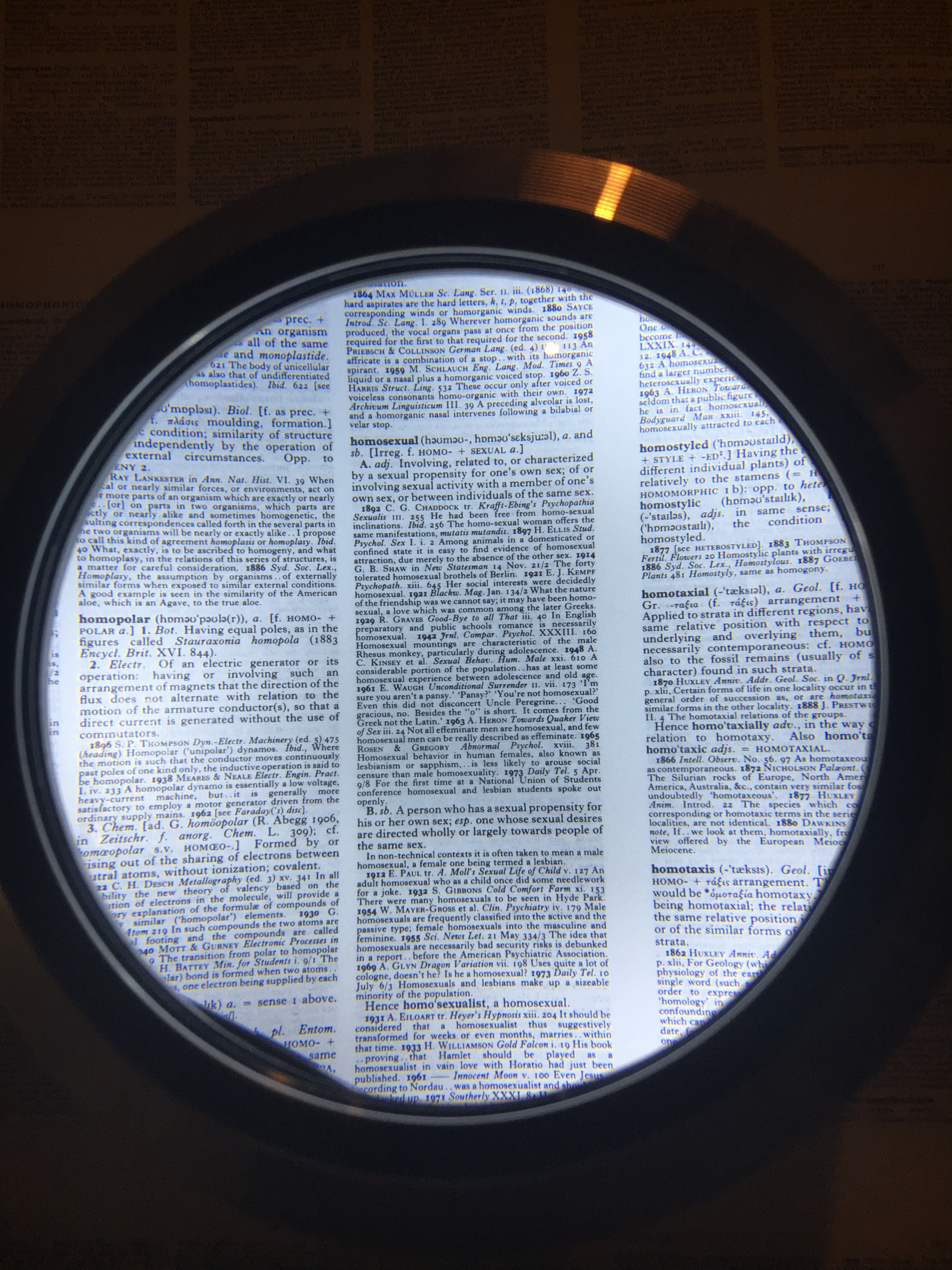
“…involving, related to, or characterized by a sexual propensity for one’s own sex; of or involving sexual activity with a member of one’s own sex, or between individuals of the same sex.” (Click to embiggen; I got a new self-lighting magnifier for my Compact Oxford—isn’t it neat?)It happened after a committee meeting for the Seattle Lesbian and Gay Chorus when we had devolved to chatting. I don’t remember exactly what was being discussed, but one of the women got upset when I used the word “gay” to refer to the entire community. “That excludes women,” she said, icily. I apologized and said I didn’t mean to do that, it was just fewer syllables and sometimes I just wished there were a shorter way to refer to everyone, and homosexual is so clinical. She interrupted, leaning in and getting much angrier. “Another word for men! Geeze, how can you do that?” When I protested that it was a clinical term originally coined to refer to both men and women she really got upset, insisting, “Homo means man! Yeah, yeah, it’s like mankind means everyone because men think they’re all the matters!”
At this point I was no longer feeling defensive, I was feeling angry. So I explained that while if one were speaking Latin, “homo” meant man, but the word wasn’t built from Latin roots, it was from Greek roots, and in Greek, homo means “the same” which is why the doctor who first coined the term picked it, as he had written about extensively that he was describing people who were attracted to and formed attachment to member of the same sex, in contrast to hetero which is greek for “other or different.” So “heterosexual” meant someone attracted to the other sex, while “homosexual” meant someone attracted to the same sex. Also, the doctor in question was himself non-heterosexual and spent much of his life trying to prove that homosexuality was not a mental illness.
Suffice it to say that she did not appreciate my lecture.
That was not the last time I got into that argument, by any means.
Other times when I’ve pointed out the difference between the Greek root and the Latin word which sounds the same, people have countered that “a lot of people think it means male!” To which I replied that a many people think the world is flat, but I’m not going to stop using the word “world” because some people are ignorant.
Don’t get me wrong—I understand that perception is important, but here’s the thing: if I point to a crowded room full of people of many different genders and say “they’re all homosexual” not one English speaking person in the whole world is going to think I’m only referring to the men. No one will be confused. Yes, a few of the women in the crowd may raise the same incorrect objection as the person in my first paragraph, and some bisexual or pansexual people in the crowd will make an equally incorrect objection (there is no portion of homosexual that means exclusively with one’s own gender, just that there is a propensity toward one’s own gender). I will grant that if there are any asexual people in the crowd they will have, linguistically, a valid bone to pick with my sweeping generalization.
The thing is, I don’t happen to like using the word homosexual because it sounds so clinical, and despite the word being coined by a pro-homo doctor, originally, it was quickly adopted by the parts of the medical establishment who insisted we were mentally ill or depraved. But I also don’t like using it to refer to the community because no matter how you slice it, it does exclude asexuals, as well as trans people who are also straight.
If I’m in a situation where queer isn’t accepted, I will sometimes punt to “non-heterosexual,” but that has the problem of defining us by what we aren’t, rather than what we are.
There are people who object to the term because it places emphasis on sex, while we often argue that the real issue is love. I have some small amount of sympathy for that line of reasoning, though it often digresses into rather sex-negative prudery. And while there is a difference between love and sex, for most non-asexuals, the two things are tangled together pretty tightly. I am attracted to other men. The initial attraction is, to be honest, about hormones and desire. For me, at least, love is a choice I make as I get to know a person. Yes, there are feelings and admiration and so forth, but I have feelings for lots of people who I don’t choose to commit myself to. I admire lots of people I don’t choose to commit myself to.
This attempt to separate the sex from sexual orientation also ignores another important reality: heterosexual relationships are just as much about sex as queer relationships are. Don’t believe me? What were the only legal arguments that anti-gay people had left by the time the case had reached the U.S. Supreme Court: that marriage was exclusively about reproduction, and that heterosexual people would never make the lifelong commitments necessary to raise the resultant children is legal marriage wasn’t reserved for straights (no, that argument makes no sense, and yes, that’s really what they wrote in their legal briefs!). Yes, the people who claim that we’re the perverts obsessed with sex argued that it was wrong to define marriage as a loving relationship geared toward mutual support (yes, that was also in their legal brief).
But I’ve digressed enough. The word “homosexual” does not simply refer to men, it comes from the Greek word homo meaning “the same.” Neither does the word refer to any exclusivity in that sexual orientation. Also, although hetero means “other or different,” neither heterosexual or homosexual linguistically imply only two genders. Heterosexual literally means sexual activity with someone of a different sex, not the opposite sex. So not only isn’t the word sexist, it also doesn’t deny the existence of genderfluid or intersex or third sex people.
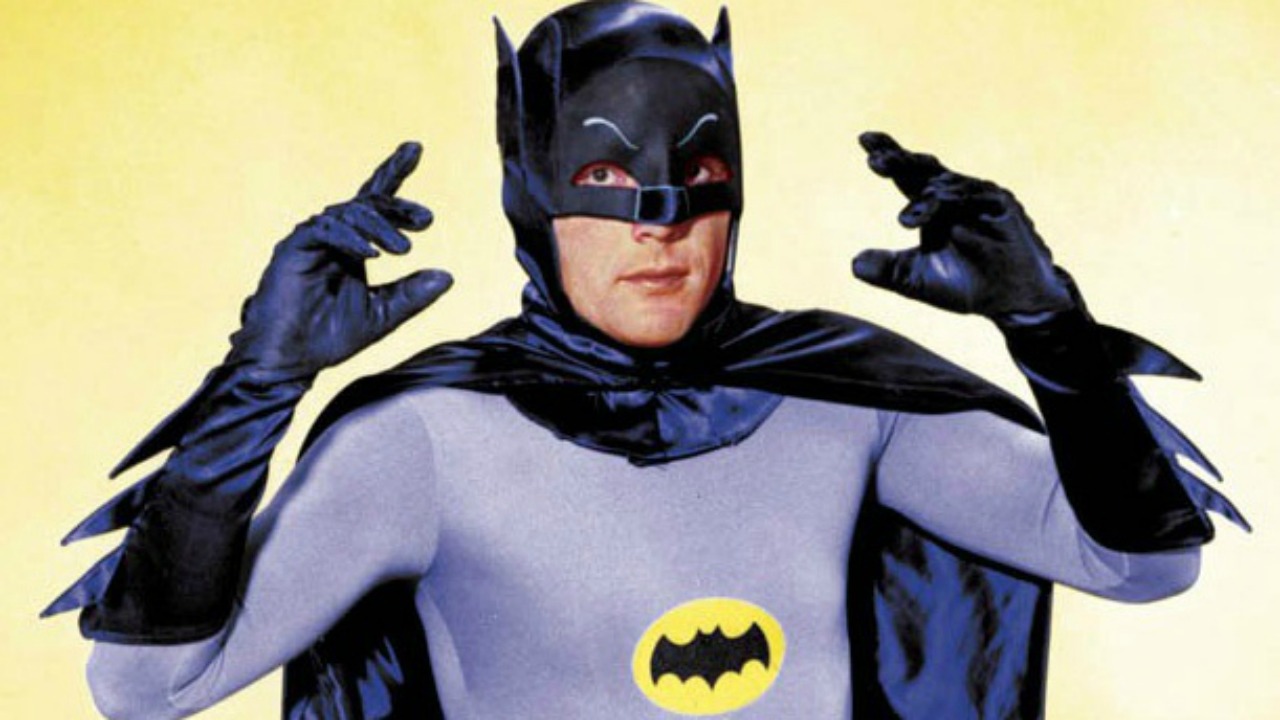
It has been said in many interviews, including by West himself, that the reason why he got the role among the actors who were screen tested for it was because he was the only one who could deliver the dialog with a straight face. The series’ incredible blockbuster success typecast West, making it difficult for him to get work, but he eventually embraced the role, eventually calling his version of the Caped Crusader the Bright Knight (as opposed to the Dark Knight of later incarnations).
And while I appreciate some of the other versions of Batman, five-year-old me looked up to West’s Batman as a hero who stood for justice and compassion, who was willing to risk everything for others, and always ready to answer the call. It was West’s commitment to the role that made that version of Batman real. You’ve answered your final bat-signal, Adam West. Rest in peace, and thank you.
When I set my goals for this year, I pledged to do monthly updates, since the years I’ve done that has resulted in better results than years I haven’t. The crazy wrinkle this year was that we knew that sometime after May 8th the new owners of the old building would give us a final move out notice, but that we couldn’t actually move until after Michael’s surgery and recovery was complete, which made it difficult to find a place to move to, since no one was willing to hold a place for more than a few weeks.
The last time I posted about the goals was at the end of March, when Michael was only a bit over a week into the recovery. My specific tasks for April were:
Pack and move!
Pack and move.
Squeeze some writing time in somehow.
Remember to have fun at NorWesCon (whether we attend the whole weekend or not).
Write at least two blog posts about things I like.
Once we finally had a lease signed in mid-April, that meant that my goals for the rest of April and all of May were:
Pack and move!
Move and unpack.
Clean out the old place.
Try to keep squeezing writing time in.
We’ve still got a lot of unpacking to do, but we’ve moved, so yay!
I got some writing in, but most of it was blogging. I did a lot of blog writing on the bus and during lunch at work. Having a slightly longer bus ride in (and being too far out to walk home, so I’m busing both ways) gives me a bit more time to write on the bus. Which is nice, though I’m finding it harder to get myself to write scenes on the phone than blog posts. I’m not sure why.
We didn’t attend NorWesCon, other than to show up at dinner time on Saturday evening, have dinner with our gang then run up to one of the hotel rooms to watch Doctor Who. But it was a great break during the first weekend that we were actually moving into a place, rather than packing and trying to find a place.
I’ve already written more about the packing, moving, hauling, cleaning, and so on than anyone cares to read, so let’s move on.
The big goals remain, though this is probably a good time to revisit them.
Don’t get mad, get busy. My tasks are: write about things I love; listen to music and audiobooks more and podcasts less; spend at least half of my lunch break writing; set specific monthly writing/editing goals in each check-in; write at least one blog post a month about organizations we can donate to that are fighting the good fight.
Reduce, pack, and prioritize. Now you might think this big goal could be marked “done” for the year, since we’ve moved, but it just needs to be rephrased: Unpack, reduce, and prioritize. We tried to purge a lot of things during the packing, but as we unpack we keep finding things that we realize should have been pitched rather than packed. And though the new place is a couple hundred square feet bigger than the old, we have a lot less storage. So, a lot of work to do here, still.
Take care of us. It’s important to remember to take rests, not to let ourselves stress about things, and so on.
Submit and publish. Initial task was to organize how I’m going to find calls for submission and set reasonable targets for the novel revision/finalization. I have thus far totally failed to get organized regarding submissions. Nearly half the year is gone and I’ve only submitted to two places. I have consolidated all of my notes for the revisions, and now that we’ve moved I can get back to that.
So June is going to be a reset month, now that the big disruption is over. My specific tasks for the month are:
Get back into the rhythm of editing the novel.
Write at least two blog posts about things I like, rather than rants or commentaries.
Get the iris bulbs, monitors, and other things that we want to give away handed off to people who said they wanted them.
Go through the rest of the Christmas decoration bins and finish that purge.




 Font Folly