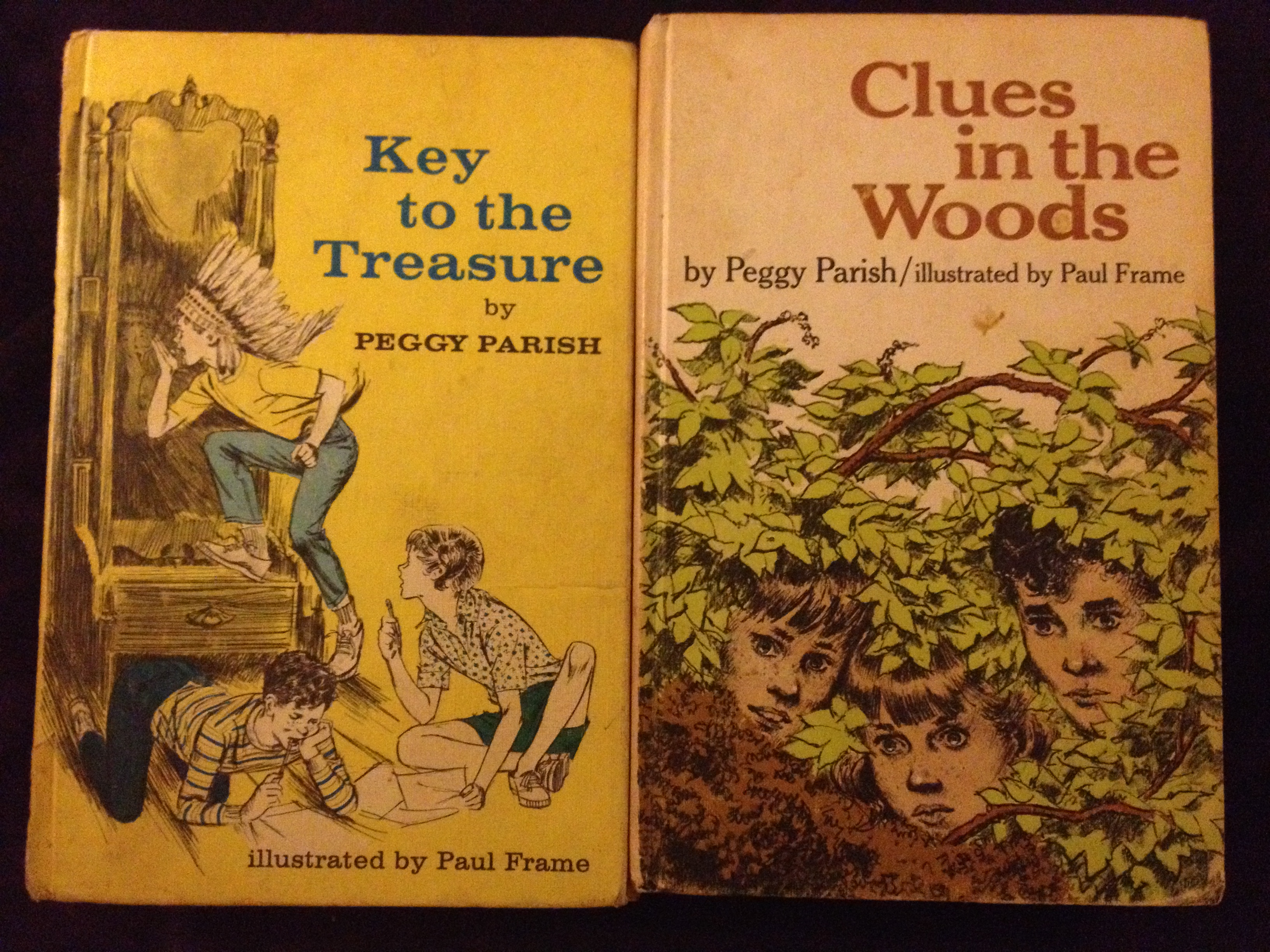
I think I was in third grade when I received my copies of Key to the Treasure, and its sequel, Clues in the Woods. The books, by Peggy Parish with illustrations by Paul Frame, were a pair of mysteries starring three siblings, Liza, Bill, and Jeb.
My old copies of these books are battered, but each still in one piece. (Click to embiggen)My copies bear the Weekly Reader Book Club imprint. I remember reading and re-reading them many times as a kid.
I also remember, a few years later, finding another book in the series in a library. Turns out Parish wrote a total of six books in this particular series. From the descriptions of the plots, I think the book I found in the library was Pirate Island Adventure, which is actually the fourth book in the series. I remember being really disappointed by the book, primarily because the mystery solved in that book is nearly identical to the mystery in the first book.
It was probably also disappointing because the books seem clearly aimed at kids aged about 8 and under, and I was probably 11 or 12 when I found my third.
The books are currently out of print, so while I’m tempted to order the four volumes I don’t own, my choices are to spend either hundreds of dollars for old copies in “new condition,” or more reasonable prices for battered used copies.
Parish is, apparently, more famous for the Amelia Bedelia series, which I’d never heard of until I tried to track down information on these other books just this weekend.
I’ve re-read Key to the Treasure a few times as an adult (yes, including once this weekend). It doesn’t hold up too badly. The portrayal of the elderly Native America woman who had left a collection of “Indian artifacts” to the grandfather of the protagonist’s grandfather is a bit cringe worthy. And the artifacts themselves, representing a mish-mash of tribes—including the famous Gilligan’s Island Tropical Witch Doctor Tribe—is a bit more than cringe-worthy.
The dialog is a bit stilted, giving me flashbacks to my 1928 edition of a Hardy Boy’s mystery where the boys get scolded by their aunt because they got their ties messed up running home from school. Not sounding like the way real kids talked, even in 1966 when the first book was printed, but more like certain people thought children’s books should sound back then.
But I still enjoyed it. And even though I’ve read it a zillion times, enough years have passed since the last reading that I wasn’t certain how they were going to solve the puzzle. So at its heart the story still works.
And it passed the Lewis test. C.S. Lewis once said, “A children’s story that can only be enjoyed by children is not a good children’s story in the slightest.”
Technically, this one probably ought to be titled “Why I hate MY hay fever, reason #7” or something.
Because my overeager immune system reacts to apparently every pollen, every spore, and every mold it encounters, and because I live in the Pacific Northwest on the west side of the Cascade Mountains (where winter mostly consists of lots of rain with the temperature only occasionally flirting with freezing), I have mild-to-horrid hay fever symptoms for a minimum of ten months out of the year.
And the variation from mild to horrid and back again is not predictable. Sometimes the pollen count goes down, but the symptoms get worse, for instance.
This particular reason is a consequence of all those aforementioned things:
I can’t tell the difference between the first few days of a cold or flu and just waking up on a given day.
So, Wednesday night/Thursday morning I didn’t sleep well. It wasn’t a night of tossing and turning, staring at the clock, wishing that I could fall asleep. I slept. I just woke up about every 40 minutes or so for no discernible reason. It wasn’t until the second alarm went off in the morning and I dragged myself to the bathroom that I realized that I was too fuzzy headed to actually attempt to do any work. So I called in sick, took some Nyquil, and stumbled back to bed.
Even then, I was taking the Nyquil because it felt like a worse-than-usual hay fever day and I hoped the Nyquil would make me sleep for real for a few hours. I didn’t take it because I thought I was sick. It just felt like a slightly worse than usual hay fever morning.
I vaguely remember Michael saying he was leaving for work. I blinked. I rolled over, and saw that more than six hours had passed.
I felt better only insofar as my brain was capable of thinking in whole paragraphs, rather than just simple sentences. My head, sinuses, and throat all still hurt. But it was, still, only at the “worse than usual hay fever day” stage.
I logged in remotely to work and took care of a few urgent issues. I ordered pizza for dinner, chatted with Michael, and so on. It continued to just feel like a worse than usual hay fever day, though with added time disorientation because I’d slept most of the day. I went to bed early, this time taking Nyquil before hand.
Friday I woke up still feeling like a worse than usual hay fever day. Friday is my usual work from home day, so I slept in a little as usual. The only real difference from a usual work from home day was that I took non-drowsy cold tablets.
Friday night, after we got home from dinner, Michael crashed because he was feeling worn out. But he often does that on Fridays, particularly during hot and hottish weather, because he works all week in a warehouse.
In the wee hours of Saturday morning, Michael woke me up. It wasn’t intentional, he was just feeling extra cold and trying to get the blankets that had bunched up under me. He muttered something about thinking he had a fever. My thought at the time was, “Darn! I’ll have to drive to our friend, Sheryl’s place, without Michael.” And I conked out.
Hours later, when I shuffled to the bathroom, I slowly became aware that my aching sinuses, headache, ringing ears, sore throat, and queasy stomach were not all hay fever symptoms. And the house felt cold, even though the thermometer said it wasn’t.
I thought back about when I last took any medicine that had acetaminophen or something else that would mask a fever. It had been about ten hours, so I got out a thermometer.
Fever. Not a high one, but higher than my typical low-grade fever.
Yuck.
So I called to beg off on Writer’s Night (we weren’t hosting this month). I made some breakfast. Checked on Michael, then spent a few hours trying to work up the energy to go to the store to get soup and juice and general groceries.
I only had three dizzy-ish spells in the store.
The hardest part was putting the groceries away when I got home. I really just wanted to collapse.
I sat down, intending to just rest a bit before calling to cancel gaming tomorrow.
I conked out for almost four hours.
And that pretty much brings us to now.
I don’t have a fever any more. Throat and tummy are no longer being icky. My ears are back to their normal level of tinitus. My sinuses and head still hurt more than a typical hay fever day.
But I have developed a mild cough.
Yuck.
Not that I would have necessarily done much differently if I had realized Thursday that this wasn’t just hay fever. But it’s still irritating to realize I was probably sick for two days before I knew it.
Before Twitter, I used to collect interesting links to news and news-ish things that I read over the course of the week, and then post them in a list on my old LiveJournal on Fridays. I called it “Friday Links.”
When I left my old job and switched to contracting, I had less freedom regarding what I could do during my lunch break. So, I got out of the habit. And people drifted away from LiveJournal. A few of us diehards still poke around there, but most of the folks who used to regularly read me there have gone elsewhere.
Now, I use my iPad to read news during my lunch break, and it’s easy to just tap and send the links to Twitter. Which isn’t quite the same.
I miss doing it. A few people who used to regularly read the old blog have mentioned that they miss my Friday Links.
The Wizard of Ahhhhs: note that the song is entirely a cappella. Great retelling of the movie:
And if you need some cute in your life, check out this youtube from winter before last at the Seattle Aquarium of a mama sea otter, Aniak, and her pup, Sekiu, when Sekiu was only one day old:
When we’re kids, we have little understanding of age. We understand that some kids are older than us, and some younger. We understand that adults get to do what they want and tell us what to do. We understand that some people are old. But exactly what all those mean is very vague.
And we want simple categories. A teen-ager is anyone aged 13 through 19, right? First graders are 5 or 6, right? So how old is a parent? How old are grandparents?
I was the oldest child in my family, and my parents were teen-agers when they married. My paternal grandparents had been 20 & 18 when they married, and my dad was their oldest, as well. My mom’s parents married similarly young, and while she was their second child, they were still quite young when she was born. That’s one reason most of my great-grandparents were around as active, alert adults throughout my childhood and teens.
My middle school basketball coach had been one of my dad’s high school buddies. His oldest son was in the same grade as I was. My middle school wrestling coach, on the other hand, had been my dad’s high school wrestling coach. Yet, his oldest son was only one grade ahead of me in school.
When you’re in middle school, you understand that adults can keep having children into their 30s and 40s. You can understand that the coach’s son who was only a year older than me had two sisters, both more than 10 years older than he was, and therefore coach could be both the parent of a middleschooler and the grandparent of one or more small children at the same time. But when you’re younger, the notion that parents can be a wide variety of ages isn’t even on your radar.
I had an example closer to home. My Mom’s baby brother (half-brother) is only three years older than me. So, one of my uncles was a senior in high school when I was a freshman in high school.
A friend of mine from college had a bad habit of hitting on high school girls. It was only a bit embarrassing when we were in college, because we weren’t that far out of high school ourselves. But when he kept doing it into his late twenties, it was getting more than a little disturbing.
But I don’t have much cause to talk. When Michael and I started dating, I was 37 and he was 27. He’s ten years younger than me, the same difference I was finding disturbing when my friend was lusting after those high school girls.
Obviously, a ten-year age difference isn’t that big of a deal when the younger person is indisputably an adult, or course.
One of my great-grandmothers was a 28-year-old widow with two small kids when she married my great-grandpa… who was only 16 years old at the time! Of course, that was nearly 100 years ago, and a 16-year-old who had been working as a ranch-hand full time for several years was not considered a child. And they stayed together for the rest of their lives, very happy together.
Then we have that much-abused term, “middle-aged.” It used to mean 50-ish, or more broadly 40-60. Men were expected to have their “mid life crisis” during the 40-60 time frame, for instance. It was sometimes defined as the third quarter of a typical lifespan. Medical and mental health people have started shifting the definition up, as life expectancy increased. I noticed a lot of people shifting it the other way, referring to anyone in their 30s as middle-aged.
I keep catching myself referring to one of the neighbors as a kid. He’s coming up on thirty, he and his girlfriend have lived together next door for more than five years. He works, pays his own bills, and is otherwise a fully functioning adult. He’s one of the most responsible people I know. When he and his girlfriend moved in, he just looked way too young to be getting his own apartment, so part of my brain pigeonholed him.
I don’t want to be that old guy who calls everyone “kid” or “son” and so on. I still feel weird when a stranger calls me “sir,” for goodness sake!
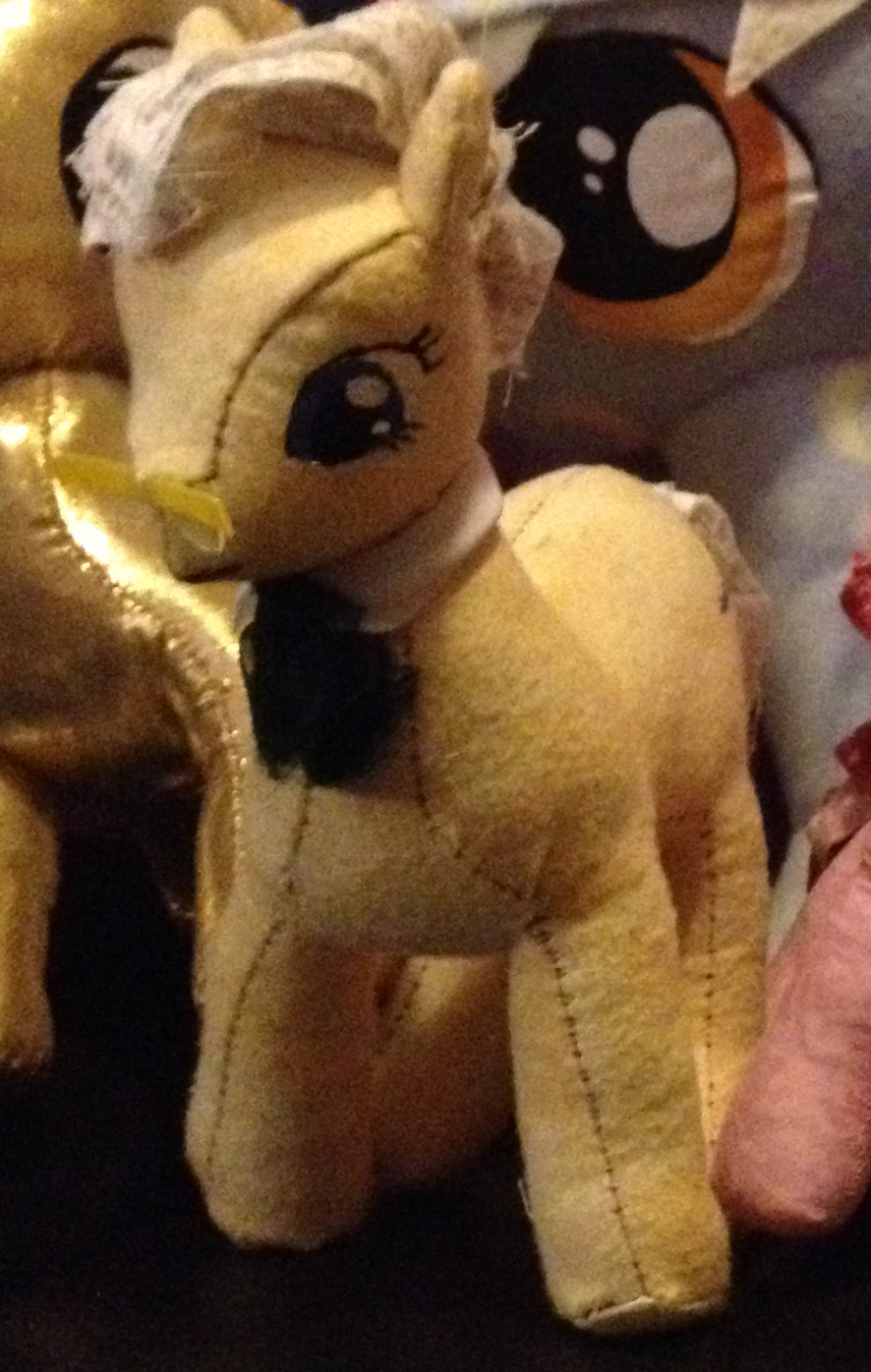
Gold Dust Applejack, from Equestria Rags.Yes, I’ve already posted a con report. Plus a couple of other blog posts related to the convention. But I always have more to say, and in this case there are some photos I still want to put up.
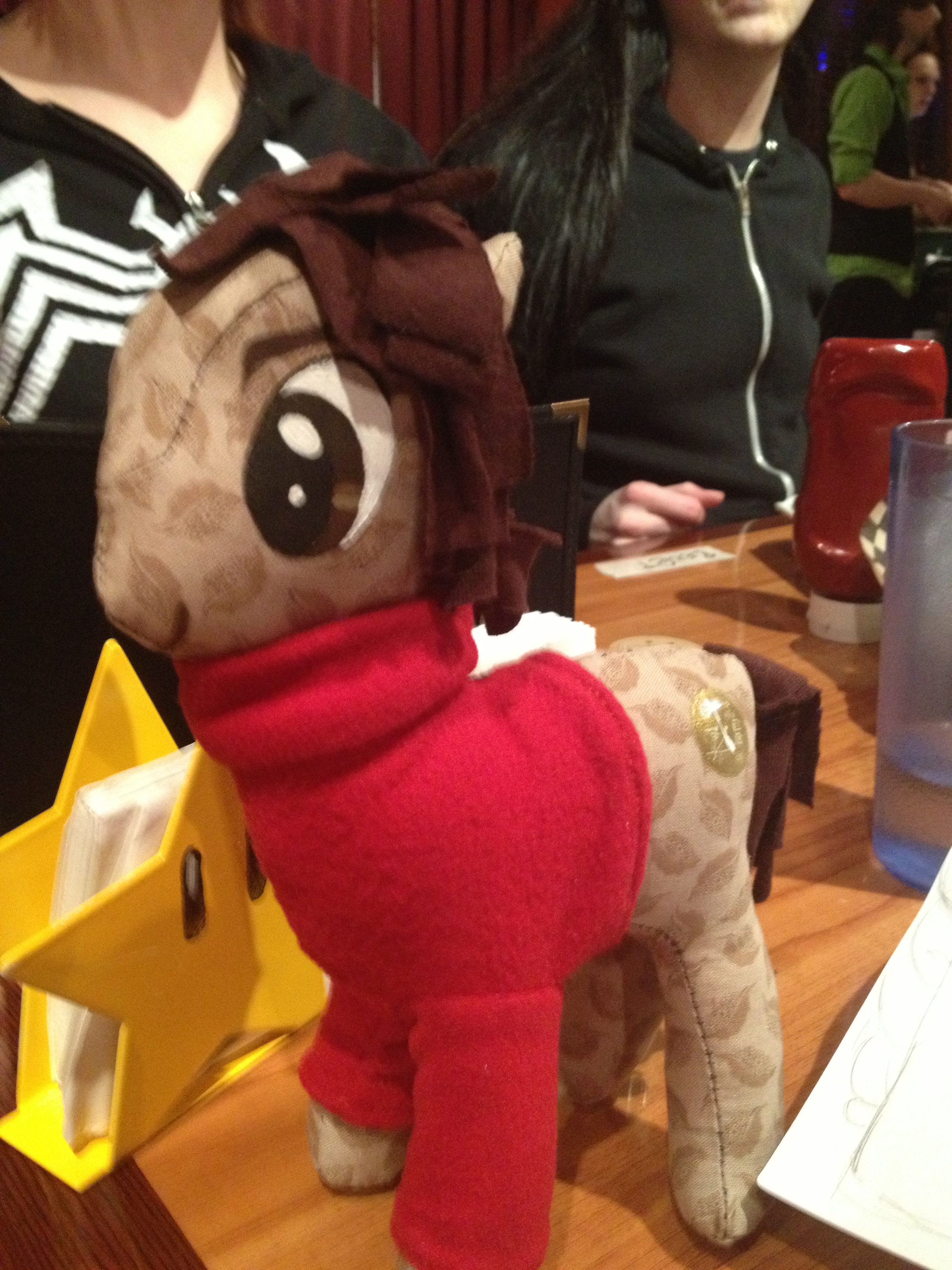
I’ve mentioned before my friend, Joi, who makes these fun rag doll ponies. She makes them from scraps. Her rules are that she only uses fabric from scrap bins, remainder piles, and thrift stores. So she finds fabric and says, “Oh, that would make an interesting Twilight Sparkle,” or what-have-you. She makes ponies based on characters in the series, or on original characters (by way of commission), and she makes ponies based on other things. I’ve seen her make a pony version of Carl Sagan, the classic Roman poet Virgil, Neil Gaiman’s Death, or the Mars Curiosity Rover. And she sells them online at Equestria Rags.
The Mayor Mare pony by Joi.The first pony I bought from her wasn’t for me. It was a pony version of Mayor Mare from the My Little Pony: Friendship is Magic series. I had to plead a bit, because it was one of her early models where she was still figuring out how to make ponies, so she hadn’t started selling them, yet, and hadn’t planned to offer it for sale. But I really wanted to give it as a present to my husband, and I talked her into it.
A pony version of Carl Sagan that Joi made for Jared for his birthday.We’ve bought more ponies since.
A few weeks before the convention, she posted pictures online of a new pony she had just finished: Applejack made from gold lamé-style fabric.
Of the characters on the show, Applejack is my favorite. Or most-favorite, since I’m the kind of person who always winds up with about five or forty favorite characters in any book or series that I get into. Anyway, of course I wanted to buy Applejack in shiny, shiny gold! Who wouldn’t?
But she was one of the ponies Joi was making explicitly for the convention. To be a successful vendor at any convention, you have to have a variety of stock. Since these are handmade (hand cut, hand stitched, hand painted, et cetera), each one is a serious investment in time. Since she makes them from scraps, that means it is very unlikely she’ll be able to make multiple ponies exactly the same.
I wanted that gold Applejack. But I also wanted her to have a successful sales experience at the con. So I had to wait until the convention to buy her, and technically I had to wait until the Dealer’s Room opened.
Squeaky Derpy was tempting me all day.I had planned to just stand in front of her table starting a few minutes before the room opened (since I would be inside setting up my own table), just waiting there with money to hand her. This was before we discovered that we were at adjacent tables. Because of where we were, getting in and out from behind our table meant climbing over other people, so it would have been a bit awkward. At the two minutes ’til ten a.m. mark, I asked her if she was going to make me go to the other side of the table. She laughed and said we could just do the exchange now.
So for the rest of the day I had my golden Applejack on my table as a second mascot and to show folks. I had to tell several people she wasn’t for sale, but that Joi had lots of other ponies right there, and she takes commissions.
While sitting at my table, getting some writing done and occasionally selling buttons and pony toys to people, I kept watching a cute version of Derpy Hooves (a supporting character from the cartoon series) that had a squeaker. The squeaky fruit bats and ponies that Joi had were very popular. People kept squeezing them to show their friends while deciding which one to buy. I had already abused my position as a Vendor to buy one of her ponies out from under customers. And she was selling well. I figure the more people who buy her things and tell their friends, the more business she’ll get online, right?
Ponies I’ve gotten from Joi: Bedtime Derpy in the back, then (l to r): Gold Dust Applejack, Mayor Mare, Pinkie Pie, Gift Applejack, and Squeaky Derpy.Michael and I also already own a lot of plushies: scores of teddy bears, tigers, otters, ponies, and so on. We didn’t really need more, right? But when I asked Michael in the evening whether it would be okay for me to buy another pony to take up room around the house, he said fine. So the second morning of the con, when I saw that Squeaky Derpy was still there, I asked if I could buy her. Which meant I had two Derpies as mascots on the table Saturday.
It’s an addiction, I know. But I ain’t going to rehab! (And these are just the ones I’ve acquired. My husband also has several!)
Anytime a group of geeks get together, they wind up exchanging tech support horror stories. Whether one has ever worked in a tech support type job or not, if you are a geek, there have been times when you’ve wound up helping a non-geek out of a bad situation which they created for themselves through ignorance of, ultimately, basic laws of physics.
For instance, on the bus this last week, a couple with a baby in a stroller got on in front of me. It was clear they were both bus newbies. They headed back looking for some empty seats, with space for the stroller.
This was a double-length bus, which means it is a normal bus pulling, essentially, a second bus’s worth of seats. The two pieces are joined in the center by the section that bends and flexes. The walls are accordian-style rubber, the floor consists of a round section which turns as the front half of the bus goes around the corner, then starts to straighten again as the second half follows it around the corner.
They put the baby and the carriage right on the flex. A place which, as soon as the bus took a right turn, would cease to exist temporarily. Anything in that space would be crushed between a row of seats in the front half, and a single seat mounted on the rotating part of the floor.
Crushed.
So I quickly told them that that was the part of the bus that flexed, and it was not a good place to put a child. They moved back to a different spot.
A lot of people think of geeks as computer techs, but being a geek is about being fascinated with how things work. Whether it’s the mechanics of how a pair of connected vehicles behave going around a curve, or the physics of moving a heavy weight up on incline, or how electronic devices communicate with each other, it’s all a subset of “How does it work?”
In my early days in the tech industry, I worked at a small start up. My official title was a vague Coordinator position, what I actually did was supervise the production and shipping department, write and design all the technical documentation, test some of the hardware and software, help the less tech-savvy employees with computer problems, and then fill in anywhere else as needed. Which included one day a week taking tech support calls from customers while the tech support department had their weekly meeting and training session.
We produced voice messaging/auto attendent systems back at a time when most offices still had typewriters rather than desktop computers. Our systems, which ran on a dedicated desktop computer running DOS (this was years before Windows existed), would connect to a small-to-medium company’s internal phone system in various ways. And we had a lot of tech support horror stories from our customers.
There was the customer who kept turning off the “fan box” because he didn’t think the room was too hot, and couldn’t figure out why the system stopped working. He kept forgetting that the biege-colored metal box that the “TV thing” sat on was the actual computer. And I hasten to explain that this guy was president of a company with a few hundred employees. He wasn’t the employee in charge of the equipment, he just had this bad habit of wandering around in the evening after most of his employees had left for the day, turning things off to save electricity.
But one of my favorites is about fundamental physics, though it didn’t seem like it at first.
A lot of those phone systems back then (and a lot today, because a lot of those medium-office size switches are simple enough electronic systems that they work just fine decades later) use a couple of serial (RS-232) ports for programming and data exchange. You’d plug dozens or more standard phone lines in to connect all the phones, but for other things you’d use the data port. They were originally designed for someone to hook up a dumb terminal or teletype to program and monitor the phone system, because this was back when what laptops did exist often cost more than a relatively new car.
Our system could connect to those ports as well as a couple of phone ports to do all the call transferring and message taking and so forth. But often it wasn’t convenient or even possible to set up the computer running our software right next to the switch. So we recommended a particular 100-foot long RS-232 cable in case the systems had to be really far apart and you needed to run the cable around something.
The one we recommended had really good, clean signal because the individual wires were thicker than in cheap cables (wider diameter wire means lower resistance to electrical signal, for one thing), with really thick, durable insulation, so the cable wouldn’t be ruined simply by being stepped on a few times.
We strongly suggested that the systems be set up as close together as they could and to use a shorter cable, just because it was easier.
We had an experienced dealer who had sold one of our systems in a larger office with one of these systems that needed the serial connector, and they had ordered one of the 100-foot cables, because they thought they would need it. They set everything up, but when they were testing the system, things weren’t working right, and it was doing it in an inconsistent way.
The cable used had 25-pin connectors, whereas the phone system used 9-pin, but adaptors for that were usually reliable. The computer had one of each type, for a while we thought they had enabled the wrong port on the computer. Ports were tested, software was re-installed, the whole configuration process was gone through step-by-step. They finally decided that the cable was the problem, because they could make everything work with an 8-foot cable they happened to have, but the shorter cable was stretched tight across the room, right where people needed to walk, so they couldn’t use that one.
Because we had sold them the long cable, we wound up sending them a new one.
A different dealer technician went back to the site with the new cable a few days later. He walked into the room, and immediately knew what the problem was.
Whereas the 8-foot cable had been too short, the 100-foot cable was too long. So when they had installed the system, the other technician had carefully coiled up the extra 50-feet of cable, secured the coil with twist ties, and set the coiled middle part of the cable on a very large, humming box that was midway between the two system.
The very large box had “Danger! High Voltage!” labels on all sides. It was a big transformer for power for the entire building. And the technician had set a multiple-wound cable that was supposed to be carrying a low-voltage data signal, right on top of it.
For those that don’t know: a large electrical device such as a transformer will generate a cycling magnetic field. If you move a metal coil through a magnetic field, the field will induce electrical currents into the coil. If you place a stationary coil into a cycling magnetic field, the same thing happens.
Setting the coiled excess cable on the transformer sent an extra current into the cable, messing up the signal.
It would be like two people were trying to have a quiet, complex conversation, while four rock bands and a jet engine are pumping out all the noise the can, right on top of them.
I understand after the tech explained it, they then had to explain that, no, you couldn’t just open the transformer and remove the magnets, because there weren’t any magnets. The magnetic field is generated by the electricity. “But I thought you said the magnets made electricity?” Which apparently turned into something resembling the old Who’s On First Routine.
I’m queer. I end up writing a lot about LGBT issues because:
I’m gay;
society is still pretty messed up in how it deals with lesbian, gay, bisexual, trans, and otherwise queer people;
many parts of society are becoming less biased about all of that, so there is frequently cool news to share about that;
and the parts of society that aren’t feel threatened by all this change and are going to ever more ridiculous efforts to make us go away, which also generates news items worth sharing (or ranting) about.
I’m a nerd. I write slightly less frequently about fantasy, science fiction, and related subjects. But a rather larger portion of my life is involved in pursuing various forms of the fantastic than everything else. It forms another of my tribes. Or a loose confederacy of a bunch of related tribes. Or something.
I’m a geek. I majored in mathematics in university, and took some classes that were supposed to be only for engineering and physics majors. I work with computers. I was a LAN administrator back when most companies didn’t have IT departments, I have racked and stacked, I’m reasonably fluent at the command line of UNIX and Linux systems, I’ve done a bit of programming, I design interfaces, and I routinely figure out (and by figure out, I mean digging into configuration files and scripts and sometimes compiled components and making the software do stuff they don’t tell you it can do) large complicated software systems without consulting manuals.
I’m a writer. By avocation I’m a storyteller. I’ve been lucky enough that my day job has been about writing/creating/designing documentation for a quarter of a century now. I’m at a point in my career where I do a lot more information architecture than actual typing of words, but it’s all about telling someone about something and how to use it. At home I write fantasy, science fiction, and mysteries. Sometimes I get them published. Sometimes I publish them myself.
I make art. I’m not great at drawing or painting, though I do both. I am pretty good at designing books and book covers. I’m inordinately fond of fonts. I sing, I compose music, I play some instruments. I assemble unrelated bits and pieces into weird wholes which some people find interesting.
I’m a collector:
Books
Dictionaries
Dice
Plushies
Gadgets
Pencils
Encyclopdias
Music
Tigers
Toys
T-shirts
Otters
Reference books
Sketchbooks
Ponies
Movies
I love purple. Of all the tribes to which I belong, the purple tribe is perhaps the hardest to explain to non-members. It isn’t just about the color, but purple is everything.
I believe. I believe that the universe makes sense on a fundamental level, even though it is also deeply weird and fuzzy. I believe in the power of mathematics, which is just a way of saying that I believe in the power of thinking, because mathematics is simply an extremely formalized way of applying our thinking processes. I believe that people are capable of breathtakingly beautiful acts of love and kindness. I believe that there are absolute matters of right and wrong, but an infinite variety of mitigation; and by absolute I do mean absolute—morality doesn’t come from a divine being, if divine beings exist he/she/they are subject to morality and just as capable as we are of screwing up.
Even though I pay almost all of my bills online, I have so far resisted the offers of the various services and agencies I have to send regular payments to to go “paperless.” Getting the bill in the mail reminds me to set up the payment. And given the unpredictability of email spam filters, I’m just a little nervous about relying on email notifications solely for my mail.
Before you start composing a comment telling me how to add an address or a domain to a whitelist, let me remind you that first, I’m a tech writer in the telecommunications industry—I have been part of the development team for products that process email; I understand about whitelists, I do.
The problem is that sometimes someone at an upstream provider will change the way a filter works. Or the company sending me the notification may make a change in the way emails are sent. And sometimes spam filters are just glitchy. I just recently had an incident where three messages were sent to me within a few days from the same sender to my account. The middle of the three was snagged by the spam filter, which made the third message a bit confusing. When I found the missing message and compared the header information in it to the two that got through, they were all identical.
So, for now, I’m sticking to paper for bills.
It seems, however, as more and more of us do most of our communicating on line, that the junk mail people are sending out twice as much junk mail, hoping somehow to get our attention. And they are going to greater lengths to make the junk mail look like something other than what it is. “Official documents enclosed” or “Response required by (date)”
There has always been some junk mail like that, but it seems to be getting worse.
And then there is the not-quite-junk-mail. I contribute to a number of causes. I’m a bit random about it. Each month after I set up all the payments for the bills coming due, I’ll ask myself, “Who haven’t I give a donation to in a while?” And so I’ll log into the web pages of a couple of these causes and make a small donation.
During election years I wind up throwing a lot of these donations to either candidates who have done something I think justifies my support, as well as a few of the more general party organizations. I’ve been doing this for years, and have gotten used to receiving mail from all of these organization asking for a new donation on a regular basis.
I’ve noticed that at least two of the party-affliated committees have begun to send out requests for donations with phrases such as “Second Notice” and “Final Notice” printed in red, which makes one think it’s an overdue bill.
But it isn’t an overdue bill. They have set themselves an arbitrary target by an arbitrary or semi-arbitrary deadline, and the previous month’s plea for a donation said something about, “Help us achieve the important goal of raising $XXX,XXX before the next filing deadline!” And if you haven’t sent in any money, then you get this so-called “second notice” saying, “We told you how important this deadline is, but we haven’t heard from you!”
It’s a donation! One of the ways that donations differ from bills is that a donation doesn’t have a deadline. A donation is voluntary. A bill is an obligation. I signed up for some service (electricity, cell phone, internet, what have you) and agreed to pay an amount on a monthly basis. There is a deadline because it is an obligation. If I don’t pay the obligation when agreed, then certain penalties will apply, possibly including having the service turned off.
But if I don’t meet this wholly made-up deadline for your fundraising goals, I’m not skipping out an an obligation. I have no obligation to donate.
Oh, the many reasons one continues to march in Pride Parades after that first exhilarating time…
One reason I marched in so many parades was because I was a founding member of the (now defunct) Seattle Lesbian and Gay Chorus. Every year we marched together with our banner. Some years we had candy to hand out. Some years we had fliers. Some years we just waved. People always shouted at us to sing, but you can’t do big choral singing in the middle of a loud street. If you try, no one can hear you over the ambient noise unless you scream. You can’t hear each other well enough to stay in key or in rhythm. We tried, a few times, to get a good mobile sound system to play recordings of us singing, but that doesn’t work well, either.
So one reason I was there in the parade year after year was to march with my fellow choristers. To show people we were there, maybe get a few more people coming to our concerts. Maybe find a few new recruits. It was always a fun group to march with.
I was also there for the same reason I marched the first time. Saying to the world that I’m here, I won’t be invisible, I’m not going away.
I was there to see all the people standing on the sidewalk. Some in couples. Some in family groups. Some were there specifically waiting to cheer for a friend, family member, or significant other who was marching with one of the groups. Some were just there to cheer everyone. Some of the folks watching together had gone to more trouble dressing up than some of the people marching. There always seemed to be at least one group like that watching from a big balcony or deck overlooking some part of the parade route.
I was there, yes, so that I’d have the satisfaction each year of either glaring at or blowing kisses at that one guy who was always there at one corner with his big sign with a bible verse on it telling us how much he thought god hated us all. I never yelled at him. One year, Ray and I stopped right in front of him, french kissed, then turned and blew kisses to him. Ray kept turning around, waving, and making yoo-hoo sounds as our group marched on. Which was hardly original, but it was fun. I don’t know if it was literally the same guy year after year. It seemed like it was. He always seemed to be alone. He was very grim-faced but always silent. At least when I saw him. I like to imagine that he eventually came out, got some therapy, and settled down with a nice leather daddy in Palm Springs.
I marched to smile and wave at the people watching. To accept the applause and return it. “Hey! We all made it another year!”
I marched to show that we’re not all cute fashion-conscious young men—some of us are chubby, grey-bearded, sci fi nerds in t-shirts and tacky Hawaiian shirts.
I marched for the friends and loved ones who are no longer with us: for Ray, who promised to stay with me for the rest of his life, who loved Disney movies and old books, who danced with an abandon I envied, who even made jokes about the chemo, and whose last words on this earth were “I love you” spoken to me; for Jim, a friend from high school who didn’t come out of the closet until he was dying of AIDS, and I don’t think ever marched at Pride; for Chet, a cousin who was sent away when he came out, who vanished for years until one day his mother got a call from a hospice, and whose immediate family continued to reject him even refusing list his name in his grandfather’s (my great-uncle) obituary; for Stacy who sang like a TV version of an opera singer and loved a good joke; for Frank who didn’t sing so well, but never missed a rehearsal; for Mikey who was as tall as a pro basketball player but would rather play Dungeons and Dragons; for Scott, who was so sure that if we prayed harder we’d both turn straight, but died in a car accident before graduation; for Kerry who was always defensive about his Vespa; for David who played even the impossible accompaniments written by Mr M and made the piano dance; for Tim who sang like an angel and loved David so much it took your breath away when you caught him smiling in David’s direction; for Todd who was diagnosed with the disorder that would become AIDS before it had a name, who made the most morbid jokes about the disease, and never allowed anyone but his partner see him cry each time he saw another funeral notice for someone he knew; for Phil who was kicked out by his parents before graduation, but put himself through college despite them; for the other Todd who moved in with one boyfriend after the next, never able to keep a relationship going for more than a couple of months until he met Jack; for Glen who had problems with labels; for Mike who had problems with middle C… and for so many others who I only knew briefly.
Because for years I was deathly afraid that people would guess. I was certain that, if people knew I was gay, that everyone would despise me. Why would anyone want to be friends with, let alone love, such a freak?
The earliest moment I remember feeling that fear was when I was four (yes, four!). I didn’t even know there were words for what I was. I had made a linguistic error, referring to two neighbor boys my age as my “boyfriends.” At that point, I thought that the word “girlfriend” meant a friend who was a girl, and “boyfriend” was a friend who was a boy. But my use of that word sent my grandmother into a tizzy, explaining to me that I must never, ever use that word. And as she explained, so emphatically that it scared the bejesus out of me, that boys would occasionally have girlfriends, and then eventually would find the one special girl that they would spend the rest of their life with, but would never, ever have those kinds of special feelings for boys, that was when I first realized that there was something wrong with me.
Later, after getting teased at school for being a “sissy,” or because I “threw like a girl,” I started to form a better picture of what that difference was.
For years, whenever my dad was angry to the point of beating me with something clublike (as opposed to just slapping, punching, and generally knocking around), he hurled the word “c*cksucker” at me repeatedly. That’s the word I remember most when I think about the time he broke my collarbone (I was ten), for instance. I didn’t know what that word meant until I was eleven. But that simply solidified everything I had already gleaned from the notion that every bully, harasser, and teaser at school, the park, or Sunday school had already made clear: boys like me were horrible, unloveable, detestable creatures.
So I did everything I could to hide it.
When puberty hit, a few months before my twelfth birthday, any doubt that I had about why all those words kept being hurled at me was gone. I threw myself into every church activity I could, because I thought if I just worked hard enough for him, surely god would eventually stop ignoring my years of tearful praying to make the feelings go away.
I honestly can’t say which motivated me more to try so many sports in middle school: trying to find a way to appease Dad, or trying to find a way to become a “real boy” to appease the bullies.
By my late teens I had finally realized that words like faggot, pussy, queer, homo, and so forth were hurled at any guy that someone meant to demean. It didn’t always mean that they thought you were literally homosexual, it was just that that was the most dehumanizing, detestable thing they could think to accuse you of being.
But because that was the most horrible thing someone could call you, it just amped the terror of what might happen if anyone realized that I actually was gay.
Even when I stopped believing that I was going to hell for feeling this way, the terror didn’t leave. Because what was really scary was the certainty that everyone I cared for would abandon me. Even when, after applying logic and ethical analysis to the abstract concept of sexual orientation, I came to the conclusion that there wasn’t anything inherently wrong with any two consenting adults choosing to love each other, I still feared that abandonment.
It took a few more years of being closeted, being extremely careful about who I let know that I wasn’t heterosexual. A few more years of telling even those few people that I was bi—it wasn’t that I was lying so much as trying really hard to convince myself. Because somehow being bisexual meant I was only half a freak, or something. A few more years of furtive attempts at having relationships with guys (and trying to do that while constantly fearing someone who wouldn’t understand might see is dreadful enough on its own, let alone all the other problems inherent with the inexperienced trying to figure out relationships)—before I was finally ready to stop hiding.
I marched because I finally realized that the sorts of people who would abandon you weren’t worth having as friends. I finally realized that my worth wasn’t dependent on their approval. I finally realized that if they had a problem with me being gay, that it was their problem, and not mine.
I marched because I was tired of hiding. I marched because I was tired of trying to be invisible. I marched because I was tired of all the people trying to make me invisible or urging me to keep it to myself.
I marched because I was ready grab the world by its metaphorical lapels, give it a shake, and say, “Hey! I’m standing right here!”



 Font Folly