Tag Archives: science

Weekend Update 8/5/2017: Let’s stick with happy stuff

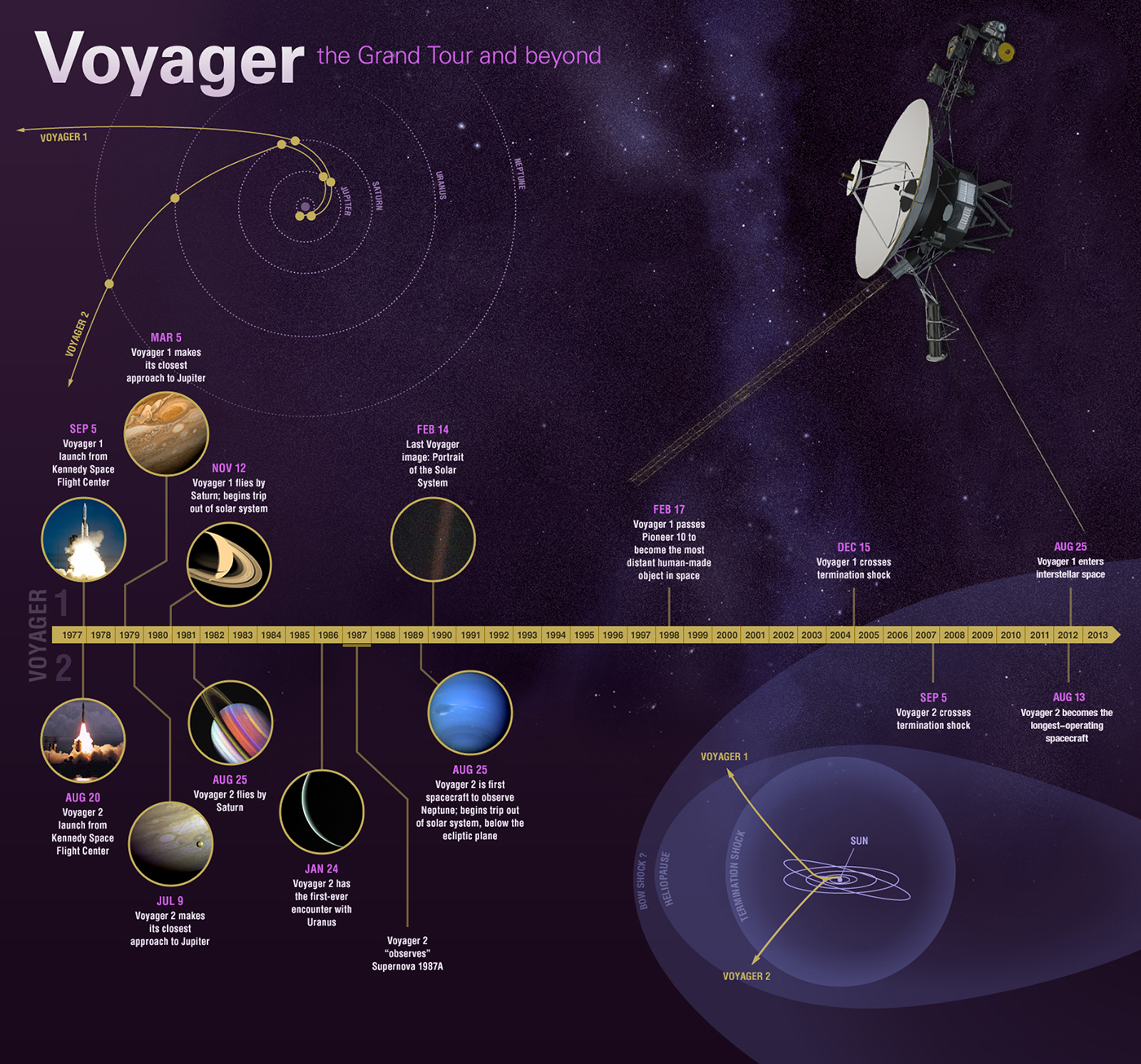
Voyager: The Grand Tour and Beyond. Image © NASA
Voyager: The Grand Tour and Beyond. Image © NASA Planetary Science Division
As often happens, several interesting bits of news that I would have included in my weekly round up of links if I had seen them before Thursday night have turned up. And some of them are things I could write a bit of a rant on, but I’m just not in the mood to rant or be outraged. We can find bad or disturbing or worrisome news everywhere. So I will just save that for next week, okay?

I really wish I’d seen this story before I did this week’s Friday Links, because it would be a great candidate for Link of the Week: The Loyal Engineers Steering NASA’s Voyager Probes Across the Universe. “As the Voyager mission is winding down, so, too, are the careers of the aging explorers who expanded our sense of home in the galaxy.” It’s bittersweet to think about: two devices built in the 70s that can only understand a programming language that has been considered obsolete for decades, billions of miles away, but parts of them are still functioning and sending their data back. It’s just a really good story. You should go read it. I’ll just point out that Voyager 1 launched just 20 days before my 17th birthday.

In much less serious news, this story (and the adorable video that accompanies it) is just funny: Gay Dads Obsess Over Baby’s First Haircut In Adorable Diaper Ad. Go, watch. Have a chuckle.

And then, in case you need some heartwarming family friendly goodness: In a Heartbeat – Animated Short Film:

(If embedding doesn’t work, click here.)

The learn more about this short film: YouTube Falls Hard for ‘In a Heartbeat,’ a Boy-Meets-Boy Story.

Dumb arguments against legal protections for transgender people, part 5

www.glaad.org/publications/debunking-the-bathroom-bill-myth
http://www.glaad.org/publications/debunking-the-bathroom-bill-myth
So-called “bathroom bills” are getting passed by cities, counties, and states lately, and it feels as if most of the queer community isn’t noticing. A lot of them are still tied up in various state legislatures, and since some of the misleadingly-named religious liberty laws have been killed once big companies threatened to take their businesses out of said states, it’s possible that a lot of queer folks just assume the same thing is going to happen with them.

At least I hope that’s what’s happening. I hope that it’s merely a lot of folks still feeling giddy about the Supreme Court ruling legalizing marriage equality nationwide thinking that the big battle is won and queer people are equal, now. We won one big battle, but there’s still a long way to go. I hope, I sincerely hope, that it is not true (as some fear) that a substantial portion of the queer population doesn’t think that trans issues matter.

Because we really do seem to be letting the haters say whatever lies they want about trans people, and a lot of the media just repeats that factually incorrect information as if it is true.

Over at Holy Bullies and Headless Monsters, Alvin Erwin has been beating the drum about our complacency: ‘Lgbts want to harm children’ – the lie the community won’t kill, and Mothers of the transgender community speak out against the hateto give a couple of examples. I’ve been beginning to think he’s right, that we’ve given up on the fight because we think marriage ended everything.

So I am really happy that one of the LGBTQ rights groups has finally started to push back: GLAAD releases new resource for journalists: Debunking the “bathroom bill” myth. This isn’t enough. This is only a first step. It’s going to take much more than making a single press kit available to hold off the attack.

Especially not when Conservative Trolls Have Been Suggesting Men Go into Women’s Restrooms to Help Legislators Discriminate Against Trans People. That’s right, as a few people have gotten the word out that there are states which have explicitly allowed trans people to use the bathroom that matches their gender identity for upwards of ten years, and that there has never, ever been a single instance of someone trying to use that law to go into a restroom and rape someone, the paragons of virtue have decide to manufacture some fake instances.

And make no mistake: these bills aren’t just aimed at trans people. It’s an attempt to get a wedge in to find other ways to discriminate against queer people of all kinds. If they normalize the idea (once again) that simply making some conservative people feel uncomfortable is an adequate defense to criminalize a behavior, trans people in bathrooms aren’t where they’re going to stop. Holding hands with a same sex partner in a public place makes those same people uncomfortable, after all.


Previously:

Dumb arguments against legal protections for transgender people.

Dumb arguments against legal protections for transgender people, part 2.

Dumb arguments against legal protections for transgender people, part 3.

Dumb arguments against legal protections for transgender people, part 4

Dumbest arguments against anti-discrimination laws, part 1.

Dumbest arguments against anti-discrimination laws, part 2.

Flying by

NASA.gov (Click to embiggen)
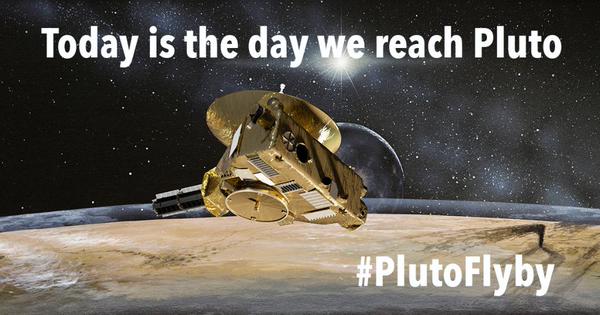
We’ve come a long way from the morning in June, 1965, when I watched my first NASA launch, live. I’m pretty sure that Walter Cronkite was the narrator of my adventure. And by long way I do mean literally. The furthest from the Earth’s surface that Gemini 4 got was about 155 nautical miles. New Horizons has traveled about 3,000,000,000 miles (that 3 billion, yes, billion-with-a-B) to do its Pluto flyby.

The Gemini launch was the first one that was broadcast live, around the world, by satellite. So a lot of people watched the launch. And it was a great flight. Ed White (Edward H. White II) become the first person to space walk, exiting the capsule in a spacesuit with a camera. NASA only let him stay out 20 minutes (actually, they were telling the other astronaut, James A. McDivitt, to get White back in sooner, but White was trying to stay out as long as he could). White and McDivitt could communicate to each other over an intercom line that was part of the tether, but it didn’t connect with the exterior radar to the ground. On top of that, the primary communication system with the ground was having some problems (the VOX unit at McDivitt’s end didn’t correctly identify when McDivitt was talking, so it kept cutting in and out and odd times, so he had to switch to the push-to-talk mechanism).

NASA didn’t want White outside of the capsule during any of the periods when the capsule was out of range of a tracking station (we didn’t have quite as extensive a network of tracking stations around the world back then, so there were a few points in the orbit where we were out of communication with the capsule).

I’ve been a space geek at least since 1965. Probably longer, but the Gemini 4 launch is the earliest one I remember watching (and apparently drove everyone crazy talking about it for weeks after).

So, yes, I’m pretty excited about our flyby of the planet Pluto (if you’re one of those deluded people who adhere to the totally ridiculous redefinition, don’t bother arguing; a scientific definition of an class of object should depend upon the objectively measurable properties of that object only, not the presence or absence of other objects in its vicinity). I can’t wait until we start receiving the images New Horizons is taking today. We’re going to learn so much!

New Horizons races past Pluto in historic flyby

Everything you need to know about Tuesday’s Pluto encounter

NASA’s First Encounters with Planets in the Solar System

Dumb arguments against legal protections for transgender people, part 4

I’ve written before about dumb arguments people make for why there shouldn’t be legal protections for transgender people. And here’s one I haven’t tackled:

The Bible says it’s a sin!

You might want to read the whole book before you make that claim:

There is neither Jew nor Greek, there is neither slave nor free, there is no male and female, for you are all one in Christ Jesus.
—Galatians 3:28

The usual Biblical arguments about transgenderism ignore this verse, or try to claim that it’s being metaphorical about how god judges people. And then they point to verses in the Bible about how god created each person, or the verses about women covering their hair and so on to infer a definitive statement from god. But they’re wrong, as I’ll explain below… Continue reading Dumb arguments against legal protections for transgender people, part 4

dsnow/dt

bonuscats.com
Not this stuff, again!
We’re having a teeny bit of snow. Compared to the winter a lot of other people have had, we’ve been getting off easy. But that doesn’t mean I won’t grouse about it.

I’ve been checking up on the blog by Professor Cliff Mass (he teaches meteorology at the U of Washington, and was once a grad student of Carl Sagan). I’ve been following his weekly weather bit on a couple of the local NPR stations for years, where he nerds out about the science of weather. Today’s “nowcast” about our current series of alternating cold and warm fronts.

He was talking about the various computer models that they run, and how as they run them again and again they all change in the same way. He said, “Meteorologists call this dprog/dt or dmodel/dt (those who know some calculus will understand the name!).”

To unpack that joke, in math we are often concerned with rates of change. So we’ll talk about dx/dy, with the “d” referred to delta or change, and the “x” and “y” each being variables representing some quantity you might be monitoring, so “dx/dy” can be transliterated into English as “the change in x in relationship to the change in y.” Which sounds weird and abstract until I point out that every time you look at the speedometer on your car, it’s showing the “the change in distance in relationship to the change in time.” Most of the time we in physics and other physical sciences, the variable “t” represents time, so “dt” is “the change in time.” So Cliff’s comment about “dprog/dt” would be “the change in [the result from the] program in relation to the change in time” and “dmodel/dt” would be “the change in [the result from the computer] model in relation to the change in time.”

Anyway, it made me think of what may be my new favorite rate of change: dsnow/dt, “the change in the amount of snow in relationship to the change in time.”

And let me just say, I hope the slope of that curve goes negative sooner, rather than later. (Which is a nerdy way of saying I want the dang snow to go away!)

Fact isn’t meaning

Some years ago, while working on a collaborative science fiction project, one of the other people mentioned that they had read that chimpanzee DNA is more than 98% identical to human DNA. “It only takes that little 1% to make a huge difference!”

I had seen articles quote this figure as well, but since the human genome project was still underway at the time, I was a little skeptical that it was accurate. However, one of my friends showed me a reference to a paper in a peer-reviewed journal where the statistic came from, and a little research seemed to indicate that it was true. So I accepted it, occasionally quoted it myself, and didn’t think about it.

Until I read a book about the human genome project, which talked about that old statistical claim in particular, and explained exactly how it came about.

If complicated science theories or statistics make your head spin, don’t panic! I’m going to explain it in a way that will not cause you any distress.

Imagine that you have printed out the text of a pair of books that are roughly the same length. You have printed it out single-sided, double-spaced, and in comfortably-sized font. Now, you take a pair of scissors to the first book, and you start cutting each page up—you don’t cut them up randomly, you cut them so that you have several thousand little pieces of papers, each one of which has one and only one word on it.

Now, you sort them. You make a pile of all of the slips of paper that have the word “the” on it. You make another pile of all the slips that have the word “blue” on it, and so on, until you have a bunch of piles of the little slips of paper, each pile containing however many instances of a single word.

Pick the ten biggest piles, only, and discard the rest. Now count the number of slips of paper in each of your ten piles, and write down the number of times each word occurs in the book you cut up.

Now, go repeat the whole process on a second book, and when you’re done, compare the two lists. Calculate by what percentage each varies on each word, and then average that variation out.

When you’re done, you find that there is a 98% match between a Harry Potter book and Fifty Shades of Grey. “Look!” you declare, “They’re practically the same book!”

But you haven’t compared the two books, you’ve only counted words and compared counts of the most common words between the two books. If you perform this treatment on any books written in the same language, you’re going to find a match.

And I think everyone realizes, when I explain it this way, that what you’ve done does not measure how similar the books are.

Of course this makes you wonder what the scientists were thinking when they did something very similar to the DNA of humans and chimpanzees.

To be fair, the scientists who authored the original paper never claimed that humans and chimpanzees only varied from each other by 1 or 2 percent. They said that they found a similarity in the number and distribution of certain combinations of base pairs of the portions of the chromosomes compared of about 98%. They knew that they weren’t comparing the entire genome, because no one had mapped the entire thing for either species.

At the time, the methods we had for analyzing DNA were crude. We could separate chromosomes, we could pull out certain sequences and count those, but there was a lot we couldn’t do.

We also assumed that the long, repetitive bits at the end of each chromosome were junk, or filler, but new research is beginning to cast doubt on that.

Make no mistake, the more we study both species’ chromosomes, we keep finding a very high amount of similarity between us. Chimps and Bonobos both are clearly very closely related to us. But we aren’t “practically the same species.”

My point is, that 98% was a fact. It was even a true fact, but it was a very specific fact: when comparing certain portions out of the whole DNA. of each species, and when counting building blocks, without much regard to how those building blocks relate to each other, the number of those building blocks is about 98% the same in each species.

Before we can know what that fact means, we need to know a whole lot more facts and a much better understanding of the context.
‘Fessing up, part 1

I was working on a post, in reaction to an op-ed I read last weekend, in which I was ranting a bit.

Okay, it was more than a bit. I was probably well into self-righteous smugness. I took a break to catch up on some news, and came across another story that, as I processed it, made me realize that I was being extremely hypocritical in my rant.

I will return to the topic, and try to write something perhaps a bit less sanctimonious, because I think I have something worth saying on the matter. But before I do that, I have to make a confession or two…

Continue reading ‘Fessing up, part 1

Warning: may prove harmful or fatal…

We put warning labels on all sorts of things. Sometimes people ignore them.

The only prescription allergy medicine that ever really eliminated my hay fever symptoms carried a warning about fatal heart problems that could happen if you took it at the same time you were taking certain antibiotics. A few years later, the warning list expanded to include additional prescription drugs. And then it had to be expanded, again, to include several over-the-counter medications and other substances.

Enough people ignored the warnings and had heart attacks, sometimes fatal, to cause the FDA to re-evaluate the drug. Their research indicated that most people would not heed the warnings about the over-the-counter drugs particularly. You know how some people are, “It’s not a real drug! It’s like aspirin!” So it was disapproved for sale in the U.S.

I didn’t want to have a heart attack, of course, but I really liked being free of the allergy symptoms. Several new drugs had been approved about the time that this one was removed that were supposed to do the same thing. Studies show that, for most people, the new drugs did at least as well as the old one, and a lot of people found one of them much better. Also, there hasn’t been much in the way of harmful side effects for the others.

Unfortunately, I’m not one of the people for whom any of the alternatives work as well. Sometimes I wish that I could go to the FDA and sign a waiver that neither I nor my heirs can ever sue over any problems with the drug, and keep taking it. The misery of really bad hay fever days makes the risk seem inconsequential.

During those days, I really resent the sorts of people who don’t pay attention to warning labels. Almost as if they are intentionally making life less pleasant for some of us.

At the other end of the spectrum are people who are overly-wary of warning labels. They know that some medications carry a long list of warnings, and they just don’t want to risk any of them. Part of the problem is that it is difficult to communicate risk on a small label, particularly to Americans, where mathematical education in public schools has long been inadequate. I remember one time trying to explain to someone that the odds of most of the harmful side effects of medications approved for sale in the U.S. are significantly lower than the chances of dying in an elevator accident. “Well, at least with an elevator, you have a chance to try to jump before the fall!”

I wasn’t sure whether to laugh or cry at the number of ways that retort was wrong.

Of course, risk assessment isn’t a simple matter. For instance, a lot of people like to point out that statistically stairs are hundreds of times riskier than elevators. That’s only true if by riskier you mean the number of injuries and deaths that occur in a given year, rather than the number that occur per use. One reason more accidents happen on stairs than in elevators is because people use stairs more often than they use elevators.

Things become even more murky when you find out that half of the fatalities associated with elevators are maintenance and construction workers doing some sort of repairs near an elevator shaft. Even more surprising, almost one quarter of the fatalities associated with elevators fall into the category of people leaning against closed elevator doors while waiting for an elevator, or people not looking and simply stepping into the shaft when the doors open.

Leaning against an elevator door? Really?

I understand why someone such as myself is willing to risk some possible side effects in order to escape the misery of weeks of sinus headaches, itchy eyes, and scratchy throats. But why on earth would someone lean on an elevator door?

Cousins, part 1

In The Human Blueprint: The Race to Unlock the Secrets of Our Genetic Script, science writer Robert Shapiro at one point explains that if you pick any two people at random on the street, it’s nearly impossible to go back more than six hundred years before finding a common ancestor. Yes, even if the two people appear to be of completely different races.

There are several caveats, the biggest being that is isn’t impossible, it’s just that the probability has gone down to such an incredibly small number (there were a bunch of zeros between the decimal point and the 1 in the percentage he gave), that for most purposes it might as well be impossible. There are pockets of human population that have been isolated for many more generations than covered in 600 years, of course. But they’re very small.

He also explained how for most of human history most people lived their entire lives within 30 miles of the place they were born, which was usually the same community where both their parents lived, and their parents before them, and so on. So most everyone in a particular community were related to each other, at least distantly.

That doesn’t contradict the previous statement, beacuse all you needed was a small fraction of people to occasionally wander far afield before finding someone to have a family with, and in a matter of a dozen or so more generations, most of the population of said insular community have inherited at least some genes from that one wanderer, and are now all distantly related to everyone back in his old community. They just don’t know it.

Humans have been doing this for hundreds of thousands of years, long before modern technology made world travel and relocation commonplace.

In other words, we’re all cousins, of one sort or another.

Abby someone

One of my favorite scenes in Young Frankenstein is when, after the recently animated monster goes on his first mini rampage, the doctor gets Eyegore to admit that he dropped and destroyed the brain of the brilliant scientist Dr Frankenstein had hoped to revive and had taken another brain from the brain depository.

“Abby Someone… Abby Normal, I think. I’m almost certain that was the name.”

No one wants to be labeled “abnormal,” but most of us also don’t want to be described as “ordinary.” We want to be close enough to normal to be excluded from the freak category, but also to be considered above average at something. So many of us spend at least part of our lives walking a tightrope, trying to find a path through that ill-defined territory that brings both acceptance and maybe a teeny bit of acclaim.

One problem with walking a tighrope is that there isn’t any room for error. And certainly no opportunity to explore new territory.

I fell off the tightrope pretty early in life. At some point before kindergarten, my parents figured out that when I was talking (or rather, babbling incessantly) while playing by myself, that I was responding to voices that I was hearing in my head. I thought everyone heard voices like that. It was the only way I knew how to think, to have conversations with different parts of myself.

I tried explaining that, but being only—what, three years old?—didn’t have the experience, vocabularly, or conceptual framework to get the idea across. All my dad understood was that 1) I heard voices, 2) I did not think of them as imaginary friends, and 3) I couldn’t stop them.

So he told me, in no uncertain terms, that I was never, ever to let anyone hear me talking to the voices. If I did, very bad things would happen to me. The least of which were that no one would be friends with me and that I would be taken away and locked up somewhere.

Dad isn’t exactly a touchy-feely kind of guy, you know?

Now there’s neuroscience to show that talking to oneself makes several mental process work better. There’s additional evidence that imagining different trains of thought as a conversation is simply an outgrowth of a number of perfectly unexceptional mental processes. The extent to which my internal monologue splits into a couple dozen dialogues is more than a single standard deviation away from the median, but it’s not so far out as to be worrisome.

I also see relationships between things differently than most. It’s the reason I used to confuse some of my fellow orchestra and bandmates when I would say that playing the tuba was no different than trumpet, you just needed to move the root note of the scale. Reading Bass or Treble clef (or, once I took up bassoon, Alto and Tenor clef) was simply a matter of sliding the starting spot up and down, as well. Switching between bassoon, saxophone, clarinet and flute was all about transposing or rotating finger positions.

I think the one that weirded them out the most was trombone. “First position is just like all valves open because the air path is shortest.” (Though French horn was actually the hardest—I had to visuallize it as air paths, but my fingers kept wanting to treat it as one of the other valved instruments.)

None of which made me a musical genius—it was just me looking at music as a series of math problems. (Of course, there were the other math majors in college who thought my love of Differential Equations was the equivalent of performing black magic).

Seeing those transpositions and substitutions as being the same whether we’re talking about notes, numbers, labels, or commands is why I can quickly (I mean really quickly) learn new scripting or programming languages, et cetera.

Which all sounds really impressive and cool and such. But that same brain is incredibly proficient at losing my keys, or the pile of papers I just had in my hand, or what do you mean my glasses are right there? I looked five times already and they’re not… Oh, well, what do you know?