Tag Archives: sf/f

Millions of Voices Cried Out in Terror — or, That’s Not the Force You’re Feeling, Guys

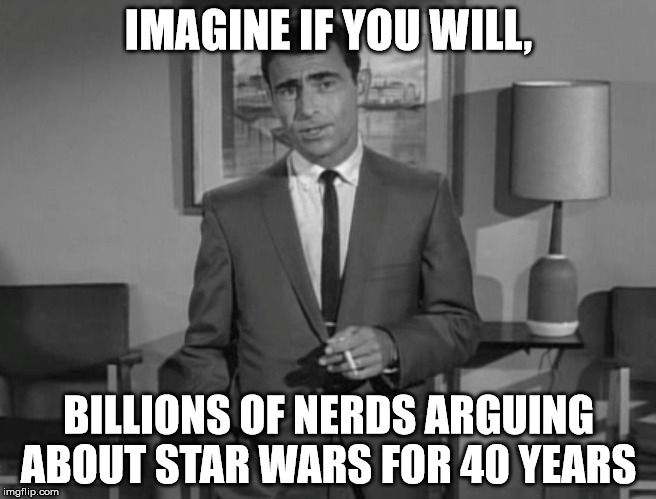
“Imagine, if you will, millions of nerds arguing about Star Wars for 40 years.”
(click to embiggen)
I’ve started this blog post many times, but I either find myself wanting to pull my hair out at the mental gymnastics the haters (who claim to be TrueFans) keep putting themselves through to try to make their arguments that up is down and two billion plus one billion equals zero… and I keep giving up. When the craziness first came to my attention, back in those bygone days when the first trailer for The Force Awakens sent them into a tizzy of anger and outrage, I figured it was just an age thing. Right? I was 17 years old when the original Star Wars came out, and I had watched the Watergate scandal unfold and take down a corrupt president a few years before. I understood that the Empire was a corrupt government founded by people who had, at one point, been treated just as any other politician proposing what ideas that some people disagreed with who turned out to be fascists who destroyed the old government, and that the Rebellion was being led by the remnants of what had been the opposition party before all of that. In other words, I understood that every single plot element in the original Star Wars was about politics.

These other folks, who whine and rage about the new movies, I just assumed they were closer to the median age of the typical internet user. Their first exposure to Star Wars had been to see it on a TV at home, possibly when they were too young to remember the first time. It was just something that was always there. Whereas I saw it as a great movie that changed the way the genre was perceived as well as creating a seismic shift in all of pop culture, to them it had always been there. And they had been too young to understand that the word “empire” was inherently political, just as the phrase “rebel spy and a traitor” was also inherently political.

Oh, how naive I was just a few years ago. I hadn’t realized that the problem was much deeper than that.

Before I go on, a few other people have examined in depth a couple of the issues at hand, and rather than try to construct the same analysis, you should go check these out:

The Beautiful, Ugly, and Possessive Hearts of Star Wars.

Biased Opinion – The Wailing Ignorance of the Star Wars Fanboys.

The latter post, by the Aaron Pound, is extremely helpful in this discussion if for no other reason the two tables showing how all of the movies in the Star Wars franchise have done at the box office, and comparing them to other franchises (expressed in millions of dollars):
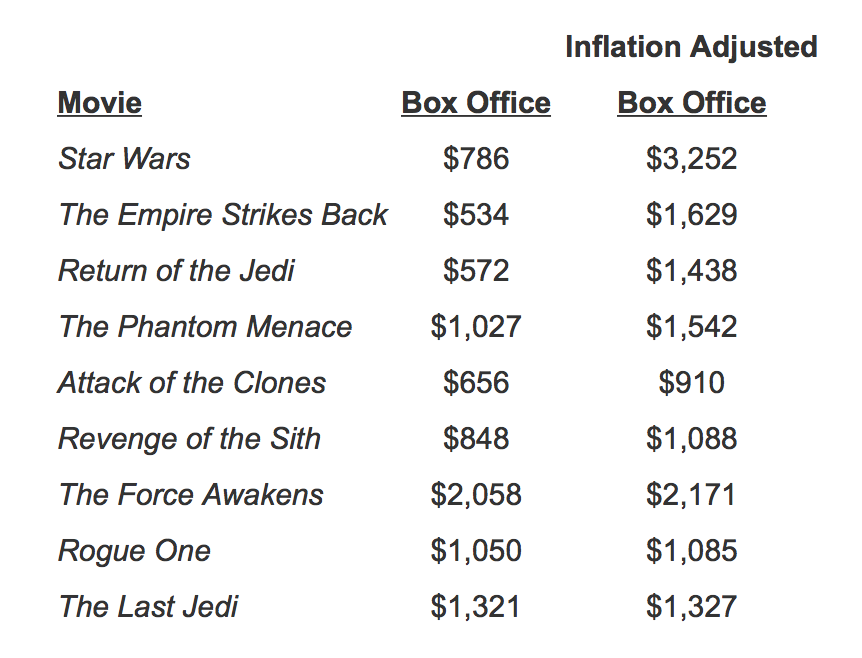
Please note: when adjusted for inflation, the original Star Wars made three-and-a-quarter billion dollars at the box office—that’s $3,252,000,000! Notice, also, the big drop-off that The Empire Strikes Back suffered, and then how the number went down a bit more for the third movie, The Return of the Jedi.

Now let’s look at the other chart (also in millions of dollars):

Aaron assembled this second chart to show how a single-character movie in a large franchise fares in comparison to the main courses, if you will. The Avengers and its sequels have made a whole lot more money than each single-character movie in the Marvel universe, and so we shouldn’t be surprised when Solo made a lot less money than The Force Awakens. Unfortunately, at least some execs at Disney didn’t understand this, otherwise they wouldn’t have authorized re-shooting almost the entirety of the film, bringing the cost of making Solo up to approximately $250 million (and then spent about $150 million promoting).

For the record, I liked Solo a lot. But I went into it knowing that because it’s a prequel, it will not cover any new ground. They had to show us how Han and Chewie meet, they had to show us how Han wins the Falcon from Lando in a card game, they had to show us the Kessel run. Those beats have to be hit. And because we’ve seen Han’s story play out in the original trilogy and The Force Awakens we already know who the love of his life will be, and he won’t meet her in this movie. Right? And when we meet Han in the original movie, he’s an established smuggler and scoundrel who owes money to at least one dangerous crime lord, so we can expect that this prequel will be some sort of criminal action-adventure movie. Therefore, it is nearly impossible to make this a movie that’s going to blow anyone’s mind.

They delivered a solid heist movie that did show us parts of the universe that the other films have mostly glossed over. It isn’t a bad movie, it’s just the sort of movie more likely to make $400 million than $1 billion, which can’t justify the amount they spent making it.

The angry guys who insist that this is more proof that some how the franchise whose main movies are earning more than a billion each is betraying true fans and so forth, don’t understand how the blockbuster movie industry works, compared to, say, the book publishing industry, or the gaming industry, and so forth. A cadre of true fans can make books profitable, but any group of “true fans” in any genre is simply too small a group to generate a billion dollars in revenue for a single movie.

Because the “true fans,” the kind of fans who argue about the economics of the cloud cities or who are dying to see the back story of characters in the original films are going to number in the thousands, at most. Whereas to make the sort of money that The Force Awakens made, you don’t just need millions of people buying tickets, you need at least 100 million.

And when you consider that the so-called “true fans” who are making this argument are the same guys who are angry that one of the leads of the new movies is a black man, and are furious that the primary protagonist is a woman, and are absolutely livid that another lead character is a chinese woman—well, that just means this is an even smaller fraction of the audience than simply people who are nostalgic for the original trilogy.

And with that belief system, well, it’s clear that they aren’t aligned with the light side of the force, either. That ain’t the force you’re feeling, guys—it’s hate.
Playing Piano on a Star’s Surface and Other Impossible Things — more of why I love sf/f

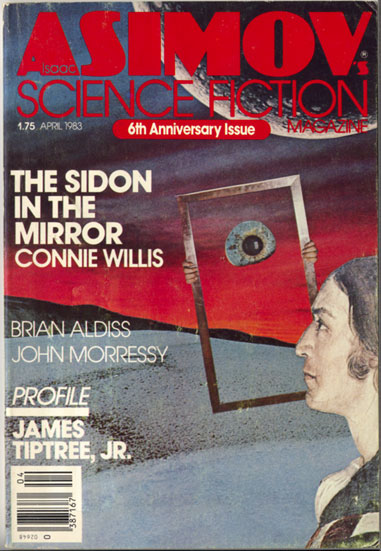
Asimov's Science Fiction Magazine, April 1983. Cover art by Marc Yankus.
Asimov’s Science Fiction Magazine, April 1983. Cover art by Marc Yankus.
In 1983 I was still attending a community college part time while working several part-time jobs, stuck in a weird financial situation too complicated and frankly boring to go into right now. The important points are that I was still very closeted and in a situation where I was dependent on conservative religious relatives and equally conservative institutions for my livelihood. I clung to science fiction and fantasy as a half-drowned person might clasp the last floating piece of wreckage after a boat disaster in the middle of the ocean. And while I couldn’t always afford to buy new sf/f books and anthologies when they came out, the local public library subscribed to three science fiction magazines, one of which was Asimov’s Science Fiction Magazine, so a few times I month I would spend an afternoon at the library reading those magazines.

And it was in the pages of the April 1983 issue of Asimov’s that I first met Connie Willis.

The novelette included in that issue, “The Sidon in the Mirror” is told from the point of view of person just arrived on a new planet. Except it isn’t a planet. Paylay is a dead star, and somehow humans have figured out how to live on a solid crust of the outer layers of the dead star. It isn’t a terribly nice place to live, but large pockets of various pure elements can be mined, so people have an incentive to come there. A side effect of the mining process has created a thin layer of mostly breathable air that is much higher in helium and hydrogen that ours is.

We learn that our viewpoint character is not human, but rather a Mirror: an alien species that has the ability to absorb personality traits, skills, and other things from other beings. They don’t take on the shape of the copied person, and the process is totally involuntary. Mirrors don’t even know they are copying, their personality being re-written as they go, unless someone else notices and tells them. There have been some instances in the past of Mirrors absorbing the murderous thoughts of others and acting on them, so they have been banned from various world.

He’s been brought to this strange mining colony to play piano in the colony’s only brothel. He had previously absorbed the piano playing skills of a now dead man who was known to both the other of the brothel and at least one of her employees, which is at least part of the reason he was brought to Paylay.

The rest of the plot is difficult to summarize, in part because Connie does a really good job of putting you inside the head of the person who doesn’t know or trust his own thoughts and motives. He is afraid he is going to be compelled to do something horrible, and there are characters he is now living among who appear to be trying to manipulate who he copies for their own nefarious purposes.

But I should explain the title. The viewpoint character’s species are called Mirrors, as explained. There is another alien creature mentioned, it’s called a sidon. Sidon’s are vicious predators, but some people have tried to tame them (because people will do that), and it has always gone badly. The miners have taken to naming their mining taps as sidons—while all the compressors and pipes and such are holding, everything seems under control. But ever miner knows it is only a matter of time before a tapped sight explodes. They’re just all trying to make their money and leave before that happens.

By the end of the tale there are violent deaths, and it is left to the reader to decide which of the deaths were murder, which were self-defense, or whether they fall into another category all together.

On one level the story is about the meaning of free will. Willis herself has said, when introducing the story in collections of her work, that the story was inspired to seeing stories of twins who were adopted out separately, and then find each other as adults and learn how many things about their lives are spookily similar. Many things we think of as choices may not be at all.

If was a tough story to read, because there were points in the tale when I wanted the viewpoint character to do something different. I saw moments he could have escaped the trap. Except when I got to the end, I found myself questioning the definition of trap I had been using. Was the trap the manipulation coming from one of the two characters who were trying to turn the Mirror into a killer, or was the trap the Mirror’s own belief that he himself would inevitably turn into a violent killer, or was the trap the fear of the other characters?

I’ve re-read the story many times over the years. And even though I know how it ends, I’m always at the edge of the seat throughout. As mentioned above, Willis really puts you in the mind of this character so that by the middle of the story, I’m just as afraid and uncertain as to what will happen as the character is.

The story made me think a lot about how we make decisions. How much of what we feel is the result of what people expect us to feel? How many decisions that we think are our own are being forced upon us? What, exactly, is the nature of our own identity?

They were questions I was wrestling with personally. While I didn’t have an sudden epiphany at the end of the tale, it did nudge me further in the direction of coming to understand how the nature of the closet. The stifling social trap that many queers find themselves living in is constructed at least as much by our desire to win the approval of society, family, and even my closest friends. It isn’t just fear that drives one into the closet, but also (ironically) the need for love.

And it took an alien playing piano on the surface of a dead star to show me that.

Good, bad; I’m the guy with the gun — more of why I love sf/f

Ash Williams (as portrayed by Bruce Campbell), unlikely savior of the world.
Scary movies give me nightmares. And I have been known not just to talk in my sleep when having a dream, but I’ve been known get up, find other people in the house, shake them awake and urgently tell them about the thing that is in the house trying to kill us. This is why I almost never watch scary movies. Fortunately, sleepwalking in general happens less often the older we get, so it’s slightly less of a problem than it used to be.

So frequently friends will tell me about how awesome a particular horror film is, and I’ll just smile and nod.

There was one movie, however, that people kept bringing up again and again. Not just people I knew. Army of Darkness, I had been assured be even a few critics, was a masterpiece of cinema–hilarous and scary all at once. And the star is Bruce Campbell, whose work I had loved in The Adventures of Brisco County Jr, for instance.

I should mention that for the most part, horror and related stories almost never cause me to have bad dreams. And I have written stories and designed gaming scenarios that has caused more than one friend to scoff mightily at the idea that I can’t watch scary movies without nightmares. What can I say? I don’t think it should be that surprising that things I see only in my own imagination will have a different effect on me than things I actually see with my eyes.

Eventually, my friend Sky and my husband Michael convinced me to watch Army of Darkness. I sat on a couch between them, and I am not ashamed to say that at times I was clutching both their hands, and I hid my face in a shoulder during some of the bloodier scenes.1

But I also laughed my ass off. It was wonderful! The film is a great and irreverent take on the notions of chosen ones, reluctant heroes, and merciless evil. It finds so many ways to put humor into situations no person would be expected to survive.

And, yeah, I had a few nightmares that week, but fortunately not the kind where I was screaming in my sleep or shaking my husband awake.2

In case you aren’t familiar, Army of Darkness is a sequel. In 1981 Sam Raimi, Bruce Campbell, and a bunch of friends (include Sam’s brother, Ted) made a lowish budget film The Evil Dead, in which Campbell first played Ash Williams. The plot is that a group of five college students go to spend a weekend at a cabin, find an old tape recorder, play the tape which proves to be a voice reciting from the cursed Book of the Dead. The spell unleashes a bunch of demons that possess members of the cast, mayhem ensues. The mayhem got gorier and gorier as things when along. As the possessed cast kills each other off, their bodies (and sometimes only parts of their bodies), are reanimated and continue to cause ever more grisly, brutal deaths.

A few years later, with a bigger budget, they made Evil Dead II which begins with a reshot and re-edited summary of the first film then picks up where the first left off, with Ash battling both the demonic books (now renamed Necronomicon Ex-Mortis) as well as the demons it summons.

And then Army of Darkness follows Ash’s adventures when he was magically transported by the 1300 where he has to fight an entire army of the evil undead, now given the name Deadites. The third film amped up the humor significantly, with a lot of the horror elements used more for comedic effect. It was still scary, though. This film was by far the most successful in the series.

A fourth film, titled simply Evil Dead is kind of a remake and kind of not. Bruce only appears as Ash in an after credits scene.

As time went on, I became a bigger and bigger Bruce Campbell fan. Not such a big fan that I went back and re-watched the earlier movies, nor the recent remake. But when a couple years ago it was announced that Starz would be showing a horror comedy series based on the series, I was quite excited. Because of the licensing and distribution deals that the Raimi brothers and Campbell had made to get the later films produced, they couldn’t make direct references to the most successful of the movies. They could reference the plot and characters of the original film, and use some elements (the name Deadites and Necronomicon Ex-Mortis), but that left them plenty of room.

Ash vs Evil Dead picks up the story of Ash as he’s well into middle age, using cheesy stories of how he lost his hand (in the first movie he had to cut it off because it was been possessed by a demon, while somehow he remained in control of the rest of his body) to seduce random women in bars. In an alcohol- and pot-fueled haze, he allows one of these women that he persuaded to come back to his small trailer, to read “poetry” from his old book, and evil is back.

What I love about the character of Ash Williams is just how much of a hero he isn’t. He’s a pathological liar (who is usually bad at it), he hits on women constantly, he says lots of casually racist and sexist things, he boozes too much, he drives while drunk and stoned, and so forth. He occasionally tries to run from the danger, but somehow he always manages to pull himself together and try to kick evil’s ass.

It’s a style of anti-hero with a long career in storytelling. I find it fascinating how closely Ash fits the mold of Samson (yes, the Old Testament Biblical character). The Biblical Samson is not, by any means, a holy guy. In the original Hebrew scripture, the word for “to have sex” appears a few dozen times in total–nearly two-thirds of the use of the word occur within the portion of the book of Judges sometimes referred to as the Samson saga.

Seriously, one of those Biblical stories involves Samson partying at a brothel for hours. The Holy Scripture literally says that he screwed every single woman in the brothel so many times that they were sore and some could barely walk and they pleaded with him to go home. Drunk, Samson staggers through the city. But the gates of the city have been locked, and the Philistines have set an ambush, intending to jump him while he is drunk and worn out from all the sex. But before they can, Samson simply tears the gates down and stumbles home.

And this is my favorite part: the scripture says he dragged the gate behind him for miles without remembering that he still had hold of it, and only midway home noticed, and he tossed it into the middle of the field before sneaking into his mother’s house and crawling into bed.

Ash Williams of the Evil Dead series doesn’t possess Samson’s legendary strength, but he manages to survive being beaten, battered, flung great distances, burned, stabbed, run over by demon possesed vehicles, et cetera, et cetera.

Yes, the series was crazy and gory, with literal buckets of blood being spewed all over the actors and sets. But it was also hilarious. Although the Deadites are undead, the show isn’t a zombie story. For one thing, the Deadites are fast. They aren’t mindless. The demons that inhabit the corpses are able to access the memories of the deceased, so they taunt the heroes along the way. They make plans and concoct schemes.

In other words, they aren’t a mindless threat, they’re actually bad guys.

I’ve had a lot of fun watching Ash’s adventures on the small screen the last three years. I was sad to learn that it wasn’t being renewed, but also happy for all the laughs we’d gotten along the way. Bruce has announced that he is retiring this character—if there are any more Evil Dead stories to tell, Ash Williams (or at least not this Ash) won’t be a part of them.

That’s okay. Ash showed us that you don’t have to be perfect to be the hero. He’s earned some rest.


Footnotes:

1. I’ve learned there are things I can do to reduce the severity of nightmares I’ll have after watching a scary movie. Watching on a small screen helps. Being able to pause or walk away when things get too tense is extremely helpful.

2. I’m more likely to wake him up by saying something angry than to scream, truth be told.3

3. I also have gotten better and making myself wake up. Seriously, just a few weeks ago a dream started to have some elements from one of the gorier scenes in a recent episode of the series, and me in the dream said, “No, I don’t not want to have this nightmare! No!” And I woke.4

4. I didn’t wake my husband up in the process, so I don’t know if this was one of the times when I said outloud the thing I was saying inside the dream, but there have been occasions in the past where I did exactly that.

NorWesCon 41 Report — Professor Plum in the hall with the selfie stick

(click to embiggen)
The very first NorWesCon I attended wasn’t actually a NorWesCon—it was called Alternacon in 1987 because some really weird things had happened at the now notorious NorWesCon 9 the year before. The convention hotel canceled the subsequent contract and the committee scrambled to put together a convention at a smaller hotel the next year and chose to temporarily rename the convention. In any case, from 1987 through 2012 I never missed a NorWesCon. For a few of those conventions (1993, 1994, and 1995) I only attended for a single day, but I managed to make at least an appearance at every one up until NorWesCon 35. For a variety of reasons (some of which will be mentioned below) my husband and I chose to skip NorWesCon 36 and 37 before resuming for 38 and 39. We had planned to attend last year, but that was before our old apartment building was sold—between needing to find a new place to live, dealing with my husband’s surgery, packing, and actually moving, we wound up cancelling our plans to attend NorWesCon 40 at the last minute.

This year my husband was on convention staff. I didn’t have any obligations—no fan table to run, no panels that I was on (it’s been years since I was an attending pro at NorWesCon), and I wasn’t on staff. Continue reading NorWesCon 41 Report — Professor Plum in the hall with the selfie stick

…and the darkness comprehended it not

I have a longer, rambling post about my feelings after seeing the movie A Wrinkle In Time last week. There’s a long digression about what the book meant to me as a kid and so forth. And I will finish it and post it soonish. But there are stressful things going on in the lives of people I love, and I’m in a weird headspace.

So, my quick review is this: The movie is awesome, it is glorious, it is moving, it is sincere, and it absolutely sells the truth of the book. There are many dissenting reviews I have seen, many from friends, so I will offer the following caveats:

  • If you’re a cynic, you will not like this movie. Don’t bother. I’m giving certain cynics of my acquaintance serious side-eye when they claim, while griping about this movie, to be fans of the book. If you’re a cynic, you completely missed the point of the book.
  • If you’re the kind of fan who complained that Tom Bombadil was left out of the Lord of the Rings movies, you will not like this movie. Don’t bother. And if you did see it, don’t post long lists of things they left out. You sound like a small-minded pedant shrilly complaining that they got the stitching wrong on the tunic of that background character from page 76…
  • There’s another kind of fan that I don’t know of a way to warn they won’t like it. But their reasons for not liking the movie were summarized best on Twitter by Matt Santori (@FotoClub): “It is earnest and it treats a girl who has low self-esteem with respect instead of ridicule. And I think that bothers a lot of men.”

There was a point, early in the movie, and not when anything that you would expect to make you cry, when I found myself crying so much I kept having to wipe my eyes to see. It was a beautiful scene that was giving me all kinds of feelings, and realized that the people making the movie had captured the wild sense of wonder and joy that I, as a 9-year-old when I read the book the first time, felt at several parts of the book. It’s a feeling that L’Engle herself described at one point:

“It seemed to travel with her, to sweep her aloft in the power of song, so that she was moving in glory among the stars, and for a moment she, too, felt that the words Darkness and Light had no meaning, and only this melody was real.”
― Madeleine L’Engle, A Wrinkle in Time

Adaptation requires elliding things, simplifying things, and in a book that was written 56 years ago, updating things. The movie is only a little over an hour, which is a perfect length for a kids movie. And there are things that work in text that don’t work so well visually, so sometimes directors have to get metaphorical.

One last note: one of the authors I follow on Twitter is Saladin Ahmed. Last Friday he saw the movie with his daughter and a whole bunch of her classmates. I’m going to paraphrase his review: “I don’t usually say ‘screw the critics.’ I will simply say, If you possibly can see A Wrinkle in Time with some kids, do so. They will love it, and you will love being there while they watch.”

Weekend Update 8/12/2017: Hugo Winners and many other things

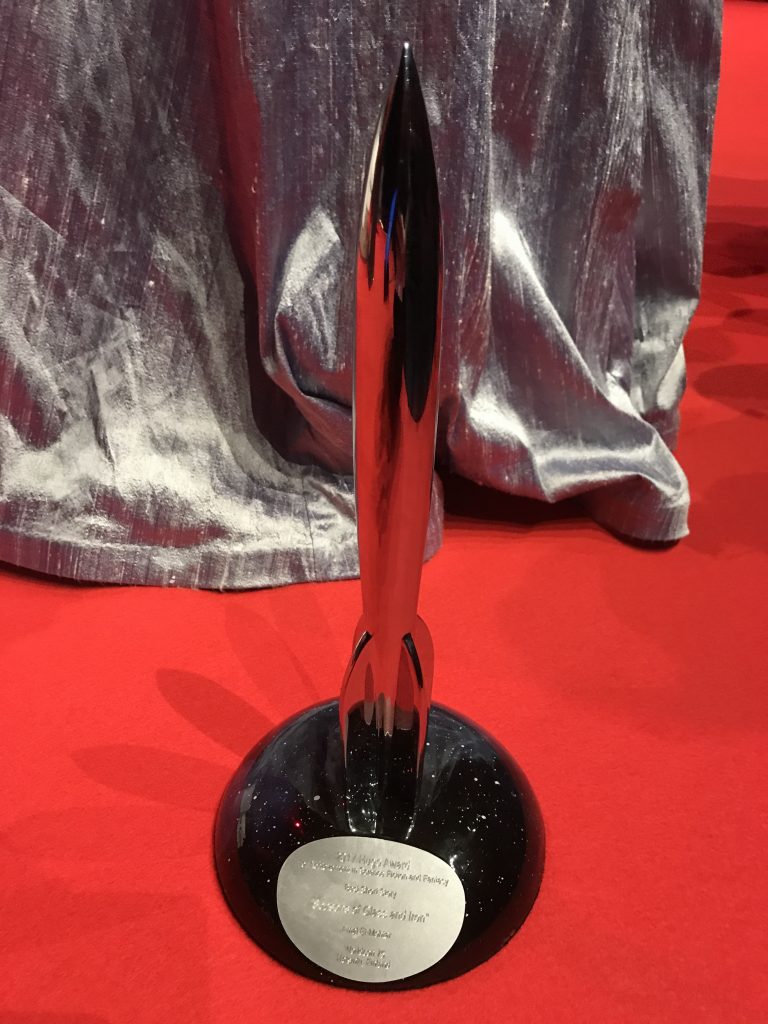
The 2017 Hugo award base was designed by Finnish artist Eeva Jokinen. (Photo by Michael Lee.)
The Hugo Award winners were announced yesterday at Worldcon 75, this year happening in Helsinki. I’m not there, but enough people I know are that my twitter feed was full of news and reactions. And it’s really fun when people whose work you love and who you have met in person are among the people bringing home rockets. I checked against my ballot after, and found that in four categories the person/work that I picked as number one had won. And it looks like in every other category, the winner was in my top three. Of course, as I said at the time, I thought that every category had at least four or five pieces that I absolutely thought deserved the award. It was a good year. And isn’t this year’s trophy gorgeous?

Anyway, the winners are:

Novel:

The Obelisk Gate, by N. K. Jemisin (Orbit Books)

Novella:

Every Heart a Doorway, by Seanan McGuire (Tor.com publishing)

Novelette:

“The Tomato Thief”, by Ursula Vernon (Apex Magazine, January 2016)

Short Story:

“Seasons of Glass and Iron”, by Amal El-Mohtar (The Starlit Wood: New Fairy Tales, Saga Press)

Related Work:

Words Are My Matter: Writings About Life and Books, 2000-2016, by Ursula K. Le Guin (Small Beer)

Graphic Story:

Monstress, Volume 1: Awakening, written by Marjorie Liu, illustrated by Sana Takeda (Image)

Dramatic Presentation, Long Form:

Arrival, screenplay by Eric Heisserer based on a short story by Ted Chiang, directed by Denis Villeneuve (21 Laps Entertainment/FilmNation Entertainment/Lava Bear Films)

Dramatic Presentation, Short Form:

The Expanse: “Leviathan Wakes”, written by Mark Fergus and Hawk Ostby, directed by Terry McDonough (SyFy)

Editor, Short Form:

Ellen Datlow

Editor, Long Form:

Liz Gorinsky

Professional Artist:

Julie Dillon

Semiprozine:

Uncanny Magazine, edited by Lynne M. Thomas & Michael Damian Thomas, Michi Trota, Julia Rios, and podcast produced by Erika Ensign & Steven Schapansky

Fanzine:

Lady Business, edited by Clare, Ira, Jodie, KJ, Renay, and Susan

Fancast:

Tea and Jeopardy, presented by Emma Newman with Peter Newman

Fan Writer:

Abigail Nussbaum

Fan Artist:

Elizabeth Leggett

Series:(Special Category added by option of Worldcon 75)

The Vorkosigan Saga, by Lois McMaster Bujold (Baen)

John W. Campbell Award for Best New Writer: (Not a Hugo Award, but administered along with the Hugo Awards)

Ada Palmer


And I’m sure that in certain corners of the trollnet there is a lot of angry thrashing: Women swept nearly every category at the 2017 Hugo Awards. To paraphrase Ruth Bader Ginsburg: and for how many years were the categories literally swept by men (and almost always white men, at that)? Let me repeat: I’m an old, literally grey bearded, cis male white fan who literally learned how to read from Robert A. Heinlein novels, and every single one of this year’s winners were fabulous sf/f works that deserve that award because they are awesome stories.

So, congratulations to all the winners!

Oh, another thing announced yesterday: Worldcon 2019 will be in Dublin, Ireland! It’ll be the first Irish Worldcon! Yay! There’s a lot of other fun news from the con, you can see a bunch of pictures and more here.

On to other things: Terry Gross is one of my favorite people to listen to on the radio. She’s been interviewing people for years, and much of what I like about her show is how many times she made me really connect with and care about people I didn’t expect to. Anyway, she was on the Tonight Show with Jimmy Fallon this week, and it was funny in a way I absolutely did not expect. Watch the whole clip to learn about her process, but also to get a really good laugh when she tells the story of the time Bill O’Reilly angrily stormed out of an interview.

NPR’s Terry Gross Has a Sick Burn for Bill O’Reilly Walking Out on Their Fresh Air Interview:

(If embedding doesn’t work, click here.

Lots of people have been freaking out about all the nuclear war talk this week. I left most of it out of yesterday’s round up of links other than to link to an analysis of why it is almost certain that we don’t actually need to be worried just yet. But besides most people not understanding the technological hurdles as to why North Korea doesn’t have that missile-capable bomb there’s more. And Nothing New On North Korea Except Donald Trump’s Freak-Out. There actually isn’t any new news. Only one agency is saying this is a possibility, and that same intelligence agency claimed the same thing several years ago and was shown to be wrong then. Furthermore, Donald isn’t suddenly talking about this because of a security briefing he got. He started angrily threatening war when he saw a headline in the Washington Post… which he has also claimed in one of the fake news outlets, but obviously he doesn’t really think that, does he? Anyway, Rachel Maddow’s clip that I linked is really good. And she had an actual
(recently retired) intelligence expert whose specialty was North Korea for decades. It’s really worth the watch.

Related, I’m really irritated that this is even necessary: From the editor in chief of Christianity Today: The Use of Nuclear Weapons Is Inherently Evil. Even though I consider myself a former christian, it angers me to a level that is difficult to describe that there are so-called christian pastors saying the opposite, saying things like Megachurch Pastor Says Trump Has God’s Approval to Start Nuclear War. Geezus! Even the religious right’s favorite president, Ronald Reagan, condemned nuclear weapons as “totally irrational, totally inhumane, good for nothing but killing, possibly destructive of life on earth and civilization.” And who can forget what the late evangelist Billy Graham said on the subject: “I cannot see any way in which nuclear war could be branded as being God’s will. Such warfare, if it ever happens, will come because of the greed and pride and covetousness of the human heart.”

Well, we certainly have a president who epitomizes greed and pride and covetousness…

Grrrr! And don’t get me started on the literal Nazis marching in North Carolina… but at least some Republicans are waking up: Former GOP Senator Calls For Trump’s Removal “Donald Trump is seriously sick. He is dangerous. As a citizen, a former U.S. Senator and twelve-year member of the Armed Services Committee, I urge you to act at once. This is an emergency.”

I can’t end on a sour note. So, here’s some much better news: ‘Sense8’ is back in production, and the finale is going to be totally ‘epic’ and Formerly Abused Husky Now Helps Children Who Have Been Abused.

Everybody was kung fu fighting, even mighty whitey — more of why I love sf/f

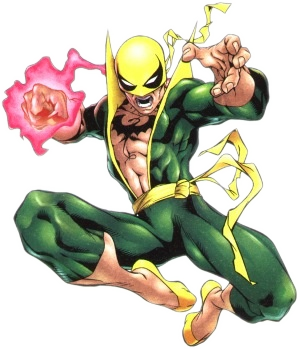
On reflection, I don't think the story lines were why hormonal 14-year-old closeted me was fascinated with the character right away...
On reflection, I don’t think the story lines were why hormonal 14-year-old closeted me was fascinated with the character right away…
This post will eventually become a commentary on the Netflix series Ironfist based on the Marvel comics character, but I have a lot of ground to cover first. I am an old literal grey-beard fan who was reading U.S. comic books before the great Kung Fu/Asian cultural appropriatation phase of the early 70s, so my relationship to any media property related to that era is a bit complicated. Because both the Jessica Jones series and Luke Cage series had significantly transcended their original comic book incarnations, I had high hopes for what might be done with Iron Fist. Alas, those hopes were not met. However, I think that the series Netflix ultimately produced is not a complete failure, and may eventually be redeemed with the subsequent series in the franchise.

In the early 70s U.S. pop culture became obsessed with martial arts. One of the best examples of this was the television series, Kung Fu which ran from 1972-1975. The show, which was wildly popular both with audiences and critics, told the story of Kwai Chang Caine, a half-chineses, half-white man raised in a Shao Lin monastery who winds up in the American Wild West wandering the countryside seeking his father while evading agents of a Chinese nobleman who wants him dead. The show cast white actor David Carradine in the role (after rejecting Bruce Lee). And it really was wildly popular. In the redneck rural communities I was living at the time, every one of my classmates would quote favorite lines from the show and make allusions to it in various ways. While the show cast a white actor in the role of the supposedly biracial lead, since ever episode relied heavily on flashbacks to incidents in Caine’s childhood, teen, and young adult years back in China, it also provided a lot of acting roles for Asian American actors in recurring and supporting roles. Probably more so than all of American TV before then. Which doesn’t make up for the white washing, but was at least a teeny step forward.

That TV show wasn’t the only bit of pop culture effected. Action movies and television series of all kinds started introducing martial arts experts to their story lines, and soon audiences were expecting amazing martial arts fights in all of their entertainment. Even the BBC’s Doctor Who had to bow to the expectation, with the velvet-jacketed Third Doctor suddenly becoming an expert in “Venusian Karate” though embarassingly what that meant was the actor occasionally exclaiming a cliche “Hai-ya!” as he felled opponents with an unconvincing chopping motion of his hand.

And comic books were hardly immune. Suddenly every comic company was adding martial arts experts (some of asian descent, some not) into their superhero lines. Comic titles such as Master of Kung Fu, Karate Kid (no relation to the 80s movies), and Kung Fu Fighter, and Dragon Fists were suddenly popping up in department store comics racks. Along side characters such as Shang Chi, Richard Dragon, Lady Shiva, and Karate Kid (no “the”) there was Danny Rand, aka Iron Fist: the Living Weapon.

Danny was a classic mighty whitey: a white orphan taken in by mysterious monks in a secret temple in the Himalayas, who masters their semi-mystical martial arts to a degree that far exceeds any of the natives and becomes their greatest warrior. This being an American comic, of course Danny comes to America, specifically New York City, where he tried to reclaim his family fortune (along the way discovering that his parents’ deaths on the journey may not of have an accident). His costume was a bit unusual for male superheroes of the time—ridiculously plunging necklines were usually reserved for women. The excuse for exposing all that skin was the black dragon mark on Danny’s chest. It’s not a tattoo, but rather a symbol that was burned into his flesh during a fight with a dragon, which is an important part of the ritual of becoming the Iron Fist.

This was the fifth issue of Marvel Premiere that featured Iron Fist. Premiere was a series Marvel used to introduce new characters or revive old ones that might lead to a new series.
When Marvel debuted in comics in 1974 I was 14 years old. I didn’t read the very first couple of issues. Back then my source of comic books was the rack at the only drugstore in the small town where we lived, and which comics they got were hit and miss from month to month. But I remember seeing this cover in that rack one day and being instantly fascinated. I bought the comic, and as I frequently did in those days, read it, re-read it, and re-read it again and again. The story was middle episode in the middle of a story arc, so I was a bit confused about some things, but was still immediately enamored with the character. I kept my eyes peeled for the character from then on, and managed to pick up a few more issues as they came out, but not all of them. It was a constant frustration at the time: not being able to count on the next issue making it to my town.

Because of that inconsistency—where I would pick up, say, issue #85 of Spider-Man, then not find another issue until #89 came out—I spent a lot of time looking for clues in the stories as to what I had missed in the intervening issues, and I would write up my own versions of the adventures my favorite heroes had experienced in between. Very occasionally I tried to draw my own comics, but mostly I wrote them out more as prose stories. This skill of figuring out all the ways a character might go from point A to point Z has been useful in my own writing since.

Eventually, after my parents’ divorce, Mom, my sister, and I moved to a town large enough to have multiple book stores and an actual comic shop, where eventually I managed to purchase at relatively cheap prices many of the back issues I had missed of Iron Fist and several other titles. I was a little disappointed that some of my attempts to fill in the gaps between issues were way off, but I still loved the character. I know now (but didn’t realize back then) that one of the things that appealed to me about the character originally was that chest-baring costume. But Danny Rand’s story also appealed to me because he was an outsider, never quite fitting in anywhere. That was something I really empathized with.

Another thing that appealed to me about Iron Fist the comic (and some of the other Kung fu-ploitation properties) was the inclusion of (often mangled, I know) zen, buddhist, and taoist philosophy. Seeing other traditions underpinning moral and ethical principles, seeing good, brave, and noble character behaving morally and ethically outside of the fundamentalist Christian framework helped me reconcile my growing discomfort with the evangelical beliefs I’d been raised with. Yes, it was culture appropriation, and it was a stripped-down and distorted representation of those other religions, but it wasn’t being done to deride those beliefs. The distortion was because of ignorance and the expediency of meeting writing deadlines, not out of a hostility to the cultures themselves. While it was problematic, it still helped me find a way to escape the clutches of a homophobic denomination. And that’s a good thing.

As I said at the beginning of this post, I had had high hopes for the Netflix Iron Fist series. I’d read enough reviews when it first came out to know that the consensus of critics and a lot of fans was that the show was nowhere near as good as some of the other Marvel-Netflix shows. But I still hoped. I still think that the show would have been improved immensely if they had cast an asian american as Danny. It would have been really easy, and I think would have made the way they chose to tell his story work a bit better. The external conflict of the series is mostly about control of the corporation originally founded by Danny’s father and the father’s best friend. The internal conflict is about Danny trying to figure out his place in the world. If they had made Danny biracial, showing his father in the flashbacks as white and his mother as, let’s say, Chinese American, then that internal conflict would have had more layers. And this story desperately needed something less shallow than a badly thought out boardroom drama.

It also doesn’t help that the actor they cast as Danny seems about as talented as a block of wood. Seriously, the adam’s apple of the actor who was cast to play Danny’s childhood friend from the mystical city displays more acting talent and skill in a single scene than the actor playing Danny does in the entire series. Another big problem is pacing. The series spent about 9 episodes setting things up that could have easily been handled in one. The first episode was pretty an okay beginning of the tale, but it wasn’t until about episode 11 that things seemed to pick up. I also can’t figure out why they showed virtually no scenes of the mystical city where Danny gets his training. Let along never showing us the dragon. I mean, what is the point of telling Iron Fist’s story without showing us all that?

Maybe they’ll do better in season two.


In case you don’t know where the title of this blog post originated, here’s a music video that might explain things:

Carl Douglas – Kung Fu Fighting:

(If embedding doesn’t work, click here.)

Destiny, prophecy, self-discovery, and love — more of why I love sf/f

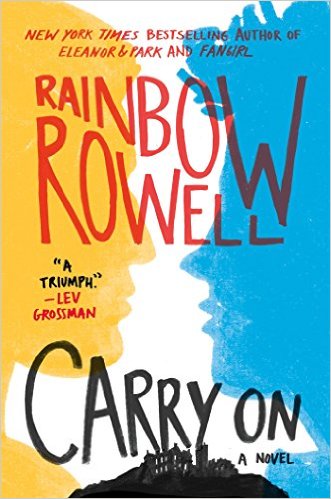
Cover of Carry On, by Rainbow Rowell, cover design by Olga Grlic (click to embiggen)
Carry On — The Rise and Fall of Simon Snow is a ghost story, a love story and a mystery.” So begins the official blurb on this novel that I found myself enjoying far more than I thought I would. First, an explanation. Rainbow Rowell, the author of Carry On first came to my attention through a recommendation on a podcast. Her work was described by one of the people on the podcast as being young adult novels that didn’t feel like YA. They also noted that she handled non-heterosexual characters really well. So I looked up some of her books and put them on my wish lists, but I hadn’t gotten around to actually trying one.

And then fan art for a book that seemed to be about teen wizards (but not characters I recognized) started appearing on my tumblr dashboard for a series that I’d never heard of: the Simon Snow series. Except there is no Simon Snow series. One of the novels by Ms. Rowell that I’d put on my list was entitled, Fangirl, and the blurb was that the main character, Cath, is just starting college, and that for the last few years her life has been dominated by her love for a series of urban fantasy novels. And these novels star a young man named Simon Snow.

In order to write convincingly about a fan who is very active in writing fanfic and has a number of close friends within the fandom, Rowell had to plot out a fictitious fantasy series. At least enough for the characters to talk about it as if it were a real series. Fangirl was a success, and received a lot of praise, particularly in sf/f circles, despite not being a fantasy story itself, because the portrayal of fannish culture was considered spot on.

After finishing that book, Rowell wound up writing a Simon Snow book. She didn’t write the entire series, she wrote a book that can be looked on as the next book that was published after all the books that Cath and her friends had been fans of in 2013 (when Fangirl was published). So, Carry On is not a sequel to Fangirl. Carry On is a sequel to the fictitious series which is talked about in Fangirl.

The magical world of Carry On bears a strong resemblance to the Harry Potter series, though it isn’t a parody or a satire. It also bears certain parallels to other young adult fantasy series. The plot seems straightforward, at first. Simon Snow attends a wizarding school called Watford. He was not born in the wizarding world, but he has immense power and various prophetic signs indicate that he is the person who is destined to defeat the Insidious Humdrum. The Insidious Humdrum is a mysterious being which, when it attacks, drains all of the magic out of the area, leaving what appear to be permanent dead zones where wizards and other magical creatures become powerless. Simon doesn’t know how he is going to defeat this creature, and has so far failed to master his magical powers. His powers are massive, but out of his control, and things tend to get destroyed when he tries to use them. His roommate at the school, Baz (full name, Tyrannus Basilton Grimm-Pitch) is Simon’s nemesis at school, and is assumed by everyone to be the person destined to try to kill Simon when the big battle with the Humdrum finally happens.

But the story isn’t really about the conflict between Simon and the Humdrum. It’s really about the nature of prophecy, what does it mean to be a chosen one, and how people (whether mortal politicians or master mages) twist belief and hope to fit their own agendas. It’s about identity, not just what it means to be a hero or villain (or the fact that it is seldom either/or), but there are allegories for ethnic identity issues and class identity issues. Oh, and more than a bit about sexual and romantic identity (which aren’t always the same thing).

There is a ghost story. There are several mysteries. And there is even a love story. There are battles magical, political, and personal. And it all hangs together very well. I have to admit, I think the wizarding world portrayed in Carry On makes a lot more sense than the world of Harry Potter, or a number of other fantasies of similar ilk, even though the magic part of the story isn’t the main focus of the plot.

I’m not sure that those two observations are unrelated.

I enjoyed the book a lot. I didn’t find most of the plot developments surprises. As one reviewer put it, the revelations as the story moves along feel more like confirmations of your existing suspicions than plot twists. But again, I don’t think that’s a bad thing. I think that’s part of why the story hangs together better than some other books we could name.

I enjoyed the book a lot. It didn’t end quite as I hoped it would, but it ended in a way that felt right and satisfying regardless. It did make me wish that some of the series and fantasy books had handled their characters as well as Rowell does. I hope that the next person who undertakes this sort of tale takes note.