I've loved reading for as long as I can remember. I write fantasy, science fiction, mystery, and nonfiction. For more than 20 years I edited and published an anthropomorphic sci-fi/space opera literary fanzine. I attend and work on the staff for several anthropormorphics, anime, and science fiction conventions. I live near Seattle with my wonderful husband, still completely amazed that he puts up with me at all.
View all posts by fontfolly →
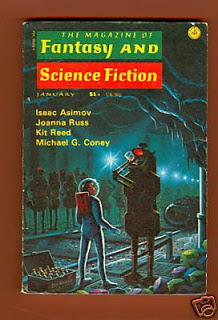
“My Boat” by Joanna Russ was published in Fantasy And Science Fiction Magazine, January 1976, cover by David Hardy. (click to embiggen)By January of 1976, I was midway through my freshman year in high school, living in a tiny town in northwestern Colorado. My parents had been separated for a few months and their divorce was underway. My physically and verbally abusive father wasn’t living with us any more, which was a plus, but everything from our finances to our daily routines were far less certain and predictable. I had had a big break-up of my own that no one knew about—because we were both extremely closeted boys in a very redneck town so of course we had been keeping it a secret. And another boy who had been one of my most consistent bullies throughout middle-school had recently coerced me into an even more covert non-consensual relationship. So to say my life at the time was a bit of a nightmare would not be inaccurate.
I still had a subscription to The Magazine of Fantasy and Science Fiction, thanks to my grandparents, and each time a new issue arrived in the mail, I would retreat to my room with it and stay up way past my bedtime devouring every page. These were the circumstances under which I first read the short story, “My Boat” by Joanna Russ…Continue reading Lost Friends in the Dreamlands – more of why I love sf/f→
I’ve had several partially drafted blog posts about protagonists and heroes and characters I love reading/watching and characters I love to hate and characters that disappoint and how my feelings as a writer are sometimes different than my reactions as a reader. Which I never seem to be able to finish.
One reason I have trouble finishing any of them is that in many ways it’s one great big nuanced topic in my head, which is impossible to condense into a thousands words, but is just as difficult to break up into meaningful sub-parts without wanting to cross-reference all the other sub-parts. And while the crazy info architect inside me thinks it would be awesome to compose a dozen blog posts each with a dozen footnotes and cross-references to the other, the practical side of me knows that way lies madness.
And then Watts Martin quoted Glen Weldon from NPR’s Pop Culture Happy Hour podcast, and this quote covers one of the big concepts in my nuanced ball in far less than a thousand words:
“We tell ourselves we embrace the antihero because we think it’s more sophisticated. We recognize that the world isn’t black and white, and that moral ambiguity and ambivalence is ‘more real.’ We tell ourselves that, and we’re awfully smug about it, but the real reason we’re doing that—that we embrace the antihero—is because we just don’t have the guts to embrace the hero. We’re too cowardly, we’re too cynical to believe in heroes. We distrust ideals because they’re too hopeful and sincere. If we believed in the heroes that embodied them, it means we’d actually have to risk something, put ourselves out there, be hopeful and sincere and look hokey and uncool. The default reflexive cynicism risks nothing.”
—Glen Weldon
Weldon is talking about anti-heroes, which is a protagonist with the opposite of the usual attributes of a hero (idealism, courage, selflessness), but that doesn’t mean that there are only two types of protagonist possible: hero and anti-hero. An anti-hero is different than an imperfect person being heroic. People rationalize the reflexive cynicism Weldon describes by pointing out that no one is perfect, therefore heroes don’t exist. While it is true that no one is perfect, a person doesn’t have to be absolutely perfect in order to be good.
As a reader, I love rooting for a character who isn’t perfect but is trying to do the right thing, any way. Dan Savage likes to say that a successful relationship is a myth two people build together. You each pretend that the other person is their best self—that best-foot-forward version of yourself you presented on your first date. As time goes on, you each try to do a better job of being that better self. It’s not simply a matter of overlooking imperfections, there is also a process of real change, of transforming yourself into someone who deserves the love of the person you love.
That isn’t just true of romantic relationship. A successful friendship is a similar jointly-created myth. And yes, a good relationship between a reader and a beloved character has some elements of that as well.
As a writer, I want readers to identify with my characters. I want them to root for the characters when the characters struggle. I want them to be disappointed when a character makes a mistake. But just as in real life when a good friend disappoints us, I want my reader to still cheer the character on when the character struggles to make amends. I want my character to be that kind of a hero: an imperfect person striving to be their better self.
It’s sincere and it’s hokey and it’s uncool, yes. But that doesn’t make it unrealistic.
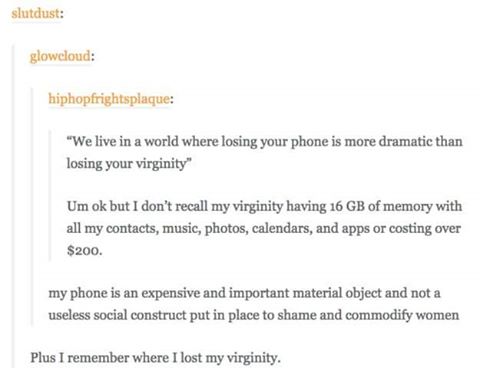
“We live in a world where losing your phone is more dramatic than losing your virginity” … “My phone is an expensive and important material object and not a useless social construct put in place to shame and commodify women” (Click to embiggen)Several years ago I listened to a Stephen Fry podcast in which he talked about one of the dangers of being a columnist/ essayist/ person who writes a lot: something he called The Milkman’s Cheery Whistle. It was how, after writing for a very long time, one might find oneself short of ideas with a deadline looming, and resort to writing a musing on some thing you remember fondly which is no longer around—a nostalgic regret. For example, a lament that early mornings in residential neighborhoods no longer include the sounds of a milkman cheerfully delivering dairy products to the front doors of customers. Isn’t it sad that everyone, including the author, buys their milk at a local supermarket by simply walking in and buying it when needed, rather than getting that personal touch of a horde of people employed to get up at ungodly hours in the morning and drive around neighborhoods leaving orders in little insulated boxes on your doorstep?
One of the reasons this is a danger is not just because it represents lazy writing and lazy thinking, but because it encourages regressive thinking in the readers. Focusing on the loss of the Milkman’s Cheery Whistle ignores the reasons things have changed. It’s more efficient and cost effective (and safer) to deliver perishable food in quantity to central distribution sites (stores), for instance. Focusing on such nostalgic regret also ignores the less cheerful truths about the past. Nostalgic regret is ultimately about ignorance.
The good old days weren’t simpler, and they certainly weren’t inherently better. For example, throughout most of history child abuse was not only legal, but condoned and even encouraged. In the U.S. it wasn’t until 1962 that the first law requiring health professionals to report suspicions of child abuse was passed in any state, and it wasn’t until the mid-70s that such laws were common. As one of my teachers told me, when he contacted me decades later feeling a need to apologize: a teacher was more likely to lose their job and become completely unemployable for reporting his or her suspicions than any parent was to suffer consequences in child abuse cases.
Nostalgic regret is sometimes about absolving oneself of any guilt from having benefited from societal systems of discrimination. For example, take people claiming now that no one was talking about racism “back in the day.” What they actually mean is that the law and society at large condoned and encouraged racism which benefited some at the expense of others. Laws required “colored people” to use separate drinking fountains, restrooms, and public schools. Lynchings weren’t mysterious events committed only by Klansmen in hoods—in the 1930s white Americans were still proudly posing for newspaper photographers beside the bodies of lynched African Americans, and not just in the south! Most people don’t realize that the NAACP was still campaigning to get anti-lynching laws passed in the 1950s.
So of course, if you were a white person living in the 40s or 50s, no black person would say anything about racism within your hearing. They didn’t want to be the next “uppity” person of color to be executed by a mob!
Nostalgic regret is also about a particular kind of need to feel superior to others. In the screenshot I’ve included at the top of this post, for instance, someone tried to make yet another comment about how kids these days are focused on trivial things instead of something the commenter thinks is more important. In this case, worrying about smart phones instead of protecting one’s virginity. Except what is virginity? It’s a social construct—an ill-defined line in the sand primarily used to define woman as property and prizes belonging to men. An arbitrary distinction purporting to measure innocence. A social contrivance to artificially define natural desires and natural acts as a set of magical experiences which are evil if they occur outside certain prescribed circumstances designed to shore up the hegemony of straight men, or a sacred revelation if they are performed within those prescribed boundaries.
I’ve been told that this isn’t merely an artificial distinction. But certain married men argue that just getting blowjobs isn’t sex (and by implications, isn’t cheating on any vows of fidelity they may have made to their spouse). Certain men who claim to be straight argue that all sorts of sex acts committed with other men aren’t actually sex, because if those acts were, then the men would have to admit they maybe they aren’t straight. And I have heard all sorts of sexual acts emphatically described as not “real sex” by those guys, believe me!
If we’re going to talk about virginity at all, we can call it what it actually is: inexperience. Far more rational to understand that a single action can’t take you from being an innocent person to a “man of the world” or whatever. Far more important than shaming people about a natural biological and social activity (don’t get me started on all the scientific proof that sex in humans and certain other species serves many useful and important other purposes besides reproduction), would be to teach people the importance of treating one another with respect, of setting boundaries about people who don’t treat you with respect, and how to deal with the emotional rollercoaster of relationships.
And as far as worrying about your smart phone: well, they are expensive pieces of equipment (and when they seem not to be expensive, that’s usually just a shell game for the even more expensive contract a phone company has gotten you locked in to), not toys. They are portable computers which usually contain a lot of valuable information—information which could be misused by unscrupulous people for many nefarious purposes. In modern society, they are a necessary tool to keeping one’s life, health, and employment intact. They are valuable in many ways, and often not just to the owner, but to people in the owner’s life. Not worrying about a lost phone would be a pretty irresponsible act.
And yes, may well have far more impact on someone than a single act of inexperienced intimate contact with someone probably nearly as inexperienced.
Perspective—fully-informed perspective and consent—is far more important than nostalgic regret.
On Saturday evening, while waiting to get seated for a thoroughly hilarious movie, I retweeted something about one of the presidential candidates. A friend replied that what I’d retweeted was B.S. I tried to figure out how to respond without coming across as dismissive or snarky. And I was not in a position to easily pull up links to back it up. And twitter isn’t a good place to try to have such conversations.
The friends asked me to send the links later. So the sole purpose of this post is to collect several links, most of which have already been posted on this blog. If you don’t want to read any more of my opinions on a particular presidential candidate, don’t click through on the Read More link below. Instead, may I suggest a happy link instead: This High School Cross-Country Team Takes Lonely Shelter Dogs On Their Morning Runs. That’s much more fun, no?
They’ve begun releasing autopsy reports of the victims of the Pulse nightclub massacre in Orlando: Most Pulse victims shot multiple times, first autopsies show. It was nearly two months ago, on June 12, that the killer snuck a gun into a busy gay night club on Latino night and opened fire, killing 49 people and wounding many others. In that time we’ve had Republican politicians express false sympathy, then days later vote down gay rights protections. We’ve had people try to claim that the act wasn’t an anti-gay crime. We’ve had people gin up evidence (which has been thoroughly debunked) that the killer was secretly gay himself. We’ve had people and politicians try to claim the killer was part of an organized Islamic terrorist organization, and that has been thoroughly debunked as well.
And a lot of people have moved on.
Some of us can’t. As I wrote before, one reason it’s so difficult for me is because my whole life I’ve lived with the fear and knowledge that there are people who hate queers enough to attack me and kill me, but I haven’t often had to think of the hatred of me being a danger to those around me. The killer’s own father said that his son had become disproportionately angry about seeing two men kissing in public over a week before the incident. Others who knew the killer have talked about his increasingly angry outbursts about gay people. Seeing two men kiss made him go kill 49 people in a busy gay nightclub during Pride month.
It’s one thing to know that bigots hate me enough to kill me. It’s another to realize some hate me enough to commit a massacre.
And it’s upsetting to know that some people who claim to be friends, and relatives who have said they love me, are completely incapable of understanding that this killer’s actions are a symptom of society’s messed up attitudes about queer people and about guns. And that’s what people are saying when they claim this is just one lone nut. Or that this isn’t really about queer people. Or that there is nothing society can do that will make these events less likely to happen. So, yeah, it’s upsetting to be told to my face that someone else’s right to sell assault weapons to a person with a history of domestic violence (despite even a majority of NRA members expressing the opinion that people convicted of such crimes shouldn’t be able to legally purchase guns) is more important than protecting the lives of people like me.
One of the other things we don’t think about in our haste to move on after an event like this is just how long the aftermath is. It’s been nearly two months, and they’re still working on the autopsies. The reports just now released are only the first part of the analysis. Experts won’t be able to begin to do a thorough incident analysis until all of the rest of the autopsy reports are complete, and then the work of coordinating those with all the other evidence and reports begins of trying to understand what happened in there.
But I need to get back to writing. Especially since I have promised some stories to several people.
Anyway, here are links to some of the interesting things I read on the web this week, sorted into various topic areas.
Links of the Week
I Know Why Poor Whites Chant Trump, Trump, Trump. This is a long read, but it is an excellent article that has almost nothing to do with Trump, and instead talks about a few hundred years of how poor people of all races have been treated and manipulated in North America.
Stockton mayor arrested at youth camp in Amador County. Previously, Mayor Silva has held official town hall meetings at an anti-gay megachurch and once held a taxpayer-funded ceremony to present the key to the city to God (who sadly did not attend).
David Huddleston, Who Played ‘The Big Lebowski,’ Dies at 85. Until I saw his obituary, I never knew Huddleston was in that movie, because I’ve never seen it nor been interested in it. To me, Huddleston was one of the last of the great character actors: he played similar men in supporting roles in hundreds of TV episodes and movies.
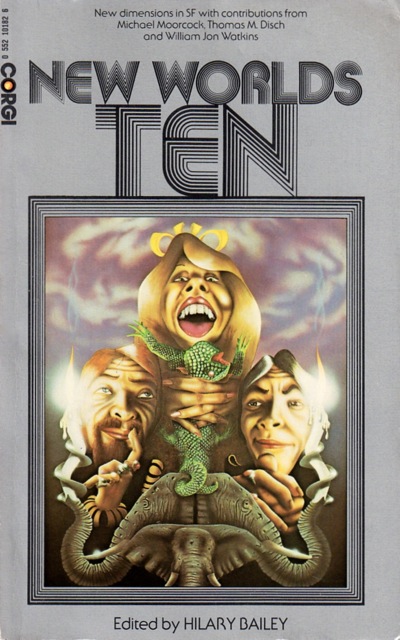
New World Ten, published August 1976. Cover artist not credited and no signature visible.I first read “The Cabinet of Oliver Naylor” by Barrington J. Bayley in a used paperback copy of the The 1977 Annual World’s Best SF edited by Donald Wolheim that I bought in either late ’77 or early ’78, though it was originally published in New Worlds (sometimes titled New Worlds Quarterly, though they never managed to published more than twice a year), a magazine founded in 1964 by Michael Moorcock, borrowing a name from a sci fi zine that had originally been published in Britain from 1936 through 1963. Moorcock meant the magazine to focus more on experimental writing. It became the birthplace of the New Wave of sf.
None of which I knew when I read Bayley’s story. I was an American high school student whose exposure to sci fi had been dictated by what was available in libraries of various small towns and the pages of U.S. magazines such as Galaxy or The Magazine of Fantasy and Science Fiction.
“The Cabinet of Oliver Naylor” is a novella about a man living in a future where many technologies we would think of as impossible are commonplace. He is flying a personal craft at the velocity of c raised to the 186th power while fiddling with an invention of his own which he hopes will lead to the solution to a problem his society hasn’t yet tackled. He is accompanied by a sort of hitchhiker named Watson-Smythe who is trying to find an artist named Corngold.
Naylor’s invention is a thespitron: a device that constructs stories from all of the possible elements of fiction. Not just stories, it creates virtual worlds inhabited by beings that may be independently intelligent. The problem Naylor is hoping to solve with his experiments is navigation. In Naylor’s time it has been discovered that reality is far bigger than believed in the 20th century: the width of what we think of as the entire universe is simply a unit of measure for this reality. With those distances, the speeds at which advanced civilizations can move, and the fact that reality itself is expanding and changing while they’re zipping around at these impossible speeds means that no form of navigation is reliable. The very fabric of space changes between one’s origin and destination, so from time to time ships become lost.
Naylor has a theory that reality isn’t defined by matter, but by abstract concepts and relationships. He’s convinced if he can truly understand the nature of identity, how objects and beings relate to each other, such as in the structure of stories, that he can create a formula or algorithm to reliable rediscover any unique object one has observed before.
Which is all very cerebral and surreal compared to Watson-Smythe’s quest to find the artist. They do find the artist, his ship seemingly stranded on the edge of a vast stretch of unreality they call a matterless lake. At which point it’s revealed that Watson-Smythe is a government agent out to arrest Corngold, and that Corngold’s model is actually a victim of rape and kidnapping.
What happens next is in some ways far too predictable. When I first read it as a teen-ager I was rather angry that I saw what was going to go horribly wrong before it did, and couldn’t believe an interstellar spy would be stupid enough to fall for it. Even the dippy overly philosophical inventor, Naylor, should have seen it coming, I felt. I was also confused as to why the model/kidnap victim/rape victim seemed completely passive and apparently too afraid, even when essentially a cop arrives ready to rescue her, to do anything against her captor.
Re-reading it more recently, I was even more irritated when I realize that the author gives literally zero lines of dialog to the only woman in the story. Even while she is being abused in front of the officer who supposedly is there to arrest her assailant, the author tells us what she does, but doesn’t let her speak. It’s not that the author says she’s mute. No, the author says that she “responds noncommitally.”
Despite being frustrated with the story, I found a lot of it fascinating. The far future technology, which includes the ability to synthesize any matter one can name from a sort of quantum blob and back again when no longer needed, reminded me a lot of the Culture series by Iain Banks. So when I was reading up on Barrington J. Bayley, I wasn’t surprised to learn that Banks was one of the younger authors who listed Bayley as an influence on his work.
I was also not terribly surprised to find Bayley’s work described as gloomy and downbeat, which this story certainly was. While looking through the list of novels and short stories Bayley had published during his life, I was a bit surprised at how few titles I recognized. I think that this story is the only one of his that I’ve ever read.
While it isn’t a very satisfying read, I can’t say that it’s a bad story. It kept my attention and made me keep turning pages wondering how it would end. Admittedly, part of that was trying to figure out how the author would pull an interesting ending out of this mix of weird characterization and convoluted philosophy and mess of a plot. The story made me want answers, and it made me think about what clues I might have missed.
Is Bayley intentionally making the characters do stupid, and predictable things, to make a point about the reality of Naylor’s world and the unreality of his invention’s constructed worlds? I’m not sure. The intentions of the New Wave writers were to experiment by breaking the established rules of writing and try to find a new way to tell and experience stories. I do have to agree with Donald Wolheim’s comment in the introduction of this story in the anthology: this story crams more science fiction concepts and ideas into it’s novella length than many whole series of novels contain.
And maybe that piling up of ideas without a clear cut answer to any of the questions the central character raises is the point. Sci fi is supposed to be the genre of ideas, after all. And this tales serves up a whole lot!
If you’re going to vote for the best candidate, rather than one with a chance of winning, why not vote for long dead Franklin Delano Roosevelt? It makes more sense than voting for Stein. (Click to embiggen)So as if I haven’t written about the Green Party candidate more than she deserves, there has been a new development. One that has caused multiple people to contact me to say that one of the things I’ve reported previously about Dr. Stein is incorrect. Snopes.com, which normally is an excellent source of debunking misinformation, had announced that Jill Stein is not anti-vaxx. And lots of people are repeating their report.
Now, in my previous blog post about why a vote for the Green Party candidate is a vote for Trump, what I said about Stein was that she flip-flops on this issue, depending on who she is talking to. Sometimes she’s anti-vaxx, sometimes she’s pro-homeopathy, and sometimes she is both pro-vaxx and anti-vaxx at the same time.
Snopes has decided that she’s not anti-vaxx primarily on the basis of one of those times that she was being both, and they have elided over part of the quote. Here’s a complete answer from a recent Washington Post interview: “I think there’s no question that vaccines have been absolutely critical in ridding us of the scourge of many diseases — smallpox, polio, etc. So vaccines are an invaluable medication. Like any medication, they also should be — what shall we say? — approved by a regulatory board that people can trust. And I think right now, that is the problem. That people do not trust a Food and Drug Administration, or even the CDC for that matter, where corporate influence and the pharmaceutical industry has a lot of influence. As a medical doctor, there was a time where I looked very closely at those issues, and not all those issues were completely resolved. There were concerns among physicians about what the vaccination schedule meant, the toxic substances like mercury which used to be rampant in vaccines. There were real questions that needed to be addressed. I think some of them at least have been addressed. I don’t know if all of them have been addressed.”
In other words, she’s like the racist who says, “I’m not racist, but…” and then lists anecdotes purporting to prove that people of a certain ethnic background are more prone to committing crimes or something similar. All of that stuff about people not trusting the FDA and that there are real questions that haven’t been addressed? That’s all straight out of typical anti-vaxx talking points. She is literally saying that she isn’t anti-vaxx but…, and then quoting all of the anti-vaxx language. It’s a dog whistle. The anti-vaxx people recognize that what she’s communicating to them are that vaccines are dangerous, that they shouldn’t trust the people who say they aren’t, and so forth.
So Snopes is wrong. Jill Stein promotes an anti-vaxx agenda, while pretending not to. I suspect that she probably isn’t sincerely anti-vaxx herself, but she’s promoting it for cynical political reasons. She’s being disingenuous when she says that there are real questions that haven’t yet been addressed. She flip-flops on it, because she knows that a significant fraction of the people idiotic enough to vote for her need to believe. But she also knows that some of the other people who are susceptible to her pitch aren’t anti-vaxx, so she tries to pander to both: Jill Stein Watered Down Her Own Statement Rejecting the Myth That Vaccines Cause Autism.
Similarly with the homeopathic stuff. She has used the language of homeopathy intermixed with statements that sound reasonable to someone who isn’t really familiar with the usual talking points of the homeopath quacks. She frequently falls back on claims that science hasn’t been able to prove absolutely beyond a shadow of a hint of a doubt that something isn’t caused by whatever is currently under discussion. Never mind that you can’t prove a negative, and what the standard is in science is to gather evidence, try to falsify your theory, and after lots of people have tested it in various ways, conclude that the preponderance of the evidence says thus and so.
She has no chance of winning. The person who is quoted in the graphic I linked above guesses her chance is one-tenth of a percent, but that wrong. She is not on the ballot in enough states to add up to the number of electoral votes needed to win. Many of the states where she is not on the ballot do not allow write-in votes for President. Many of the states where she is not on the ballot will not count write-in votes for President if the candidate has not registered electors with the state. The Green Party doesn’t have electors in most of those states.
It is literally impossible for her to win. That’s not an opinion, that’s fact.
Her candidacy is worse than a joke, it’s a scam. Don’t fall for it.
Cultural Note: My title today is a cultural reference to a one-woman play written by Pat Bond and Clifford Jarrett in the late 70s, Gertie, Gertie, Gertie Stein Is Back, Back, Back. Their title was itself a reference to the Time Square Reader Board’s report at the beginning of Gertrude Stein’s U.S. lecture tour in 1934. Please give yourself a prize if you recognized the reference.
Flow chart to help figure out if your First Amendment rights have been violated. (Click to embiggen)So I recently wrote about a professional internet troll who was finally kicked off Twitter after years of extensively documented organized harassment of (mostly) women on line. He was finally kicked off because he went after one of the actresses in Ghostbusters and she was famous enough that major news sites carried stories about it and so forth. In case there was any doubt about what will actually motivate a company like Twitter to enforce its own rules. Anyway, I got a fairly long comment on that post yesterday. The person left the comment under his own WordPress account, which links to a very active blog, so he isn’t trying to be anonymous. And he asks some questions, apparently expecting answers.
But I’m not approving the comment, and have added him to the blacklist because he couldn’t finish the comment without including racial slurs (aimed at the actress).
So I’m not going to subject anyone else on the internet to that. Since I have previously stated that my policy is to approve comments that disagree with me if the person seems to legitimately want to discuss, I confess that I wrestled with the decision for a little bit. One of the options I have is to edit a comment before I approve it. So I could just delete the slur, right? But I’ve never edited a comment, because that seems to cross a line for me. The comment system warns you that I screen comments and it won’t appear until approved, but editing opens me up for accusations that I’ve changed something else, you know.
And I honestly don’t want to send any traffic to a site run by someone who would deploy a slur like that.
But I do want to address a few things. The commenter first opined that if I were going to write about this particular instance of harassment, I’m obligated to write about any and every other instance of harassment going on in the world. No, no I’m not. This is a personal blog. I’m not a journalist. I’m not representing myself as a news site. I have been an editor of campus newspapers a zillion years ago, and worked as a freelancer for a short time; but even then, editorial discretion applied—a publication should choose which stories are relevant to their readers, and in how much depth to cover them.
I have written about some other instances of harassment. I’ve written about the general topic of online harassment many times. I link to news stories and opinion pieces about these sorts of things in Friday Links quite often.
The commenter went further and listed three specific events which he thought were similar to the organized harassment story I mentioned above, and asked whether I have covered them, as well. Again, with the assertion that I’m obligated to do so since I commented on this one. Of the three events he listed, two are mythical. They are false stories that many conservative web sites trot out from time to time that have been debunked. So, no, I have not written about them.
The third one, the Isreali Hasbera operation, well, I suppose it is worth commenting on, but if Al Jazeera has declared it a failure two years ago, I’m not sure what more there is to say about it: The grand failure of Israeli hasbara. An even bigger problem is that a government intelligence agency creating sock puppet accounts to harass and spread misinformation, while it is a deplorable thing, isn’t the same as a private individual encouraging other private individuals to flood yet another person’s social media accounts with racist and misogynist harassment, death threats, rapes threats, et cetera.
It’s a false equivalency. Just as a private company deciding not to serve a customer who abuses other customers is not censorship. I understand that the commenter is looking at the alleged online harassment by government officials as similar to other forms of harassment. Harassment is bad. Which I’ve said many times.
But it’s not in the same lane as a raving mob of fragile man-babies/mens-rights-advocates harassing someone. It’s not in the same lane as sci-fi/fantasy fandom gatekeeping. It’s not in the same lane as societal racism and misogyny. All of those are topics I comment on all the time. And the original story was an intersection of all of those things, which is one of the reasons why I commented on it.
But I comment on things like that because I have personal experience with all of those things. I can write about them from that experience. I don’t have personal experience with the machinations of the Isreali government. The likelihood that I’ll have something to say that is any different or insightful than other articles/posts you can read on that topic is nil. So I don’t go there very often. I’m far more likely to comment on Isreali pinkwashing, because as a queer man, I have some experience seeing my very existence used as a talking point by politicians.
Yes, I’ve also commented on various atrocities committed by governments. So, maybe if there’s a new development in this area someday, I might comment on it. More likely I’ll include a link in Friday Links and let my readers who are interested follow up.
It’s my blog. It’s my opinion. I get to decide what I get worked up over, and what things I will ask my readers to spend their bandwidth on. The wingnut has his own blog. He can talk about these topics there.
Jerry Emmett, the 102-year-old honorary chair of the Arizona Democratic delegation, speaks during the Roll Call of the States.It’s the fifth Friday in July, and I’m glad that Friday is finally here. It was a much better week, for me, at least in the news from the real world sense. I’m feeling a lot more hope for the future this week than I was last week.
Anyway, here are links to some of the interesting things I read on the web this week, sorted into various topic areas.
Ken Ham Isn’t a Big Bad Ogre: Why I Feel Bad About Ark Encounter. But he is still a liar (who posted photos of another event claiming that it was opening day), and a con man (who convinced the state to give him tax money for a religious project, that’s after essentially embezzling from a religious group he used to work for in Australia), and a peddler of lies and pseudo science. But we’re suppose to believe he’s not an ogre. Fine, he’s not an ogre, he’s a parasite.






 Font Folly