I've loved reading for as long as I can remember. I write fantasy, science fiction, mystery, and nonfiction. For more than 20 years I edited and published an anthropomorphic sci-fi/space opera literary fanzine. I attend and work on the staff for several anthropormorphics, anime, and science fiction conventions. I live near Seattle with my wonderful husband, still completely amazed that he puts up with me at all.
View all posts by fontfolly →
I find myself reading about consent a lot. Having grown up in a culture which socializes guys not to take “no” for an answer, while socializing girls not to make trouble and always put other people’s wants and comforts first, it’s no wonder a lot of people don’t seem to understand consent in that context. Then there’s the whole Harper Lee and her “new” book situation. Is she healthy and aware enough to give informed consent? Does she actually know what’s going on, or is she a victim of the younger lawyers from who sister’s old firm who have taken over her estate now that her sister has died?
When I had read that her home state had initiated an investigation because of the reports of coercion, and that the state had determined that she had given her consent freely, I was mollified. I also rationalized it by comparing it to volumes I own of posthumously published material from Arthur Conan Doyle and from J.R.R. Tolkien. Those early drafts (heavily annotated by experts) and small one-offs originally created for a limited audience are fascinating and very educational, particularly from a writers’ point of view. If I can own those and enjoy them, do I have a right to condemn anyone who purchases this “new” book?
Of course, there is a difference. Tolkien and Conan Doyle have been dead for decades, these things have the notes and commentary making it clear that they are drafts or incomplete works. They aren’t being represented as something the author thought was a finished product. They’re clearly an exercise is the academic study of the work of those writers, and intended to illuminate the other works of the author.
But now I read that the investigation that looked into Harper Lee’s case did not include any medical personnel. No part of the investigation seemed to focus on whether she still possesses the capacity to give informed consent. That changes things a lot.
I do like one local book reviewers’ take on it: he read the new book, says the first chapter is amazing and you can understand why instead of outright rejecting it, the editor asked her to write a different story without the flashbacks to the narrator’s childhood, but rather to tell a story about the protagonist as a child. And then as you get into the rest of the book, the fact that this is a first draft of a first novel by a novice author is clear. And, he says, you can see why, with the help of an agent and the editor, it took her about a dozen rewrites of that second version of the book to arrive at To Kill A Mockingbird.
One other reason: there is absolutely no doubt that at the time Lee wrote To Kill A Mockingbird that she thought it was complete, that she was ready for it to publish, and that she knew what she was doing.
It’s also, if my very vague memories of reading it in my early teens, a very good book. Which I intend to re-read soon!
As usual, there were a few big news stories of the week I didn’t include in Friday links, and a few that have had more developments that I didn’t see until after I set up the posts to publish. Because I put the Friday Links post together Thursday night, but also because I post a full version of the post to my old LiveJounal and Dreamwidth blogs and my Blogger site, none of which I’ve ever been able to fully automate, so I spend way longer putting them together than I probably ought to.
Anyway, my social media streams were flooded with a lot of Caitlyn Jenner stuff. Mostly people reacting to other people’s snark and derision, especially about her winning the Arthur Ashe Courage Award, Caitlyn Jenner at ESPY Awards: Accept People ‘for Who They Are’. The speech itself was awesome, with a lot of heart, and focused on the problems of trans kids: Caitlyn Jenner honors transgender boy with Macomb County ties during her ESPYs speech. But haters gotta hate. And I think all we can do when they do is shut them down, like Joey Vicente, a U.S. Army behavioral health specialist did in the post I’ve pictured here. Click it to embiggen and read it.
Tangentially: GoodAsYou.Org’s Jeremy Hooper reads all the news blogs and such of the professional anti-gay haters so we don’t have to, and reports that Maggie Gallagher of NOM is trying to claim that support for gay marriage is suddenly plummeting. Jeremy explains how Maggie has constructed this lie (or is it self-delusion), but there’s also this: U.S. Support for Same-Sex Marriage Stable After High Court Ruling. Which isn’t stopping the wingnuts (especially my relatives on Facebook) from continuing to post foaming-at-the-mouth rants about the coming apocalypse because of the gays, how the rainbow flag is a “dark symbol of tyranny,” and the need to assert their religious liberty by discriminating agains the gay. Patheos has a nice counter to this: Your “Deeply Held Religious Belief” Isn’t Biblical. If only there was some way to get people to stop screaming and listen, eh?
It’s Friday! A glorious Friday that did not arrive a moment too soon. I should have more witty things to say, but I’m just soooo tired.
Anyway, here is a collection of some of the things that I ran across over the course of the week which struck me as worthy of being shared. Sorted into categories with headings so you can skip more easily:
Santorum Calls For A Constitutional Amendment To Ban Same-Sex Marriage. Note that the other wingnut pesidential hopefuls decided it was slightly more reasonable to call for a constitutional amendment giving states the right to define marriage. Which is slightly less bigoted-sounding.
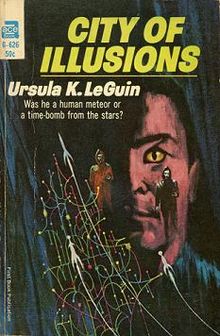
The cover of my paperback version is a bit more tattered than this image I found (Click to embiggen).I think I found my copy of Ursula K. LeGuin’s City of Illusions at the used book store that was in a town thirty miles away from the town I lived in for most of middle school. I know that I owned it before my folks split when I was 15. I don’t recall exactly where I acquired it, but I do know why I wanted to book: the character on the front of the cover had cat’s eyes, which I thought was really cool.
I don’t think this was the first sci fi novel I read that featured such a character. There are are so many sci fi books with characters that look mostly human, but have eyes like a cat or a bird of prey. But it was the eyes that really grabbed me.
The story begins with the man on the cover being found in the woods without any memory, not even a language, no clothes, and no clues as to who he is. The people who find him aren’t certain he’s human, because of the eyes, but they take him in, name him Falk, and teach him. We learn that this is Earth of a distant future, once part of an interstellar federation of some sort, conquered by aliens, and now severely de-populated and isolated from the rest of interstellar society. The aliens technically rule the world, but they keep to themselves in a single massive city.
Falk eventually sets out on a quest to try to discover who he is. This allows the author to show the reader other parts of the world before Falk finally is taken captive by the alien overlords who tell him he’s one of only two survivors of a crashed spaceship from another world. They introduce him to the other survivor, and offer to restore his memory—though it will mean erasing his current personality. Falk agrees, and the novel switches to the point of view of the restored personality, who doesn’t know what Falk knows about how the humans on earth are treated. The aliens want Falk to go back to his own people and tell them how they are running earth as a garden, keeping the humans happy.
Eventually the original personality is able to awaken Falk’s memories, which also means that he winds up with two personalities trying to work together.
I’ve left out an important detail: just about everyone seems to be telepathic, Falk, all the humans he meets, and the aliens. Telepathy was how the old Federation came to be, because no one can tell a lie in psychic communication. Except it turns out the alien invaders can. Falk and the restored original personality realize the aliens aren’t going to let him go if he remembers the truth about Earth, so he has to steal a spaceship and escape to his homeworld where he may be able to convince them to attempt to liberate Earth. There’s a cute telepathic trick that Le Guin uses at a crucial point in the climax, and the story ends on wit Falk on his way to his homeworld, but without the certainty that Earth will be liberated.
The novel straddles several categories of science fiction. The world is a post-apocalyptic world, even if the apocalypse happened a thousand years ago and a new, stable set of societies have developed. There’s also the aliens subjugating humans genre. And the isolated protagonist who has to discover who he is.
The novel is one of three loosely connected books (the others being Rocannon’s World and Planet of Exile) in which Le Guin was working out a single future history, in which humans have been seeded on many worlds, and they have diverged in various ways, but still consider themselves one race. This is where it encompasses another idea that was more popular in Golden Age science fiction: humans aren’t native to Earth, but were seeded there hundreds of thousands of years before our time.
Some of her much more famous later books, The Left Hand of Darkness, The Dispossessed, and The Word for World is Forest are sequels, in a sense, to these books. They all allude to the common history of these three, in any case, so a lot of people lump them all (along with a few others and some short stories) into a single saga called The Hainish Cycle. Le Guin herself has rejected the label, in part simply because the collective works don’t tell a single story. Another reason is that in the first three books she was trying to figure out how to do a future history, rather than having drafted a coherent future history as a grand backstory to it all. So there are contradictions and variances in the histories of all the books.
The City of Illusions is one of those stories that sticks with me in weird ways. I remember Falk, his struggle to discover himself, and especially the way that Le Guin portrays the two people living inside one head phenomenon at the end. I remember the notions and paradox of telepathic lying. But I forget things like what the aliens are like. I forget what any of the other human societies that Falk visits during his adventures are like. That’s not a bad thing. The story is, on one level, about isolation and discovery. And that part really resonated for me at that age. Some of her other ideas from this book I find myself incorporating into my own stories without consciously realizing where they came from. Which I think means that Le Guin conceived them and executed them well: they’ve become part of the fabric of how I think things would actually work.
Years later, I have read many other Le Guin books, and I own her translation of the Tao Te Ching, a holy book that figures in this novel’s plot. Which I think means that once I finish reading this last Hugo novel, I need to add City of Illusions to this year’s queue for a re-read.
As the number of people officially announcing their candidacy for the Republican nominee for president keeps going up and up, I’ve noticed a lot of people making the same lame meta-joke: “Looks like instead of a clown car, we need a clown van.” This joke, besides being lame because each political observer has been repeating the van comment several times, is bad because it completely misunderstands the whole point of calling the field of potential candidates a clown car to begin with…Continue reading Of clowns, cars, and twits→
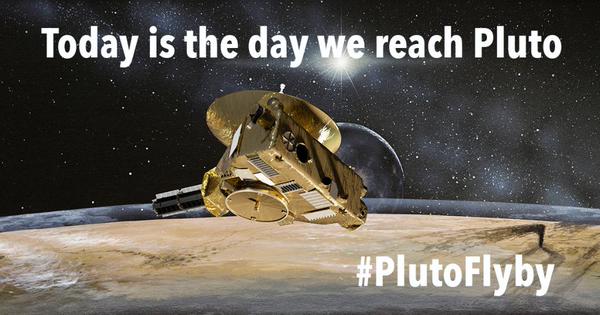
NASA.gov (Click to embiggen)We’ve come a long way from the morning in June, 1965, when I watched my first NASA launch, live. I’m pretty sure that Walter Cronkite was the narrator of my adventure. And by long way I do mean literally. The furthest from the Earth’s surface that Gemini 4 got was about 155 nautical miles. New Horizons has traveled about 3,000,000,000 miles (that 3 billion, yes, billion-with-a-B) to do its Pluto flyby.
The Gemini launch was the first one that was broadcast live, around the world, by satellite. So a lot of people watched the launch. And it was a great flight. Ed White (Edward H. White II) become the first person to space walk, exiting the capsule in a spacesuit with a camera. NASA only let him stay out 20 minutes (actually, they were telling the other astronaut, James A. McDivitt, to get White back in sooner, but White was trying to stay out as long as he could). White and McDivitt could communicate to each other over an intercom line that was part of the tether, but it didn’t connect with the exterior radar to the ground. On top of that, the primary communication system with the ground was having some problems (the VOX unit at McDivitt’s end didn’t correctly identify when McDivitt was talking, so it kept cutting in and out and odd times, so he had to switch to the push-to-talk mechanism).
NASA didn’t want White outside of the capsule during any of the periods when the capsule was out of range of a tracking station (we didn’t have quite as extensive a network of tracking stations around the world back then, so there were a few points in the orbit where we were out of communication with the capsule).
I’ve been a space geek at least since 1965. Probably longer, but the Gemini 4 launch is the earliest one I remember watching (and apparently drove everyone crazy talking about it for weeks after).
So, yes, I’m pretty excited about our flyby of the planet Pluto (if you’re one of those deluded people who adhere to the totally ridiculous redefinition, don’t bother arguing; a scientific definition of an class of object should depend upon the objectively measurable properties of that object only, not the presence or absence of other objects in its vicinity). I can’t wait until we start receiving the images New Horizons is taking today. We’re going to learn so much!
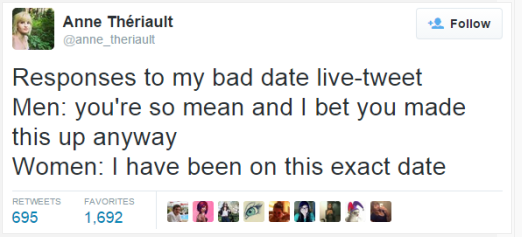
In one of the Discworld books, Terry Pratchett asserts the theory that there are only a small number of real people in the world, and the many people you meet are merely duplicates; that’s why you seem to meet the same kinds of people over and over again. I was reminded of this phenomenon by a string of tweets by Anne Theirault being shared around on Tumblr. They begin with her observation of a couple at the next table who seem to be on a coffee date that is not going well.
(Click to embiggen)She proceeds to live tweet the conversation she is overhearing. The guy talks about himself constantly, without ever asking his date about herself. Any time she volunteers something about herself, he has to turn it into something about him. Example, she mentions she likes to cook, he tells her that she must taste this exotic sauce that he makes that a friend who is a chef says is great. And so on. Eventually the woman on the date fakes getting a text from her mother as an excuse to escape.
(Click to embiggen)A little later Anne tweeted about all the reactions she was getting. Specifically, that most of the men who responded asserted that she’s being unfairly mean to the guy and/or accusing her of making the whole thing up. While the overwhelming majority of women respond that they have been on exactly the same date.
The Tumblr post has been shared nearly 200,000 times as of this morning. I noticed that I was not the only queer guy by any means to share it and comment that we had also been on this exact date. Other people have added the observation that they know it’s true not just because they’ve been on a similar date themselves, but because they know dates like that happen every single day.
I noticed that a lot of people sharing it on Tumblr make the observation that this proves you should never date a writer (the guy describes himself as a writer and says a lot of very cringe-worthy stuff about writing). Which means that these people completely misunderstand. First, Anne Theirault, who live-tweeted the exchange, is herself a writer. That wasn’t the observation she was making. The guy isn’t cluelessly obnoxious and self-absorbed because he’s a writer. He’s cluelessly obnoxious and self-absorbed because he’s a guy.
When I reblogged the Tumblr post, I observed that I had been on that exactly date back in the 90s, and had to fake coming down sick in order to flee. I was the writer in the conversation. The other guy was a performance artist. But I’ve had the exact conversation (not in the context of a date) with guys who are in marketing, guys who are software engineers, guys who are car mechanics, guys who run their own businesses, et cetera. And even worse, I know that there have been conversations I’ve been in when I was the cluelessly self-absorbed guy who only wanted to talk about myself and never let the other person get a word in edgewise.
Guys are socialized to be that kind of person. We’re supposed to assert ourselves, and dominate conversations. If we don’t all have the requisite extroversion streak to dominate, we’ve at least all been socialized to expect that our needs are always important, that of course anything we are involved in is going to be interesting to other people—not just interesting, but exceptionally interesting, because everything we do is special and unique and better than what anyone else is doing. Guys are taught to be entitled. We’re also taught that it is our job to win people over to our side. To be competitive even in a conversation. We’re taught that a date isn’t a chance to get to know another person, a date is an opportunity to conquer and take the other person as a prize.
Some of the specific assertions that Anne tweeted that the guy makes about how incredibly hard writing is, and how he has to struggle with his inner demons to write, even those are not something that is common to writers nor restricted to writers. The performance artist disaster of a date spent a lot of time explaining to me how very very hard it was to do what he did, how he had to dig into his worst childhood memories to infuse his performance pieces with meaning, and so on. It’s a product of the self-absorption and competitiveness. He was trying to impress me, to make me swoon over his great emotional depths and work ethic.
The only inner demons a writer needs to struggle with are Procrastination, Distraction, and the “But it’s not perfect yet!” urge. And those aren’t really demons. They are ordinary (and usually quite minor) imperfections. Our struggles aren’t exceptional. They are the same kinds of things that everybody struggles with.
Not all guys are like that all of the time. There are even some guys who are almost never like that. Some of us have realized we can be like that, that it isn’t good way to be, and we try not to let our arrogance bulldoze everyone else. I am also aware that there are even some gals who can be that way. Humans are not perfect.
Unfortunately, a lot of humans are imperfect in very similar ways.
Another in my series of posts recommending web comics:
Caterwall by Spain Fischer Caterwall is the story of Pax, who is the orphaned son of a knight who was the hero of the kingdom, and his best friend Gavin, who is the descendant of a line of seers. Pax is a young man who has a reputation for pulling pranks and telling lies, who gets exiled from the kingdom. Gavin joins him in exile. I like the story and really like the artwork. It’s just so cheerful and cute, even when grim things are happening. Caterwall is a graphic novel, the first 25 pages are available on the web site. The first book has recently been published and is available for purchase here.
I have recommended “Mr. Cow,” by Chuck Melville many times before. A clueless cow with Walter Cronkite dreams presides over a barnyard of a newsroom. But I need to update the recommendation because the comic has moved to a new site. The old Web Comics Nation site died without notice (literally), stranding several artists and leaving no way for them to post pointers from their old URLs to their new homes. Chuck has found Mr. Cow a new home on Comic Fury: mrcow.webcomic.ws. His other comics have also been moved to the new host: Champions of Katara and Felicia, Sorceress of Katara. If you like Mr. Cow, Felicia, or Flagstaff (the hero of Champions of Katara) you can support the artist by going to his Patreon Page. Also, can I interest you in a Mr. Cow Mug?
I’m a big fan of (and have previously recommended) “Deer Me,” by Sheryl Schopfer. This artist is also a friend. I have previously described this strip as: “Three roommates who couldn’t be more dissimilar while being surprisingly compatible.” Except in a recent story line Thomas has moved out! Eeek! After a storyline that took us back to the high school days of some of the characters, the storyline has returned to “the present day” where various consequences of the Thomas’s moving out are coming to pass. While checking the links, I realized that my older recommendations for this comic linked to a specific strip on the artist’s art blog, rather than the main comic URL (DeerMe.Net), and she’d moved her blog to a new host, so those links don’t work anymore. So, I’m updating and re-recommending. In any case, if you enjoy Deer Me, you can support the artist by going to her Patreon Page!
Some of the comics I’ve previously recommended:
And I love this impish girl thief with a tail and her reluctant undead sorcerer/bodyguard: “Unsounded,” by Ashley Cope.
The Young Protectors by Alex Wolfson begins when a young, closeted teen-age superhero who has just snuck into a gay bar for the first time is seen exiting said bar by a not-so-young, very experienced, very powerful, super-villain. Trouble, of course, ensues.
If you want to read a nice, long graphic-novel style story which recently published its conclusion, check-out the not quite accurately named, The Less Than Epic Adventures of T.J. and Amal by E.K. Weaver. I say inaccurate because I found their story quite epic (not to mention engaging, moving, surprising, fulfilling… I could go on). Some sections of the tale are Not Safe For Work, as they say, though she marks them clearly. The complete graphic novels are available for sale in both ebook and paper versions, by the way.
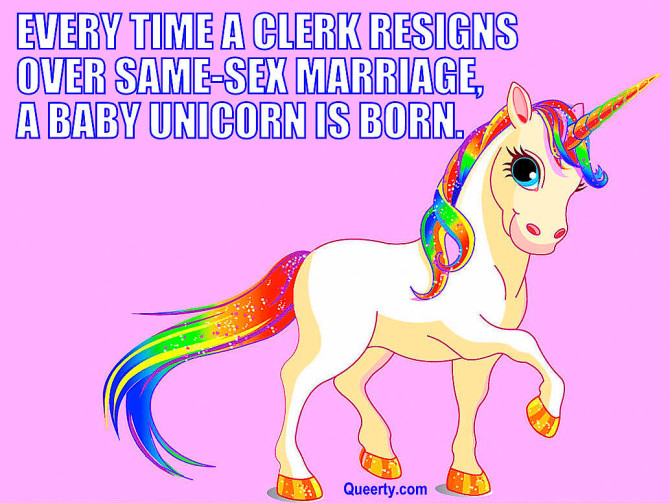
The folks at Queerty.Com have asked comedian Sam Kalidi to create a new meme each week for Queerty readers. This is this weeks. They want you to share it! (Click to embiggen)Yesterday’s Friday Links was epically longer than usual. There was just so much crazy news this last week!
Individuals like Tony Perkins and Bryan Fischer and organizations such as the National Organization for Marriage, the Family Research Council, or the American Family Association want a resistance against marriage equality… As if they are puppeteers, anti-gay organizations and personalities are pulling the strings, buoying the arrogance and recklessness of clerks and various other government officials and thereby manipulating them to refuse to carry out their duties… Anti-gay groups are attempting to manipulate us all into an unnecessary holy war in which they hope to reap the benefits of pointing and saying “see, we told you so.”
Related, there are a couple of stories making the rounds (particularly on the Facebook pages of your most conservative relatives and former classmates) that are trying to fan the same flames: Gay Man Sues Bible Publisher For $70M For Causing Him Distress, Turns Out He’s Not Crazy. While he isn’t crazy in that there are some big problems with Biblical translations, he filed the suit seven years ago and it was thrown out. The other one is partially true and current, but there is a very important detail being left out: Oregon bakers forced to pay $135,000 after sharing lesbian couple’s home address. So the fine isn’t for refusing to sell the cake, it’s for publishing private information of customers (who they refused) leading to so many death threats to the couple, the social services almost removed foster children from the home for fear that those loving Christians leaving the death threats might actually follow through.
Completely unrelated to all of that: one particular link in yesterday’s post caused one friend to stop reading and send me a message to tell me it stopped him from looking at the rest. It was a story about a particularly awful child abuse incident which I put under the heading “This Week in Heart-wrenching” because like any child abuse case it was heart-wrenching. This is not the first time someone has told me they wish I wouldn’t include bad news in the links.
I don’t want to get into a weird pedantic argument about what constitutes bad news, other than to say that each person who has made that request has also, at other times, commented on other links to things that someone would classify as bad news in ways indicating that they were glad I linked to it.
But I do want to talk a little bit about why I include links like that. One of the other links under the same heading was about efforts to identify the body of a dead child. I believe that as a human being (let alone a citizen), I have an obligation to that murdered child. She deserves to be buried with her name. She deserves to have law enforcement find out how she was murdered and at least attempt to bring her killers to justice. Both of those things require that she be identified. If I can increase the chances, no matter how little, by sharing the link to the artist’s reconstruction of her face, I think I should do it. That one, for me, is a no-brainer.
Also, literally no-brainer in that the reason both of those links ended up in Friday Links was because I saw the headline in my news aggregator, I clicked on it out of emotional reaction. Then I read the stories. They were both heart-wrenching, and I tapped the share link to send to my list for Friday Links as a totally visceral, emotional, non-rational surge of “Oh My Goodness! This is too horrible to be ignored!”
That’s how those sorts of stories get into the list.
For a long, long time sex advice columnist, gay rights activist, and Seattle gadfly Dan Savage has had a continuing feature on the blog of the local alternative weekly’s paper called “Every Child Deserves a Mother and a Father.” He started it because, when he and his husband adopted a baby 17-or-so years ago, they began being harassed by even more threats, hit-pieces in conservative news sources, and so forth by various anti-gay people. The charge that the reason queer couples shouldn’t be allowed to adopt, shouldn’t be allowed to have civil unions, and shouldn’t be allowed to marry is always couched in an argument that children can only properly and lovingly be raised by a pair of opposite-sex parents because reasons. The argument usually summed up as “every child deserves a mother and a father. So any time a story of a straight couple abusing (sometimes to the point of murdering) a child crossed his news feed, Dan would share it under the “Every Child Deserves a Mother and a Father” heading. His point being that the mere fact that the adults raising a child don’t have matching genitals never guarantees that the children will be loved and cared for.
This feature always drew its detractors, too. “You don’t have to share these horrible stories to make your point,” or “Don’t make it sound like you’re happy to have your point proven correct” et cetera. For a while in reaction to those comments, Dan started including links to charities such as The National Children’s Alliance or The Child Help Foundation, giving those of us who read the stories of the horrible abuse an option to do something to help. Which maybe I should do the next time one of these stories winds up ripping my heart out and making we want to share the story.
I didn’t include the story because I was trying to make a political statement. I included it because it was heart wrenching, because I think it is too horrible to be ignored. I can’t save either of those kids. Sharing the news won’t bring either one back. But pretending I don’t know about their deaths doesn’t do anything to prevent other cases like theirs, either.
I don’t have any clever conclusion to this digression. All I can say is that there is a National Child Abuse Hotline (1-800-4-A-Child/1-800-422-4453) that anyone can call if you suspect a child is in danger and you’re not sure who to notify. There is a lot of social pressure to hope for the best, to assume that the parent or significant other of the parent is just having a bad day. There is a fear of getting an innocent person in trouble. And there is an aversion to even thinking about the bad things that might be happening out of sight. All of those things contribute to cases like the sad one I linked to Friday.
So I share it as a reminder that there are awful people in this world who don’t always look awful. To make us mindful. To, maybe, encourage someone who has seen something like this, to call someone before the next child dies.
National Child Abuse Hotline (1-800-4-A-Child/1-800-422-4453)
It’s Friday! Because I took a vacation day Monday (therefore making the holiday weekend a four-day weekend) you would have expected this short week to be a bit of a romp. No, work was… well, one very disturbing thing and then a few more-than-usual chainsaws, plus the super hot weather and ongoing weirdness from a few homophobic relatives, leaving me exhausted and wrung out by the end. I am soooo glad the weekend is here. Even if I have activities scheduled both days.
Anyway, here is a collection of some of the things that I ran across over the course of the week which struck me as worthy of being shared. Sorted into categories with headings so you can skip more easily:
Republicans Are Too Angry About Gay Marriage: If the GOP wants to stay relevant, it has to become less hateful. There’s a big disagreement I have with the writer. He says that “fewer people are going to listen to those ideas if millions continue to believe that Republicans are intolerant of large swathes of Americans” which implies that Republicans aren’t actually intolerant, it’s merely a misperception. While I know some Republicans who aren’t, they are by far the minority–and that’s backed up by statistics, it isn’t just anecdotal.
The plague of angry white men: How racism, gun culture & toxic masculinity are poisoning America. I grew up in a very redneck family in very redneck communities, and I was taught: Guns are for hunting. Guns are for target shooting (so you can be good at hunting). Guns are not for shooting people! The only time I ever saw my paternal grandmater raise his hand to anyone was to deliver a slap up-side-the-head to one of my cousins when he pointed an unloaded rifle at his little brother. “You never point a gun at a person! Not as a joke! Not because you think it’s unloaded! Never!”

 I find myself reading about consent a lot. Having grown up in a culture which socializes guys not to take “no” for an answer, while socializing girls not to make trouble and always put other people’s wants and comforts first, it’s no wonder a lot of people don’t seem to understand consent in that context. Then there’s the whole Harper Lee and her “new” book situation. Is she healthy and aware enough to give informed consent? Does she actually know what’s going on, or is she a victim of the younger lawyers from who sister’s old firm who have taken over her estate now that her sister has died?











 Font Folly