All posts by fontfolly

Unknown's avatar

About fontfolly

I've loved reading for as long as I can remember. I write fantasy, science fiction, mystery, and nonfiction. For more than 20 years I edited and published an anthropomorphic sci-fi/space opera literary fanzine. I attend and work on the staff for several anthropormorphics, anime, and science fiction conventions. I live near Seattle with my wonderful husband, still completely amazed that he puts up with me at all.

What a difference…

Mother nature always finds new ways to amaze. Levees are holding in the face to Hurricane Isaac… holding, but the floods are just overtopping them.

Back in 1980, when Mt St Hellens erupted, I lived not far downstream. When the volcano started seriously rumbling, my Great Uncle tried to get my grandparents, Mom, my Aunt Silly, and all us kids to come live with him in California. He had actually started the process of buying a nearby house (he was fairly well off). He was convinced we were all in great danger.

Grandpa pointed out that Uncle Lyle lived in the Shasta Valley… In the shadow of a larger volcano that was part of the same mountain range. Since no one can see the future, we could be trading one natural disaster for a worse one.

It wasn’t until that eruption that I learned Mom, my sister, and I had been living in a flood plain for both the Cowlitz and Columbia rivers for at least four years. Decades before, dikes had been built along the rivers, and as sometimes swampy land dried out, people started building.

For the weeks and months after the eruption, seeing the water level of the Cowlitz sometimes within inches of overtopping the dike certainly made one think.

The difference between inconvenience and disaster is sometimes just a matter of inches or minutes. No matter how many precautions and contingency plans we’ve made, there’s always something that can be worse than we imagined. Or something we didn’t think of. Or simple a bit of bad timing.

Life is a gample. We should be grateful for the wins, learn lessons from the losses, and always be ready to lend a helping hand.

Doin’ the Macarena!

My husband calls it “the pocket Macarena,” that routine many of us do when leaving home: check pockets to make sure we have keys, wallet, phone, et cetera.

My Going To Work Macarena involves checking for: badge/bus pass, wallet, phone, eyeglasses, headphones, backpack. I don’t have to check for my watch, because my arm just feels wrong if it isn’t there. Before I get to that, there’s the quick check of the backpack, to confirm it contains: lunch, iPad, work laptop, and keys. Continue reading Doin’ the Macarena!

Who’s stifling what?

About a year and a half ago I found myself discussing phones with a friend of a friend. At the time, I didn’t own an iPhone. My phone was a Samsung Alias 2. It was a very clever design, that could open either like an old flip phone, or sideways and use a full Qwerty keypad.

It wasn’t a smart phone. It was a “feature phone” which meant I got a few poorly designed apps (seriously—the phone had e-ink keys, which could have displayed any character they wanted, but the calculator app still expected you to understand the plus was mapped to the ->; arrow key, and minus to and <;- arrow key, and multiply to the ^ arrow key, and so on), and if I wanted to pay about twice as much as a user with a real Smart phone would pay for a data plan, I could have email on the phone. And if I wanted to pay that much again, I could have a ridiculously low amount of web browsing.

I loved that phone. That design was innovative. I would have liked a better interface for the silly apps, but I understood going in that it wasn't a smart phone, and they weren't charging smart phone prices for the phone itself. It wasn't the manufacturer's fault that the carrier was being a dick about data pricing. It didn't cost them four times as much to give email and web access to this phone as it did to send it to an Android or Windows phone on the same network. It was a great phone, and I still highly recommend the model to people, if you can find it.

But I didn't need a smart phone, I argued then, because I owned an iPod Touch, and frequently had access to free wifi. When I didn't have access to wifi, I was usually with my husband, and he had a Droid with a data plan (from the same carrier, we were on a shared family plan). So he could look up things if we needed it.

The guy I was talking with explained how he had had a Blackberry for a few years, but had switched to the iPhone as soon as they came out with the iPhone Nano.

I thought he was joking. But he insisted that he had an iPhone Nano. "I told the salesman that I had loved the iPhone, but it was too expensive. And he asked me if I had seen the iPhone Nano, which was so much cheaper."

I told him there was no such thing as an iPhone Nano.

He said, "People keep telling me that. But I have one. Maybe Apple only released it for a little while then decided to discontinue it."

So I asked him to show it too me.

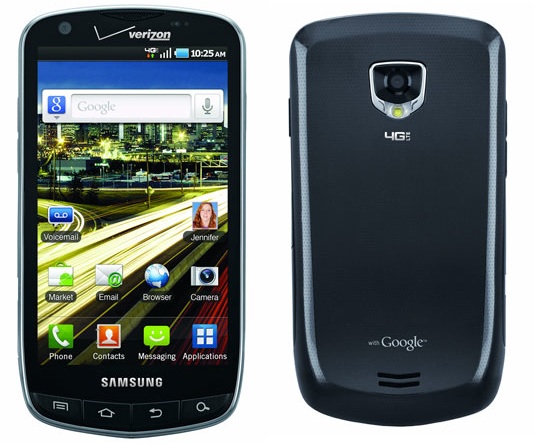
He pulled out his phone, and it looked something like this:
Samsung Android Phone
It wasn’t this exact model. I don’t think the model of Samsung phone pictured had been released, and his had had been from AT&T. After a quick search of images, this is the first one I found that looked like his.

But I pointed out the Samsung logo, rather hard to miss. And told him it wasn’t an Apple iPhone. That it was an Android phone.

He got a little huffy, and oddly enough accused me of being an Apple Hater. He showed me several things on the phone, specifically certain icons that did, indeed, look an awful lot like the icons for similar apps on my iPod Touch.

Now, it was a salesperson at an AT&T store who told him it was an iPhone Nano, and his own stubbornness (and perhaps a little bit of denial that he had been taken in by the salesperson) that was primarily to blame for his insistence that it was a cheap model of an iPhone. But the salesperson couldn’t have had a hope of getting away with it, and wouldn’t have succeeded in his deception if the phone itself, not just the general idea of a touch screen, but the specific icon set, the overall UI, and so on, had not been such a slavish knockoff of the iPhone.

I had played with several Android phones whose interfaces did not mimic iOS to the degree that this Samsung phone did. It’s not that difficult to make a touch screen user interface that looks and feels significantly different.

Copying is not competition, it’s deception. Copying is not innovation, it’s theft.

Telling someone they can’t sell a knock off is not stifling competition. You know what does stifle competition and innovation?

Encouraging or cheering on the people selling the knock-offs.

Be excellent

So last weekend we hung out with a whole bunch of crazy people.

We do that a lot. Most of our vacation are at conventions: general science fiction conventions, comic conventions, specialized conventions (furry, gaming, you name it). And last weekend we went to a local convention for fans of My Little Pony: Friendship is Magic (also known as MLP:FIM, or just MLP). Continue reading Be excellent

I do not think it means what you think it means

A few years ago an acquaintance discovered that a piece of artwork she had drawn, scanned, and posted on her own website had been taken by a clothing company and used on t-shirts, which they sold gazillions of. She spent a lot of time trying get them to stop using her art. She doubted she’d ever get them to pay her for it, she mostly wanted them to stop using her art without her permission.

She called them “thieves” and “lazy.” And she was correct.

So I was amused recently when some of her supporters called Apple a “patent troll” for suing Samsung over design theft.

“But wait,” you say, “It’s not the same thing! Apple is going after them just because they made something with a touch screen! They’re not going after them for copying a specific piece of artwork!”

Have you read the 300-page Apple multi-touch patent? It isn’t 300 pages of padding, it is a precise description of the heuristics underlying how the machine can tell the difference between an intentional two-fingered gesture and an inadvertent thumb from the other hand touching the screen at the same time the user’s index finger on the primary hand is touching the screen. Among a lot of other things. So that particular claim is not “it’s a screen that you touch” but rather, “it’s a touch screen which uses these precise algorithms in concert with these precise physical components to control the device in these precise ways.”

Whether or not algorithms and other software processes ought to be patentable (and there are valid arguments that they oughtn’t), under the current system they are. And if a touch device uses those precise algorithms and those precise components in that precise way, then it is copying, not inadvertently doing something superficially similar.

Some of the claims that Apple asserted in the lawsuit were much more of a stretch than that, and it appears that between the judge and the jury those were not upheld.

My other gripe is the now rampant misuse of the term “patent troll.” A patent troll is a person or “company” which does not produce any products of any sort, let alone anything that actually uses the patent under question. Instead, its sole economic activity is to sue people and companies who are making products which may or may not violate the patent, in order to force a financial settlement.

A recent classic example is a company that holds a patent, purchased many years ago from an “inventor” for an enhancement to a fax machine which would allow the owner of the fax machine to press a single button on the fax to send a message to the manufacturer in order to, among other things, purchase supplies for the machine. The inventor never built such a fax machine. He totally failed to convince any fax machine manufacturers to add such a feature to their machines.

Now a holding company which exists solely to sue people over patent violations has been using the patent to go after people who put a virtual button into their apps or web pages that users can click in order to buy stuff. The purpose of the lawsuits by this company is not to prevent people for having buttons you click to buy stuff, nor is the purpose to get people to think of some new way to buy stuff. The sole purpose of the lawsuit is to scare at least some of the people and companies to hand over money to make the lawsuit go away.

Apple did ask for money. They didn’t get as much as they asked for. And the amount they were awarded (we will see if they actually get even that much; even before an appeals process goes through, the trial judge may reduce the amount), while it would be enough to set you or me up for a life of incredible luxury, is actually not that big of a deal to either Samsung or Apple.

And the outcome Apple really wanted was accomplished long before the lawsuit went to the jury. The products the jury found in violation of the patents the jury upheld are almost all obsolete products. Once it was clear Apple was willing to sue, Samsung started changing the design of devices so it was less likely consumers would confuse their product with Apple’s.

And in the long run, I think that’s a good thing. No one is going to invent something better than what is currently on the market if everyone keeps copying each other. And while I think we have a lot of cool tools and toys to play with now—I love living in the future!—I want stuff that’s even cooler!

At least 20% cooler, if you please.

…and a cast of thousands!

Back when I was very active in ElfQuest fandom (I think it was the early Triassic age), I wrote a lot of stories for several fanzines, and one of the things I became a bit (in)famous for were stories featuring a whole lot of characters. I would squeeze in dozens, sometimes scores of characters into relatively short stories.

It wasn’t something I set out to do. It was just the way my brain worked. If something was happening in the little fictional tribe or village or whatever that we had created, the way that something affected each of the characters in said setting just seemed natural. I didn’t include every one of the reactions that occured to me, just the ones that moved the story along, or would naturally play out in a particular scene I needed for the plot.

It wasn’t hard. It just felt right.

I tend, therefore, to be fond of books, movies, and TV shows with ensemble casts. I love watching the way all those characters interact. I love seeing how the consequences of even the smallest incidents can sometimes ripple out to a wide communtiy.

I still write that way. The book I’m currently most busy writing has at least three major protagonists (and a secret fourth), at least (counting quickly on my fingers) twenty-six supporting characters with multiple lines of dialogue, four primary antagonists, and about eleven minor antogonists/minions.

It may seem an impossible number, but then I pull some books from my shelf by some quite successful authors, and when I count all the characters, I get very similar numbers. So clearly there are readers out there besides me who can follow this sort of thing.

I may wind up trimming some sub-plots. I certainly did in the last one. I even managed to get at least one funny short story/spin-off out of it. But while I’m in the middle of writing the first draft, I have to just point all the characters toward the finish and shout, “Charge!”

“Maybe it was the heavy syrup?”

When shopping late-ish last night for ingredients for packing lunches this week, I grabbed a can of the wrong fruit salad. Instead of the version packed in fruit juice, I got the one packed in heavy syrup. Which means the extra sugar absorbed from the high fructose corn syrup negates the healthy value of the fruit fibre.

When I realized my mistake, after getting home, I wasn’t thinking of my blood sugar or related topics. No, the moment I saw the words on the label, from some dark recess of my memory came the sound of an actress in a situation comedy saying, “Maybe it was the heavy syrup!” images from the sitcom flooded my head: the wife saying she had left a note on a car because she lost control of her shopping cart and banged into a stranger’s car; the husband saying she shouldn’t have left the note; an insurance adjustor contacting them with an exorbitant bill; denials, recriminations, meeting with the married couple who owned the car, seeing the car which looks like it was run over by a herd of buffalo; finally, the hilarious scene where two of the characters observe one of the owners of the car doing incredible damage to their own car trying to back out of the driveway.

The problem is, half of those scenes in my memory are in black and white. And in one set of scenes, the protagonists who are being stuck with a bill for damages they didn’t cause are Marine Pfc Gomer Pyle and his Sergeant, and in the other it’s Edith Bunker and her husband, Archie.

Now, the heavy syrup line is only in the All In the Family version of the tale, though it is the most hilarious line in the episode, thanks to the acting talents of Jean Stapleton. But otherwise, the two episodes from two shows made by different companies a decade apart, are incredibly similar.

Many people (some of them dear friends) would take this example as proof that all TV is bad, recycling old plots.

But if recycling plots makes something irredeemably bad, than no story created by humans in the last 10,000 years or more is good.

There are no truly original plots. Humans have been telling each other stories for as long as we’ve been human. Certain neuroscientists and anthropologists have made a very good case that telling stories is the most critical defining trait differentiating humans from other creatures. In all those generations of tales told round the fire, someone has already thought of the cool idea for a tale that just occured to you.

There is no such thing as a unique character. There is no situation which, at least in the abstract, hasn’t been used for a tale. There is no incongruity that hasn’t been exploited as a punchline.

The magic isn’t in the setting, or the situation, or the character, or the nifty plot twist you think no one will see coming. There is a certain alchemy in the combination of ingredients, but even that isn’t it.

It’s the execution.

Can you, the storyteller, evoke the situation in the mind of your audience? Can you make it so compelling that they willingly follow you into the dream, and make it real?

Just as the joke about the heavy syrup wasn’t that original, but the actress made us believe, for just a moment, that her character was so innocent and naive, she believed that the heavy syrup in a single can of fruit could be responsible for all that destruction.


Update, June 2013: Since Jean Stapleton’s death, I’ve been getting a lot of hits on this page with people searching on Ms Stapleton’s name and the about syrup. I suspect you’re looking for a video clip, such as:

Or:

Memory landmarks

Navigating one’s own memory can be tricky. My husband has been talking about replacing the small laser printer on the upper shelf of his desk for a while, and when he recently mentioned that the one he has is about 10 years old I scoffed. I bought him that as an upgrade “just a couple Christmases ago.” I was certain.

Nope. Because of the way he obsessively backs up device drivers, he could show me that the original drivers he installed for the computer were for Windows 98, second edition. “Remember, when you upgraded to Win 2000 shortly after, we had trouble getting drivers that would work.”

“Ah!” I said, “I knew that printer was before I switched back to Apple, but didn’t realized how much Before Mac it was!”

Before Mac and Since Mac is a fuzzy divider, because sometimes I put the line in May ’09, when I replaced my desktop computer with a MacPro tower, and other times I put it in Jan ’09, when for laptop use I stopped bouncing back and forth between my Sharp PC and my Mac Powerbook, and bought myself a Macbook.

A much more solid mental landmark is the Before Layoff and After Layoff. Of course, having been employed at the same company for more than 20 years (having survived 5 or so previous recessions), June 30, 2008 sticks out quite prominently.

The previous major landmark was half-fuzzy, and half so hard-and-bright-it-hurt: Before Ray Died, and After. The Before is very, very clear. The only reason there’s fuzz at all is I kind of, sort of, almost completely went to pieces for a few months after my first husband died. I remember things that happened during that time, but I’m really unclear on the precise order some of them happened in.

That’s why there’s some fuzziness on another landmark. Michael had known Ray and I for a couple years before Ray’s death, and Michael and I started dating about three months after Ray died… But it was still during that period when my memory is a bit shattered. Don’t get me wrong, I remember dating and falling in love, just don’t ask me which date happened when.

There are lots of other landmarks. Before Grandma Died, Before Grandpa Died, Before I Came Out and Divorced, Before My First Marriage, Before Seattle, Before Longview, Before My Folks Split Up… and so on.

Others are less about the physical world. I’ve already mentioned Before Mac, and at least implied Before Win2000 but there are a lot more. Before InDesign, for instance, and much earlier, Before PageMaker. Then there’s many different phases of During WordPerfect (since my workplace swtiched to it, away from it, back to it and away; during most of which time and long after WP was my preferred word processor for personal use). There’s Before I Gave In And Got A Cell Phone, there’s Before I Embraced Word Processors, or Before I Figured Out Orson Scott Card Was An Evil Bigot And That’s Why So Much of His Writing Bothered Me, or Before I Read Wyrd Sisters And Became A Pratchett Fanatic.

That latter, by the way, is right up there with Before Star Wars, Before I Knew Who Asimov Was, and Before I Knew Where Books Come From.

So, what are your landmarks?

Sleep, interrupted

Two nights in a row I’ve woken up, wide awake, at about 3am. Night before last, it was a sudden realization of why a scene I had struggled writing the night before wasn’t working. Last night it was a bad dream in which a bunch of my closest friends were upset and crying, and somehow it was my fault.

Neither interruption is being conducive to my recovery from the awful cold. Continue reading Sleep, interrupted

In traffic

Yesterday while I was waiting for my bus to go to work, I watched a woman dressed oddly step off the curb across the street. The street in question is a six-lane major arterial that is nicknamed, among regional transportation professionals, “the little freeway.” It isn’t an actual highway, but it is very busy, and drivers routinely zoom along over the speed limit.

She stepped off right in front of a car. My heart jumped a beat. The driver swerved and missed her (luckily the next lane had an opening for him to swerve into). The driver tapped his horn. Just a quick tap, not a long, angry lean on the button thing. The woman flipped off the car and started shouting.

She did not retreat to the curb. She ambled further, crossing lanes, as cars stopped for the crazy person. She kept yelling angrily, occassionally flipping the bird in random directions as she craned her neck and tried to look over all the cars now stopped for her, as if she were trying to see if a bus was coming (there’s a big bus stop going the other way right across from the one I catch my work bus to).

Still yelling angrily, she ambled back to the curb and started walking toward the corner.

Traffic began moving again.

She got to the corner, and without waiting for the light or even looking, she stepped off in the crosswalk. Again, miraculalously, cars stopped. She crossed, getting honked at only one more time. Once she reached our side, she was still angrily yelling, apparently at some invisible person right in front of her.

I had a brief moment of worry that the crazy lady was going to try to get on our bus (which was one of the vehicles that had had to stop to let her cross). She didn’t; she stalked right through the crowd waiting for the bus, yelling all the way, without meeting anyone’s eyes.

Later, during lunch, I was reading my usual news sites. At about the same time this lady was playing chicken with traffic, in another part of town, a man was seen sitting in the middle of a road. His legs were crossed, elbows on hos knees, and his face buried in his hands as if he were crying. A couple pedestrian passers-by called to him to get out of the road. One stepped off the curb and approached him.

A car came careening down the road. The bypasser who had stepped off the curb jumped back. The car did not stop. It struck the man, killing him, and kept going as if nothing had happened. Police apprehended him a short distance away. The 23-year-old has been booked into jail for driving under the influence and vehicular homicide.

Reading that made my heart skip a beat again, and I marvelled, briefly, that the woman I watched had avoided a similar fate.

In the evening, shortly after I got home, my husband came into the house and told me about his day. The second thing he told me was that he had been run over on his way into work. He rides his bike to and from work. He said he was riding along in the bike lane, when a woman chatting on her cell phone suddenly turned right.

“I was banging on the front of the car after she stopped, trying to get her to back up, because my leg was pinned under my bike, which was pinned under her car.”

He insisted he was uninjured, and I couldn’t prove otherwise. Amazingly, all he had to do for the bike was replace his front tire. There’s a bicycle repair shop right next to his place of work.

He rode the bike home from work.

Three times, yesterday, traffic incidents made my heart skip a beat.

Of the stories, the one that still amazes me most is the crazy lady who was never struck. Not because she did anything to protect herself. It was entirely because a large number of drivers were alert enough to see her and stop.

The saddest is the guy killed by the drunk driver. Why was he sitting in the rode? Was he mentally ill or severely impaired and just didn’t realize where he was? Was there some sort of medical issue playing out? Was he hoping to get killed? We’ll never know.

The one that most frightens me, of course, is my husband’s accident. Unlike the others, he was right where he was supposed to be: obeying the laws, wearing his helmet, flashing lights on his bicycle, the whole thing. He came only inches from injury or far worse because a driver was paying more attention to something other than her driving.

I don’t tell him I love him often enough.