“I know it’s here somewhere…”I’ve written a few times about some of the issues I face being a packrat who comes from a long line of packrats. One of the manifestations of the behavior is that I collect things, but not all of the things I collect are the sorts of things most people think of as collectable: keyboards, headphones, iPods, dictionaries, typewriters… and word processing programs. In a sense, my predilection for downloading and trying out new word processors is not unlike the way that many writers and artists and such like to try out new pens or buy new notebooks or sketchpads. You’re always looking for tools that will make some of your job easier, or are just nicer to use. And in the case of things like paper or pencils or brushes, they do get used up or wear out periodically, so having replacements already handy can be a good thing. When I see a cool-looking mechanical pencil, for instance, there isn’t much harm in picking it up and at least considering buying it. One of the pencils I already own might break, or get misplaced, right?
Software programs don’t usually work that way, but the non-rational part of my brain doesn’t quite get that. So seeing a review of a word processor that extolls features that appeal to me has the same effect on that impulsive part of the brain that makes me pick up a new pencil or pen or pocket notepad when it catches my eye in the store.
Many apps offer free trial versions, so it is literally a matter of just clicking or tapping a few times on my phone or laptop, and the next thing you know there’s a new word processor installed on my iPhone or iPad or Macbook Pro. And I will play with it for a bit, maybe find some things I like about it. If it works well and is cheap, well, I might buy it. If the free version has no time limit, I may just leave the free version on indefinitely.
Another in my series of posts recommending web comics that I think more people should read:
Stereophonic by C.J.P.“Stereophonic” by C.J.P. is a slice of life comic set in 1960s London. The two main characters are Elliot, an introverted art student, and Alex, an outgoing singer in a small band who works in a pub to make ends meet. When our story begins Elliot needs a flatmate to help with the rent and Alex needs a new place to live. It’s a very sweet and slow-build story. The artist describes it as a “queer historical drama that follows the lives of two young men living in 1960s London.” The art is good and the supporting cast is interesting. But I want to warn you that the story comes to a hiatus just as a couple of the subplots are getting very interesting. The artist had a serious health issue which was complicated by family problems, but has since started posting updates to his blog and Patreon page, assuring us that the story will resume soon. There are 300 pages of the comic available to read at that moment, let’s hope more comes soon. If you like the comic and would like to support the artist, C.J. has a Patreon page, plus t-shirts and other merchandise available at his store.
Some of the comics I’ve previously recommended: Some of these have stopped publishing new episodes. Some have been on hiatus for a while. I’ve culled from the list those that seem to have gone away entirely.
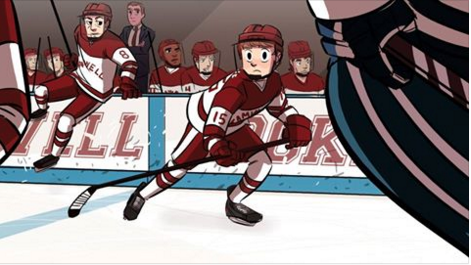
Check, Please! by Ngozi Ukazu is the story of Eric “Bitty” Bittle, a former junior figure skating champion from a southern state who is attending fictitious Samwell College in Massachusetts, where he plays on the men’s hockey team. Bitty is the smallest guy on the team, and in the early comics is dealing with a phobia of being body-checked in the games. He’s an enthusiastic baker, and a die hard Beyoncé fan.
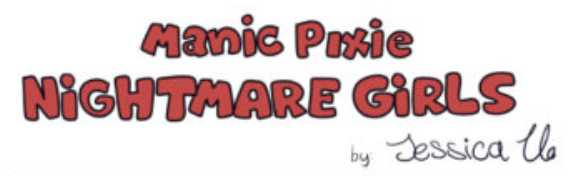
“Manic Pixie Nightmare Girls” by Jessica Udischas is a hilarious web comic that tells of the adventures of Jesska Nightmare, a trans woman trying to make her way in our transphobic world. The comics are funny, insightful, and adorably drawn. The sheer cuteness of the drawing style is a rather sharp contrast to the sometimes weighty topics the comic covers, and I think makes it a little easier to keep from getting bummed out to contemplate that the strips aren’t exaggerations. If you like the strip, consider supporting the artist through her patreon.
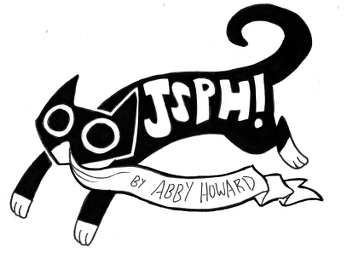
The Junior Science Power Hour by Abby Howard. is frequently autobiographical take on the artist’s journey to creating the crazy strip about science, science nerds, why girls are just as good at being science nerds as boys, and so much more. It will definitely appeal to dinosaur nerds, anyone who has ever been enthusiastic about any science topic, and especially to people who has ever felt like a square peg being forced into round holes by society.
The Young Protectors: Engaging the Enemy by Alex Wolfson begins when a young, closeted teen-age superhero who has just snuck into a gay bar for the first time is seen exiting said bar by a not-so-young, very experienced, very powerful, super-villain. Trouble, of course, ensues.
“Deer Me,” by Sheryl Schopfer tells the tales from the lives of three friends (and former roommates) who couldn’t be more dissimilar while being surprisingly compatible. If you enjoy Deer Me, you can support the artist by going to her Patreon Page!
Scurry by Mac Smith is the story of a colony of mice trying to survive a long, strange winter in a world where humans have mysteriously vanished, and food is becoming ever more scarce.
And I love this impish girl thief with a tail and her reluctant undead sorcerer/bodyguard: “Unsounded,” by Ashley Cope.
Fowl Language by Brian Gordon is a fun strip about parenting, tech, science, and other geeky things. The strips are funny, and he also has a bonus panel link to click on under the day’s strip.
The Last Halloween by Abby Howard is the creepy story of 10-year-old Mona who is reluctantly drafted to save the world on Halloween night. This is by the same artist who does the Junior Science Power Hour. She created this strip as her pitch in the final round of Penny Arcade’s Strip Search, which was a reality game show where web cartoonists competed for a cash prize and other assistance to get their strip launched. Though Abby didn’t win, she started writing the strip anyway. If you like the comic, you can support Abby in a couple of ways: she has some cool stuff related to both of her strips in her store, and she also has a Patreon.
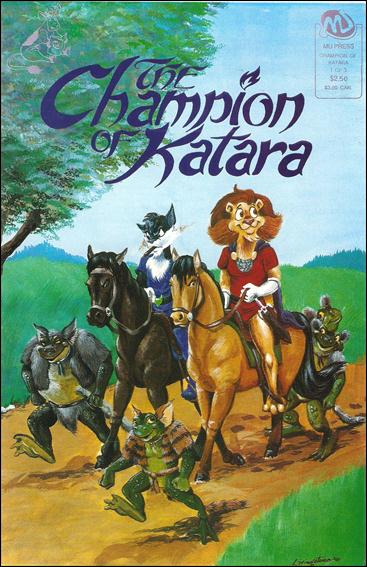
“Champion of Katara” by Chuck Melville tells the tale of a the greatest sorcerer of Katara, Flagstaff (Flagstaff’s foster sister may disagree…), and his adventures in a humorous sword & sorcery world. If you enjoy the adventures of Flagstaff, you might also enjoy another awesome fantasy series set in the same universe (and starring the aforementioned foster sister): and Felicia, Sorceress of Katara, or Chuck’s weekly gag strip, Mr. Cow, which was on a hiatus for a while but is now back. If you like Mr. Cow, Felicia, or Flagstaff (the hero of Champions of Katara) you can support the artist by going to his Patreon Page. Also, can I interest you in a Mr. Cow Mug?
If you want to read a nice, long graphic-novel style story which recently published its conclusion, check-out the not quite accurately named, The Less Than Epic Adventures of T.J. and Amal by E.K. Weaver. I say inaccurate because I found their story quite epic (not to mention engaging, moving, surprising, fulfilling… I could go on). Some sections of the tale are Not Safe For Work, as they say, though she marks them clearly. The complete graphic novels are available for sale in both ebook and paper versions, by the way.
Oglaf, by Trudy Cooper and Doug Bayne is a Not Safe For Work web comic about… well, it’s sort a generic “medieval” high fantasy universe, but with adult themes, often sexual. Jokes are based on fantasy story and movie clichés, gaming tropes, and the like. And let me repeat, since I got a startled message from someone in response to a previous posting of this recommendation: Oglaf is Not Safe For Work (NSFW)!
This photo of the Eagle Creek Fire, taken by Kristi McCluer of Vancouver, Washington, went viral this week, though few who shared the photo gave her credit.It’s Friday, the second Friday in September. Usually at this point I will wax poetic about the blessédness of this month and the superiority of people burn during it, but right now with all the insane weather and earthquakes and wildfires and tsunamis… I’m not sure it’s really appropriate
All week long locally they’ve been promising us that the hellish smoke layer (seriously, ashes were falling from the sky like snowflakes on Tuesday, and the sun has been blood red for days) would start to clear out and be all gone before the end of the week. And then each day the forecast has revised and moved that day back. As I right this Thursday night we are still under a layer of smoke, air quality has only improved to Moderately Bad, and there has been no sign of the promised rain.
Anyway, here are the links I gathered this week, sorted into categories as accurately as I could.
Click to embiggenIn 1990 Mister Rogers Sued The KKK For Impersonating Him (and won!). In 1990, Mr. Rogers sued the KKK for impersonating his voice in prerecorded messages. These messages said “AIDS was divine retribution” and included radio skits simulating lynchings of black children on a playground. The messages were spread to elementary and middle school children by passing out misleading fliers with a phone number to call for a special message from a friendly neighbor.
“Bugs Bunny: where kids used to learn about classical music and drag queens.”At several points during my childhood people asserted the claim that what was “wrong” with me was caused by the movies/TV shows I watched or the books I read. At one point certain extended family members were trying to convince my parents that I shouldn’t be allowed to watch scary cartoons. At another point, a lot of church people were certain that my interest in science, particularly astronomy, was turning me into a satanist or even worse, an atheist! There were lots of times that various people asserted that either musicals, or fantasy/sci fi, or some other thing I was interested in was why I kept getting bullied by the other kids at school. The truth is, that many teachers, church members, and family members were all bullying me as much as any kids at school were, though they weren’t willing to admit it. Throughout my childhood and teen years I was constantly trying to figure out how to get people to stop despising me. A big part of why I couldn’t figure it out was that there were actually two reasons. First, I was queer, and second, I was smarter than average with a particular knack for analytical thinking.
When people find a person in their midst who does not conform to their expectations, their reaction is to try to find a behavioral cause of that non-conformity. Because admitting that different kinds of people exist naturally challenges the simplest notion of normality. So when confronted with a smart, slightly gender-non-conforming kid who seems to know about things people don’t expect kids to understand, they go looking for an easy explanation of why I’m different. And it really was both of those differences that confused people. More than one relative on different sides of the family commented that as a young child I seemed like an adult trapped in a kid’s body.
When you are clinging to the notion that there is a limited number of ways to be normal with someone who doesn’t fit any of your notions, the easiest thing is to look at which of the non-conforming person’s interests seem least like theirs. So in the 1960s and ’70s, people focused on my interest in science, science fiction, fantasy and related topics. Because before the era of the personal computer and the cultural behemoth that was the original Star Wars, those things were completely beyond the kin of normal humans. Some of the cover art of magazines and paperback books raised a few eyebrows. At least one relative asserted the belief that reading superhero comics, with all of those skin tight costumes on the male heroes, would turn a boy into a sissy.
In retrospect I find it hilarious, because of all the media/fiction I can recall from my childhood, the only place where gender fluidity and related topics occurred regularly was not in science fiction, fantasy, or science fact books, but in one of the most popular forms of pop culture of many decades: Looney Tunes cartoons, specifically Bugs Bunny cartoons.
Even before Bugs Bunny had the name “Bugs,” he was dressing up as a woman to seduce a male character. Long before he ever dressed as a woman to distract Elmer Fudd or Yosemite Sam, the character then referred to informally as “Happy Rabbit” disguised himself as a female version of the unnamed hunter’s dog to distract the dog from his trail. So if everyone’s theory that somehow what made me non-conforming was the shows I watched, clearly it should have been Bugs Bunny they focused on, right? Contrariwise, Bugs is a great argument against the whole media-causes-queerness argument: as I pointed out in a post last week, for a number of years the Looney Tunes cartoons weren’t just ubiquitious, they were almost universally adored by a couple of generations of folks. If media exposure causes queerness, then just about every single person aged 40-something through 60-something alive in North America right now should be an out queer, because Bugs taught us all that to be a drag queen was to be triumphant.
This meaning of drag: “Women’s clothes as worn by a man; (less commonly) men’s clothes as worn by a woman; a party at which such clothes are worn” as rendered in the Oxford English Dictionary has been around since the late 19th Century. The first written citation coming in 1870 as a reference to male actors portraying female characters on the stage. At various times in the history of the theatre, it had been common to cast young men in the feminine roles, because it was considered inappropriate for women to perform on stage. So there is a certain tradition in the theatre (which cropped up later in movies, though usually for comedic effect) of men dressing as women on stage. There is also a tradition of characters of either sex on stage and in movies dressing in disguises—sometimes disguises that shouldn’t fool anyone—and carrying on for scene after scene completely pulling the wool of the eyes of other characters.
The disguises that Bugs donned in the various cartoons weren’t always drag. The point of the gag was how gullible Bugs’ adversary could be in light of the disguise, no matter how ridiculous. Which is why I don’t think it ever occurred to anyone back then that how easily the hero of the story could adopt the persona of a woman and seductively entrance the villain might be just a little bit queer. Maybe it was the fact that the audience was in on the joke—Bugs was dressing as a woman to fool his antagonist and make the audience laugh, not because he enjoyed it, and certainly not because he was actually trying to seduce the other character. Maybe it was simply the fact that they understood the jokes in a Bugs Bunny cartoon, but sf/f didn’t appeal to them, and a lot of that cover art looked erotic, demonic, and sometimes both.
To me, the ease with which Bugs transformed himself in his various disguises is a manifestation of a much, much older narrative tradition: The Trickster God. One of the oldest examples of which is the Old Norse story of the time that Loki is tasked by Odin with getting the gods of Asgard out of a particularly unwise bet. The gods had made a deal with a builder to create a magnificent fortification, but that if the builder couldn’t do it in a ridiculously short time with no help except that of his horse, the gods would never have to pay for the fortress. It quickly becomes clear that that both the builder and his horse are possessed of magical abilities and will succeed at the seemingly impossible task. Loki tries various things, but eventually is only able to succeed by transforming himself into a beautiful mare in heat, and thus lure the magical horse away. In the Norse story, Loki actually mates with the horse and later gives birth to another magical steed, Sleipnir, which becomes Odin’s horse and figures in a lot of other myths.
I’m just glad that I never pointed out that little similarity back then. It was one thing when I was sometimes forbidden to check out certain books from the library, or buy certain paperbacks at the used book store. It would have been infinitely crueler to forbid me from watching Bugs and Daffy!
Sometimes there’s a lot more staring at the screen than pressing of the keys.There have been stories I struggled with for years. There was this one story where I had this very interesting character whose voice just flowed from the fingertips at the speed of lightning when I wrote the opening scene for her story. I knew the trouble she was in and how she would eventually get out of it. She was a new character in an existing setting where I had a lot of great established character who could play the supporting roles. It just felt like magic every time I re-read the half dozen scenes I’d written. It was taking me longer to get to the resolution than I had originally thought when I had the story idea, but I figured that once I ironed a couple of plot issues out, I could probably trim a few of the scenes so far.
Then I read the story aloud to my monthly writers’ group.
I honestly don’t remember much of the critique I got from the group that night. And truth be told, I didn’t read everything I’d written. I only read the opening scene, and by the time I reached the end of the scene, I already knew that the story was a disaster. Part of it was the nonverbal reaction of the group, yes, but that wasn’t what killed the story for me. No, just hearing it aloud in my own voice revealed that it was an awful opening to an unpleasant story.
The character was in a very unpleasant situation, but that’s not what I mean when I say it was an unpleasant story. I mean that it was unpleasant to read the scene that I’d written. And I knew the rest of them suffered the same problem. I had picked the wrong place to start the story, and I was fairly certain that while my new character was interesting, she shouldn’t be the viewpoint character for this particular story. She might still be the protagonist, but she wasn’t the person who should narrate this particular tale.
And I learned all of that before any of the other writers in the group said a word. Just from the act of reading it aloud.
It’s advice I have received for as long as I can remember. Back when I was a grade-school student haunting the library’s magazine collection reading back issues of The Writer and Writer’s Digest I saw the advice again and again: read the story aloud to yourself before you show it to other people. It’s advice I’ve given many times. But I don’t always follow it. That particular story I really should have.
Reading it aloud, either to yourself or an audience, will expose awkward sentences at a minimum. There are all sorts of sentences you can write that make perfect sense, follow the rules of grammar and so forth, but when you try to say them out loud, your tongue trips on them. That’s why I always have a pencil or other writing implement in my hand when I read aloud, so I can circle the places I stumble over awkward phrasing.
But that isn’t the only thing you learn reading it aloud. There are numerous studies that show, for instance, the act of simply speaking about a problem you’ve been worrying about makes you think of it in a new light. Neurologically, they say, that’s because different parts of the brain interact differently. It’s not just the act of putting a problem into words, it appears to also be the fact that as you listen to yourself speak, different areas of the brain react differently than when you contemplate a problem in silence.
That process doesn’t just apply to solving real world problems, obviously. Listening to your story aloud makes you process it differently than reading it silently.
Reading it aloud to someone else brings in a different level of information, much of it non-verbal as I alluded to above. Your listeners may fidget, or become distracted, for instance. You’re not holding their attention. You’ll get other cues, as well.
That particular tale was re-written substantially several times, though I didn’t bring each draft back to the group. I tried telling the story from the points of view of three different supporting characters before I found the right viewpoint character and the right starting point. The fourth version, when it was read, got very positive responses. And eventually was published, and I got a few compliments from readers of the ‘zine.
The key to realizing my approach was wrong was to simply read the opening scene aloud–advice I have tried to follow much more faithfully ever since.
“Union Accomplishments: Safe working conditions; Safety regulations; No toxic dumping; No child labor abuses; Standard minimum wage; 40-hour work week; Overtime pay; Paid vacation; Pensions; Healthcare; Equal Pay for Equal work.”Both of my grandfathers were life long union workers. Dad moved in and out of union and non-union portions of his industry. When Mom re-entered the work force after my parents’ divorce, she became a union member and other then a few stints in management, remained one until she retired. I, on the other hand, work in an industry that has fought to keep unions out, and for various social reasons, the same co-workers who complain loudest about how everyone is classified as “professional” and therefore exempt from overtime pay and the like, are also convinced that unions would be a disaster.
Which is really sad. Mostly I blame the decades-long war on unions waged by mostly the Republican party. They have managed, somehow, to convince people to believe, in the face of overwhelming evidence to the contrary, that businesses have always given out wages and benefits out of the goodness of their hearts.
I don’t understand how anyone who has worked for any business larger than a mom-and-pop operation can believe that.
“If unions are bad for the economy, why did America’s greatest era of prosperity have more workers under union contract than any other time in history?”
It’s not that profits are driving business decisions, it’s that maximizing benefit to business leaders while milking short-term profits without investing in workers and their skills for long-term benefits.
You can keep talking about the economic insecurities of angry white guys, but you have to recognize that the source of economic insecurity is not market forces, or immigrants, or equal opportunity laws. It’s the people in that top 1%. And somehow we’ve got to get those scared angry white guys to recognize that they are being duped.
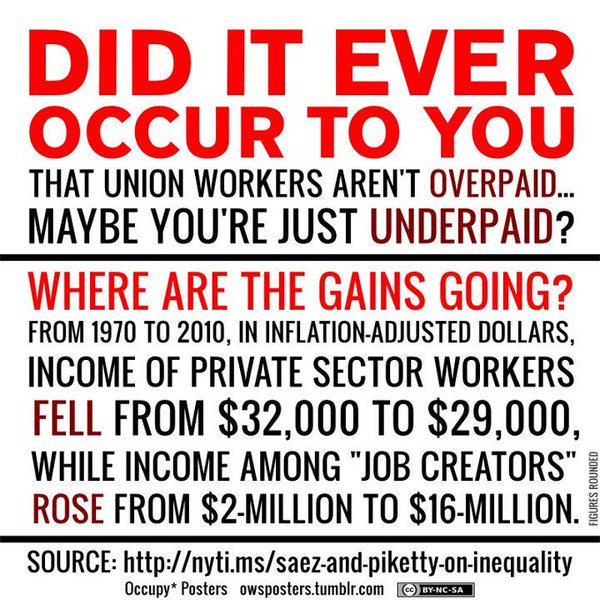
“Did it ever occur to you that union workers aren’t overpaid, maybe you’re underpaid? Where are the gains going? From 1970 to 2010, in inflations-adjusted dollars, income of private sector workers fell from an average of $32,000 to $29,000, while income among ‘job creators’ rose from $2-million to $16-million.” Source: nyti.ms/saez-and-piketty-on-inequality
Often on Saturdays I post some follow-ups to stories that were in the previous day’s weekly roundup of links, or just post commentary on some news items that I found after posting the Friday roundup. But not a whole lot jumped out at me. This is probably because I worked a longer day than I hoped to yesterday, and then I immediately went into holiday weekend mode, so I have been avoiding the news, unless it has to do with my beloved Seahawks. I also save images and memes and such as possible illustrations to blog posts all the time, but only use a fraction of them. So here are some of my recently collected images/memes/what-have-you:
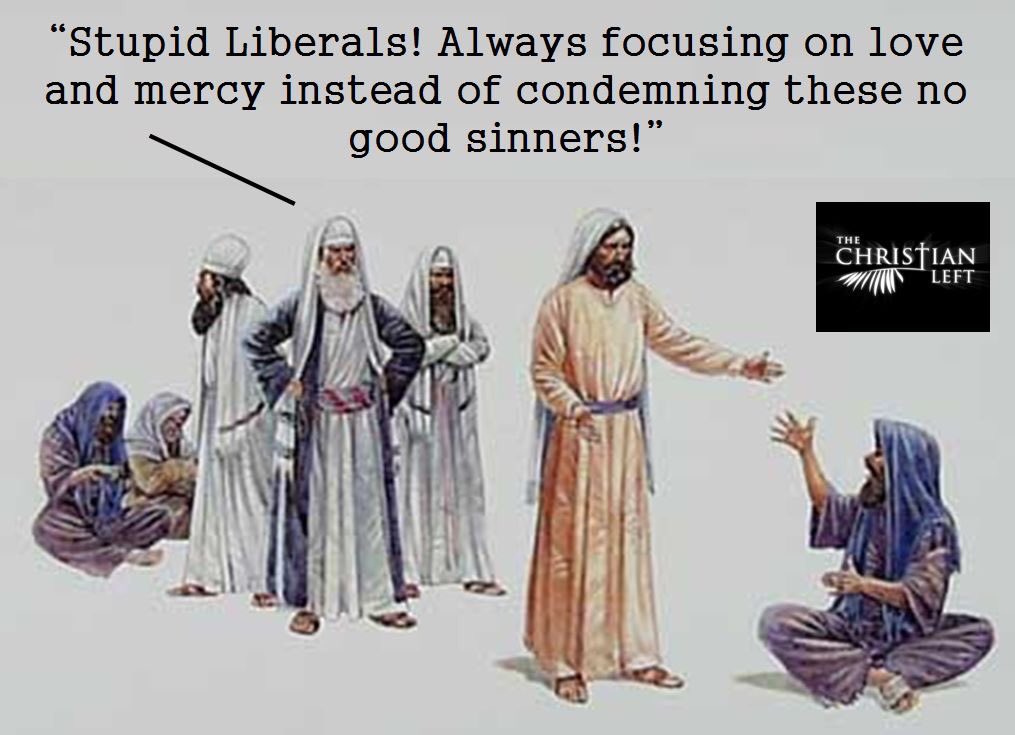
“Spoiler Alert! The Nazis lose at the end.”“If you’re unemployed it’s not because there isn’t any work.” Click to embiggen and read this explanation of one of the things wrong with our current version of capitolism/corporate welfare…“Muslims serving Houston: this is American. Nazis destroying Charlottesville : this is Unamarican.”“Stupid liberals! Always focusing on love and mercy instead of condemning these no-good sinners!”Presidents Bush, Obama, and Clinton all showing the proper way to respond to a natural disaster…If you’re a Nazi and you’re fired it’s your fault *clap* *clap*, If you’re a Nazi and you’re fired it’s your fault *clap* *clap*, You were spotted in the mob, now you’ve lost your f-ing job, If you’re a Nazi and you’re fired it’s your fault *clap* *clap*!”
Ah, September, the most blessed of months. The month in which superior people are born! Perhaps, now that it has arrived, are long horrible hot and dry nightmare of a summer will end?
It’s also Friday, so, here are the links, sorted into categories as accurately as I could.
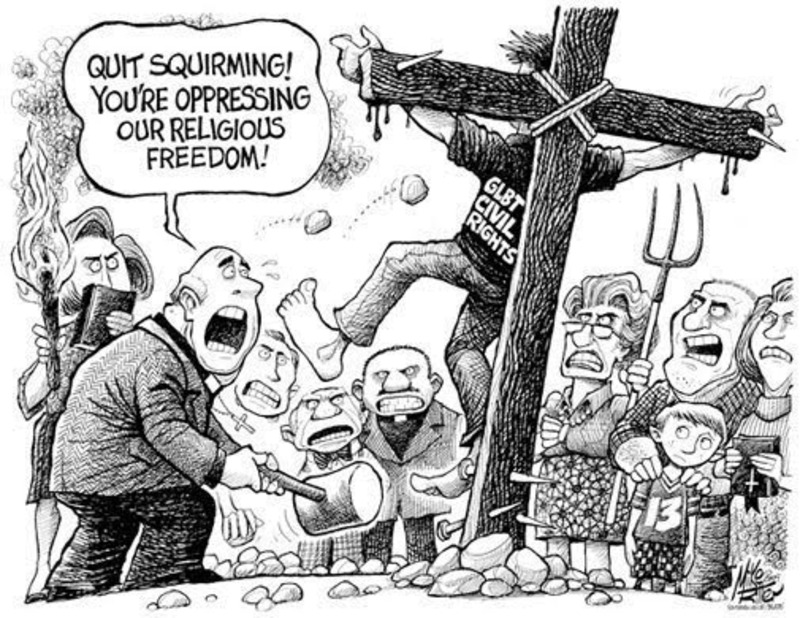
“Quit squirming!” (click to embiggen)I have a half-finished “Adventures in dictionaries” post that I meant to have ready for today, but I realized that my quick dismissal of the Nashville Statement yesterday isn’t really adequate, given the significance of the statement. I originally dismissed it as just more of the same old hate from same old haters, and made a reference to the fact that a couple of the primary signers of the thing are so-called religious leaders who have been embroiled in scandals covering up sexual abuse within their own religious organizations. Those things are both true, but there is an aspect of the thing that I had overlooked yesterday.
So, in case you missed it, a group of conservative evangelical organizations have banded together, calling themselves The Council on Biblical Manhood and Womanhood, and they issued this multipart statement of faith, most of which is exactly the same old ant-gay, anti-trans, anti-equal rights for woman, stuff that we are used to hearing from these bigots. But this time there is one important difference.
That difference is Article X:
WE AFFIRM that it is sinful to approve of homosexual immorality or transgenderism and that such approval constitutes an essential departure from Christian faithfulness and witness.
WE DENY that the approval of homosexual immorality or transgenderism is a matter of moral indifference about which otherwise faithful Christians should agree to disagree.
In other words, they are now explicitly and emphatically saying that anti-LGBT bias is an essential part of being a christian, and anyone who does not subscribe to their anti-LGBT beliefs are not christians.
Now, for some years many of us on the queer and queer-affirming side of this divide have been pointing out that they have boiled christianity down to nothing more than the hatred of the gays. Politicians who in no other way support what any reasonable person would call Christ-like values, nor who love in anyway according to christian values are given high ratings, endorsements, and money by these organizations as long as they oppose marriage equality, trans rights, and so on.
There was that amusing Tumblr post I linked to awhile back where someone made a joke about homophobes, and scores of angry christians swarmed on the post calling it anti-christian hate. Then the original poster had to point out that the word “christian” didn’t appear anywhere in joke. It literally said “homophobe” but, “you guys went ahead and read yourselves in there.”
But whenever we accuse them of throwing out all of Jesus’s teachings (in the Bible, Jesus never said a single word, not one, about homosexuality) and replacing them with a hatred of us queers, they have emphatically denied it.
Until now.
I’ve seen some folks say to just ignore it, because they don’t officially speak for anyone. But here’s one of the problems I have with that. In May of 1845 a bunch of conservative Baptist churches sent representatives to a meeting in Augusta, Georgia, and issued a 14-point statement of why they were separating from the rest of the Baptist Churches. Twelve of the fourteen points in that statement were affirming the institution of slavery in various ways, along with the segregation of the races and the inherent superiority of the white race. That was the birth of the Southern Baptist Convention, years before the civil war.
Even after the war, that group continued to fight for white supremacy and racial segregation, until 1971… at which time the finally endorsed desegregation and shifted their focus to abortion, women’s rights, and gay rights. They were the core of the Moral Majority. They remain a core consituency of the Republican Party in general and Donald Trump in particular.
I know this, because I was raised in that church. I’ve always been proud of the fact that my own grandfather was one of the delegates to the 1971 convention where racial segregation was finally removed from the official doctrine of the church. I was less proud of how many members of our home church at the time quit to form a new Bible Baptist Church over the issue of racial segregation.
So, 172 years after issuing a similarly bigoted statement, pain and suffering are still being inflicted on some segments of the population. I have trouble not fearing something similar here from the signatories of the Nashville Statement. Adopting hate and sticking to it didn’t make that group whither away. It grew, until it became (and remains) the largest Protestant denomination in North America.
Until now, they have always stopped short of explicitly saying that the christians who disagree with them on this issue aren’t really Christian. I think this represents a new battle line from people who feel emboldened by the election of Donald Trump. I don’t think this is just the same old, same old. These are the same people who, when we point out that the teachings of Jesus contradict them, claim that Jesus’s various admonitions about love and compassion only apply to fellow christians. They’ve been sanctioning the murder of abortion providers for decades, as well as the bashing and murder of queer and trans people. This statement puts targets on many more people.
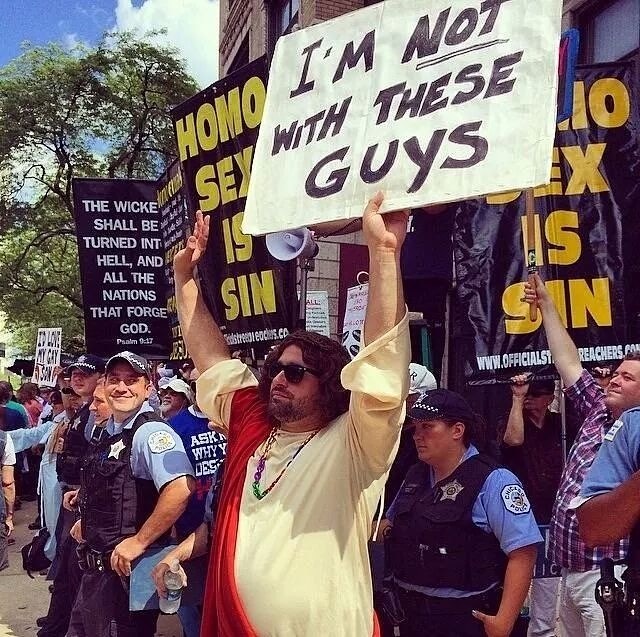
“I’m not with these guys.” (Click to embiggen)When I was a teen-ager our church had a debate about locks. I think the precipitating event was the purchase of a new organ for the main sanctuary, but I also know there had been an incident of one of the other churches in the neighborhood being vandalized. The upshot was, someone had proposed that we put locks on the main doors of the church. We had long had locks on some specific rooms inside the building, and the auxilliary wing of the church was locked up when not in use, but the main building and specifically the sanctuary (which is the official name of the large room with the pews, pulpit, and baptismal) were always unlocked and open to everyone.
There was a lot of talk during the meeting about insurance—either that our current insurance carrier didn’t want to cover us against theft and vandalism for parts of the building that were unlocked at night, or they were going to raise our rates significantly, I don’t recall which. There were a number of people in the congregation who felt maybe we should start locking the main building. “We aren’t in a tiny town and it isn’t the fifties,” is how I think one person put it. Another person told a story of homeless people routinely sleeping in churches and sometimes not being careful about where they went to the bathroom.
One of the associate pastors rose to his feet on that one and said, “Call me foolish if you want, but I think the proper response to finding a homeless person sleeping in your church should be to offer them a meal, and then ask what other help do they need!”
I grew up in Southern Baptist Churches where the tradition is that all business decisions related to the church are decided by the congregation as a whole. At regular intervals the usual Wednesday Prayer meeting would begin with a business meeting. Any congregation member, no matter their age, who attended the meetings had a vote. I had been attending business meetings at the many churches we attended (as my family moved) for as long as I could remember. I seldom remembered one that became more impassioned than that debate about whether to put locks on the sanctuary door.
It was beginning to look as if the majority was leaning toward adding the locks. And then one elderly member of the congregation struggled to stand up. She had been frail and needed a walker to get around for some years, but she never missed a service at the church. She let the person sitting next to her help her to her feet, but then she sort of shook him off and raised her face as if she was speaking to the heavens themselves, and I hadn’t heard her voice sound so firm in years. “For I was hungry and you gave me nothing to eat, I was thirsty and you gave me nothing to drink, I was a stranger and you did not invite me in, I needed clothes and you did not clothe me, I was sick and in prison and you did not visit me. And they will answer, ‘Lord, when did we see you hungry or thirsty or a stranger or naked or sick and in prison and did not help you?’ And he will reply, ‘Truly I tell you, whenever you did not do it for the least of these, you did not do for me!'” She paused, looked around at all of us, and then added. “We call it a sanctuary! That is what it is supposed to be! This isn’t our house, it is His house, and he already told us what we ought to do!”
And then she sat down.
Every one was very quiet for a moment, then someone said, “I move that we do not put locks on the sanctuary.” About forty of us said, “Seconded!” And the deacon conducting the meeting said, “Everyone in favor, signify by saying ‘amen’?” That was a very loud chorus of “amens.” Then the deacon asked, “Any opposed?” And I think one person said “Nay,” and he was immediately admonished by his wife.
Before I move on, a few notes. It has been many years since I considered myself a Christian. I usually say that I didn’t reject the church, but my denomination (which is still anti-gay decades later) rejected me. At that time, I felt I had no choice but to look for spiritual fulfillment elsewhere. I usually define myself as Taoist, now. But when that woman started quoting the Gospel of Matthew, chapter 25, I found myself murmuring along with her. I wasn’t the only person, by any means, but my point is that I was the kind of kid who could quote entire chapters of the Bible from heart. Some of those passages still speak strongly to me.
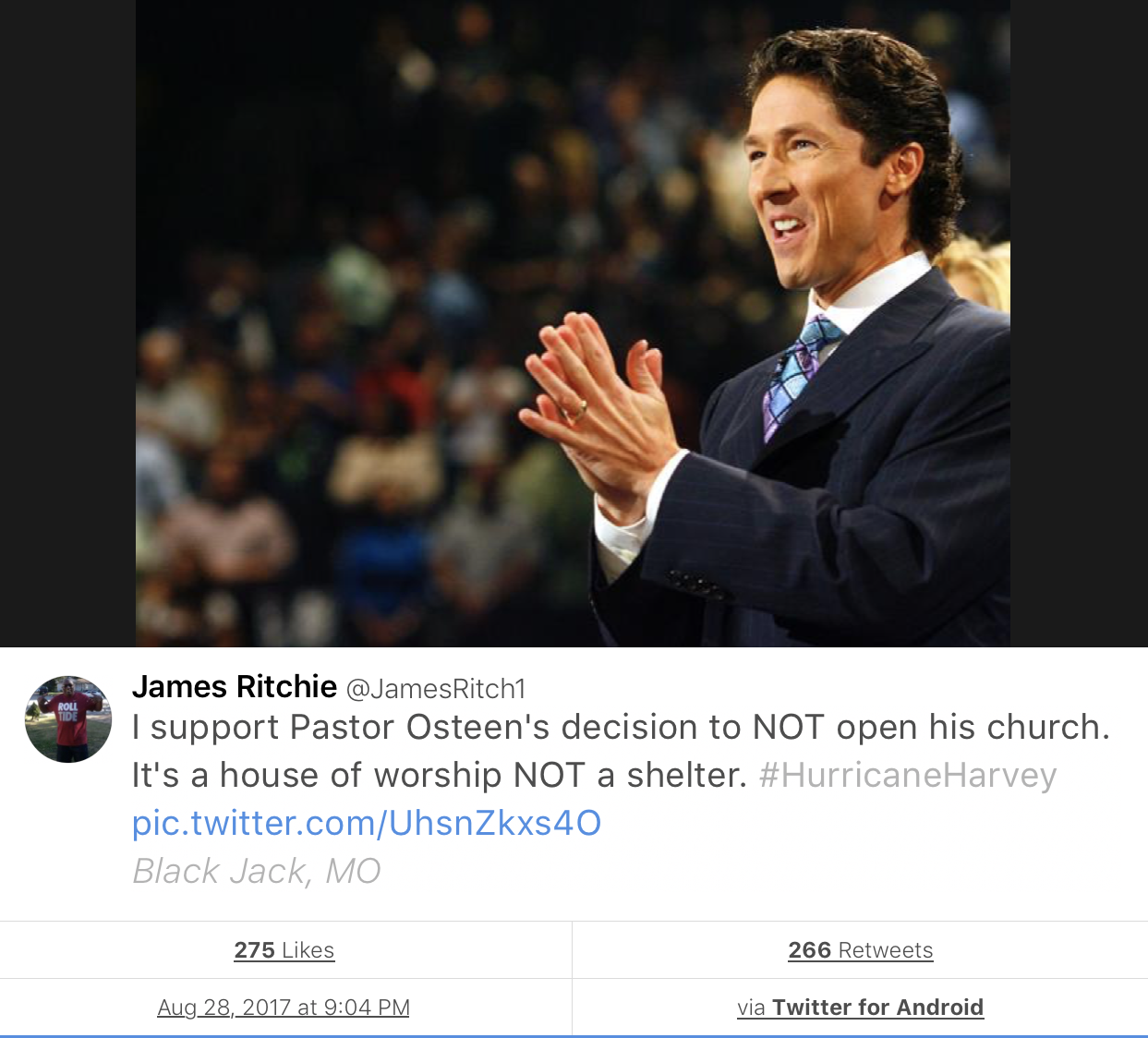
If it isn’t a sanctuary, it is not a house or worship.So, yes, I was one of the people a bit outraged when so-called christian televangelist Joel Osteen, mega church pastor in Houston, Texas, refused to open his building as a shelter to his neighbor flooded out of their homes: Joel Osteen’s Houston megachurch opens to Harvey victims only after backlash. The church’s statements have been slightly contradictory. There are plenty of posts on the internet you can track down of people living nearby walking to the church during the time when the church claimed it was flooded to show there wasn’t any flooding. And during the time when they said it was not locked people walked up and took videos of themselves trying doors and so forth.
So let’s get a few things straight. Osteen’s “ministry” preaches so-called prosperity gospel, the essence of which is: if you’re rich, that’s a sign God likes you. If you’re not, maybe he doesn’t. This runs absolutely counter to almost every word Jesus actually said. The church in question isn’t just a megachurch, it is a former sports arena that the “ministry” purchased for millions of dollars, then spent at least 70 million more renovating. The renovations include installing two artificial waterfalls inside the church, yet somehow in all of that they neglected to put in any symbols of Christianity: there are no crosses or any other signs inside the sanctuary that indicate in any way that it is a christian house of worship. Thousands of TV cameras and screens and a top-notch sound system so that you can always see and hear Osteen, though.
While the child inside me who used to love reciting John 16:33, or Matthew 5:3-16, or Matthew 25:31-46 gets outraged at Osteen’s actions, I can’t really say that he is much of an outlier of typical evangelical christian thought. Most evangelical christians believe, whether they say it aloud or not, in the Just World Fallacy: if bad things happen to you, they are almost certainly a punishment from god. In other words, if you’re poor, it can’t possibly be because the entire system of the economy and society is geared to transfer wealth and resources from everyone else to the rich, it’s because you’re probably secretly doing something sinful. If you get a horrible disease, it isn’t caused by a virus or chemicals you’ve been exposed to in your deregulated workplace, et cetera, it’s because you’re doing something sinful, et cetera. And therefore, poor people, sick people, and so forth don’t deserve help and compassion. Like Osteen’s prosperity BS, it is the opposite of what Jesus actually taught.
As if one object lesson in just how uncompassionate and unchristian many of these so-called religious leaders are, at the same time this was unfolding, another group of evangelical leaders were doubling down on their anti-gay, anti-trans, anti-sex, anti-joy hateful rhetoric: Evangelical Leaders Release Anti-LGBTQ Statement On Human Sexuality. The fact that some of those “leaders” have been involved in serious scandals trying to cover-up rampant sexual abuse within their organization is really all anyone needs to know about them.
But someone else described these situations far more eloquently long ago:
“Not every one that saith unto me, Lord, Lord, shall enter into the kingdom of heaven; but he that doeth the will of my Father which is in heaven. Many will say to me in that day, Lord, Lord, have we not prophesied in thy name? and in thy name have cast out devils? and in thy name done many wonderful works? And then will I profess unto them, I never knew you: depart from me, ye that work iniquity.”
—Jesus, as quoted in the Gospel of Matthew, chapter 7, verses 21-23.






















 Font Folly