I’ve mentioned before that I collect images and memes and such as potential illustrations for Friday Links posts or political commentary, and I’m always collecting more than I wind up using. So every now and then I’m going to do a post like this where I just publish a bunch.
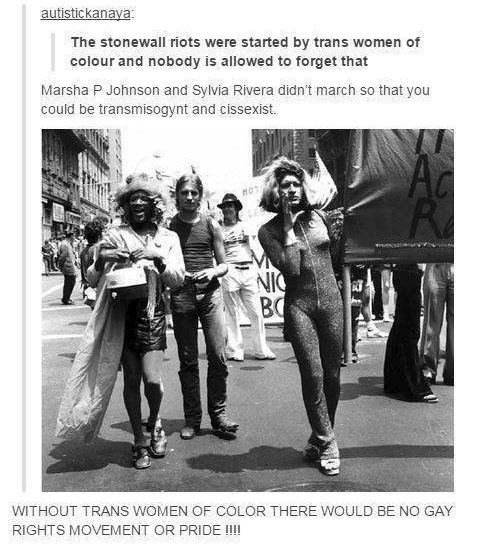
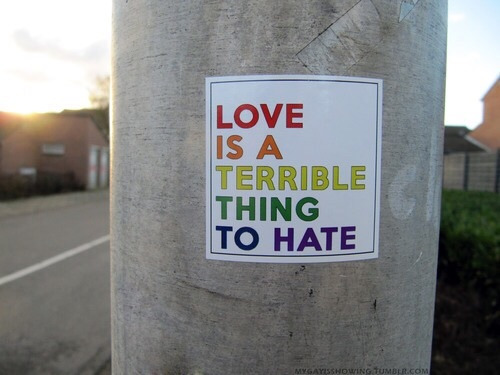
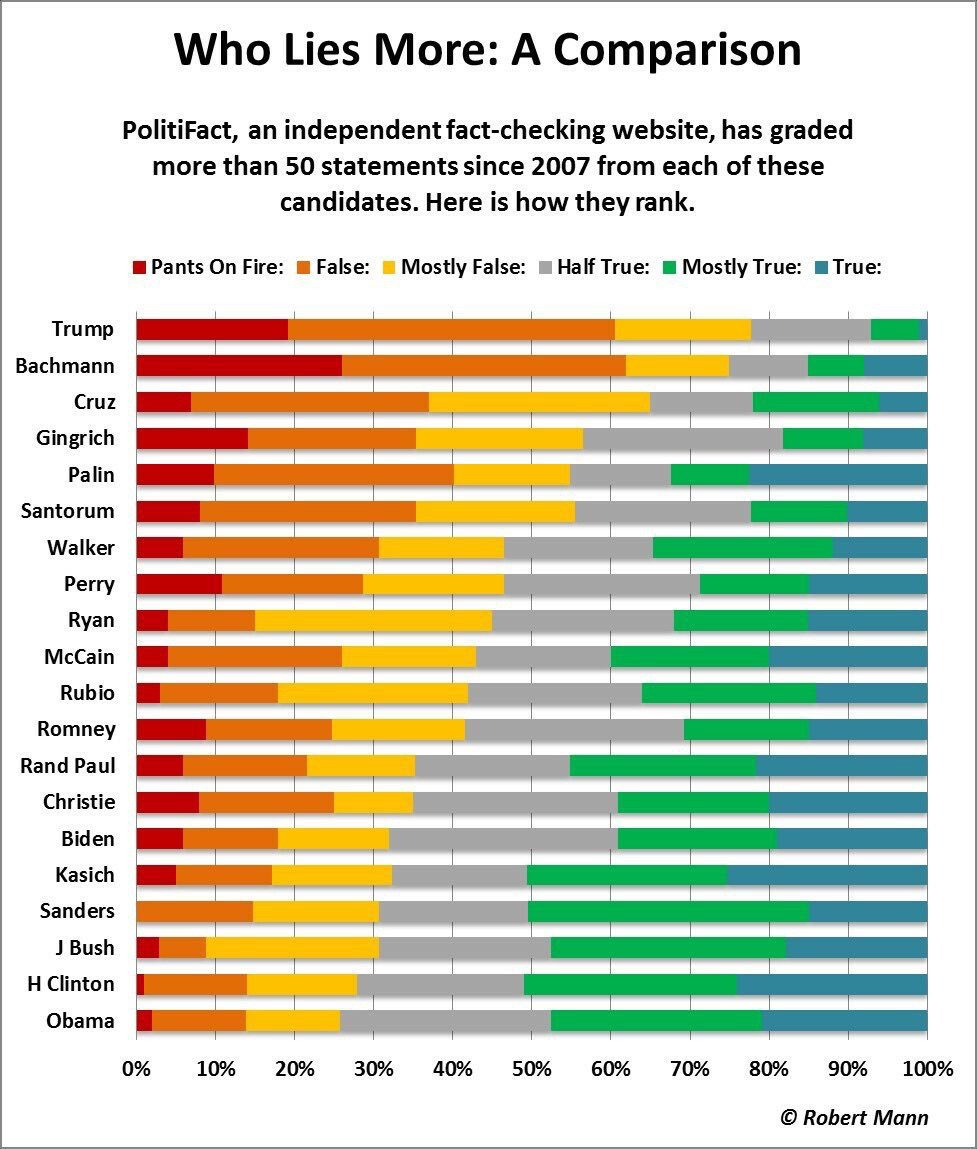
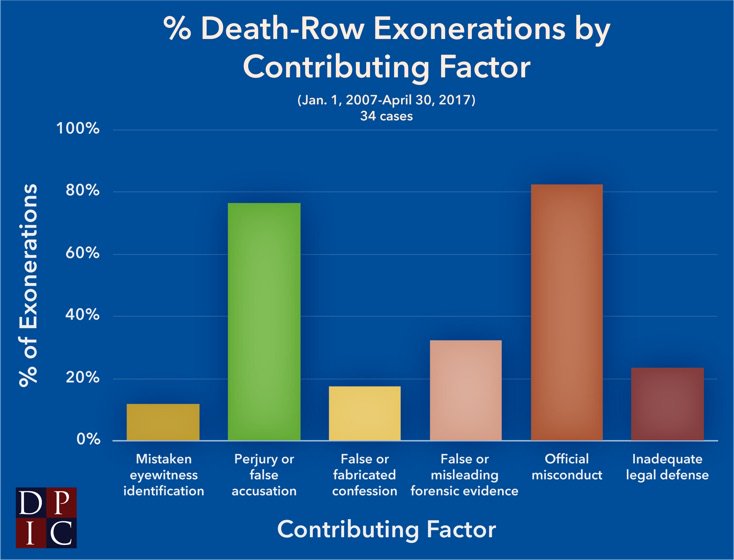
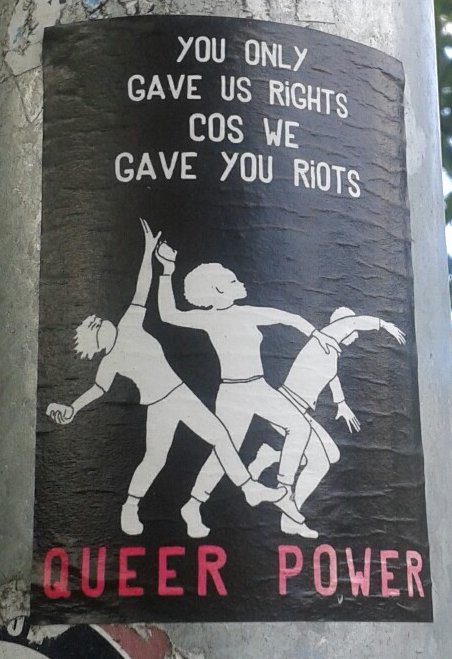
“The Stonewall Riots were started by trans women of colour and no one is allowed to forget that.” (Click to embiggen)“Love is a terrible thing to hate.”“Who lies more?” Please stop repeating the lies that all of them do it. One end of the political spectrum fails fact checks far more often than the other.(Click to embiggen)“Percentage of Death-Row Exonerations by Contributing Factor.” Gee, several of those categories constitute official malfeasance. (Click to embiggen)This is what “Make America Great Again” meant to far too many of Donald’s supporters (and staff, and Donald himself, to be honest). (Click to embiggen)“When I find myself in tweets of trouble, Mother Russia comes to me, speaking words of wisdom… covfefe!”“You only gave us rights because we gave you riots. Queer Power” (Click to embiggen)“We kept fighting after Stonewall. We’re still fighting the AIDS Crisis. We kept fighting after Anita Bryant. We kept fighting after Jesse Helms. The struggle is far from over. I’ll keep fighting. Will you?”“Pride 2017”
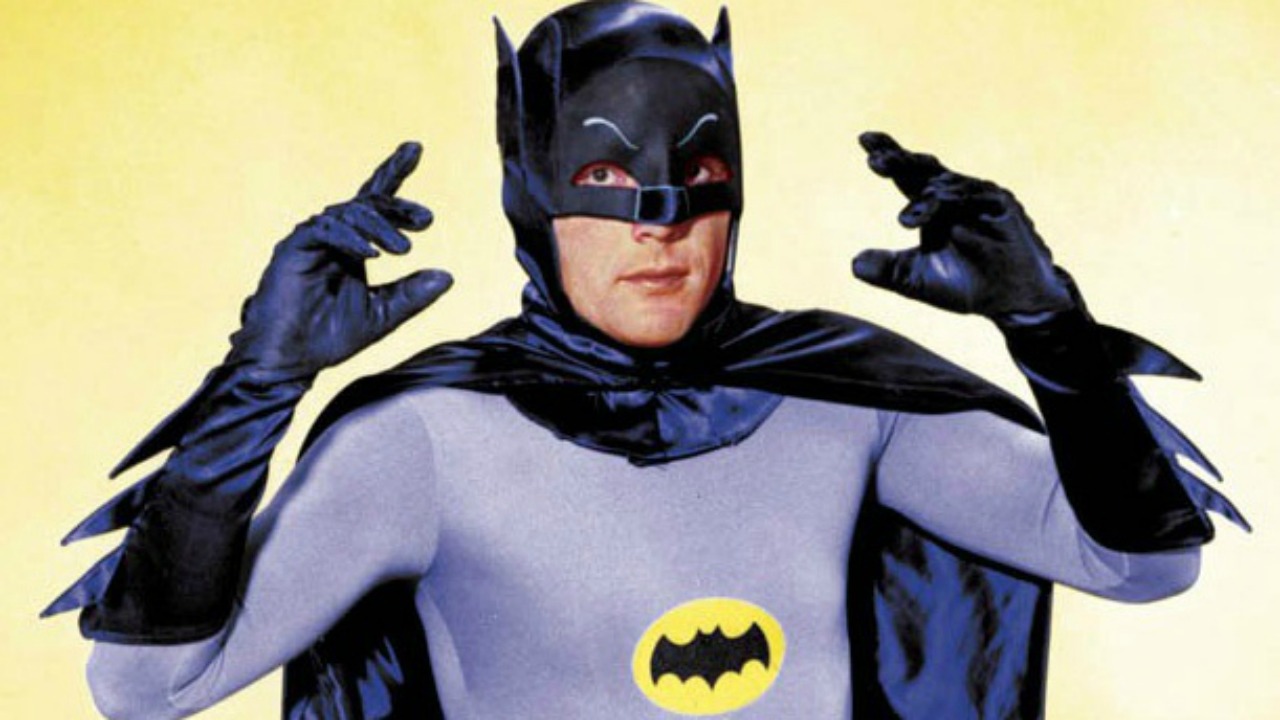
It has been said in many interviews, including by West himself, that the reason why he got the role among the actors who were screen tested for it was because he was the only one who could deliver the dialog with a straight face. The series’ incredible blockbuster success typecast West, making it difficult for him to get work, but he eventually embraced the role, eventually calling his version of the Caped Crusader the Bright Knight (as opposed to the Dark Knight of later incarnations).
And while I appreciate some of the other versions of Batman, five-year-old me looked up to West’s Batman as a hero who stood for justice and compassion, who was willing to risk everything for others, and always ready to answer the call. It was West’s commitment to the role that made that version of Batman real. You’ve answered your final bat-signal, Adam West. Rest in peace, and thank you.
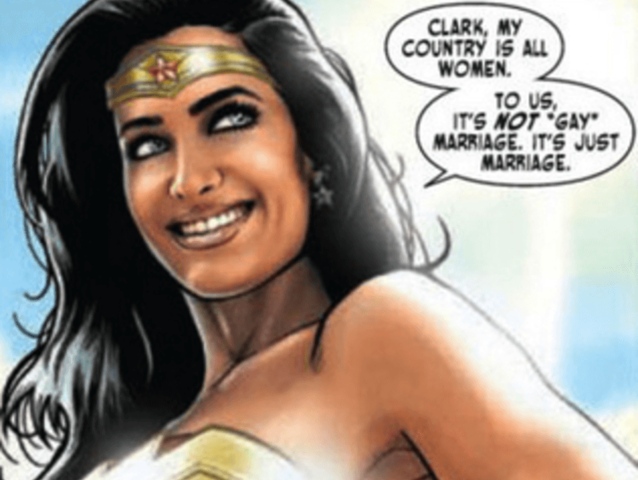
“Clark, my country is all women. To us, it’s not ‘gay marriage,’ it’s just marriage.”It’s Friday. The second Friday in Pride Month. And the news in the real world continues to be both depressing and frightening. So, if you haven’t yet, I highly recommend you go see Wonder Woman, because no matter who you are, it should make you feel empowered (well, unless you’re an alt-right/neo-nazi/MRA jerk with enough self awareness to recognize what the bad guys believe). Seriously.
Anyway, here are the links I found interesting this week, sorted into categories.
Is Trump’s blocking of some Twitter users unconstitutional? A lot of people think the first amendment is only about personal expression and the press, but the first amendment also guarantees citizens the right to petition their government; Trump has turned his personal twitter account into an official policy communication conduit and some would argue a public forum.
The most recent edition of the full OED. Please note that this isn’t 20 copies of the same book; it takes these 20 volumes to add up to one dictionary!I’ve mentioned many times that my childhood was spread over ten elementary schools in four different states thanks to my dad’s employment in the petroleum industry. Those ten schools varied a lot, but one thing all of them had in common was a library; and one of the things each of those libraries had in common was a big dictionary. They didn’t all have the exact same dictionary, but there was always at least one large hardbound dictionary, frequently on display on a stand or lectern.
I distinctly remember the library at the elementary school in Kimball, Nebraska keeping its dictionary on a pedestal that was too tall for me to reach the book, and it had a sign that said it was off-limits to anyone below fourth grade. When I asked why, I was told that it was too heavy for us smaller kids to lift, that it was printed on extremely thin paper which was easily torn, and besides, us lower grade kids couldn’t really understand it. I argued, of course, which got me nowhere. In fact, a note about my bad attitude was sent home to my parents. Surprisingly, my dad wasn’t angry at me about that, and seemed to actually take my side (though he didn’t go so far as to do anything about it).
I was apparently so offended at the notion that I, as a second-grader, couldn’t understand a dictionary, that I ranted about it at Sunday School. Which eventually led the wife of the pastor at the church we were attending to give me a dictionary of my own. It was an old desk dictionary whose cover was held on by a lot of layers of black book tape, but it was mine. My parents didn’t have a dictionary in the house before then (though over the next few years we acquired a couple more).
But to get back to those big dictionaries in the library, all of them said “Webster’s” on the cover, often in gold printing. A large number of them were probably various printings of Merriam-Webster’s New International Dictionary second edition. But because the original dictionaries edited by Noah Webster had fallen into the public domain by 1889, other publishers have been using the name in the title of their dictionaries. So some of them were probably from other publishers.
I was in the fifth grade when I learned the latter fact: that just because a dictionary’s cover said “Webster’s” didn’t mean it actually was Webster’s. But at the same time I also learned about the Oxford English Dictionary. The teacher in question was deeply enamored with the OED, having started using it at libraries while he was studying in the United Kingdom, and hoped someday to own his own copy. He told us that the dictionar was so big it couldn’t be published in one book, but was split into multiple volumes, like an encyclopedia, and cost thousands of dollars. I remember specifically him explaining that it was about 30 volumes.
I learned later that the last bit was completely wrong. At the time this teacher was studying abroad, the second edition of the OED hadn’t yet been printed. The second edition is 20 volumes, whereas the first was originally ten volumes, with only three supplemental volumes having been published by the time the teacher was back in the U.S. and teaching us in the tiny town of Roosevelt, Utah. I don’t know if he truly didn’t remember how many volumes it was (which suggests that he may have used it at a library only once or twice), or if he was exaggerating for effect (giving this teacher’s personality, either was likely), but he was incorrect about the number of volumes.
Still the image of thirteen big hardback books being necessary to contain all the text of a dictionary was pretty magical. And ever since I’d learned of its existence, I too, dreamed of a day when I would have a copy of the OED of my own. It is definitely a dream, because the retail price of the full twenty volume set is usually listed at $1295 – though you can usually find it being offered at just under a thousand. I found a set in a used bookstore once… locked up in a glass case and being offered for even more than that. It wasn’t the 20-volume second edition (first published in 1989) but the old 10 volume set from 1928.
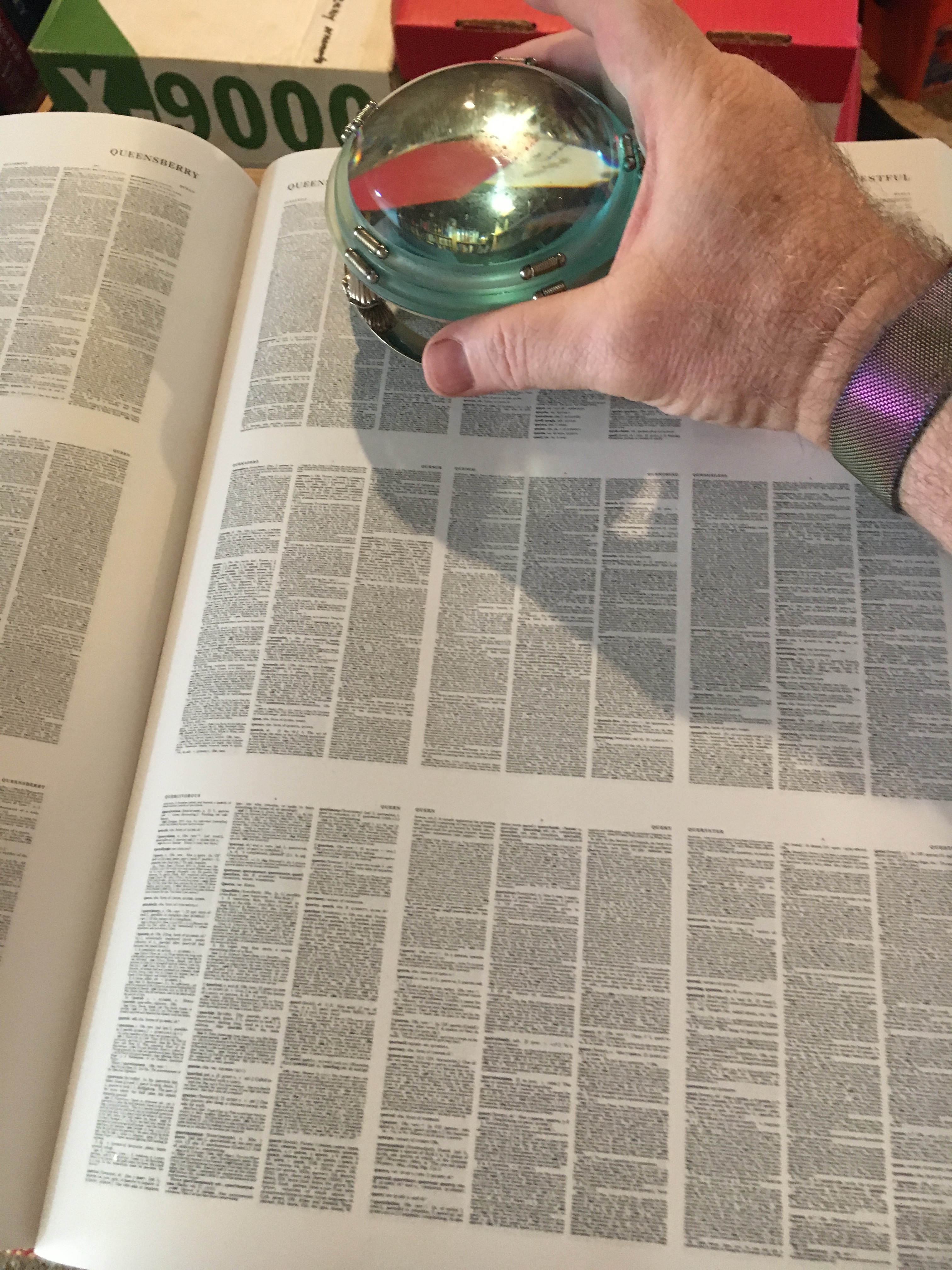
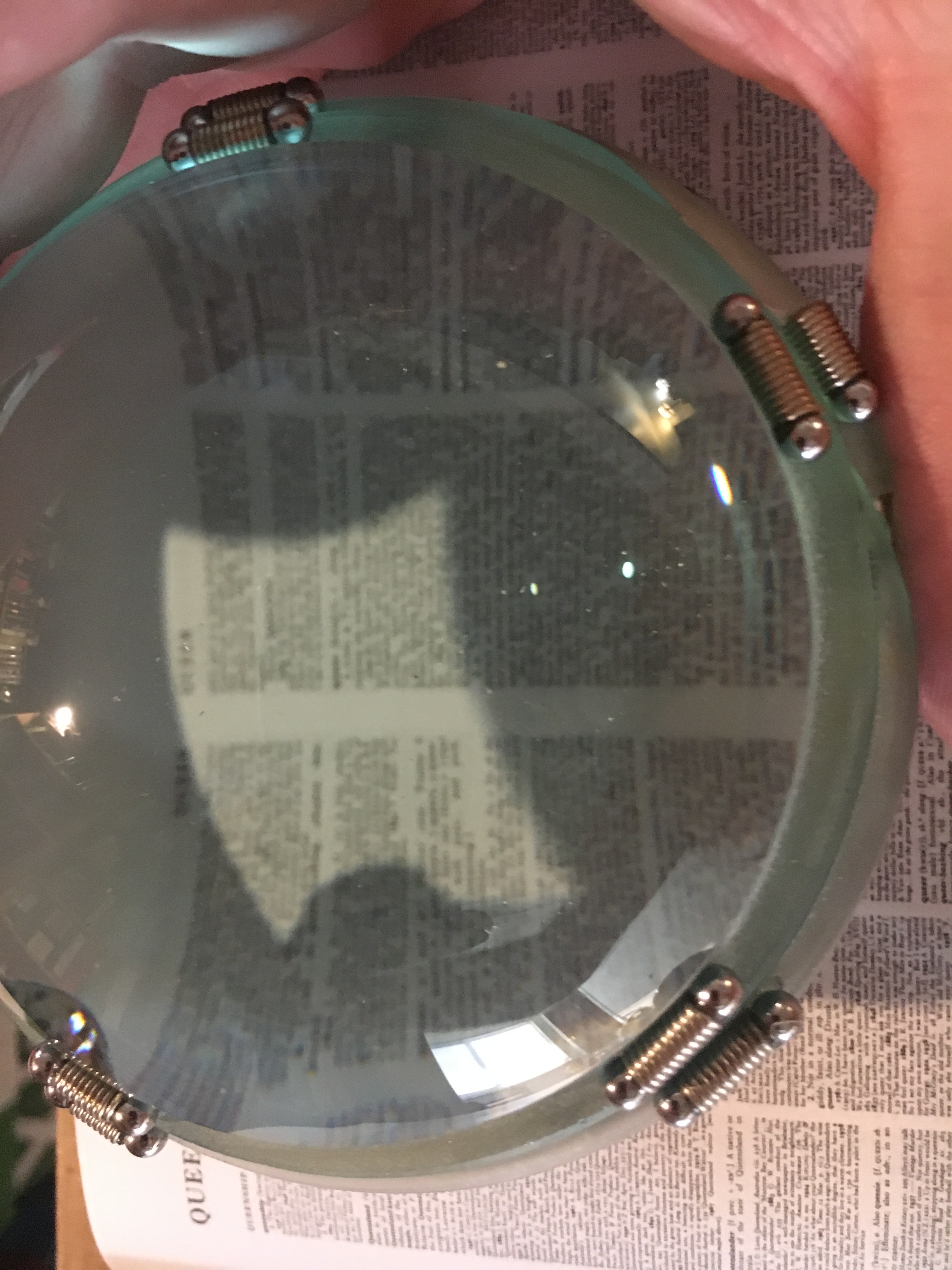
The Compact Oxford is not an abridged dictionary. It contains all of the text of the full 20-volume set (me included for scale).Given those prices (and once you learn how much work goes into producing a high quality dictionary {many years, dozens of editors, hundreds of readers scouring old books}, you’ll understand why the price tag is so high), I had to content myself with various abridged versions for several years. Until my husband surprised me on one birthday with the Compact Oxford English Dictionary. The Compact Oxford is a very clever book: it contains the full text of the twenty volume dictionary in a single book. They do that by printing on each page of this oversized book tiny images of pages of the dictionary—nine pages of the large dictionary on each page of the Compact. The resulting text is so small that you need a strong magnifier to read the text. So it’s a little weird… but also very cool. At least in a geeky way.
Each of the blocks of text you can see is a page worth of three-column text printed very small.I’d heard about the Compact Oxford long before I’d seen one. Sometime in the early 90s a co-worker mentioned that there was a one-volume version that they sold with a magnifying glass, but that’s all the details I had at the time. I didn’t realize that they were publishing a bunch of miniature images of full pages, nor did I understand just how tiny the type really was. I had been been quite happy with my copy of The Oxford Dictionary and Thesaurus: American Edition because it is a big, hefty dictionary, almost the size of some of my other unabridged dictionaries, and it had those painstaking word histories that the Oxford is famous for. Then one birthday my husband hauls out a giant present and sets it in front of me. I thought it was a computer of something at first, until I tried to lift it. It was way too heavy for the size. Under the wrapping paper as a big box with the words “The Compact Oxford Dictionary” and “Includes Magnifier.” I was speechless. He was grinning ear-to-ear, of course. It came with more than a magnifier (and a velvet bag to keep the magnifier in). There is a secondary book with instructions on how to use the big book, a protective holder that the two books can slide into—you can put the holder on the shelf, read the spine of the dictionary, and tilt it out easily enough. The holder is substantial enough that even on a shelf with a whole bunch of equally ginormous books (such as six other unabridged dictionaries from other publishers) and it will hold the space open for the book. Which I realized is most useful when you got to put the book back.
Getting the light just right is often a challenge.Being the kind of nerdy collector I am, getting this book has kicked off another obsession: trying to find the perfect magnifier. A regular magnifying glass that you might pick up for home use only magnifies about 2x or 3x, and that’s just not enough to read the tiny print. The one that came with the book is a 4x magnifier, which is adequate. In the years since I got the dictionary, I’ve found a couple of 5x that work better, though sometimes getting the light right is tricky. There have been many times I’ve slid the magnifier around with one hand while shining a flashlight with the other, finding the perfect angle to light up the words without creating a glare on the part I’m trying to read. It works best with a table big enough that you can lay the dictionary flat while you’re reading.
I’m more than occasionally asked by people why I need more than one dictionary–often with the admonishment, “You know, you can look words up online.” The free online dictionaries give you a fraction of the information about each word that even a $30 collegiate dictionary will provide, is the short answer. And most don’t have the word histories—telling you what year the first use of a particular meaning of the word appeared in print. There is also something to be learned by comparing the definitions in different dictionaries. Which people who aren’t word nerds don’t understand. Then, of course, for some of my dictionaries, there’s that Old Book smell. And you just can’t get that from an online reference.
It is true that more often I look things up in the electronic Shorter Oxford that I bought for both my Mac and iPad/iPhone, simply because it’s more convenient, and I’m usually not needing all of the extra information. (And the purchased app contains more information that the free online sources!)
But the real reason that someone who will suggest looking things up online instead of cracking open a dictionary will never understand is that the dictionaries aren’t just to “look it up” and go. Books have always been magical portals for me. They take me to far away places, or fabulous worlds, or just the mind and heart of another person. That’s true of both fiction and non-fiction. Dictionaries and encyclopedias aren’t just references to me. I love to read them. I love to browse from entry to entry, going down metaphorical rabbit holes as, while I’m reading about one word, a reference is made to a derivation of another word, or a different word that shares a similar root (I love the phrase some dictionaries use, “more at xxxx”!), and going off to read that, which leads to another, and another…
The whole world is contained in a good dictionary. Not just language and meaning, but history and culture (yes, the good and the bad). Finding all of that isn’t something you get just be reading an entry or two. You have to wander and browse and get lost among the words.
If you want a good, but affordable version of the Oxford Dictionary (technically small enough to fit in a pocket), it can be had: The Oxford Color Dictionary. It’s not just a dictionary about colors; they put the word color in the title because all of the main headings in the book are printed in a nice blue, which isn’t just meant to make it pretty. As I said it is technically a pocket dictionary. The pages are very small and the font is smallish. They use of color for the words and black text for the definitions, etymologies, et al. It really makes it easy to find the words you want. And it’s cheap! There’s also a companion Color Thesaurus.
Sorry, the Save Draft button and the Publish button are too close together on the interface, and sometimes while I’m working on a blog post, particularly a longer one where I save many times, I accidentally click publish without realizing it.
When I set my goals for this year, I pledged to do monthly updates, since the years I’ve done that has resulted in better results than years I haven’t. The crazy wrinkle this year was that we knew that sometime after May 8th the new owners of the old building would give us a final move out notice, but that we couldn’t actually move until after Michael’s surgery and recovery was complete, which made it difficult to find a place to move to, since no one was willing to hold a place for more than a few weeks.
The last time I posted about the goals was at the end of March, when Michael was only a bit over a week into the recovery. My specific tasks for April were:
Pack and move!
Pack and move.
Squeeze some writing time in somehow.
Remember to have fun at NorWesCon (whether we attend the whole weekend or not).
Write at least two blog posts about things I like.
Once we finally had a lease signed in mid-April, that meant that my goals for the rest of April and all of May were:
Pack and move!
Move and unpack.
Clean out the old place.
Try to keep squeezing writing time in.
We’ve still got a lot of unpacking to do, but we’ve moved, so yay!
I got some writing in, but most of it was blogging. I did a lot of blog writing on the bus and during lunch at work. Having a slightly longer bus ride in (and being too far out to walk home, so I’m busing both ways) gives me a bit more time to write on the bus. Which is nice, though I’m finding it harder to get myself to write scenes on the phone than blog posts. I’m not sure why.
We didn’t attend NorWesCon, other than to show up at dinner time on Saturday evening, have dinner with our gang then run up to one of the hotel rooms to watch Doctor Who. But it was a great break during the first weekend that we were actually moving into a place, rather than packing and trying to find a place.
I’ve already written more about the packing, moving, hauling, cleaning, and so on than anyone cares to read, so let’s move on.
The big goals remain, though this is probably a good time to revisit them.
Don’t get mad, get busy. My tasks are: write about things I love; listen to music and audiobooks more and podcasts less; spend at least half of my lunch break writing; set specific monthly writing/editing goals in each check-in; write at least one blog post a month about organizations we can donate to that are fighting the good fight.
Reduce, pack, and prioritize. Now you might think this big goal could be marked “done” for the year, since we’ve moved, but it just needs to be rephrased: Unpack, reduce, and prioritize. We tried to purge a lot of things during the packing, but as we unpack we keep finding things that we realize should have been pitched rather than packed. And though the new place is a couple hundred square feet bigger than the old, we have a lot less storage. So, a lot of work to do here, still.
Take care of us. It’s important to remember to take rests, not to let ourselves stress about things, and so on.
Submit and publish. Initial task was to organize how I’m going to find calls for submission and set reasonable targets for the novel revision/finalization. I have thus far totally failed to get organized regarding submissions. Nearly half the year is gone and I’ve only submitted to two places. I have consolidated all of my notes for the revisions, and now that we’ve moved I can get back to that.
So June is going to be a reset month, now that the big disruption is over. My specific tasks for the month are:
Get back into the rhythm of editing the novel.
Write at least two blog posts about things I like, rather than rants or commentaries.
Get the iris bulbs, monitors, and other things that we want to give away handed off to people who said they wanted them.
Go through the rest of the Christmas decoration bins and finish that purge.
“Music is like breathing—I don’t get tired of breathing, and don’t get tired of music.” —Ray CharlesI often listen to music while I’m writing. But I don’t just listen to random music; I make special playlists for certain characters or projects. My oldest playlist (rather uncreatively named “Writing”) was created in 2003, when iTunes first became available for Windows1.
A friend recently commented that a lot of my playlists re-use songs. He’s right, particularly since many of the lists I’ve been sharing lately are based on some of my writing lists2. That’s because I assign some songs to particular characters. Or I assign some songs to particular character combinations. For instance, I use the Matt Goss song, “Evil” if I’m working on a story or section of one of the fantasy novels when the characters of Madame Valentina and the Zombie Lord figure prominently; because the song’s lyrics sound like something that Madame Valentina would say to her former friend and comrade-in-arms about why they are no longer friends. Other songs represent something a bit more abstract and just wind up in lots of playlists.
I listened to music while writing long before having a program that could play pre-programmed lists. And I even had playlists, of a sort. I used to make myself mix tapes3 on cassette. Like the playlists now, they were often meant as sort of a soundtrack for a project I was working on at the time. Before I had that technology, I used to like to listen to certain albums on vinyl while I wrote4. But more often I listened to the radio, where I had no control on what music would come up.
I’ve had multiple friends comment that they can’t write at all while listening to music that has lyrics. They can only write to music if the music is only instrumental. They mention this because they are confused when the vast majority of my writing playlists are made up of songs (often dance, pop, or rock songs, but queercore, baroque pop6, and broadway style musicals7 figure heavily as well) that have lyrics. I attribute this ability to two things. First, the fact that back when I was 11 years old9 and such I listened to the radio while I wrote. But another factor is familiarity. I usually only put songs that I know relatively well into the playlists, which means I don’t have to spend a lot of brain power parsing the lyrics when I hear it.
But even when I put new songs that I have only just discovered into the playlist they quickly become familiar. Because—and this is something I only realized recently is different than the way these friends use writing playlists—I don’t just listen to the playlist while I’ve actually writing. I listen to the playlist to get me in the mood to write a story. By which I don’t mean I sit quietly listening to the playlist hoping that I’ll eventually feel like picking up the keyboard and getting to work. No, I listen to the playlist during the day at the office, or while riding the bus to work, or while walking home, and so on.
I mentioned above that some songs function as themes for some of my characters or certain relationships, but I also have some songs that are essentially theme songs for specific subplots, or story arcs, or even specific plot twists. It’s not that I sit down and think, “Okay, this moment here needs a song,” it’s more that I’ll hear a song and find that when I listen to it it makes me think about that bit of the story. So I add the song to one of my existing writing lists; or I take subsets of several existing writing lists plus this song that hasn’t been in one of the lists before, and put together a new one. Which is another reasons that some of my lists repeat songs in other lists.
I know that I’m not the only person who uses inspirational playlists this way. But clearly the idea of listening to a writing playlist other than when you’re writing isn’t an obvious one. And it is true that sometimes I find, while I’m actually writing, that I need to switch to something other than the new writing playlist I’ve been listening to recently. There are times when I’m focused more on the words than the story. But that doesn’t happen often.
I think that might be another difference. I’ve always had a little trouble understanding why some people get so hung up on what to write next. Particularly when they describe struggling to find exactly the right word, or that a particular sentence kept coming out awkward. Because writing isn’t about showing off your gigantic vocabulary. It’s storytelling. And you can tell any story, even a new and unique one that is yours and yours alone many ways. This is sort of an extension of an idea that Stanley Fish talks about in his excellent book, How to Write a Sentence. Fish argues that the basic tool of the trade of a writer is the sentence, not the word, because words don’t take on their exact meaning until they are put in the context of a sentence, right?
The important part of a story aren’t specific sequences of words or astonishing turns of phrase. The story is about the characters confronting a problem, how they react to it, how they grow (or fail to) as they endure the slings and arrows of the tale. It’s about how the reader feels about those things. It’s about how the reader is moved by the events, what those events mean to the characters, and the state of each character as they reach their final fates.
That’s why lyrics shouldn’t distract you. Because good songs speak to your emotions. And emotions and events are what you need to be focusing on while writing your story. The words are just how you get there. They aren’t the end, they’re the means.
Put on your headphones, queue up some music that makes your heart and soul want to dance. Then, start writing.
Footnotes
1. That’s right, I used iTunes for three years before I owned my first iPod.
2. I very very occasionally publish lists of the songs on my blog. I slightly more often zip up all the songs in a list and share the file with friends who express interest.
3. Other people made mix tapes to get to people they were romantically interested in or already dating as a way to express their feelings. I assembled tapes of songs for myself.
4. Once I had my own record player, I could put a stack of vinyl albums on the spindle, and it would play one side of each album one after the other. It only held three albums5, but it was a way to build a very primitive sort of playlist.
5. The big stereo in the living room could hold five or six albums in a queue!
6. For instance, Rufus Wainwright or John Grant.
7. Yes, I’m the kind of queer man who listens to musicals! So sue me!8
8. It almost goes without saying that I appeared in musicals in school, but the truly frightening thing is that I’ve written a musical!
9. I decided to become a writer when I was four or five years old, after Mom responded to my question about where books come from. I wrote my first “book” when I was six. I learned to type at age 10, and wrote a lot of short stories on my mom’s Easter Pink Smith-Corona Silent Super typewriter until, just before my twelfth birthday, my paternal grandmother gave me her 1952 Remington Let-R-Riter. I owned my own typewriter! And I went crazy with the writing.
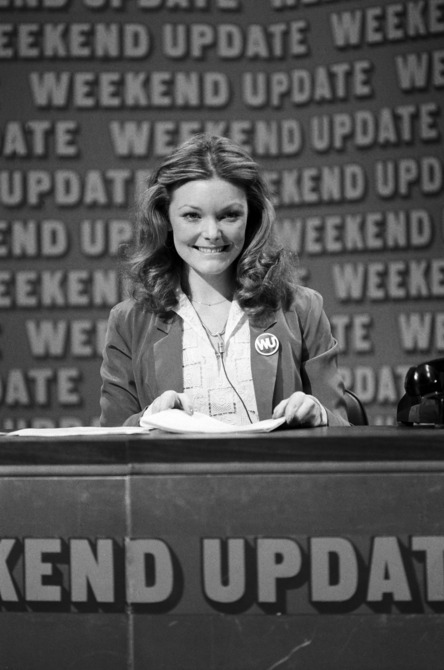
Jane Curtin anchoring Weekend Update on Saturday Night Live.Yesterday’s weekly round up of links had only one story on Wonder Woman: the fact that is had an extremely positive rating on Rotten Tomatoes (among all superhero movies of all time, second only to The Incredibles.) I didn’t include any stories about the man-babies who are complaining: Conservatives Cry Misogynist Tears Over All-Female “Wonder Woman” Show. So Alamo Drafthouse Cinemas announced a couple of “No Guys Allowed” showings at two of it’s theatres, one in Austin, one in Brooklyn. And a bunch of entitled douches got upset. This kicked of a string of responses. My favorite is: Austin Mayor Responds To Man Angry About ‘Wonder Woman’ Screening. I love that the mayor’s response begins, “I am writing to alert you that your email account has been hacked by an unfortunate and unusually hostile individual. Please remedy your account’s security right away, lest this person’s uninformed and sexist rantings give you a bad name. After all, we men have to look out for each other!”
And let’s talk about some real-life heroes. I had a bunch of stories yesterday about last week’s hate crime/white nationalist terror attack on a Portland train. The quick sum-up, an angry man started yelling at two teen-age women of color on the train, three guys tried to intervene, the angry man stabbed all three guys, two of whom died at the scene. Angry man is in custody and at his arraignment was screaming white nationalist slogans. People have donated a lot of money to funds to help the families of the two men who died and help cover the medical expense of the survivor. I covered all of that, yesterday.
“We need to remember that this is about those little girls. I want you to imagine that for a second, being a little girl on that MAX.This man is screaming at you. His face is a pile of knives. His body is a gun. Everything about him is cocked, loaded and ready to kill you. There is a history here with this. You can feel that this has happened before, and the only thing that was different was the names and faces. And then a stranger, two strangers, three strangers come to your aid. They try to help you. And that pile of knives just throws itself at them. Kills them.”
—Micah Fletcher
Speaking of Pride Month: Netflix And FilmRise Separately Acquire Transgender-Themed Documentary Films. One of the documentaries is The Death and Life of Marsha P. Johnson; Johnson was one of the trans heroes at the original Stonewall Riots, and is often credited with being the actual person who threw the first brick that night.
“We are all a little broken. But last time I checked, broken crayons still color the same.”We had an extremely productive holiday weekend, getting a lot of errands and unpacking done. There’s still a lot to do. I hoped to continue the work weeknights this week, but we had another impossible deadline at work this week, which meant I worked really long hours Tuesday, Wednesday, and a bit of Thursday. That also means that this week’s collections of links may be a bit smaller than usual.
Anyway, here are the links I found interesting this week, sorted into categories.
“queer – a homosexual…” Looking up the definition in the Compact Oxford English Dictionary requires using a magnifier.Twenty-five years ago I was dramatically confronted with the hypocritical nature of my feelings about the word “queer.” My coming out process had been long and convoluted. This particular incident (which I’ve written about previously) happened after I had separated from my wife and begun the process of getting a divorce. Getting to the point of admitting to myself that I definitely wasn’t bi hadn’t been pleasant, and I felt that the ordeal required some sort of rite of passage. So when a friend mentioned that she was going to participate in a National Coming Out Day march, which was going to start from a location near my then-workplace, it seemed a perfect fit. It was only after arriving that I found out the event was sponsored by Queer Nation. Queer Nation was controversial within the LGBTQ+ community at the time for both their radical attitude but mostly (among the LGBT people I knew at the time) just for insisting on using the word “queer.”
The argument against the word was that it had been used as an insult against children who failed to fully conform to the ideal for their assigned gender, resulting in many adults in the LGBTQ+ community to experience great pain when hearing the word. I understood that argument, though I had found myself at the receiving end of a lot of vitriol from within the community if I happened to use the word “gay” as an umbrella term, because it left out lesbians. Similarly, I had also been yelled at from using the term “lesbian and gay” because it excluded bisexual people. And the arguments and screaming fits over the word “homosexual” are so convoluted (and intimately tied to the etymology of the word) that they deserve a separate blog post.
So I had found myself, as an active member of a couple of non-profit organizations related to the LGBTQ+ community, constantly trying to say the full initialism in every sentence.
Some gay friends who really disliked Queer Nation saw me marching up the street behind the Queer Nation banner that day (we were actually doing the Queer Hokey Pokey when we passed in front of the bar where a bunch of my friends had met for other reasons). And I got a lot of grief later from them. Some of them just teased me about it, but some were a bit more upset. While I was trying to explain why I wasn’t embarrassed about marching with Queer Nation nor did I regret it, one friend got in my face pretty angrily about it. And thus I found myself retorting, “I am going to call myself Queer if I want to, and fuck you if you don’t like it!”
My feelings about the word shifted during that argument.
Because I realized the argument has a big flaw. Yes, I was bullied as a kid with the word “queer,” but I was also bullied just as viciously with the word “gay.” And the people who argued most vehemently 25 years ago that queer was completely unacceptable, just as emphatically insisted that I should proudly call myself gay. Similarly, I know many women who were bullied during childhood and beyond with the word “lesbian” and derivatives of the word, yet now they’re supposed to proudly call themselves that word, and we’re supposed to call them that rather than use “queer.”
According to several of my dictionaries, in the last two hundred years queer has gone from an adjective meaning “strange, peculiar, or eccentric” to a verb meaning “to spoil or ruin” to an adjective meaning “of or related to homosexuality” to a noun meaning “a homosexual man” to a both a noun and an adjective: “a non-heterosexul person” or something “related to non-heterosexuality.”
Words change. Queer may be derived from the Old High German twerh which was an adjective describing something that was “oblique or not at a right angle.” In other words, not straight. One can see how describing something that was physically at an odd angle would come to metaphorically refer to something that was odd or peculiar in other ways.
My dictionaries that cite the first use of a each particular sense of a word by date indicate that the word was not used as an adjective referring to homosexuality until 1922, and then the noun usage for a homosexual man came 1935. Yet an unabridged dictionary I have that was published in 1957 lists only the definition, “odd, strange, eccentric.”
I see people who are too young to really remember the heyday of Queer Nation amid the horrors of the AIDS crisis in the 80s and 90s still making the argument that we shouldn’t use the word. They say “some people” are triggered by the word queer, so we shouldn’t use it. What they mean is they have been told by some LGBTQ+ folks my age that they are triggered by the word. I, however, remain extremely skeptical of anyone who claims a single word is a consistent trigger. Triggers are tricky, but in my experience, the people claiming to be triggered by the mere utterance of a single specific word really mean that they dislike the word, not that hearing it gives them flashbacks forcing them to relive horrific experiences. This kind of claim cheapens the very useful meaning of the word “trigger” to describe a phenomenon that some survivors of trauma experience. And I’ve never, ever heard anyone claim to be triggered by the words “gay” or “lesbian” even though those words were used as vicious insults just as often as “queer” was.
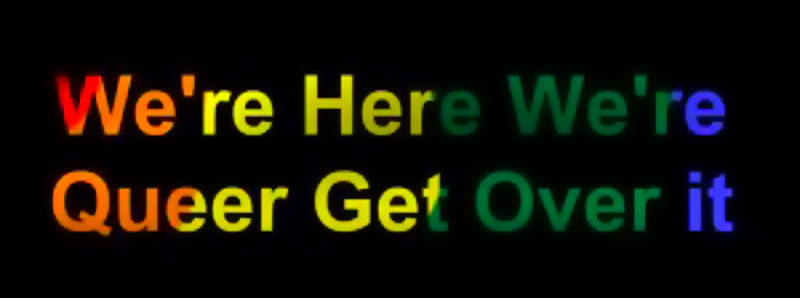
“We’re here, we’re queer, get over it.”So, I’m not going to try to squeeze the various QUILTBAG initialisms (LGBT, GLBT, LGBTI, LGBTQ, LGBTQ+, LGBTQA ad nauseam — and boy, does it get nauseam!) into every sentence. I’m queer. I’m a queer man who is a member of the queer community. The community includes trans people, bisexual people, pansexual people, asexual people aromantic people, non-heterosexual people of all genders, genderfluid people, two-spirit people, bigendered people, ambigendered people, et cetera, et omnia, et perpetua. No matter how you look at all of those people, if you get us all together, many of us are quite strange, a little odd, or wildly eccentric in wonderful ways. So queer is a word that encompasses us well.
If a specific person asks me not to call them queer, I will make an effort not to use the word to refer to them specifically, but I’m going to go right on calling myself and the community queer. I’m here, I’m queer, and I’m not going to be silenced by anyone.








 Font Folly