Tag Archives: personal

More confessions of a guy who likes the rain

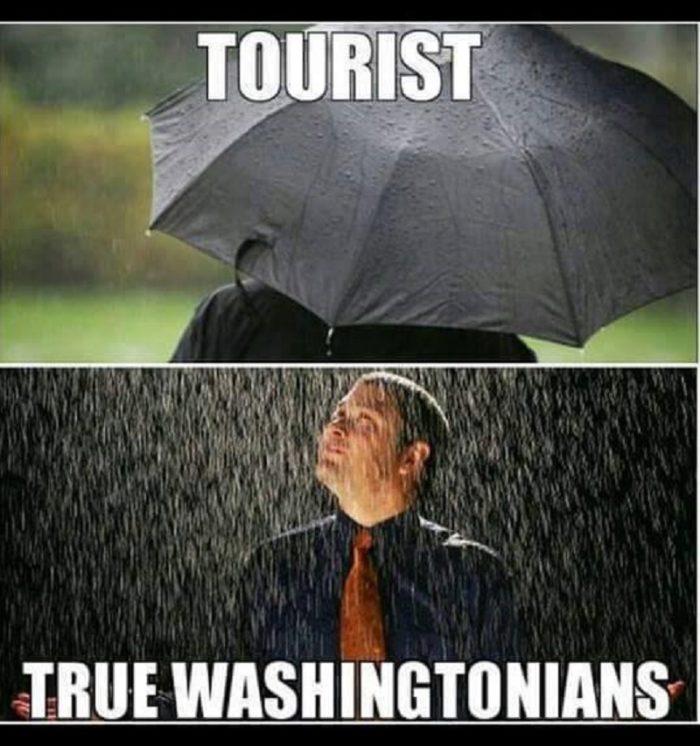
Picture of a person under an umbrella in heavy rain, labeled Tourists. Below, a man stands in the rain, head tilted up, eyes closed, labeled True Washingtonians.
(Click to embiggen)
Thursday evening, as I was turning out lights and otherwise getting ready to climb into bed, rain started pounding the roof, hard. It had probably been raining for awhile, but I hadn’t noticed the sound until then. We’ve been getting a lot of drizzly days the last couple of weeks, but this was the first time in a long, long time that I’d heard that kind of really hard rain. So I pulled on my slippers and a shirt (since I was just wearing my fleece Seahawks shorts and ankle socks), went out on the veranda, stepped up to the rail, and held out my arms to let the rain fall on my for a few minutes.

It was the first time that evening that I had felt good.

I didn’t realize that I was sick on Thursday until about an hour after getting home from work, when the cough started. I have hay fever for at least ten months of the year, and weather transition periods are one of the times that my symptoms get really bad. And the previous two weeks, while we had had some drizzle and scattered showers with temperatures in the 60s, we’d also had at least one day each week when clouds all vanished and the temp edged up passed 80. So lots of transitions.

My hay fever almost never includes coughing. Congestion, sinus headache, sometimes achey/itchy eyes, and yes lots of sneezing, but not coughing. And if the hay fever has been severe for a few days in a row, I also start feeling really run down.

So all day Thursday I had felt like I had no energy, I had to work hard to stay focused on tasks at work (it was one of the few times I was glad that I had nearly half the day in meetings). My sinuses were very painful to the point that my throat was feeling it. I was in denial that it was an actual cold right up until that cough.

And a funny thing about when I’m in denial that I’m sick: the moment I admit that maybe it might not be hay fever, I notice that every symptom I have is worse. It’s like the denial sets up a dampener that cuts out half the pain signals coming in? I realized that in addition to the coughing, my throat was more acutely sore than I had thought, and my sinus headache was worse, et cetera.

I took some cold meds right away, but the coughing kept going, and it seemed like each coughing fit made my whole body more miserable.

So that moment of standing in the rain and really, really enjoying it was great.

Friday had already been scheduled as a work from home day, so I hunkered down with coffee and tea and got through it. We had to cancel weekend plans with friends—not just because I was miserable, but also because we don’t want to infect anyone. The two times that I had to leave the house, I wore a mask and did a handwash before leaving the house. I already had a doctor appointment scheduled for Tuesday morning where (along with periodic blood work) I was supposed to get my flu shot, so I figured if the cold hadn’t begun to get better by then, I’d see what the doctor thought.

He doesn’t think I have the flu, but I do have an upper respiratory infection. So! Antibiotics for me!

At several points during the weekend I took comfort in opening the windows so I can hear the rain coming down. I started having the chills on Saturday, so I haven’t been going out on the veranda except briefly to refill the bird feeder, but I can hear the rain just fine with the windows open, and even feel the cool, moist rainy breeze on my face occasionally.

I love Seattle weather when it’s rainy or just cool and overcast.

I love it so much that I get cranky at people complaining about the weather when it arrives in the fall, or when it lingers into June. I try not to say disparaging things to them when it comes up, because I have been know to gripe and whine about the heat during the seven-ish weeks of real summer weather we get most years. But in my head I think of the folks who gripe about our weather as anti-rain trolls—particularly the ones who wax rhapsodic about the great hiking trails or the beautiful mountains that they love to ski or snowboard on.

All that snow? It’s what happens to the rain storms after they pass over us and get to the mountains. All those gorgeous hiking trails? There’s a reason we call most of the forested area of the Olympic Pennisula a rain forest. Yeah, we have pine trees (and other conifers) instead of a tropical plants, but it’s still a rain forest and all those lovely hiking trails wouldn’t exist if we didn’t have all the rain.

So, welcome to one of my favorite times of year! Let me enjoy the rain in peace. I’ll try to whine less about being sick. And I will continue to try to keep my griping about the heat each summer to a minimum. Deal?
It’s not just a word—when I say “Nazi” I mean it

The cover of the very first appearance in any comic of Captain America shows him punching out Adolf Hitler, in case there was any doubt whose side he was on.
The cover of the very first appearance in any comic of Captain America (March 1941) shows him punching out Adolf Hitler, in case there was any doubt whose side he was on. (click to embiggen)
I keep seeing the same retort coming up again and again on line: “You’re just calling everyone who disagrees with you a Nazi!” And while I know a bunch of them saying that are just trolling, I also think a bunch of them actually believe it. So let’s clear some things up. The original Nazis were a Aryan nationalist movement in Germany that rose up amid the social turmoil occurring in the former German Empire during the aftermath of World War I, exacerbated by the world wide Great Depression. Which isn’t to say that the social and economic upheaval justified the movement, just that it made fertile soil for resentment and hatred, right?

The Nazis wanted an ethnically and culturally “pure” society, and were willing to use violence to make it happen. That means they advocated for what would now be called “self-deportation” of anyone who did not match their mythical Aryan ideal. In other words: everyone who wasn’t white, who wasn’t culturally Christian, who wasn’t heterosexual (Berlin in the 1930s had a thriving and public homosexual community), and who didn’t agree with them were out. In the early stages the government arrested undesirables under pretexts of other crimes while they turned a blind eye to the actions of their supporters who terrorized people in various ways. The message was clear to people of color, to Jewish people, and queer people: disappear or else.

Both of my grandfathers fought in World War II. Even though both of them were from the south and their accents would make anyone think they were “good old boys” they had no patience for racism or sectarian prejudice. And while the image most people have of white guys who were their age in the 1980s, they both despised Reagan. My paternal grandfather said for years that he was going to move to North Carolina (we had relatives there, so he visited a lot) and establish residency just so he would have the pleasure to vote against the notorious racist senator, Jesse Helms.

My dad, on the other hand, was a blatant racist. He regularly used the n-word and other racial slurs. And every time he did within earshot of his own father, Grandpa would tell him not to use that kind of language around him. My maternal grandfather also told Dad not to talk like that.

But it wasn’t just about coarse language. When Dad would say things (about Black people or Jewish people or queer people) like: they should go back where they came form, or they were all lazy/greedy/dishonest/immoral, or they deserved it when bad things happened to them—my grandfathers called him on it.

I can’t tell you how many times I heard my paternal grandfather admonish my dad sternly along the lines of: “I didn’t spend four years of my life fighting in a war just so people could do the same racist hateful stuff here! All people deserve respect and a chance to live their lives, no matter where they were born or what religion they believe or the color of their skin!”

Each time he argued with my dad on those subjects, he mentioned his service in WWII and compared Dad’s beliefs to those of the Nazis.

My maternal grandfather wasn’t around Dad and me at the same time as often as my paternal grandfather was (and after the divorce when more details of how bad Dad’s physical abuse had been, Grandpa absolutely refused to be around him), so I only heard him lecture Dad like that once, but it was a doozy. As I recall, it went something like this: “I spent years fighting Nazis and fascists. I watched a lot of good men die. I saw people who had been starved and beaten and imprisoned just because their skin was the wrong color or they attended the wrong kind of church. And all of that bloodshed happened because people said that kind of B.S. you just said and other people believed it. You have a right to your opinion, but if you try to put THAT opinion into action… well, I for one am not afraid to fight again!”

Both of my grandfathers knew what Nazis and fascists were. They literally fought them. And when Dad spouted off his racist, anti-semetic, and otherwise bigoted opinions, they all but called him a Nazi.

They set the bar, for me. When I hear someone saying that people of color should “go back where they came from” or that every member of a particular religious background is a terrorist, or that the poor or disabled or mentally ill people are burdens on society that need to be “dealt with,” or that whole categories of people should be locked up, or that the economy isn’t working right because of “those people” taking “our jobs” and someone should do something about it, or lump refugees and immigrants together and call them all disparaging names, et cetera, then I’m going to say you’re talking like a Nazi. And you are advocating the policies of Nazis.

I do not call everyone who disagrees with me about some things a Nazi. There are people I disagree with on really important things that I don’t think are talking like Nazis. I have a couple of relatives I could name who are opposed to gay rights in general and marriage equality in particular. They are civil when they talk to me or my husband, and they don’t think they have a bigoted bone in their bodies. They’re wrong on that point. And obviously as an out proud queer man we disagree about a bunch of important things because of their feelings about gay rights. But they don’t believe that we should be herded into “quarantine camps” and they are outraged that border agents have seperated familes and put children in cages and so forth. We disagree on some pretty important things, but they don’t advocate the policies of Nazis. So I don’t call them that.

If you don’t like being called a Nazi, maybe, just maybe, you should take a closer look at the kind of things you’re saying, the people you are supporting or defending, and the policies you’re advocating. Because if you take an honest look, you may finally see a Nazi looking back at you from the mirror.

And like my grandfathers said, those policies aren’t welcome here.

Why I hate hay fever reason #6502

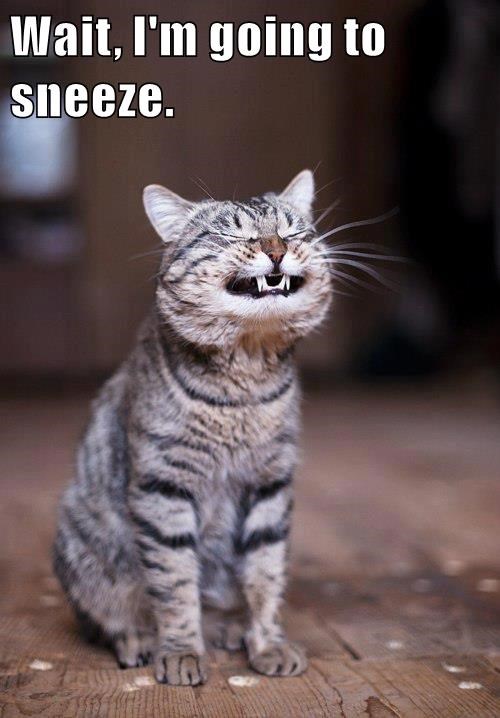
“Wait, I'm going to sneeze.”
“Wait, I’m going to sneeze.”
Some people will be surprised that I’m writing about hay fever when it is practically autumn. Well, this is one of the reasons my hay fever is so annoying. I have a moderate-to-severe allergic reaction to every pollen, spore, and mold that the allergists test for, and in the mild climate west of the Cascade Mountains, that means hay fever season runs from about mid-Febbruary to approximately mid-December every year.

We’ve had a significant shift in the weather this weekend. In the middle of last week we had one day where the temperature creeped above 80º in some places. All this week, the daily highs are forecast to be in the lower to mid-60s, plus rain every day.

I absolutely love this kind of weather.

Unfortunately, one of the “features” of my hay fever is that my sinuses react most harshly to changes. If a new species that hasn’t been the predominant pollen-contributor in a while ramps up production, my sinuses go bananas. If the weather changes, whether from damp and cool to dry and hot or the other direction, then it’s all congestion and running nose and red itchy eyes for a couple of days.

So, while I should be ecstatic that I had to pull the lightweight jacket out of the backpack (where it gets carried most of the summer in case we have rain) to wear for the trip in to work, I am instead sniffly and sneezing and miserable.

Pass me that box of kleenex, please?

Course Correction vs Necromancy—a follow up on exclusion at sf/f conventions

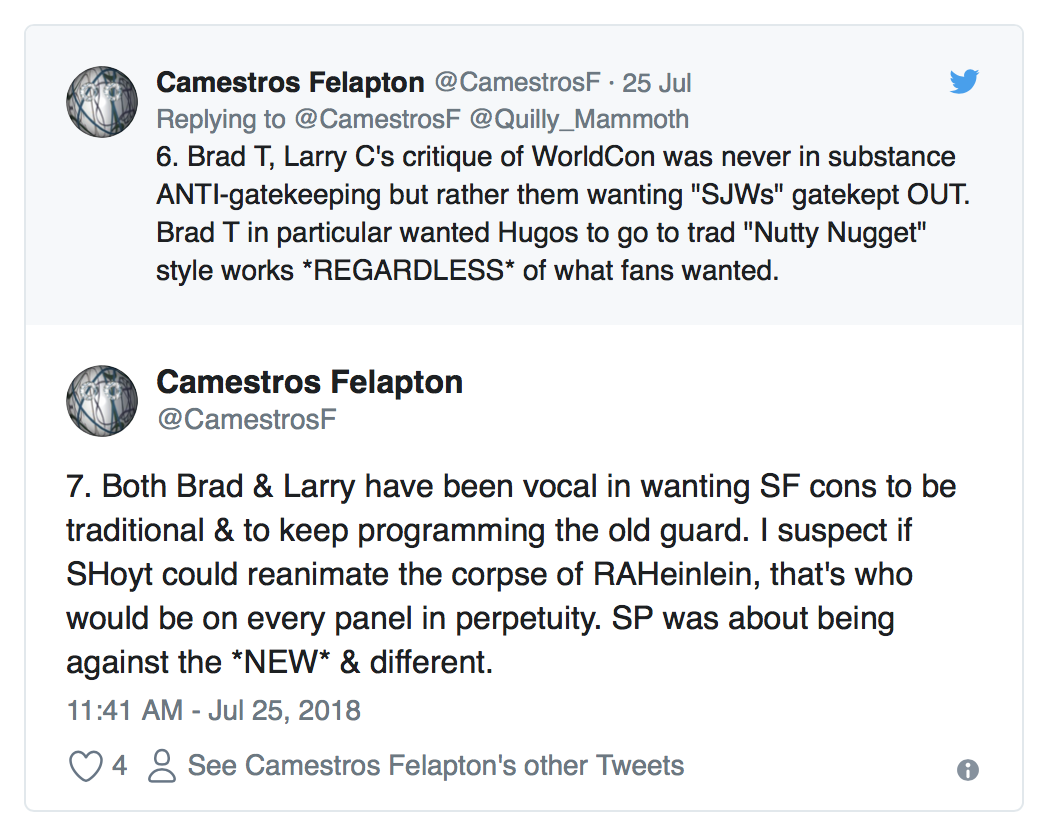
“Brad T, Larry C's critique of WorldCon was never in substance ANTI-gatekeeping but rather them wanting "SJWs" gatekept OUT. Brad T in particular wanted Hugos to go to trad "Nutty Nugget" style works *REGARDLESS* of what fans wanted. Both Brad & Larry have been vocal in wanting SF cons to be traditional & to keep programming the old guard. I suspect if SHoyt could reanimate the corpse of RAHeinlein, that's who would be on every panel in perpetuity. SP was about being against the *NEW* & different.”
More commentary on the programming issues (click to embiggen)
I wrote a couple of weeks ago about problems with the Worldcon Programming, and more particularly some of the very telling comments some programming staff members made.

The con chair asked Mary Robinette Kowal (who I quoted in one of those posts) to assist in repairing the programming grid. She’s run programming for more than one Nebula conference (and I believe a few other conventions) and seemed a good choice. She made a couple of short comments online right after agreeing, in which she said she had several volunteers to help, and would be too busy for the next several days to answer any questions from people not directly involved.

The con has subsequently published a new schedule, which looks much more diverse (in both topic and participation). I’ve seen several of the pros who had previously said they would withdraw from programming to make room for others since post that they had agreed to participate in at least one event in the new schedule.

I’m sure it was a mad scramble, and my hat’s off to the staff for realizing they needed to fix the problems, for being willing to accept help when it was offered, and to everyone who pitched in. It looks like a great program. I hope this was a learning experience for some people.

And I hope everyone who attends has a fabulous time.

But the best commentary I’ve seen on the topic of convention programming, the desire some fans have to only include popular/well-known/established writers, et cetera, has got to be the amusing short story Cora Buhlert posted a few days ago: Convention Programming in the Age of Necromancy – A Short Story. You should go read it there, because it’s hilarious, but I will include the opening to give you a taste:

At the daily program operations meeting of a science fiction convention that shall remain unnamed, the debate got rather heated.

“We absolutely need to hold the ‘Future of Military Science Fiction’ panel in Auditorium 3,” the head of programming, whom we’ll call Matt, said.

“And why?” his fellow volunteer, who shall henceforth be known as Lucy, asked, “Is military SF so important, that it needs one of the bigger rooms, while we shove the ‘Own Voices’ panel into a tiny cupboard?”

“No,” Matt said, “But Auditorium 3 has air conditioning.”

Lucy tapped her foot. “And? Are old white dude military SF fans more deserving of coolness and air than own voices creators and fans?”

Matt sighed. “No, but Heinlein’s reanimated corpse is coming to the panel. And trust me, he smells abominably. Oh yes, and he’s declared that he wants to attend the ‘Alternative Sexualities in Science Fiction’ panel, so we’d better put that in a room with AC, too.”

A personal note: The first time I was in charge of programming for a convention was an accident. I was on staff as the convention book editor (and I was also responsible for laying out the pocket program), and had previously been a panelist at the same convention. The person who was in charge of programming missed a couple of meetings as we were getting down to the wire, and she wasn’t responding to e-mails or phone calls from anyone. I was getting frantic because I didn’t have content for the program books. Many of us who had responded to the programming survey were worried because we hadn’t heard what panels (if any) we were on.

Turned out that the person in charge of programming had had a massive stroke and was in the hospital for an extended time. The hospital had not been able to contact her daughter (who was also on con staff, but she lived on the other side of the country, and her job at the con was strictly on-site. The daughter was on an extended business travel thing during the weeks all this was going down). The upshot was that at nearly the last minute to finish the program books, we found all this out, and suddenly I was in charge of programming. With the help of a couple of other people (and with a pile of email messages once we redirected the programming alias), I put together a programming grid in about three days. It wasn’t the best programming grid I ever saw, but we got it done.

And panelists were happy. We got a lot of compliments on the programming.

And that’s how I ended up in charge of programming for the following two years at that convention. We had a slightly less frantic process the next two years.

The woman who had the stroke did get out of the hospital and even attended the next couple of year’s convention in a wheelchair. Sadly, one of the things my successor had to put in his first grid as programming lead was a memorial service for her.

I wish I had a more upbeat ending to this tale.

The only conclusion I have is: running programming for a convention takes you in directions you never expected. It is an adventure, but remember that one of the definitions of “adventure story” is something really awful that happens to someone else.

Future hazy, or we’ll take our weather blessings as we can

“My birthstone is a coffee bean.”
(click to embiggen)
Monday evening when I left the office I noticed the slightly smoky or hazy look right away. I thought, at first, that perhaps a big truck with a load of gravel or something had just driven by and left a lot of dust in the air? Or maybe something had blown up a bunch of dirt from one of the several large construction sites near our building, you know. But as I proceeded to do my semi-random walk1, it became apparent that there was a slight haze everywhere, include, when I could see it, on the horizon. This was a bit worrying, especially remembering last year and the long stretch of days when we were blanketed in smoke from region wildfires, turning the sun a scary red, and sending everyone with hay fever and/or asthma into a bad way.

But the closest wildfires I had heard about in the news were in California. Also, since we’ve been in a heatwave, I have been paying attention to weather reports and prevailing wind directions, if for no other reason to pick which direction to aim the fans in the windows at home. And the wind had been coming from the north or northwest very consistently for days, which is the wrong direction to bring California smoke to us.

Of course, Professor Cliff Mass’s blog had the answer (including satellite pictures): Most of the of smoke has not been local, but rather came from huge fires over Siberia!

There was a silver lining to the globe-spanning smoke: it was blocking enough sun to pull region temperatures down by 1-4º Fahrenheit. Given that Sunday was the hottest day of the entire year, even a few degrees of cooling is greatly appreciated!

Wednesday morning while I was waiting for my bus, and then later walking from the bus to the office, I kept feeling phantom raindrops. My weather apps showed 0% chance of rain, and the radar showed nothing nearby. Also, the clouds didn’t look right for rain. At one corner, while waiting for the crosswalk to change, I was looking up at the cloud cover and I figured it out.

It wasn’t clouds. It was June Gloom in August. June Gloom is often a bank of fog on the region which doesn’t look like fog on the crowd, it looks like 100% cloud cover, but the bank only extends a thousand feet or so up. The air is very moist and cool, and water droplets aren’t falling from the sky, but they do occasionally form in the air around you.

And that’s a great feeling after a heatwave, let me tell you!

For the next several days, at least, the daily high temperatures are forecast only in the 70s, which is much more pleasant than we’ve had for a while. And we’re supposed to get some rain. I don’t know if it will be enough to get the creek and river levels back up from their current very low levels. And the long term forecast has some high 80s again next week, so we aren’t completely out of the woods, yet.

But I’ll gladly take several days of normal temperatures and a little rain.


Footnotes:

1. Since home is now too far from work to walk home, in an effort to replace that lost exercise, I set me watch to an open-ended outdoor walk, and walk around downtown, letting whichever crosswalk is showing WALK when I get to each corner2, until the watch says I’ve walked a mile, than I turn and head toward the bus stop.

2. I say semi-random above because, for instance, the first three blocks are not random. I walk straight up the steepest hill three blocks until I get to the mostly-flat part of downtown. And there are two major thoroughfares after that which I treat as bounding boxes. If I hit either of those and the crosswalk is green, I don’t cross, but instead circle the block and head back.

Millions of Voices Cried Out in Terror — or, That’s Not the Force You’re Feeling, Guys

“Imagine, if you will, millions of nerds arguing about Star Wars for 40 years.”
(click to embiggen)
I’ve started this blog post many times, but I either find myself wanting to pull my hair out at the mental gymnastics the haters (who claim to be TrueFans) keep putting themselves through to try to make their arguments that up is down and two billion plus one billion equals zero… and I keep giving up. When the craziness first came to my attention, back in those bygone days when the first trailer for The Force Awakens sent them into a tizzy of anger and outrage, I figured it was just an age thing. Right? I was 17 years old when the original Star Wars came out, and I had watched the Watergate scandal unfold and take down a corrupt president a few years before. I understood that the Empire was a corrupt government founded by people who had, at one point, been treated just as any other politician proposing what ideas that some people disagreed with who turned out to be fascists who destroyed the old government, and that the Rebellion was being led by the remnants of what had been the opposition party before all of that. In other words, I understood that every single plot element in the original Star Wars was about politics.

These other folks, who whine and rage about the new movies, I just assumed they were closer to the median age of the typical internet user. Their first exposure to Star Wars had been to see it on a TV at home, possibly when they were too young to remember the first time. It was just something that was always there. Whereas I saw it as a great movie that changed the way the genre was perceived as well as creating a seismic shift in all of pop culture, to them it had always been there. And they had been too young to understand that the word “empire” was inherently political, just as the phrase “rebel spy and a traitor” was also inherently political.

Oh, how naive I was just a few years ago. I hadn’t realized that the problem was much deeper than that.

Before I go on, a few other people have examined in depth a couple of the issues at hand, and rather than try to construct the same analysis, you should go check these out:

The Beautiful, Ugly, and Possessive Hearts of Star Wars.

Biased Opinion – The Wailing Ignorance of the Star Wars Fanboys.

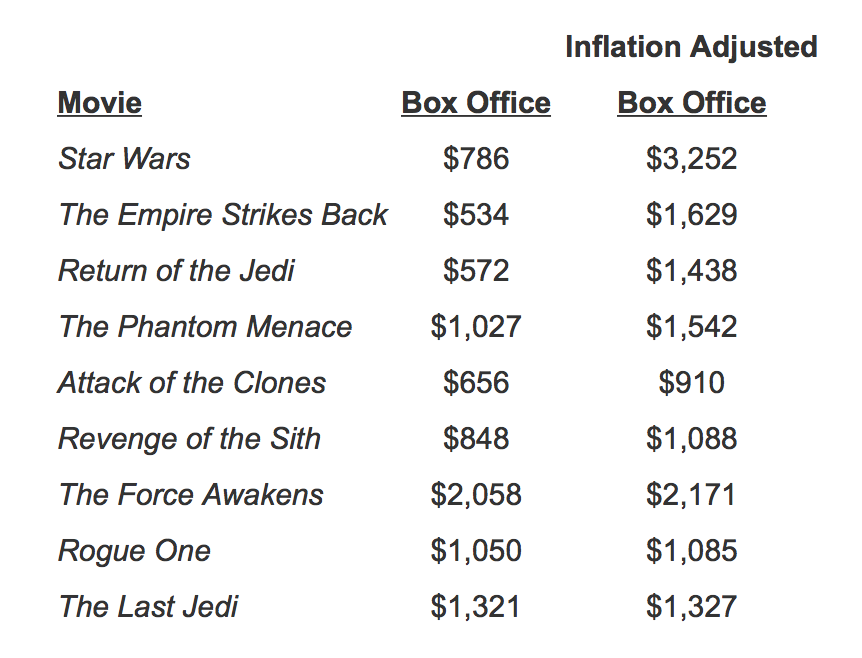
The latter post, by the Aaron Pound, is extremely helpful in this discussion if for no other reason the two tables showing how all of the movies in the Star Wars franchise have done at the box office, and comparing them to other franchises (expressed in millions of dollars):

Please note: when adjusted for inflation, the original Star Wars made three-and-a-quarter billion dollars at the box office—that’s $3,252,000,000! Notice, also, the big drop-off that The Empire Strikes Back suffered, and then how the number went down a bit more for the third movie, The Return of the Jedi.

Now let’s look at the other chart (also in millions of dollars):

Aaron assembled this second chart to show how a single-character movie in a large franchise fares in comparison to the main courses, if you will. The Avengers and its sequels have made a whole lot more money than each single-character movie in the Marvel universe, and so we shouldn’t be surprised when Solo made a lot less money than The Force Awakens. Unfortunately, at least some execs at Disney didn’t understand this, otherwise they wouldn’t have authorized re-shooting almost the entirety of the film, bringing the cost of making Solo up to approximately $250 million (and then spent about $150 million promoting).

For the record, I liked Solo a lot. But I went into it knowing that because it’s a prequel, it will not cover any new ground. They had to show us how Han and Chewie meet, they had to show us how Han wins the Falcon from Lando in a card game, they had to show us the Kessel run. Those beats have to be hit. And because we’ve seen Han’s story play out in the original trilogy and The Force Awakens we already know who the love of his life will be, and he won’t meet her in this movie. Right? And when we meet Han in the original movie, he’s an established smuggler and scoundrel who owes money to at least one dangerous crime lord, so we can expect that this prequel will be some sort of criminal action-adventure movie. Therefore, it is nearly impossible to make this a movie that’s going to blow anyone’s mind.

They delivered a solid heist movie that did show us parts of the universe that the other films have mostly glossed over. It isn’t a bad movie, it’s just the sort of movie more likely to make $400 million than $1 billion, which can’t justify the amount they spent making it.

The angry guys who insist that this is more proof that some how the franchise whose main movies are earning more than a billion each is betraying true fans and so forth, don’t understand how the blockbuster movie industry works, compared to, say, the book publishing industry, or the gaming industry, and so forth. A cadre of true fans can make books profitable, but any group of “true fans” in any genre is simply too small a group to generate a billion dollars in revenue for a single movie.

Because the “true fans,” the kind of fans who argue about the economics of the cloud cities or who are dying to see the back story of characters in the original films are going to number in the thousands, at most. Whereas to make the sort of money that The Force Awakens made, you don’t just need millions of people buying tickets, you need at least 100 million.

And when you consider that the so-called “true fans” who are making this argument are the same guys who are angry that one of the leads of the new movies is a black man, and are furious that the primary protagonist is a woman, and are absolutely livid that another lead character is a chinese woman—well, that just means this is an even smaller fraction of the audience than simply people who are nostalgic for the original trilogy.

And with that belief system, well, it’s clear that they aren’t aligned with the light side of the force, either. That ain’t the force you’re feeling, guys—it’s hate.

Can I offer y’all some tea?

Making sun tea on my veranda.
A while back I was reading with more than a bit of amusement a conversation on tumblr where some Americans (by which I mean people from the U.S.), specifically some of my fellow southerners, were trying to explain sweet tea to some British folks. There were a few Brits who had spent some time in the U.S. also chiming in. I’m not sure if the most amusing bit was how many of the Brits were scandalized that most Americans don’t own tea kettles, or how horrified they were to learn about southern sweet tea. Southern sweet tea is not the same as tea which has had sugar or honey added. Southern sweet tea is an altogether different phenomenon. Just for a hint of what I mean, there is a recipe for Tea Punch (a different drink, but likely the granddaddy of sweet tea) from shortly after the American Revolution that includes this: “Make a pint and a half of strong tea in the usual way, then pour it boiling over a pound and a half of sugar…”

This article gives a nice overview: Why Sweet Tea Is the South’s Quintessential Drink.

In the movie version of Steel Magnolias Dolly Parton’s character observes that “sweet tea is the house wine of the south.” Which is true, though there can be weird nuances. For one thing, there are people who disagree about which parts of the country constitute the south. Seriously! I once had a temporary co-worker from Georgia sniff very disdainfully at I and another co-worker after we mentioned that our families came mostly from Oklahoma and Texas, that “those aren’t part of the south, those are in the West.” I have also heard people from North or South Carolina insist the Florida is not part of the south. I’ve been told by one acquaintance who grew up in New Orleans that “N’Orleans doesn’t really do sweet tea!” Whereas a friend whose family comes from other parts of Louisianna once commented after sampling my sweet tea, that I didn’t have nearly enough sugar in it. Some people insist that Sweet Tea states should get their own designation, with arguments about whether the “tea line” encompasses all of Texas, or only East Texas, for instance.

I grew up on sweet tea, and I learned how to make it from my mom and various grandmothers and one grandfather, and each of them had a slightly different recipe. They were all good in their own ways, but they were also very different. Many families guard their sweet tea recipes, sometimes referring to them by names like, “Great Aunt Pearl’s Sweet Tea.” So, before we get any further, I’m going to warn you right now that no, I absolutely will not tell you my Great-grandma S.J.’s Sweet Tea recipe, nor Great-grandma I’s, nor my Nice Grandma’s Sweet Tea recipe nor her Sun Tea recipe (which is a different beast altogether).

What I will do is tell you my Evil Grandmother’s Sweet Tea recipe. One reason why is because she frequently told it to other people outside the family. Another reason is because I don’t think hers was the best, but it will give you an idea of how these go.

My Evil Grandma insisted that Sweet Tea was best made in an aluminum pitcher. She had a 2-quart aluminum pitcher for just that purpose. To make her tea, you fill a whistling tea pot with water and set it to boil. While it is going, you measure out four and a half cups of sugar into the bottom of the aluminum pitcher, then you add a half teaspoon of baking soda. You let the kettle get to a loud whistling, then pour the still boiling water into the aluminum pitcher. Stir furiously until the sugar dissolved, then count out fourteen Lipton flow-through tea bags, put them in the pitcher, stick a lid on it, and put it into the fridge for one hour. Then, take the pitcher out, pull out the tea bags, but make sure you squeeze them so all the dark tea gets into the pitcher. Top off the pitcher with however much tap water is needed to fill, and stir some more (because some of the sugar probably precipitated out). Put it back in the fridge for at least another hour. Now, you can serve it over ice.

Now that you’ve read the one recipe that I am willing to disclose, we can analyze it a bit. Most of the sweet tea recipes I have acquired over the years use tea bags, not loose tea. And very often people have strong feelings about which ones to use. I have seen, for instance, recipes that call for specific brands and varieties of tea bags–specifying X bags of specific brand of black tea plus Y bags of a specific brand of mint tea plus Z bags of a specific brand of orange pekoe, for instance.

I will neither confirm nor deny having witnessed two relatives almost come to blows over an argument about whether an Earl Grey tea is ever suitable for sweet tea (with a third relative opining that Earl Grey is all right in a sun tea as long as you have a few other kinds with it, but really should only go in to sweet tea if you have nothing else).

Why do some recipes include baking soda, you may ask? Tea leaves contain tannic acid which is very bitter. When you steep most teas for more than, say, 2 minutes, you can get a lot of tannic acid in the tea. Some people swear that a small amount of baking soda (which is an alkaline compound and will neutralize an equal amount of acid) mellows out the tannic acid flavor. I’ve also heard people claim that the baking soda helps with dissolving more sugar into the water.

Many recipes specify how to boil the water. There are people who insist the sugar must be in the pitcher that the hot water or hot tea is poured into. Others say that most of the sugar should be mixed with the water as it is brought to a boil.

My Evil Grandma’s sweet tea was very dark, nearly the color of coffee. A lot of people say that is two strong, the tea should have more of a rich reddish color than a deep brown.

Because most of my life has been lived outside of the sweet tea states, I got used to drinking the rather weak and completely unsweetened tea served here. Also, in my late twenties when I realized just how rampantly adult-onset diabetes stampedes through my dad’s family, I made the decision to mostly stop sweetening my tea or coffee. And now that I am diabetic, I don’t make sweet tea ever.

And while we’re on the subject of diabetes, I want to point out that all of the sweet tea recipes from my mother’s side of the family called for way more sugar than any that I learned from Dad’s side, yet Dad’s family is where almost all the diabetes is. So don’t come at me on that.

While I don’t make sweet tea, I still make and drink a lot of tea and have many fond memories of sitting down with friends and family, everyone with a frosty glass of tea, on hot summer days. So the last few weeks, after my husband brought home a one gallon glass jug, I’ve been experimenting with sun tea recipes, based only loosely on my Nice Grandma’s. Put the collection of specific tea bags in the water, set it out in the sun for an hour, then remove the bags and let the jug chill in the fridge. The one thing to remember about sun tea is that since the water is never brought to a boil, it is more susceptible to bacterial contamination, so you want to finish off the whole batch in no more than two days.

It’s not quite the same, but drinking the cold, unsweetened tea that I’ve made this way, brings all those fond memories back. As Fred Thompson observed in his book, Cornbread Nation,

“Sweet tea—your mother’s sweet tea—means you are home.”

Playing Piano on a Star’s Surface and Other Impossible Things — more of why I love sf/f

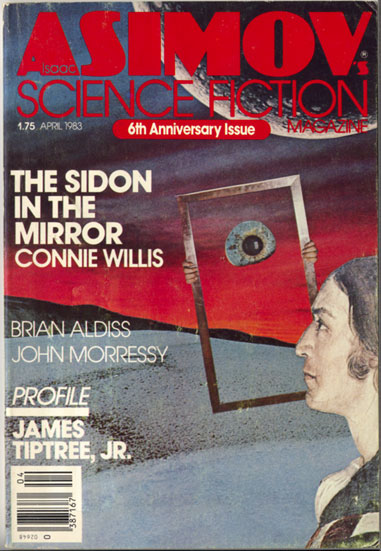
Asimov's Science Fiction Magazine, April 1983. Cover art by Marc Yankus.
Asimov’s Science Fiction Magazine, April 1983. Cover art by Marc Yankus.
In 1983 I was still attending a community college part time while working several part-time jobs, stuck in a weird financial situation too complicated and frankly boring to go into right now. The important points are that I was still very closeted and in a situation where I was dependent on conservative religious relatives and equally conservative institutions for my livelihood. I clung to science fiction and fantasy as a half-drowned person might clasp the last floating piece of wreckage after a boat disaster in the middle of the ocean. And while I couldn’t always afford to buy new sf/f books and anthologies when they came out, the local public library subscribed to three science fiction magazines, one of which was Asimov’s Science Fiction Magazine, so a few times I month I would spend an afternoon at the library reading those magazines.

And it was in the pages of the April 1983 issue of Asimov’s that I first met Connie Willis.

The novelette included in that issue, “The Sidon in the Mirror” is told from the point of view of person just arrived on a new planet. Except it isn’t a planet. Paylay is a dead star, and somehow humans have figured out how to live on a solid crust of the outer layers of the dead star. It isn’t a terribly nice place to live, but large pockets of various pure elements can be mined, so people have an incentive to come there. A side effect of the mining process has created a thin layer of mostly breathable air that is much higher in helium and hydrogen that ours is.

We learn that our viewpoint character is not human, but rather a Mirror: an alien species that has the ability to absorb personality traits, skills, and other things from other beings. They don’t take on the shape of the copied person, and the process is totally involuntary. Mirrors don’t even know they are copying, their personality being re-written as they go, unless someone else notices and tells them. There have been some instances in the past of Mirrors absorbing the murderous thoughts of others and acting on them, so they have been banned from various world.

He’s been brought to this strange mining colony to play piano in the colony’s only brothel. He had previously absorbed the piano playing skills of a now dead man who was known to both the other of the brothel and at least one of her employees, which is at least part of the reason he was brought to Paylay.

The rest of the plot is difficult to summarize, in part because Connie does a really good job of putting you inside the head of the person who doesn’t know or trust his own thoughts and motives. He is afraid he is going to be compelled to do something horrible, and there are characters he is now living among who appear to be trying to manipulate who he copies for their own nefarious purposes.

But I should explain the title. The viewpoint character’s species are called Mirrors, as explained. There is another alien creature mentioned, it’s called a sidon. Sidon’s are vicious predators, but some people have tried to tame them (because people will do that), and it has always gone badly. The miners have taken to naming their mining taps as sidons—while all the compressors and pipes and such are holding, everything seems under control. But ever miner knows it is only a matter of time before a tapped sight explodes. They’re just all trying to make their money and leave before that happens.

By the end of the tale there are violent deaths, and it is left to the reader to decide which of the deaths were murder, which were self-defense, or whether they fall into another category all together.

On one level the story is about the meaning of free will. Willis herself has said, when introducing the story in collections of her work, that the story was inspired to seeing stories of twins who were adopted out separately, and then find each other as adults and learn how many things about their lives are spookily similar. Many things we think of as choices may not be at all.

If was a tough story to read, because there were points in the tale when I wanted the viewpoint character to do something different. I saw moments he could have escaped the trap. Except when I got to the end, I found myself questioning the definition of trap I had been using. Was the trap the manipulation coming from one of the two characters who were trying to turn the Mirror into a killer, or was the trap the Mirror’s own belief that he himself would inevitably turn into a violent killer, or was the trap the fear of the other characters?

I’ve re-read the story many times over the years. And even though I know how it ends, I’m always at the edge of the seat throughout. As mentioned above, Willis really puts you in the mind of this character so that by the middle of the story, I’m just as afraid and uncertain as to what will happen as the character is.

The story made me think a lot about how we make decisions. How much of what we feel is the result of what people expect us to feel? How many decisions that we think are our own are being forced upon us? What, exactly, is the nature of our own identity?

They were questions I was wrestling with personally. While I didn’t have an sudden epiphany at the end of the tale, it did nudge me further in the direction of coming to understand how the nature of the closet. The stifling social trap that many queers find themselves living in is constructed at least as much by our desire to win the approval of society, family, and even my closest friends. It isn’t just fear that drives one into the closet, but also (ironically) the need for love.

And it took an alien playing piano on the surface of a dead star to show me that.

More likely to replace than upgrade — confessions of a penny-pinching gadget lover

About to unbox the new and retire the old...
About to unbox the new and retire the old…
On Christmas morning 2009, before my husband and I left the hotel near my Mom’s place to celebrate with the family, each of us had picked out one present for the other to open just us. I don’t recall what I got Michael, but he gave me a new shiny Apple Magic Mouse. Apple had just introduced the new wireless mouse with gesture support two months earlier. And I had played with one at the Apple store. But, I was really happy with my two wired Apple Mice that I used with my desktop and my laptop at the time (and I had a tiny purple wireless mouse that I used with the laptop when I wasn’t somewhere that the wired one would work), so despite the fact that I love cool gadgets, and contrary to the popular myth about Apple fanboys, I didn’t think it was worth spending money on a new mouse when the ones I had all worked just fine.

Once I had the Magic Mouse and had been using if for a while with one computer (getting used to the greater number of options the gesture support provided), by the end of the year next year I had purchased another Magic Mouse so that both of my computers had one.

When the Magic Mouse 2 came out almost three years ago, the most significant change was an entirely internal battery. They also updated the bluetooth chip and processor, and managed to make it slightly lighter. Otherwise it was virtually identical, and I didn’t see a reason to update. Part of the reason for that at the time was my Macbook Pro was over 4 years old, and my Mac Pro was over six years old, and it seemed a little silly to get super shiny new mice for older machines.

When I got my shiny new Macbook Pro with Touchbar in late 2016, I considered buying a new mouse along with it, but then I was dropping a lot of money on the laptop, so my inner cheapskate was opposed to additional unnecessary expenses. And, the old Magic Mouse worked just fine with it.

I admit that last year, when they introduced the new iMac Pro which was available in Space Grey which could come with a Space Grey Magic Mouse (among other accessories), my inner gadget lover went “oooooooo! Shiny! Want!” However, Apple was only selling the Space Grey Mouse (and Space Grey Keyboard and Space Grey Magic Touch Pad) with the matching iMac. So despite that fact that I had a cool Space Grey Macbook Pro, I couldn’t get the Space Grey Mouse.

And besides, as the inner cheapskate kept pointing out, the old Magic Mouse worked just fine.

And it did.

Until about a month and a half ago, when it started loosing connection with the Macbook a lot more often, but more annoyingly, instead of taking just a few seconds to reconnect when I moved or clicked it, I would have to fiddle with the mouse for at least a minute before it connected again. Two weeks ago, it got a little worse. The mouse would eventually reconnect, but it would immediately disconnect and I would have to fiddle for another minute before it connected and would remain connected for… a while.

I did notice that it was more likely to do this when the batteries were reporting less than 70%. Now I’ve had this bad habit of ignoring all the warnings from my laptop that the batteries are low. Dismissing the alert again and again for days until the batteries completely die. Then I go swap them out (we keep several sets in chargers all the time, because between the two of us we use the rechargables in a couple of wireless keyboards, at least four wireless mice, one wireless Magic Track Pad, and several small motion-activated LED lights around the house). Funny thing is, that when I get the exact same low battery alert on my Mac Pro Tower, and I almost always stop when I’m doing and go swap the batteries.

Anyway, the upshot is that I know the mouse has in the past worked perfectly fine when the batteries are at 1%. Also, because I’m a weird nerd whose past career titles have included quality assurance and hardware qualification engineer, I did some experiments, and confirmed that even when the batteries are low and the mouse is in another room, it remains connected to the laptop and can control the cursor…

It was getting really annoying by now.

Aren’t they pretty together?
And recently Apple has started selling the Space Grey Magic Mouse 2 as a stand alone accessory… so I could get a new mouse to replace the flaky almost nine-years-old one and it would match my laptop. So I did.

Now, a lot of people who have looked at the mouse (but haven’t used it) complain that the lightning recharge port is on the bottom of the mouse. “So if it dies, I have the wait around for it to charge back up! I can’t use it while it’s plugged in.” Bull. Seriously, it’s a purely B.S. objection because here’s the thing: if you connect it for two minutes, that charges the battery enough for nine hours of use. In And remember what I said about about alerts from the computer that the battery is low? I am being serious when I said that I would ignore it and keep using the mouse for days. So, when you see the alert, make a mental note, and the next time you go to refresh your beverage, or run to the bathroom, or get up to walk around (which my Apple Watch reminds me to do once an hour), plug the mouse in for a few moments and you will be good to go.

I know, my use case doesn’t match everyone elses, but I am quite certain that if Apple had put the port where all the complainers want it, that those some complainers would be bitching about how awkward the device which is designed to be wireless and that you use wirelessly all the time is when the attach a wire to it.

Anyway. I am sad that my first Magic Mouse is flaking out. But I’m also very happy with my shiny new one!

Pride means love and survival—confessions of a joyful fairy

“Queer as hell and felling swell”
(click to embiggen)
I’ve been to a lot of Pride parades and festivals since attending my first in 1990. One year I participated in the San Francisco Pride Parade one weekend, flew back home to Seattle where I marched in our parade the following week, and then in August I found myself in Vancouver, British Columbia where I hadn’t realized it was going to be their Pride Parade. San Francisco’s was like so gigantically larger and brasher than any other I had ever seen, while Vancouver’s was small but very enthusiastic.

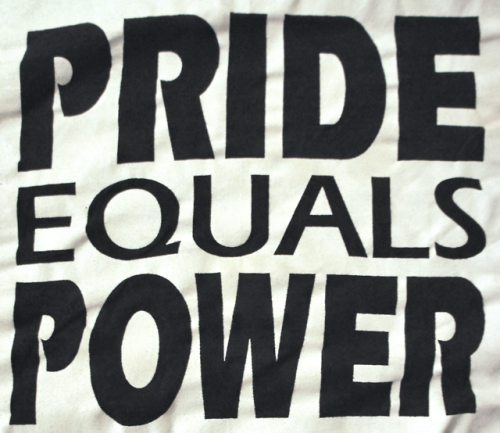
“Pride equals power”The reason for the parade, ultimately, is to declare our existence–our survival in a society that is less than welcoming. We’re here. We’re your daughters, your neighbors, your sons, your co-workers, your friends, your siblings, or your parents. We’re not mysterious creatures lurking in seedy clubs–we’re the guy sitting across from you on the bus reading a book, or the two gals sitting in that next pew at church, or the pair of guys in the grocery store discussing how many hot dogs to buy for the cookout, or the grey-haired guy trying to read a label on a bottle of cold tablets in the pharmacy, or that kid on the skateboard going past your bus stop, or that guy sipping a coffee at Starbucks, or that gal a couple table over at the same coffee shop laughing at something on her computer.

We’re real, we’re everywhere, and we have hopes and dreams and worries just like you. We’re not asking for special rights, we’re asking for the same rights you take for granted. We’re asking to live our lives as openly as you live yours.

I enjoy watching the parade to acknowledge that survival. I cheer while watching the parade to express my admiration, support, and love for all of these survivors.

I cheer for people who are being brave and marching in their first parade; we see you and welcome you to the tribe.

I cheer and applaud so that those whose families rejected them and told them never to come back will know they have another family, and we’re clapping for them right now.

I cheer so that group of teen-agers (half of them straight and there to support their bi, gay, lesbian, and trans friends) will get the recognition they deserve.

“Why do some people feel more comfortable seeing two men holding hands than holding guns?”I cheer so the couple in their matching sequined costumes will know someone appreciates the work they spent (perhaps being up all night gluing those sequins on).

I cheer the older couples walking together holding hands; we see your love and we celebrate how long you and your love had endured.

I cheer the younger couples walking hand in hand; I wish I had felt free to do that at their age, but I hope they have a bright future.

(click to embiggen)
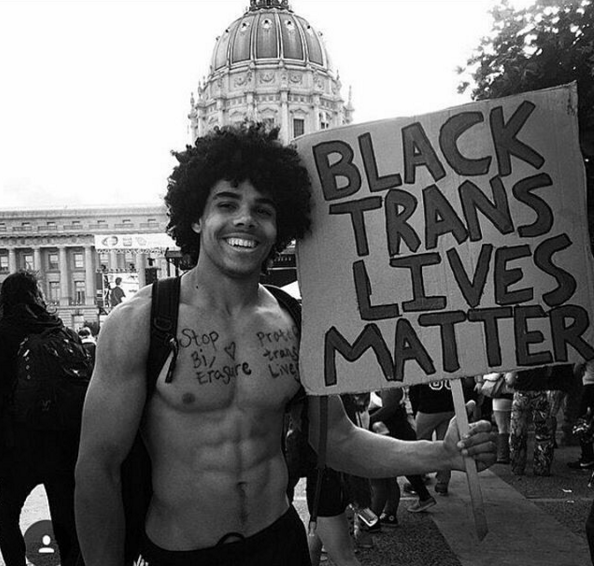
I applaud and cheer so that the trans* gals and trans* men know they are seen for who they are and we think they’re beautiful, wonderful, and I am proud to call them brothers and sisters.

I cry when I see those who are carrying a photo or wearing the name of a deceased loved one; we see your loved one and share your grief.

I cheer for PFLAG so that straight parents who have spent countless hours explaining to friends and relatives that their queer kids have nothing to be ashamed of, and yes they are very happy, and no those things you’ve heard or read about their health and lifespan are all myths will know their efforts are appreciated by the whole community.

I clap and cheer and laugh and cry as the parade goes on and on showing how big and wonderful and diverse and amazing our community is.

(click to embiggen)
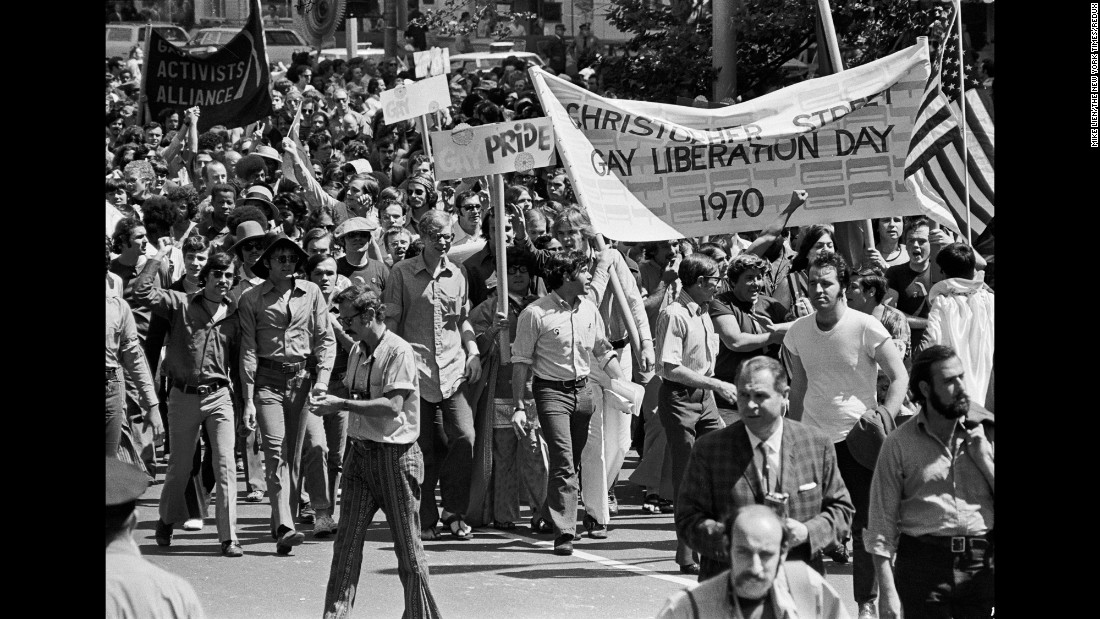
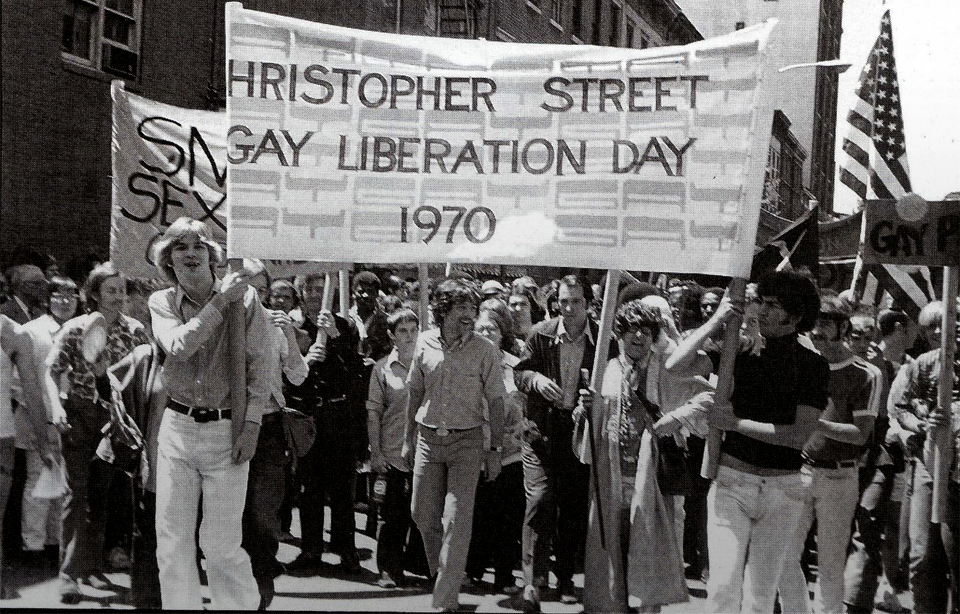
The very first Liberation Day Parade in New York City, was a protest march on the first anniversary of the Stonewall Riots (the first Pride was a riot). People were afraid of what would happen at the first march. Only a couple dozen people showed up at the starting point, with their protest signs. But they marched. And all along the announced route of the march, the sidewalks were lined with people. Street queens, and trans people, and gay men and lesbians and queers of many other stripes.

(click to embiggen)
And then completely unplanned thing happened. As the small group of marchers went be, queer people and supporters started stepping off the curb and joining. By the time the marchers reached the Sheep’s Meadow in Central Park, the crowd numbered in the thousands.

It has been a tradition of Pride Parades ever since, that spectators step off the curb and join the march.

So when I march, there comes a point where I do that. I have cheered and applauded and made sure that others were seen. I have witnessed their love and courage and unique style. Until it is my turn to join the march. To be visible. To declare by my presence in that throng that I am queer. I’m here. And I will never go back into the closet.
Me with my rainbow parasol