I started to do a Weekend Update post with a couple of the stories below on Saturday, but I needed to get shopping done and be back up and set up somethings before my gaming group logged into the group chat at 1pm. So I didn’t get to it. I also frequently save memes, cartoons, and the like to use as an illustration for a blog post or Friday Five. I always gather a lot more than I can actually use, so every now and then I share some that I didn’t use. And I was struck by the fact that for several of the stories I had been leaning toward putting in the Weekend Update, I have a related graphic.
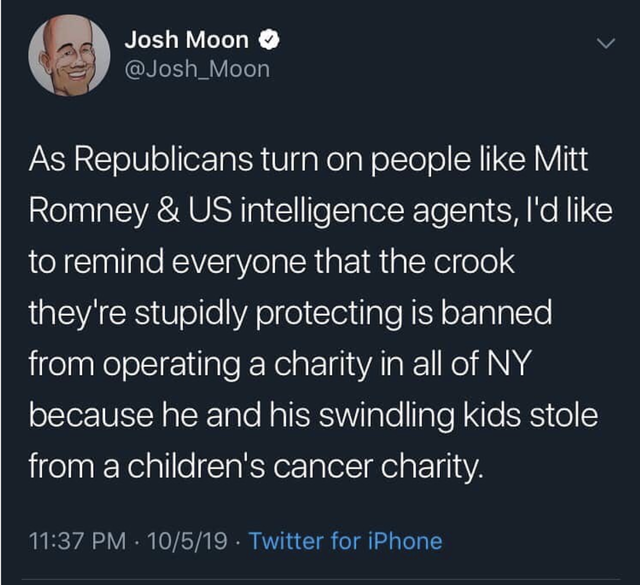
“AA Republicans turn on people like Mitt Romney & US intelligence agents, I’l like to remind everyone that the crook they’re stupidly protecting is banned from operating a charity in all of New York state because he and his swindling kids stole form a children’s cancer charity.”
“Just to be clear: if someone supports a political candidate who seeks your extermination, they also support yout exterminatiion. It doesn’t matter how they treet you interpersonally. They want you dead structurally.”
…and it was only a year ago he posted a pic of himself online wearing a “Broke Hoe” t-shirt and bragging about being $4million in debt…
Broke Homocon Milo Forced To Sell Website. Wow… a bit over a year ago he was actually bragging about being in debt, then last month he was whining on Telegram (the only social media platform that hasn’t banned him) about the fact that his followers don’t buy his books or donate.
Despite the graphic, this post is not about what most people think of as politics. (Click to embiggen)So, I’ve written a few times about social media, with the observation that a lot of the dysfunction that people like to attribute to the technology is really just human nature. Which doesn’t mean it’s not a problem, it’s just that neither tweaking the technology nor abandoning it altogether is going to solve those problems. But, the technology does have problems; sometimes one of those problems is that it is simply amplifying some of our less-functional traits, and sometimes it’s something much more complicated.
I’ve also previously mentioned that I’m one of those people who has found that if I don’t check Facebook from time to time I absolutely will get no news whatsoever from some branches of the family that I would like to stay in contact with. Muting and carefully unfollowing/blocking some people has decreased some of the previous annoyance—I don’t need to be reminded that Cousin Windbag thinks god will destroy America because I was legally allowed to marry my husband by seeing all the hateful memes and such that he posts constantly to his wall, for instance. And no one needs to see all the racists, xenophobic, anti-semetic nonsense Uncle Blowhard shares. But no matter how carefully I curate the feed, things get through that are a bit more than an annoyance.
Such as the friend request from an ex-step-cousin who (when he was a young adult and I was still a child) constantly referred to me as “that faggot” to other family members. I didn’t really want a reminder of that particular bit of childhood bullying, thank you very much. I don’t know why he decided to send me a friend request, but the particular political leanings displayed on his public wall makes it seem very unlikely his intention is to apologize.
Or the relative that, so far as I can remember, hasn’t contacted me in several years (to be fair, I also have not made an effort to reach out to them) who decided to send me a private message to offer condolences for the death of my father nearly three years after the fact. Now, offering condolences is fine—and there are many reasonable explanations for why someone hadn’t been able to offer them sooner.vBut here’s the thing: my dad was an emotionally and physically abusive man and it wasn’t at all a sense of loss that I felt when he died. Heck, one of my best friends made me practice saying, “We weren’t that close. We’d hardly spoken in forty years,” when my father was lying in hospice so I wouldn’t instead blurt out something inappropriate if an acquaintance or co-worker offered condolences.
This is also one of the relatives that I’m muting on my timeline because of all the anti-gay, anti-immigrant, et cetera stuff they post. In other words, all the same sort of things that Dad would rant about if you gave him a chance.
Sometimes people drift out of your life because of circumstance. But sometimes it’s a choice. Our different worldviews and values are a far bigger barrier to any relationship I’d have with this relative than the 1200 miles distance between our homes.
And please don’t tell me that it’s just politics and that family is more important than a mere opinion. Politics isn’t like be a sports fan. I can be friends with people who root for football teams I dislike, just as I am friends with people who don’t like my Seahawks. But politics is about policies that all of us have to live under. And politics is also about values. Unfortunately, a lot of politics is about which people are treated as people under the law, and which are treated as things.
For example: the way our society is structured, you have to work to survive. If you aren’t willing to say that queer people, trans people, people of various ethnicities, and so should protected from job discrimination, then you are saying that you don’t care if those categories of people die. Similarly, if your reaction to finding out our government has been seizing children at the border and packing them into cages is to try to blame the parents rather than being incandescently outraged at the abuse of children, I am more than justified in judging you for that.
I’m allowed to decide I don’t want to be friends with people whose values are monstrous.
Many times when critiquing social media, people focus on the impersonalization—it is easy to forget that it is another person on the other side of the screen and say things we would never say in person. But there is also the inverse problem, particularly with the way some social platforms work so hard to connect you with people you used to know, mutual friends, an so on: over-personalization. I and the second relative mentioned above haven’t seen each other in person in decades, nor talked in years. But thanks to the social media, an illusion can exist of continued contact because they can see my posts.
In my mind, I’ve been giving this person the cold shoulder for years—but in a completely non-confrontational way. And admittedly, I’ve been happy about being able to mute some people and so forth without them ever knowing that I have. I’ve let the technology aid and abet my passive-aggressive method of cutting them out of my life. Which means I’m at least partly responsible for these awkward moments that do more to remind me of bad things from the past than cheer or console.
I don’t have a pat answer of how to go forward. I think it is okay to let yourself drift away from people who have more negative impact on you than positive. But I think it is also important to ask yourself whether you’re making an effort to be a positive in the lives of those around you.
So, we had a mild-ish summer this year (which after several years in a row of breaking the previous hottest-summer-ever records was nice), and we had our usual not-quite-fall-yet weather for most of September, until the very end of the month where temperatures dropped, we got snow in at least one of the passes, and suddenly it feels a lot more like November than October. And, oh, yes, when I came down with a bad cold or flu three weeks ago, it seems so did half of my co-workers… and just as I thought I was getting over it, I get hit with another round.
The one upside, I think, to being sick for a few weeks with long work hours is that I was distracted for most of September about the proximity of my birthday. I did keep forgetting. I almost broke the rule my husband has imposed for years: From about a month before my birthday through Christmas, I’m not supposed to buy things for myself that other people might get me for my birthday. I can buy food, medicine, clothes, and other necessity types of things, but not books or movies or anything at has ever been on one of my wishlists. I didn’t break the rule… I just came close a few times. Because I kept forgetting what month it was.
And that’s a good thing because of what usually happens during September. See, two days after my birthday is the birthdate of my first husband, who died 22 years ago. And a few weeks before my birthday is the anniversary of the first date I ever had with my late husband. And most years when I realize that my birthday is coming up, that immediately reminds me of Ray’s birthday and the anniversary, and that often kicks off a bit of seasonal depression. Typically said depression doesn’t let up until mid-November: the anniversary of his death.
It isn’t always really bad. Sometimes it just means that for a that few months I’m prone to more moodiness than others.
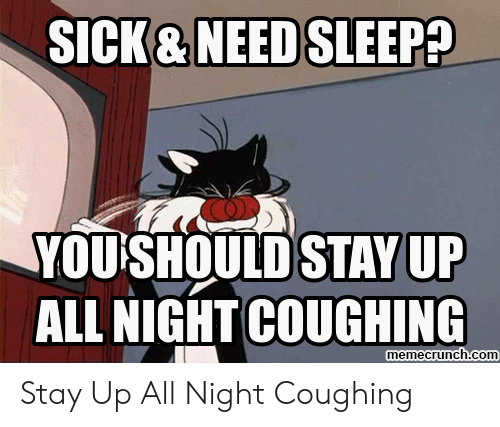
This year it didn’t really hit until the day after his birthday… and so far it hasn’t been very bad. Or at least not bad as the misery of being sick. Not being able to get any sleep last night from the coughing, for instance.
Not that being miserable sick is necessarily any better, but what can you do?
Today is my birthday. If you want to know which birthday, let’s just say that I am the only prime number less than 60 and greater than 54, okay? When I was a kid, my birthday was early enough in the school year that I often seemed to catch teachers by surprise. It was late enough in September that, under the rules of the school district we lived in when I turned five years old, I wasn’t allowed to be enrolled until the next year. So I was usually older than the rest of the kids in my class. There were some downsides to that, but also a few upsides.
The other thing that used to be more of an annoyance when I was younger was how crowded the birthdays were among my extended family. I was born 39 days after my Mom’s 17th birthday, and only 6 days before my Dad’s 18th birthday (yes, my parents were 16 years old when they got married!). I was also born 8 days after one of my cousins (the one that has been called my almost twin since we were infants, because when Grandma was babysitting both of us strangers would think we were twins). I was born two weeks before one grandmother’s 38th birthday and ten days after one grandfather’s 40th birthday. Also within a few weeks of my birthday were the birthdays or two uncles, and a whole bunch of other cousins (and demi-cousins, and step-cousins, and cousins-once-removed and so on).
During my teen years, when we lived in the same community as most of my mom’s siblings and other extended family members on her side, from the middle of August through Christmas there were one or two birthdays every single week. And my grandmother on that side (who was emphatically the ruling matriarch of the clan) insisted that everyone needed to show up and celebrate everyone else’s special day. Which didn’t really feel all that special when it was the 6th or 9th extended family get-together of that month, you know? Not that I have a right to complain. My one cousin whose birthday is two days after Christmas would be the first to point out that there are worse times to have one’s birthday than late September.
Which is sort of a convoluted way to say that while I have always enjoyed those times that we have gotten together with a bunch of friends to have a blow-out birthday, I’m also perfectly happy to spend the day lazing around the house, reading, and enjoying the well-wishes from friends; and then celebrating with a dinner with my husband.
But to get back to the cluster of family birthdays and why I mention being a homo in the title of this post: one of the step-cousins I mentioned in passing above had his birthday just a couple of days before mine. He was the step-son of one of my dad’s siblings, and therefore didn’t join the family until I was about 11 years old. When I was in middle school he was in college, and whenever we were visiting his family, or if his family came to visit the grandparents (and therefore we all had to show up for at least part of the visit), he always found a way to tell me that I was a freak.
By which I mean he would literally say, “You are such a freak!” or “God, you really are an over-educated freak, aren’t you?” He only called me a faggot to my face once that I recall, but years later I learned that my aunt (his step-mother at the time) was constantly admonishing him for calling me a faggot while talking about me with other family members. And I want to emphasize here, he was 20 years old and when I was 13—so this wasn’t a child being cruel to another child, but rather someone who supposedly was an adult being cruel to a child. Anyway, it should come as no surprise that I didn’t shed any tears when said aunt divorced his father when I was in high school. I thought I would never have to deal with his nonsense for the rest of my life, right?
Well, now we live in a world that includes Facebook. I typically log in to Facebook no more than about once or twice a month, and only then because for some family members I care about, Facebook is the only way to reliably get news about what’s happening in their lives. And so a couple weeks back when I logged in to ping some of my fellow Seahawks fans, what did I find but a friend request from this jerk…
Now, to be fair, he wasn’t the only person during my childhood who found ways to point out that I didn’t conform to societal expectations. I spent most of my childhood trying to figure out why so many of my classmates, public school teachers, Sunday School teachers, and pastors thought that there was something wrong with me. Specifically, why so many classmates, teachers, adult relatives, and at least one pastor kept calling me a “pussy,” “sissy,” “homo,” “faggot,” “weirdo,” et al. Once puberty hit in full force, I finally knew and all of that energy was redirected to trying to convince myself that I wasn’t gay, but that somehow I could thread the needle between my sexual orientation and the expectations of both society at large and the evangelical church in specific.
So, he wasn’t really that much of an outlier among the folks I had to deal with back then, but still, I look at that friend request and have to ask, “Why?” Because when I look at his timeline, it is all pro-NRA and pro-Trump memes. Therefore I can’t imagine that he is reaching out to apologize and say that he wishes he had been more supportive of my non-conformities when I was a kid. Maybe he is, but even looking at his current photos all that comes to mind is all of those times he called me a freak and how he used to disparage me to other family members. So, no, I am not going to accept his friend request.
I spent too much time as a child, teen, and young adult trying to accommodate haters like him. As an adult, I’ve forged a life with friends who love me and accept me (even though I am far from perfect) for who I am. I don’t feel any need to make time for people who couldn’t do that when they had the chance.
I usually end my birthday posts with some words of wisdom about some lesson I have learned. This year I’ve going to paraphrase/mangle Harvey Fierstein:
There is nothing you need more from other people than love and respect. Anyone who couldn’t give you that when they had a chance, doesn’t deserve a place in your life.
Yesterday was the autumnal equinox, which means that in the northern hemisphere summer is over, and fall is here! I love fall. I sometimes have described fall as my favorite season. Though I have also said that here in western Washington state we have only two seasons—Rainy and Road Construction. And I’ve also joked about Decorating Season. Regardless, I really enjoy the fall. I don’t deal well with hot weather, so even when we have a slightly milder summer as we did this year, I’m always super happy when the weather people start saying things like we aren’t likely to break 80º F this year. Besides the cooler temperatures, this also means that it starts raining more regularly, and I love the rain.
Fall means more than just a change in the weather. Until well into my twenties, fall also meant the beginning of a new school year. And while as a child the restarting of school meant dealing with bullies, it also meant new text books and new teachers. And I’m a big book-loving nerd who enjoys learning new things. So the arrival of autumn makes me think about new project, or gives me inspiration to work harder on unfinished stories and the like.
Fall is also the kick-off of Decorating Season, as mentioned above. I don’t do quite as much elaborate decorations for the various holidays as I used to, but I have hung up a glittery Happy Harvest thing on the front door, and I have a bunch of window clings of autumn leaves and pumpkins and jack-o-lanterns and black cats. So spooky things will be going up in the next few days. Then after Halloween I’ll swap out for more generic harvest and Thanksgiving stuff.
Which means that Christmas isn’t far around the corner. Which means I need to start doing a better job finding presents for people on my list!
But for now, I’m just happy that it’s finally Fall!
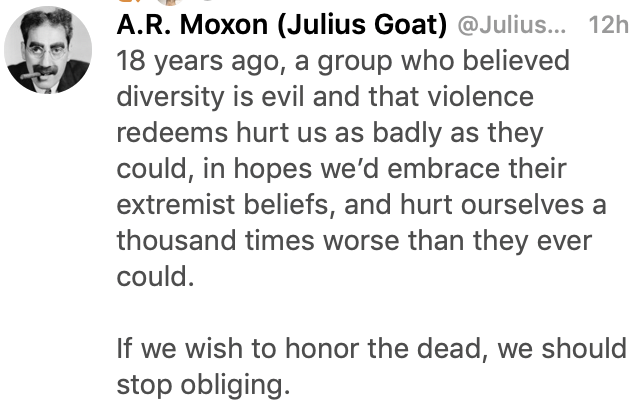
“18 years ago, a group who believed diversity is evil and that violence redeems hurt us as badly as they could, in hopes we’d embrace their extremist beliefs, and hurt ourselves a thousand times worse than they ever could. If we wish to honor the dead, we should stop obliging.”“Trump was the first man in history to be in three places at once. On 9/11, Donald was downtown being a first responder WHILE he was in NJ watching Muslims celebrate WHILE he was in Trump Tower calling TV stations to brag about his building now being the tallest! ”“In remembrance of Mark Bingham, a heroic gay man who sacrificed his life on United Flight 93.”
I finished a post about a very silly topic which I intended to publish on this Wednesday, and it was only when I was scheduling it that I remembered what the date would be. So I decided to do something else. Way back on the first anniversary of 9/11 I wrote a post on another blog that I eventually reposted here on one of the later anniversaries: “Living for 9/12.” It’s hard for me to muster the scant amount of optimism I caught in that post this many years on, because the terrorists won. We’ve embraced the hate. For 18 years we have whittled away at our own liberty, and have not made ourselves one bit safer.
We have, in fact, made ourselves less safe. The hatred we have embraced has given us a plethora of home-brewed domestic terrorists who continue to carry out the agenda of those 19 shitheads who hijacked those jets and killed 3000 people.
One day in the summer of 1981, I was walking around the inside of a huge church sanctuary in Virginia, every now and then stopping to clap once, then listen to the echo. It was something I did just about every day that summer—each day in a different church. I was a member of an evangelical inter-denominational youth choir. I was one of the singers, but I was also the Lead Sound Technician. And while a bunch of the singers were carrying in the sound equipment, our risers, and other parts of our touring program, I would do this exercise to figure out where I wanted to place our speakers and where to aim them. I took this part of the job very seriously.
I was 20 years old. I was a deeply closeted gay guy who for several years had been struggling to reconcile my love of science and my sexual orientation with the religion I had been raised in (Southern Baptists) which is extremely anti-gay, anti-evolution, anti-birth control, anti-modernity, et cetera and ad nauseam. Only eleven years before that day had the Southern Baptist Convention adopted its resolution on race, which was intended to end segregation in Baptist Churches themselves. At the denomination’s founding in 1845, 12 of its 14 statements on faith had been explicitly in favor of slavery, the segregation of the races, and the supremacy of the white race.
That 1970 resolution didn’t make Baptists pro-equality. The very church that my parents had been members of when I was born, for instance, split after the resolution. A number of members forming a new “Bible Baptist” church the aligned itself with one of the other conventions that had split from the Southern Baptist in the previous couple of decades. And at the 1972 convention the convention adopted a resolution condemning public school de-segregation.
One of the pastors leading that charge to re-assert the church’s racist past in 1972 was Jerry Falwell, Sr. Falwell was the pastor of Thomas Road Baptist Church in Lynchburg, Virginia. He was also the host of the syndicated radio program, the Old Time Gospel Hour, which my grandmother listened to faithfully, where he frequently preached against the civil rights movement, women’s rights, gay rights, and a boatload of other topics. In 1971 he founded Liberty University, which to this day still forbids students of differing races to date. And in 1979 he founded the so-called Moral Majority, a political organization bent on supporting conservative Republicans and rolling back what rights women, racial minorities, and queer people had won in the 70s.
In the mid-80s Falwell infamously lost a lawsuit to one of his former classmates from Baptist Bible College, Jerry Sloan. Sloan had come out of the closet after leaving Baptist Bible College, and had become active with Metropolitan Community Church, which was one of the few explicitly gay and lesbian inclusive denominations at the time. Sloan and Falwell participated in a television debate about, among other things, gay rights. After Falwell insisted that he wasn’t at all prejudiced against gay people, Sloan quoted Falwell as having publically called the MCC “brute beasts” and “a vile and Satanic system.” Further, he said Falwell had predicted “one day they will be utterly annihilated and there will be a celebration in heaven.”
Falwell said that it was a lie. And when Sloan said he had it on tape, Falwell bet him $5,000 (on television with millions of witnesses) he couldn’t produce it. When Sloan did produce the tape, Falwell refused to pay. So Sloan sued him, won the $5,000 plus court fees, and he donated it all to a queer community center: Falwell Pays $8,900 to Homosexual Activist.
Jerry Falwell, Sr, was a bigot and a liar (not to mention a chisseler for not paying his bet). And he became a multi-millionaire by preaching hate and promoting hate through his radio show, university, and his political organizations. And I, for one, did not shed a single tear when he died in 2007.
So, back to 1981. Earlier in that year, the Director of the touring choir mentioned that he was “this close” to getting us a tour date at Falwell’s Thomas Road Baptist Church. And without thinking, I blurted out, “if you do, I quit.” The Director was flabbergasted and tried to explain how much exposure we would get there—and possibly be on the Old Time Gospel Hour. I said, “I refuse to have anything to do with that evil man. I refuse to do anything that implies I support his divisive, hateful theology.”
A member of the board of directors who was literally helping me untangle some microphone cables when this exchange happened, chimed in, “Me, too. Falwell preaches the opposite of Christ’s teaching, and if you’re going there, I’m resigning from the board and pulling my kids out of the choir.”
The director made some sort of joke to diffuse and change the subject. Later he made sure to inform both of us that he had decided on his own against pursuing the Thomas Road gig because the strict dress code would, among other things, force us to change our uniform and force a lot of the guys to get extremely short haircuts. I like to think that excuse was his way of saving face, and that my threat had been effective.
And so while later that summer in 1981 we did perform at a Baptist Church in Lynchburg, Virginia, it wasn’t Falwell’s—it was a beautiful historical building, which is still there, though it has since merged with another church and changed its name and denomination. And I’m glad I didn’t have to quit the chorus over it.
You may remember that the two pool boy scandals of which I’ve written before — besides having a lot of sexual innuendo — involved Falwell, Jr. finding ways to finance multi-million dollar real estate deals for the benefit of the handsome young men after spending a lot of time flying each young man to various luxurious places along with Falwell and his wife on their private jet.
The new article (interestingly enough written by a journalist who attended Liberty University) lists other financial deals, including loans of $300,000 and more to Falwell’s friends, funneling lucrative contracts related to the university to businesses owned by his son, and more. Plus, apparently Falwell is very fond of talking about his sex life with colleagues. With a lot of crude details of the things he and his wife do.
And most tellingly, in one incident involving the guy many of us have referred to as “the other pool boy” (though he was employed as a personal trainer when he met Falwell, Jr). Junior texted pictures of his wife in sexual fetish costumes—to a bunch of staff members, plus the trainer. He claimed afterward that he had meant to just send it to the trainer (I believe that), but he also tried to claim to the people accidentally included on the wayward message that the purpose of sharing the pictures was not actually sexual. No! Falwell, Jr sent the personal trainer pictures of Mrs. Falwell in fetish gear because the trainer had helped her lose a lot of weight.
Um, yeah, no I don’t believe that.
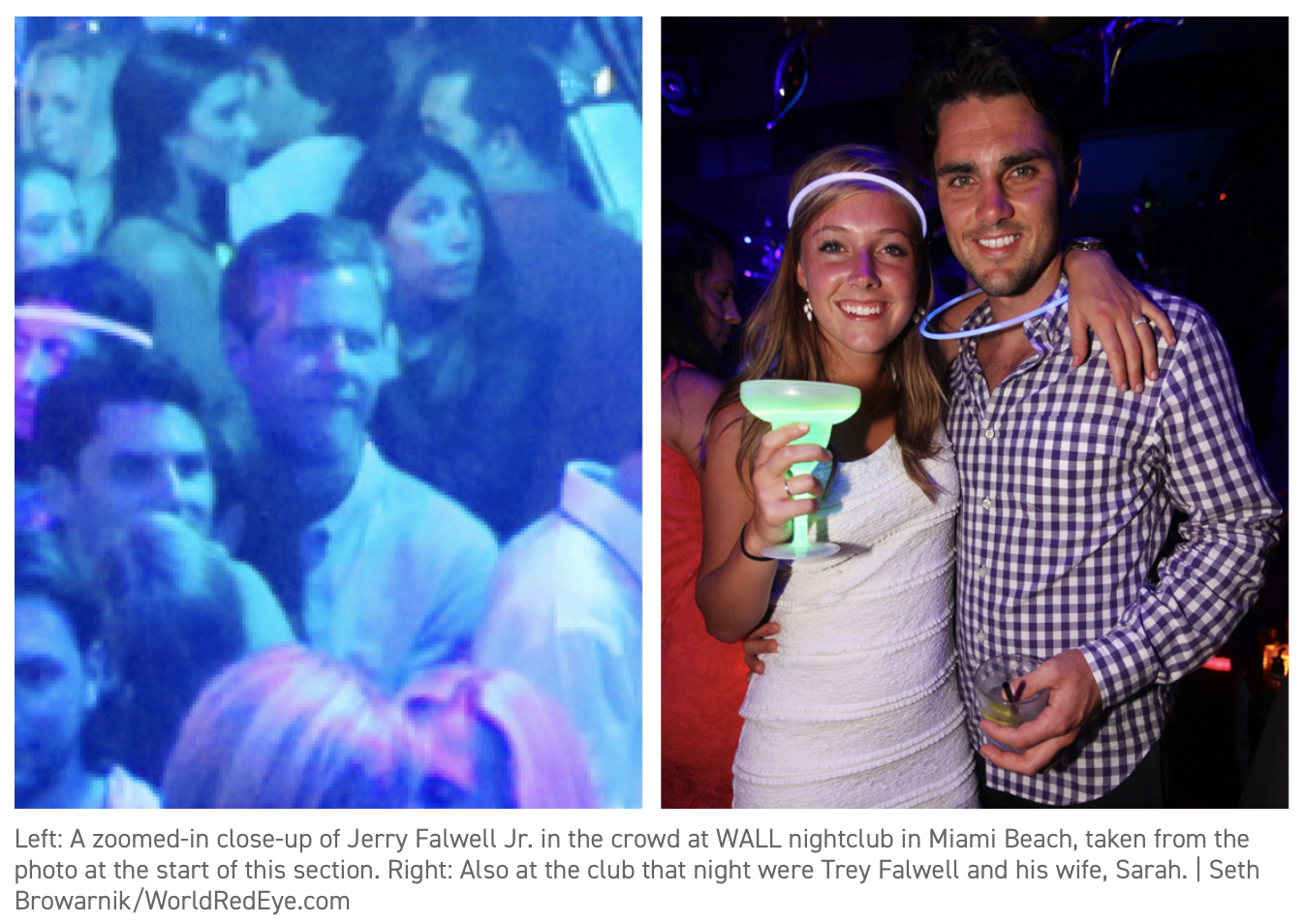
Remember: Junior’s largest salary comes from being president of a religious school that forbids drinking and dancing, among other things. So why are he and his son partying at south Miami nightculbs? (click to embiggen)Listen, hot-wifing, threeways, and cuckold fantasies are all perfectly healthy sexual things that a committed couple who are into ethical non-monogamy should be able to engage in without shame. But when you run a couple of massive non-profit organizations (and draw more than a million dollars in salary between those jobs) that explicitly condemn homosexuality, family planning, women’s rights, sexual liberty, drinking, and dancing (yes, dancing!)—well, then this kind of scandal becomes of interest to the public. Because remember, those non-profit organizations are tax exempt, and therefore all of these shenanigans are being subsidized by our tax dollars.
On top of that, Falwell, Jr effectively swung the evangelical base of the Republican party firmly behind Trump (and all of the evil, non-Christ-like policies that has unleashed on us). And apparently he did so because Trump’s fixer, Michael Cohen, made a blackmailer with more of those kinds of pictures of Mrs. Falwell go away.
You should go read the Politico story. It is full of fascinating details (and keeps the sexual stuff, as much as it could be, more tasteful than I would). The amount of information that people were willing to give the reporter is amazing, given that Liberty University and the associated businesses famously have very strict non-disclosure agreements that claim to stay in force even after a person leaves.
Listen, some of those financial deals are clearly prosecutable crimes. Junior’s using tuition funds and donations to finance his jet-setting lifestyle and that of his friends—and probably sex partners.
“We’re not a school; we’re a real estate hedge fund,” said a senior university official with inside knowledge of Liberty’s finances. “We’re not educating; we’re buying real estate every year and taking students’ money to do it.”
Given that he’s been flying some of these people across state lines in his private jet to close some of these deals, Junior maybe should have thought twice before calling the Feds.
Maybe he thinks that his buddy, Trump, will bail him out. After all, Trump’s very fine lawyer, Michael Cohen, helped get rid of that pesky blackmailer right? Except now Cohen is cooling his heels in federal prison, convicted of financial crimes on Trump’s behalf. Trump hasn’t shown any sign of being willing to pardon Cohen. Or any of the four other people Mueller got to plead guilty to related crimes, nor the four people Mueller got convicted, nor the 19 other people still under indictment whose cases are on-going.
So, Junior may need to start prepping for some less luxurious accommodations than those he is currently accustomed to.
Note:
(Part of the title of this post comes from the hymn, “Up from the Grave He Arose (Low in the Grave He Lay),” by Robert Lowry. It was hymn number 113 in the 1956 Baptist Hymnal.)
This picture is actually from a thunderstorm in 1999 (c) Patrick Haggerty/Associated PressI don’t deal well with warm weather. I have sometimes phrased this as, “I melt at 80 degrees or higher.” For most of the 43 years that I’ve lived in western Washington state, that hasn’t been a big problem, because we usually only get a week or so of weather in the high-80s and up most summers. The previous few years (as the average temperature of the atmosphere has been climbing), have been a different story. Last summer and the summer before we had several weeks of the high weather accompanied by smoke from wild fires in Eastern Washington and British Columbia. Smoke so severe that health officials weren’t just recommending that some people might want to wear masks, but urged everyone to wear particular masks for days on end.
It was awful! The sky was a sick yellow color, the sun was a hellish red color, everything stank of smoke, my sinuses were swollen as if the worst hay fever day was coinciding with a sinus infection, and it was so hot I just wanted to curl up in a deep freeze somewhere.
And the two things — higher average temperatures and smoke — were related. Because wild fires are both more likely and harder to contain because of the heat and how dry all the plantlike growing in the wilderness was.
This summer we had something that was more like the summers of old (which are going to continue to be less likely as we go). We had a week of really hot weather, then a few days of cool weather, a week or too of kinda hot weather, a few days of cool, and then another week of really hot weather, with a bit of a cool down to only sort-of hot weather, and so on.
Then, Saturday night, this happened: Hundreds of ‘insane’ lightning strikes bring chaos to Seatte. And while the actual storm was a bit disturbing, it was part of a big shift in the weather pattern, as we move out of the summer pattern and more toward fall. The long-term forecast is we won’t hit 80 degrees Fahrenheit
again this year, which has me cheering. And the short-term forecast is periods of occasional rain today and tomorrow, partly sunny Wednesday, and then back to rain.
I love the rain. Really. I like listening to it coming down. I like hearing the sound of tires on the wet roads. I like to go outside and stand in it for a while… I’m just really happy.
Another upside to the slightly closer to normal weather over the summer is that I didn’t have as many awful hay fever days. I still had a lot of bad hay fever days and I was taking extra meds a lot, but it wasn’t nearly as bad as the last several summers.
Of course, I’m not out of the woods there, yet. A lot of flowering plants, some trees, and many grasses will keep pollinated for the rest of this month and into October. And when the pollen starts to subside, all the ferns (which grow all over the place in our damp client) will start sporing. And then some time in November as the ferns stop filling the air with their spores we’ll have mushrooms and toadstools popping up everywhere and the air will be filled with fungal spores and molds until (if) we get a hard freeze.
But it’s a lot easier to deal with hay fever when I’m not also feeling like the air is baking my body as a walk around.
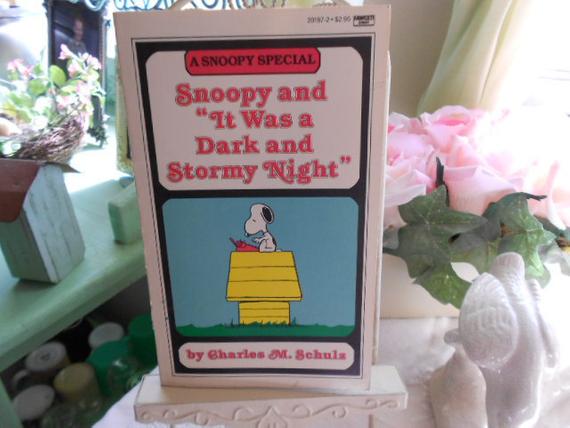
This, alas, is not my copy of this book. I don’t know what happened to my copy. I moved several times during my 20s and early 30s, and I think the book disappeared in one of the moves.So I’ve seen this one post on Tumblr many times where people are just outraged, really outraged, that the Bulwer-Lytton contest exists. And I keep refraining from chiming in to explain that they don’t understand, because 1) I am afraid it will just come across as Mansplaining, and 2) if they really don’t understand, they will never understand the truth. So I’m going to explain it on my blog. And since my blog cross-posts to tumblr, if any of them connect the dots, I can just block their comments on my blog.
So, first, the misunderstanding. They are all upset because “It was a dark and stormy night” seems to be a good opening line to any story. And you know what?
They are right.
Those 7 words are a great opening line. Edgar Allan Poe and Madeleine L’Engle both used the same seven words as openings to stories that went on to acclaim.
So what’s the problem?
There are a lot of contests out there where people are challenged to compose a horrible opening sentence to a fictitious novel, and those contests are named after Edward Bulwer-Lytton, first Baron Lytton, because of a horrible opening sentence he wrote for a novel called Paul Clifford published way back in 1830. The problem is that Baron Lytton didn’t put a period after night… his actual opening sentence went on for a whopping 58 words total.
Fifty-eight words! With at least two parenthetical clauses (depending on how you count, it can be four or five!)!
Full disclosure: I once won a Bulwer-Lytton contest for an opening line to a fictitious sci-fi novel, and I am personally acquainted with two other people who won such contests.
So, let’s look at the actual opening sentence, shall we?
It was a dark and stormy night; the rain fell in torrents—except at occasional intervals, when it was checked by a violent gust of wind which swept up the streets (for it is in London that our scene lies), rattling along the housetops, and fiercely agitating the scanty flame of the lamps that struggled against the darkness.
If Lytton had just allowed his editor to change that semi-colon to a period… except he would have had to re-word the following phrases a bit, too, and he refused. So that’s the real problem. He wouldn’t concede that his opening sentence should have been both 1) multiple sentences, and 2) re-worded.
The most egregious sin in the sentence that Bulwer-Lytton insisted on, in my opinion, is that “(for it is in London that our scene lies)” because it breaks the fourth wall (which no other part of the novel does). Plus there were much more elegant ways (and with fewer words!) to convey the information. For example, consider this as an opening:
It was a dark and stormy night.
Rain fell in torrents—interrupted at intervals by violent gusts of winds. The winds swept up the London streets and rattled the housetops—fiercely agitating the scanty flames of the lamps that struggled against the darkness
I’m not the greatest editor in the world, but my first attempt at cleaning up the fifty-eight word run-on sentence to three sentences totalling forty-four words. And not one single nuance was lost with that reduction in word count!
My rewrite represents a reduction of words to about 76% of the original. And my primary skill set is developmental editor. I suspect a grammatical editor could reduce the word count by at least another 25% without losing a single instance of meaning.
And that is the point of the Bulwer-Lytton contests: quite often succinct is far superior to verbose. And a lot of people mistake elaborate vocabularies as being superior to concision.
I mean, knowing lots of words is cool, and sometimes elaboration is better than minimalism. So I get it. But no one is saying “It was a dark and stormy night” is a bad opening line. On the contrary, we’re saying that Bulwer-Lytton should have stuck with that and moved on.
Finally, for full disclosure, this is the sentence with which I once won a Bulwer-Lytton contest:
Lance Lace, skulking in the shadow of a spaceport warehouse, checked the charge on his blaster and wondered—for not the first time that night—what all of this had to do with the pair of pliers and water-soaked lace panties found in the pockets of the murdered Rigellian.
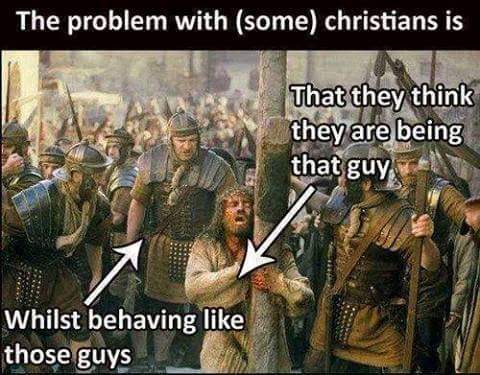
“The problem with (some) christians: That they think they are being that guy (points to Jesus being lashed and tortured) whilst behaving like those guys (points to the roman soldiers beating Jesus).”Marriage, as we know, is a blessed arrangement. We also know that it’s an ancient tradition. Except, of course, exactly what that arrangement was and how it was arranged has been a constantly changing thing for all of human history. For instance, in some of the Ancient Greek city-states the tradition of male line inheritance required that if a man of property died without a son, a surviving daughter or granddaughter of child-bearing age would be forced to marry her closest male relative and that husband would then become the heir. Many societies didn’t merely allow a man to hve more than one wife—it was expected! There were fewer societies that allowed a woman to have more than one husband, but those existed, too. Even if we restrict ourselves to the Judeo-Christian traditions, remember that the Biblical King Solomon had 700 wives and 300 concubines.
Most European traditions didn’t assume monogamy was part of marriage until something between the 6th and 9th Centuries AD. Christian teachings didn’t start treating marriage as a sacrament until the 16th Century AD (despite that oft-quoted verse about “what god has joined together”). The same sort of people who quote that verse while demanding that secular law follow their tradition ignore the parts of the New Testament where the Apostle Paul condemned marriage as a waste of time, and only grudgingly said that if a man found himself so burning with lust it distracted from evangelizing should he marry.
The modern notion of marriage being about two people who fall in love and decided to pledge themselves to each other didn’t really become common until the 1700s. Now, it’s true that songs and poems and such from the 12th Century on waxed rhapsodic about courtly love, but it was considered the exception, rather than the rule.
All of these facts contradict what I was told about marriage growing up in Southern Baptist churches. Marriage, according to them, was a sacred institution that had existed unchanged since the beginning of time. And it had always been about a man and a woman who love each other and commit to a lifetime together. And once married, no matter what the circumstances, the two are bound together in love and divine grace, et cetera.
And they really did mean no matter the circumstance. I sat through more than one sermon where the pastor said that even if you make a mistake and marry the person god didn’t want you to, once you exchange your vows before god, that person is now the right person.
Despite the above, as far as I know, every single Baptist church we had ever been a member of had at least one married couple in which at least one member had been married to someone else before, been divorced, and had now re-married. And most people in the church treated the second marriage as just as sacred and eternal as the ideal they kept talking about. The usual hand-waving was the god forgives everyone who repents, and therefore if someone has committed the sin of divorce, but now has sincerely repented and pledged to make it work this time, well, god’s going to bless that.
Of course, before many members of a congregation were willing to go to that step, the divorced person would have to suffer for a while. They had to have a moving tale of the pain and heartache and regret they went through to show the sincerity, you see. Because someone had to be to blame, right? And if someone is to blame, then they must be punished. Like the women in this story: For Evangelical Women, Getting a Divorce Often Means Taking All the Blame.
That idea, that divorce is always wrong, doesn’t just hurt women who are in bad marriages. It also hurts children. I’ve written more than once about how my father was physically and emotionally abusive. When my mom shared her pain and fear with people at church, the answer was always the same: if she had enough faith, god would change dad.
No matter what evidence was presented.
When I was 10, my dad beat me on a Sunday afternoon with a broom handle while calling me the worst names imaginable. By the time he was done not only was I covered in bruises and contusions and worse, I had a broken collar bone. I had to be taken to the emergency room. Later that week—while my arm was still in a sling, I was bruised everywhere, and stitches visible on my face—our pastor looked me in the eyes and told me that if I would just be obedient and act the way my father wanted, Dad wouldn’t have to be so strict. Keep in mind, Dad had sworn off religion a few months before I was born. He refused to set foot in church and wasn’t the slightest bit friendly or welcoming when the pastor visited our home. Yet still, because of their theology about marriage and the husband’s role as master of the home, anything bad that happened to the rest of us was our fault.
I don’t know everything the pastor said to Mom, because I was taken away by one of the church ladies (who scolded me some more for upsetting my father so much he did this to me) while the pastor talked to Mom in private. But Mom came out of the meeting convinced that it was her fault. If she just had enough faith and loved Dad enough he wouldn’t be this way.
Somehow that doesn’t seem like the wise plan of a loving god, you know?
What brought all of this to mind today is this odd little bit of news I came across: Hate Group NOM Allows Web Domain To Expire. The National Organization for Marriage was at the forefront of the battle against gay civil unions, marriage equality, gay adoption rights, and several related fights for years. They poured millions of dollars into ad campaigns to defeat gay rights initiatives and so forth. They have insisted again and again that they don’t hate gay people—they are just defending traditional marriage.
The kind of traditional marriage that says a woman must stick to her husband even if he beats her and their children severely, for instance.
The organization still exists, and its president, Brian Brown, is still sending out fear-mongering email blasts to supporters begging for money. The last time the IRS got them to partially disclose their donors (they have been under investigate for many years because they never file complete paperwork or comply with court orders to disclose campaign spending) their donations (and the number of donors) had dropped off significantly. NOM used to be an umbrella organization for at least 8 different “education and advocacy” funds and a bunch of Political Action Committees, now all but two of those have been shut down. Apparently last year each of those two remaining entities reported income of less than $50,000.
I’m hoping that the website lapsing is a sign this hate group is gasping out its dying breaths. Joe Jervis, who runs the Joe.My.God gay news blog, reports: “I’ve put in the required whopping $12 bid to snap up the domain, which will redirect to JMG if I’m successful.”
If you can’t muster the empathy to tell an abused child or an abused spouse that being a victim isn’t their fault, you don’t know what “love they neighbor” means. And you can’t claim to be following a loving god while doing and saying hateful things about whole categories of people.
The title comes from the hymn, “Love Divine, All Loves Excelling” by Charles Wesley, #2 in the 1956 Baptist Hymnal. All of the Baptist Churches I was ever a member of used the 1956 edition of the Baptist Hymnal. The next major update didn’t happen until 1991, by which point I was out of the closet and officially declared myself a former Baptist.










 Font Folly