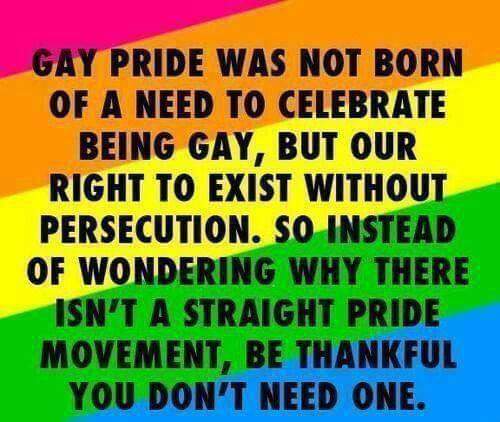
“Gay pride was not born out of a need to celebrate being gay, but our right to exist without persecution. So instead of wondering why there isn’t a straight pride movement, be thankful you don’t need one.”It’s that time of year again. The perennial question arises: “If you get a Gay Pride Parade, why can’t we have a Straight Pride Parade?” I can’t decide which is the saddest aspect of this question: 1) that they think this tired old canard is clever, 2) that they don’t understand that 99.9% of all television, movies, news, and other public discourse is geared toward affirming heterosexual life, including straight sexuality (so every day is already Straight Pride Day), or 3) that they don’t understand that Queer Pride events are about our very right to exist—an act of defiance against those who want us to be invisible or dead—not merely our right to party?
And some people seem to be most hung up about the fact that we have parades and festivals. Especially the parade seems to bug them. They are always quick to say that they don’t have a problem with gay people, but the truth is that what bothers them is us being visible. When they ask us why we have to flaunt who we are, what they are really saying is why can’t he be quiet and stay hidden and not remind them that anyone who is different than they exist.
And you know how you can prove this? Ask them if they have ever raised the same objections to St. Patrick’s Day parades. The earliest St. Patrick’s Day parades in colonial times were about Irish Nationalism, since all of Ireland was under British rule at the time. By the mid- and late 1800s the St. Patrick’s Day parades were about Irish equality in the U.S., since anti-Irish and anti-Catholic sentiment was quite high, and yes often encoded in laws and government policy. While the anti-discrimination purpose of the parades has faded away, the parade is still about taking pride in one’s Irish heritage. If a person doesn’t object to Irish pride parades (which is exactly what St. Patrick’s Day parades are), but they do object to LGBTQ+ Pride parades, the only logical reason can be that they object to the Lesbians, Gays, Bisexuals, Trans, and all other Queers in particular, and not the idea of a parade celebrating identities in general.
I can pretend that the question isn’t a passive-aggressive exercise of bigotry and give you some simple answers. Why do we need Pride?
We need Pride because people still target gender non-conforming children in schools, and now adults aren’t just making excuses for the bullying and discrimination, they are writing it into law!
We need Pride because people will go to great lengths to take away any rights we managed to get.
We need Pride because queer kids are born everywhere, not just into families and communities that love and accept them, but often into families where they are bullied (sometimes bullied until they kill themselves) and they need to know that they aren’t alone.
We need Pride because the world tries to make us hate ourselves, tries to make us be ashamed to love, and most importantly tries to convince us we are utterly alone.
None of those reasons apply to straight people. No one bullies straight children just because they are straight or gender conforming. No parents kick their straight children out on the street because they are straight. No one is targeting sports bars to kill straights because they saw a man kiss a woman somewhere. No preachers are going on the air to say that straight people deserve death. No one is passing laws saying gender conforming children aren’t allowed in public school bathrooms. No one is passing laws trying to ban straight people from adopting children or getting medical benefits for their partners. Straight people and straight people’s sexuality (ever seen a romantic comedy?) is the subject of at least 99% of all movies, television shows, et cetera. So straight people don’t need pride. But if you really think you do, no one is stopping you from organizing your own parades (though I’ve argued before that you already have those, too).
The reason queers like me have been able to stand up and be ourselves is because other queers before us were brave enough to be out and brave enough to protest when necessary. Be it staging sip-ins to protest laws that made it illegal for a bartender to knowingly allow two homosexuals be served in the bar, or fighting back when police raided a gay club, or picketing in front of federal buildings, or boycotting industries whose spokespeople lobbied for laws to take away our rights, or protesting laws making it a crime for us to be intimate with the person of our choosing, or marching in the first ever Pride event in June 1970. Those of us who can stand up for ourselves now owe a debt to those earlier generations of queers. We can’t pay them back directly, so we have to pay it forward. We do that by standing up and being counted and being visible for all of the people (especially kids) who can’t safely be out themselves, yet.
We need Pride not because we’ve come so far, but because there is still a long, long way to go.
I’ve mentioned before that I collect images and memes and such as potential illustrations for Friday Links posts or political commentary, and I’m always collecting more than I wind up using. So every now and then I’m going to do a post like this where I just publish a bunch.
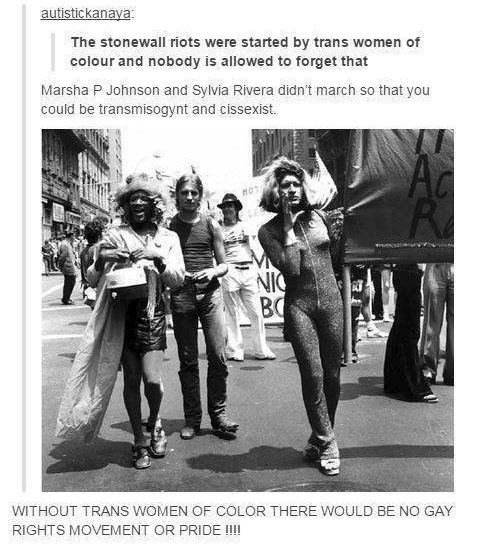
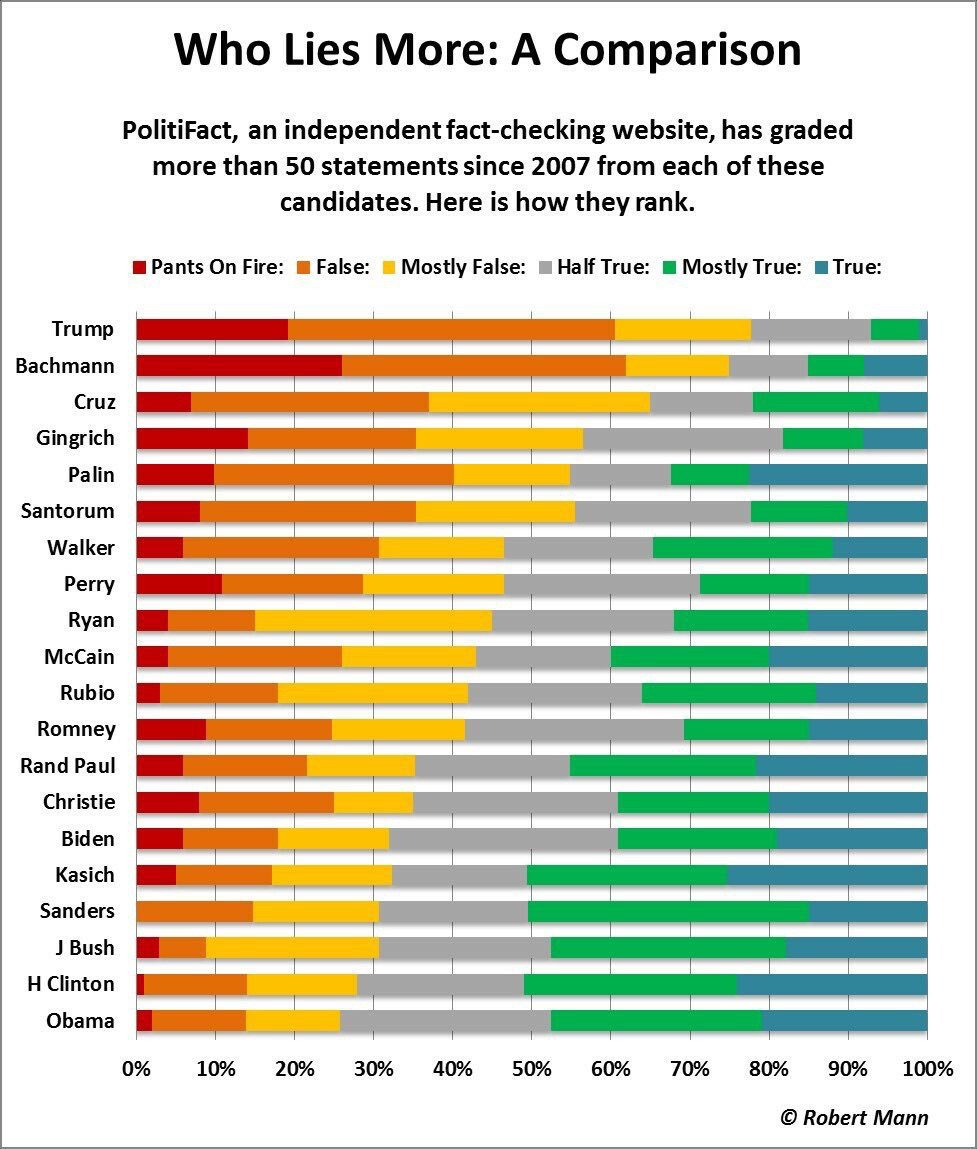
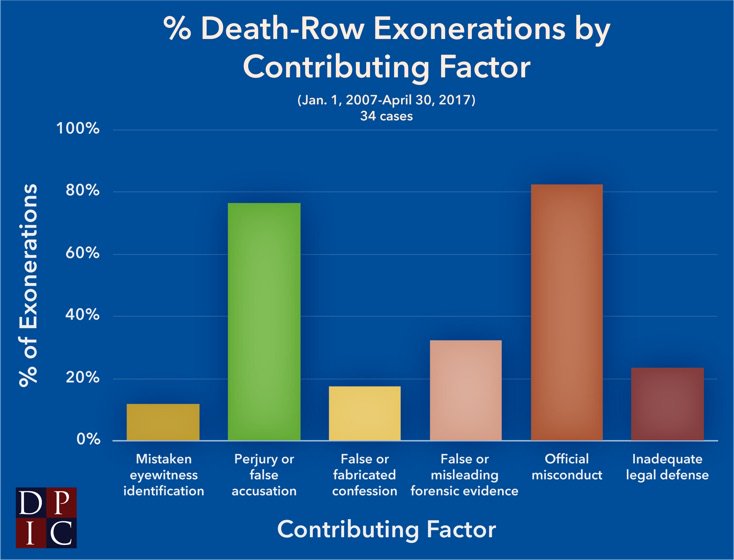
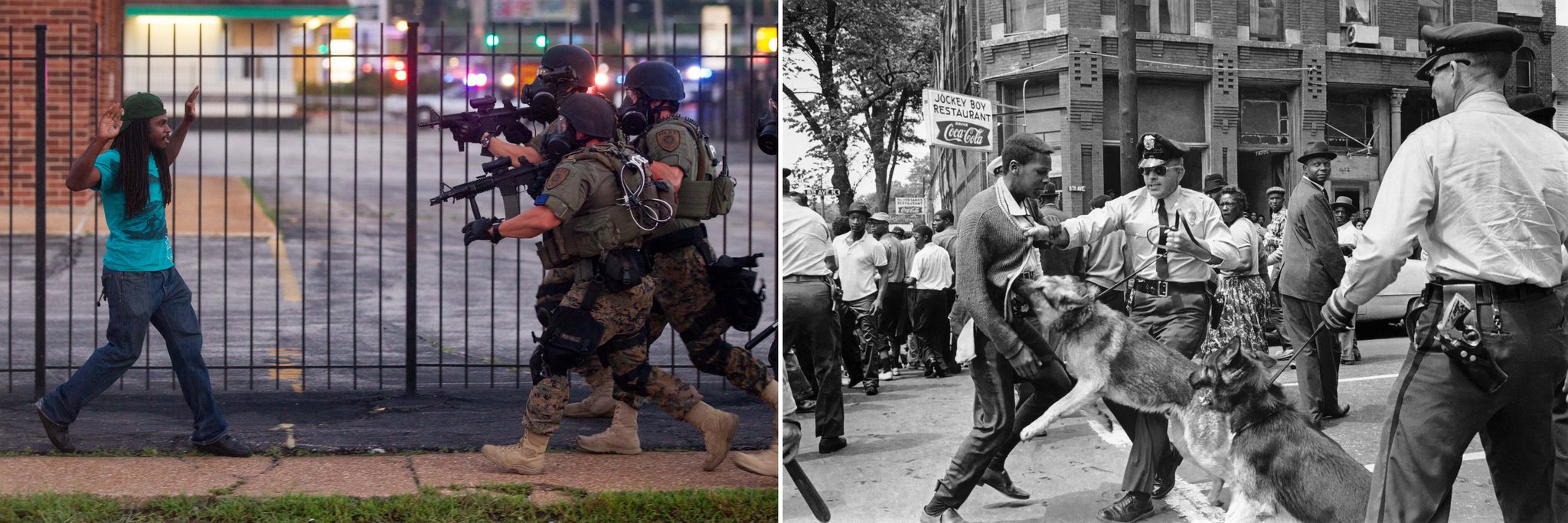
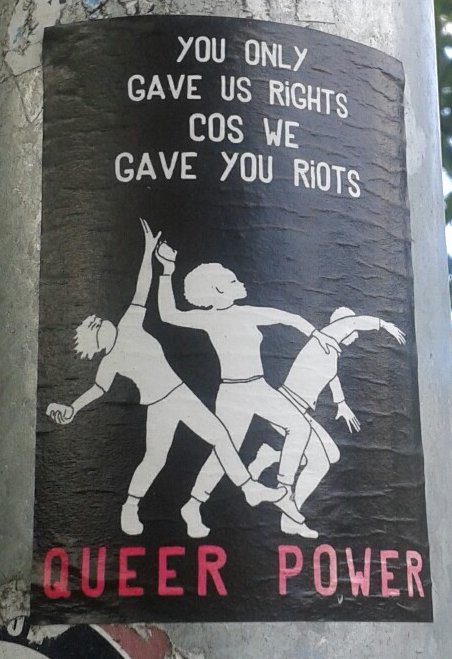
“The Stonewall Riots were started by trans women of colour and no one is allowed to forget that.” (Click to embiggen)“Love is a terrible thing to hate.”“Who lies more?” Please stop repeating the lies that all of them do it. One end of the political spectrum fails fact checks far more often than the other.(Click to embiggen)“Percentage of Death-Row Exonerations by Contributing Factor.” Gee, several of those categories constitute official malfeasance. (Click to embiggen)This is what “Make America Great Again” meant to far too many of Donald’s supporters (and staff, and Donald himself, to be honest). (Click to embiggen)“When I find myself in tweets of trouble, Mother Russia comes to me, speaking words of wisdom… covfefe!”“You only gave us rights because we gave you riots. Queer Power” (Click to embiggen)“We kept fighting after Stonewall. We’re still fighting the AIDS Crisis. We kept fighting after Anita Bryant. We kept fighting after Jesse Helms. The struggle is far from over. I’ll keep fighting. Will you?”“Pride 2017”
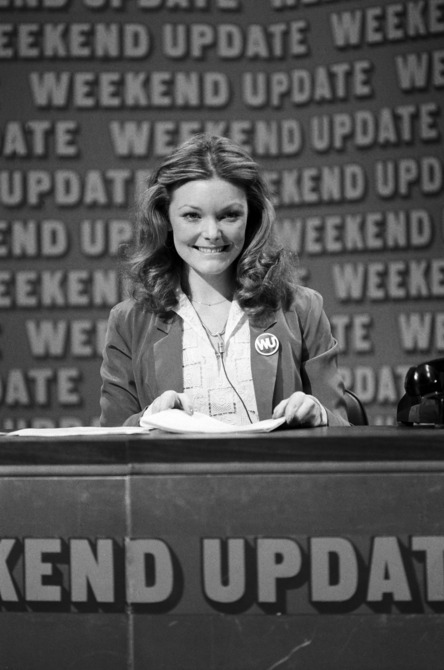
Jane Curtin anchoring Weekend Update on Saturday Night Live.Yesterday’s weekly round up of links had only one story on Wonder Woman: the fact that is had an extremely positive rating on Rotten Tomatoes (among all superhero movies of all time, second only to The Incredibles.) I didn’t include any stories about the man-babies who are complaining: Conservatives Cry Misogynist Tears Over All-Female “Wonder Woman” Show. So Alamo Drafthouse Cinemas announced a couple of “No Guys Allowed” showings at two of it’s theatres, one in Austin, one in Brooklyn. And a bunch of entitled douches got upset. This kicked of a string of responses. My favorite is: Austin Mayor Responds To Man Angry About ‘Wonder Woman’ Screening. I love that the mayor’s response begins, “I am writing to alert you that your email account has been hacked by an unfortunate and unusually hostile individual. Please remedy your account’s security right away, lest this person’s uninformed and sexist rantings give you a bad name. After all, we men have to look out for each other!”
And let’s talk about some real-life heroes. I had a bunch of stories yesterday about last week’s hate crime/white nationalist terror attack on a Portland train. The quick sum-up, an angry man started yelling at two teen-age women of color on the train, three guys tried to intervene, the angry man stabbed all three guys, two of whom died at the scene. Angry man is in custody and at his arraignment was screaming white nationalist slogans. People have donated a lot of money to funds to help the families of the two men who died and help cover the medical expense of the survivor. I covered all of that, yesterday.
“We need to remember that this is about those little girls. I want you to imagine that for a second, being a little girl on that MAX.This man is screaming at you. His face is a pile of knives. His body is a gun. Everything about him is cocked, loaded and ready to kill you. There is a history here with this. You can feel that this has happened before, and the only thing that was different was the names and faces. And then a stranger, two strangers, three strangers come to your aid. They try to help you. And that pile of knives just throws itself at them. Kills them.”
—Micah Fletcher
Speaking of Pride Month: Netflix And FilmRise Separately Acquire Transgender-Themed Documentary Films. One of the documentaries is The Death and Life of Marsha P. Johnson; Johnson was one of the trans heroes at the original Stonewall Riots, and is often credited with being the actual person who threw the first brick that night.
“queer – a homosexual…” Looking up the definition in the Compact Oxford English Dictionary requires using a magnifier.Twenty-five years ago I was dramatically confronted with the hypocritical nature of my feelings about the word “queer.” My coming out process had been long and convoluted. This particular incident (which I’ve written about previously) happened after I had separated from my wife and begun the process of getting a divorce. Getting to the point of admitting to myself that I definitely wasn’t bi hadn’t been pleasant, and I felt that the ordeal required some sort of rite of passage. So when a friend mentioned that she was going to participate in a National Coming Out Day march, which was going to start from a location near my then-workplace, it seemed a perfect fit. It was only after arriving that I found out the event was sponsored by Queer Nation. Queer Nation was controversial within the LGBTQ+ community at the time for both their radical attitude but mostly (among the LGBT people I knew at the time) just for insisting on using the word “queer.”
The argument against the word was that it had been used as an insult against children who failed to fully conform to the ideal for their assigned gender, resulting in many adults in the LGBTQ+ community to experience great pain when hearing the word. I understood that argument, though I had found myself at the receiving end of a lot of vitriol from within the community if I happened to use the word “gay” as an umbrella term, because it left out lesbians. Similarly, I had also been yelled at from using the term “lesbian and gay” because it excluded bisexual people. And the arguments and screaming fits over the word “homosexual” are so convoluted (and intimately tied to the etymology of the word) that they deserve a separate blog post.
So I had found myself, as an active member of a couple of non-profit organizations related to the LGBTQ+ community, constantly trying to say the full initialism in every sentence.
Some gay friends who really disliked Queer Nation saw me marching up the street behind the Queer Nation banner that day (we were actually doing the Queer Hokey Pokey when we passed in front of the bar where a bunch of my friends had met for other reasons). And I got a lot of grief later from them. Some of them just teased me about it, but some were a bit more upset. While I was trying to explain why I wasn’t embarrassed about marching with Queer Nation nor did I regret it, one friend got in my face pretty angrily about it. And thus I found myself retorting, “I am going to call myself Queer if I want to, and fuck you if you don’t like it!”
My feelings about the word shifted during that argument.
Because I realized the argument has a big flaw. Yes, I was bullied as a kid with the word “queer,” but I was also bullied just as viciously with the word “gay.” And the people who argued most vehemently 25 years ago that queer was completely unacceptable, just as emphatically insisted that I should proudly call myself gay. Similarly, I know many women who were bullied during childhood and beyond with the word “lesbian” and derivatives of the word, yet now they’re supposed to proudly call themselves that word, and we’re supposed to call them that rather than use “queer.”
According to several of my dictionaries, in the last two hundred years queer has gone from an adjective meaning “strange, peculiar, or eccentric” to a verb meaning “to spoil or ruin” to an adjective meaning “of or related to homosexuality” to a noun meaning “a homosexual man” to a both a noun and an adjective: “a non-heterosexul person” or something “related to non-heterosexuality.”
Words change. Queer may be derived from the Old High German twerh which was an adjective describing something that was “oblique or not at a right angle.” In other words, not straight. One can see how describing something that was physically at an odd angle would come to metaphorically refer to something that was odd or peculiar in other ways.
My dictionaries that cite the first use of a each particular sense of a word by date indicate that the word was not used as an adjective referring to homosexuality until 1922, and then the noun usage for a homosexual man came 1935. Yet an unabridged dictionary I have that was published in 1957 lists only the definition, “odd, strange, eccentric.”
I see people who are too young to really remember the heyday of Queer Nation amid the horrors of the AIDS crisis in the 80s and 90s still making the argument that we shouldn’t use the word. They say “some people” are triggered by the word queer, so we shouldn’t use it. What they mean is they have been told by some LGBTQ+ folks my age that they are triggered by the word. I, however, remain extremely skeptical of anyone who claims a single word is a consistent trigger. Triggers are tricky, but in my experience, the people claiming to be triggered by the mere utterance of a single specific word really mean that they dislike the word, not that hearing it gives them flashbacks forcing them to relive horrific experiences. This kind of claim cheapens the very useful meaning of the word “trigger” to describe a phenomenon that some survivors of trauma experience. And I’ve never, ever heard anyone claim to be triggered by the words “gay” or “lesbian” even though those words were used as vicious insults just as often as “queer” was.
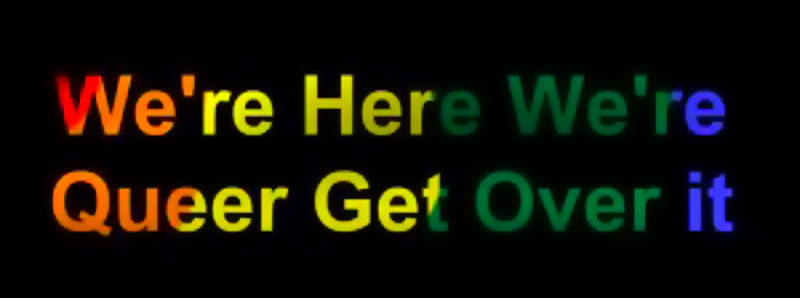
“We’re here, we’re queer, get over it.”So, I’m not going to try to squeeze the various QUILTBAG initialisms (LGBT, GLBT, LGBTI, LGBTQ, LGBTQ+, LGBTQA ad nauseam — and boy, does it get nauseam!) into every sentence. I’m queer. I’m a queer man who is a member of the queer community. The community includes trans people, bisexual people, pansexual people, asexual people aromantic people, non-heterosexual people of all genders, genderfluid people, two-spirit people, bigendered people, ambigendered people, et cetera, et omnia, et perpetua. No matter how you look at all of those people, if you get us all together, many of us are quite strange, a little odd, or wildly eccentric in wonderful ways. So queer is a word that encompasses us well.
If a specific person asks me not to call them queer, I will make an effort not to use the word to refer to them specifically, but I’m going to go right on calling myself and the community queer. I’m here, I’m queer, and I’m not going to be silenced by anyone.
“Go ahead! Explain to us how you, a straight person, know more about homophobia than we do.”(Click to embiggen.)In a recent post I commented on the case of Andrew Shirvell, a former Michigan assistant attorney general who lost his job because he mounted a harassment and stalking campaign (using state resources) against an openly gay college student. During the post I commented on how Shirvell pings everyone’s gaydar and talked about the roots of his particularly vicious and obsessive homophobia. And a new commenter decided to explain to me how very homophobic it is for me to characterize Shirvell’s mannerisms and speech patterns as prissy.
Oh, straightsplaining again! Hurrah! Thank you, so much, anonymous straight person, for explaining homophobia to me. How foolish of me to think that my 50+ years of surviving the slings and arrows of homophobia gave me any understanding of it.
Okay, let me clarify a few things:
Fact the First: you are correct, not every gay man is a sissy. Bully for you for being so open-minded!
Fact the Second: there are actual studies that show that, while not all queer men are sissies, at least 75% of boys who exhibit the characteristics causing them to be labeled “sissy” during childhood grow up to come out as queer.
Fact the Third: no matter what their actual sexual orientation, every boy who ever lived in our society who exhibits any of those gender-nonconforming behaviors was bullied because of them.
So, whether you believe that Shirvell is a closet case or not, my assertion that homophobic bullying is part of the root of his insanely over the top obsessively vicious homophobic campaign against that college student is still valid. You’re barely technically correct that we don’t know Shirvell’s orientation for certain (though I’m 99.99999% certain that he is queer of one sort or another). But the sheer level of sissy behavior one sees in any of the video interviews Shirvell gave back when he was defending his campaign tells me that he wasn’t just bullied occasionally as a child, but quite viciously and continuously. And we know from many studies that enduring that kind of bullying is one of the sources of adulthood excessive homophobic attitudes and behavior.
While we’re on the topic of those studies: those studies also show that the more virulent an adult man‘s homophobic attitudes and opinions are, the more likely it is that their body will exhibit involuntary arousal at the sight of scantily clad men. In other others, the more homophobic, the more likely that they are a self-loathing closet case. Add that to the study above, and it’s possible that my 99.99999% assessment is too low.
Fact the Fourth: I was a sissy. My childhood bullies included not just my classmates, but many of the adults in my life: family members, some teachers, and many adults at church. Yes, during my early teen years I was verbally homophobic. In my later teen years the only reason I wasn’t was not because I had become enlightened, but rather because as I had given in to my hormones a number of times, I wasn’t willing to be a hypocrit. But I was still convinced that I was going to go to hell for giving in to those feelings. So I understand Shirvell’s situation.
I do feel sorry for Shirvell the child. I know he had a horrible experience, even though I don’t know all the details. However, he’s an adult, now. He’s been exposed to information about sexual orientation, including the medical studies that it is not a choice (and therefore, since part of the theological definition of sin is being a willful disobedience, that means homosexuality cannot be a sin). He’s had more than enough time to start coming to terms with his childhood trauma and at least make the decision not to be the kind of bully that made his childhood hell. He has very emphatically chosen not to do so. Shirvell the adult deserves not one iota of sympathy. Not one.
Fact the Fifth: Please understand, I’m not stereotyping Andrew Shirvell as a gay man, I’m stereotyping him as a self-hating closet case—and he’s given us so, so much ammunition. It’s not just about the way he prances or speaks, it’s what he says as he’s ranting about the imagined sexual depravities of the targets of his homophobic rants—he simply sounds like he spends an inordinate amount of time imagining queer sex.
And there isn’t a plausible heterosexual explanation for that.
Note: Comments on this entire blog have always been moderated. Specific commenters have been whitelisted, but everyone else’s comments sit in a queue until I approve them. And I don’t see any point in approving comments that are insulting, or obviously coming from sock puppets or—such as the comment alluded to here—indicate the person isn’t interested in listening.
“This is the first time in the history of the United States that someone has run openly as a gay person and been elected to public office.” – Kathy Kozachenko, Ann Arbor, Michigan, April 2, 1974On April 2, 1974, forty-three years ago, University of Michigan student and Human Rights Party candidate Kathy Kozachenko was elected to the city council of Ann Arbor, Michigan, making her the first openly gay or lesbian person to run successfully for political office in the United States. Notably, Kozachenko was not the first gay or lesbian person to serve openly in public office; in fact, her predecessors on Ann Arbor’s city council, Nancy Weschler and Jerry DeGrieck, came out during their first and only terms, making them the first openly queer officeholders in the United States. (To be clear: the distinction is that Kozachenko was openly gay as a candidate, whereas Weschler and DeGrieck did not come out until after their elections.)
After serving one term, Kozachenko stepped out of the public eye, though not out of the activist life entirely. After meeting her life partner, Mary Ann Geiger, and having a son, Kozachenko retreated more fully into private life and her place in queer history went virtually ignored for decades.
In “The First Openly Gay Person to Win an Election in America Was Not Harvey Milk,” a 2015 piece for Bloomberg politics, Steve Friess explored the factors that contributed to Kozachenko’s diminished place in the history of gay liberation: geography, misogyny, timing, messaging. When asked why the groundbreaking gay journalist Randy Shilts referred to Harvey Milk as “the first openly gay elected official in the nation,” for example, Kozachenko “figures there was little fuss at the time because it was just liberal, small-city Ann Arbor.”
“I don’t think I was brave,” Kozachenko told Friess, “because I was in a college town where it was cool to be who I was. On the other hand, I stepped up and did what I felt needed to be done at the time. Maybe that’s the whole story, that ordinary people can do something that then other people later can look back on and feel really good that they did this.” #HavePrideInHistory #KathyKozachenko (at Ann Arbor, Michigan)
“Sick of your heteronormative bullshit.”Not long before my 16th birthday we moved to southwest Washington and began attending the church where my maternal grandparents were members. My new Sunday School teacher was a middle-school librarian in his day job. This particular church had all Sunday School classes segregated by gender (which was fairly typical for Southern Baptist Churches3) and by age, so it was a bunch of guys ranging in age from about 14-18 years old. One Sunday morning shortly after we joined the church, the teacher was telling an anecdote from his public school job, and he mentioned the novel Are You There, God? It’s me, Margaret?. “Some of you may have heard of it,” he said.
Without thinking, I nodded my head and said, “Yeah, it’s a pretty good book.”
The teacher turned on me as if I had just transformed into a rattlesnake and was switching my tail ready to strike4. He had the most appalled look on his face. Then the expression changed to very amused condescension, “Oh, Gene! You would never have read this book! It’s a book for girls, and is completely inappropriate for a boy!”
I shrugged and said, “If you say so…”
He shook his head, chuckling even more condescendingly, and then went back to his story.
But I had read the book, several years earlier. I had gone through a pretty intense Judy Blum phase6, see. It started with the novel, Then Again, Maybe I Won’t which was, among other things, about a boy dealing with puberty and significant changes in his family’s financial situation. I had loved the book so much, that I proceeded to read everything else of hers I could get at the public library (or through inter-library loan) in the small Colorado town we had been living in at the time. Sure, Are You There, God? It’s Me, Margaret is a book about (among other things) a girl going through puberty and all that entails. But it’s also a book about one’s relationship with the faith they were raised in, and learning to make adult decisions about what you yourself believe.
The idea of boy’s toys and girl’s toys and boy’s books and girl’s books is pretty messed up when talking about small children, but it seems to me it is much more messed up when talking about teen-agers8. Some people will immediately point out that the teacher may have been so appalled because he thinks of menstruation as a sexual topic9, and good Christian boys who are not yet married10 aren’t supposed to know anything about sex. As if that argument is any less BS than the idea that a boy could never possibly read and enjoy a book that some people think of as a girl’s book.
It’s all heteronormative BS. My church insisted on separating girls from boys in Sunday School classes in part to supposedly thwart sexual improprieties12. But heteronormative BS is not limited to members of fundamentalist evangelical churches.
YouTube’s completely BS explanation18 for why they’re restricting videos that just happen to be made my Queer people. (Click to embiggen)YouTube is hiding some videos touching on various topics related to the LGBT community17. Not sexual videos. Among the videos that have been found to be hidden the Restricted Due to Mature Content label are: trans people showing how to apply make-up, a gay vlogger talking about 8 LGBT African-Americans who ought to be remembered during Black History Month, music videos without sexual content that happen to have been made by queer musicians, some coming out videos, and so forth.
Before anyone tries to lecture me of all people that this doesn’t constitute censorship (which I never said it did), let me explain. YouTube is privately owned, yes. But it offers a service to the public, and therefore must abide by the legal and ethical obligations that comes with offering a public accommodation. They incur those obligations whether or not they charge fees for the service. Among those obligations is one that is sometimes referred to as truth in advertising19: if you represent that your product or service does a thing when it does not, you can face penalties. YouTube claims that it is simply labeling content of a “mature or inappropriate nature” so that other users who choose to surf in restricted mode will not see offensive20 material. They also keep referring to it as a voluntary program.
“8 Black LGBT Americans Who Inspire Me” is not mature content. How to apply foundation, eyeliner, and lipstick is not mature content. “How I Came Out to my Family” is not mature content. Nor are any of those inappropriate.
It is also misleading in the press release to say the program is voluntary. Yes, whether or not a viewer choose to see content that has been labeled “Restricted” is voluntary. Whether a creator’s material is thus labeled is not. Neither are the creators informed that their material has thus been labeled. They have to log into YouTube as a different account and set that account not to view Restricted material and then try to view their own videos to see which ones have been labeled “Restricted.”
So I’m exercising my free speech right to call BS on YouTube. This isn’t a misunderstanding on our part. It is a discriminatory business practice21. It is more of the same old heteronormative BS where anything that admits that queer people exist is treated as if it is pornography, even when they are doing something as innocuous as sharing make-up tips22.
Footnotes:
1. By “we” I mean my mom, my oldest sister, and myself. Dad had remarried and was living in Utah by that time, with where my step-mom was had just given birth to the youngest of my half-siblings2.
2. It is worth pointing out that the precipitating event of my parents’ divorce was the discovery that Dad had been carrying on an affair with the woman who became my step-mom for years.
3. Many years later that particular church decided to allow a mixed gender Sunday School class, but only for the people over 65 years old. And members who happened to be that age but didn’t want to attend Sunday School in a mixed gender setting were allowed to attend the adult men’s or women’s class, instead. When my grandmother told me about it, she actually tittered and made a comment about how radical it was to let men and women discuss the Bible in the same room. My step-grandfather then commented that, “Well, I guess at our age they don’t expect anyone will misbehave.” From which you can correctly infer that one of the things at least some Evangelicals believe is that you can’t put people of the opposite gender in rooms with closed doors without the very real risk that sexual hijinks will ensue.
4. Which may seem like a really strangely specific metaphor, but because one of the churches we had briefly attended during my nomadic childhood had included some members who were into snake handling5, I actually had seen another man in a church have the exact expression as this teacher did when a rattlesnake in a jar that most of us didn’t realize one of the members had snuck into the church, suddenly got very tired of being trapped in said jar.
5. Snake-handling: A practice in certain Pentecostal and Evangelical churches inspired by a literalistic reading of Mark 16:17–18. Handling venomous snakes without being harmed is seen as a sign of one’s faith and possession of the Holy Spirit.
6. To be fair, many years later, when I mentioned something about Judy Blum during a conversation at work, at least one of my co-workers gave me a rather startled look and asked, “You read Judy Blum when you were a teen-ager?” When I said that I had and mentioned a couple of my favorites7, her response was a very emphatic, “Wow!”
7. Deenie, It’s Not the End of the World, and of course Then Again, Maybe I Won’t.
8. Although, attitudes like this teacher’s make it easy to believe the story that gets shared around from time to time of the adult male legislator with a wife and teen-age children who didn’t know that menstrual blood flow was an involuntary biological function.
9. It’s a biological function that occurs in members of one sex, yes. And it is related to the reproductive cycle, yes. But it’s biology. And sometimes a health issue. Fully functioning adult members of a society ought to have at least a passing knowledge about the health issues of their species, regardless of whether they experience it themselves.
10. I should mention that two of the guys sitting in that Sunday School room with me that morning would, in less than two years time, each have a rushed marriage to their respective girlfriends who would each give birth to their first child only a few months afterward9.
11. A situation which studies have shown again and again and again would happen much less frequently if kids are given accurate information about sex, sexuality, reproduction, et cetera.
12. Because sex (and flirting and dancing14) can only happen between people of opposite sexes, right16?
13. There is no thirteenth footnote.
14. An old joke which was much beloved by my college debate coach (though I’ve heard it from others before and since): “Why do Baptists condemn sex other than missionary position15? Because they’re afraid it might lead to dancing!”
15. It’s true, even married people are not supposed to do anything other than very vanilla sex. Which is the inspiration of a similar joke: “Why do Baptists say it’s sinful for a woman to smoke cigarettes? Because they’re afraid it might lead to oral sex!”
16. Which is ridiculous. I know for a fact I wasn’t the only queer boy sitting in that Sunday School classroom that morning. Not that I had any romantic or sexual relationship with the other guys, just that I and two others each came out of the closet years later. One of them I’ve run into a few times since, as he lives in Seattle, now, too. Last I heard, the other was living in San Diego.
18. You can read a bit more of YouTube’s side here: YouTube apologizes for blocking LGBT videos. Note that the headline is completely false. YouTube’s statement is not an apology for blocking the content. It says the word “apologize” but it’s for our supposed confusion at not realizing that they’re restricting LGBT content for reasons and not because of other reasons. Except we aren’t confused, we understand perfectly.
19. The principle is not limited to advertising. Any communication about the use of the product can be subject to this scrutiny.
20. Oddly enough, a lot of videos spouting off white supremacist, racist, and anti-queer bigotry (often making the kinds of hate speech which YouTube’s user guidelines says are not allowed) are freely available on the service without the Restricted label. So it is reasonable to conclude that the service is applying a definition of “offensive” that tilts cartoonishly far in one particular political direction.
21. Restricting or denying service due to the sexual orientation or gender identity of the people producing it, which is clearly the case in the vast majority of the identified videos.
22. And if you think that it’s universally offensive for people of some genders or some gender identities to wear make-up, then please explain why we keep having to see the horrific spray-on tan of our deplorable president.
Photo by Monivette Cordeiro, Orlando Weekly.Nine months ago today an angry man walked into Pulse, a queer nightclub in Orlando, and murdered 49 people. According to the FBI and his own family, during the weeks and months leading up to the attack, he had become more noticeably outraged every time he saw gay men in public together. He plotted the crime carefully. He set up fake profiles on gay hook-up apps and used conversations there to find out which night clubs would have the biggest crowd. It was a carefully crafted anti-queer hate crime.
I’ve gotten into the spiral of argument with some people that all hate crimes are crimes intended to cause terror, so it is technically correct to call it a terrorist act. And while that is true, it sidesteps the issue of just who was the crime intended to terrorize? We know that the gunman was targeting queer men. We know that because of all the angry outraged rants his family and colleagues have revealed during questioning. We know because he told his wife that he wanted to kill fags (she knew what he was planning, which is why she’s under arrest). We know because of the conversations he had on hookup apps where he would engage in conversation with gay men and ask which clubs were the hottest—where can he go to find the biggest crowds, the most popular places for gay men to have a good time?
He did not commit this crime to terrorize straight Americans. He was out to kill as many queer men as he could, and to put the fear of death into all queer people not to be out. That’s the point of this crime: to make queer people hide, go back into the closet, stop being out and open and unashamed of who we love. And if you don’t refer to this crime as an anti-queer or anti-gay or anti-LGBT crime, then you are doing exactly what the gunman wanted: you are erasing us from public life and discourse.
And if you get insistent and defensive about failing to mention that it was a anti-queer crime? That tells us, beyond any shadow of a doubt, that on some level, you agree with the gunman.
That’s not me calling you a bigot. That’s you being a bigot.
If you don’t like to think of yourself as a bigot, then you need to do something about that. A really good first step is to admit that being uncomfortable denouncing a crime as an anti-queer/anti-gay/anti-lesbian/anti-LGBT/anti-trans crime is a symptom of some level of prejudice. Which you need to let go of. Start calling this shooting what it was: a hate crime aimed at the LGBT community.
1. “Month’s mind” a practice in some traditions where family and friends gather about a month after someone’s death to celebrate that person’s life2.
2. Yes, I’m pedantic enough that I don’t like using the word “anniversary” to refer to periods of time of less than a year. I know people have been doing it verbally since at least the 1960s, and in writing since the 1980s, and I’m not normally a staunch prescriptionist regarding dictionary definitions, but this one still bugs me a little. Most of the terms that have been proposed to substitute (mensiversary, lunaversay, and uncianniversary) for this monthly commemorations strike me as silly. But knowing that there is an older, if obscure liturgical term, that I can pronounce it easily, I’m going to give it a try.
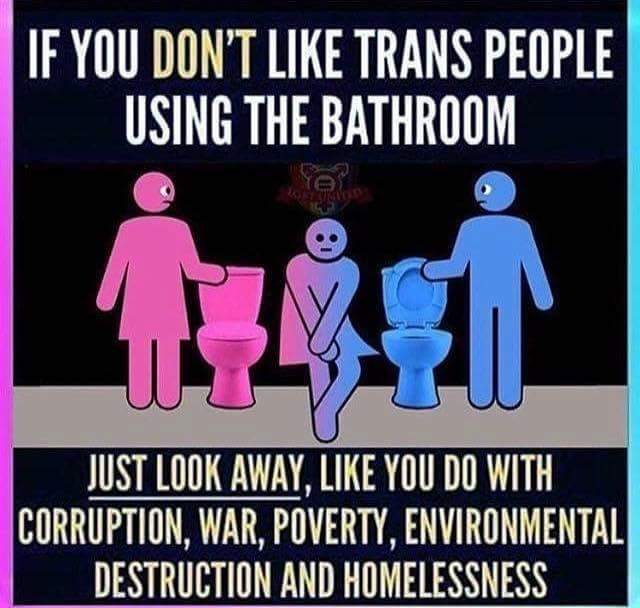
“If you don’t like trans people using the bathroom, just look away like you do with corruption, war, poverty, environmental destruction, and homelessness.”Midway through my second grade year my family moved from Colorado to Nebraska. My dad’s job in the petroleum industry meant that we moved a lot (ten elementary schools in four states). I had a number of unpleasant experiences the first week at the new school. I misunderstood several things. The teachers and other school officials simply didn’t tell me about several rules. And the other kids weren’t exactly welcoming to the new kid. when I say unwelcoming, that’s putting it mildly. The second or third day there, I was cornered in the bathroom by several boys only some of whom I recognized from my classroom. They wanted to know if I was the idiot who got in the wrong line at the lunch room. I don’t remember everything that was said to me, but they communicated as only grade school bullies can that I was a stupid sissy—a freak who didn’t belong with the real boys.
The school was far more regimented than either of the previous grade schools I had attended. There were rules and assigned times for everything. We were sent to the restroom at three specific times each day, for instance. And my new bullies singled me out for taunting and humiliation every single restroom break.
I didn’t want to explain what was happening. Previous incidents of being bullied by other kids had always resulted in my dad yelling at and beating me for being a pushover. When I attempted to stand up for myself as he’d said, I got in trouble at school, which resulted in more yelling and beating. So I couldn’t let my parents know what was happening in the bathroom. And I knew I couldn’t let the teachers know, because eventually they would inform my parents.
So I stopped going to the bathroom.
I convinced my mom to let me walk home for lunch instead of eating at the school cafeteria. I don’t remember how I convinced my parents, but I did. I used the restroom at home in the middle of the day. At school, when we were marched off at our appointed times midmorning and midafternoon, I would loiter outside the restroom until we were collected and taken out to recess. Since I was eating at home, I skipped the midday restroom trip. I changed my drinking habits. I stopped using the drinking fountain at school, because if I didn’t drink water I wouldn’t need to pee as often. And so on.
I managed to avoid going into the restroom at that school almost entirely for the rest of the time we lived in that town. I still got bullied on the playground, in the classroom, and so forth. But because teachers were always nearby, the kind of bullying that happened was slightly less horrible that what could happen when a bunch of the mean boys had you trapped in a room that the adults seemed to never enter.
When we moved to a tiny town in Wyoming next, I wasn’t able to avoid the restrooms. The town we moved to didn’t have a school, so we rode a bus to a town almost an hour’s drive away. I can still remember how scared I was at what would happen the first time I went into that school’s bathroom. That school was less regimented, so I as usually able to get by with only one trip per day, and I could time it so I wasn’t using the restroom when a lot of the other boys were. Similarly with the town back in Colorado but near the Kansas border that we moved to for the last part of my third grade. And the next town, and the next.
Even when I was in high school, I learned to avoid certain bathrooms and certain times of the day. Because yes, even in my teen years, there were guys ready and eager to demonstrate to the class faggots just how despised we were, and the boy’s restroom was a place that they could do so with impunity.
I’m not trans. I don’t pretend to speak on behalf of the trans community. But I am very familiar with that cold fear that strikes like a fist in the gut when walking into a public restroom and someone looks at you in a less than friendly way. I’m a grown ass man in my mid-fifties, and there are still moments of anxiety any time I am in a public restroom and there are other people in there with me. There are little checklists that part of my brain runs through. Am I behaving the way I’m supposed to? Is this person going to interpret something I do in the wrong way?
Heck, part of me still freaks out if a straight co-worker strikes up a conversation in the restroom at the office! Making eye contact or saying anything to the wrong guys was the surest way to get bullied when I was a kid, and it doesn’t matter how many years ago that was, the conditioned reflexes are still there—the surge of stress hormones and keying up of fight or flight response happens every time.
So these bills and court fights about where or whether trans people can use restrooms at school and other public accommodations strike close to home. I get really upset that people think keep portraying the queer people as the dangerous ones in public restrooms.
Everyone needs to eat, drink, breathe, and yes, people also need to pee from time to time. We have public restrooms for that. A number of places in our country have had laws and policies that explicitly allow people to use the restroom of the gender they identify with for many years, and there has never, not once, been an incident of a trans or otherwise queer person using those policies to assault anyone in a restroom. The only incidents of people going into a restroom to harass women have been straight anti-gay people doing it to try to make headlines in order to justify these bathroom bills or to yell at a woman who doesn’t want to sign their anti-trans petition.
Seriously.
This isn’t about privacy. It isn’t about protecting women or girls. It is about making it impossible for trans people to exist in public spaces at all. It is about punishing trans and gender non-conforming people. It is about giving bigots an excuse to harass queer people or anyone who seems maybe a little queer.
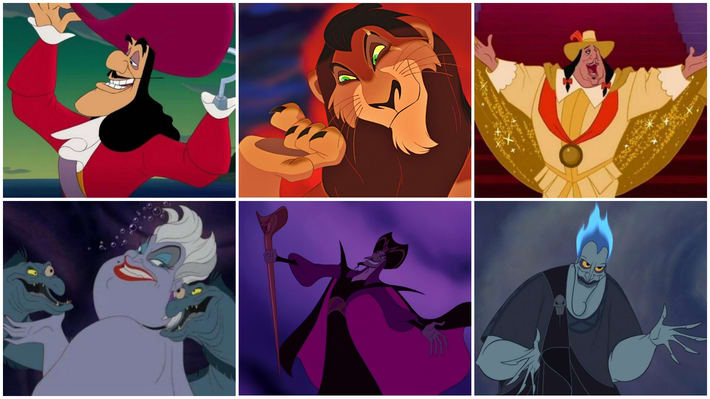
The Disney library (like that of most big studios) is already full of coded gay characters, as either villains, jokes, or both. (click to embiggen)It’s happened twice so far this year: big media company makes an announcement about how they’re adding an explicitly gay character to an upcoming release, then reveal that it’s a character that everyone outside the company already assumed was gay and has been the butt of homophobic jokes about said media property for years. The one that’s getting all of the attention right now is Disney’s announcement that in the live action remake of Beauty and the Beast it will be revealed that Le Fou is “exclusively gay.” I think they meant explicitly, but lets ignore that weird phrasing for a moment, because it gets worse. The director clarified that Le Fou is confused about his feelings for Gaston. He’s oddly attracted to this man who abuses him and uses him to do his dirty work.
Which is exactly what homophobes have been sniggering and making fag jokes about with Le Fou since Disney released the animated version of the movie. Gaston is a parody of hetero hypermasculinity, and Le Fou is is craven, clownish sidekick willing to do anything at all to get the slightest bit of attention from Gaston. Le Fou’s lack of manliness in the animated film could be rationalized as being there to throw Gaston’s exaggerated masculinity into sharp contrast. Okay. Except that is exactly what the Hollywood sissy/coded gay sidekick has always been: he’s the example of what a “real man” isn’t. His whole point it to prove that unmanly men are jokes, at best. Not real people, but punchlines.
So they are taking the implicit hateful characterization and making it an explicitly hateful characterization. Thanks, but no thanks.
Le Fou is a typical unmanly minion.There will be people who insist that we shouldn’t judge it until we see it, but they’ve given me enough information that I already know they have messed this up. The fact that they decided to announce it, for one. Just as if a person begins a statement with, “I’m not a bigot, but…” we all know that pure bigotry is going to follow, if you feel the need to announce you’re enlightened and inclusive, you don’t know what those words mean. The director has described the classic negative stereotype (confused, obsessed with a straight man) is what they’re going for. Worse, they’ve referred to it more than once as a moment. Just a moment. You know why it’s a moment? Because they are already making plans to edit that moment out of the international release, because they knew as soon as word got out that countries would start threatening to ban the film. Heck, Alabama is already up in arms about it!
That means that it’s a tacked on joke. It’s not part of the plot. It’s not a meaningful part of Le Fou’s characterization.
Even if they do something with it. Let’s say that at the end of the film they have a moment that implies maybe Gaston is ready to return his feelings? What message does that send? It tells us that hating women (Gaston’s exaggerated masculinity includes a lot of misogyny in the animated feature, just sayin’) or being rejected by women is what makes men gay. And, oh, isn’t that great inclusion?
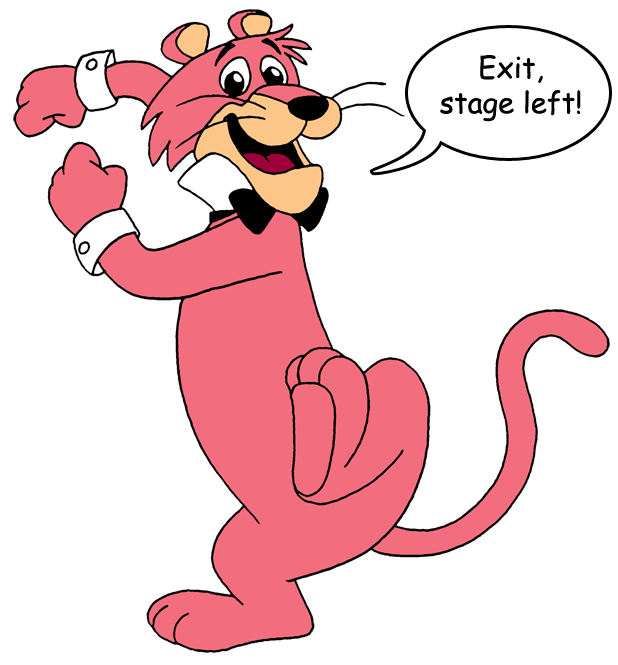
He was a pink lion without a mane wearing a string tie and cufflinks (despite not otherwise having clothes) whose dialog was littered with theatre jargon, delivered in a fey/swishy voice. He was a classic sassy gay character already!I mentioned that the Beauty and the Beast revelation was the second time this has happened this year. Previously it was Snagglepuss. Yes, DC Comics/Warner Brothers announced that the Hanna-Barbera cartoon character, Snagglepuss, was going to be reimagined in a new comic book series as “a gay Southern Gothic playwright.” Literally my reaction on twitter a nanosecond after I saw the first person retweeting the headline was, “reimagined? But that’s what he already was!”
Snagglepuss was a version of the sassy gay friend from the beginning. He was protagonist of his cartoon series, which wasn’t typical for the sassy gay friend (who is more typically a sidekick to one of the lead characters), but Snagglepuss broke the fourth wall constantly, addressing the viewer with his arch asides and sardonic observations. He was the viewer’s sassy gay friend, in other words. And he was cheerful and optimistic and always trying (but usually failing) to improve his life in some way. Despite the many setbacks, he remained cheerful and upbeat.
So the DC Comic (besides being drawn by an artist who has apparently never seen an athropomorphic character before—seriously, go hit that link above and tell me if that isn’t the worst comic book artwork you’ve ever seen!) takes the happy, upbeat fey lion and turns him into a bitter old queen. Again, thanks but, no thanks!
Coded queer characters have been appearing in pop culture for decades. Their portrayal as comic relief or as villains (and sometimes both) sent a clear message that they were not normal people. They are never the heroes. They can be loathed as villains, or tolerated and laughed at as sidekicks, but they will be lonely and unloved in either case. Neither of these supposedly inclusive announcements changes that homophobic message. It’s not, contrary to what certain evangelical hatemongers are saying, indoctrinating kids to be accepting of gays. It’s instead reinforcing the same old bigotry: we don’t matter, we are jokes, we are never the heroes, we are never loved.
Just another means of erasing the truth of our existence. No thanks!







 Font Folly