“Keep Calm and Achieve Your Goals”When I set my goals for this year, I pledged to do monthly updates. Mostly because I’ve done a better job achieving those goals during the years that I did the updates. So, how did I do in March?
My specific tasks for March were:
At this point it’s time to just pack everything, so pack! We’ve been packing. There are boxes stacked everywhere.
Get the new living situation sorted. We’ve contacted a number of property managers, but haven’t gotten a place nailed down.
Make reasonable progress on writing/editing knowing that the above is going to eat up most of our available time.I got a small amount done, but not much.
Disconnect from the internet at least one night each week. I managed to do this every week!
Write at least two blog posts about things I like. I gave myself a lower number for this month because I figured with the packing and trying to find a new place I wouldn’t have as much time to write or blog. I still managed to beat this number by writing four posts about things I like!
My overall goals for the year, where I’m trying to follow the idea of replacing bad habits with better ones:
Don’t get mad, get busy. My tasks are: write about about things I love; listen to music and audiobooks more and podcasts less; spend at least half of my lunch break writing; set specific monthly writing/editing goals in each check-in; write at least one blog post a month about organizations we can donate to that are fighting the good fight.
I did fairly well on this one.
Reduce, pack, and prioritize. We now officially know that we have to find a new place to live this year. We have lots of stuff to go through and decide what to discard and what to pack.
Packing, hauling, getting rid of stuff continued apace. My hubby found a great charity to ship a lot of our books to. That helps me feel better about getting rid of them.
Take care of us. My initial tasks are related to some specific medical things that aren’t urgent, but need to be dealt with. I am going to remain vague on the details of this one.
My husband had his surgery and I tried to play nurse. He’s recovering, and it’s a great relief to get this taken care of before the move!
Submit and publish. Initial task was to organize how I’m going to find calls for submission and set reasonable targets for the novel revision/finalization.
I worked on three submissions. Got one done. I’m frankly amazed at the amount of progress I did make this time given everything else.
Finally, my specific tasks for April are:
Pack and move!
Pack and move.
Squeeze some writing time in somehow.
Remember to have fun at NorWesCon (whether we attend the whole weekend or not).
Write at least two blog posts about things I like.
“Sir, I have had enough of your shenanigans, so I bid you good day. I said good day to you sir!”Whenever Aaron Schock is in the news again, hits on one particular old post about him suddenly spike on my site. This happened Wednesday, which sent me looking for the story: Ex-Rep. Aaron Schock Alleges FBI Had His Staffer Wear A Wire, Steal Docs. Schock is on trial for all sorts of financial shenanigans while he was in office (Conning some constituents into paying over $7000 into a fake account allegedly for travel expenses which he actually billed to tax payers, $140,000 in false mileage claims, a $5,000 chandelier for his office also billed to the tax payers, et cetera), which had driven him to resign. I’ve described Schock before as badly-closeted because he’s a Republican with a perfect anti-gay record who not only lived with his boyfriend while he was a congressman, but took the boyfriend on official trips, where even though said boyfriend was listed as a staff photographer, he never took any photos and Schock but rather posed at Schock’s side along with the other congressmen and their wives, at dinner sat beside Schock as the other spouses did, conveniently had an adjoining hotel room et cetera, et cetera. Never mind the times he’s been photographed or videoed in gay bars, or the time he led reporters and a camera crew around a gay neighborhood and kept (on camera) getting destracted with his gaze lingering on hunky shirtless men as they walked by.
It’s kind of pathetic.
I keep half expecting Schock to eventually come out and try to claim that the pressure of the closet unbalanced his mental health and all of his wrongdoing was the result. Or maybe just to claim that the FBI’s investigation into his financial wrongdoings was all some sort of homophobic plot. Which, given that Schock on at least one occasion gave a speech in the House of Representatives chambers in which he insisted that it should be legal for employers to fire people just because they think they might be gay, landlords to evict or refuse to rent to people they suspect are gay, and so on.
Once he’s convicted I hope he gets a long sentence.
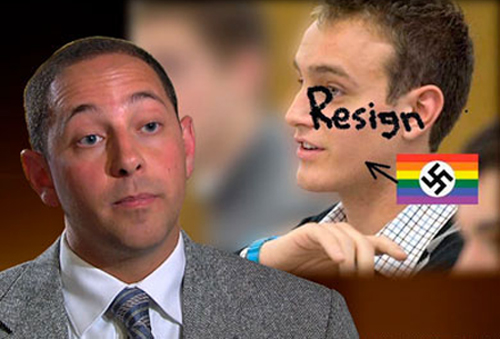
He’s not the only homophobe formerly employed by the government in the news this week: Former Michigan Asst AG Andrew Shirvell Loses Law License for Anti-Gay Attack on UM Student Chris Armstrong. Shirvell’s story is weird. Back in 2010 Chris Armstrong, was elected student body president at the University of Michigan. Armstrong was the first openly-gay person elected to that office. Shirvell, meanwhile, worked as an assistant attorney general in Michigan. The minute Shirvell saw a news story about Armstrong’s election, he logged onto Facebook and created a page called Chris Armstrong Watch and posted a bunch of barely coherent anti-gay rants. Facebook suspended the page as a violation of community guidelines, so Shirvell created is one blog (which for a long time had as a banner a picture of Armstrong with an image of a gay pride flag with a swastika superimposed on it and the word RESIGN scrawled across Armstrong’s face).
But it wasn’t just hundreds of anti-gay blog posts. Shirvell spent nearly every night parked in his car across the street from a house where Armstrong and several other students lived, taking pictures of everyone who came in and out of the house. He posted the pictures (and when he could the names) of each one, writing about what sorts of lewd sexual depravities he assumed had to be going on inside the house. On one occasion when Armstrong and his housemates hosted a party, Shirvell drove around the block for hours, taking pictures and trying to get proof that they were serving underaged people alcohol. We know he drove around the block for hours because a) he blogged about it extensively, b) he called the police at 1:30 and tried to get the partiers arrested for disturbing the peace and in his official statement to the police told them he had been driving around the block for hours, and c) several of the neighbors had called in the suspicious car circling the neighborhood. And just to be clear, Shirvell didn’t live nearby!
Armstrong eventually sued Shirvell for harassment, stalking, and related things asking for legal fees and $25,000 in damages. The jury awarded $4.5million in damages. On Shirvell’s appeal, that judgement was reduced to $3.5million, but otherwise all findings of the jury were upheld by the appeals court. The U.S. Supreme Court refused to hear Shirvell’s appeals. It’s unlikely that Armstrong will ever get the money, but the principle at least has been upheld that a government employee can’t harass a queer kid (Armstrong was 21 years old for most of this, but he was a college student, for goodness sake!).
No one has ever been able to get a reasonable explanation from Shirvell for why Armstrong of all people became the target of his fierce and vitriolic obsession. Even under oath on trial (where acting as his own lawyer, he questioned himself for two hours, and then under cross-examination was forced to admit everything he had just testified about Armstrong and the situation was a lie)! Sure, Shirvell was a University of Michigan alumnus (he graduated 8 years before Armstrong became student body president), so you can argue that his initial interest was simply because he followed news about his former school, but the obsessive behavior against someone he otherwise didn’t know was really over-the-top.
The reason he can’t explain himself is that that there isn’t a rational explanation. There is, sadly, a very understandable irrational one. Shirvell is a 36-year-old man who has never been married and never been known to date a woman. In video appearances he doesn’t merely ping a lot of people’s gaydar, it’s like a mega-super-gay four-alarm alert. Shirvell is a self-loathing closet case. And I’m hardly the first person to realize this.
Shirvell had been involved in a few public anti-gay activities before the Armstrong case (my favorite was the campaign to get a local pizza parlor to stop putting a rainbow flag in its window during Pride Month), and his rants then were a bit crazy. He appears to have been raised in a conservative Catholic family (he attended private Catholic schools for his primary grades and high school, and got his jurisdoctorate at a Catholic law school—in fact the University of Michigan is the only public school he ever attended). In interviews Shirvell comes across as not just mildly effeminate, but very prissy. I have no doubt that he was bullied throughout his childhood. So Shirvell has spent his entire life desperately trying to prove to people that he’s straight. He hid himself and denied his feelings and subjected himself to the torture of the closet his entire life. He’s likely never had even a clandestine romantic relationship!
…And then he sees that news story about an openly gay student being elected student president at his alma mater. He sees the smiling pictures of a young man who isn’t hiding those feelings, isn’t suffering alone in the closet, isn’t loathing himself. Shirvell sees that this good-looking, happy-looking young queer man isn’t merely being tolerated by his family and fellow students, but he’s well-liked and even celebrated! No wonder Shirvell over-reacted. Shirvell has been a powder keg of self-hatred and insanity just waiting to explode. So far he’s destroyed his own reputation, gotten himself saddled with an impossible financial obligation, and now even lost his law license because his actions weren’t just creepy and crazy, they constituted legal misconduct.
(click to embiggen)Some would argue we should feel sorry for Andrew Shirvell. But honestly, the number of times during the trial that Armstrong said if Shirvell would just apologize he would drop the case represent only a fraction of the opportunities that Shirvell had to get off this particular crazy train. At this point he has no one to blame but himself.
It’s Friday! We’re at the very end of March. Wow. The year is whizzing by and we’re behind on everything!
We’re still packing like crazy and looking for a new place to live. My husband is recovering from his surgery. The doctor is happy with how things are going. My hubby is getting a bit impatient. I’m not sure I’m doing a good job of convincing him not to push himself too hard. Camp Nanowrimo starts tomorrow and usually I’m the one nagging friends to do it, but I don’t think I’ll have much time for writing this next month.
Anyway, here are the links I found interesting this week, sorted into categories. You will notice it is a shorter collection than usual.
“Bigotry wrapped in prayer is still bigotry”As the legal battle over marriage equality moved its way toward the Supreme Court a few years ago, the anti-gay forces found their old legal arguments being debunked and thoroughly rejected by all but the most arch-conservative of judges, so that by the end they had fallen on a convoluted and truly weird argument. Marriage, they said, had to legally remain applicable solely to straight couples because without the legal institution of marriage forcing straight people who accidentally become pregnant raising their kids together, all children would be deprived the benefits of two-parent families. Basically, they asserted that straight, traditional-minding humans are so terrible that they are incapable of being responsible about reproduction without the inconvenience and expense of divorce to enforce responsibility.
There are many, many problems with the argument (not the least of which is that humans have been having children both in and out of wedlock for as long as marriage has existed, and unmarried parents are perfectly capable of being responsible child-rearers, while married parents are just as capable of being irresponsible). The only way their argument could even begin to make sense was if the laws were changed so that any time unmarried humans get pregnant that they are forced to marry, and if divorce became completely unavailable. But even then it would have big logical holes. One of those being that allowing non-straight people to marry didn’t take marriage away from straights.
This is hardly the only time that fundamentalist religionists have argued that some people must be oppressed because other people are terrible and incapable of self-control. This is why in some countries it is illegal for women to go out in public without clothing that conceals their faces, et cetera. Men, the reasoning goes, are incapable of refraining from randomly raping women if they happen to get a glimpse of a woman’s cheeks or hair, apparently. Similarly, dress codes in schools and the like are are built around restricting girls (seriously, go look at them: the codes for girls are complicated and specific about concealing this and that body part with notes about how far above or below the knee skirts must reach and so forth, while the boys’ rules almost always boil down to: wear clean, mostly untorn clothes) because boys are deemed incapable of refraining from sexually assaulting a girl if they happen to get a glimpse of a girl’s shoulder or knee.
In other words, women and girls must be tightly controlled and restricted because men and boys are terrible people. This is also the source of a lot of the victim-blaming that happens around rape: it’s not the rapist’s fault if the woman was out in public alone, or dressed “that way,” or drunk somewhere, et cetera, et cetera.
This logic shows up in a lot of other policies and practices, and has come to light this week because (among other rightwingers) our Vice President believes it would be immoral to have any female friends, which is also why there are virtually never any women in any significant staff positions under the veep now, nor in any appointed state positions when he was governor and so on. Having women as managers and directors and so forth would necessitate occasionally having one-on-one meetings. There’s also the fact that governors and similar executives are most likely to appoint and promote people they develop friendly relationships with. If a boss believes it’s immoral to be friends with a women, guess what that means about women’s chances for advancement?
This assumption that people who might potentially be attracted to each other can never be in close proximity without supervision is why the churches I was raised in insisted on separating Sunday School classes and Bible studies and similar activities by gender. And it’s the reason that people from such churches get so freaked out about being around gay people, particularly in locker rooms and bathrooms. That meme that defines homophobia as “being afraid gay men will treat you the way you treat women” isn’t a joke.
It’s why fundamentalist communities that claim to be accepting while “disagreeing with the lifestyle” discourage friendships between straight guys and gay men and straight women and lesbians. When you combine that with the fundamentalist belief that sexual orientation isn’t an inherent trait, that means that such communities also discourage friendships between opposite sex straight people and queers. And it’s all subtle and usually not even talked about. But it manifests in lots of ways. In my 20s, for instance (when I still hadn’t come out), I learned that throughout my teen years I had been excluded from some activities and some positions within my church and the evangelical teen choir I was in for all that time because everyone suspected I was gay. These were adults making this decision about a kid without ever talking to me about it. And that’s on top of the bullying and related activities from the kids my own age.
It’s another layer of cruelty. Just like the religious people who claim that they welcome queer people into their church so long as they are celibate, never date, et cetera. You’re welcome as long as you’re lonely with no love in your life.
But all of it comes back to that idea: the reason rightwing leaders (who are always men for supposedly theological reasons) assume that gay men can’t refrain from assaulting other men is because they believe that they, themselves, are incapable of refraining from jumping the bones of anyone they are sexually attracted to if given half a chance. So we can’t use public bathrooms and have to stay out of locker rooms and not work in jobs where we might be around people unsupervised, can’t live in their neighborhoods, et cetera, et cetera, et cetera because they are terrible.
It is beyond stupid. If they’re so bad, they are the ones who should resign and go live like hermits, right?
“Not every book is for every reader.”—Meg White ClaytonEarlier in the week I wrote about responding to reviews (short version: don’t be a jerk) and dealing with diversity critiques (stop, listen, learn), so I might as well talk about the process of deciding whether and how to incorporate feedback into your story in a more general sense.
Most advice I’ve read about using feedback as a guide for revision assumes that every writer feels compelled to immediately change their story to comply with every suggestion, and that most of us need pep talks to remember the story is ours. There’s nothing wrong with such pep talks, but my experience has been that many writers (myself included) are more inclined to dismiss most advice, critique, and suggestions unless such feedback comes from someone we know and trust.
Be open. Don’t dismiss feedback out of hand, and resist the urge to argue or explain.
Yes, if you are attending a writing workshop taught by an author you have long admired, and bonding with your fellow students, you’re likely to take every single piece of advice to heart, even the contradictory ones, and tie yourself in knots trying to rewrite your story to address every issue. Similarly, if you have a critique group you trust, you may find yourself in a similar situation after they go over a story. In that circumstance it is important to remember the Neil Gaiman quote: “Remember: when people tell you something’s wrong or doesn’t work for them, they are almost always right. When they tell you exactly what they think is wrong and how to fix it, they are almost always wrong.”
People are making suggestions because the story isn’t working for them. Some of the suggestions are contradictory because the people offering them are misidentifying the root cause. Before discarding contradictory advice, see if you can find an intersection. For instance, one time I received feedback on a draft novel from three people whose opinion I trust. One was quite insistent that I needed to add some dream sequences or some other sort of mystical experience to more explicitly explain why the reclusive shrine-guardian was compelled to undertake a quest to save the world. Another thought I should remove several characters (including the shrine guardian) that (in their opinion) weren’t contributing to the main plot, because there were just too many things going on, and clearly the center of the action was the cursed thief. The third person wanted me to split off the shape-shifting fortuneteller (and a few other characters) into their own book.
The intersection of those comments was a fundamental issue all three readers were missing: the novel doesn’t have one protagonist, it has three protagonists whose fates are intertwined and that all come together in the end. Now the reason these readers were missing that detail was not because they were dense or didn’t appreciate the story; they were missing it because I as the author hadn’t made it clear. It was not working in the story. I needed to fix it, but the fix did not involve removing characters, or adding dream sequences, or splitting the book in two. The fix also didn’t require massive rewrites. The fix required dropping a few scenes that weren’t carrying their weight, replacing them with some that did more, and making tweaks to several others.
Look for the unobvious connection. Just because advice seems contradictory doesn’t mean it is wrong.
Sometimes the feedback you get appears to come from a different planet. I’ve mentioned before the reader who complained about my happy endings. The story that was the straw that broke the camel’s back for that reader was a tale which ends with two of the main characters saying good-bye as one is going to escort the corpses of several murder victims on their journey to their families. The story had featured some graphic violence long before getting to that scene. While the killer had been caught and was going to be facing justice, and some of the characters had survived, given how many didn’t and where I set the final scene (literally next to some coffins) I had trouble thinking of it as a happy ending.
I’m a person who fundamentally believes in hope. I’m never going to write stories that will appeal to the sort of reader who insists that happy endings never happen for anyone. That particular story had already been published, so it was a bit late to revise it. But I still found the feedback worthwhile. It was worth asking myself if I had written something earlier in the story that had led this reader—who was really looking to read something grim and dark—to think that that’s what this one was going to be. Did I raise an expectation that I failed to deliver?
Maybe I did. A lesson I took away from that was to remember to look for those unintended expectations. Everyone has heard the famous advice about the gun on the mantlepiece: if you show the reader a gun on the scene, the gun needs to figure in the plot before the story is over. The advice doesn’t just refer to guns, it means that when you draw the reader’s attention to things, people, or events that seem to signify certain dramatic possibilities, that something needs to come of it. That isn’t to say that I must write stories that meet the reader’s expectations, just to make certain that I don’t mislead the reader midway through the story. Yeah, misdirection is okay as long as you play fair (that’s a topic for an entire blog post on its own), and you don’t want to telegraph the ending to the reader, but don’t play bait-and-switch.
Don’t blame the messenger. Maybe the person giving you the weird sounding feedback is absolutely the only being in the universe who will misread your story this way, but don’t forget that where there’s smoke, there’s usually fire.
I’ve gotten feedback that left me feeling confused and conflicted about whether my story is worth telling. That might be a good time to follow the advice I read in a magazine article decades ago (and have long forgotten who wrote): sit down and write out an explanation of what is wrong with each part of the critique to don’t like. Do not ever send this to the person, repeat any of it to the person, or post it. Instead, set your reply and this story aside and go work on something else. Later, when you can look at this story objectively, pull out your explanation and go through your story. Is everything you say in the explanation in the story? Is it clear in the story? Chances are that some things you have assumed the reader will infer aren’t as obvious as you though. Sometimes you’ll discover that you never actually mentioned one very important fact for your plot. You thought you did, but it isn’t actually there. Now destroy that explanation/argument you wrote, and rewrite your story.
Argue with yourself, not the reader. Figure out what is missing, and add it in.
Many times I’ve written scenes that never wind up in the story. Sometimes I write them because I’m not certain what to do next, then later I realize that scene isn’t necessary. Sometimes I write them because I’m trying to figure out something that I plan to have happened in the past or off screen, but I need to be able to have characters who lived through the events react accordingly later. And sometimes I write a scene because I received suggestions or critiques that I either wasn’t certain I agreed with, or was quite certain I disagreed with but it kept coming up from multiple people. So I tried writing the scene that followed the suggestion. Usually what happened is not that the new scene went into my story and replaced a bunch of other stuff, but rather, in the course of writing the scene, I figured out something else about the story. Just trying to write it the way other people wanted it to go clarified where the story actually needed to go.
Give it a try. Every writer writes stuff that eventually we decide not to use or to change significantly. Don’t be afraid to spend some time giving alternatives a go.
Trust the story. Recognize that you will stumble and sometimes fall. It doesn’t matter how many times you do that, if you keep getting back up and get moving. So stop thinking about the story, and go write it!
“Listening to hear not listening to speak.”Yesterday I posted about responding to reviews and how generally you shouldn’t ever respond to a negative review with more than “I’m sorry you didn’t enjoy it.” I also had some advice about responding to positive reviews and questions about your book or story. But that was about responding to reviews of your work from a quality and plot context. But what do you do when someone says, for instance, they feel a particular character perpetuates negative stereotypes about a particular ethnic group (or a sexual minority, or a specific culture, or a specific gender, or a specific sexual minority, and so on)? First and foremost, do not, I repeat, do not argue with the person.
It’s the most natural thing to do, because you know you don’t have a bigoted bone in your body, so of course you aren’t racist/sexist/homophobic/anti-semetic or whatever the person has just said. So of course you feel the need to defend yourself. But you’re wrong. That’s because what you think they mean is that you are a horrible bigot, but that isn’t what’s going on here. What the person is actually trying to communicate is this: “I felt devalued or erased by some of the content of your story.” Nothing you say can change the feelings they had when they read your book. So the first sense in which it is wrong to argue is that you see this as an attack on you, whereas they are explaining how attacks on them that society has been subjecting them to their entire lives are being unintentionally aided and abetted by your story.
The other sense in which you are wrong is the belief that you don’t have any bigotry at all. Because all of us do. It is impossible to grow up in human society without absorbing a lot of prejudice. Including prejudice aimed at ourselves. Queer people have to overcome a lot of internalized homophobia just to come out of the closet. Women learn and internalize misogyny and sexism. Ethnic minorities learn and internal racial prejudice, and so forth. So it doesn’t matter how much you feel you aren’t bigoted, there is going to be some unconscious prejudices boiling around inside. And problematic content isn’t usually about overt bigotry, but is often more subtle.
So, when someone confronts you about any unintentional bigotry in your work, you need to do three things:
Stop
Listen
Learn
It is tempting, even if you stop yourself from getting defensive, to respond to this sort of criticism as just another kind of negative review and say, “I’m sorry you didn’t enjoy it” then try to change the subject. But this is a different category of discourse entirely. And quite often the people who bring this criticism to you did enjoy most of your story. That’s why they’re taking the time to tell you about this problem. So a better response would be, “I’m sorry the book disappointed you in this way.” If you can say that sincerely, you might also say that you didn’t intend to do that, but don’t let it become an attempt to prove they’re wrong. Better to say, “I’ll try to do better.”
If the person wants to explain to you what it was in your work that made them feel this way, listen. Don’t argue, listen. If the person doesn’t want to talk in more detail about it, that’s all right. It doesn’t mean that they’re wrong or that you’ve someone won the argument. As uncomfortable as it is for you to hear that something you wrote made someone feel de-valued, it is just as uncomfortable (and riskier) for them to bring it up. Dealing with every day discrimination and microagressions means that members of marginalized communities have already had to defend themselves and explain how they are hurt by discrimination thousands of times. And they don’t have the energy to try to educate you in depth on the issue.
Which is where we get to the learning. Once it has been brought to your attention that some readers feel this way (which you never intended) while reading your work, it’s your job to decide how to do better. I love quoting the advice “Remember: when people tell you something’s wrong or doesn’t work for them, they are almost always right.” That’s part of a Neil Gaiman quote. One of the truths Gaiman is getting at is that if one reader feels a particular way about your work, many other readers will, too. The rest of Neil’s quote talks about fixing problems, and fixing it is the writer’s responsibility, not the reader’s. They’ve told you how it made them feel. If you don’t want some of your audience feeling that way, you have to decide how you’re going to fix that going forward.
I want to emphasize that I know this process isn’t easy. The first time someone told me a story I wrote had sexist bits in it I became extremely defensive and reacted like a complete jerk. I was wrong to do that. Fortunately, I also spent some time, after I acted like a jerk, re-reading the story and trying to see it from the reader’s point of view.
And she was right. There were several little things I had done just because that’s what women characters do in that situation in millions of books and television episodes and movies that we’ve all watched. And it was a simple matter to make some very minor changes to get rid of them. I didn’t become suddenly a sexism-free writer after that. I found myself a couple years later being asked by someone why after six chapters into a book I was writing, not one single female character had appeared or had a line of dialog—in a story that was set in a ordinary public school in a small modern American city. There were a number of women and girls in my imaginary world, some of whom were going to figure in the plot later, but for whatever reason, I had omitted them in the opening chapters. This, by the way, was the incident I’ve mentioned before that prompted me to re-read a whole bunch of my work applying the Bechdel–Wallace test1, and finding myself very embarrassed at how many of my stories failed it.
And even though since then, I have tried to educate myself on it, and made several changes to the way I tell some stories, I still find problems. I was editing a scene in one of my currently still-in-progress novels not that long ago when I happened upon a line of dialog that I barely remembered writing, and it was a very clichéd and sexist line. I changed it. Now not only is it not sexist, I think it’s funnier.
Again, not every such criticism is going to be spot-on. A few years ago I got a long angry letter about how a story I wrote perpetrated hate against religious people. The rant included accusations that I had been “brainwashed by the femi-nazis” so I wasn’t inclined to take it completely to heart. I asked some religious acquaintances to read the story (without mentioning the negative review) to give me feedback on the portrayal of religion and the various religious people in the story. Not that if they disagreed that proved the reviewer wrong, it was just two more perspectives from people who I trusted.
I ultimately had to make the decision about whether the story perpetuated anti-religious bigotry.
That’s all we can do: try to learn, try to see things from other perspectives, and find people we trust to check our conclusions from time to time. Members of particular marginalized groups can disagree. A few years back I and another gay male sci fi fan and writer got into a really long discussion about whether something I had written perpetuated negative stereotypes about gay men3. We never came to a complete meeting of minds on the topic.
1. Based on a 1985 comic strip from the series Dykes to Watch For by Allison Bechdel, in which one woman asks another if she wants to go to the movie, and the second woman explains that she has a rule, she will only go to a movie if “…one, it has at least two women in it who, two, talk to each other about something other than a man.” Then she confesses that the last movie she’d been able to go to was Alien, because there is one scene where the two women on the spaceship crew talk about the monster. But only the one. Bechdel herself expressed some discomfort with people naming the test after her, since she said she got the idea for the rule from a friend, Liz Wallace, and to the writings of Virginia Woolf.2
2. If a movie or book passes the test, that doesn’t prove that said work isn’t sexist. All the Bechdel-Wallace test is assess whether women appear in the work to specific degree. That fact that so many works fail to achieve even this level of inclusion is just sad.
3. Remember, it is not a valid defense against an observation of bigotry to be a member of the marginalized group in question, any more than claiming to have a friend in the group absolves you of all culpability. Internalized homophobia can manifest in even the most woke queer person.
“Why do I do this every Sunday? Even the book reviews seem to be the same as last week’s. Different books, same reviews.” —John OsborneI’ve been seeing comments on social media about the wrong ways to respond to a negative review of your book—specifically admonitions against attacking, stalking, and bullying the person who gives you a negative review. Being a writer (and sometimes publisher) myself, I follow a lot of writers on social media, so bits of advice like this go by a lot. But this particular one seemed specific enough that I went on a Google search to see who had done what ridiculous thing now. I couldn’t find any such incident newer than 2015, so maybe this is just a case of old news cycling through everyone’s stream again.
There have been a few really notorious cases of this type. There’s the author who seemed to become obsessed by one person who had given lots of negative reviews online to a lot of books. The author tracked down the reader in real life, going to rather absurd lengths to document all the things the reader had said in her various personal profiles on different social which appeared to be false or exaggerations. It culminated in the author going to the reader’s home and confronting her. That’s not only not cool, it’s stalking under the legal definition in most states in the U.S., and could be prosecutable.
Another author tried to sue Amazon and a reviewer for libel.
Then there’s the various Anne Rice incidents: posting a link to a bad review on a book blog on her Facebook page and encouraging 740,000 plus fans to harass the reviewer in 2013; writing a scathing 1100 reply to a reader review on Amazon in 2004; issuing a petition to try to force Amazon to reveal the real names (and contact information) of customer reviewers; trying to get bad reviews reclassifyed as cyberbulling in 2015; et cetera.
I’ve seen some really good articles and at least one of those humorous flow charts about how to respond to negative reviews. And those are great. But negative reviews are only a subset of the problem. And I realized that when I shared and commented on one of the recent posts about this, that I was repeating advice that I’d received from some of my music directors back in the day. I was in orchestra, band, choir, and a small men’s ensemble in school, and then choir and small ensemble in college, and later sang in a gay & lesbian community chorus. I’ve had a lot of music directors, but it was always the choral directors who gave advice about responding to negative comments and other sorts of reviews one might receive to a concert. And what they said can apply to any creative work, so here we go:
When someone tells you they disliked your performance/your story/et cetera: Your response should always be limited to a simple and sincere, “I’m sorry you didn’t enjoy it.” As one choral director said, “Don’t give in to the temptation to try to convince the person that the concert was great. Don’t try to educate them about the significance of the piece, the history of the composer, and especially about how much hard work you put in. Just say, ‘I’m sorry you didn’t enjoy it’ and move on.” Doing anything else just makes people feel angry and defensive.
Personally, I think this response is best deployed with someone contacts you directly or tells you in person that they didn’t like your story/book/painting/what-have-you. In the case of published reviews or reviews posted online, the best response to negative reviews is to pretend you didn’t see them. Maybe talk to a close friend about any particularly badly phrased review, if you need to vent a bit, but don’t respond online or publicly in any way. Don’t send the reviewer private messages. Don’t post links to the negative review.
Arguing with someone is not going to change how they feel about it. And it may well convert them from someone who merely didn’t like this story, to someone who has a grudge and goes out of their way to bad mouth all of your other work.
Negative reviews aren’t the only kind that can be problematic:
When someone tells you they really liked it: Say, “Thank you. I’m so happy you enjoyed it.” This may really seem like a no-brainer, but I can’t count the number of times that a musician, artist, or writer I’ve known has responded to positive comments by saying something like, “But we did it wrong!” or “I hated it! Look at all of these mistakes I made!”
One choral director put it really well: “What you just said to that person is, ‘You have really bad taste in music or are really clueless because you didn’t notice the mistake.’ It’s an insult. Even if you are convinced that they are merely being polite, just say ‘Thank you. I’m glad you liked it.’”
It’s really easy when I look a something I wrote to see all the flaws. Particularly if it is something I wrote a while ago. Even if the story has prompted more than one reader to contact me to tell me they were so enthralled by my tale that they missed their train stop or their cue or stayed up way too late reading it. When I look at the story, I just think how the characterization of one of the supporting characters was inconsistent, or that I could have done a more subtle job revealing that clue, or why did I include the lyrics of the song one of my suspects was performing in that pivotal scene?
But those readers enjoyed it. They didn’t have to send me a comment. I might have never known they had even seen that story if they hadn’t gone out of their way to do so. They liked it. And that’s why I wrote it! I wanted someone to read it and like it! I shouldn’t try to talk a fan of my work into hating.
We’re socialized to be self-effacing. We’re taught that being overly proud of our work means we’re an arrogant jerk. Some of us have self-esteem issues and sincerely have trouble believing that people actually like our work. Don’t give in to either of those tendencies. Just say, ‘Thank you.’ Bank the compliment, and remember it the next time you read a negative review.
When someone asks questions about it: This one is tricky. We’re all socialized to answer questions when asked. Some of us are a bit too happy to expound at length if someone shows the slightest interest it our work.
It’s okay to answer questions. As one director put it, “It’s understandable that someone might ask why we performed a classical piece in German for an English-speaking audience, for instance. It’s perfectly reasonable to answer the question. Just make sure you simply answer it, and don’t try to pick a fight. Don’t assume that they are trying to start an argument. Tell them that the piece was originally written in German, and that you think music is beautiful in any language.” Questions about minor things in the plot of your book or character motivations which seem to be genuine confusion on the part of the reader can be answered in person or direct conversations as long as you don’t get defensive. Similarly to factual question about the publishing process—but keep it as simple as possible.
When it comes to published/online reviews as opposed to someone contacting you directly, don’t get drawn into an argument. Straightforward questions with a simple, factual answer are fine. For instance, I once saw in a review of a story that was part of a continuing series but had been picked up for reprint in another publication the comment: “I liked the story well enough, but wish I knew more about these characters.” It was simple to post a comment: “For more stories set in this universe using these characters, check out [Link to a place to buy them].” I said absolutely nothing else. Just an answer to the one question that had a simple answer.
Sometimes a person asking a question is looking to start an argument. And sometimes it’s quite obvious that they’re doing it. I once got a question about one story along the lines of, “Why did you have to give us a happy ending, again? Your stories really draw me in and get me interested in all the characters, but then you have yet another unrealistic ending. In real life things never work out like that!” If someone is doing this sort of back-handed compliment disguised as a question, you need to treat it as a negative review. “I told the story as I saw it. I’m sorry you didn’t enjoy it.”
Other questions may be less obviously a back-handed compliment, but still not have a simple factual answer, such as, “I don’t understand why the author made such an unlikeable character the hero of this story” or “Why are there so many sub-plots in this book? Why can’t we just stick to one character?” or “Why did the main character spend all that time moping and talking? He should have kicked some butt and showed them who’s boss!” There is no answer you can give to this person that will make them happy. You had your reasons for writing the story, they wanted to be reading a different story. Again, you need to treat these sorts of questions the same as a negative review. If it’s in a published or on-line review, don’t respond. If a reader is asking you directly, say as simply and sincerely as possible, “I’m sorry you didn’t enjoy it.”
You can elaborate a little bit. “That isn’t the story I was telling” or “This was the best way I could think of to tell this particular story with these characters” or something like that. It is so tempting to try to convince the person that what you did was the right thing
(Click to embiggen)Finally, remember that sometimes the reason you got a bad review has nothing to do with you or your story. Mark Kloos recently shared on twitter: “Don’t fret about your Amazon reviews. I just got a three-star review because my novel isn’t a 36-count package of Jimmy Dean sausages.” And he included a screen capture of the review. While technically this violates the negative review advice above, it’s clear that the reviewer wasn’t actually reviewing the book, and Kloos didn’t ask people to go harass the reviewer.
That example leads to the final piece of advice from several of my choral directors: “Once the concert is sung the only thing you can do is be proud of the parts that went well, laugh about the parts that didn’t, and start practicing for the next performance.”
If you like his work and want to support him, he’s got several books collecting earlier strips, mugs, and other fun things for sale!
Some of the comics I’ve previously recommended: Some of these have stopped publishing new episodes. Some have been on hiatus for a while. I’ve culled from the list those that have gone away entirely.
“Deer Me,” by Sheryl Schopfer tells the tales from the lives of three friends (and former roommates) who couldn’t be more dissimilar while being surprisingly compatible. If you enjoy Deer Me, you can support the artist by going to her Patreon Page!
Scurry by Mac Smith is the story of a colony of mice trying to survive a long, strange winter in a world where humans have mysteriously vanished, and food is becoming ever more scarce.
And I love this impish girl thief with a tail and her reluctant undead sorcerer/bodyguard: “Unsounded,” by Ashley Cope.
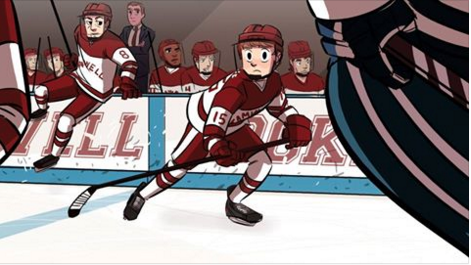
Check, Please! by Ngozi Ukazu is the story of Eric “Bitty” Bittle, a former junior figure skating champion from a southern state who is attending fictitious Samwell College in Massachusetts, where he plays on the men’s hockey team. Bitty is the smallest guy on the team, and in the early comics is dealing with a phobia of being body-checked in the games. He’s an enthusiastic baker, and a die hard Beyoncé fan.
The Young Protectors by Alex Wolfson begins when a young, closeted teen-age superhero who has just snuck into a gay bar for the first time is seen exiting said bar by a not-so-young, very experienced, very powerful, super-villain. Trouble, of course, ensues.
Fowl Language by Brian Gordon is a fun strip about parenting, tech, science, and other geeky things. The strips are funny, and he also has a bonus panel link to click on under the day’s strip.
The Junior Science Power Hour by Abby Howard. is frequently autobiographical take on the artist’s journey to creating the crazy strip about science, science nerds, why girls are just as good at being science nerds as boys, and so much more. It will definitely appeal to dinosaur nerds, anyone who has ever been enthusiastic about any science topic, and especially to people who has ever felt like a square peg being forced into round holes by society.
The Last Halloween by Abby Howard is the creepy story of 10-year-old Mona who is reluctantly drafted to save the world on Halloween night. This is by the same artist who does the Junior Science Power Hour. She created this strip as her pitch in the final round of Penny Arcade’s Strip Search, which was a reality game show where web cartoonists competed for a cash prize and other assistance to get their strip launched. Though Abby didn’t win, she started writing the strip anyway. If you like the comic, you can support Abby in a couple of ways: she has some cool stuff related to both of her strips in her store, and she also has a Patreon.
If you want to read a nice, long graphic-novel style story which recently published its conclusion, check-out the not quite accurately named, The Less Than Epic Adventures of T.J. and Amal by E.K. Weaver. I say inaccurate because I found their story quite epic (not to mention engaging, moving, surprising, fulfilling… I could go on). Some sections of the tale are Not Safe For Work, as they say, though she marks them clearly. The complete graphic novels are available for sale in both ebook and paper versions, by the way.
Oglaf, by Trudy Cooper and Doug Bayne is a Not Safe For Work web comic about… well, it’s sort a generic “medieval” high fantasy universe, but with adult themes, often sexual. Jokes are based on fantasy story and movie clichés, gaming tropes, and the like. And let me repeat, since I got a startled message from someone in response to a previous posting of this recommendation: Oglaf is Not Safe For Work (NSFW)!
“Mr. Cow,” by Chuck Melville tells the tale of a clueless cow with Walter Cronkite dreams. If the twice-weekly gags about a barnyard of a newsroom aren’t enough excitement for you the same artist also writes and draws (and colors!) some awesome fantasy series: Champions of Katara and Felicia, Sorceress of Katara. If you like Mr. Cow, Felicia, or Flagstaff (the hero of Champions of Katara) you can support the artist by going to his Patreon Page. Also, can I interest you in a Mr. Cow Mug?
A demonstrator holds a sign reading “Trumpcare – Fake Healthcare” during a health care rally at Thomas Paine Plaza on February 25, 2017 in Philadelphia, Pennsylvania. Rallies are being held across the country in support of the Affordable Health Care Act. (Photo by Mark Makela/Getty Images)It was always unlikely to pass both houses of congress, but the extent to which Donald and the Republicans bungled this should be that big a surprise. Since election day slowly many of Donald’s supporters have come to understand that the Affordable Care Act that they love because it gave millions of them coverage and Obamacare which they hate for reasons are one and the same. Not all of his voters, by any means, but a lot of them. There are a lot of articles out there trying to explain why Trumpcare failed, if you want more of the details. Or here for a a good bit of analysis: How disastrous for Trump is healthcare collapse?
President Trump today blamed Democrats for bungling internal party negotiations on a piece of legislation that they’ve been campaigning on for over seven years the bill’s demise, to which Jayapal replied, “Hahahahahahah.”
They have a majority of both houses. They don’t need a single Democratic vote to pass anything. And we didn’t even get to the Senate and any attempt to filibuster, so there isn’t any way to put this on Democrats. Except that they will, and a certain number of their voters will believe it. Of course, they had a majority in both houses for most of Obama’s presidency, and they never managed to repeal Obamacare then, either. The ugly truth that they were keeping from themselves is that they only reason any of the votes to repeal passed in the house was because several factions within the Republican ranks knew it was a meaningless vote. Complete repeal wouldn’t pass in the Senate, and President Obama was ready to veto it if they did.
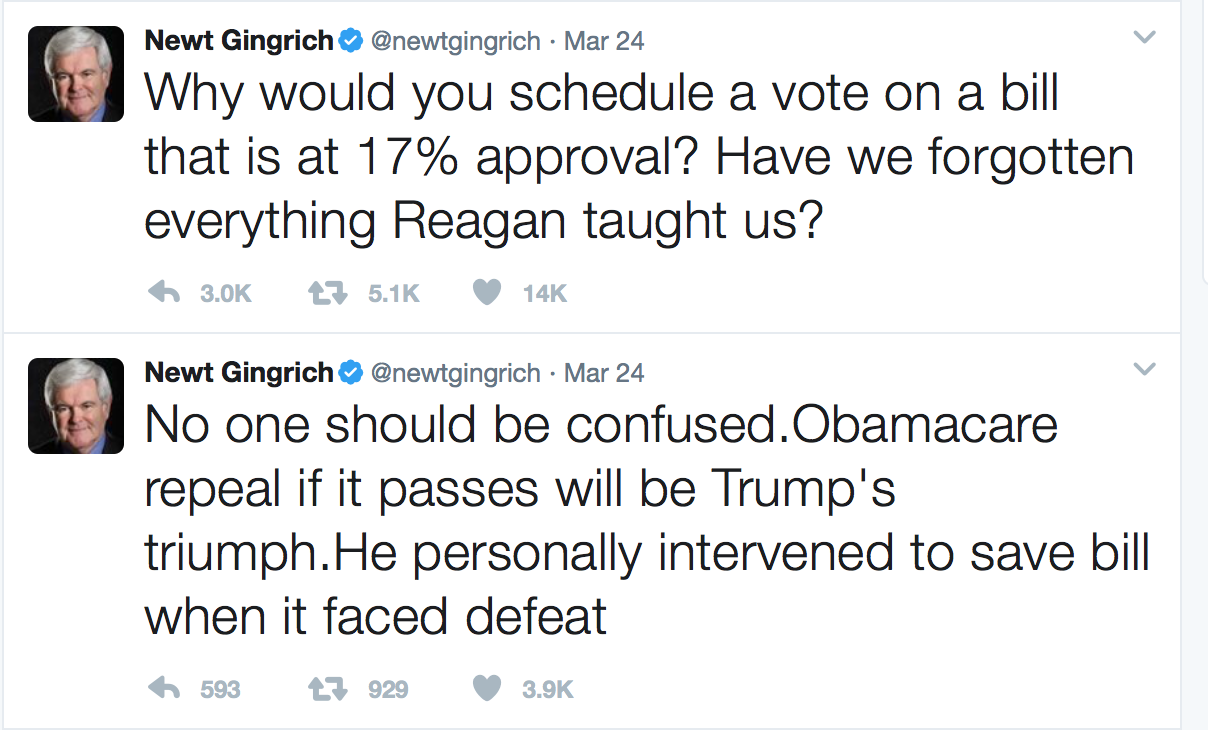
Newt goes from anticipating victory to trying to pretend he understood it’s a lost cause in just 7 hours.Even pro-Republican news sites were reporting earlier in the week Only 17% of Americans support ‘Trumpcare’, yet just hours before the rescheduled vote, folks like Newt Gingrich were tweeting and bragging about how Obamacare was going down. I mention Newt because just 7 hours later, Newt had changed his tune to “Why would you even schedule a vote?”
One reason it failed is that, yes, thousands of constituents called their Republican congresspeople and urged them to vote no. But don’t forget that another reason it failed was because there exists a group in Congress who want the replacement to hurt even more poor people: TrumpCare Postponed: Too Horrible for Moderate Republicans, Not Horrible Enough for Freedom Caucus. Even when Donald tried to negotiate directly with this small group, they couldn’t get them. And each concession Donald and the Speaker of the House offered the Freedom Caucus drove more of the moderate Republicans into the no camp. Obamacare is seen favorably by 57% of voters, making it far more popular than the replacement, our so-called president, or congress itself. And the provisions that the Freedom Caucus want to remove enjoy a walloping 90% approval from voters (as mentioned in that article), which makes if really hard for me to see how, even if they got this thing through the House, how it would have passed in the Senate.
It’s Friday! We’re four weeks into March already. I find myself a bit cranky at the end of the week. My husband’s surgery went well last week and he seems to be recovering well, but I’m just tried and really would like a long nap.
Anyway, here are the links I found interesting this week, sorted into categories.
‘Missing Richard Simmons’ And The Nature Of Being Known. “… speaking metaphorically, not every expression of gratitude arrives on paper, which you can keep with you, pinned to your life indefinitely. Some thank-you’s arrive written on rocks, and if you feel obligated to carry all of those rocks everywhere you go for the rest of your life, if you can’t learn to look at them, be grateful for them, and set them down, even they become a lot to carry.”
Man Arrested For Deadly Midtown Stabbing Reportedly Came To NYC To Kill Black People. A white man who subscribes to white nationalist views when to New York City for the explicit purpose of killing a homeless black person. And it was so, so, so difficult to find a news story covering the white supremacist hate crime that didn’t begin by describing how fashionably dressed the knifer was, or focusing on the police record of the victim,















 Font Folly