Tag Archives: queer

Invisible or tragically dead… reflections on representation

lovingmemoryI was catching up on some podcasts last week, specifically going back through episodes that I had started but not finished. I was listening to Cabbages & Kings, which is a sci fi/fantasy podcast that focuses on books and other written stories, with a focus on the things readers love about the experience of reading. In that specific episode the host, Jonah Sutton-Moore, was discussing queer romance in sf/f with Carl Engle-Laird who is an editor at Tor Books and is bisexual. It was a good episode, but I was shocked when Engle-Laird said that he had only recently learned about the Tragic Queer Trope/Cliché, and specifically that he had learned about it after he had already selected two books for publication in which the only queer character in the story dies. He says something along the lines, “I had just learned about this cliché and the pain it causes so many people, and I was about to publish two books that fit it and realize there’s trouble coming my way.”

The host of the podcast shared a similar story, about how he had reviewed a book in which the two main characters, who happen to be lesbian, overcome the obstacles of the plot and apparently live happily ever after. In the review he had expressed some surprise at how many rave reviews he’d read of the book before reading it himself. Not because the book wasn’t good, he didn’t see that it was a breakout book as so many reviews described. People reading his blog had to tell him that what felt groundbreaking about the book was the fact that the queer characters not only lived to the end of the book, but actually got a happy ending.

I’m not shocked that the straight host of a sci fi podcast was unaware of the prevalence of the phenomena described at TV Tropes as Bury Your Gays and Gayngst, or a bit more honestly explicitly at places like Another Dead Lesbian or The Curse of the Tragic Lesbian Ending and so on. I was disappointed, but not shocked.

It was the queer editor not knowing about this cliché that shocked me.

And I want to be clear, this isn’t meant to be a slam at either the podcast host nor his interviewee. I’ve been listening to this podcast for months, I like it (heck, I nominated it in the fancast category for the Hugos this year!), I listened to several more episodes after the shocking moment (and I’m all caught up again!), and will continue to recommend it.

But I’m still always disappointed when people in the business are unaware of just how unwelcoming to queer people most pop culture is in general, and sci fi/fantasy is in particular.

I realize that it is hard for non-queer people to grasp this, since they are so used to seeing themselves reflected in every show. Any time I’ve talked about a specific instance of “Bury Your Gays” with non-queer friends, their first reaction is always to explain to me that other people die in the book/movie/series. It isn’t that queer characters should never die. The problem is that nearly every queer character depicted in a relationship in pop culture either dies, or is left alone, bereft, and grieving over the death of the only other queer character in the story at the end.

All. The. Time.

That’s on the rare occasions that queer characters in relationships are included at all. Most often, queer characters simply aren’t in the stories. In those rare cases where queers are included, they are unattached romantically without any plot line other than to be the funny/eccentric sidekick to a straight character, or they die. And quite often it is a senseless death that exists for no reason other than to shock the viewer and give one of the surviving characters a reason to grieve and motivation to accomplish their goal.

One of several infographics at jcwelker.com/post/141225630214/vandelrio-nonadraws-this-is-my-final-project
If you think I’m exaggerating, here’s a couple of statistics for you. According to GLAAD, out of the 881 regular characters appearing in all of the primetime network shows during the fall of 2015, 35 of them were lesbian or bisexual women. We are now just a bit over 80 days into 2016, and since January 1, eight of those fictional women who love women have been killed on screen. That’s nearly one quarter (22.85%) of all the women who love women that have been allowed to appear on television screens this year killed.

Imagine, for a moment, if in the last three months 22% of all the regular characters on every single show on network TV had been killed off on screen. That’s 194 characters, almost 2.5 a night. Seriously, if regular characters were being killed off on every television show at that rate, people would be up in arms. They would be sending angry messages to networks executives asking why there is so much more violence in every show. The Daily Show and/or John Oliver would have some epic comedic rants about the murderous spree that all of the network producers had gone on, and those rants would be viral on Youtube.

Right?

If one quarter of all regular characters on network television shows were killed off every 80 days, then every show would have effectively a complete cast turnover every television season. And that makes no sense for a continuing story over multiple seasons, so no show-runners in their right minds would do that.

Fictional murders, senseless deaths on screen, et cetera are not random acts of violence. They are decisions that show runners and writers and network executives make. People are making the decision to kill off queer characters at a much higher rate than any other category of fictional character. Just as a lot of us have called bullshit on writers, producers, and executives who claim they can’t add a queer character to an existing series or franchise until the “right story” comes along, it is at best self-delusion when the decision-makers try to claim that it is just a coincidence that they kill off queer characters at such a high rate.

It is sometimes argued that the only reason that we notice when queer characters are killed off is because there are so few of them to begin with, therefore each loss is especially keenly felt. But that ignores the disproportionate rate of the deaths. Yes, if a quarter of all characters appearing in regular recurring roles in all shows were killed every 80 days, we could argue that the only problem is how few queer characters there are. Even if that were the only reason, the lack of representation itself would still be a problem, as I’ve argued before: Invisible no more: rooting out exclusion as a storyteller.

The truth is that both the lack of representation, and the excessive rate of disposal of the few examples of representation we ever get are symptoms of a deeper problem. Author Junot Diaz summed up the real issue best:

You guys know about vampires? You know, vampires have no reflections in a mirror? There’s this idea that monsters don’t have reflections in a mirror. And what I’ve always thought isn’t that monsters don’t have reflections in a mirror. It’s that if you want to make a human being into a monster, deny them, at the cultural level, any reflection of themselves. And growing up, I felt like a monster in some ways. I didn’t see myself reflected at all. I was like, “Yo, is something wrong with me? That the whole society seems to think that people like me don’t exist?”

There is an agenda to deny us representation—to pretend we don’t exist at all if possible, or to make certain we are perceived as monsters, freaks, or tragedies if we must be acknowledged. Whether a particular storyteller consciously agrees with that agenda or not, whenever you leave us out, or kill us off without thinking about the message it sends, or sit by silently while someone else does those things, you are serving that agenda.

Maybe you should think about that for a bit.

Weekend Update – 11/7/2015: Children Being Failed

Source: thedesmondproject.com/Homelessness-Info.html (Click to embiggen)
Every minute I’m blogging is a minute I’m not adding to my NaNoWriMo word count, but some things have crossed my virtual desktop since making yesterday’s Friday Links post that I think need to be shared.

First, many weeks back I shared links to the story of Joel Andrew, an 18-year-old student who was kicked out by his parents for being gay. They didn’t just kick him out, they refused to pay for tuition at the college he was enrolled at, they refused to sign any financial aid forms (which means that legally he can’t apply for federal aid until he turns 25, yes it’s a thing), and they demanded that he stop using his last name (Andrew is not his original surname). The daughter of his dance teacher set up a GoFundMe page to raise money to pay his tuition for one semester, tons of people donated, and so on. There’s more news, and it’s good news (as much as you can get from a story like this): College Dance Student Raises $60K For Tuition After Parents Disown Him For Being Gay. Go read the linked stories.

The parents now claim that they didn’t kick him out, and didn’t demand that he stop using their last name, but I strongly suspect that’s a case of the classic, “I didn’t tell him he had to move out. I told him that if he was living under my roof who would have to stop seeing his boyfriend, stop admitting he’s gay, et cetera, et cetera.” Anyway, Joel is doing alright, now. Which is good. I want to echo Dan Savage’s comments that there are a lot of Joels out there who didn’t have someone to set up a GoFundMe page. We can help kids like Joel by donated to organizations such as the Ali Forney Center, the True Colors Fund, or the Point Foundation. There are a lot of local charities that serve the homeless, particularly homeless teens. Find one near you and help if you can.

Second: I included one link yesterday to news that the Latter Day Saints church has officially declared that gay members are no longer simply sinning, but are now apostates, and not only that, but that children of gay people in same sex relationships are banned from Baptism and serving in the church until they turn 18 and then only if they renounce their own parents. As Natasha Helfer Parker writes at Patheos: ‘…how dare we go against our own doctrines and punish the children for the “sins of their fathers?”‘ Being an apostate means that one has renounced or completely abandoned their faith and it in utter rebellion against said faith and principals. Calling being in a gay relationship ‘apostasy’ puts it on par with murder and rape, and as more than one observer as commented, the church doesn’t refuse baptism to the children of murderers nor rapists. It’s got more than a few members upset, obviously.

It would be really easy to make snarky comments. When stories like this are posted on gay news sites, there are always people chiming in with, “what gay person would want to live in {fill in name of extremely conservative state}” or “why would anyone want to belong to a religion that doesn’t welcome them?” or “all religions are B.S. anyway, so why should we care?” and so on. My answer remains the same: we don’t choose where we are born and we don’t choose which family we are born into. As children we were dependent on our families and communities of origin for the means of survival. Policies like this hurt people who cannot protect themselves. They create an atmosphere of bullying and coercion that drives children to commit suicide. And particularly in close-knit communities that encourage extended families to remain close and depend upon one another, this kind of intolerance ruins lives.

The repercussions of B.S. like this reach well past childhood or the children directly impacted. These teachings are what drives parents to kick their children who appear to be gay, lesbian, bi, or trans from their homes, for instance. The LDS church isn’t alone in this by any means. The Southern Baptists can claim that they love and respect everyone, but when in the same statement about marriage equality they say “Silence in the face of evil is itself evil” they’re saying to every queer or questioning kid growing up in their churches that they way they were born is evil. Which will lead many of them, after years of praying and doing everything in their power to stop feeling the way they do and being who they are to believing they are irredeemable and inherently unlovable. Just as the Catholic church can keep tricking reporters into repeating the claim that the church is “more welcoming to LGBT people” when that welcome is not unlike the parents I talked about earlier—you’re welcome to be told again and again that who you are is inherently disordered and you may only stay so long as you live a miserable, lonely existence constantly denying who you are.

Third: The loss of the Houston Equal Rights Ordinance is not simply a matter of one city. Nor is it as simple as hate and ignorance winning. We need to do some evaluation like this one: Why Houston’s Equal Rights Ordinance Failed 80 if for no other reason that we’ve seen before that the anti-gay folks will reuse arguments that worked once again and again to take rights away. They are going to mount more campaigns just like this one to try to take away protections in jobs, housing, and so on. It isn’t a new tactic, by any means, but it’s one that can be made to work: How The Religious Right Learned To Use Bathrooms As A Weapon Against Justice

And they aren’t just using it to get anti-gay people to vote against us, they are already trying to get us to turn on each other: Homocon Petition: Drop The “T” From LGBT. It’s an anonymous petition. It is being promoted by certain gay republican jerks who have in the past argued against marriage equality and anti-discrimination laws. Scores of books can be written about why those folks actively participate in their own oppression, but make no mistake: this petition is not coming from people who have the well-being and rights of any queer person in mind. It’s called divide and conquer. If they can get us fighting among ourselves, it will be easy to not just stop the advancement of freedom, but to actually turn back the clock.

Don’t be fooled!

Invisible? Difficult to see what others have erased

1442933694_celebrate-bisexuality-dayI had a topic queued up for this week’s Throwback Thursday/More of why I love sf/f post, but then I remembered that it’s Bisexual Awareness Week, which is an expansion of Bisexual Visibility Day, and I thought, maybe I should write about some of the sci fi stories that I remember reading in my late teens/early twenties that nudged me into thinking maybe I was bi rather than gay.

As I tracked those stories down over the last few days, I realized something: none of the characters in those books actually identified as bisexual. The characters talk about bisexuality as an abstract, in exactly the way a closeted queer person might with their friends as a means of tentatively sounding out the friend to see if said friend would accept them if you came out as gay or bi.

And then there was no actual coming out. No romance other than opposite-sex couples, et cetera. It was a little irritating. Especially since one of the rules I adopted about my “more of why I love sf/f” posts is that I want to talk about books, stories, authors, movies, et al from the genre that I love rather than focus on critique or griping. So I couldn’t write about those stories that I had misremembered as having bisexual characters without it turning into a big gripe session.

So I’m not going to write about them tomorrow. And other than that explanation, I’m not going to write anything more about them, today, either. Because today is Bisexual Awareness Day, and it’s is supposed to be a celebration of and for bisexual people, not a time for a old white gay guy to gripe about related issues. So I encourage you, if you don’t know why Bisexual Visibility Day exists, and is different that National Coming Out Day and why it’s needed, to read this: Bisexual Visibility Day: Why being a bisexual is not easy.

And you might find this interesting: Celebrating the ‘B’ in LGBT: A history of Bisexual Awareness Week.

And while you’re at it, take a look at this: Why Bisexual Visibility Is Important.

As I mentioned earlier in the week, I’m not bisexual myself, but I happen to be married to someone who is, as well as having several other important people in my life who are bi. So I have at least an empathetic understanding of their struggles, and how some of those overlap with mine, while many are different.

Remember, love is love; shout it for the world to hear.

Invisible? Refusing to see what’s already there…

Kissing otters
Ah, love!
I was having a discussion about a movie with some friends on line, and two of us were commenting upon the possible romantic relationships between some of the characters. Because one of the pairs under consideration were two male characters who had not explicitly been portrayed as non-heterosexual, another friend in the conversation commented that he never understood why people do that.

At the time, I decided to keep the conversation light, and simply said that we saw it because it was obvious. The real answer is a lot more complicated and serious than that. I didn’t feel up to explaining the unconscious homophobia underlyng the very question, and sometimes, frankly, I’m just tired of being disappointed in people.

But the problem persists, far beyond the people involved in that conversation. And yes, it is a problem, a very real and serious problem. What is the problem, you ask? Some people say the problem is invisibility or cluelessness, but…

In this way the writer can present his cowardice, laziness, and lack of imagination, as artistic integrity. “I couldn’t write gay characters; I didn’t have any.” Hand-to-forehead; the tortured auteur.
—Andrew Wheeler, writing for Comics Alliance

It’s actually about erasure and willful blindness. As I’ll explain further…

Continue reading Invisible? Refusing to see what’s already there…

Picnic on the Queer Side: more of why I love sf/f

We're queer, we're nerds, get used to it!
We’re queer, we’re nerds, get used to it!
I was 13 years old and had been a semi-faithful reader of the Magazine of Fantasy and Science Fiction for a few years. I think I found my first copy in a magazine rack in a drug store sometime during fourth grade. I had pleaded and begged for a subscription of my own, and one of my grandparents had bought me a subscription for my twelfth birthday—except they got me a subscription to Galaxy Science Fiction instead. Which wasn’t bad, it meant I got a magazine about the size of a paperbook every month filled with short stories, novelletes, and sometimes serialized novels. But my adventures in the pages of Galaxy magazine is a story for another blog post.

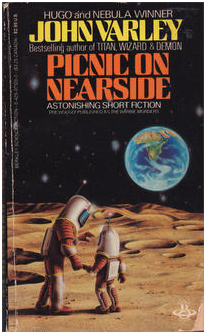
It was summer, just months before my 14th birthday, when I got hold of the new copy of the Magazine of Fantasy & Science Fiction and found inside it a story called “Picnic on the Nearside” written by John Varley. In it, the narrator, Fox, who was 12 years old and lived on a colony of the moon sometime in the future, had been in an epic argument with his mother, because he wanted a Change. He didn’t explain right away what the change was, but before that reveal, we learned that people in his society could easily alter their bodies (his mother exchanged her feet for peds/hands before going out to a party; and Fox mentioned a time he had assembled an eight-legged cat). Then Fox’s best friend, Halo, shows up as a nude woman, which finally explained what the change was. Fox and Halo had been best buds for years, and Fox worried that now that Halo was a woman, it would ruin their friendship.

Cover of the paperback edition of on of Varley's anthologies which included the story in question.
Cover of the paperback edition of one of Varley’s anthologies which included the story in question.
There are many other interesting things that happen in the story: Fox and Halo take Fox’s parents’ vehicle out on the surface without permission and get into a misadventure. But the really mind-bending part of the tale was the setting: a society where changing genders was only slightly more complicated than changing one’s clothes, and where everyone was okay with it. That was just mind-boggling!

I have to make a couple of digressions here. The first is that not all queer people are transgender, transsexual, nor transvestite. Gay boys don’t want to become women, we’re guys who are attracted to and fall in love with other guys. The proper answer to the clueless question, “Which one is the woman” is “Neither, that’s the point!” But one of the reasons young gay boys often idolize female characters in their favorite movies, books, and so forth is because the female characters are the objects of desire of the male characters. Similarly, young lesbian girls often idolize male characters in works of fiction. Young bisexuals may find themselves idolizing both, and so on.

Because there were no openly gay characters in any of movies, TV shows, books, short stories, et cetera which made up our cultural landscape growing up, one of the only ways to imagine ourselves in the worlds we longed to live in was to identify with the female characters. So on one level, “Picnic on the Nearside” offered me a more explicit way of projecting myself into that world. It was as if one of my subconscious coping mechanisms had been made manifest in the plot! Therefore, this story so intrigued me not because its imagined future would afford me an opportunity to change genders (which wasn’t what I wanted), but because it offered an escape from the expectations that boys were only allowed to do boy things, and only allowed to be friends with other boys, and only allowed to be boyfriends with girls.

The other digression is about the difference between a gender fluid milieu and a gay/lesbian culture. Varley has written a lot of stories set in the same world as “Picnic on the Nearside,” including several with the same character, Fox, as the protagonist (though the stories starring Detective Anna-Louise Bach {for example, “The Barbie Murders”} may be a bit more famous). Many of his characters change genders and have love affairs with people who have also swapped genders, but many times his imaginary gender fluid society is still very heterosexual. Fox never thinks of Halo as a potential sexual partner until they are opposite gender, for instance. Some of the couples who appear in the various stories seem to be just friends when they happen to be the same gender, then become lovers only when they happen to be opposite.

Many psychologists and sociologists now theorize that men who like to dress up as women and have sex with other men while thus dressed up are actually exploring an exaggerated heterosexuality. Having, in the online world, been sometimes emphatically propositioned by guys like that, and found myself turned off by their “flirting” that consists of trying to get me to say I will treat them the way an extremely selfish chauvinist man might treat a “slut,” I see their point. The men pursuing those scenarios are so into their fantasy of what heterosex could be that sometimes they want to experience it from the girls’ side. They aren’t turned on by the other man as a man, they are turned on by the situation of a woman submitting to a man in very specific ways.

Looking back on some of Varley’s stories, they can feel more like a mostly hetero exploration of gender roles, rather than a pan-gender exploration of sexual orientations.

There’s nothing wrong with that, and there’s a lot right with it.

A lot of the pain, fear, and bigotry directed toward LGBTQ people is grounded in very narrow and strict views of gender. It’s why homophobic men are almost always also misogynist (or at least very chauvinist). So anything that makes us question those assumptions about intrinsic differences between men and women, what roles men and women are each allowed to take in society, and the morality of those gender binaries is a good thing. And there’s no question that Varley’s tales exposed many of hypocrisies at the heart of all those assumptions.

I became a Varley fan that summer. Even more so, I became a fan of the protagonist, Fox, who went on to appear in the short story “The Phantom of Kansas” and the novel Steel Beach. Questions of gender and sexuality are at most a minor consideration in most of his stories, and I’ve come to appreciate his ability to take seemingly any speculative notion (no matter how weird) to its logical conclusion, and still tell a cracking good yarn along the way. What grabbed me that summer, while re-reading Fox and Halo’s misadventure again and again, was that there was at least one writer willing to tell stories that didn’t exclude a queer viewpoint. And there were editors who would print it, and by implication, readers other than me who wanted to read it.

And that was an amazing epiphany for a 13-year-old gay boy in the rural and very redneck Rocky Mountains.

Go purple!

Millions go purple on Spirit Day in a stand against bullying and to show their support for lesbian, gay, bisexual and transgender (LGBT) youth.

I’ve written way too much about my own experiences being bullied in my youth. It can be depressing to think that all these decades later it’s still going on. But I refuse to be daunted. And these kids do, too:

(If embedding doesn’t work, click here.)

Find out how to go purple at http://glaad.org/spiritday

Show your colors

Copyright 2014 Gene Breshears
Most of the color guard are Boy Scouts, plus troop 98, which recently left the boy scouts after the sponsoring church overwhelming voted not to fire the gay scoutmaster and force the BSA to kick the church out (they have since joined Baden-Powell Service Organization).
It’s been more than a few years since Michael and I attended the Pride Parade or the Pride Festival. One friend, seeing the pics I was posting to twitter, commented, “I thought you didn’t like going to the parade any more!” And I had to explain that it wasn’t a matter of liking, but more a matter of trying to get both of us up and moving early enough on a Sunday to get there.

I like the parade.

Copyright 2014 Gene Breshears
It’s not zillions of blocks long, but we have a big rainbow flag!
I like it so much, that one time I attended three in one year. San Francisco and Seattle weren’t on the same weekend that year (they’re usually both on the last Sunday in June), and the Seattle Lesbian & Gay Chorus (of which I was a member) sang a joint concert with the San Francisco Lesbian/Gay Chorus for Pride weekend. So Ray (my late husband) and I flew down to San Francisco, went to a lot of pride events, I sang in the concert, and we watched the gigantic parade. Then, back in Seattle, we marched with the chorus in Seattle’s not quite so big parade. Then, about a month later, we spent a long weekend in Vancouver, B.C., where we watched and cheered a much, much smaller (but extremely enthusiastic) Pride Parade.

copyright 2014 Gene Breshears
The only picture I got of us together at the parade. I know, nostril shot. Sorry.
When I started dating Michael (a few years later, after Ray died), he was a bartender at a lesbian bar down in Tacoma. Tacoma didn’t usually have a parade, though they had a pride festival a week or two after Seattle’s. For several years he had had to work on the day of Seattle’s Pride Parade (he said it was always a weird night, because half the usual crowd was up in Seattle at our parade and parties). After he stopped working at the bar in Tacoma (by which point we were living together), he got a job at a non-gay bar in Seattle. Working late Saturday night and having to work again Sunday made attending the parade less than fun for him, though he did let me drag up off to it a couple of times.

Then we hit this long period of either having too many other things going on, or one or the other of us being sick, or just not quite up to getting up and moving in time. So we missed a bunch.

Copyright 2014 Gene Breshears
They make George Takei, one of the original cast members of Star Trek grandmaster? Of course I have to be there!
Watching most of the parade today (we only watched for three hours… there was still a bunch of parade to go, but we wanted to get to the festival in time to see George Takei on the main stage), the thing that struck me is that the parade has become even more ordinary. I’ve described my first pride parade before, noting that while there were outrageous costumes, more than a few near-naked people (though actually less than most non-gay parades I’ve attended), and so forth, the majority of people marching and riding floats looked pretty ordinary: people or all ages, shapes, and sizes in t-shirts and shorts or jeans. That’s decidedly more true now than it was when we last attended more than eight years ago.

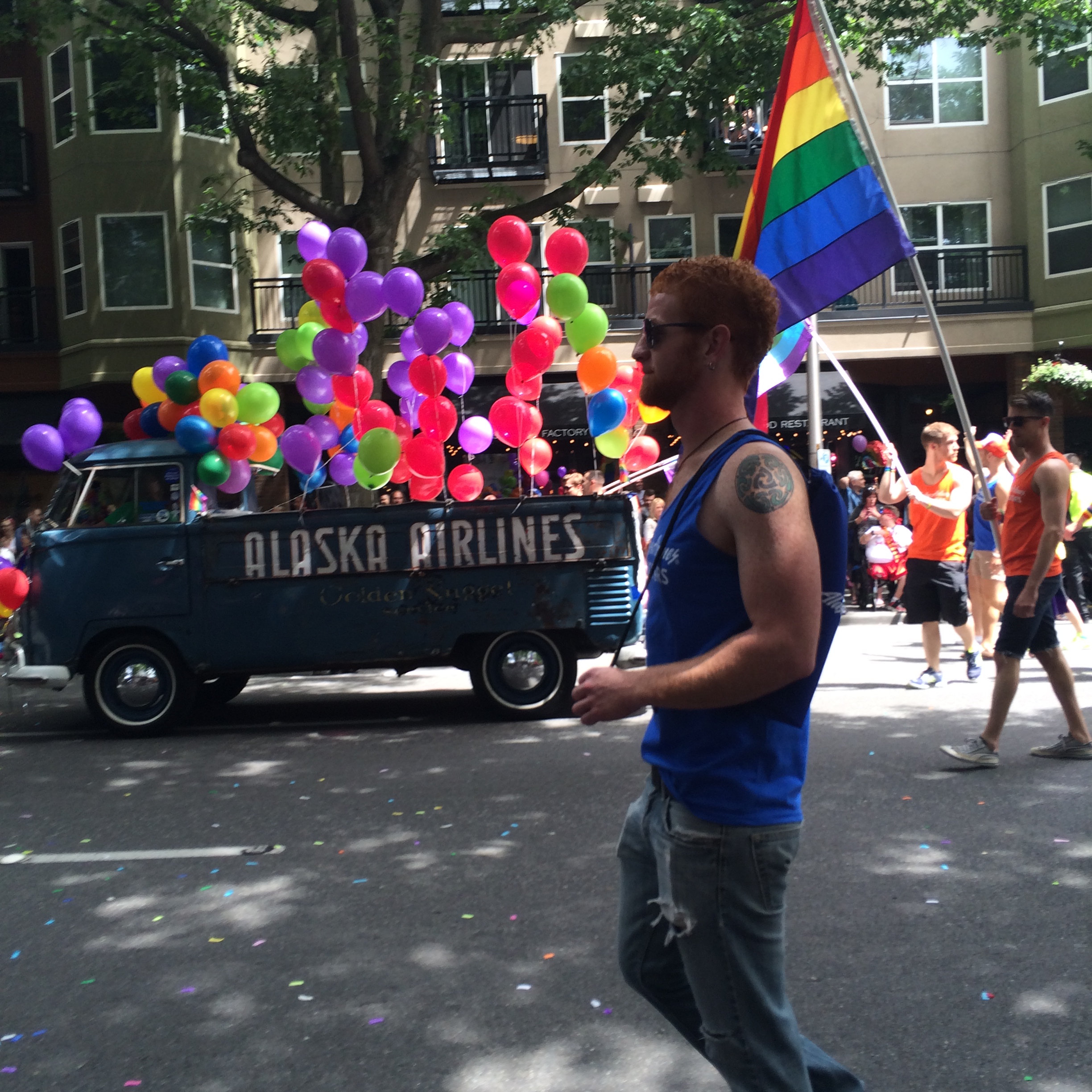
This was only part of the Alaska group, they had another vehicles and a crowd of employees on foot.
I believe that is less about gays assimilating into mundane society (as some have suggested), as it is about corporations assimilating to the idea that inclusivity is good business. The first parade I attended had a few contingents of employees of some of the large employers in the area, but only a few. This year I saw groups of employees from several major banks, mobile phone companies, grocery stores, airlines, cruise lines, wineries, insurance agencies, restaurants, et cetera, et cetera. About half of the contingents, I would say, were groups of employees. And the standard ensemble for those groups is a t-shirt identifying their employer with pants or shorts.

Copyright 2014 Gene Breshears
Market Optical’s float said, “Look with your eyes, not your hands” and then had go-go boys with multi-colored handprints all over their bodies.
There were still plenty of the non-profits and recreational groups, and those were where you most often saw the more outrageous costumes (though the Market Optical float was the one with the most scantily-clad go-go boys). There were scantily-clad people, including a large group of people on bicycles and roller skates wearing nothing but body paint. Most of the naked bikers were painted to look like characters from Star Trek. It didn’t occur to me while we were watching the parade that they had probably decided to do that because George Takei was the grand marshall.
Copyright 2014 Gene Breshears
In the past it was the bars and dance clubs that would put a cage dancer in the float, not an optician!

I should mention the unpleasantness. Back when the Parade was on Cap Hill (aka, the Gayborhood) every parade I marched in had some “Repent sinners!” protestors. Except most years it was one grim-faced bearded guy holding up a sign at one corner, saying nothing. A couple times he had a small group, but that was it. Apparently now that we’re in downtown Seattle we now get an entire mini-parade of haters. According to the people standing next to us, last year or the year before there were some very angry confrontations. Now a couple of bicycle cops follow along. The haters walk the route before the parade officially starts. It looked like a lot of them, with a lot of signs and one guy with a bullhorn.

Copyright 2014 Gene Breshears
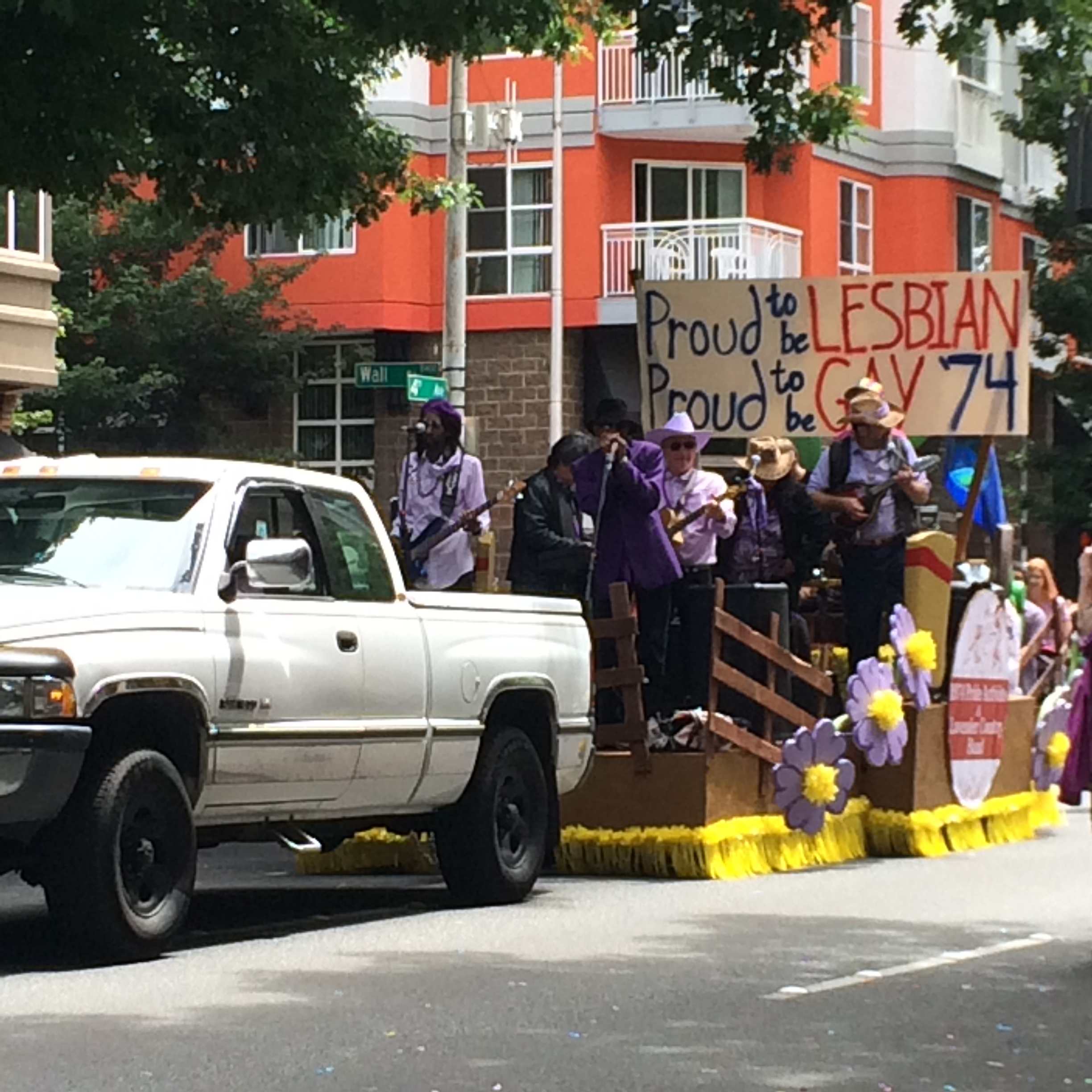
The parade committee invited a lot of people who participated in the first Seattle Pride, including a country band called Lavender Country.
I say it looked like, because once I realized who they were, I simply turned my back on them, and refused to look at all. Michael did the same, except he glanced over when a lot of cheering broke out: two womyn ran out into the street and kissed in front of the bullhorn guy. Apparently it happened a lot along the route.

Now I feel a need to digress a moment, here. While I am a fierce advocate of free speech even for people I disagree with, here’s the thing: the Supreme Court has ruled that we have the right to exclude the ex-gay groups and the pedophile groups from marching in our parade, and the Boston St. Patrick’s Day parade has the right to exclude gay people from their parade. So, why is it, when the streets have been blocked off because we have a permit for a parade (and we are paying the city for the police to route traffic, and so forth) that we can’t exclude these people from the route that we’ve paid for for the duration? Instead of escorting them so angry faggots won’t attack them, shouldn’t the police arrest them?

Two guys were walking along with one of the groups and had their Dalmatians with them--with rainbow spots!
Two guys were walking along with one of the groups and had their Dalmatians with them–with rainbow spots!

I know all the reasons why we shouldn’t push for that: we should show more tolerance than they do, they’ll milk it for fundraising and propaganda purposes how they’re being oppressed, and so on. But you know darn well if we showed up at their church on a Sunday morning and starting reading a “How To Come Out To Your Parents” pamphlet over a bullhorn, they would call the cops.

That’s enough about the bad stuff.

Copyright 2014 Gene Breshears
I did manage to get one non-blurry picture of gay Batman, even if it is a silhouette.
There’s so much more I could share. I kept trying to get a non-blurry picture of the guy skating as gay Batman. He was with two others, one was the joker, and the other had some Superman emblems mixed with other things. As far as I can tell the three were just skating up and down the full length of the parade, so they passed us several times. Then Batman crashed into a woman standing next to us. No one was hurt. It got a little funny, because she kept asking him if he was all right, and he said not to worry about him but was she all right? And that went back and forth several times.

Copyright 2014 Gene Breshears
Rainbow tie-dye overalls over rainbow tie-dye shirt!
There was a very shy little kid who wanted candy, but would hide whenever anyone who was passing things out tried to give them to him. There were fun floats. There were several bands and drum and pipe corps, including the Police Department’s drum and pipe corps. There were several groups with pets. Lots of youth groups. Lots of trans* groups. There was a troop of librarians doing synchronized maneuvers with book carts. There were kids, lots of kids. And of course lots and lots of rainbows.

It was a great parade. And I’m so glad that we’re marching through downtown now, and filling the Seattle Center with hundreds of thousands of people, instead of cramming smaller crowds into the gay ghetto. I do want to support the businesses up there that have always been ready to answer the call of all the queer non-profits over the years. And since we have three parades now, we can! I think next year we need to make an effort to attend the Dyke March on Saturday and/or the Trans March on Friday.

Because it’s been a long, long time since I did three parades in a single year…

Times, they are a-changin’

AFP PHOTO / FLORIDA KEYS NEWS BUREAU / Carol TEDESCO
AFP PHOTO / FLORIDA KEYS NEWS BUREAU / Carol TEDESCO”
When I was still active in the Seattle Lesbian & Gay Chorus, we would occasionally have group discussions about non-musical topics. Since the chorus was a non-profit organization with a mission affirm the positive aspects of lesbian, gay, and bisexual experience and unite communities1, we would sometimes talk about some serious topics about outreach, and making the world a better place. Many times in those discussions, people would talk about their dream of a day sometime in the future when it really wouldn’t matter to anyone whether you were queer or straight.

While I longed for that day myself, I wasn’t at all confident it would happen in my lifetime. Now, I’m not so sure… Continue reading Times, they are a-changin’