Tag Archives: science fiction

Malice or ignorance — more reflections of exclusion at sf/f conventions

I need to do a bit of a follow up to my previous post about the issues at Worldcon. I didn’t touch on everything that happened, and since the issue blew up, Mary Robinette Kowal, whose tweet from years ago on a related subject I quoted in that post, has agreed to help redo the programming. Kowal has been running the programming tracks at the annual Nebula conferences for a while, and she had posted a nice summary of their process for trying to put together a program that appeals to many parts of the community. So many of us are provisionally hopeful that the situation will be a bit better at the actual convention than they appeared just days ago.

I have also been reminded that sometimes it is difficult to tell the difference between ignorance and actual malice. Now, I was thinking that most of the bigotry that seemed to be motivating the issues were likely unconscious—all of us are often unaware of just how many prejudices we have absorbed from society. Alis Franklin, in particular, has pointed out another explanation for much of the problem:

“This all feels very much like people used to running a small-town parochial con with an established member-base suddenly getting in a twist because they have to accommodate (gasp) outsiders.”

And she’s likely on to something. A lot of this does sound like the people in programming are speaking from their past experience running their local convention, where they believe they know their audience and what those attendees expect. But even if that is the case, I still suspect that their local crowd includes a lot more queers, people of color, and other folks who are interested in topics that their local con doesn’t recognize in programming—because as I said, we’re everywhere, and we’re all used to being excluded and dismissed; so much so that when we raise an issue and are shut down, we often just hold our tongues thereafter.

On the issue of the one pro whose submitted bio was edited to change all of eir pronouns to “he” and “him”, and the insistence for a few days that this was a bio taken from the web (when no one can find such a bio and they can’t provide a link), that gets into the conscious versus unconscious bias. Either the person who copied the bio was simple too ill-informed about non binary people and nontraditional pronouns, and simply assumed it was some kind of extremely consistent typo (which I think is a stretch), or they’re one of those people who balk at pronouns to the point of refusing to use any they don’t agree with and decided to change the bio and then claim it was a mistake if they were called on it.

I don’t know if the same staffer is the one who decided not to use another pro’s usual publication bio and photograph, and instead write a different bio using information that usually was not released publicly and use a photo taken from the pro’s private Facebook. In any case, it is difficult to construct an “honest mistake” excuse for that one. And if it is the same staffer, I think that is more than adequate proof that the changed pronouns on the other bio was an intentional aggression.

In several of the discussions online I’ve seen a lot of people not understanding what the problem was with requesting semi-formal wear for the Hugo ceremony. Foz Meadows summed it up better than I did:

”…the fashion at the Hugo Awards ceremonies tends to be a welcoming, eclectic mixture of the sublime, the weird and the comfortable. Some people wear ballgowns and tuxedos; some wear cosplay; others wear jeans and t-shirts. George R. R. Martin famously tends to show up in a trademark peaked cap and suspenders. Those who do dress up for the Hugos do so out of a love of fashion and pageantry, but while their efforts are always admired and appreciated, sharing that enthusiasm has never been a requisite of attending. At an event whose aesthetics are fundamentally opposed to the phrase ‘business casual’ and whose members are often uncomfortable in formalwear for reasons such as expense, gender-nonconformity, sizeism in the fashion industry and just plain old physical comfort, this change to tradition was not only seen as unexpected and unwelcome, but actively hostile.”

I also note that a few days ago Mike Glyer posted a link to a letter from decades back from E.E. “Doc” Smith (the author of the Lensmen books, among others) when the 1962 WorldCon asked for all the ladies attending the award ceremony to wear long formal gowns. Smith commented that his wife had not owned formal wear since entering retirement and thought it was unreasonable to expect people to go to such an expense.

Which is a nice segue to this: until the 34th WorldCon (MidAmericaCon I, 1976 in Kansas City, Missouri) the Hugo Awards were given out at the end of the convention banquet. The banquet consisted of eating (obviously) while the guests of honor gave speeches. Fans who couldn’t afford the extra expense of the banquet were allowed in (usually in a separate area such as a balcony) for the awards portion. The awards ceremony was separated from the banquet in 1976 for a couple of reasons, but one was to make it easier for everyone who wanted to attend to do so. The conventions had gotten so large that the fraction who wanted to see the award ceremony was too much for the banquet halls of typical convention hotels to accommodate, and there had always been the problem of people who couldn’t afford the banquet ticket. I wanted to close with that because I have seen a number of people arguing that the people who are feeling unwelcome because of this con’s actions are making unreasonable demands to change traditions of the conventions.

The traditions change over time for many reasons. It isn’t about change for the sake of change, it is change of the sake of practicality and realism. People have, in the past, believed that science fiction and fantasy was only created by straight white guys, and was only loved by other straight white guys. That has never been true, but the illusion was maintained through a variety of societal forces and some willful ignorance. It has become increasingly difficult to maintain that willful ignorance, and besides, ignorance is never a good look on anyone. It’s not about whether fandom is diverse, it is about to what lengths some people are willing to go to ignore, silence, or push out that diversity.
Subtracting homogeneity, fighting erasure—reflections on exclusion at sf/f conventions

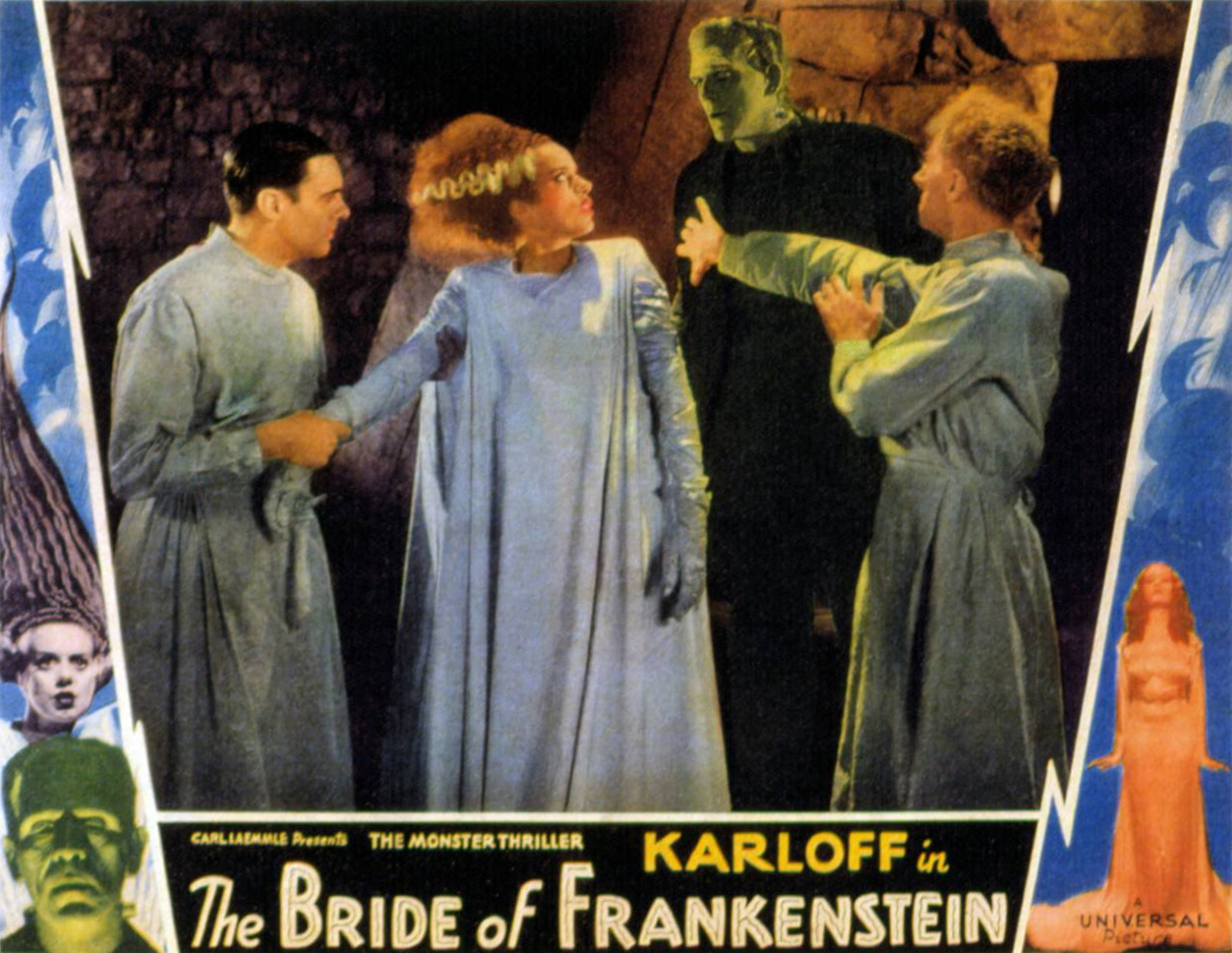
James Whale who directed Universal's Frankenstein in 1931 and Bride of Frankenstein in 1935 was an openly gay director in the 20s and 30s.
James Whale who directed Universal’s Frankenstein in 1931 and Bride of Frankenstein in 1935 was an openly gay director in the 20s and 30s, just one example of a queer person who created classics in the genre. The movies were adapted from the book Frankenstein written by Mary Wollstonecraft Shelley, a woman, who is credited with creating the science fiction genre with said book.
So a problem that had been brewing for a while with this year’s WorldCon came to a head this weekend. There had been hints and rumblings. I’d heard that many pros were mentioning having problems communicating with some members of staff. Then there was the request to all the Hugo nominees to wear semi-formal wear to the award ceremony, so it would be “elegant and professional looking.” That one rang alarm bells for me because almost everytime I’ve ever heard anyone use the term “professional looking” it was a dogwhistle for everything from “please don’t be obviously gender non-conforming” to “please don’t look like the kind of person who can’t afford a bespoke suit” to “please don’t dress ethnic” and so on—in other words, trying to enforce some homogeneity.

So how things came to a head: a professional writer who has been nominated for a Hugo this year was told they weren’t going to be on programming because “there is a kind of creator who appeals to Hugo nominators, but are totally unknown to convention attendees.” The email also managed to misgender the pro and… well things went downhill, after the pro and their spouse posted some of this information online. The programming people contacted the spouse, asked the spouse to convey their apology and expressed disappointment that they went public instead of handling this privately.

And that prompted many many other writers and creators to come out of the woodwork, posting their own many attempts to deal with similar issues (such as, “why did you discard the bio my publisher sent you, and pull information from my private Facebook account instead?” “What do you mean that people like me aren’t of interest to convention attendees?”)—indicating that a whole bunch of people had been trying to address this privately to no avail.

Only when it became public and dozens of authors who were on the programs wrote in to either withdraw, or at least suggest that other, newer, less well known writers could take their place on some panels, did the con chair issue a real apology (there had been a “we’re sorry if anyone’s offended” style non-apology the night before).

Because the thing is, the people who were being excluded weren’t just new writers to the field, it was overwhelmingly the queer creators, the non-white creators, and the women creators. And at one point, the programming person explicitly said, “Do you expect a WorldCon to be like WisCon?” WisCon being famously more feminist-friendly and queer-friendly than most other conventions.

Other people have written about this situation, and probably better than I, but there’s a part of this whole thing that just really presses my buttons, and it aligns with a theme I’ve written about many times on this blog: to wit, queer people, trans people, people of color, women, and people of many religions and cultures have been fans of sci-fi/fantasy (and created sci-fi/fantasy) for as long as it has existed. We aren’t new. We aren’t exotic. We aren’t fringe or band-wagoners. We’ve always been here, we just have seldom been allowed to be visible. As Mary Robinette Kowal observed at least four years ago:

“It’s not about adding diversity for the sake of diversity, it’s about subtracting homogeneity for the sake of realism.”
—Mary Robinette Kowal

Let’s go back to the explanation that was being given before the backlash forced them to scrap their programming plans and start over: “There is a kind of creator that appeals to the Hugo nominators who is not known by the convention attendees.”

I have at least three responses to that:

First, nominators are attendees. In order to nominate for the Hugo Awards and in order to vote for the winners, one must purchase a membership to the convention. And you know who else are attendees? The pros who are coming to the con that the con com doesn’t want to let on the program. Sure, not every attendee participated in the nomination process, and not every one of them nominated ever finalist, but some fraction of the attendees did. And the number of people who nominate is more than large enough to be a statistically significant sample of fans. So it is an entirely misleading and useless distinction to try to draw between attendees and nominators.

Second, this argument is a form of gaslighting. I’ve seen some people compare it to the old TrueFan arguments (and the more recent Real Fan claims from melancholy canines), and those are good comparisons, but I think a better model is the Moral Majority. I know I hark back to that particular group a lot, and I admit I know so much about them because they originated in the denomination in which I had been raised and they came to national prominence literally as I reached legal voting age, so my earliest election experiences included being told again and again that, because I disagreed with them, I was a member of the implied immoral minority.

This is the same kind of argument: “attendees” are implied as being the vast majority of fans, and these majority of fans don’t find “that certain kind of creator” interesting, unlike the “nominators.” The nominators are, by inference, supposed to be viewed as a fringe, extremist minority whose interests can’t possibly overlap with the implied majority. And just as the Moral Majority’s very name contained two lies (they were neither moral nor a majority), this notion that type of fans who are not interested in a “certain kind of creator” must consititute such an overwhelming majority that virtually no programming to appeals to anyone else is worth having.

Third, the majority/minority part isn’t the only form a gaslighting being attempted. Because here’s the thing: in most of the Hugo categories, it is not people who are nominated, but works of sci-fi/fantasy. The authors are referred to as nominees, but technically it is a specific novel, novella, novelette, short story, et cetera that is nominated. But that phrase, “a certain kind of creator who appeals to the nominators” puts the emphasis on the creator and the creator’s identity. In other words, they are arguing that the nominators really didn’t like the specific story, but have chosen the story to fulfill a quota or something.

In other words, the person who made this statement believes that the story nominated doesn’t really deserve to be nominated, and believes that the nominators don’t believe that either. It’s the same racist/homophobic/transphobic/misogynist arguments that the melancholy canines were making. A “certain kind of creator” is a dogwhistle. The nominators may want queer/trans/women/people of color, but “normal” people don’t. That’s what that statement says. And this is why I still fervently believe the person who said that should be fired from the con com.

Fourth, finally, they are arguing that attendees are only interested in seeing creators they already know and love. Completely ignoring the fact that most fans want to both see old favorites and to find new writers/stories/shows/what-have-you that might become favorites. One of my favorite parts of attending conventions are when I am exposed to new authors I’d never heard of before, and new works that I’d never seen. I’m always writing down names of authors and stories and ‘zines and so forth, and then going to look them up after the con.

Many of the authors who are currently in my personal list of favorites, are people who I learned about at a convention panel. Yes, once they become a favorite, I will look for their names in the programming grid and try to see some of their events, but I’m not just there to see the folks I already know.

The conventions where I ran programming were all smaller than WorldCon, but I have run programming at conventions. I know it is hard work. I know it can feel like thankless work. But one of my goals with that programming was to provide convention attendees opportunities to learn new things, to find new artists or writers and so forth that they didn’t previously know about; to introduce the work of many people to new audiences, while also giving fans a chance to see the people whose work they already liked.

If you don’t see that both of those goals should equally drive the programming of a sci fi or fantasy con, then you absolutely should not be working on programming. Go work for a commercial convention where the only point is to sell autographs. Do not volunteer for a World Science Fiction Con.

Millions of Voices Cried Out in Terror — or, That’s Not the Force You’re Feeling, Guys

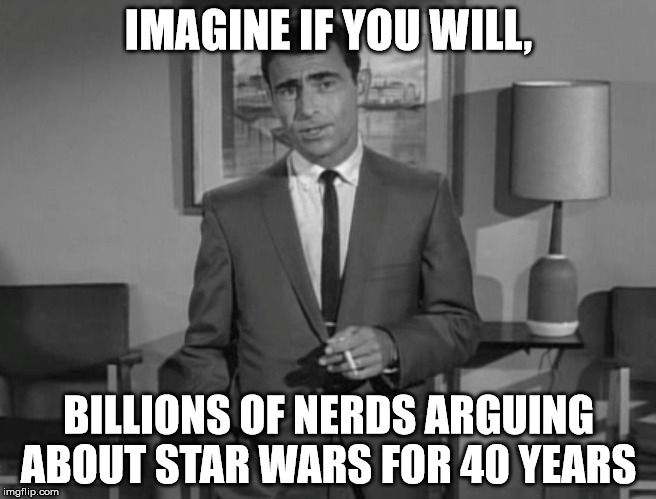
“Imagine, if you will, millions of nerds arguing about Star Wars for 40 years.”
(click to embiggen)
I’ve started this blog post many times, but I either find myself wanting to pull my hair out at the mental gymnastics the haters (who claim to be TrueFans) keep putting themselves through to try to make their arguments that up is down and two billion plus one billion equals zero… and I keep giving up. When the craziness first came to my attention, back in those bygone days when the first trailer for The Force Awakens sent them into a tizzy of anger and outrage, I figured it was just an age thing. Right? I was 17 years old when the original Star Wars came out, and I had watched the Watergate scandal unfold and take down a corrupt president a few years before. I understood that the Empire was a corrupt government founded by people who had, at one point, been treated just as any other politician proposing what ideas that some people disagreed with who turned out to be fascists who destroyed the old government, and that the Rebellion was being led by the remnants of what had been the opposition party before all of that. In other words, I understood that every single plot element in the original Star Wars was about politics.

These other folks, who whine and rage about the new movies, I just assumed they were closer to the median age of the typical internet user. Their first exposure to Star Wars had been to see it on a TV at home, possibly when they were too young to remember the first time. It was just something that was always there. Whereas I saw it as a great movie that changed the way the genre was perceived as well as creating a seismic shift in all of pop culture, to them it had always been there. And they had been too young to understand that the word “empire” was inherently political, just as the phrase “rebel spy and a traitor” was also inherently political.

Oh, how naive I was just a few years ago. I hadn’t realized that the problem was much deeper than that.

Before I go on, a few other people have examined in depth a couple of the issues at hand, and rather than try to construct the same analysis, you should go check these out:

The Beautiful, Ugly, and Possessive Hearts of Star Wars.

Biased Opinion – The Wailing Ignorance of the Star Wars Fanboys.

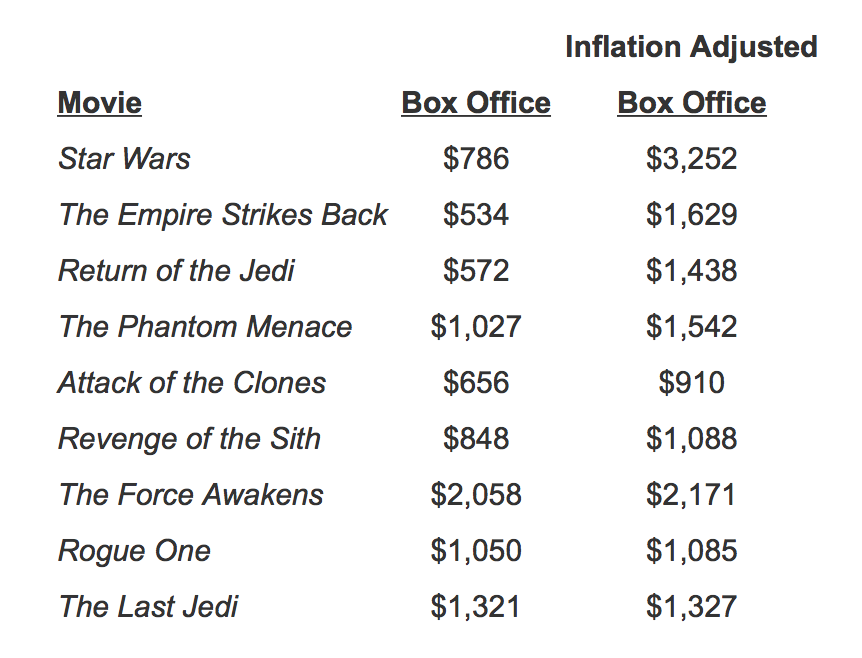
The latter post, by the Aaron Pound, is extremely helpful in this discussion if for no other reason the two tables showing how all of the movies in the Star Wars franchise have done at the box office, and comparing them to other franchises (expressed in millions of dollars):

Please note: when adjusted for inflation, the original Star Wars made three-and-a-quarter billion dollars at the box office—that’s $3,252,000,000! Notice, also, the big drop-off that The Empire Strikes Back suffered, and then how the number went down a bit more for the third movie, The Return of the Jedi.

Now let’s look at the other chart (also in millions of dollars):

Aaron assembled this second chart to show how a single-character movie in a large franchise fares in comparison to the main courses, if you will. The Avengers and its sequels have made a whole lot more money than each single-character movie in the Marvel universe, and so we shouldn’t be surprised when Solo made a lot less money than The Force Awakens. Unfortunately, at least some execs at Disney didn’t understand this, otherwise they wouldn’t have authorized re-shooting almost the entirety of the film, bringing the cost of making Solo up to approximately $250 million (and then spent about $150 million promoting).

For the record, I liked Solo a lot. But I went into it knowing that because it’s a prequel, it will not cover any new ground. They had to show us how Han and Chewie meet, they had to show us how Han wins the Falcon from Lando in a card game, they had to show us the Kessel run. Those beats have to be hit. And because we’ve seen Han’s story play out in the original trilogy and The Force Awakens we already know who the love of his life will be, and he won’t meet her in this movie. Right? And when we meet Han in the original movie, he’s an established smuggler and scoundrel who owes money to at least one dangerous crime lord, so we can expect that this prequel will be some sort of criminal action-adventure movie. Therefore, it is nearly impossible to make this a movie that’s going to blow anyone’s mind.

They delivered a solid heist movie that did show us parts of the universe that the other films have mostly glossed over. It isn’t a bad movie, it’s just the sort of movie more likely to make $400 million than $1 billion, which can’t justify the amount they spent making it.

The angry guys who insist that this is more proof that some how the franchise whose main movies are earning more than a billion each is betraying true fans and so forth, don’t understand how the blockbuster movie industry works, compared to, say, the book publishing industry, or the gaming industry, and so forth. A cadre of true fans can make books profitable, but any group of “true fans” in any genre is simply too small a group to generate a billion dollars in revenue for a single movie.

Because the “true fans,” the kind of fans who argue about the economics of the cloud cities or who are dying to see the back story of characters in the original films are going to number in the thousands, at most. Whereas to make the sort of money that The Force Awakens made, you don’t just need millions of people buying tickets, you need at least 100 million.

And when you consider that the so-called “true fans” who are making this argument are the same guys who are angry that one of the leads of the new movies is a black man, and are furious that the primary protagonist is a woman, and are absolutely livid that another lead character is a chinese woman—well, that just means this is an even smaller fraction of the audience than simply people who are nostalgic for the original trilogy.

And with that belief system, well, it’s clear that they aren’t aligned with the light side of the force, either. That ain’t the force you’re feeling, guys—it’s hate.

Playing Piano on a Star’s Surface and Other Impossible Things — more of why I love sf/f

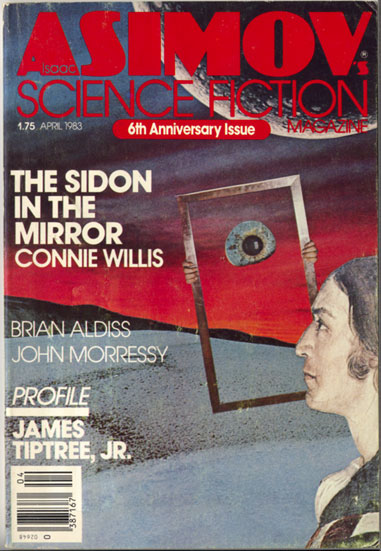
Asimov's Science Fiction Magazine, April 1983. Cover art by Marc Yankus.
Asimov’s Science Fiction Magazine, April 1983. Cover art by Marc Yankus.
In 1983 I was still attending a community college part time while working several part-time jobs, stuck in a weird financial situation too complicated and frankly boring to go into right now. The important points are that I was still very closeted and in a situation where I was dependent on conservative religious relatives and equally conservative institutions for my livelihood. I clung to science fiction and fantasy as a half-drowned person might clasp the last floating piece of wreckage after a boat disaster in the middle of the ocean. And while I couldn’t always afford to buy new sf/f books and anthologies when they came out, the local public library subscribed to three science fiction magazines, one of which was Asimov’s Science Fiction Magazine, so a few times I month I would spend an afternoon at the library reading those magazines.

And it was in the pages of the April 1983 issue of Asimov’s that I first met Connie Willis.

The novelette included in that issue, “The Sidon in the Mirror” is told from the point of view of person just arrived on a new planet. Except it isn’t a planet. Paylay is a dead star, and somehow humans have figured out how to live on a solid crust of the outer layers of the dead star. It isn’t a terribly nice place to live, but large pockets of various pure elements can be mined, so people have an incentive to come there. A side effect of the mining process has created a thin layer of mostly breathable air that is much higher in helium and hydrogen that ours is.

We learn that our viewpoint character is not human, but rather a Mirror: an alien species that has the ability to absorb personality traits, skills, and other things from other beings. They don’t take on the shape of the copied person, and the process is totally involuntary. Mirrors don’t even know they are copying, their personality being re-written as they go, unless someone else notices and tells them. There have been some instances in the past of Mirrors absorbing the murderous thoughts of others and acting on them, so they have been banned from various world.

He’s been brought to this strange mining colony to play piano in the colony’s only brothel. He had previously absorbed the piano playing skills of a now dead man who was known to both the other of the brothel and at least one of her employees, which is at least part of the reason he was brought to Paylay.

The rest of the plot is difficult to summarize, in part because Connie does a really good job of putting you inside the head of the person who doesn’t know or trust his own thoughts and motives. He is afraid he is going to be compelled to do something horrible, and there are characters he is now living among who appear to be trying to manipulate who he copies for their own nefarious purposes.

But I should explain the title. The viewpoint character’s species are called Mirrors, as explained. There is another alien creature mentioned, it’s called a sidon. Sidon’s are vicious predators, but some people have tried to tame them (because people will do that), and it has always gone badly. The miners have taken to naming their mining taps as sidons—while all the compressors and pipes and such are holding, everything seems under control. But ever miner knows it is only a matter of time before a tapped sight explodes. They’re just all trying to make their money and leave before that happens.

By the end of the tale there are violent deaths, and it is left to the reader to decide which of the deaths were murder, which were self-defense, or whether they fall into another category all together.

On one level the story is about the meaning of free will. Willis herself has said, when introducing the story in collections of her work, that the story was inspired to seeing stories of twins who were adopted out separately, and then find each other as adults and learn how many things about their lives are spookily similar. Many things we think of as choices may not be at all.

If was a tough story to read, because there were points in the tale when I wanted the viewpoint character to do something different. I saw moments he could have escaped the trap. Except when I got to the end, I found myself questioning the definition of trap I had been using. Was the trap the manipulation coming from one of the two characters who were trying to turn the Mirror into a killer, or was the trap the Mirror’s own belief that he himself would inevitably turn into a violent killer, or was the trap the fear of the other characters?

I’ve re-read the story many times over the years. And even though I know how it ends, I’m always at the edge of the seat throughout. As mentioned above, Willis really puts you in the mind of this character so that by the middle of the story, I’m just as afraid and uncertain as to what will happen as the character is.

The story made me think a lot about how we make decisions. How much of what we feel is the result of what people expect us to feel? How many decisions that we think are our own are being forced upon us? What, exactly, is the nature of our own identity?

They were questions I was wrestling with personally. While I didn’t have an sudden epiphany at the end of the tale, it did nudge me further in the direction of coming to understand how the nature of the closet. The stifling social trap that many queers find themselves living in is constructed at least as much by our desire to win the approval of society, family, and even my closest friends. It isn’t just fear that drives one into the closet, but also (ironically) the need for love.

And it took an alien playing piano on the surface of a dead star to show me that.

NorWesCon 41 Report — Professor Plum in the hall with the selfie stick

(click to embiggen)
The very first NorWesCon I attended wasn’t actually a NorWesCon—it was called Alternacon in 1987 because some really weird things had happened at the now notorious NorWesCon 9 the year before. The convention hotel canceled the subsequent contract and the committee scrambled to put together a convention at a smaller hotel the next year and chose to temporarily rename the convention. In any case, from 1987 through 2012 I never missed a NorWesCon. For a few of those conventions (1993, 1994, and 1995) I only attended for a single day, but I managed to make at least an appearance at every one up until NorWesCon 35. For a variety of reasons (some of which will be mentioned below) my husband and I chose to skip NorWesCon 36 and 37 before resuming for 38 and 39. We had planned to attend last year, but that was before our old apartment building was sold—between needing to find a new place to live, dealing with my husband’s surgery, packing, and actually moving, we wound up cancelling our plans to attend NorWesCon 40 at the last minute.

This year my husband was on convention staff. I didn’t have any obligations—no fan table to run, no panels that I was on (it’s been years since I was an attending pro at NorWesCon), and I wasn’t on staff. Continue reading NorWesCon 41 Report — Professor Plum in the hall with the selfie stick

…and the darkness comprehended it not

I have a longer, rambling post about my feelings after seeing the movie A Wrinkle In Time last week. There’s a long digression about what the book meant to me as a kid and so forth. And I will finish it and post it soonish. But there are stressful things going on in the lives of people I love, and I’m in a weird headspace.

So, my quick review is this: The movie is awesome, it is glorious, it is moving, it is sincere, and it absolutely sells the truth of the book. There are many dissenting reviews I have seen, many from friends, so I will offer the following caveats:

  • If you’re a cynic, you will not like this movie. Don’t bother. I’m giving certain cynics of my acquaintance serious side-eye when they claim, while griping about this movie, to be fans of the book. If you’re a cynic, you completely missed the point of the book.
  • If you’re the kind of fan who complained that Tom Bombadil was left out of the Lord of the Rings movies, you will not like this movie. Don’t bother. And if you did see it, don’t post long lists of things they left out. You sound like a small-minded pedant shrilly complaining that they got the stitching wrong on the tunic of that background character from page 76…
  • There’s another kind of fan that I don’t know of a way to warn they won’t like it. But their reasons for not liking the movie were summarized best on Twitter by Matt Santori (@FotoClub): “It is earnest and it treats a girl who has low self-esteem with respect instead of ridicule. And I think that bothers a lot of men.”

There was a point, early in the movie, and not when anything that you would expect to make you cry, when I found myself crying so much I kept having to wipe my eyes to see. It was a beautiful scene that was giving me all kinds of feelings, and realized that the people making the movie had captured the wild sense of wonder and joy that I, as a 9-year-old when I read the book the first time, felt at several parts of the book. It’s a feeling that L’Engle herself described at one point:

“It seemed to travel with her, to sweep her aloft in the power of song, so that she was moving in glory among the stars, and for a moment she, too, felt that the words Darkness and Light had no meaning, and only this melody was real.”
― Madeleine L’Engle, A Wrinkle in Time

Adaptation requires elliding things, simplifying things, and in a book that was written 56 years ago, updating things. The movie is only a little over an hour, which is a perfect length for a kids movie. And there are things that work in text that don’t work so well visually, so sometimes directors have to get metaphorical.

One last note: one of the authors I follow on Twitter is Saladin Ahmed. Last Friday he saw the movie with his daughter and a whole bunch of her classmates. I’m going to paraphrase his review: “I don’t usually say ‘screw the critics.’ I will simply say, If you possibly can see A Wrinkle in Time with some kids, do so. They will love it, and you will love being there while they watch.”

She Knew What She Was Doing and Why – Ursula K. Le Guin

“Fake Rule: The generic pronoun in English is he. Violation: “Each one in turn reads their piece aloud.” This is wrong, say the grammar bullies, because each one, each person is a singular noun and their is a plural pronoun. But Shakespeare used their with words such as everybody, anybody, a person, and so we all do when we’re talking. (“It’s enough to drive anyone out of their senses,” said George Bernard Shaw.) The grammarians started telling us it was incorrect along in the sixteenth or seventeenth century. That was when they also declared that the pronoun he includes both sexes, as in “If a person needs an abortion, he should be required to tell his parents.” My use of their is socially motivated and, if you like, politically correct: a deliberate response to the socially and politically significant banning of our genderless pronoun by language legislators enforcing the notion that the male sex is the only one that counts. I consistently break a rule I consider to be not only fake but pernicious. I know what I’m doing and why.” —Ursula K. Le Guin, Steering the Craft: A Twenty-First-Century Guide to Sailing the Sea of Story
“Fake Rule: The generic pronoun in English is he.
Violation: “Each one in turn reads their piece aloud.”
This is wrong, say the grammar bullies, because each one, each person is a singular noun and their is a plural pronoun. But Shakespeare used their with words such as everybody, anybody, a person, and so we all do when we’re talking. (“It’s enough to drive anyone out of their senses,” said George Bernard Shaw.) The grammarians started telling us it was incorrect along in the sixteenth or seventeenth century. That was when they also declared that the pronoun he includes both sexes, as in “If a person needs an abortion, he should be required to tell his parents.” My use of their is socially motivated and, if you like, politically correct: a deliberate response to the socially and politically significant banning of our genderless pronoun by language legislators enforcing the notion that the male sex is the only one that counts. I consistently break a rule I consider to be not only fake but pernicious. I know what I’m doing and why.”
—Ursula K. Le Guin, Steering the Craft: A Twenty-First-Century Guide to Sailing the Sea of Story
“Dear Mr Radziewicz,
I can imagine myself blurbing a book in which Brian Aldiss, predictably, sneers at my work, because then I could preen myself on my magnanimity. But I cannot imagine myself blurbing a book, the first of the series, which not only contains no writing by women, but the tone of which is so self-contentedly, exclusively male, like a club, or a locker room. That would not be magnanimity, but foolishness. Gentlemen, I just don’t belong here.
Yours truly,
Ursula K. Le Guin”

Ursula K. Le Guin, Acclaimed for Her Fantasy Fiction, Is Dead at 88.

The fantasy and science fiction community pays tribute to Ursula K. Le Guin.

Ursula K. Le Guin, the spiritual mother of generations of writers; John Scalzi pays tribute.

I’ve written about two of Le Guin’s books that were instrumental in my life: Timebomb from the Stars – more of why I love sf/f and The Original Wizard School – more of why I love sf/f. Please note I said in my life, not just in my understanding of science fiction/fantasy or how to write. Her stories did that, too—but Le Guin’s books were particularly important to teen-age me trying to learn how to be comfortable in my own skin.

As I said in one of the earlier blog posts, she may not have explicitly meant her story to help a queer kid learn to accept himself, but that’s what her tales did for me. Also, every time I re-read one of Le Guin’s books, I notice ideas that she develops in the story that have become such an intrinsic part of how I look at stories, that I have forgotten she was the one who introduced me to the idea. The ideas in her tales weren’t messages that slap you in the face, they are simply a part of the story in such a way that you accept them. They aren’t “Ah ha!” moments, but more like, “Of course!”

I don’t know how to express how heavy my heart is because of her passing. Tuesday afternoon, when my husband got home from work, he asked me if I had been paying attention to the news or twitter, then told me that Ursula K. Le Guin had died, and I just said, “No! Oh, no!” emphatically. It struck me harder than a celebrity death has in a long time. Once I was finished with work, I cued up the audiobook in which Ursula read her own translation of the Tao Te Ching, because I just needed to hear her voice for a while.

I was a little surprised how upset I was, until I read John Scalzi’s column above. I hadn’t realized it, but she was a spiritual mother to me, despite my only ever meeting her at a book signing. And he’s right. It takes time to mourn a mother.

Weekend Update 8/12/2017: Hugo Winners and many other things

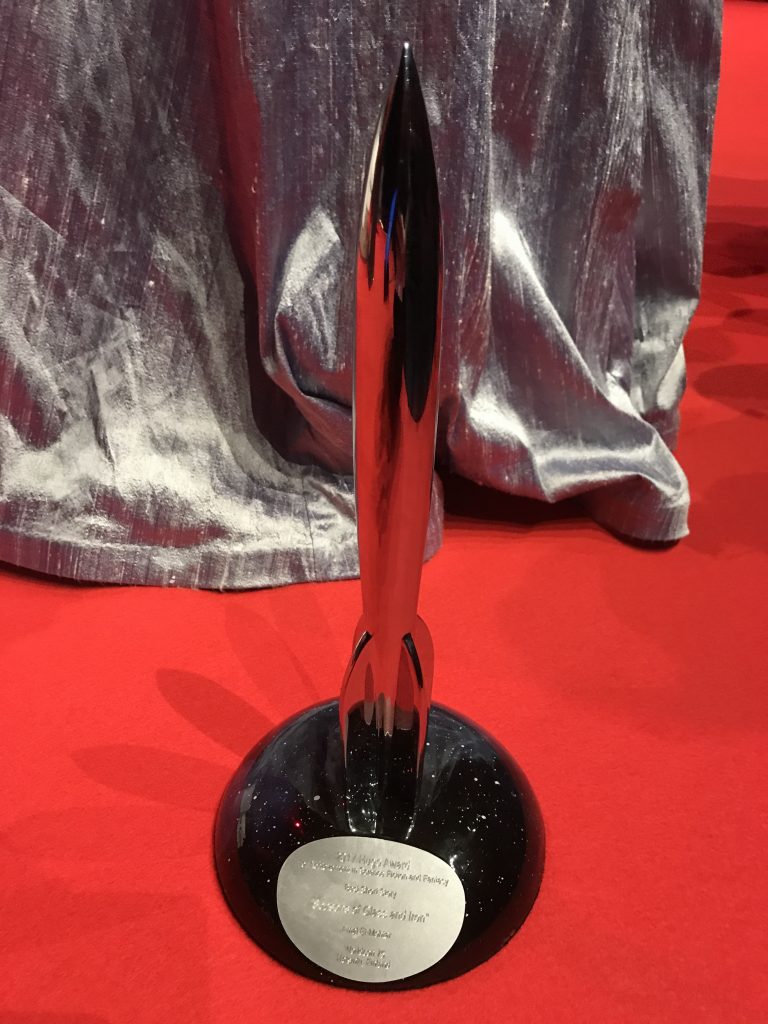
The 2017 Hugo award base was designed by Finnish artist Eeva Jokinen. (Photo by Michael Lee.)
The Hugo Award winners were announced yesterday at Worldcon 75, this year happening in Helsinki. I’m not there, but enough people I know are that my twitter feed was full of news and reactions. And it’s really fun when people whose work you love and who you have met in person are among the people bringing home rockets. I checked against my ballot after, and found that in four categories the person/work that I picked as number one had won. And it looks like in every other category, the winner was in my top three. Of course, as I said at the time, I thought that every category had at least four or five pieces that I absolutely thought deserved the award. It was a good year. And isn’t this year’s trophy gorgeous?

Anyway, the winners are:

Novel:

The Obelisk Gate, by N. K. Jemisin (Orbit Books)

Novella:

Every Heart a Doorway, by Seanan McGuire (Tor.com publishing)

Novelette:

“The Tomato Thief”, by Ursula Vernon (Apex Magazine, January 2016)

Short Story:

“Seasons of Glass and Iron”, by Amal El-Mohtar (The Starlit Wood: New Fairy Tales, Saga Press)

Related Work:

Words Are My Matter: Writings About Life and Books, 2000-2016, by Ursula K. Le Guin (Small Beer)

Graphic Story:

Monstress, Volume 1: Awakening, written by Marjorie Liu, illustrated by Sana Takeda (Image)

Dramatic Presentation, Long Form:

Arrival, screenplay by Eric Heisserer based on a short story by Ted Chiang, directed by Denis Villeneuve (21 Laps Entertainment/FilmNation Entertainment/Lava Bear Films)

Dramatic Presentation, Short Form:

The Expanse: “Leviathan Wakes”, written by Mark Fergus and Hawk Ostby, directed by Terry McDonough (SyFy)

Editor, Short Form:

Ellen Datlow

Editor, Long Form:

Liz Gorinsky

Professional Artist:

Julie Dillon

Semiprozine:

Uncanny Magazine, edited by Lynne M. Thomas & Michael Damian Thomas, Michi Trota, Julia Rios, and podcast produced by Erika Ensign & Steven Schapansky

Fanzine:

Lady Business, edited by Clare, Ira, Jodie, KJ, Renay, and Susan

Fancast:

Tea and Jeopardy, presented by Emma Newman with Peter Newman

Fan Writer:

Abigail Nussbaum

Fan Artist:

Elizabeth Leggett

Series:(Special Category added by option of Worldcon 75)

The Vorkosigan Saga, by Lois McMaster Bujold (Baen)

John W. Campbell Award for Best New Writer: (Not a Hugo Award, but administered along with the Hugo Awards)

Ada Palmer


And I’m sure that in certain corners of the trollnet there is a lot of angry thrashing: Women swept nearly every category at the 2017 Hugo Awards. To paraphrase Ruth Bader Ginsburg: and for how many years were the categories literally swept by men (and almost always white men, at that)? Let me repeat: I’m an old, literally grey bearded, cis male white fan who literally learned how to read from Robert A. Heinlein novels, and every single one of this year’s winners were fabulous sf/f works that deserve that award because they are awesome stories.

So, congratulations to all the winners!

Oh, another thing announced yesterday: Worldcon 2019 will be in Dublin, Ireland! It’ll be the first Irish Worldcon! Yay! There’s a lot of other fun news from the con, you can see a bunch of pictures and more here.

On to other things: Terry Gross is one of my favorite people to listen to on the radio. She’s been interviewing people for years, and much of what I like about her show is how many times she made me really connect with and care about people I didn’t expect to. Anyway, she was on the Tonight Show with Jimmy Fallon this week, and it was funny in a way I absolutely did not expect. Watch the whole clip to learn about her process, but also to get a really good laugh when she tells the story of the time Bill O’Reilly angrily stormed out of an interview.

NPR’s Terry Gross Has a Sick Burn for Bill O’Reilly Walking Out on Their Fresh Air Interview:

(If embedding doesn’t work, click here.

Lots of people have been freaking out about all the nuclear war talk this week. I left most of it out of yesterday’s round up of links other than to link to an analysis of why it is almost certain that we don’t actually need to be worried just yet. But besides most people not understanding the technological hurdles as to why North Korea doesn’t have that missile-capable bomb there’s more. And Nothing New On North Korea Except Donald Trump’s Freak-Out. There actually isn’t any new news. Only one agency is saying this is a possibility, and that same intelligence agency claimed the same thing several years ago and was shown to be wrong then. Furthermore, Donald isn’t suddenly talking about this because of a security briefing he got. He started angrily threatening war when he saw a headline in the Washington Post… which he has also claimed in one of the fake news outlets, but obviously he doesn’t really think that, does he? Anyway, Rachel Maddow’s clip that I linked is really good. And she had an actual
(recently retired) intelligence expert whose specialty was North Korea for decades. It’s really worth the watch.

Related, I’m really irritated that this is even necessary: From the editor in chief of Christianity Today: The Use of Nuclear Weapons Is Inherently Evil. Even though I consider myself a former christian, it angers me to a level that is difficult to describe that there are so-called christian pastors saying the opposite, saying things like Megachurch Pastor Says Trump Has God’s Approval to Start Nuclear War. Geezus! Even the religious right’s favorite president, Ronald Reagan, condemned nuclear weapons as “totally irrational, totally inhumane, good for nothing but killing, possibly destructive of life on earth and civilization.” And who can forget what the late evangelist Billy Graham said on the subject: “I cannot see any way in which nuclear war could be branded as being God’s will. Such warfare, if it ever happens, will come because of the greed and pride and covetousness of the human heart.”

Well, we certainly have a president who epitomizes greed and pride and covetousness…

Grrrr! And don’t get me started on the literal Nazis marching in North Carolina… but at least some Republicans are waking up: Former GOP Senator Calls For Trump’s Removal “Donald Trump is seriously sick. He is dangerous. As a citizen, a former U.S. Senator and twelve-year member of the Armed Services Committee, I urge you to act at once. This is an emergency.”

I can’t end on a sour note. So, here’s some much better news: ‘Sense8’ is back in production, and the finale is going to be totally ‘epic’ and Formerly Abused Husky Now Helps Children Who Have Been Abused.

Zen, Bradbury, and the Hugo Awards – more of why I love sf/f

A quote from Ray Bradbury's “Zen and the Art of Writing” (click to embiggen)
A quote from Ray Bradbury’s “Zen and the Art of Writing” (click to embiggen)
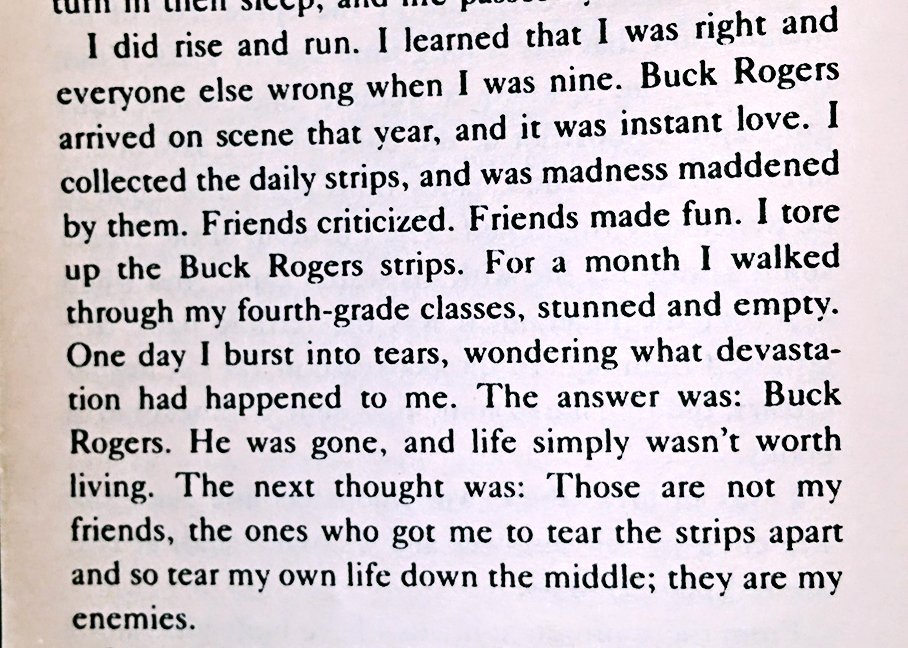
Recently someone posted these images of a couple of paragraphs out of Ray Bradbury’s book Zen and the Art of Writing which is only one of the times he told this story. At the age of nine Bradbury fell in love with the Buck Rogers comic strip in his local newspaper, and began cutting out and saving the strips and so forth. His classmates at school teased him for loving such a ridiculous and unlikely story. The teasing eventually drove him to tear up with collection of carefully cut out comic strips. And he was miserable for some time afterward. The bit I found most profound in this version of the story was his realization that the classmates who made fun of the stories he loved weren’t his friends, they were his enemies. It was a realization that resonated deeply.

A later paragraph from Ray Bradbury's “Zen and the Art of Writing” (click to embiggen)
A later paragraph from Ray Bradbury’s “Zen and the Art of Writing” (click to embiggen)
But it’s a realization that is difficult to remember when one is on the other side of that divide. We’ve all been there: a friend or relative is completely enamored with an activity or book or series or movie that we just can’t stand. And try as we might, we can’t understand what they see in it. Assuming that the pastime in question isn’t something that harms anyone (so let’s leave dog fighting and fox hunting and the like out of the discussion), it shouldn’t matter to us where their enthusiasm goes, right?

And yet it it can bother us a lot.

Some works of art (movies, books, TV series) are racist or sexist or misogynist or homophobic or transphobic or ableist, but still have some redeeming qualities. We’ve all liked something which had some problematic stuff in it. The original Dune novel is homophobic (the more evil a character was, the more gay they were, no good character is even bi-curious), for instance, but I still really enjoyed the novel when I read it as a teen (and the first few sequels). I still like the book, but now that I’ve become aware enough to recognize the homophobia, there is a caveat when I recommend it.

I wrote a lot of fan fiction in my late teens and early twenties and some of it utilized the same problematic trope as Dune: the few bisexual and gay characters I wrote back then tended to be at least a bit on the wicked side. This was true for a while even after I started coming out to myself as queer. So while I can’t excuse the inherent homophobia in a lot of stories written in the 50s, 60s, and even the 70s, I understand that it doesn’t always come from an actively malicious place. I’ve also written before about how shocked I was when, after someone pointed out a certain amount of sexism in a story I’d written, that when I looked at a lot of my other works with that in mind, there was casual sexism all over the place. So just because someone is able to enjoy a piece of art because of a small amount of problematic content that doesn’t necessarily mean that they endorse the prejudice.

However…

While I’m willing to let other people like whatever they want, I’m not required to approve of their choices or withhold judgment. If someone only likes things that are extremely anti-semetic, for instance, it’s perfectly okay to infer from that predilection that the person is more than okay with anti-semetism. Furthermore, if:

  • the only works a person likes pushes a misogynist, homophobic, racist agenda;
  • and/or if they actively try to exclude works that give marginalized people a place at the table;
  • and/or if they actively harass fans who recommend works that center marginalized people;
  • and/or if they campaign against writers or artists because of their race, ethnic background, sexual identity, et cetera;
  • and/or if they say that portraying queers or people of color and so forth in a positive manner represents an existential threat to civilization…

…they have clearly shown that, like Bradbury’s classmates, they are not friends, and are actually enemies. Not just enemies of queers and other marginalized people, but in my not-so-humble opinion, enemies of science fiction/fantasy itself. I firmly believe and will always insist that sf/f is ultimately about hope. Even the most dystopian sci fi and gruesome horror hinges on a glimmer of hope. I am not being a hypocrite or intolerant if I decide to stop spending time with enemies (which includes exposing myself to their opinions). I am simply following Bradbury’s example: I’m taking my dinosaurs and leaving the room.

That’s enough about that, for now.

Voting on the Hugo Awards ends soon, and I’ve been fiddling with my ballot off and on for a while. Because of the move, I didn’t get around to downloading the Hugo Packet until later than usual. And because the unpacking is still going on and June at work was all about lots of very long hours, I’ve been having trouble reading all the stuff that made the ballot which I hadn’t already read.

Anyway, the status of my ballot as of Wednesday night is behind the link…

Continue reading Zen, Bradbury, and the Hugo Awards – more of why I love sf/f

The incredibly true confessions of a totally queer sci fi geek

“Half naked... staring at phallic spaceships... totally straight, right?” © Syd Barrett (Click to embiggen)
“Half naked… staring at phallic spaceships… totally straight, right?” © Syd Barrett (Click to embiggen)
The Hugo Award Finalists were announced yesterday. This is the first year with two rules changes that were enacted to try to prevent certain angry reactionary (misogynist racist homophobic) parties from slate-nominating a bunch of horrible stuff onto the ballot. The pups took over entire categories of the ballot two years ago (but we No Awarded all of those categories), and slightly less-destructively last year. The good news! They only got one nominee in on a few categories (plus two nominees in one), and even then, several of their slate pics were works that almost certainly would have gotten on the ballot without their help. I don’t want to re-hash the two puppy camps, their arguments and so forth here, because plenty of pixels have been spilled on that already. For this queer old fan, a big reason science fiction and fantasy holds a big place in my heart is because its promise of better worlds and a better future was how I survived the bullying, bashing, hatred, and rejection of my childhood. That there are people who so despise people like me being included in works of sf/f that they’ll organize a bloc-voting scheme is more than a little infuriating.

But there are a few things to talk about on this year’s finalist ballot and the new rules. Mike Glyer at File 770 does some number sifting in an attempt at Measuring the Rabid Puppies Effect on the 2017 Hugo Ballot. David Gerrold, science fiction author (including perhaps most famously the Star Trek Original Series script, “The Trouble with Tribbles”) and 2015 World Con Guest of Honor sums up a lot of my throughs in a post of Facebook, part of which I excerpt here:

“My seat-of-the-pants analysis (I could be wrong) is that the Hugos are in the process of recovering from the 2015 assault, precisely because the Worldcon attendees and supporters see themselves as a community.

“There’s a thought buried in that above paragraph — that communities unite to protect themselves when they perceive they are under attack. This works well when the attack is real, such as Pearl Harbor. But it can also have negative effects when hate-mongers such as Bryan Fischer and Pat Robertson (both of whom were in fine form this week) invent a scapegoat (LGBT people) for unwarranted attacks in an attempt to unite the community around their own agendas.

“So while those who have a long history of participation in Worldcons will see this unity as a good thing — those who identify themselves as the aggrieved outsiders will see it as more evidence that the establishment is shutting them out.

“Myself, I see it as a collision of two narratives — one that is based on 75 years of mostly healthy traditions, and one that is based on a fascist perception of how the world works.

“Most important, however, is that most of this year’s ballot suggests that we are seeing a return to the previous traditions of nominations based on excellence. Most of the nominations are well-deserved, and my congratulations to the finalists.”
—David Gerrold

I would characterize the two narratives as:

  • one thinks that a better tomorrow includes the notion that Infinite Diversity in Infinite Combinations is a good thing, and
  • the other that thinks the world was a better place when the heroes were always white men, while women only appeared in stories for the two purposes of being rescued by the hero and being his reward for a job well done.

But Gerrold’s wording works well, too.

Anyway, because of the drubbing they received the last two years and the rules change, one of the puppy groups essentially folded up shop. The other, realizing that the rules made it nearly impossible for them to take over entire categories, went with a more limited ticket this year. As mentioned in one of the links above, this resulted in them naming about 7% of the nominees, and a few of their picks are complete piles of steaming meadow muffins. Which means in every category we have four or more excellent choices to evaluate and choose from. Not everyone sees this year’s ballot as good news. One puppy apologist tries to claim that this year’s balloting numbers proves that the Hugos have driven off half the fandom (here’s a Do Not Link to his post if you want to read it). Now this is a person who claims that we’ve been telling Christian and conservative fans that they aren’t welcome. Whereas all that has happened is that more than a token number of people of color and an occasional LGBT person has made it onto the ballot.

Anyway, his reasoning is dubious on a mathematical level. First, he shows that the number of nominating ballots dropped by between 42-46% in some categories, and that sounds dire. Until you remember that the number of nominators surged last year way above the usual number precisely because after news got out about how the puppies had piddled on the ballot in 2015, a bit more than 2300 fans who had not previously been voters bought supporting memberships and voted in 2015. The overwhelming majority of those new voters resoundingly voted No Award in the categories the puppies had taken over. Fewer of those fans returned to nominate in 2016 for variety of reasons, but not all of them, by any means. Again, the majority handed the puppies a resounding rebuke and we passed two rules changes that made the bloc voting scheme less likely to succeed.

Statistical analysis of the nominating and voting in 2015 and 2016 showed that the number of puppy voters was probably no more than about 250 people those two years. That many people nominating in lockstep could take over the entirety of some down-ballot categories, but it couldn’t win. The larger of the two puppy groups gave up this year—not posting recommendations, not writing their angry blog posts, and generally not bringing a lot of attention to the cause. Their 250 people could not account for more than a fraction of the 1600 nominator drop that happened this year. Most of those 1600 who didn’t participate are from that group of fans who joined for the explicit purpose of opposing the puppies, and now believe that the rule changes and so forth have taken care of the problem.

Analysis of the partial numbers we have from this year’s nominations indicates that the remaining puppy voters number between 65 and 80 people. That’s a 68% drop-off in their group, a far more significant number, I think.

There have always been fewer nominators than voters. Nominating (filling in five blanks in each category) is harder work than voting (choosing from a small list of finalists in each category). And in order to vote or nominate you must purchased at least a supporting membership to WorldCon. A lot of fans don’t have the extra money laying around to buy a membership to a WorldCon that they aren’t attending. So you have to be pretty devoted to the ideas of sci fi/fantasy and/or feel a certain amount of sentiment toward the Hugo Awards themselves to participate year in and year out. Folks who normally don’t spend those funds on that felt something we loved was under assault, and we shifted our priorities a bit to make a stand.

The puppies whipped up some reactionary anger by referring to certain past winners as being motivated by nothing more than Political Correctness, and spinning a very distorted narrative that some of their favorite authors weren’t winning because of an anti-conservative or anti-christian agenda. An angry desire to give the middle finger to so-called PC elites might motivate people to spend some money and do some copy-and-pasting once or twice, but it’s hard to sustain that anger.

I love science fiction and fantasy. I think of it as a literature of hope and imagination. Even dystopian sf, in my opinion, touches on that hope for a better tomorrow even while it portrays a dire future. I am not the only fan, by any means, who was drawn to the literature because I felt like an outsider who didn’t belong in the mundane world of the present. Sf/f has always attracted outcasts of all sorts, which is why many more fans (not just the people of color, the women, and the queers) felt it was worth defending. I know that at least some of the puppies feel as if they are outcasts, though their argument is difficult to back up with facts. White male authors still make up a disproportionately overwhelming majority of the published works, and usually a majority of the nominees for these sorts of awards. They aren’t in any danger of being excluded. I’ve voted for books and stories in the past written by people I knew I disagreed with politically, because the story was good. It isn’t the political views of the author (and not usually of the story, though some of the examples in 2015 were so heavy-handed at hitting the reader over the head with politics and religion that I started to wonder if it wasn’t supposed to be a parody).

I want sf/f to be welcoming, yes. But not so welcoming that people who have literally called for the extermination of writers who include queer characters in stories to feel welcome. Or call an author who happens to be African a savage. I do have my limits.

See, I want the awards to recognize cool stuff written by people who really love telling stories. I like it when the ballot includes stories and authors I’ve not previously heard of. I like it even better when those stories make me want to read more by that person in the future. I don’t want “inclusive” stories or “diverse” stories for the sake of diversity, I want stories that look like the real world, where cisgender people and trans people and people of color and straight people and not-straight people and people of many different religions and people of no religion and people of different abilities are all included. Not to meet a quota, but because that’s how the real world is now! Yeah, as a queer man I’m happy when I see queer characters in a story, but it isn’t enough on its own to make me vote for it.